The Jamhuriyat Road to Taksim Square: Shilpi Suneja

Guest post by SHILPI SUNEJA

Istanbul, 4 June

istanbul11

The evening of 3 June, 2013 was the first time I’d experienced the sting of pepper spray. I was walking on Cumhuriyet Caddesi near Taksim Square in central Istanbul, where, for the past five days, civilians and the Turkish police have been clashing over what the international media has called “a matter of a few trees”. Certainly, the spark of what is now a huge mass protest spanning multiple cities with over 1,000 injured, was the issue over Gezi Park, an area in central Istanbul where the Prime Minister, Tayyip Erdogan has proposed to build a shopping complex. The plan was to graze the green space and create a shopping complex. This in an area that already boasts of a Hyatt, a Hilton, a Swiss hotel and shopping centers with national and international brands. “There’s already so many shopping malls here,” said a Turkish friend speaking about the government’s decision. “Why build another?” The grazing of the park was supposed to start on Thursday, May 30th. By that time, hundreds of people gathered and occupied the park, bringing tents, books, and children. The police, in response, burned their tents and dispersed the protesters using pepper spray and tear gas. Continue reading The Jamhuriyat Road to Taksim Square: Shilpi Suneja
विश्वविद्यालय और उत्कृष्टता के प्रश्न

पद ग्रहण करने के बाद लगभग हर पखवाड़े हमारे राष्ट्रपति किसी न किसी शिक्षा संस्थान में दीक्षांत समारोह में भाग ले रहे हैं। इससे शिक्षा, विशेषकर उच्च शिक्षा के प्रति उनके  लगाव और चिंता का प्रमाण  मिलता है।  हर जगह उन्होंने इस पर व्यथा जताई है कि हमारे  विश्वविद्यालय के दो सौ श्रेष्ठतम शिक्षा संस्थानों में कहीं नहीं हैं। चिंता कोई  नई नहीं है। हमारे विश्वविद्यालयों में प्रथम श्रेणी का शोध नहीं होता, हम मौलिक खोज नहीं कर पाते , ज्ञान भंडार में हमारे योगदान के प्रमाण की तलाश हमें लज्जित करती है! शिकायतों की  फेहरिस्त और लम्बी हो सकती है। इस पर ताज्जुब ज़रूर किया जा सकता है कि पलक झपकते ही  समितियां और क़ानून बनाने की अभ्यस्त व्यवस्था ने इस प्रश्न पर विचार करने के लिए अब तक कोई समिति क्यों नहीं बनाई !

एक प्रवृत्ति इस सवाल से कतराने की  रही है। इस राष्ट्रवादी रवैये के मुताबिक़ हमारी अपनी परिस्थितयां है और हमें श्रेष्ठता के अपने पैमाने बनाए चाहिए,   पराए पर्यावरण में पहने फूलने वाले शिक्षा संस्थानों से तुलना व्यर्थ है, उनके मानदंड हमारे मानदंड नहीं हो सकते! लेकिन हम सब जानते हैं  कि  यह तर्क समस्या से कतराने का खूबसूरत आवरण है, कि  हम अंतरराष्ट्रीय वातावरण में काम कर रहे हैं और ‘हमारा’ सीमित अर्थ में ही हमारा है। Continue reading विश्वविद्यालय और उत्कृष्टता के प्रश्न

Workers in Maruti Suzuki Manesar plant – Justice Delayed is Justice Denied: ICLR

Preliminary report of the findings of the INTERNATIONAL COMMISSION ON LABOUR RIGHTS, released on 31 May 2013, New Delhi

The International Commission for Labor Rights (ICLR) constituted a team of lawyers and trade unionists from France, Japan, South Africa, the USA and India to investigate the incidents that led to the summary dismissal of over 500 permanent workers and over 1800 contract workers at the Manesar plant of Maruti Suzuki India Limited (MSIL) in August 2012. The team was constituted to bring international law and policy perspectives to bear on a situation that has festered for almost a year, with – at a minimum – 147 workers in jail over that period. The Commission reminds the Government of India that, under well-recognised international and domestic principles, “justice delayed is justice denied.”

The group also brings important comparative perspectives on the current or proposed role of this company in the global economy. MSIL has a parent company in Japan, substantial exports to Africa and Europe, a proposed assembly plant in South Africa, and an investor base in the United States – understanding the company’s practices in India is an imperative for those committed to corporate accountability and sustainable development jurisdictions outside India. Continue reading Workers in Maruti Suzuki Manesar plant – Justice Delayed is Justice Denied: ICLR

Rushed Reforms in Delhi University: Akshita Nagpal

Guest post by AKSHITA NAGPAL

It was only in 2012 that we got a subtle whiff of the broth brewing in the minds of the bosses of Delhi University. While this isn’t the first time that authorities have attracted opposition from everyone on the other side of the ideological fence, the repercussions of the present push for hasty implementation of the Four Year Undergraduate Programme(FYUP) might be much more damning. Refuting change is not what the displeased body of teachers and students mean to convey. The opposition is against the hasty implementation and lack of insight sharing on the workings of the new system. Keeping up with the absurd pace of implementation, procedural requisites as pivotal as UGC approval have been done away with! Continue reading Rushed Reforms in Delhi University: Akshita Nagpal

Promises and Perils of FYUP: An Appeal to Students and Citizens: Sunny Kumar

This is a guest post by SUNNY KUMAR At the current moment, Delhi University is caught in a tremendous crisis. On the one hand, the DU administration is hurriedly forcing through the Four Year Undergraduate Programme (FYUP). On the other hand, students, teachers, intellectuals and all those concerned with education are opposing it. The DU administration has declared that all students taking admission in DU will enter a four year honours degree. Within this FYUP scheme, if students wish they can leave at the end of two years with a Diploma or at the end of three with a Bachelor degree (without honours). It is only at the end of four years that they can leave with a Bachelor (Hons) degree. Teachers and academics have raised many valid objections about the way in which this tectonic shift is being imposed on DU. Here, we will not belabour many of the arguments that have been made effectively elsewhere. Instead, we will mainly address the Vice Chancellor’s two central claims – of greater employability and flexibility – being made in defence of the FYUP.

To understand the new scheme better, let us look at what will be taught under FYUP.

Will the FYUP, with the above course content and its multiple exit options truly make students more employable? Will it help them get better jobs or give them extra advantage in choosing future academic options? Let us look at some of the facts: Continue reading Promises and Perils of FYUP: An Appeal to Students and Citizens: Sunny Kumar

Breasts, cancers and the ethics of reptiles: Ramray Bhat

This is a guest post by RAMRAY BHAT  Two weeks ago, tucked in between lurid details of spot-fixing during IPL matches, and an inordinate attention to how Sanjay Dutt spent his first few moments in jail, was an important bit of news about a high profile American movie actor having undergone preventive surgery in order to escape a future encounter with breast cancer. The source of the information was an op-ed written by the actor in The New York Times.

The mainstream Indian media not quite knowing how to report this kind of information first presented it in the blandest fashion and then hurried to the closest cancer hospital to interview its surgeons. The social media took the expected route of initially spouting knee-jerk reactions some of which were misogynous and offensive. The response later evolved into a division between two camps. One hailed the actor for being courageous. The other criticized her for a variety of reasons such as her choice of undergoing surgery without being afflicted with the disease, and her soft advocacy for a detection procedure that is out of the economic reach of a majority of women in her own country, let alone those from the third world. Ruth Fowler’s article from the left-leaning Counterpunch adopted a cavalier tenor and chided the actor for her op-ed with what seemed like nitpicking arguments.

Continue reading Breasts, cancers and the ethics of reptiles: Ramray Bhat

Of Gandhi and a Godfatherly Copyright Offer- Part 2: Shamnad Basheer and Lawrence Liang

This is the second part of an earlier post in which we refuted the claims made by the International Federation of Reproduction Rights Organisation about the ongoing copyright case filed against Delhi University and Rameshwari Photocopy Services. A group of students (ASEAK) and academics (SPEAK) have separately impleded themselves in the suit.

Gandhi, Karan Johar and Cafes?

The FRRO recycles the insidious idea that the cost to students of paying the license fee for course packs would be the equivalent of an ‘evening in a student café’. This naïve assumption could be the result of watching too many Karan Johar films in which all Indian campuses look like Riverdale and all students wear Gucci and Nike. Click here for a contrary perspective

For sure, there are a number of rich Indian students who probably spend way more on cafes than they do on books (forgive them father for they know not what they do). But when we think of articulating copyright norms, what kind of student should serve up as our policy addressee? The urban upper middle class creamy layer student who constitutes but a miniscule proportion of the totality or ones from lower economic strata that constitute the vast majority?

Continue reading Of Gandhi and a Godfatherly Copyright Offer- Part 2: Shamnad Basheer and Lawrence Liang

Old Films: Habib Tanvir

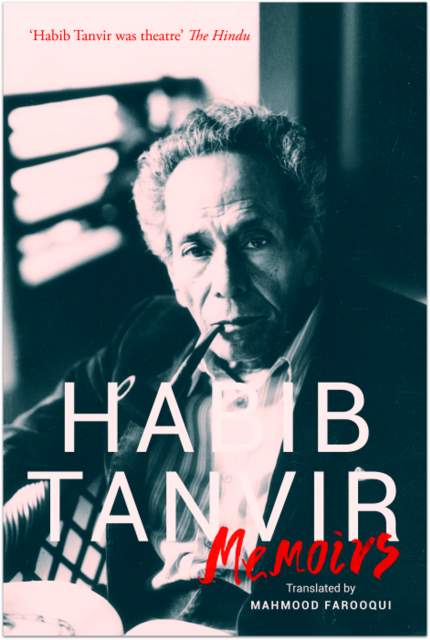
This is an excerpt from HABIB TANVIR’s Memoirs, translated by MAHMOOD FAROOQUI, to be released this evening 7 pm at the India Habitat Centre in Delhi.

1-habib-t-mahmood-cover
Memoirs by Habib Tanvir, translated by Mahmood Farooqui, Penguin Viking, Delhi, 2013; Rs. 599, pp. 400

First of all there was the bioscope. A woman wearing ghaghra and choli would roam around from mohalla to mohalla calling out to the children and gathering them at a chowk or in large courtyard, would take out a long stool from her arm pit and place it on the ground, would remove an octangular and muddy looking tin box from her head and place it on top which had a small mouth covered by a black cloth which the child would remove and peer inside. The women usually came from Rajasthan. The box would contain ten or fifteen cards of photographs, she would show them one after the other and also introduce them in a particular musical speech, ‘see the Rauza of Taj Bibi, see the Lal Qila of Dilli…etc.’ At one time only one child could see the pictures, which would be projected through a lens and lit up through a bulb inside the box which would make the photographs appear larger and more dramatic. When one child was through another would take his place. A large and restive crowd of children would be gathered around waiting their turn. Even the elders would be eager to see Hindustan through these pictures. She would charge two to three chhedams from everyone who took a peep. When the show was over, she would hawk her way to another mohalla. Continue reading Old Films: Habib Tanvir

PUCL statement condemning the Maoist massacre in Darbha Valley

This statement was put outby the PEOPLE’S UNION FOR CIVIL LIBERTIES on 26 May, and the one below it on 25 May by PUCL’s Chhattisgarh unit

PUCL Condemns Killings of Congress Party leaders, their PSOs and Ordinary Villagers by Maoists in Dharba Ghati of Sukma District, Chhattisgarh

The PUCL strongly condemns the ambush of a Congress party election cavalcade by the dalam of the CPI(Maoist) party at Dharba Ghati area in Sukma district of Chhattisgarh on Saturday, 25th May, 2013, resulting in the death of 28 people including Congress party leaders, their personal security officers and ordinary villagers of the area. PUCL denounces as totally unacceptable, the abduction, kidnapping and subsequent killing in cold blood of the Congress party President of Chhattisgarh, NK Patel, and his son Dinesh. The Maoists also killed Mahendra Karma, the founder of the dreaded Salwa Judum, and his security guards. Continue reading PUCL statement condemning the Maoist massacre in Darbha Valley

Eleven things India must do in Kashmir: Justin Podur

india_kashmir_rebel_attack
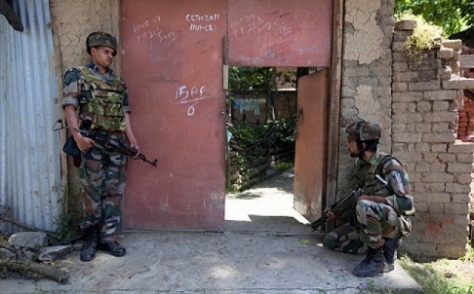
Indian Army soldiers at an encounter site with militants in Kashmir on Friday. AP photo

Guest post by JUSTIN PODUR: I spent a week in Srinagar, the capital of Kashmir, at the end of April 2013, talking to people among whom there was a wide range of opinion. While almost everyone supports freedom, some are resigned to India never letting Kashmir go, others believe that the struggle will go on and take different forms, some are just trying to survive. It seemed to me, at the end of a calm week during tourist season, that India is bringing about all of the things that it fears: Pakistani influence, violence,  radicalisation of youth, political Islam, and hatred of India. Continue reading Eleven things India must do in Kashmir: Justin Podur

Statement condemning the Maoist politics of murder Chhattisgarh

We, the undersigned, strongly condemn the horrific massacre of leaders and workers of the Congress Party and the security forces accompanying them, carried out by the CPI(Maoist) in Chhattisgarh on Saturday. We also wish to express our deepest condolences to the families of all those killed in the convoy of Congressmen returning from an election rally at Sukma in Bastar dtrict.

The killing of senior state Congress leaders and their cadre is particularly barbaric and reprehensible as they had, in the course of the Maoist ambush, become captives or had surrendered voluntarily. This is tantamount to cold-blooded murder of prisoners in custody, an act that goes against all norms even in a state of civil or international war. The targeting of a political party in this fashion by the Maoists is also highly disturbing. Continue reading Statement condemning the Maoist politics of murder Chhattisgarh

Of Gandhi and a Godfatherly Copyright Offer: Shamnad Basheer and Lawrence Liang

In an op-ed in the Hindu, we highlighted an egregious copyright law-suit slapped against Delhi University and its photocopier by leading foreign publishers. The IFFRO (International Federation of Reproduction Rights Organisation) and its partner organisations which collect moneys on behalf of publishers issued a response to this piece, expectantly touting the virtues of acquiring a copyright license from them.

Unfortunately, owing to space constraints, we could only offer a pithy rebuttal to their response in the Hindu.

Below is a more elaborate version of our rebuttal.

(For those who came in late, here is a short jingly version of what this law suit is really about)

For those interested in tracking the case, see updates on SpicyIP

An Irrefusable Offer:

In their response, the IFRRO and its counterparts once again offer the option of a tantalizingly cheap copyright license, repeatedly stressing the “reasonableness” of their offer.

Continue reading Of Gandhi and a Godfatherly Copyright Offer: Shamnad Basheer and Lawrence Liang

Hindutva in Karnataka: Experiments in Terror

Image

(Note: This article is a chapter of the book ‘Five Years of Saffron Rule in Karnataka’ Edited by Ambrose Pinto S.J., Manak Publications, Delhi, P. 338, 2013)

..Here it is enough to point out that Hindutva is not identical with what is vaguely indicated by the term Hinduism. By an “ism” it is generally meant a theory or a code more or less based on spiritual or religious system. But when we attempt to investigate into the essential significance of Hindutva, we do not primarily and certainly not mainly concern ourselves with any particular theocratic or religious dogma or creed..
 
 (V.D. Savarkar, Hindutva, Delhi: Bharti Sahitya Sadan, sixth edition, 1989, pp3f) Continue reading Hindutva in Karnataka: Experiments in Terror

Iqbal Chacha and a Voice from the Past: Sameer Khan

Guest post by SAMEER KHAN: Mr. Chaddha lived in my neighbourhood, a tall lanky elderly gentleman who looked young for his age. I would often see Mr. Chaddha come for a morning walk in our local park, but I stayed aloof, not having an interest in the elderly gentlemen in the park who were either part of laughter clubs or the local residents union.  Whenever I managed to struggle out of my bed for my morning exercise I would notice Mr. Chaddha walking ramrod straight like a soldier. He was never generous with his smiles and would simply nod his head whenever I greeted him.

One pleasant winter morning as I passed Mr. Chaddha in the park I was surprised to hear him call my name. I went towards him, and looking at me from his towering height he asked me, “Can you read and write Urdu?” Startled by the question I answered, “Uncle I can read Urdu but I am not too confident of my writing abilities.“

He said, “Well actually I want someone to write a letter for me in Urdu” Continue reading Iqbal Chacha and a Voice from the Past: Sameer Khan

How to respond to a legal notice from The Times of India

Shamnad Basheer shows the way:

We strongly object to the vile language and the highly aggressive tone used in the notice. We can respond in kind, but we choose to be a bit more civil with you.

You choose to issue this highly malevolent letter, hoping to intimidate us into a meek apology. Unfortunately, while the meek may inherit the earth, they are bound to be shown no favour by corporate powerhouses such as your client.

So, let’s cut to the chase and explore your alleged grievances articulated rather flatulently in over seven pages of a highly intemperate legal notice.

Read the full story at Sans Serif.

Shamnad Basheer for PM!


Manifesto of a New Initiative: Statement by New Path

This guest post is a statement by NEW PATHa collective of people, mostly from backgrounds in social movements and mass organisations, who have been discussing how the work of people’s struggle and revolutionary transformation can be taken forward in the Indian context. Those discussions led to the decision to found a new organisation, tentatively called “New Path”.

Below is the draft manifesto, sent to us by friends associated with the initiative. It is being circulated for comments, criticism, suggestions and observations. New Path does not aim to be a traditional revolutionary party. Rather, it seeks to be a political formation that seeks out opportunities, through struggle, to weaken bourgeois hegemony in this country.
Continue reading Manifesto of a New Initiative: Statement by New Path

Gujarat and the Illusion of Development: Shipra Nigam

This Guest post by SHIPRA NIGAM is a review of a volume of essays edited by Atul Sood Poverty Amidst Prosperity: Essays on the Trajectory of Development in Gujarat (Aakar Books 2013).

gujarat-farmers_507544e

Thousands of farmers protested in March this year in Ahmedabad against the state’s industrialization policies

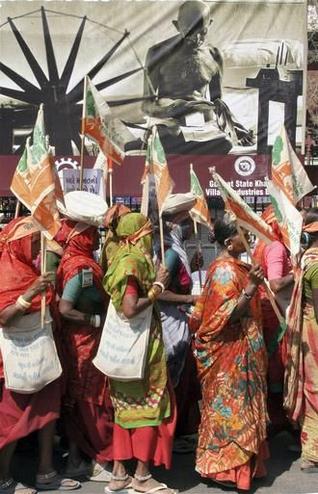
This volume of essays is the outcome of a detailed study by a team of contributing research scholars led by Atul Sood. This timely evaluation provides an insight into many crucial questions: What are the constituent elements of Gujarat’s growth story? To what extent can the successful features of Gujarat’s growth story be attributed to the political regime fashioned by Narendra Modi? Is it possible to replicate even this limited success story at the national level – as Modi’s starry eyed upper and middle class following would like to believe? More significantly: what are the implications of Gujarat’s Development Model in terms of its sustainability and its desirability? What happens when we assess this development through a set of comprehensive   measures, judge its implication for the average citizen’s material wellbeing, and see what it means for the political and economic rights of citizens?  Continue reading Gujarat and the Illusion of Development: Shipra Nigam

Capitalism, Sexual Violence, and Sexism: Kavita Krishnan

Sexual violence cannot be attributed simply to some men behaving in ‘anti-social’ or ‘inhuman’ ways: it has everything to do with the way society is structured: i.e., the way in which our society organizes production and accordingly structures social relationships. Once we understand this, we can also recognize that society can be structured differently, in ways that do not require – or benefit from – the subordination of women or of any section of society. 

What are the material structures that underpin sexual violence? As I address this question I will also engage with some of the arguments made in two recent articles which offer a professedly Marxist analysis of sexual violence and women’s subordination in India; one is ‘On the Empowerment of Women’ by Prabhat Patnaik, People’s Democracy, January 27, 2013, and the other is ‘Class Societies and Sexual Violence: Towards a Marxist Understanding of Rape’, by Maya John, Radical Notes, May 8, 2013.    Continue reading Capitalism, Sexual Violence, and Sexism: Kavita Krishnan

The value of undergraduate education for ‘Other’ students: Sanjay Kumar

Guest post by SANJAY KUMAR.

We are a tired party after two days quick hike up to the base of IndraharPass in the Dhauladhar range. Half of the students are visually challenged, the other half have been painstakingly guiding them over tricky stretches of the trail. The bus for Delhi is three hours late. We are stretched over our carry mats, reclining on backpacks, on the pavement behind a row of buses at Dharamshala bus stand. The issue under discussion is Atheism. It hasn’t taken long for visually challenged students to split into firm believers who pray regularly, occasional/opportunist believers, agnostics and atheists. Arguments are both experiential and theoretical. During one particularly intense exchange an occasional believer asks a firm believer, “If there really is a God who is omnipotent, good and takes care of every one, then tell me why has he made us so that we can not see?” It is an old normative argument against the conception of God. Presumably Darwin turned atheist arguing similarly with himself after witnessing the pain of his infant daughter due to an incurable illness. Closer home, revolutionary Bhagat Singh gives a liberal juridical version of the argument in ‘Why Am I an Atheist?’ Believer’s reply is spontaneous, in a matter of fact way. “You know what, I find myself really fortunate in being visually challenged. Due to this I got a chance to study. Had it not been for this, I would have been selling sweets from my father’s push cart in our small town.”

Realities of life in a country like India have to be piercingly brutal for a talented young man to think that it is mainly through his physical disability that he got access to a decent education and moving out of a life of poverty. This note is intended to bring some consequences of such reality to the recent discussions on Kafila regarding education at Stephen’s College.

Continue reading The value of undergraduate education for ‘Other’ students: Sanjay Kumar

Goodbye Asgharsaab : Remembering Asghar Ali Engineer

Image

Mera azm itna buland hai ki paraye sholon ka darr nahin

Mujhe khauf aatish e gul se hai kaheen yeh chaman ko jala na de.

(“My intentions are so high that I am not afraid of the unknown blaze

 I am afraid of the fire of the flowers lest it burn the garden  – Shakil Badauni )

 I will never forget the sips of tea I shared with Asgharsaab in a tea shop at Wardha more than a year ago. I had hardly any premonition at the time that this would be my last meeting with him. Continue reading Goodbye Asgharsaab : Remembering Asghar Ali Engineer

In Search of a Liberal Education

The article below represents the full, expanded text of a piece that just appeared in EPW here. I am posting the full version here in its entirety both because I hope it will begin a distinct discussion that allows us to reflect on what can be done in the current moment within DU as well as to give voice to the expanded argument.

Some texts are wonderful to teach with. In one, Ravi Kanbur writes about the “nature of disagreement” about poverty reduction. He asks: “how can people with seemingly the same ends disagree so much about means? How can seemingly the same objective reality be interpreted so differently?”[1] As a teacher, his questions allow one to teach skills – reason, logic, argument and critique— as well as demonstrate an ethical imperative that should guide not just our intellectual lives but our everyday lives as citizens: how do we understand and engage with a dissenting perspective?

Kanbur’s question is an excellent example of the kind of critical and analytical skills a liberal education offers. Today, Delhi University [DU] is seeking to create a core curriculum – a Foundation of eleven required courses – that repeatedly refers to this idea of a liberal, core education as part of a new Four Year Undergraduate Programme [FYUP]. These eleven courses are required for all students in DU regardless of their degree subject. Further, should they take a two-year diploma option, they would represent the lion’s share of what some students will learn in their entire time at university. These courses have a clear aim: “multi-disciplinary” education that will “strengthen the educational base of the students in relation to the grand challenges facing India” and ensure that students “acquire both key knowledge and ability.” [2] Core to this restructuring effort is an emphasis on “skills and employability.” In a recent interview, Vice-Chancellor Dinesh Singh lays his cards out on the table: “Absolutely. That’s one of the games here. To get our students to be employable.” This is particularly important, he goes onto argue, for the students taking the two-year diploma: “In two years’ time, we also give them some knowledge-based skills, at least their employability goes up.”[3]

Continue reading In Search of a Liberal Education

DISSENT, DEBATE, CREATE