In Solidarity with Oprah

I recently read a scathing article on Oprah Winfrey. I was quite shocked. The journalist made such fuss about her honest observations as if it’s criminal to not know something. However, what were more astonishing were the serendipitous parallels between her journey to Indian and mine to US. And when I read the article, I almost felt as if someone was mocking at me. I felt outraged and decided that I’ll write this note in solidarity with Oprah. Perhaps then, people will see the injustice done to her. Well, I am a celebrity too, here in this country. Not as big as Oprah but it doesn’t matter. It doesn’t matter even if you’re not able to place me at all. The real celebrities don’t publicize themselves anyway. They’re obscure, consigned to oblivion, with some quaint looking academic in some foreign university (probably US) fawning at the greatness of their work. These days all it takes to be a celebrity is to be notorious with your face pasted everywhere. You’d be surprised by the lack of work backing most people you take for celebrities. Anyway, I am notorious enough for the people who’ve suffered me on stage, I really don’t have much work to support me, and I guess I have had had enough presence in media to statistically pass off as a celebrity. Continue reading In Solidarity with Oprah
Some Reflections on Capital and the Workers’ Movement After Manesar

Workers’ Violence and Corporate Violations of Law

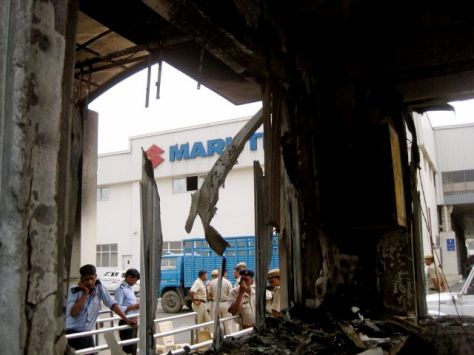
It has been a long time in the making. The violence at Maruti-Suzuki’s Manesar plant on 19 July 2012, that led to the ghastly killing of the general manager, Awanish Kumar Dev was waiting to happen. While the killing was gruesome, I believe this is merely a ‘freeze shot’ of a larger film that has been playing for a very long time now. While it is the media’s wont to focus only on these moments of spectacular violence and then dish out reports from handouts provided by managements and the police, sometimes, such moments of conflagration do illuminate what has been in the dark for so long.

What follows below is an attempt to think through some of the issues that seem to me to lie at the bottom of the violent event. The ‘violent event’ here is not simply what took place in Maruti-Suzuki’s Manesar plant now; it is rather a shorthand for the whole series of such conflagrations that have been taking place over the past few years in the National Capital Region (NCR) – starting with Honda Motors and Scooters 2005,  Graziano Trasmissioni 2008, and many others since – Rico Auto Industries, Pricol Ltd and so on. The struggle in Honda Motors that had been brewing for a long time had eventually spilled over into a series of public protests with severe police violence in the full glare of the media. Things have never been the same in the entire belt since. Rico Auto Industries incident in September-October 2009 subsequently became an important milestone – galvanizing as it did a number of other workers’ strikes. There it had started when the workers struck work after 17 of their colleagues had been dismissed ‘on disciplinary grounds’. Actually, the workers rightly felt that this was to quash their attempt to form a union. And while the workers were protesting at the gate, a group of hired goons attacked them, killing one of the workers and injuring many others. In the Graziano Trasmissioni the issue of contention was the reinstatement of 136 dismissed workers which led to a massive unrest in the unit in Greater NOIDA, leading eventually to an incident not very different from the present one. Continue reading Some Reflections on Capital and the Workers’ Movement After Manesar

What set off the violence at Maruti’s Manesar plant?: Anumeha Yadav

Guest post by ANUMEHA YADAV

Photos by Anumeha Yadav

The year-long industrial conflict at Maruti Suzuki India Limited (MSIL), India’s largest automobile manufacturer’s Manesar plant turned violent on 18 July. At 3:30 pm on Wednesday afternoon, representatives from Maruti Suzuki Workers’ Union and the Maruti management had met to discuss the reinstatement of Jiya Lal, a permanent worker who had been suspended that morning after an altercation with his floor supervisor. Lal is a Dalit and alleges that he had reacted when the supervisor made derogatory casteist remarks against him. The workers were protesting that the management had been unfair, suspending Lal from service while merely sending the supervisor home on leave for a few days. Continue reading What set off the violence at Maruti’s Manesar plant?: Anumeha Yadav

The Poet, His Poems and His Tales

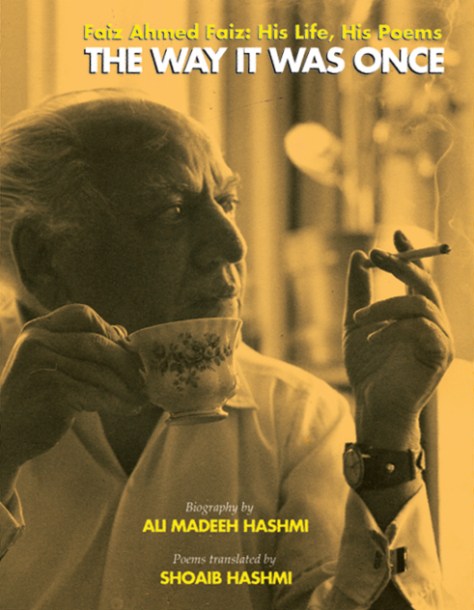
Faiz Ahmed Faiz: His Life, His Poems: The Way It Was Once by Ali Madeeh Hashmi/ Shoaib Hashmi; pp 256; Rs 499; Harper Collins Publishers India, 2012

After a decade without a day job, and associating with Dastangoi for over six years, I can safely say that I am a career storyteller. And one of the things I have learned is that resumes don’t make a person, stories do. Often these stories are not our own stories, but stories we’ve heard amongst loved ones, extended families, friends, work places, milieu; stories we’ve grown up with, stories distilled deep enough to become an integral part of our existence. We may not often identify with our resume but with our stories, always – acquaintanceship strikes, the moment our stories resonate. Continue reading The Poet, His Poems and His Tales

Maruti Suzuki Manesar Workers – Casteist Attack and Repression

The following is a statement issued by the Maruti Suzuki Workers’ Union (MSWU) on 19 July following violence and repression at the Manesar plant yesterday.

The Manesar factory of Maruti Suzuki

The Maruti Suzuki Workers Union (MSWU) is anguished at the recent developments in Maruti Suzuki plant, IMT Manesar where the management has resorted to anti-worker and anti-Union activities in a pre-planned manner leading to violence and the closure of the factory yesterday.

We have had a long tough struggle with the strong unity of our permanent and contract workers to establish and register our Union last year, and had recently as of April 2012 submitted our Charter of Demands to the management of Maruti Suzuki, and the process of negotiation for wages and other demands was underway. However the management has done its utmost to derail the process since long and is trying to break the back of the spirit of unity of the workers and the legitimacy of the Union.

Continue reading Maruti Suzuki Manesar Workers – Casteist Attack and Repression

A blow to reproductive rights in Pakistan: Ayesha Asghar

Guest post by AYESHA ASGHAR

Early in July, Kashmala Tariq, Member of the National Assembly (MNA) of Pakistan, whom Wikipedia describes as “actively involved in women’s rights”, opposed the tabling of the Reproductive Health Bill 2012, saying that it was not in conformity with Islamic laws. The Bill was introduced by another MNA, Atiya Inayatullah, with the purpose of providing reproductive health services, including legal access to abortion,  to women in Pakistan.

Tariq accused the Bill of following the agenda of foreign NGO’s and stated that such proposals that might be in contravention of Islamic injunctions should be sent to the Council of Islamic Ideology and every party’s opinion should be sought. The Bill has been sent to the Cabinet Division for further deliberations.

Does this mean that our women representatives don’t know what reproductive rights include? The responsibility of women parliamentary representatives in Pakistan is more challenging than that of men, as women are more often made victims of oppression either in the name of culture or religion.

Continue reading A blow to reproductive rights in Pakistan: Ayesha Asghar

Of Peace and Other Illusions

This week I reviewed War and Peace in Jangal Mahal, edited by Biswajit Roy, for The Hindu. Kafila readers will be familiar with at least two of the essays in the compilation – by Nivedita Menon and Aditya Nigam and will remember our hectic debates on the subject.

The collected letters of correspondence between the Communist Party of India (Maoist) and the Indian state is an archive of corpses: policemen and guerrillas, commanders and comrades, police informers and Maoist sympathisers. The body count racked up by each serves as a signalling mechanism for the other.

Except for the police and Maoist commanders, the dead usually don’t get to choose sides; their identities are written in reverse, a teleological narration that details seemingly insignificant decisions that end in death.

In June this year, the CRPF, state police and CoBRA battalion killed 19 men, women and children in an anti-Maoist operation, claiming those killed were hardened Maoists. When newspapers reported that villagers said they were conducting a public meeting when they were surrounded by police and shot, the police pointed to six troopers injured in the encounter and asked why villagers were holding a meeting in the middle of the night.

The Maoists have an explanation for their violence as well. “The notion of just principle in a normal situation is different from that [in] a war-like situation,” wrote Maoist commander Kishenji in a letter to the Bengali daily, Dainik Statesman , in which he explained his party’s policy of killing police informers, “During war, freedom of thought, consciousness, initiative and innovation is much limited in scope.”

Read the rest of the review here

Mad Rush for Top CPM Jobs!: CPI (Mohammad Rafi) News Service

Guest Post by CPI ( Mohammad Rafi) News Service

Mad Rush for Top CPM Jobs!:  CPI (Mohammad Rafi) News Service

New Delhi, 15 July 2012: The CPI(M) headquarters saw a mad rush of job applicants after General Secretary Prakash Karat said in a magazine interview that his party paid Rs. 3000-4000 to its whole-time cadre as salary every month. Job seekers from around the country clamoured for immediate appointment to as full time party cadre amidst unruly scenes reminiscent of a typical day at the Indian Parliament.

Karat had mentioned this figure while answering a question as to why the Party’s leaders were mostly from upper caste and middle class backgrounds. According to the CPM General Secretary working class members were hesitant to become whole-timers as ‘ it’s not easy to survive on this small amount’. Continue reading Mad Rush for Top CPM Jobs!: CPI (Mohammad Rafi) News Service

‘Patriotic’ Criminal, ‘Nationalist’ Terrorists

Why Crimes of Lt Col Purohit Are Being Sanitised ? 

Written in different times and under a different context, one discovers that George Orwell’s classic novel 1984, which lampoons authoritarian regimes, is finding strange resonance in today’s India. Readers may be reminded that the Ministry of truth also called ‘minitrue’ – one of the four ministries in Oceania -the fantasy land in the novel, whose job is ‘to engage in any necessary falsification of historical events’ has few slogans written on its wall. It unashamedly declares ‘War Is Peace’, ‘Freedom is Slavery’, ‘Ignorance is Strength’.

As far as my knowledge goes there are no such slogans written on the walls of MHA – ministry of home affairs – here in Delhi whose job is supposed to put a tab on the internal situation of the country, but it appears that it is increasingly moving on similar lines where untruth is packaged and presented as ‘truth’. It is not for nothing that it is finding itself increasingly mired in one controversy after the other. No sooner that it found itself at odds with reality about the illegal abduction of an engineer from Saudi Arabia came the news that it had put its seal of approval on a fake encounter of poor tribals in faraway Chhatisgarh where many other cabinet members of the ruling dispensation had termed it a ‘cold blooded murder of innocents’. But nowhere does its ineptitude seems more blatant if one considers the way it deals with cases of stigmatisation of minorities especially Muslims or for that matter handling cases of what is known as Hindutva terror. Continue reading ‘Patriotic’ Criminal, ‘Nationalist’ Terrorists

The Right to Our Bodies

In a case where the “facts” are both complex and yet also the question at hand, let us start with one that should be undisputed: Pinki Pramanik says she is a woman. She has lived as one, competed as one, and identifies as one. She and no other person or institution – particularly the law or medical science – has the right to decide what her gender identity is regardless of her anatomy, her chromosomes or her hormones. As the investigations against her began, her claim to be a woman should have been accepted at face value regardless of whether narrow judgments of her appearance, manner, physicality or dress led some to believe otherwise.

To add to Nivedita’s post below and track what the Pinki Pramanik case continues to tell us, here is a link to the rest of the Times of India piece cited above that appeared on Monday. The argument I make in that piece has taken a new turn. The gender test results, as reported by the media currently, now say that Pinki is “male” because she has XY chromosome. Yet the report says at the same time that she has “female genital ducts and female external genitalia.” What indeed, then, are we to make of a “conclusive” report that finds Pink to be “male”? The terms and words of the test undo themselves and the underlying assumptions and pathways to the conclusion are far from apparent. If Pink is indeed intersex, then all of these results can stand without the conclusion the report draws of her being “male.” Worth reading are a Journal of American Medical Association article here on Gender Testing and the Olympics, Alice Dreger on sex and gender testing in sports here.

In a national daily this morning, there is a photograph of Pinki. She is taking cooking lessons with her mother in her village. The performance of her gender has begun as her sex is questioned. The only strategy open to her is to now constantly claim all that is uncontestably “woman”: a saree, a pallu over the head, in the kitchen, learning from her mother. Yet again the binaries and essentialisms of our gender identities are reproduced as Pinki tries to erase signs of the apparent “masculinity” of her appearance and behaviour that has driven much of the outrage against her thus far.

On bodies and gender, and what Pinki Pramanik teaches us

The story of Pinki Pramanik and her partner can be pieced together like any other story of intimacy gone bad. After all, human beings invariably encounter pain and betrayal in intimate relationships, just as they encounter joy and desire. No relationship is free of power, whether produced by individual personalities or by social structures — patriarchy, the assumption of heterosexuality as natural, caste, class, race. Why then has Pinki’s story become about something else altogether? Because we assume that our bodies are “naturally” male or female.

But would anyone pass a gender test?

(Here’s the rest of this short piece published in Indian Express yesterday).

Last year I had posted The disappearing body and feminist thought on kafila, raising very much the same issues.

Fallacious perceptions of development – a tribal view from Jharkhand: Richard Toppo

Guest Post by RICHARD TOPPO

Almost a century ago, Katherine Mayo published a book titled ‘Mother India’ that criticized the Indian way of living, and Rudyard Kipling  spoke of the ‘White Man’s Burden’. These writings reflected the colonial perspective that what colonizers did was in the best interest of the colonized people. Consequently, most well-meaning citizens of colonial powers were alienated from the horrible plight of the colonized. Purpose well served – unopposed exploitation.

Years later, independent India seems to walk the same line. The tribal communities in central areas of Jharkhand, Orissa and Chhattisgarh have faced rampant exploitation, displacement and dispossession from their resources at the hands of the state. However, the government has successfully produced  an illusionary perception of ‘development’ that has alienated the middle classes of India from the miseries of tribals. As a result, the government in alliance with corporate interests ruthlessly exploits the tribal population, almost unchallenged by other sections of  society. Continue reading Fallacious perceptions of development – a tribal view from Jharkhand: Richard Toppo

CPI(M)’s ‘July Crisis’ and Challenges for Rebuilding the Left

In an unprecedented move ,  the JNU unit of the SFI (SFI-JNU) has been dissolved by the ‘Delhi State Committee of the Students’ Federation of India’ [SFI is the CPI(M) student wing]. What is interesting about the press statement issued by the ‘Delhi State Committee’ following this momentous decision, is that it is signed by the Acting President and the Acting Secretary. The state secretary Robert Rahman Raman has since resigned in protest against the decision and the state president, according to him happens to be among those expelled. The state secretary in his statement has protested against the SFI Delhi state committee’s decision, ‘taken with just 12 members present and without adequate consultation or effort to retain the unit.’  The matter then, is far bigger than that of an errant SFI unit.

Clearly, leading state functionaries of the organization too are involved in the heresy that has called forth this action by the high priests of the CPI(M). Anyone who knows the command structure of the CPI(M) and how it works, can see immediately that a decision as important and unprecedented as this cannot have been taken by something as inconsequential as the Delhi state committee of the SFI. Indeed, even the Delhi state committee of the CPI(M) could not have taken this decision without the concurrence of the highest leadership – in this case Prakash Karat, the general secretary, himself. Continue reading CPI(M)’s ‘July Crisis’ and Challenges for Rebuilding the Left

Discordant notes: A review of Sadia Dehalvi’s “The Sufi Courtyard: Dargahs of Delhi”

The Sufi Courtyard: Dargahs of Delhi by Sadia Dehlvi; pp 252; Harper Collins Publishers, India, 2012

There is a sudden spurt of interest in Sufism among a section of our population that did not have such an interest a decade or two ago. Some were introduced to Sufism and its spiritual philosophical moorings through interactions with those who knew something about it, and realised that the ideas of Wahdat-ul-Wujood had parallels in the Adwait philosophy and it was this consonance that intrigued many to an extent that they got interested in exploring Sufism a little more. There were others who discovered Sufism through the west. Just as many had discovered Hindustani classical music when George Harrison began to learn the Sitar from Pandit Ravi Shankar in the ’60s, there are those who discovered Rumi when there was a spurt of interest in Jalal-ud-Din Rumi in the west, particularly in the US, with several translations appearing within a short span. Rumi has been known for centuries in our parts as Maulana Room; his poetry was quoted by Persian-knowing Indians till the 1950s and early 1960s, in conversations and writings, almost as often as Mir and Ghalib are quoted by the Urduwallas. An introduction to Rumi in the last decade or so has led eventually and inevitably to Sufism and a kindling of interest in our own indigenous Sufis. Continue reading Discordant notes: A review of Sadia Dehalvi’s “The Sufi Courtyard: Dargahs of Delhi”

Satyashodhak: Brahminical Manoeuvre: Madhuri M. Dixit

Guest post by MADHURI M. DIXIT

G. P. Deshpande’s play Satyshodhak is currently being performed in Maharashtra and Delhi and has received positive reviews in print and electronic media1 .It is praised for portraying Jotiba Phule’s life and work, its relevance for dalit emancipatory politics and also for the participation of the Pune Municipal Corporation’s workers as actors. There is a mood of celebration and a congratulatory back patting tone in the appraisal of a supposedly qualitatively different production. In addition to that, the writer has claimed that the production means a ‘successful and meaningful experiment of political education’ 2 of the workers/actors who are dalits. However, the flaunted success of the play and claims about its political import are belied by a performance that offers a very brahmanised Phule. It is very interesting to see that the author claims ‘a meaningful experiment’ of political education of the workers by offering them a pro-upper caste version of Phule. The very choice of producing a play about Phule in 2012 after a shelf life of twenty years 3, the writer’s articulated positions regarding it and the knowledge of Phule delivered through it, involve, I suggest, an upper caste cultural politics embodied in the brahman friendly figure of Phule.

Continue reading Satyashodhak: Brahminical Manoeuvre: Madhuri M. Dixit

Can University Teachers Bend the Sri Lankan State?

The major strike launched by university teachers in Sri Lanka on July 4th is gaining momentum. Their struggles are proving to be the single most sustained and nationally organised movement in Sri Lanka’s post-war years. This strike follows previous trade union action taken last year where the Heads of Departments of state universities resigned from their positions for several months. With the Government unheeding of their demands, the Federation of University Teachers Associations (FUTA) has reinitiated a full blown strike that is national in character with state universities from all regions of the country participating. Continue reading Can University Teachers Bend the Sri Lankan State?

Once There Was Hindutva Terror ..?

Bomb blasts have taken place near the Delhi High Court, in Bombay, Bangalore etc. Within a few hours of such bomb blasts many T V channels started showing news item that Indian Mujahidin or Jaish-e-Mohammed or Harkatul-jihad-e-islam have sent e-mails or SMS claiming responsibility. The names of such alleged organizations will always be Muslim names. Now an e-mail can be sent by any mischievous person, but by showing this on TV channels and next day in the newspapers the tendency is to brand all Muslims in the country as terrorists and bomb throwers…Should the media, wittingly or unwittingly, become part of this policy of divide and rule?

(Justice (retired) Markandey Katju, Chairman of the Press Council of India, October 10, 2011 at a get-together with mediapersons)

1.
Introduction

What is common between the murder of the leader of a private army of landlords at the hands of his own gang members in faraway Bihar over distribution of booty, the felicitation of a terrorist lodged in jail as ‘living martyr’ (zinda Shaheed) in Punjab or the anointment of a hatemonger as the poster boy of the main opposition party ? Formally speaking there are no connections but if one tries to dig further few subterranean linkages become clear. Whether one agrees or not they exhibit the growing legitimacy of authoritarian, fanatic, exclucivist politics in this part of the subcontinent . Continue reading Once There Was Hindutva Terror ..?

Report of Committee to Review NCERT Textbooks and Note of Dissent by MSS Pandian

Clarification: These documents did not reach us through any member of the Committee.

We have re-ordered the first document to place the Executive Summary at the beginning. Otherwise, no changes have been made. We have also linked to the sites from which you can download the actual text-books so that you can see what has been recommended for deletion/change.

MSS Pandian’s Note of Dissent follows the report of the Committee.

A Report of the Committee constituted for Reviewing the Textbooks of Social Sciences / Political sciences, for Classes IX-XII constituted by NCERT

EXECUTIVE SUMMARY     

 a)       The Committee’s terms of reference were to identify the educationally     inappropriate materials and provide alternative suggestions for the six        textbooks in Political Science.

b)       Since six textbooks covered different themes such as Political Theory,     Indian Constitutions, Indian Politics and World Politics, the    Committee requested the subject experts from Political Science, to      give their opinion using the NCERT guidelines for the textbooks    preparation.  The opinion expressed by the experts was used as   resource material to arrive at the final view by the Committee .The      Committee also made use of some literature, particularly on the use   of cartoons in teaching.

c)      The Committee used the guidelines developed by the NCERT to prepare the textbooks for the review of educational material        including the cartoons. Since the NCERT did not provide specific guidelines for the inclusion of cartoons (and used the general NCF           guidelines for selection and use of cartoon), the Committee made use of general guidelines and also suggestions of some eminent researchers who have worked on the use of cartoons in teaching, to review the inclusion of cartoons in six textbooks on Political Science.

d)       The Committee has made recommendations for each of the six textbooks          for changes in the current year. The Committee recommended (a)       removal of    some cartoons, (b) change in the “Note “below the        cartoons Unni and Munni to bring  clarity and improvement in the message and (c) removal        of       some cartoons on Unni and Munni.

e)      The Committee has also made suggestions for modification in material    which can be considered at the time of the general review of the       textbooks in future. Continue reading Report of Committee to Review NCERT Textbooks and Note of Dissent by MSS Pandian

जेल डायरी: अरुण फेरेरा

Guest post by ARUN FERREIRA

Translated from English by Anil Mishra

नागपुर जेल की उच्चसुरक्षित परिसीमा में स्थित अंडा बैरक बग़ैर खिड़कियों वाली कोठरियों का एक समूह है। अंडा के प्रवेशद्वार से दूसरी अधिकतर अन्य कोठरियों में जाने के लिए लोहे के पाँच दरवाज़ों, [और पैदल] एक संकरा गलियारा पार करना होता है। अंडा के भीतर कई अलग अहाते हैं। हरेक अहाते में कुछ कोठरियाँ हैं, और हर पहली कोठरी दूसरी से सावधानीपूर्वक अलगाई गई है। कोठरियों में बहुत कम रोशनी होती है और आप यहाँ कोई पेड़ नहीं देख सकते। आप यहाँ से आसमान तक नहीं देख सकते हैं। मुख्य निगरानी टॉवर के ठीक ऊपर से अहाते में एक बड़ा भारी, ठोस अंडा हवा में लटकता रहता है। लेकिन इसमें (और अन्य अडों में) एक बड़ा फ़र्क़ है। इसे तोड़कर खोलना असंभव है। बल्कि, यह क़ैदियों (के हौसलों) को तोड़ने के लिए बनाया गया है।

 अंडा वो जगह है जहाँ सबसे ज़्यादा बेलगाम क़ैदियों को, अनुशासनात्मक क़ायदों के उल्लंघन करने की सज़ा के लिए क़ैद किया जाता है। नागपुर जेल के अन्य हिस्से इतने ज़्यादा सख़्त नहीं है। अधिकतर क़ैदी पंखे और टीवी वाली बैरकों में रखे जाते हैं। बैरकों में, दिन के पहर काफ़ी इत्मिनान वाले, यहाँ तक कि आरामतलब भी हो सकते हैं। लेकिन अंडा में, कोठरी के दरवाज़े ही हवा के आने जाने का एकमात्र ज़रिया है, और ये भी कुछ ख़ास आरामदायक नहीं, क्योंकि ये किसी खुले प्रांगण में नहीं, एक ढंकेमुंदे गलियारे में खुलता है। Continue reading जेल डायरी: अरुण फेरेरा

Olympics, Art and the Orbit of Capital : Anirban Gupta Nigam

Guest post by ANIRBAN GUPTA NIGAM

The facts:

In 1992,  Prijedor – a mine in a place called Omarska in Bosnia – was transformed into a concentration camp by Bosnian Serb forces. The number of Bosnian and Croat people held in the camp varies between at least 3,334 and 5000-7000. Many of them – around 700-800 by some accounts, many thousands by others – were murdered.

A little over a decade later, in 2004, the world’s largest steel producing company, ArcelorMittal took control of 51% of the Ljubija mining complex, of which the mine of Omarska is a part. In the former concentration camp where thousands had been detained and many brutally killed, mining activity has now resumed. A year later – 2005 – ArcelorMittal promised it would financially back and oversee the construction of a memorial for the victims at Omarska. They never did. Not only that, according to some reports ArcelorMittal recently enclosed the space around the mine, denying people entrance and effectively privatising a place of great trauma and violence for exclusive reasons of commerce.

Meanwhile the company, through the artistic prowess of Anish Kapoor, spearheaded the construction of a massive public art monument meant to become one of the symbols of the forthcoming London Olympics. The Olympic Tower – also known as the ArcelorMittal Orbit – has, from its very beginning, been subject to both massive criticism and support. The back and forth over its status as genuinely “great art” or “fascistic gigantism” and a “waste of public money,” has centred on how people respond to the physical structure, as well as on the merits and demerits of having a large corporate house direct a public art initiative of this kind. On the 14th of April this year, Mladen Jelača, Director of ArcelorMittal in Prijedor, verified to Milica Tomic (from the Monument Group in Belgrade) and Eyal Weizman (professor in Goldsmiths, University of London) that iron from the same ore that was mined in Omarska had indeed been used in the construction of the ArcelorMittal Orbit.

Continue reading Olympics, Art and the Orbit of Capital : Anirban Gupta Nigam

Girls, Science and Sexism

Thanks to friends on feministsindia list for these links. The first is a how-not-to and the second, an alternative vision – essentially, just pictures of women actually doing science!

EU made this demeaning and sexist video to encourage women to do science. Take a look at the outraged comments that follow from women scientists.  It was taken down from their website after the negative feedback they received.

(Courtesy Sangeeta Chatterji)


And the alternative:

Girls Doing Science via the blog Feminist Philosophers

(Courtesy Sana Contractor)

DISSENT, DEBATE, CREATE