If only there were no people, democracy would be fine…

This post has been jointly written by Nivedita Menon and Aditya Nigam

At Ramlila Maidan

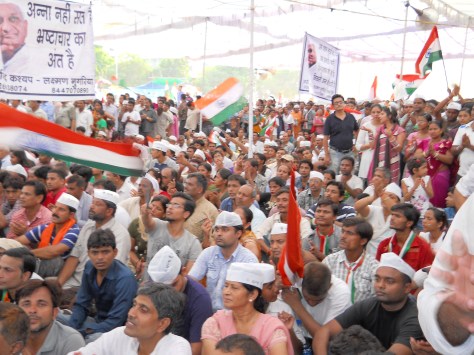
We went to Ramlila Maidan yesterday, the four of “us” considerably swelling the numbers of about a lakh and a half of people there by 6.30 pm, when we left. They were either sitting inside, milling about outside all around its walls, or pouring in having walked from India Gate.  (Is the media exaggerating the numbers? In our opinion it is underestimating them considerably).

Continue reading If only there were no people, democracy would be fine…

A Case for Fractured Solidarities and Skepticism: Ghazala Jamil in response to Nivedita Menon on Anna Hazare

Guest post by GHAZALA JAMIL

On August 17 at 5:30 in the morning I sat up to follow the latest developments on Hazare front (for sleepless nocturnal souls like me it helps that Ramzan are on). Logged into my facebook account and found that I have been labelled ‘a cynic’ for my status updates and posts on Hazare mobilisation. Got into a facebook ‘discussion’ argument with a friend abroad (All my homesick friends abroad have been smelling wafts of the ‘Arab Spring’ in all this).

Continue reading A Case for Fractured Solidarities and Skepticism: Ghazala Jamil in response to Nivedita Menon on Anna Hazare

Many Halves of a Split Screen

I’ve been struggling to write on the Hazare moment but in her piece here, Nivedita Menon has begun going where I wanted to so I shall just add to her conversation with a second set of experiences and questions. Forgive the fragments.

In a post earlier that was written after the first stirrings in Egypt, I had asked a set of questions about politics, protests and publics:

“Could reclaiming public space for conversations, debates and voices – regardless of what these voices want to say and whether “we” agree with “them” or not – become a single point agenda for a movement of our own? Could the idea of the public bring urban residents together – regardless of what we want to do once we’re in that space? Could public space be an answer that rallies people together – the more voices, the more noise, the more debates, the more antagonism that come, from any point of view, would that noise not represent a resistance to the single story being told about India today?

Could such spaces be created? Would anyone come? How can they be sustained? How can we use new forms of information flows and technologies in this process? What are the new sites and spaces of struggle open to us?”

I believe, in one sense, this moment has been brought to us. I had been speaking about “inequality” in that post as an ideal broad concept that brings people together. It isn’t what has happened here and that is not something to forget. It is “corruption” – narrowly defined, poorly understood but deeply felt. So be it. The Noise is here. Now what?

I was walking through hordes of people last week in Jantar Mantar, on India Gate. It was the first time I’ve been among publics in this city with city streets so alive and full of people and yet felt totally emotionally, politically and intellectually disconnected from them. It was an uncomfortable, strange feeling. After years of thinking about what it would take to get people onto the streets in anger, seeking change, how could the moment feel so empty? Is Nivedita right – are “we” missing something? Am I? How is one meant to engage?

Continue reading Many Halves of a Split Screen

Resisting The Popular

The drama that is being enacted in Delhi for the last one week, rather five months, has thoroughly exposed the intellectual hollowness of the political life of India. This moment would also be remembered as the lowest to which collective intelligence of a people can descend to. Critiquing people is not the job of the politicians or the media, not in our times at least . Gone are the days when you had a Mohan Das Karamchand Gandhi who could stand up to the masses and withdraw a popular movement risking their wrath or a Jawaharlal Nehru who commanded the authority to chide his own people. The days of Rabindra Nath Tagore are also over who had the courage to openly challenge, criticize a saint like Gandhi and write ‘anti-people’ novels like Ghare baire. If we have time and patience to turn the pages of our history , we would find that their criticism was an integral part of their long and continuous engagement with their people. Theirs was not a utilitarian relationship . People knew that they love them and care for them and that is why they never turned away from them.

The names we have mentioned above belong to an era when the grammar and vocabulary of popular politics were being transformed. They refrained from simplifying things and devised a language which people were challenged to learn. It was their inexhaustible trust in the intelligence of their people that encouraged them to constantly innovate and complicate rather than simplify. It was this air which a young man Bhagat Singh was breathing, who, going against the grains, wrote that violent methods were no substitute to popular political mobilisation, who knew that the appeal of Subhas Chandra Bose was dangerous and it was Nehru, with a scientific and internationalist outlook, he advised the youth to follow.

Continue reading Resisting The Popular

We should be there: The Left and the Anna moment

My head has been in a whirl the past few days with a single question – how do we on ‘the Left’ manage so unerringly to be exactly where ‘the people’ are not, time after time?

At this moment I don’t mean the organized Left, for the Left parties  have been cautious about criticizing  the current upsurge; they strongly defended the right to democratic protest when Anna Hazare and his colleagues were arrested, and now have launched a Third Front initiative on the issue of corruption and the Lokpal Bill; the students’ front of CPI (ML), AISA, has been organizing militantly on the issue for a very long time now, and is very much part of the campaign.

I mean the few hundreds who form my own community, the people with whom I have organized protests and run campaigns and sat on dharna and drafted petitions;  struggled against communal violence and sexual harassment,  for queer freedom and workers’ rights, against the nuclear bomb and nuclear energy, in support of reservations and against the moves in our universities to hold up appointments to reserved posts. Many of these people I know personally, some are among my closest friends, and many more I know as part of the broad Left/secular non-party tendency in the country’s politics, where I feel most at home.

Continue reading We should be there: The Left and the Anna moment

NAPM Extends Support to Anti-Corruption Movement and Demand for an Effective Lokpal

[The statement was issued by the National Alliance of People’s Movements on 14 August. Much has happened since then – the arrest of Anna Hazare – accopanied by silence and often ridicule poured by the radical elite, but in the face of what is perhaps one of the most widespread mass movements in India after Independence. Over the past few days, we have been witness to innumerable demnstrations and marches in almost every colony in Delhi – where no TV camera ever reached or was even expected to when the ‘real’ action is going in in central Delhi. Contrary to the general propaganda and even our own earlier impression, this is no more simply a middle class movement. I am reproducing it here, somewhat belatedly, because it still touches on some of the post important points at issue in the ongoing struggle. – AN]

Anna Hazare Ji and manyothers across India will be starting their fast from August 16th in Delhi demanding an effective Lokpal. NAPM supports the people’s movement for a corruption-free India and urges the citizens of the country to plunge into this struggle. NAPM, along with other organisations is holding relay fast, human chains, public meetings and other programmes, in Chennai, Pune, Mumbai, Narmada Valley, Hyderabad, Guwahati, Bhubaneshwar, Bangalore, Mysore, Mou, Balia, Allahabad, Muzzafarnagar and other places. We urge our members and supporters to join this call and challenge the corrupt and defensive governments at the Centre and the states.

We strongly disapprove of the way in which government has been trying to put severe restrictions on holding peaceful protests in the capital, and Delhi Police under the garb of implementing the Supreme Court’s Guidelines is imposing unnecessary conditions on protests, as it did early this month on SANGHARSH anti-land acquisition protest, AISA-DYF anti-corruption protest and others. For an independent democratic country like ours, imposition and insistence on police permission and strict guidelines for holding peaceful protests and Sataygraha seems completely contradictory and only shows shrinking spaces for democratic freedom of expression and curb on fundamental rights of its citizens.

Continue reading NAPM Extends Support to Anti-Corruption Movement and Demand for an Effective Lokpal

The Lokpal- NCPRI approach: the right to differ

In the midst of the overwhelming focus on Anna Hazare and the campaign around a bill that lacks consistency or clarity, both legal or ethical, below is a letter from Aruna Roy drawing our attention to an alternative approach to the Lokpal. It is an existing process for us to partake in, agree, disagree and/or rally behind.

Click here for more information on this alternative.

A letter from Aruna Roy

We write to you on a matter of mutual and common concern, the
Lokpal bill, now in Parliament. The context of this letter is
explained below.When the Joint Drafting Committee of the Lokpal was working on the Jan
Lokpal ,  the NCPRI had written to the Chair, Shri Pranab Mukherjee,
and the co-chair Shri Shanti Bhushan, enquiring about the TORs and the
process of and participation, in public consultation. Both assured us
that there would be formal public consultation. It did not happen.

When the government bill went to cabinet with the intention of placing
it in the monsoon session of parliament, the NCPRI decided to make its
position known. The NCPRI is continuing with its deliberations and
consultations and has  prepared an approach paper and a set of
principles for circulation. This is a work in progress.

The belief in consultations and discussion is the reason why we write to you. Continue reading The Lokpal- NCPRI approach: the right to differ

Benaam Shahidon ke Naam – शेहला मसूद के लिए: Tanzil Rahman

Guest post by Tanzil Rahman

Benaam shaheedoN ke naam (बेनाम शहीदों के नाम )

तंजील रहमान

For Shehla Masood, Niyamat Ansari , Amit Jethwa and many like them who are killed everyday across the world for daring to speak out the truth.

Ye Jang ruki thi kab  ये जंग कब रुकी थी

Ye jang to jaari hai  ये जंग तो जारी है

Ye jang hamaari hai  ये जंग हमारी है

Ye jang hamee’at ki  ये जंग हमी’अत की

Insaan ki qeemat ki  इंसान की कीमत की

Har ahl-e-hawas se hai  हर अहले-हवास से है

Har ahl-e-hakam se hai  हर अहले-हकम से है

Har zuml-o-sitam se hai हर ज़ुल्म-ओ-सितम से ही

Har jhoot se, nafrat se हर झूठ से, नफरत से ही

Auhaam se dahshat se औहाम से दहशत से है

Har rang ki zulmat se हर रंग की ज़ुल्मत से है

Ye jang to jaari hai ये जंग तो जारी है

Ye jang hamaari hai ये जंग हमारी है

Continue reading Benaam Shahidon ke Naam – शेहला मसूद के लिए: Tanzil Rahman

THREE MEN FACE IMMINENT EXECUTION: Urgent Action petition from Amnesty International

Two Sri Lankans and an Indian national convicted for the assassination of India’s former Prime Minister, Rajiv Gandhi, are facing imminent execution in Vellore prison in Tamil Nadu, India. This follows the rejection of their mercy petitions by the President of India. If carried out, these would be the first executions in India since 2004.

Murugan and Santhan, both 41, and Arivu alias Perarivalan, 37, were sentenced to death in January 1998 by a Special Anti-Terrorist Court on grounds of involvement in the assassination of India’s former Prime Minister Rajiv Gandhi. Their sentence was confirmed by the Supreme Court of India in May 1999. According to information received by Amnesty International and reports in the Indian media, their mercy petitions were rejected by the President in August 2011, following the advice of the Government of India.

The rest of the petition is available here. The petition opens in German, but you can use the option on the top right to change to English.


Indian Academics Urge Divestment from POSCO: Sign petition

Children and women of Gobindpur village in  Jagatsinghpur district form a human chain to stop the forces from destroying their homes

The US-based Mining Zone Peoples Solidarity Group (MZPSG) has been working on an international solidarity campaign as part of the anti POSCO campaign in Orissa. They  launched a divestment campaign some months ago aimed at four retirement funds, all of which have significant investments in POSCO.

One of these is the TIAA CREF, that is, the US-based Teachers Insurance and Annuity Association – College Retirement Equities Fund, a financial services non-profit organization that is the leading retirement provider for people who work in the academic, research, medical and cultural fields.

As part of the campaign 600 US based faculty wrote to TIAA CREF some weeks ago, asking it to divest from POSCO. They are now seeking support from faculty based in India, expressing solidarity with their US -based colleagues and pressing upon TIAA CREF the urgency of the need to divest from POSCO.

Please consider signing the petition using the link provided below.

PLEASE DO NOT SIGN IN AS ANONYMOUS.

Indian Academics Urge Divestment from POSCO

If you do sign, please forward this to at least five to ten colleagues and friends working in your university or any other Indian university/college.

Please note that the signatures page will be updated manually by the admin, so you may not see your signature immediately on signing the petition.

The Banality of Bengal: Jyoti Rahman on the Tribulations of the Bangladeshi Hindus

Guest post by JYOTI RAHMAN

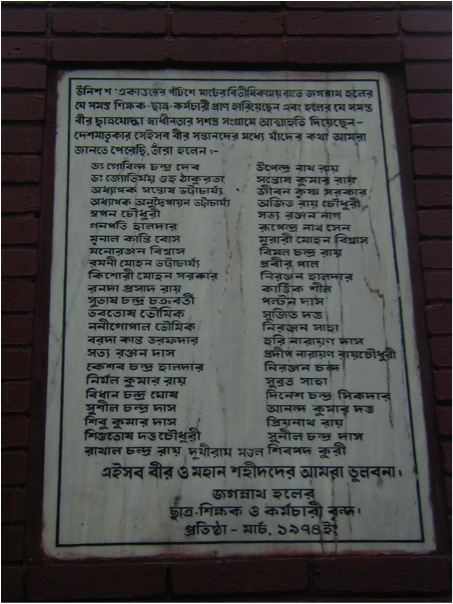
List of names of Hindu students and professors massacred at Jagannath Hall on night of 25th March, 1971 by the Pakistani Army. Click to enlarge. Photo credit: Udayan Chattopadhyay.

Nirad C Chaudhuri and Jatin Sarker were both born in Hindu families in the Mymensingh district of eastern Bengal, now Bangladesh. Chaudhuri, about four decades older than Sarkar, wrote his autobiography before India held its first election, and ceased to be an unknown Indian. Sarker also wrote his life story. Unlike Chaudhuri, Sarker’s was in Bangla, published in Bangladesh, never translated in English, and not available in India or beyond. He remains unknown. Which is a pity, because if you want to know what has happened to the land where both these men were born, Sarker is a far, far better guide than Chaudhuri.

Sarker, of course, stopped being an Indian on 14 August 1947, when Mymensingh became part of East Pakistan — the eastern wing of Jinnah’s moth-nibbled land of the pure. His family didn’t move to India. They were not atypical. Many Hindu families remained in East Pakistan. Perhaps it was the presence of Gandhi. Perhaps it was the fantastical belief that Subhas Chandra Bose would return in 1957 — a century after the Great Uprising, two centuries after the Battle of Plassey — to reunite Mother Bengal.   Continue reading The Banality of Bengal: Jyoti Rahman on the Tribulations of the Bangladeshi Hindus

Statement on the Martyrdom of Shehla Masood

To add your name to this statement write to Akhlak Ahmad – syed.akhlak at gmail dot com

16 August, 2011

“I am proud to be an Indian. Happy Independence Day.”

– Shehla Masood, 15 August, 2011

Gandhi “the purpose of civil resistance is provocation”. Anna has succeeded in provoking the Govt and the Opposition. Hope he wins us freedom from corruption. Meet at 2 pm Boat Club Bhopal”
– Shehla Masood, 16 August, 2011 few minutes before her martyrdom

Shehla Masood, a Madhya Pradesh based civil rights and environmental rights activist was was shot dead by an unidentified person in front of her residence in Koh-e-Fiza locality in Bhopal around 11 AM on 16th August, 2011.

We the undersigned aghast at the irony that tigers, tribals, trees and civil rights and environmental rights activists are being hunted and killed in the same manner. Continue reading Statement on the Martyrdom of Shehla Masood

When the State Celebrates the People’s Independence but the People Don’t: Twelve Questions for the Press Trust of India

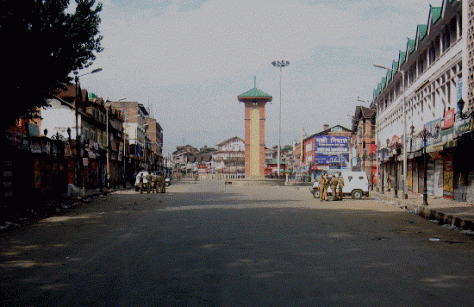
Srinagar's Lal Chowk on 15 August 2011. Photo credit: Zahoor Zargar / KashmirDispatch.com

To:

The Editor,
The Press Trust of India,
New Delhi.

Dear Editor:

This is regarding your news report, “I-Day Celebrated Peacefully in Kashmir Valley“.

While the news report tells us how the celebrations were held by the chief minister in Srinagar and the deputy chief minister in Jammu, and what arrangements were made for the celebrations to take place, there’s one line in that report that tells us:

Meanwhile, normal life was was affected in Kashmir Valley due to a shutdown called by both factions of Hurriyat Conference and tight security restrictions for the Independence Day.

I have a few questions for you.

Continue reading When the State Celebrates the People’s Independence but the People Don’t: Twelve Questions for the Press Trust of India

जोश मलीहाबादी की एक नज़्म – आज के नाम

जोश मलीहाबादी की नज़्म ‘रिश्वत’ के कुछ टुकड़े, इस स्वाधीनता दिवस के नाम.

[Apologies for some missing nuqtas, despite my best efforts.]

लोग हमसे रोज कहते हैं ये आदत छोडिये
ये तिजारत है खिलाफे-आदमियत छोडिये
इससे बदतर लत नहीं है कोई, ये लत छोडिये
रोज अखबारों में छपता है की रिश्वत छोडिये

भूल कर भी जो कोई लेता है रिश्वत, चोर है
आज कौमी पागलों में रात-दिन ये शोर है. Continue reading जोश मलीहाबादी की एक नज़्म – आज के नाम

Onwards to the Independence of the Corrupt!

Let us pledge this 15th of August, that we will tirelessly work towards the independence – nay dictatorship – of the corrupt. We must tirelessly fight every attempt to raise  corruption as an issue – by gullible people who do not understand that corruption is not a real issue. We will not allow such people to be misled by demagogues and fascists who are  interested only in power – even if they do not show their hunger for power by contesting elections. Indeed, precisely because they do not contest elections.

Is the new mantra of democracy? How else do we understand the deafening silence on the series of dictatorial measures adopted by the government, on the part of all those who have been vocal, indeed strident, in their attack on the Anna Hazare movement? It is one thing to be opposed to the Anna Hazare movement but the silence – from parties as well as intellectuals, democratic rights groups and self-righteous editorial commentators of the Indian Express – on the desperate measures being adopted by one of the most corrupt governments ever, is inexplicable. It is as if the only threat to democracy today comes from a group of people who want to raise their voice in civil disobedience against public money being looted by elected representatives acting at the behest of powerful corporate interests.

First the Delhi Police simply refused permission to Anna Hazare and the India Against Corruption fast. Then they asked them to hold their protest in Burari! That is to say on the border of Haryana. This was but another way of disallowing it. Then they came out with a novel idea – a set of preconditions that include an undertaking that there will not be more than 5000 people and that the fast will be wound up in three days. Clearly, no self-respecting set of protestors will agree to such conditions and so ‘Team Anna’ refused to sign the undertaking.

Continue reading Onwards to the Independence of the Corrupt!

Songs After Independence

Guest Post by Indu Vashist

Click here for full broadcast: Songs After Independence

Acknowledging Independence day without nationalism, the hosts of Desi Dhamaka use Independence Day as a platform to explore contemporary social and political issues in South Asian. Featured are songs in Urdu, Hinglish, Tamil, Bengali, Punjabi, English, just to name a few. The artists featured range from Iqbal Bano singing to Faiz Ahmed Faiz’s lyrics to Indian Ocean, from Alisha Chinoy to Mohd Rafi, and much more.

Montreal based Indu Vashist and Srinath Baba are the hosts of Desi Dhamaka, a South Asian music show with a political and social twist. It airs on CKUT, a non-profit, campus-community radio station based at McGill University. CKUT provides alternative music, news and spoken word programming to the city of Montreal and surrounding areas, 24 hours a day, 365 days a year. Hear us at 90.3 MHz on the FM dial, 91.7 by cable, or listen on-line.

What caste do you think the Financial Times is?

See update below.

So… I get a phone call yesterday. It’s a reporter from the Financial Times who wants to know what I feel about the recent ban on the movie Aarakshan in certain states, and also what do I feel about caste-based reservations in general, whether caste is still relevant in the India of today, the theory that quotas just increase inequality etc.. I tell her I haven’t seen the movie, and if she still wants to know what I feel about caste-based reservations we could talk for a bit. She says she absolutely wants to know. So I say fine, and we have a 45-minute conversation. Allow me to reproduce a very simplified version of that conversation (in Q&A forrmat):

1. Q: Do you believe movies like Aarakshan can be provocative or controversial; as in, are certain groups justified in taking offence and asking for a ban? Continue reading What caste do you think the Financial Times is?

Letter from Ladakh

13th August 2011

Dear Chintan,

Some days ago, I was at Pangong Tso. Pangong is a lake, a large saltwater lake. I heard some days ago that the lake is not very deep. The waters were blue, green and clear at different spots, reminding me of my first visit to Robben Islands in Cape Town in 1999 where I was awed at the different colours that the sea assumed in the course of its course. There is no fish in Pangong lake, as I was also told some days later. We only saw a mother duck swimming with her babies and a few insect-like fish. Also, there is no boating permitted on the lake. This is because Pangong Tso is a border area where India border with China and for security reasons, no activity is permitted on the lake.  Continue reading Letter from Ladakh

Issues in sri lanka today: A primer for activists in india

Originally written for the forthcoming Human Rights Forum Bulletin

Very often issues related to sri lanka are spoken in a manner that is disjointed from one another. We often do not have a clear holistic picture. Many of the problems in stands vis-à-vis sri lanka come from this lack. We need a holistic picture not just of the present situation but of past histories. The holistic picture needs to be rigorous and honest; based on continuous work on the area and gathering of knowledge. In the case of sri lanka, as in many other things in the world, the significance of this cannot be stressed enough. We barely have any reports that have come out of sri lanka that are either biased or have had to struggle to expose many things and those concerned have often paid a heavy price; sometimes the price has been their life.

A friend from sri lanka, who lives in Colombo, recently commented that, right now, the situation is worse than during the war in some senses. The surveillance and the hidden violence is so intense and widespread that it is hard to escape it and there is never enough warning. The quest to turn sri lanka into a Sinhala Buddhist nation governed by a fascist is well underway. All of this being done under the garb of democracy; a garb that has not been hard to look right through. Continue reading Issues in sri lanka today: A primer for activists in india

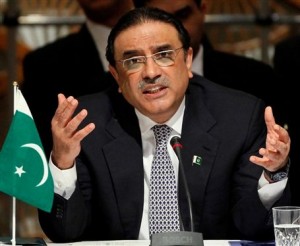
In Defence of Asif Ali Zardari: Abdullah Zaidi

Guest post by ABDULLAH ZAIDI

What comes to your mind with the mention of Asif Ali Zardari? “A cunning, vile, and corrupt man,” said my 19 year old cousin. This was a good summation of what the urban middle-class thinks of him. The more I hear people talking about him the more I am convinced of the power of propaganda. “Give the dog a bad name and hang him,” Zardai once said about himself. That is what is at work here.

Despite what has been said about him, Zardari did have a political background. His father Hakim Ali Zardari entered politics well before Partition and was a member of the Khaksaar Tehreek in 1931. He was first elected to the National Assembly in 1970s. All this talk of Zardari as a political orphan who hogged the Bhutto dynasty upon marriage with Benazir, is a non-starter. In Benazir’s husband, the Bhutto family wanted someone who would remain loyal to her. That is exactly what they got in him. For Zardari, family would always come first. This was the case at the time of Benazir’s death, when he kept the family together. Benazir would often tell close aides that despite his failings, Zardari always remained loyal to the family. Continue reading In Defence of Asif Ali Zardari: Abdullah Zaidi

Breivik’s model nation and migrants in South Korea: Bonojit Hussain

Guest post by Bonojit Hussain

Norwegian mass killer Anders Behring Breivik, in his manifesto, hailed Hindutva forces in India as an important ally in his envisaged fight against what he calls the “cultural Marxist/social humanist” world order. But he seems to be far more impressed by the conservative cultural milieu of South Korea as far as migrants are concerned; so much so that his manifesto is not only replete with praises for South Korean society and State but also his stated goal for Europe is to achieve a “mono-cultural” ethos, modeled on South Korea. Breivik believes that South Korea being a “scientifically advanced, economically progressive” society “out rightly rejects multiculturalism and Marxist cultural principles”.

Breivik’s manifesto might appear to be full of rambling political rants; but it seems he is not radically off the mark in understanding Korea’s hatred for migrants. So much so that right wing groups in Korea must have smiled and said in Unison “At last! Somebody recognizes our real value”.

Continue reading Breivik’s model nation and migrants in South Korea: Bonojit Hussain

DISSENT, DEBATE, CREATE