An appeal against infringement of university autonomy in Sri Lanka

The Ministry of Higher Education has issued a directive that all state universities should hire the services of Rakna Lanka Ltd for provision of security services. The undersigned of the University academic community considers that directive to be in complete contravention of the norms and conventions by which universities are expected to function.

The letter issued by the Secretary to the Ministry of Higher Education seeks to bypass standard procedures that are followed in the university system in the hiring and outsourcing of services. That process requires tenders to be called for and for a suitable company to be selected in a transparent and independent manner. The Secretary’s instruction therefore is in violation of established processes and is contrary to the underpinning principles of governance and the autonomy of academic institutions.

Read the whole article here.

Letter from Japan to the Prime Minister of India

Respected Prime Minister of India, and Chief Minister of Tamilnadu:

We are residents and organisations from Japan, and are intimately aware of the unpredictability and uncontrollable nature of nuclear power. We are the unfortunate witnesses of two nuclear holocausts.  It is with pain that we see the Indian Government pursuing a dangerous path of constructing large nuclear power plants within even larger nuclear “parks” where power generation capacities are pegged at up to 10,000 MW.

Continue reading Letter from Japan to the Prime Minister of India →

The fire lit by Senkodi: Prema Revathi

Senkodi, a 20 year old woman, part of Makkal Mandram a commune in Kancheepuram immolated herself outside the collector’s office on the 29th of August in Kancheepuram. She left a letter saying that it was in solidarity with the campaign against the death penalty awarded to Perarivalan, Murugan and Santhan in the case relating to Rajiv Gandhi’s killing. Growing up in the commune Senkodi was part of the struggles that were around her such as those for land and other rights of marginalised communities. Much has been written about her both maligning her and her comrades as well as hailing her ‘martyrdom’. Below is a piece that brings into question the reasons for her death and the reactions to it. It is translated as accurately as possible in language and tone from it’s original Tamil version. It is a piece written to raise questions within progressive spaces in tamilnadu, but can be easily read into similar contexts.

Guest post by PREMA REVATHI
Translated from the Tamil by Ponni 

The human heart is a strange creature. The utter helplessness and pathos I felt after I heard of the death of Senkodi reminded me of lines I had heard ages ago which stuck with me;

Continue reading The fire lit by Senkodi: Prema Revathi →

செங்கொடி மூட்டிய தீ

Guest Post by PREMA REVATHI
An English translation, with a background note, is available here.

மனித மனம் விசித்திரமானது. செங்கொடியின் மரணச்செய்தியை கேட்டதும் ஆறாத இயலாமையின் இருள் சூழ்ந்துகொண்டுவிட்ட மனதில் எப்போதொ ஒரு காலத்தில் மனதில் ஆழப்பதிந்துபோன

“ இந்த பூமியின் தேசங்களில்

ஒளி வீசுக செங்கொடியே…”

என்ற பாடல் வரிகள் மீண்டும் மீண்டும் அலையாடியது.

புரட்சிகர போராட்டத்தால் இந்த பூமியையே மாற்றிவிடும் ஒரு பெருங்கனவு இன்று முள்ளாய் உறுத்தும் ஒரு பழங்கனவாய் விடைகள் இல்லாத திசைவழிகள் இல்லாத நம்பிக்கைதரும் தலைமைகள் இல்லாத இத்தனிமையான அரசியல் இரவில் துறுத்திக்கொண்டிருக்கும் வேதனை முகத்தில் அறைகிறது.

ஆயிரமாயிரம் வார்த்தைகள் செங்கொடி பற்றி எழுதப்பட்டுவிட்ட, எழுதப்பட்டுகொண்டிருக்கும் இக்கணத்தில் நெஞ்சுருக்கும் இந்த இன்மையும் புகைப்படத்தில் தீர்க்கமாயொளிர்ந்து கொண்டிருக்கும் அவள் விழிகள் கேட்கும் கேள்விகளும் அலைகழித்துக் கொண்டே இருக்கின்றன.

Continue reading செங்கொடி மூட்டிய தீ →

Gautam Book Centre

AK Gautam

It is the sort of place you will not find unless you are looking for it. Even if you find the address in Hardevpuri near Shahdara, you will not know where to knock. There is no signboard that will tell you this is Gautam Book Center. “A signboard will attract the attention of those who don’t like our books,” explains AK Gautam.

These are not books of pornography or an underground militia. These are books on caste.
Continue reading Gautam Book Centre →

‘Every eye-witness said there was no death before the police intervened’

This release comes from the PEOPLE’S UNION FOR CIVIL LIBERTIES, Rajasthan

Gopalgarh (Bharatpur, Mewat) Police Firing Incident
Preliminary Findings of the Fact Finding Team released in the Press Conference on 19th Sept, 2011

Photo credit: PUCL Rajasthan

This preliminary report of the PUCL team pertains to the incident of the police firing in Gopalgarh, district Bharatpur, Rajasthan. As per the media reports, the police resorted to firing to quell rioting mobs. The government has acknowledged eight deaths and 23 injured in this incident. Following this, the PUCL, Rajasthan constituted a Fact Finding Team to conduct independent inquiry into this incident. The team comprised Kavita Srivastava, National Secretary, PUCL, Professor Shail Mayaram (Delhi), Professor Yogendra Yadav(Delhi), Ms. Nishat Hussain (Vice President, PUCL, Rajasthan) Mr. Sawai Singh (Organising Secretary PUCL, Rajasthan), Mr. Noor Mohammed (PUCL, Alwar), Mr Virendra Vidrohi (PUCL, Alwar), Adv. Ramjan Chowdhary (PUCL, Mewat district, Haryana), Mr Gaurav Srivastava(PUCL intern). Mr. Neelabh Mishra, Editor, Outlook (Hindi) and a section of progressive members of the Gurjar and Meo community also accompanied and assisted the fact finding team. Continue reading ‘Every eye-witness said there was no death before the police intervened’ →

‘Jan Sansad demands a Development Planning Act not an Act to Facilitate Land Acquisition’

This release comes via the NATIONAL ALLIANCE FOR PEOPLE’S MOVEMENTS

Nellore, September 18 : “Government of Andhra Pradesh has given licenses to 28 companies to establish thermal power plants with a total capacity of 32,000 MW. How can a fragile coastal zone can take up so much of ecological pressure ? Is this the way to plan the needs of electricity for development ?” asked the delegates who had come from different parts of the State and joined by eminent social activists Medha Patkar, Sandeep Pandey, Banwari Lal Sharma, Gabriele Dietrich, Sister Celia, Manoj Tyagi, Viveknanad Mathane, P Chennaiah, Ramakrishnam Raju and others. Jan Sansad was hosted by NAPM and Jana Vigyan Vedika at the premises of Nehru Yuva Kendra, Nellore. Continue reading ‘Jan Sansad demands a Development Planning Act not an Act to Facilitate Land Acquisition’ →

Dengue outbreak in Lahore. Humour follows

Dengue patients in a Lahore hospital

Wars, insurgencies, floods, an economy in the doldrums, and now dengue. If Pakistan is not a “failed state,” some credit must go to the Pakistani sense of humour.

There’s been terrible out break of Dengue fever in Lahore. 39 have died and the toll keeps rising – it was 36 when I began collecting the material for this post. Sohaib Gulbadan tweets: “My Hizb-ut-Tahrir friend is sharing articles suggesting dengue outbreak in Lahore is a CIA strategy. Acha.”

Perhaps it is in response to that sort of stuff that Haseeb Asif writes this hilarious blog post:

Continue reading Dengue outbreak in Lahore. Humour follows →

Out of Development’s Waiting Room, Out of Democracy: The Continuing Agony of the DHRM

[with inputs from Baiju John]

Faced with the never-ending agony to which the members of the Dalit Human Rights Movement (DHRM) in Kerala seem to be subject to, it appears that that the more familiar ways of marginalizing of dalit people in Malayalee people do not work anymore. The past few days have seen horrendous attacks on these people near the town of Varkala in Thiruvanathapuram district. The DHRM has accused the Siva Sena and the BJP of violence, but it appears that both the authorities and the press are equally and irremediably deaf. Continue reading Out of Development’s Waiting Room, Out of Democracy: The Continuing Agony of the DHRM →

Urgent Help Needed in Koodamkulam

As you all might be aware around 15000+ people are gathering everyday for more than 4 days from 3 south Tamil Nadu districts as part of an indefinite hunger strike to stop the Koodamkulam Nuclear Plant.

More than 100 people are on indefinite fast and some people’s health are turing bad as well. They are more or less in a isolated situation within the village of Idinthakari near Koodamakulam. There is a huge battalion of Police waiting outside the village venue. The police is trying to block the free passage of people into the village. The state administration and central administration has neglected the protest till now. The non-violent protest needs to be sustained, but people are losing their patience. The leaders who are very few in number though exhausted after 4 days of sleepless nights are trying their level best. Continue reading Urgent Help Needed in Koodamkulam →

Lessons from Malegaon: JTSA

This is a statement put out by the JAMIA TEACHERS’ SOLIDARITY ASSOCIATION

Punish those guilty of misleading probes
Compensate the victims NOW!

13 September 2011: The NIA has finally put the official seal on what many activists, the families of the accused and the people of Malegaon had been saying for long: that the arrest of nine Muslim men for the 2008 Malegaon blast was a result of a communal witch-hunt, which passes for investigations into terror charges. As a consequence of the investigating agencies’ hubris and prejudice, nine innocent men had to spend five long years in jail, while their families suffered and they were stigmatized.  Continue reading Lessons from Malegaon: JTSA →

In Allahpur, a Moment of Truth

(First published in Untold Stories)

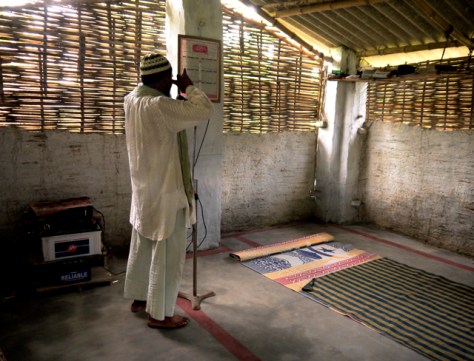
Imam Shamsuddin calls for prayer. Photo credit: Shivam Vij

Like nearly every village in South Asia, Allahpur, in the east Indian state of Bihar, is geographically divided on the lines of caste. On one side of a dirt track live the upper-caste Muslims (Syeds, Sheikhs and Pathans) and on the other side live the lower-caste Muslims (Ansaris, Dhunias and Raains). There are only four Hindu families in Allahpur, and they are all lower castes, their houses amid the low-caste Muslim houses.

For five years now, the low caste Muslims have been praying at a ramshackle mosque they built, boycotting the mosque in the upper-caste Muslim area, a stone’s throw away.

Continue reading In Allahpur, a Moment of Truth →

Where have the pilgrims gone?

The Journey is an integral part of any pilgrimage, the manner in which it is conducted is crucial to the successful conclusion of the endeavour. An edited version of this article first appeared in the travel and culture magazine Terrascape, published from Delhi. Photos: Himanshu Joshi/Curun Singh

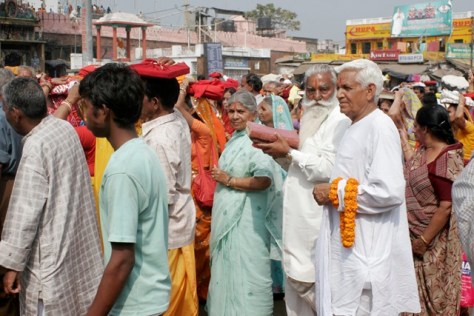
Pilgrims at Puri, outside Jagannath Temple

There is a scene in Mughal-e-Azam, the early 1960s blockbuster of a movie by K Asif, where Akbar and his queen, the mother of his first son Jahangir (wrongly identified by K Asif and also by Ashutosh Gowarikar as Jodha Bai) stumble through the hot sands of Rajasthan under the mid-summer day sun that seemed intent on drying up and burning everything in sight. The two are on a pilgrimage. The pilgrimage was to fulfill a vow that Akbar had taken.

What I have to say in this piece can best be prefaced by narrating the story of that vow. Continue reading Where have the pilgrims gone? →

Growing up with PTV in Poonch: Saqib Mumtaz

Guest post by SAQIB MUMTAZ

Away from the revolution of direct to home (DTH) and cable TV networks, the nineties were the time of one channel, when Doordarshan was synonymous with Television for most Indians, especially in rural areas. There was not much on television for a kid growing up except the occasional cartoon clips and Shaktimaan. I was fond of Meena and her parrot Mithu. They were loveable unthreatening characters. The duo imparted important lessons on a variety of social issues. Movies were a strict no-no and the news was other things adults were interested in. Every evening my grandfather would tune in to the Hindi news which was followed by another news broadcast in English. Even as a kid I could sense the repetition but never the reason of watching the same news twice.
In my memory of those days, it’s not Doordarshan that I associate myself with. Luckily for many of us near the border there was PTV.

Continue reading Growing up with PTV in Poonch: Saqib Mumtaz →

A Critical Primer on India’s UID: Simi Chacko and Pratiksha Khanduri

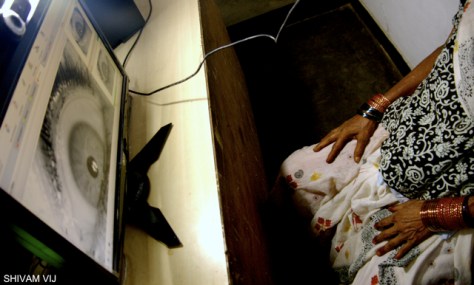
This guest post by SIMI CHACKO and PRATIKSHA KHANDURI is the full text of a booklet released in August 2011. A .pdf version of the booklet (41 pages, 304 KB) can be downloaded here.

A citizen gets her iris scanned for a UID 'Aadhar' card in Delhi.

Introduction

A. UID: The Basics

B. The Enrolment Process

C. Benefits of UID

D. Concerns: Biometrics, Privacy, Data security, Surveillance

Continue reading A Critical Primer on India’s UID: Simi Chacko and Pratiksha Khanduri →

Prominent Indian journalist beaten up by Jammu and Kashmir Police

Is the Jammu and Kashmir Police a private, leaderless, unaccountable militia force that can go about beating up anyone they like in the name of saving Kashmir for India?

Well known Indian author and journalist David Devadas, a fellow with the Nehru Memorial Museum and Library in Delhi and author of a book on Kashmir, was beaten up by personnel of the Jammu and Kashmir Police in Srinagar on September 5. Sheela Bhatt reports on Rediff.com:

In a letter written to Jammu and Kashmir Chief Minister Omar Abdullah, Devadas said that on September 5, when he was crossing the Rambagh bridge in his car in evening in heavy traffic, he heard a loud bang at the back of his car. His car was hit by another car. Continue reading Prominent Indian journalist beaten up by Jammu and Kashmir Police →

On a Lit Note: Hilal Mir

Guest post by HILAL MIR

I woke up this morning in an utterly confused state of mind. During the night I dreamt about having the tour of the Harud Literary Festival. My first astonishment came while in a queue outside the venue. Like the French streaming Parisian streets in teary-eyed joy at the sight of American liberators after having secreted themselves in root cellars for months from the sniffing gaze of Nazi jackboots, I felt similar joy at observing Indian soldiers not hurling ritual abuses from vehicle rooftops while asserting the right to overtake from any side and any crevice on the busy Panthachowk intersection.

The venue, Delhi Public School, is stone’s throw away from the intersection and within the earshot of any moist abuse hurled from those ubiquitous army trucks. Kashmiris finally had a dry day. Continue reading On a Lit Note: Hilal Mir →

Which populism?: Saroj Giri

Guest post by SAROJ GIRI

As I read it, neither Aditya, nor Partha nor Gyan seems to deny that the Anna Hazare movement is populist. The debate here seems to be about: what kind of populism is it? Aditya is saying that this populism can lead to progressive political consequences, ‘by the presence of an anti-institutional dimension, of a certain challenge to political normalization’, while Partha (and Gyan too if I read him correctly) seem to be arguing that this populism is not progressive even if sometimes anti-institutional. And here Aditya reads Laclau contra Partha: that populism may indeed be the royal road to the constitution of the political. Partha and Gyan maintain that this populism works with a notion of ‘we the people’ who are free from corruption defined against ‘they the corrupt enemy’ (the government and netas). This ‘we the people’ can very well gloss over all internal contradictions, social divides and heterogeneities – hence Gyan points out that Dalits and minorities will not be counted or simply assumed away.

Continue reading Which populism?: Saroj Giri →

The Sublime Object of Anti-Corruption: Sumandro

 Guest post by SUMANDRO

Recent discussion around the issue of corruption in Kafila has generated several references to and logical possibilities of understanding anti-corruption as an ideology, however, without finally drawing that conclusion. In this post I argue that the specific ideological functioning of this idea of anti-corruption is central for understanding the nature of the movement.

Partha Chatterjee writes: “The word [‘corruption’] creates an illusion – a fundamentally false image – of equivalence between two very different practices.” But for Chatterjee, this illusory character of ‘corruption’ is not comparable to the kind of illusion involved in the ‘mystical character of commodities.’ He argues: “But it is this illusion of equivalence that has been achieved, for the moment at least, by the rhetorical and performative adroitness of the Anna campaign and the spectacular bungling of the Congress leadership.” The multivalent illusion of ‘corruption,’ for Chatterjee, is shaped by the skilful performance from the activists’ side and lack of the same from that of the government. I would later argue that on the contrary, the skilful performance by the activists and the lack of the same from not only the government’s side but also that of different left positions are actually made possible by the essentially multivalent nature of the ideology of anti-corruption.

Continue reading The Sublime Object of Anti-Corruption: Sumandro →

Harud Literary Festival: The Misrepresentation Continues

In a post on the Wall Street Journal’s India Realtime blog, journalist Tom Wright says at one point:

In the open letter, the signatories said it was impossible to have a literary festival in Kashmir [Link]

I asked him on Twitter as to where the open letter says that. He replied:

the opening graph says you can’t hold a literary festival in the context of kashmir [Link]

Given that he was being specific about the location of the “impossible to hold” claim in the open letter, I wondered for a moment if I was wrong. I checked the first two paragraphs of the open letter I had posted but found no such claim: Continue reading Harud Literary Festival: The Misrepresentation Continues →

Haappy Onam, [Kallu] Shaappy Onam!

So Onam is in full-swing in Kerala.  I am writing this so that Kafila does not remain an ‘onamkeraamoola’, which in Malayalam literally means a place into which Onam does not enter — a place cut off from civilization, that is, populated by country bumpkins. Onam in Kerala now means many things to many people and I’m listing some of these below:

Continue reading Haappy Onam, [Kallu] Shaappy Onam! →

DISSENT, DEBATE, CREATE