The Mountains Are Coming Closer

(This article by me has appeared in the Sunday Guardian, Delhi, and the Friday Times, Lahore.)

The voices that reverberate in your head after a visit to Kashmir leave you numb, making you sadder the more you think about them. You know that it is going to be worse when you visit next year. The mountains that you see faintly from over the bridges on the Jhelum river in downtown Srinagar, a thousand-year-old settlement, you know they are coming closer.

An old man you see on the road wants your attention. No, not here. Let’s get inside a parked car. You wonder what secrets are to be passed on. From inside his pheran he takes out a bundle of papers. Both his sons were picked up from Kathmandu in Nepal in 2000, where they were eking out a living. Had they been militants why would they have … look, look, this paper, certificate of registration of Indian nationals in Nepal? The last he heard of his sons some years ago was that Indian intelligence had detained him in Delhi. He is coming to Delhi next month. Could you help? All he wants to know is what happened to his sons, which prison are they in, could he see them once? Read more…

Caste in Urdu Prose Literature: Ajmal Kamal

Cover of "The Adventures of Amir Hamza (M...
A cover of 'The Adventures of Amir Hamza'

Guest post by AJMAL KAMAL

The historical division of society in South Asia on caste lines is now an acknowledged sociological, political and economic fact. However, caste as a literary or social discourse does not, for several reasons, form a part of the predominantly Muslim culture of Urdu. Nor has there been much academic exploration of the role caste plays in the life of South Asian Muslim communities as against others. As far as the Urdu literary writing is concerned, it has traditionally focused exclusively on the lives and concerns of conquerors, their cohorts and their descendants, who typically prided themselves on their real or perceived foreign origins. Even after modern, socially committed writing began in Urdu around the 1930s, caste as a variable for social exploration was largely ignored in favour of economic class. Continue reading Caste in Urdu Prose Literature: Ajmal Kamal

These rapes aren’t rapes? Amrita Nandy

Guest post by AMRITA NANDY

Like the French, Mona, a 30-year old sex worker in Delhi, is intrigued and amazed over the hullabaloo around the DSK sexual assault case.  From her one-room shed, she has been keenly following television channels for the latest on the scandal. She asked me if I had any updates, adding: “That man may be in jail for 25 years! Really? Unbelievable. For us, being assaulted at work is a regular part of it. I tolerate some of it and ignore the rest. But you see… I cannot complain if I am harassed. A sex worker is a doll in the hands of her customer. No one will play with the doll if she complains!”

While Mona’s fatalism may have helped her cope, the risks at work are especially dire for non-brothel sex workers.  Some have nearly been killed.

Continue reading These rapes aren’t rapes? Amrita Nandy

Corruption, the New Caste: Thomas Crowley

Guest post by THOMAS CROWLEY

In the mainstream coverage of the Ramdev hullabaloo, there has been, unsurprisingly, little substantive discussion about corruption itself: its fundamental causes; its widespread effects; the viability of different plans to combat it. Who would want a dry, intellectual discussion of the root causes of corruption when we can stare uneasily at pictures of Baba Ramdev holding a sword and wait with bated breath for his holy army to congregate?

But let’s – for the moment – take seriously Ramdev’s proposal that the death sentence be meted out to India’s corrupt. If the press is to be believed – especially the foreign press – this may just mean killing every Indian. For, implicit in many media reports is the assertion that corruption is part of the Indian psyche, an essential component of what it means to be Indian. In this sense, corruption serves the same conceptual role as caste: it essentializes an ever-changing historical phenomenon, freezing it in time and obscuring its economic and political roots. Much as the British taught Indians and foreigners alike to understand India predominantly in terms of caste, modern commentators are encouraging both desis and firangis to conceptualize India as the land of unending corruption. (Of course corruption has not replaced caste as a mode of understanding India; the fascination with caste still runs deep.)

Continue reading Corruption, the New Caste: Thomas Crowley

Six Dead Villagers and a Lost Road: This did not happen at Baba Ramdev’s ‘Yoga Camp’ at Ramlila Ground in Delhi

Sometimes, thankfully, one does not need to write an over-long post to make a point.

Everybody knows how the entire television media has been giving enormous airtime to BJP and its allies giving vent to their outrage on the condemnable police action on Baba Ramdev’s ‘Yoga Camp’ in the Ramlila Maidan in New Delhi. One woman, named, Rajbala is still seriously injured. No casualties have been reported so far.

Though it must be said that Acharya Balkrishna, Baba Ramdev’s right hand man, seems to have had the pitch of his voice transposed a few octaves higher, giving his heartfelt statements at press-conferences the timbre of a dulcet castrati. I suppose, depending on how you look at the fate of Acharya Balkrishna’s vocal cords and other organs, that is a casualty. Continue reading Six Dead Villagers and a Lost Road: This did not happen at Baba Ramdev’s ‘Yoga Camp’ at Ramlila Ground in Delhi

On Lathicharging a Satyagraha: Dilip D’Souza

Guest post by DILIP D’SOUZA

So what do you think happened when the police assaulted a gathering of satyagrahis with lathis? Here’s what happened to some people I met from such a gathering.

  • Tulsibai, 45+, was hit on her stomach and wrist.
  • Manglubai, about 40, was hit on her buttocks.
  • Rajkumaribai, who didn’t know her age, had a deep wound on the upper part of her thigh that she showed us shyly.
  • Jiggelal, 60, was hit so hard on his arms and legs that he blacked out. Continue reading On Lathicharging a Satyagraha: Dilip D’Souza

POSCO: Lies, Crimes and Atrocities

This statement about today’s events in Jagatsinghpur, Odisha, comes from the CAMPAIGN FOR SURVIVAL AND DIGNITY

Today, more than a thousand armed police besieged the gram panchayat of Dhinkia in Jagatsinghpur District of Orissa to crush the resistance to the POSCO steel plant. For the entire day thousands of people sat in the heat, where several people (including children) and even two policemen fainted. At noon the Collector declared their protest “unlawful” and subsequently loudspeakers blared threats about use of tear gas, lathi charges, “those engaging in unlawful protests being dispersed” continuously for four hours. Efforts were made to divide the protesters as well. The protesters remained firm. Eventually, perhaps afraid of the heavy media presence and unable to break the will of the people, the police withdrew. The people have left some of their number on guard, fearful of the police’s return at any time.  Continue reading POSCO: Lies, Crimes and Atrocities

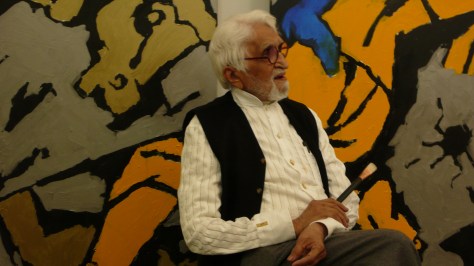
Alvida, Maqbool Fida: M.F. Husain, Free at Last

M. F. Husain at the Serpentine Gallery during the Installation of 'Indian HIghway', December 2008

Like possibly several other children growing up in the kind of lower-middle class metropolitan households that attempted to reconcile their aspirations towards culture with their frugal habits in the 1970s and1980s in Delhi, my first introduction to the art of our time was the framed print of a Husain painting. We had no television. And my parents had no gods. The only icons in our modest house were two framed pictures – an inexpensive N.S. Bendre, (Lalit Kala Akademi) print of a few women at a well and the reproduction of a Husain painting, possibly detached lovingly and carefully from an Air India calendar, possibly featuring the kind of goddess image that incensed the zealots who made it impossible for M. F. Husain to live out his final years in India. Continue reading Alvida, Maqbool Fida: M.F. Husain, Free at Last

Action Alert – Imminent Police Attack on POSCO Affected Villages

Update of anti-POSCO People’s Movement as on 10th June 2011, 12 noon. 

· Police and protesting public are face to face now: Twenty platoon police forces with officers have already reached at the boarder of Govindpur village where more than 2000 villagers are protesting against the forceful land acquisition by government of Odisha for POSCO through 24X7 vigil.

· Protesters are determined to resist any use of force by the government and police forces. Even women and children have come to the forefront as they form the first two shields of protection.

· Senior police officers, with arms and weapons, are threatening people to dismantle through loud speakers. We will let you know the development here

Kindly call the following authorities to lodge your protest.

In solidarity,
Prashant Paikray
Mobile – 09437571547 Continue reading Action Alert – Imminent Police Attack on POSCO Affected Villages

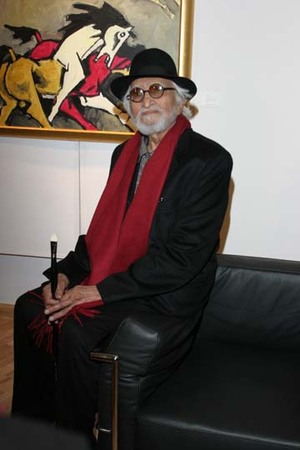
On the passing away of MF Husain: SAHMAT

Photo credit: Jay Mandal

This statement has been put out by the SAFDAR HASHMI MEMORIAL TRUST (SAHMAT)

M. F. Husain

Easily the most iconic artist of modern India, Maqbool Fida Husain passed away in London on 9 June 2011. M. F. Husain was born in 1915 in Pandharpur, the famous temple town in Maharashtra. Bereft of his mother’s presence since childhood, Husain grew up in the multi-cultural milieu of Indore where his father migrated around 1919.

Indian civilization, in all its diversity, had been Husain’s basic inspirational project. Since the year of Independence, through the Nehruvian decades and thereon, cognizant of all the challenges involved in nation-building, Husain had been steadfast in maintaining a most affirmative relationship with the Indian peoples’ consciousness of their national identity. Through him, we have learned to address a whole gamut of issues pertaining to the interactive dynamic of modernity with the country’s many-layered art and culture. Continue reading On the passing away of MF Husain: SAHMAT

Women Against Sexual Violence and State Repression condemns crackdown on anti-corruption protesters

WSS strongly condemns the midnight crackdown on thousands of people staging a ‘Satyagraha’ and hunger strike at Ramlila Maidan with Baba Ramdev for demands related to corruption and black money.

We are astonished at Mr Manmohan Singh’s defense of police action saying that there was no alternative. The attack on the protesters was absolutely unwarranted as the ‘satyagraha’ was neither causing any law and order problems nor was it disrupting the peace of the city in any manner.

We are not supporters of Baba Ramdev but clearly see the role of dissent in upholding a democratic society. Continue reading Women Against Sexual Violence and State Repression condemns crackdown on anti-corruption protesters

Pranayam was Never so Painful

(Please see an update made at the end of this post.)

I am watching the fog of tear gas shells descend on Ramlila Maidan on the live television feed on my computer. What was supposed to be a ‘yoga camp’ led by Baba Ramdev, and the fully-funded-free circus of his so-called ‘indefinite hunger strike’ against ‘Black Money’ has now turned into a tear-gas purgatory. It is midsummer, but inside that big tent it looks like a particularly foggy-smoggy night in a Delhi midwinter. It must hurt like hell, in the nostrils, in the lungs. With every breath that Ramdev’s disciples take (and how well they know the art and science of heavy breathing) their eyes must sting. Pranayam was never so painful. I hold my insomniac breath as I sit watching, riveted. Continue reading Pranayam was Never so Painful

Baba Ramdev, Baba Ramdev

Commonwealth Games scam: Manmohan knew all, did nothing

RTI activist Subhash Agrawal has obtained correspondence between the then sports minister Mani Shankar Aiyar, and Prime Minister Manmohan Singh, that shows the PM was informed about the scam as early as October 2007. And did nothing. You can download here (.pdf, 4.2 MB) the 52 pages long RTI reply Agrawal got from the PMO.

Make Delhi Metro safe for women! Please Mend The Gap

PLEASE MEND THE GAP is a citizen- led initiative to promote gender equality and commuter safety in public spaces. 

Follow these two links for some background:

A few weeks ago, a friend was molested on the Yellow line of the Delhi Metro

A flash mob of citizens got together to protest against the Delhi Metro, claiming that it is promoting a gender divide.

Sign PMTG’s Petition to Chief Minister and DMRC

We believe that a majority of women do not feel safe while travelling in the Delhi Metro. We have spoken to a cross-section of Metro commuters who have shared with us their experiences most of which include instances of verbal and physical harassment mostly faced by women, specifically in the women’s-only compartment. In fact, a few days ago, some of the members of our group who were traveling at night observed that the women’s-only compartment was populated with men who had occupied almost all the seats forcing the women to stand, leaving them with no choice but to actively demand the seats they were entitled to. The men were unapologetic and dismissive. Most shrugged off the women’s protest by claiming falsely that the women’s-only compartment turns general post 9 p.m..

Women who choose to travel in the general compartment are also harassed. There have been many instances where men have told women that they are not welcome in this compartment and should use the compartment reserved for them. This attitude has become so deeply entrenched in commuters’ mindsets that most accidentally refer to the general compartment as the ‘men’s compartment’. There have been times when authorities have driven out men from the women’s-only compartments, but without having imposed any fine whatsoever…

The situation needs to change. It is the duty of the State and the DMRC to spearhead this change.

Read the full petition and sign.

Dominique Strauss-Kahn and the union maid: Dean Baker

A little-reported fact of the Dominique Strauss-Kahn case is that his accuser is a union member – with rights the IMF opposes, says Dean Baker in the Guardian.

But do listen to this song first!


“The reason that this is an important part of the story is that it is likely that Strauss-Kahn’s alleged victim might not have felt confident enough to pursue the issue with either her supervisors or law enforcement agencies, if she had not been protected by a union contract. The vast majority of hotel workers in the United States, like most workers in the private sector, do not enjoy this protection.

Received via Mini Mathew

A major victory for the agitating workers in Gorakhpur

A major victory for the agitating workers in Gorakhpur

Dismissed workers taken back

Factory owners buckle under pressure – Locked out mills to start from June 3

New Delhi, June 2. Workers in Gorakhpur achieved a major victory in their struggle when the factory owners agreed to start the two locked out mills from June 3 and take back the dismissed workers. 12 of the 18 workers will join work immediately and the remaining 6 will be taken back after a domestic enquiry. The workers also forced the owners to accept that no one from the management will be in the enquiry committee; it will have two members from the office staff and one workers’ nominee.

The decision was taken at negotiations held till late night at the district magistrate’s residence. The two owners of the VN Dyers and Processors yarn mill and textile mill, the district magistrate and deputy labour commissioner and seven workers’ representatives were present at the meeting.

These two mills in the Bargadwa area of Gorakhpur were illegally locked out since April 10. Around 500 workers work in both of these mills owned by the Ajitsaria family having an annual turnover of more than 150 crores. 18 workers of these two mills were dismissed by the owners. The workers were agitating for reinstatement of their colleagues and restarting the factories.

Continue reading A major victory for the agitating workers in Gorakhpur

Growing Inequality and Deprivation in Telangana – Questions evaded by Srikrishna Committee: Bhim Reddy

Guest post by BHIM REDDY

[The movement for a separate Telangana state has been raging now for quite some time. At Kafila, we have not yet had the occasion for a discussion on the pros and cons of the issue. This post deals with one aspect – that of agricultural economy and its relationship to the perceptions of discrimination. We hope that this post will lead to some debate on a very important issue. AN]

Rural Telangana has experienced income declines for ninety percent of its population, increase in inequality and a drastic decrease in the class-size of cultivators accompanied by an increase in the class-size of agricultural labourers since early 1990s.  This revealing evidence is presented in Srikrishna Committee (Committee for Consultations on the Situation in Andhra Pradesh, headed by Justice B.N. Srikrishna) Report based on NCAER (National Council of Applied Economic Research, New Delhi) surveys conducted once in the year 1993-94 and another in 2004-05. The Committee’s concern over this scenario, despite the purpose of its constitution being to study the situation in Andhra Pradesh state in the context of unrest in Telangana region, has not attracted any attention beyond its worry that the vulnerability of the deprived masses can be ‘used’ by political groups: “…most of the deprived communities in Telangana are facing hardship and therefore are vulnerable to mass mobilization on one pretext or the other, including political mobilization with promises which may or may not be met”. Beyond this shallow concern the Committee is indifferent to such evidence that any study characterised by objectivity and rigorous interrogation would be compelled to undertake a critical examination of the trajectory of economic development and state’s policy, and attempt to explain the cause of such deprivation and growing inequity.

Continue reading Growing Inequality and Deprivation in Telangana – Questions evaded by Srikrishna Committee: Bhim Reddy

The Power of Crowdsourcing

The ‘Viral’ Revolutions Spread Across Europe

The New Democratic Upsurges

The mainstream Western media that celebrated the democracy movements in the Arab world not very long back, is relatively silent now. For, then it was the Arab youth’s striving for the ‘western values’ of democracy that it was celebrating. Now that the cry of ‘democracy’ is arising from its very midst, it does not seem to quite know what to do. From May 15 on, for almost two weeks Madrid and other Spanish cities have been witnessing some of the largest demonstrations in recent memory. Protesters have thronged the Puerta del Sol, virtually camping there. As government forces started cracking down, demonstrations began to grow in an ever expanding scale spreading to many other Spanish cities. When the government moved to ban demonstrations on May 20, in the run up to the regional and municipal elections, the protests acquired an even more militant form. A ‘snapshot’ of the rallies in defiance of the ban:

The initial protests against the planned multibillion euro bailout plan for banks, austerity measures and against high unemployment almost 45 percent among the youth), according to reports, were not very large but when the government responded by arresting several activists and demonstrators, things started going out of hand. That was the ‘spark that lit the prairie fire’. As Ryan Gallagher’s report in the New Statesmanput it:

A demonstration against the arrests was organised in the city’s main square, Puerta del Sol, and numbers soon snowballed when word got out over the internet. What began as a group of fewer than a hundred activists reached an estimated 50,000 within less than six days.

The protesters whose arrests had sparked the initial demonstration were released and immediately returned to the square. By the time they arrived, the demonstration was no longer just about their treatment at the hands of the police. It was about government corruption, lack of media freedom, bank bailouts, unemployment, austerity measures and privatisation.

Here is another video of a fierce battle being fought on the streets of Madrid: Continue reading The ‘Viral’ Revolutions Spread Across Europe

Gautam Navlakha detained, denied entry into Kashmir: Press note from IPTK

Press Note: For immediate release
INTERNATIONAL PEOPLE’S TRIBUNAL ON HUMAN RIGHTS AND JUSTICE IN INDIAN-ADMINISTERED KASHMIR (IPTK)
www.kashmirprocess.org

From: Dr. Angana Chatterji, Convener IPTK and Professor, Anthropology, California Institute of Integral Studies; and advocate Parvez Imroz, Convener IPTK and Founder, Jammu and Kashmir Coalition of Civil Society

TRIBUNAL CO-CONVENER DENIED ENTRY INTO KASHMIR

Srinagar, May 28, 2011: On May 28, 2011, Mr. Gautam Navlakha, Convener, International People’s Tribunal on Human Rights and Justice in Kashmir (IPTK) and Editorial Consultant, Economic and Political Weekly, was stopped at Srinagar airport on his arrival from New Delhi, and asked to go back. Officials invoked Section 144 of the Code of Criminal Procedure. By the time the authorities finalized their decision regarding his return, there were no remaining flights out of Srinagar. Mr. Navlakha is being detained and taken to an undisclosed location until May 29, when he will be allowed to return home.

Mr. Navlakha is a noted public intellectual and peace activist. His denial of entry raises urgent concerns about the status of freedom of speech and movement in Kashmir. Given the egregious violence that was inflicted on people by state forces in the Summer of 2008, 2009, and 2010 in Kashmir, we are deeply concerned that state forces not suppress democratic activities in the Summer of 2011, and not isolate Kashmiris from human rights defenders that travel to Kashmir to bear witness to atrocities and speak for peace and justice.

We understand that harassment, intimidation, and threats to IPTK members or their families are acts aimed to target and obstruct the work of the Tribunal. In November 2010, Professor Richard Shapiro, an academic from the United States and life-partner of IPTK Co-convener Angana Chatterji, was denied entry into India without any charges or due process.

Earlier, in June 2008, IPTK Co-convener Pravez Imroz and his family were targeted and an explosive device was thrown at his home. Imroz has been denied a passport. In July 2008, a First Information Report charged Angana Chatterji and IPTK Co-convener Zahir-Ud-Din, then editor of Etalaat English Daily, with acting to incite crimes against the state, following his publication of an article on mass graves written by Chatterji. IPTK Liaison Khurram Parvez has been threatened and is extensively surveilled. All Tribunal communications and the movements of its members in India and abroad are monitored.

We remain gravely concerned about the physical and psychological safety and integrity of all Tribunal members. We remain gravely concerned about our ability to continue our work, and the ability of out-of-state Tribunal members to travel to Kashmir.

DISSENT, DEBATE, CREATE