
[An edited version of this article by me has appeared in the November-December 2010 issue of Conveyor, a magazine published from Srinagar.]
On 22 October 2010, there was a public seminar in Delhi, titled “Azadi: The Only Way”. I did not plan to attend it as I had important work that day. However, a day before the event, it was announced that the keynote speaker would be none other than Syed Ali Shah Geelani. How could one not go to hear what the man of the moment had to say?
I reached late, when two speakers had already spoken, Kashmiri Pandits had already created a scene, even getting into a physical fight with some Kashmiri Muslims. As I entered the precincts of the Little Theatre Group auditorium, I met Delhi University student Suvaid Yaseen who showed me a small cut in his hand, caused by the fisticuffs with the Pandits. Some of the Pandits had been taken away by the Delhi Police and detained for a few hours, many others still inside the auditorium. The auditorium was full of cries of “Hum kya chahtay? Azadi!” To hear that in central Delhi rather than Srinagar’s Lal Chowk is a little incredible. But it had happened before, on 7 August, at Jantar Mantar, the only place in the capital of the world’s largest democracy where protest is allowed. At Jantar Mantar too, Pandits were being restrained by the Delhi Police. Continue reading The Logical Urges of Sedition
 One of the issues that the Binayak Sen trial has revealed is the quality of the investigative process in the case and the nonchalance with which the police has flouted even routine guidelines, safeguards and rules.

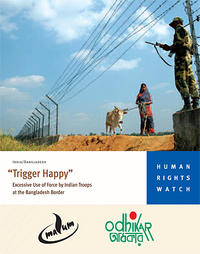 HUMAN RIGHTS WATCH has released an 81-page report that documents the situation on the border region, where both Bangladesh and India have deployed border guards to prevent infiltration, trafficking, and smuggling. They found numerous cases of indiscriminate use of force, arbitrary detention, torture, and killings by the security force, without adequate investigation or punishment. The report is based on over 100 interviews with victims, witnesses, human rights defenders, journalists, and Border Security Force and Bangladesh Rifles’ (BDR) members. You can read the report
