
“Right there, right there!”
“Where? I can’t see the damn station. Where is it?”
“Right there, you walk past that little lane, you will hit the station.”
Grudgingly, I walked through the lane and lo and behold! I was at the platform of Govandi railway station. It just took me a little row of settlements and some open drains running by them to get to that wretched Govandi station (not to forget to mention, passing by some of the children playing around and that sole bhaiyya woman sitting idly).
Did I say wretched? Yes, wretched is the feeling I get when I am at Govandi station. Perhaps in my life, I must have been to Govandi station exactly six times. Of the four of those six times, I have traveled in the east of Govandi, towards the Tata Institute of Social Sciences (TISS). But the last two times, I have actually experienced the wretchedness of Govandi station, when I have had to get off platform number 1 and then go past all the squatter settlements, till I eventually get to the infamously famous Lallubhai Compound.
Under Development: Singur

If you are in Kolkata between 27 June and 2 July, you may do well to visit the Seagull Arts and Media Resource Centre, Kolkata, for an exhibition of photographs of Singur. There will also be a panel discussion and a film festival. Continue reading Under Development: Singur
Join The Dots: Silent Emergence of Hindu Terrorism
I
What is common between Kathmandu – the capital of Nepal ; Thane, Vashi which happen to lie in Maharashtra; Tenkasi, which is part of Tamilnadu and Indore, which lies in Madhya Pradesh? Aprops there seem to be no commonality, although a close look at stray sounding incidents in these places brings forth a pattern which has serious import for the manner in which (non-state) terrorism is viewed in this country. It is disturbing that media which calls itself ‘watchdog of democracy’ and which has no qualms in stigmatising the minority community on unfounded allegations of ‘terrorist acts’ has suddenly gone mute since the perpetrators of terrorist acts in all these cases belong to the majority community.
Continue reading Join The Dots: Silent Emergence of Hindu Terrorism
Pride, Prejudice and Politics
Reproduced from the Indian Express this morning. Of course, I wrote it entirely with Kafila in my heart, the Express just got it first :)
___________
A gay man is given two years of electroshock therapy in a major city hospital to “cure” him — the National Human Rights Commission refuses to file a complaint. A 2004 book on queer politics sees 34 contributors write under their full names, many for the first time. Lesbian women continue to commit suicide rather than be forcibly married. Large sections of the media openly support campaigns against Sec 377 — the 1861 law that criminalises “unnatural offences” — and widely carry an open letter written by Vikram Seth and Amartya Sen against the law. The law still stands over the head of the gay community, but the challenge to it in the Delhi High Court inches towards a verdict. Meanwhile, aravanis (as hijras are known in Tamil Nadu) win a landmark battle for the legal right to have government identification cards and passports issued under “E” as their gender. Continue reading Pride, Prejudice and Politics
An epitaph for the bull-hull economy
S. Anand draws his own conclusions from a trip to Azamgarh, about which Aditya Nigam had earlier written a post on Kafila.
While the urban elite, who can afford to indulge the growing fad of organic slow-food, would now happily pay a premium price for the hard bread (appreciating its high-fibre content) that Dalits were forced to eat owing to denial and deprivation, the rural Dalits are forced into the maida economy of Maggi Continue reading An epitaph for the bull-hull economy
Gomti Nagar to Bundelkhand
It has been over a year since Mayawati came to power in UP and I am absolutely sick of seeing news reports beginning with the comment, “In a state ruled by a Dalit chief minister, a Dalit youth was killed…” This hostility towards Mayawati is ironically couched in the language of ‘Dalit empowerment’, the phrase used so loosely its is completely devoid of meaning. Where were all these reporters and their editorialising and their concern for Dalits when Yadavs were running the state?
What has Mayaywati been doing for Dalits? That question will be answered again and again without talking to a single Dalit. But if you do go looking for something, you will find it. The redoubtable Nilanjana Bose reports: Continue reading Gomti Nagar to Bundelkhand
Claims and Space – Thoughts from the Feet
Fort,
Bombay – 400 001.
Clean footpaths,
Spic and span,
Bombay – 400 001. Continue reading Claims and Space – Thoughts from the Feet
Prasanta Chakravarty – Of Demos, Innovation and Affect
Carrying forward the debate around Partha Chatterjee’s article in EPW.
by PRASANTA CHAKRAVARTY
In the wake of the development debates around the nation, one witnesses an interesting array of articles—polemical as well as academic—that takes on headlong issues of political intervention by developing the terms of negotiation and deliberation in a certain direction. And that is the story of growing up—that democracy is the story of pragma, of mature understanding of the contestatory space. These are reminders that politics of good intentions is benign self-deception. Worse: it is apolitical, prophetic, self-indulgent.
Continue reading Prasanta Chakravarty – Of Demos, Innovation and Affect
In the war against terror…
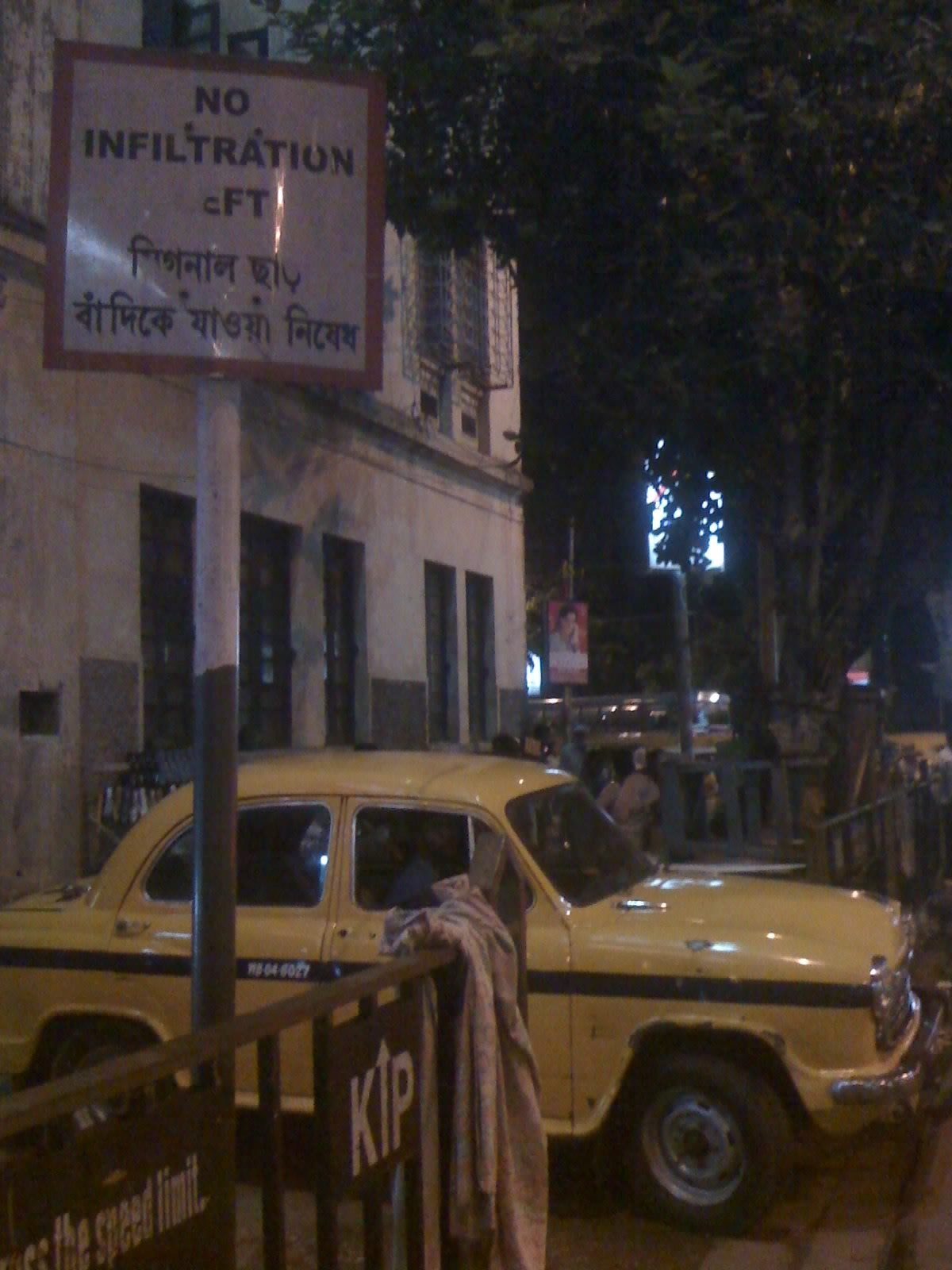 The Kolkata Municipal Corporation does its bit ….
The Hyde Act and the 123 Treaty
I have for a long time wondered about the noise that constantly gets made on the possibility of an Indo-US nuclear deal. And recently, for quite unrelated purposes, had to do some thinking on this for a posting on the Sarai Reader List. I thought that the substance of what I had to say in that posting, might be of interest to Kafila readers. So apologies for cross posting of this material, which has appeared previously on the Reader List.
Now, what is the Hyde Act, what exactly is the 123 Treaty? These matters need a little clarification.
The Hyde Act, or, the Henry J. Hyde United States-India Peaceful Atomic Energy Cooperation Act of 2006, to give the act its full title, is a piece of legislation, introduced by Congressman Henry Hyde, passed by the US Congress, which creates the legal basis for co-operation between the United States and India. See the Wikipedia articles on the Hyde Act and the 123 Agreement. Continue reading The Hyde Act and the 123 Treaty
Why NAMO Loves To Hate Prof Nandy
Prof. Ashish Nandy, India’s leading intellectual acknowledged as one of the the founding fathers of postcolonial studies has recently got a new ‘identity’. According to the Gujarat Police he is now an accused in a criminal case supposedly for ‘promoting enmity between different groups on grounds of religion, race, place of birth and language.’ Definitely neither Prof Nandy nor many of his admirers would have ever imagined in their wildest dreams that a day would arrive when he will face prosecution for his writings. But as they rightly say it, in Gujarat things happen bit differently. Continue reading Why NAMO Loves To Hate Prof Nandy
Broken news
Got these from a friend. Enjoy.
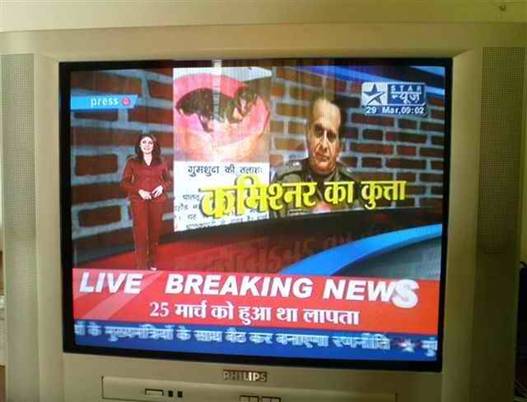
Lost on 25 March, the Delhi police commissioner’s dog was soon found, giving star news an opportunity to ‘break news’ and do a special show replacing a news bulletin. Below: they continued flashing the news and calling it ‘breaking’ even when other news forced itself on to the screen.
Ahilan Kadirgamar on Southasian Solidarity and Questions of State and Land
[This guest post is by AHILAN KADIRGAMAR who is an activist with the Sri Lanka Democracy Forum. He has written about the international dimension of the conflict and peace process in Sri Lanka and worked on human rights concerns related to the conflict. His current interests include the political economy of state-society relations and attempts at state reform in Sri Lanka.]
I have been travelling between cities, from Kathmandu to Delhi to Calcutta and down south to Madras. Visiting friends, but also trying to understand peoples’ perceptions of Sri Lanka in a time of war. I give talks here and there, but many more meetings over tea and dinner. There is an older tradition of solidarity, but now I am thinking again of the meaning of Southasian solidarity.
In Calcutta, on an activist’s book shelf, I find a book signed and gifted to her in the mid-eighties by Para, my friend from Berlin who passed away last year. Kumaraswamy Pararajasingham, a Marxist and human rights activist in Lanka in his early years, was a pillar of Tamil dissent over the last two decades of exile in Germany. An old Marxist in Calcutta, asks me about Hector Abhayawardhana, the theoretician of the Lanka Sama Samaja Party Continue reading Ahilan Kadirgamar on Southasian Solidarity and Questions of State and Land
Political Society and the Fable of Primitive Accumulation
This is a response to Partha Chatterjee, whose recent essay we had posted for further debate.
Partha’s work has been a central reference point for the work of many of us and his notion of ‘political society’ has provided an unprecedented opening, a possibility – that of thinking the ‘unthinkable’. I would go so far as to say that the enunciation of the idea of ‘political society’ has been one of the most important conceptual interventions of ‘postcolonial’ political theory – that is to say, political (and social theory) produced from/in the postcolonial world; an intervention in theory that for the first time brings in the postcolonial experience into its very heart. I shall even claim that the potential and possibilities of this concept are of far wider applicability than the geographical ‘third world’ and can provide a lens for looking at the so-called first world itself. But on that more later. Continue reading Political Society and the Fable of Primitive Accumulation
Understanding the Nepali mandate
(Three years back, Nepal was in the middle of a miserable war. 7 people were killed every day, mostly by the army but also by a ruthless Maoist military. An autocratic monarch ruled from his palace in Kathmandu. The street agitation led by established parties was not going anywhere. The Maoists were waging an armed struggle with control over most of the hill hinterland, as well as the strength to block supplies to the capital. There was a political deadlock among the three power centers and a military stalemate between the Royal Nepal Army and the People’s Liberation Army. Continue reading Understanding the Nepali mandate
Beyond just a ‘Home and a Name’
[The transformation of the agenda of the mainstream left in Kerala is beginning to produce resistance, and nowhere is this more visible than at Chengara in the south eastern Pathanamthitta district. The ongoing struggle for land there brings into relief not just the denial of productive resources to the real tillers of the soil – the Dalits – in Kerala’s land reforms, but also the shift of the left from the fight against inequality to the distribution of ‘minimum entitlements’. It also draws attention to the manner in which a ‘state-centric’ civil society, mainly the large network of poor women’s self-help groups sponsored by the State’s poverty eradication “Mission’, has been authorized as ‘authentic civil society’. All claims made outside these formal institutions are thereby rendered illegitimate and indeed, ‘against the law’. At Chengara, the protestors have been resisting the combined force of the state and the major political parties, laying claims to productive resources – and rejecting ‘minimum entitlements’. Indeed, the darker side of ‘democratic decentralization’ in Kerala, the ‘new Kerala Model’, as it has been called by its admirers, is the implicit legitimacy it grants to blatant violence unleashed upon people who struggle for economic equality, who do not find ‘minimum entitlements’ the solution to rampant and growing economic inequalities in contemporary Kerala. No wonder, then, that the Chief Minister of Kerala felt no qualms in warning the leader of the Chengara land struggle, Laha Gopalan, that if the protestors did not peacefully return to their villages (where they could put in applications for 3 or 5 cents of land for housing), they would have to encounter “police with horns and thorns” – in other words, not just armed police, but a bestial force. Nandigram, in short.
The struggle, however, remains vibrant and growing. Below is a translated version of a speech made by leading Dalit activist and intellectual, Sunny M Kapicadu, at a night-vigil organized in support of the ongoing land struggle in Thiruvananthapuram on 7 March 2008, in which he defends the struggle against powerful efforts to malign and undermine it. – JD ] Continue reading Beyond just a ‘Home and a Name’
Democracy and Economic Transformation – Partha Chatterjee
[Political theorist Partha Chatterjee’s work has been the reference point for many contemporary theorizations of politics in India and others parts of the postcolonial world. Chatterjee has recently published an important essay, which we reproduce below. Many friends and colleagues in Kolkata and elsewhere have requested Kafila to provide the forum for this debate, considering the common interest that many of us have in issues raised here. Some reformulations by Chatterjee, especially in the aftermath of Nandigram, call for a more sustained political theoretical reflection. The article also raises issues directly related to questions of rural-to-urban migration that has seen some debate in Kafila lately. – AN]
Economic & Political Weekly
April 19, 2008 [Download PDF]
Democracy and Economic Transformation in India
With the changes in India over the past 25 years, there is now a new dynamic logic that ties the operations of “political society” (comprising the peasantry, artisans and petty producers in the informal sector) with the hegemonic role of the bourgeoisie in “civil society”. This logic is provided by the requirement of reversing the effects of primitive accumulation of capital with activities like anti-poverty programmes. This is a necessary political condition for the continued rapid growth of corporate capital. The state, with its mechanisms of electoral democracy, becomes the field for the political negotiation of demands for the transfer of resources, through fiscal and other means, from the accumulation economy to programmes aimed at providing the livelihood needs of the poor. Electoral democracy makes it unacceptable for the government to leave the marginalised groups without the means of labour and to fend for themselves, since this carries the risk of turning them into the “dangerous classes”.
Partha Chatterjee
The first volume of Subaltern Studies was published in 1982. I was part of the editorial group 25 years ago that launched, Continue reading Democracy and Economic Transformation – Partha Chatterjee
Jaswant Singh ko Gussa Kyon Aata Hai?
There are rare occasions when one is witness to the making of history before our own eyes. The dismantling of the 240 year old Nepalese monarchy and the ushering of Nepal into a Republic has been one such occasion.
As rightly said by a senior Nepali leader “A day comes once in a century. Today is day that Nepali’s long cherished dream has come true.”
But as far as the Sangh Parivar and its affiliated organizations are concerned they have openly expressed their displeasure over these developments. Looking at their sectarian worldview and anti-human understanding of history it does not look surprising. These are the very forces who supported Monarchy till the very end and were enamoured about the ‘model Hindu Rashtra’ in operation here which denied every right to broad cross-section of people. People who still pat themselves on the back for the ‘successful Gujarat Experiment of 2002’ or who celebrate demolition of a five hundred year old mosque as ‘Day of Valour’ can have only such convoluted understanding of things.
Continue reading Jaswant Singh ko Gussa Kyon Aata Hai?
Kavita Srivastava’s report on last year’s Gujjar confrontation in Rajasthan
 [This detailed report was prepared by Kavita Srivastava, the Jaipur-based general secretary of the People’s Union for Civil Liberties. Posting this here to make it publicly available as it is not on the PUCL website. Please note that this was a rough draft. ]
State Violence and Caste Confrontation in Rajasthan
I. Outline of the week long movement for ST Reservation by the Gurjars
Soon after independence the Bhil Meenas got reservations in the Districts of Dungarpur, Banswara, Chittorgarh and Udaipur. At the time of 1931 census the Bhil Meenas were over 20, 000, however today they have reduced to half they are only 10,000 in number.
This was an issue of contention for the Meenas as they felt that they also deserved to be STs so they decided to raise their voice against this injustice as they called it. Under the leadership of Lakshmi Narayan Jhirwal they organized themselves.
11th June 1952: Meenas organized a sammelan near Dudu (Jaipur) district for the inclusion of the Meena community in the Schedule list for reservation. The Gurjars supported this wholly. Continue reading Kavita Srivastava’s report on last year’s Gujjar confrontation in Rajasthan
“There is no such thing as the caste system anymore”
 In April last year, Avinash Dutt and I had interviewed the political scientist Christophe Jaffrelot. We walked around Lodhi Gardens, tape recorder in hand, and I ended up transcribing more than five thousand words that night. Tehelka had published a shorter, edited version. Here’s the full thing.
I was reminded of this interview after encountering the argument here that there should be, and is, a Dalit-Brahmin alliance against the already much-demonised OBCs. I thought that this way of seeing the BSP’s victory in the Uttar Pradesh elections was not only incorrect, but also seemed to be in need of the argument that Jaffrelot makes in this interview: that seeing caste as a ‘system’ is outmoded, at least as far as electoral politics is concerned.
1- Shivam: Which is more important for the average Indian, religion or caste?
It is sometimes not only those two but much more. Continue reading “There is no such thing as the caste system anymore”
The Patriot Act of Intellectual Property
I was at a meeting recently to discuss what is now being termed, as The Patriot Act of Intellectual Property. Some of the leading economic powers including the US, European Commission and Japan have been negotiating an agreement, the Anti Counterfeiting Trade Agreement (ACTA) which attempts to redefine IP enforcement. The Bush administration is particularly keen that they finalize this agreement before the end of his term. At the moment the substantive content of the agreement is not known, and the few details that are available are only because of a leaked document of the US government available in Wikileaks.
 KAFILA - COLLECTIVE EXPLORATIONS SINCE 2006