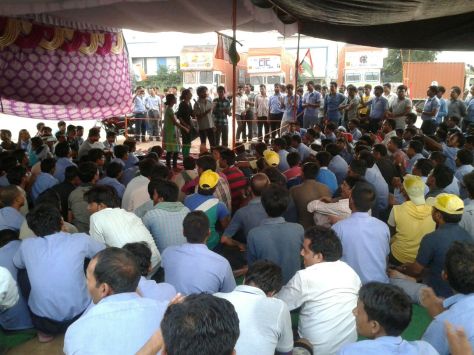
Continued attempts of Hindutva forces to foment communal tension in North-West Delhi: Investigation Report

This is a guest post by NAUJAWAN BHARAT SABHA on the communal mobilisation in working class colonies in North West Delhi.

1. Introduction

In recent months Hindutva fundamentalist forces have been involved in fomenting communal tensions and paving the way for riots in the workers’ colonies of North-West Delhi in a very systematic manner. There has been a surge in the number of RSS shakhas in the parks and on the vacant land of DDA in this area. At the same time the activities of Bajrang Dal are also on the rise in this area. Most of the workers’ residences in the areas of Holambi Kalan, Holambi Khurd, Bhawana, Narela, Bhalaswa Dairy etc. are part of resettlement colonies where the working population which was uprooted from different parts of Delhi have been resettled.

Several illegal activities such as gambling and sale of illegal liquor, smack and other intoxicants are carried out on large scale in these colonies as a matter of routine. Apart from the ordinary working population there also exist lumpen elements in substantial numbers. In the shakhas of RSS mainly shopkeepers, contractors, house owners, property dealers and the middle class youth are seen while the lumpen elements play an important role in hooliganism during communal tensionS. It is in the mobilization of such lumpen elements that the Bajrang Dal comes into picture. These days widespread public contact campaign is being organized even in the middle class colonies of the entire area on the pretext of running a signature campaign under the banner of “Go Raksha Maha Abhiyan”.

Continue reading Continued attempts of Hindutva forces to foment communal tension in North-West Delhi: Investigation Report

A Statement Protesting Approval to Introduce Injectable Contraceptives in the National Family Planning Programme

The following is the text of a letter written by activists and scholars working in the field of medicine, public health and women’s rights, to the Union Minister for Health and Family Welfare:

To

Shri Jagat Prakash Nadda,

Union Minister for Health and Family Welfare,
Ministry of Health and Family Welfare,
Nirman Bhavan, Maulana Azad Road,
New Delhi 110 011

22nd September 2015

Statement Protesting the Approval to Introduce Injectable Contraceptives in the National Family Planning Programme

We, the following health groups, women’s organisations, peoples’ networks and individuals are extremely disturbed by the news report published in the Times of India (dated 16th September 2015) that the Union Health Ministry has approved Depo Medroxy Progesterone Acetate (DMPA) for use in the National Family Planning Programme (FPP).

It may be re-called that following a Supreme Court case filed in 1986 by women’s groups regarding serious problems with injectable contraceptives like Depo and Net-En, the Court directed the government to monitor safety issues in use of injectable contraceptives but did not ban its use. While they are available in the private medical sector, the Drugs Technical Advisory Board (DTAB), the highest decision-making body on technical matters in the Ministry of Health &Family Welfare, in 1995 held that Depo-Provera is not recommended for inclusion in the FPP. Continue reading A Statement Protesting Approval to Introduce Injectable Contraceptives in the National Family Planning Programme

तर्क और विचारों से कौन डरता है ? – दाभोलकर, पानसरे और कलबुर्गी की शहादत के बहाने चन्द बातें

1

Photo : Courtesy – http://www.newslaundry.com

1.

आग मुसलसल जेहन में लगी होगी
यूं ही कोई आग में जला नहीं होगा

दोस्तों

कातिल के पिस्तौल से निकली ऐसी ही आग का शिकार हुई तीन अज़ीम शख्सियतों की याद में हम सभी लोग ‘कलम विचार मंच’ की पहल पर यहां जुटे हैं। विगत दो साल के अन्तराल में हम लोगों ने डा नरेन्द्र दाभोलकर, कामरेड गोविन्द पानसरे और प्रोफेसर कलबुर्गी को खोया है। गौरतलब है कि सिलसिला यहीं रूका नहीं है। कइयों को धमकियां मिली हैं। ऐसा समां बनाया जा रहा है कि कोई आवाज़ भी न उठाए, उनके फरमानों को चुपचाप कबूल करे। दक्षिण एशिया के महान शायर फैज़ अहमद फैज़ ने शायद ऐसे ही दौर को अपनी नज्म़ में बयां किया था। ‘निसार मैं तेरी गलियों पे ऐ वतन, के जहां ; चली है रस्म के कोई न सर उठा के चले..’

और इसी माहौल के मददेनज़र हम इसी अदद मसले पर आपस में गुफतगू करना चाह रह हैं कि आखिर तर्क और विचार से इस कदर नफरत क्यों दिख रही है ? कौन हैं वो लोग, कौन हैं वो ताकतें जो विचारों से डरती हैं, तर्क करने से खौफ खाती हैं ? चन्द रोज लखनउ की सड़कों पर उतर कर भी आप ने ऐसे हत्यारों के खिलाफ आवाज़ बुलन्द की थी। और एक तरह से समूचे देश के विभिन्न नगरों, कस्बों में जो इस मसले पर जो बेआरामी, बेचैनी देखने को मिली थी, उसके साथ अपनी आवाज़ जोड़ी थी। आज की यह चौपाल, आज की यह गोष्ठी दरअसल इसी सिलसिले की अगली कड़ी है। हम उन चिन्ताओं को आपस में साझा करना चाह रहे हैं ताकि यह जो माहौल बन रहा है, जो गतिरोध की स्थिति बनती दिख रही है उसमें थोड़ी हरकत पैदा की जा सके।

इसे दिलचस्प संयोग कहेंगे कि इस गोष्ठी का आयोजन बीसवीं सदी के पूर्वार्द्ध के महान सामाजिक विद्रोही पेरियार रामस्वामी नायकर / 17 सितम्बर 1879-24 दिसम्बर 1973/ के 139 वें जन्मदिन के महज एक दिन बाद हो रहा है। कल ही देश के तर्कशील समूहों, संगठनों ने, विचारों की अहमियत जाननेवाले तमाम लोगों ने उनका जन्मदिन मनाया, वही पेरियार जिन्होंने ताउम्र तार्किकता, आत्मसम्मान, महिला अधिकार और जातिउन्मूलन के सिद्धान्तों का प्रचार किया और आन्दोलन किए। मालूम हो कि तमिल लिपि में नए बदलावों के जनक पेरियार समाजवादी रूस की उपलब्धियों से भी प्रभावित थे और उन्होंनेे नास्तिकता एवं तर्कशीलता के प्रचार के लिए अभिनव मुहिमों का आयोजन किया था।

Continue reading तर्क और विचारों से कौन डरता है ? – दाभोलकर, पानसरे और कलबुर्गी की शहादत के बहाने चन्द बातें

Bihar Needs a Corbyn Moment: Sushil Chandra

Guest post by SUSHIL CHANDRA

If the media discourse on Bihar elections has any semblance of truth, this election is a choice between Pepsi and Coke. Whatever you choose, you get a cola of casteism, corruption and gangsters. On one hand we have winning combination of intermediate castes, the assured Muslim vote, the great legacy of fodder scam and kidnapping rings with added glitter of so called good governance and on the other hand the return of feudal dominance, the guaranteed promise of a theocracy and another band of gangsters. It is difficult to fathom from the media coverage that there is a third alternative available in shape of left which is free from all these attractions and offering a principled platform. You can see on television Upendra Kushwahas and Pappu Yadavs holding forth on their great vision for Bihar, the daily tantrums of Majhi and Paswan for their tug-of-war on seats but talk of the left and even Ravish Kumar forgets to mention them on his daily shouting matches on Bihar election. Is it because of our corporate media is not willing to invest in those not willing to invest on caste and religion? Continue reading Bihar Needs a Corbyn Moment: Sushil Chandra

Workers right to unionize being trampled upon in yet another factory in Manesar: Report

Report on the protest by automobile workers in Manesar by BIGUL MAZDOOR DASTA AND AUTOMOBILE INDUSTRY CONTRACT WORKERS UNION


IMG-20150921-WA0005

On the morning of 18 September 2015 when the workers employed in the Bridgestone company reached their factory gates they were met with Police officers and hired bouncers at the gate. When the workers tried to enter the factory premises they were resisted by the uniformed and the non-uniformed goons of the Factory Management. The Police beat up the workers and prevented them from entering the premises of the factory in spite of having a court order for tool down and without any prior notice the workers were sacked by the company. More than 400 workers employed in Bridgestone Factory in Manesar have been unlawfully sacked by the Company authorities after the workers demanded to get their Union registered. The workers are currently protesting outside the factory and have gathered there to raise their voice against the injustice and oppression that they are facing at the hands of the factory management.

Continue reading Workers right to unionize being trampled upon in yet another factory in Manesar: Report

Cow Slaughter – Can a Directive Principle Trump Fundamental Rights of the Most Marginalized? Mariya Salim

Guest post by MARIYA SALIM

The debates and demands around the issue of the prohibition of cow slaughter in India are a highly volatile, political and contentious subject, with the cow being revered as sacred by most Hindus in the country. Although almost all the proponents calling for a national legislation for a total ban on slaughter of cow and other cattle today look to the directive principles of state policy and use an economic and agrarian argument to defend their demand, it is interesting to note that the constituent assembly debates around this directive principle clearly indicate that it was as much a religious issue, reasoned on science and agriculture instead however, for some of those who wanted it to be an integral part of the Indian Constitution.

After much debate and deliberation in the Constituent Assembly and a demand from a few members of the assembly, to include a total ban on the slaughter of cows as part of fundamental rights in the Indian Constitution, a compromise was reached and the protection of the revered bovine found place in the Directive Principles of state policy, which incorporates this Hindu sentiment in a somewhat guarded and hesitant form[1]. Most notable among the members raising the issue were Pandit Thakur Dass Bhargava and Seth Govind Das[2]. Syed Muhammad Sa’adulla, another member argued that he would rather have the insertion on the protection of cow slaughter as a religious ground, as, the argument on economic grounds will ‘create a suspicion in the minds of many that the ingrained Hindu feeling against cow slaughter is being satisfied by the backdoor’ and he went on to give facts and figures on how cow slaughter is not as bad ‘as it is being made out to be’ from the economic point of view. [3]  Continue reading Cow Slaughter – Can a Directive Principle Trump Fundamental Rights of the Most Marginalized? Mariya Salim

The Patel agitation and the ‘paradox’ of demanding OBC status: Rita Kothari

Guest Post by RITA KOTHARI

Not long ago, a Gujarati film, Kevi Rite Jaish (“How will I go?”  dir. Abhishek Jain, 2012) provided to its viewers a rare fare. It was, unlike Gujarati films of the past, based on the life of urban Ahmedabad  and told the story of a young man whose dilemma was similar to that of scores of aspiring youth in Gujarat. Harish Patel, the protagonist, is obsessed with the idea of migrating to the United States and becoming, like many members of his community of Patels, a ‘motel-king.’ Harish Patel’s room is decorated with Statue of Liberty and Obama – deities that he needs to propitiate. However, his inability to answer satisfactorily the questions  asked by the visa officer at the US embassy leads to his failing to get a visa. The film builds up in comical vein the “trauma” of this event,  which prevented Harish Patel from  fulfilling his dreams in the promised land.  Several abortive attempts, including one involving fake sponsorship papers, bring to the viewer the satirical picture of a community that in the film at least, cannot see beyond motels and United States. The title poses  a real and rhetorical question for Harish Patel, who finally realizes that there are opportunities in his motherland  and this self-realization, certainly not a profound one, is suggested by signifiers of home-made food made by his mother.  A thoroughly ordinary film that this was, its success lay in striking a chord among young viewers who may also have been the chief patrons of such an economic venture.

To my knowledge, there was no counterview to the film contesting the stereotype of the Patel community, for this is indeed the dominant image of an urban Patel in popular imagination—affluent, enterprising and obsessed with the United States. Continue reading The Patel agitation and the ‘paradox’ of demanding OBC status: Rita Kothari

Kudumbashree in Chandydesham/Muneerland — In Three Parts

Part One: Prologue

In 2008, I reported the results of research on Kudumbashree women leaders at the village level, from seven districts in Kerala. Those were the days when Kudumbashree was being projected as the ultimate answer to all of women’s woes, and the chorus consisted of politicians, official feminists, researchers, bureaucrats, development experts – in other words, everyone, well, almost. What I had to say was not pleasant to their ears. However, implicit in my reporting was the essential changeability of Kudumbashree, which was after all a government programme. The discussions around the modifications of the Kudumbashree bye-law and its approval were on during our fieldwork, and even though we reported after it was finalised and approved, it was too early for us to assess its impacts.

Continue reading Kudumbashree in Chandydesham/Muneerland — In Three Parts

A Contested line – Implementation of Inner Line Permit in Manipur: Deepak Naorem

This is a guest post by DEEPAK NAOREM

Violence and the accompanying disruption of everyday life in Manipur is not a recent phenomenon. This year too, the state was plunged into a spiral of violence following demands for the implementation of Inner Permit Line, a law originating in the colonial period. This demand is based on real or imagined fears that Manipur, like Sikkim and Tripura, would be overwhelmed by the ‘outsiders’ and that the ‘indigenous people’ of Manipur would become a minority in their homeland. Such demands are neither new nor surprising in this part of the world, where a nearly-unfathomable ethnic, demographic and political jigsaw puzzle was created by British colonialism; one that was deepened by even more myopic and inconsistent policy in the post-colonial years. However, this year, following the death of a young student by police firing during a student protest in Imphal, the movement demanding the Inner Line Permit (ILP) gained considerable momentum in Manipur. Subsequently, the legislature was forced to introduce three bills in the Manipur State Legislative Assembly on 28th August, 2015, ensuring the implementation of Inner Line Permit in the state. This in turn triggered another wave of violence with the ‘tribals’ and tribal organizations opposing the three bills, eventually bringing life to a standstill in the state.

Continue reading A Contested line – Implementation of Inner Line Permit in Manipur: Deepak Naorem

Scramble for Muslim Votes as Owaisi Jumps into Bihar Polls: Abhay Kumar

Guest post by ABHAY KUMAR

Ever since Asaduddin Owaisi, president of the All India Majlis-e-Ittehadul Muslimeen (henceforth MIM), addressed a well-attended public meeting in Kishanganj  on August 17, speculation about his party contesting election in Bihar has been rife. Three weeks after the rally, Owaisi, eventually, decided that he would field candidates in Muslim-dominated Seemanchal region of Kishanganj, Araria, Purnia and Katihar. “MIM will put up candidates in Bihar’s Seemanchal region, which is not only backward but also has a lot of problems. There has to be over all development,” Owaisi told media, giving the leaders of anti-Hindutva Grand Alliance jitters.

Contrary to Owaisi’s latest move, some political observers had held the view that given the weak organisational structure of the MIM in Bihar and late entry in the state, Owaisi was unlikely to jump into assembly election. For example, senior journalist and political commentator, Khurshid Hashmi said that if Owaisi had been serious about Bihar election, he would have launched his campaign much earlier as he did in UP. Continue reading Scramble for Muslim Votes as Owaisi Jumps into Bihar Polls: Abhay Kumar

The Woman Worker Re-emerges – Lessons from Munnar

For once, the praise of the mainstream media in Kerala does not sound like empty hyperbole or sickening sycophancy. More than six thousand women workers were on strike in the Kannan Devan tea estates of Munnar in defiance of their trade union leaders, seeking higher wages — and equal wages with men workers who are paid more though their work is lighter — and alleging that the trade union leaders were pocketing benefits due to them. The workers receive very low wages and live under truly despicable conditions not far removed from colonial conditions despite the fact that the Kannan Devan Plantations in now technically under the workers who own sixty per cent of the shares. The blather about losses in the tea industry conceals the enormous control over land that the Tatas hold for a trivial sum paid to the government. It also deflects attention from the serious charges of encroachment made against the Tatas, which our political class has not pursued much. Continue reading The Woman Worker Re-emerges – Lessons from Munnar

पेटलावद विस्फोट – मौतों पर बजती तालियाँ : जसबीर चावला

Guest Post by Jasveer Chawla

Madhya Pradesh CM Shivraj Singh Chouhan, who visited the blast site at Petlawad near Jhabua this morning, faced protests from angry residents               (Photo courtesy : http://www.odishanewsinsight.com)

मध्यप्रदेश के झाबुआ जिले के पेटलावद क़स्बे में बस स्टेंड के पास भीड भरे स्थान पर रहवासी और व्यवसायिक क्षेत्र के एक मकान में अवैध रूप से रखे विस्फोटक जिलेटिन के भंडार में शनिवार विस्फोट हो गया. विस्फोट से ९० लोगों की मौत हो गई और दर्जनों घायल हैं जिनमें से कई की हालत गंभीर है,जिन्हे इंदौर,दाहोद अादि जगह भेजा गया.

मुख्यमंत्री श्री शिवराज सिंह चौहान ने रविवार को घटनास्थल का दौरा किया और सार्वजनिक रूप से घोषणा की कि सरकार हायकोर्ट के किसी जज से इसकी न्यायिक जाँच करवायेगी.दोषियों को दंडित किया जायेगा. मृतकों के परिजनों को १० लाख रुपये और घायलों के इलाज का सारा खर्च सरकार करेगी और पीड़ित परिवारों के रोजगार पर भी सरकार ध्यान देगी.

✔️ ‘व्यापमं’ प्रदेश के मुख्यमंत्री जब ये घोषणायें कर रहे थे तो उनके पास खड़े उनके दल के लोग उनकी ‘भामाशाही’ घोषणाओं पर बार बार तालियाँ बजा कर स्वागत कर रहे थे.सामने दुखी और पीड़ितों का विरोध करता हुजूम था.

✔️ इस ‘विस्फोट’ से सीधे प्रश्न उठते है.मध्यप्रदेश कोई सीमावर्ती राज्य नहीं है जहाँ कोई आतंकवादी आ गया और मुठभेड़ हुई और मकान में रखे विस्फोटक सुलग उठे ना ऐसी आतंकवादी घटना है जिसमे आतंकवादी बाजार/घर / ट्रेन/बस में बम प्लांट कर देते हैं और रिमोट से या आत्मघाती तरीके से विस्फोट कर देते हैं.ऐसा कुछ नहीं था.

यहां के जैन समुदाय का एक व्यापारी (आतंकवादी की कोई जाति या धर्म नही होता,ऐसा ही लिखते हैं ना ?) जो भाजपा के स्थानीय व्यापारिक प्रकोष्ठ का पदाधिकारी था (अपराधी किसी भी राजनैतिक दल का हो सकता है ?) १० वर्षों से क़स्बे में एवं मध्य व्यवसायिक क्षेत्र में अवैध रूप से किराये के मकान में भारी मात्रा में रखे जिलेटिन डायनामाइट का भंडारण कर रहा था.

इतनें वर्षों तक पुलिस, प्रशासन सोया था जो वहाँ पर इतनी मात्रा में कुएँ /खदानों में वैध/अवैध विस्फोट के लिये जिलेटिन का भंडारण हो रहा था ? Continue reading पेटलावद विस्फोट – मौतों पर बजती तालियाँ : जसबीर चावला

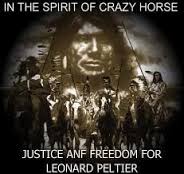
Sovereign Imagination – The Art Of Leonard Peltier: Frances Madeson

September 12 was Native American artist Leonard Peltier’s birthday, his 40th behind the bars of a jail in the USA. FRANCES MADESON pays tribute to him.

images

Leonard Peltier is the longest held Native American political prisoner in the U.S. He was wrongfully convicted in the 1975 killing of two FBI agents on the Pine Ridge Reservation in South Dakota. Leonard was at Pine Ridge at the request of the traditional elders who witnessed the brutal murders of over sixty Native people in what is termed the “reign of terror.” To date, no one has been charged or brought to trial [for those 60 murders] and yet he has served over 40 years for standing between the line of fire and the Keepers of our Sacred Ways on the very soil that was witness to the massacre at Wounded Knee. The trial for Leonard consisted of numerous documented constitutional violations, intimidation and coercion of government witnesses, falsifying of information, and manufactured evidence. Although the prosecutor admits “we don’t know who killed the agents,” and Mr. Peltier was denied the right to present a defense, he remains in a super-max penitentiary.

The Peltier capture and incarceration story is an important through line in the ongoing narrative of colonization of Native peoples. As much as one might desire to assign him dual hats — a jaunty beret for artist, a feathered warbonnet for AIM (American Indian Movement) freedom fighter — the identities are merged, and not readily separable; donning and doffing haberdashery is a privilege a man in Leonard Peltier’s position does not possess. He has but one vulnerable hatless, head, and it’s been on the chopping block for a very long time.

Read this article here.

An Attempt to Make Sense of Culture in Islam: Raoof Mir

Guest post by RAOOF MIR

Purity and corruption has remained one of the recurrent themes in the entire history of Islam. The arrival of Islam in Arabia did not mean a radical departure from the past. Wael B. Hallaq, a noted scholar on Islamic law and Islamic intellectual history establishes through his commendable work that “much of Arabian law continued to occupy a place in the Shari’ah, but not without modification.” Prophet Mohammed, who founded this new faith by introducing new nomos, also let several old customs and institutions to remain unchallenged. Despite his critical attitude toward the local social and moral environment, Prophet Muhammad was very much part of this environment and was deeply rooted in the traditions of Arabia.

Though the new converts to Islam entered into a new cosmological order, they at the same time, continued to adhere to the practices of old pagan culture. Since the arrival of Islam many individual reformists or reform movements have intended to reform Islam and decontaminate it from its ‘accretional’ aspects. These reformative endeavours envisaged a Muslim community that is not only socially distinct but also repudiates the pre-existing cosmological order. However, so far, there has been no end to this conflict. This conflict between the formal ideology of reformists (Textual Islam) and functional behaviour of the majority of the Muslims (Lived Islam) continues till today. Continue reading An Attempt to Make Sense of Culture in Islam: Raoof Mir

UGC Guidelines on the Safety and Security of Students in Higher Educational Institutions – Protecting Students or Building Walls ? Sujata Chandra

Guest Post by Sujata Chandra

The University Grants Commission has issued a set of ‘Guidelines on Safety of Students On and Off Campuses in Higher Educational Institutions‘ in April 2015, which is beginning to be discussed recently by students and faculty in many universities and higher educational institutions (HEI). They begin by discussing the height of walls and kind of barbed wire that are needed to ‘fence’ in higher educational institutions. But the most disturbing thing is the kind of walls and barbed wire they seek to install in the minds of students.

The ‘Guidelines’ feature a number of problematic provisions in the name of assuring a ‘safe and secure learning environment’ for students. These provisions, if implemented, will simply assert the state’s notion of morality and end up transforming students into submissive entities. The vision of ‘students’ in these guidelines is that of infantile beings who require ‘permission’ from authority figures (university administration, law enforcement officials and ‘parents’) at every stage of their life on and off campus.

One of the key provisions relates to the necessity of setting up police stations within university campuses. The presence of police forces within university campuses can only have a ‘chilling effect’ on student life, especially with regard to the quality of political activism and discussion. Universities are meant to be spaces of liberty and autonomy, and the presence of policemen on campus does not bode well for either. One can clearly envisage university authorities asking students to obtain ‘police permission’ to hold meetings, protests, screenings and simple gatherings. Ostensibly, the presence of a police station on campus is supposed to act as a deterrent to sexual harassment and sexual violence. Continue reading UGC Guidelines on the Safety and Security of Students in Higher Educational Institutions – Protecting Students or Building Walls ? Sujata Chandra

Elections, Politics and Tamil Nationalism: Hopeless Impasse and Strivings of the People

This article co-written by SWASTHIKA ARULINGAM AND AHILAN KADIRGAMAR was originally published in the September 2015 issue of Samakalam, a Tamil monthly magazine on contemporary affairs. A group of us have been writing a column every month titled ‘Dissent and Debate’. Samakalam is a unique effort to interpret the debates in the national press in Sri Lanka to the Tamil speaking audience and in turn also engage the rest of the country on debates in the North and East through a few articles in English.

The Tamil National Alliance (TNA) has swept the 2015 parliamentary elections in its Tamil constituencies. This victory further consolidates the power of the TNA and particularly the Federal Party (ITAK). However, this is also the weakness of Tamil nationalist politics. Historically, Tamil politics dominated by the Federal Party has done little other than win elections. Politics should be much more, building alliances with other political forces and mobilising society and finding solutions to people’s social, economic and political problems. Tamil nationalist politics neither seems to have the capacity to govern as with the Northern Provincial Council (NPC) nor does it seem to have a vision to recover Tamil society out of the post-war crisis in the North and East. This article addresses the future of Tamil politics given this problematic political trajectory. Continue reading Elections, Politics and Tamil Nationalism: Hopeless Impasse and Strivings of the People

Appeal by the Striking Students of Delhi College of Art – Students of Delhi College of Art and Ambedkar University, Delhi

Guest Post by Students of Delhi College of Art, with a statement in solidarity by students of  Ambedkar University, Delhi (Department of Visual Arts)

[ This post compiles communications sent out by students of the College of Art, Delhi, their charter of demands (which include very basic and fundamental demands – and it is indeed a revelation that students have to resort to a strike to get this charter even noticed) and a letter in solidarity (see end of the post) with the College of Art students from Students of the Department of Visual Arts, Ambedkar University, Delhi. We are posting this to continue to bring to attention the condition of students of art, media and film in the country. Kafila has already posted articles on the conditions of the students of the Film & Television Institute of India. This post also needs to be seen in the context of the recent statement by the Minister of Culture, Government of India, about ‘cultural pollution’. Clearly, the rot is within institutions, and has not been caused, as the minister seems to think, by the ‘encroachment of Western culture’. We hope that this series of posts can contribute to a real debate about the state of art, culture and cultural institutions in India and the rest of South Asia. ]

Students of College of Art, New Delhi have been on strike for last thirteen days. The strike had to happen, when the individual voice of art students in the college was ignored and suppressed for years. This bundling up of dissent was inevitable.

Continue reading Appeal by the Striking Students of Delhi College of Art – Students of Delhi College of Art and Ambedkar University, Delhi

Old Age Culture Homes and other Cultural Pollutants – Lessons in Toxicity from the Minister of Culture

The world’s largest ‘cultural’ organization, the Rashtriya Swayamsevak Sangh (National Volunteer Organization) recently met with the minister responsible for what is probably, in real terms, the world’s smallest ‘culture’ ministry, the Ministry of Culture, Government of India. Under Khaki shorts, size does matter. The big tell the small, what’s what.

Continue reading Old Age Culture Homes and other Cultural Pollutants – Lessons in Toxicity from the Minister of Culture

Global Investors Meet in Chennai – Bargaining over the Bride: T Venkat

Guest Post by T VENKAT

The Government of Tamil Nadu organized a Global Investors Meet (September 9-10), on the lines of the now famous ‘Vibrant Gujarat’ model. GIM, as they call it, was touted as intending to attract thousands of crores of investment to Tamil Nadu. The main routes from the airport to the many different venues in Chennai were prepared to receive the corporate celebrities and the political heavy weights. For the past week, workers worked through the night getting the venue, the routes and the hoardings ready for this big day. As I was passing through the venue the day before the event began, watching all the meticulous planning, the overflow of cops and their blaring vehicles, the flood lights and the workers underneath them, the whole exercise seemed surreal.

The City is decked up for the great event. Continue reading Global Investors Meet in Chennai – Bargaining over the Bride: T Venkat

Statement on Controversial Amendments to Land Laws by Gujarat Assembly: Jameen Adhikar Aandolan Gujarat

Jameen Adhikar Aandolan Gujarat (JAAG)

Khet Bhavan, Opp. Cargo Motors, Near Gandhi Ashram, Ahmedabad-380 027

PRESS NOTE

The Gujarat Assembly has, recently, passed some controversial amendments to 4 existing legislations, viz.

§  The Gujarat Tenancy and Agricultural Lands Act, 1948

§  The Saurashtra Gharkhed, Tenancy Settlement and Agricultural Lands Ordinance, 1949

§  The Gujarat Tenancy and Agricultural Lands (Vidarbha Region and Kutch Area) Act, 1958

§  The Gujarat Agricultural Lands Ceiling Act, 1960

The thrust of all amendments in these 4 legislations is to make transfer of land to industry and industrialists as easy as possible and at minimum cost to the purchasing industry/industrialist by legalizing any and all (past) illegalities on their part. Not only that, pending legal cases are also to be deemed to have lapsed, bringing into question whether the phrase ‘rule of law’ holds meaning any longer. Moreover, while deciding legality/validity or otherwise of questionable transactions, the government official (Collector/Mamlatdar) have been granted arbitrary powers of the highest degree. The government is also, by law, making it mandatory for itself to ‘rescue’ a rogue industrialist who fails in his/her undertaking to put up an industry and to compensate him/her ‘adequately and appropriately’.

 We hold these amendments to be wholly anti-people and completely unconstitutional. The GoG cannot, any more, claim to be pro-farmer (despite repealing the LARR Bill) or pro-poor, as these amendments expose its anti-farmer mindset. We also maintain that these amendments are not geared to spur ‘development’ at all; they are consciously trying to increase the already unbridgeable economic disparities thus exacerbating social unrest.

While we condemn the government, we are also mindful of the fact that the opposition (in this case the INC) has a constitutional duty and people’s mandate to raise its voice whenever it perceives the government to be straying from its pro-people orientation. Sadly, we find the present dispensation to be entirely laidback and lackadaisical in discharging this duty. We condemn the opposition in equal terms in failing to uphold its constitutional duty and in making the voice of the farmer, and the poor heard in the Assembly.

Achyut Yagnik, Anand Mazgaonkar, Ashim Roy, Ashok Shrimali,  Bharat Jhalla, Ghanshyam Shah, Girish Patel, Hiren Gandhi, Indukumar Jani,Krishnakant, Persis Ginwalla,Rajnibhai Dave, Rohit Prajapati,Rohit Shukla,Sagar Rabari, Saroop Dhruv, Sonal Mehta, Swati Desai, Trupti Shah

Statement Against Prof. Kalburgi’s Murder: Academics for Democracy, Chennai

The following statement against the murder of Professor Kalburgi was issued by Academics for Democracy, a forum of academics based in Chennai.

As a group of academics and scientists who are involved in various ways towards promotion of democratic values, we wish to condemn the murder of Prof. M. M. Kalburgi, who was shot dead by unidentified gunmen on August 30th , in strongest possible terms.

Prof. Maleshappa Madivalappa is a well known writer in Kannada and a former Vice Chancellor of Hampi university, who  raised his voice against religious malpractices and superstitious ideas on several different occasions. He is an authority on vachana sahitya, whose collection of research articles titled Marga were academically acclaimed. He was awarded the Karnataka Sahitya Academy Award in 2006 for Marga. Continue reading Statement Against Prof. Kalburgi’s Murder: Academics for Democracy, Chennai

DISSENT, DEBATE, CREATE