
Jinnah propounded his two-nation theory in 1939—exactly two years after Savarkar presented it.
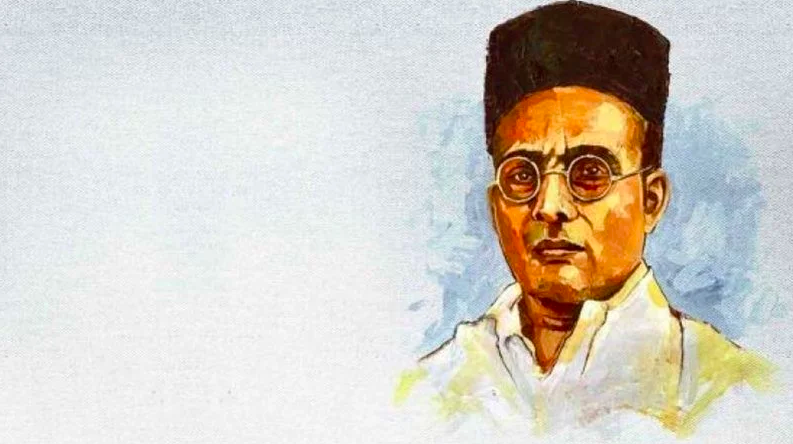
Who could have been the best prime minister of independent India?
Nehru or (Vallabhbhai) Patel?
For more than last five years, we have been a witness to this manufactured debate—courtesy Bharatiya Janata Party (BJP), which has tried all the tricks in its kitty to create a false binary between these leading stalwarts of independence movement, who called themselves ‘Gandhi’s sipahis’.
Anyway, thanks to the differences of perception within the saffron fraternity, a new competitor to Sardar Patel seems to have emerged from within the Hindutva Brigade who is being projected as someone who would have been a “better PM”.
Uddhav Thackreay, chief of Shiv Sena and at present, a junior ally of the BJP in Maharashtra, recently made his choice clear by stating that if Veer Savarkar would have become the prime minister, “Pakistan would not have come into existence”. At a book release event, he even refused to call Nehru a Veer (courageous), making a rather provocative statement: ‘I would have called Nehru brave if he would have survived jail for 14 minutes against Savarkar who stayed in the prison for 14 long years.’
Definitely, the fact that Nehru spent more than nine years in different jails of the colonialists without ever compromising his basic principles—whereas, the 14 years spent by Savarkar were interspersed with mercy petitions sent by him to the British, wherein he had even expressed his readiness to ‘serve the government in any capacity they like’—did not bother him at all.
( Read the full article here : https://www.newsclick.in/humko-savarkarich-mangta
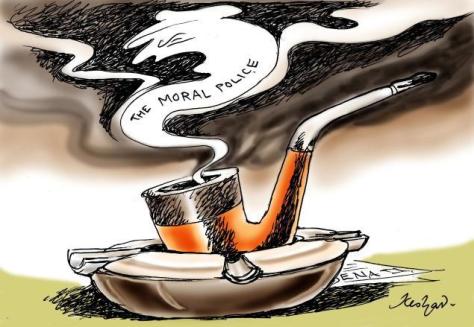
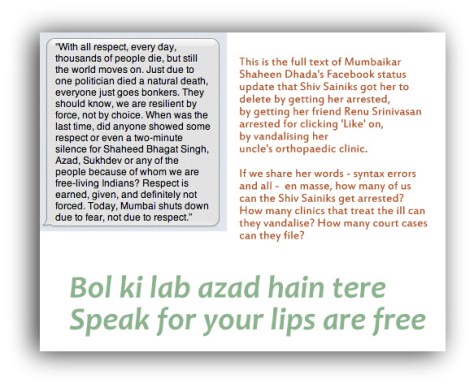
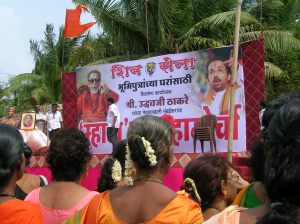 I was moving around Mumbai city on that weekend, mainly in the western suburbs. Several posters and banners were put up all over, announcing a call to a mass rally by Shiv Sena chief Uddhav Thackeray. Thackeray’s clarion call for that meeting was: “Housing for the bhoomiputra“. Bhoomiputra literally means son of the land. On an overt reading of the poster and slogan, one could conclude that the Sena is back to its advocacy of the sons of the soil theory which originally raised it to prominence in the 1960s. But when I attended the rally and noticed the people who attended it, I asked myself, so who exactly is this son of the soil that the Sena is talking about? Is it the Marathi manoos, the local underdog who the Sena argues has no social and economic space in his/her own city? If it is truly the Marathi manoos, then how do I interpret the presence of North Indian women, Bohra muslim women, perhaps even Dalit women, and many other women who I tried to mark but could not classify as either Hindu or Christian or any other particular else. Hmmm ….
  KAFILA - COLLECTIVE EXPLORATIONS SINCE 2006