Report #2: Palhallan Under Siege

This is the second of a series of fact-finding reports on the recent violence in Kashmir. The fact-finding has been conducted independently by a team of BELA BHATIA,VRINDA GROVER, SUKUMAR MURALIDHARAN and RAVI HEMADRI. For an introduction to this series, see here, and also see the first report.

Broken windows in Palhallan testify to a widely used strategy of intimidation

Continue reading Report #2: Palhallan Under Siege

Revisiting Obama’s Visit: Suvrat Raju

Guest post by SUVRAT RAJU

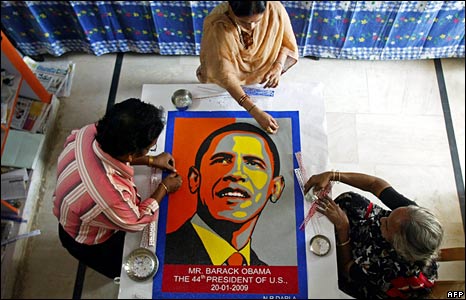
January 2009: Indian artist Darla Nageswara Rao (left) has used more than 33,000 coloured stickers on his portrait of Barack Obama. The work has taken 160 hours to complete.

Although the Indian media collectively swooned on President Obama, and breathlessly informed its audience about how many rooms he had booked at various five-star hotels, there was surprisingly little discussion on two key questions. What is Obama’s foreign policy record? Moreover, what impact will his visit have on most Indians?

Continue reading Revisiting Obama’s Visit: Suvrat Raju

This Chhath Puja, Ram ke naam: Mahtab Alam

Guest post by MAHTAB ALAM

Last week, after a gap of almost 12 years, when I was asked by my family members to accompany them to see Chhatth Puja, an ancient Hindu festival dedicated to Surya, the Sun God, I could not resist myself and readily agreed to join them. As a school going boy, I had always enjoyed watching the festival and devotees performing the rituals observed for the Puja in my hometown Supaul, a district of Bihar, which borders the Tarai region of Nepal. In the last 12 years, I couldn’t get a chance to do so due to the mobile nature of work I am involved in. The Puja, most elaborately observed in Bihar, Jharkhand and the Terai regions of Nepal in modern times, and those areas where migrants from these regions have a presence. Chhath, usually observed six days after Diwali, was observed on 12 November this year. Continue reading This Chhath Puja, Ram ke naam: Mahtab Alam

Dilemmas of ‘Right of Nations to Military Occupation’: A Response to Rohini Hensman

Dear Rohini,

Apologies for taking the liberty of writing a separate post to respond to yours. I am doing so as a separate post not only because this response is rather too long for the comments space, but also because I have been wanting to address the issues you have raised. The issues are not new; I have been hearing them ad nauseaum since 2008, when the Kashmiri demand for independence from India took on a renewed momentum. In your post you bring in various external contexts – such as Rosa Luxemburg and the Sinhala-Tamil conflict. I am grateful that you do so, because it is always useful to learn from history and not repeat history’s mistakes. However, there are other recent histories of conflict and conflict resolution you don’t talk about, but which many Kashmiris are aware of – Kosovo, East Timor, Northern Ireland. Some new countries are being formed as we speak!

Also, there is history and context in Kashmir too, which you don’t go into. Your post talks more about LTTE than about Kashmir. Here, I will try to stick to Kashmir in responding to you.

Photo credit: Shivam Vij Continue reading Dilemmas of ‘Right of Nations to Military Occupation’: A Response to Rohini Hensman

Protesting FTII students write to Ambika Soni

Studnets at the Film and Television Institute of India, Pune, have been protesting against the commercialisation of India’s best known film school. In letters to the Union Information and Broadcasting Minister Ambika Soni, they write:

In the proposal, made by Hewitt at the behest of your ministry for the ‘up-gradation of FTII to international standards’, refers to FTII as a ‘brand’. What this company fails to understand that this ‘brand value’ it refers to has come into being because of the diploma films that the students of the ‘3 year subsidized course’ have made it in the last 50 years. The other ‘self sustained courses’ that exist today (with its self sustainence) exists and has any value, if at all, because of these 3 year diploma courses. Continue reading Protesting FTII students write to Ambika Soni

October 27, 1947: Dakota in my dell: Sameer Bhat

Guest post by SAMEER BHAT

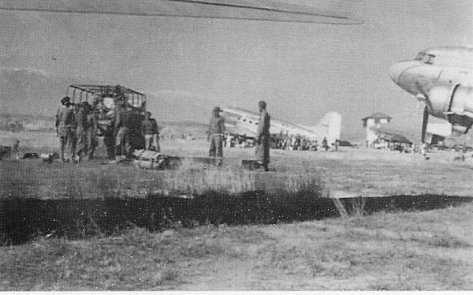
Dakotas at Srinagar airfield, October 1947

Continue reading October 27, 1947: Dakota in my dell: Sameer Bhat

Report #1: Attack and killing on Pattan hospital premises

This is the first of a series of fact-finding reports on the recent violence in Kashmir. The fact-finding has been conducted independently by a team of BELA BHATIA, VRINDA GROVER, SUKUMAR MURALIDHARAN and RAVI HEMADRI. For a introduction to this series, see here.

View of the hospital ward ‐ staff think that Adil may have been on the bed with the red mattress when the CRPF incursion took place.

Continue reading Report #1: Attack and killing on Pattan hospital premises

Introduction: Fact Finding Team to Kashmir

This post introduces a fact finding team’s work on the recent violence in Kashmir. The contents of the report are being posted as separate posts and will be linked below as and when they’re posted.

Since June this year, the Kashmir valley has been torn by mass protests which have been met with overwhelming force by Indian security forces. Curfews and closures have been frequent, often shading into each other. No less than 111 deaths have been registered, of which a large number have been of students and youth in the age group of 8 to 25 years. There have besides, been hundreds of cases of injuries, of both protesters and those who just happened to be at the wrong place at the wrong time. An independent fact-finding team went to the Kashmir valley at the end of October to go into the totality of the situation, principally to inquire into the causes for the unconscionably large number of deaths that have occurred in the current phase of mass agitation. The team comprised of academic BELA BHATIA, advocate VRINDA GROVER, journalist SUKUMAR MURALIDHARAN and activist RAVI HEMADRI of The Other Media, a Delhi based campaign and advocacy organisation, at whose initiative the effort was organised. Each member of the team spent varying lengths of time in the valley, but in total, roughly about twenty-five person days were put in the fact-finding exercise. In groups or individually, the team met the families of almost 40 persons who had been killed since the beginning of the civil unrest. Several individuals who had suffered serious injuries were also met. The team worked out of the state capital of Srinagar, and visited villages and towns in five of the Kashmir valley’s ten districts: Baramulla in the north (Sopore and Baramulla tehsils); Anantnag (Bijbehara and Anantnag tehsils) and Pulwama (Pulwama tehsil) in the south; Badgam in the west (Chadura and Badgam tehsils) and Srinagar itself. Separate sessions were held with journalists and media practitioners, university teachers and students, doctors, lawyers and activists besides officials in the police headquarters and the civil administration. The findings of the team are being released in a series of short reports beginning with following two sections. Forthcoming reports will deal with various facets of the situation that civilians in the Kashmir valley face in a season of unabated turmoil.


Next in this series
Report #1: Attack and Killing on Pattan Hospital Premises
Report #2: Palhallan Under Siege
Report #3: Shooting the Messenger in Kashmir

The Hidden Arm – Criminals for Hindutva?

I.

Anyone ever heard about Sudhakar Rao Maratha alias Sudhakar Rao Prabhune ? A hardcore rightwing criminal who was nabbed by the M.P. police few months back in Jhansi which seized a car, a revolver and five cartridges from him. In fact one of Sudhakar’s colleague Shivam Dhakad was already under the custody of Ujjain police when Sudhakar was apprehended. According to the senior police officers Sudhakar Rao was in touch with RSS Pracharak -Terrorist Sunil Joshi, who was shot dead in Dewas in 2007 under mysterious circumstances.

Hardcore right-wing criminal Sudhakar Prabhune alias Sudhakar Rao Maratha, who could throw light on the mysterious murder of RSS pracharak Sunil Joshi, has been arrested in Madhya Pradesh. The 26-year-old was wanted in connection with a string of murders of Muslims in Ratlam and Mandsaur. The state police claimed he was arrested on Tuesday from Bilkhiria when he was on way to Bhopal from Sagar. …

Rao took to crime when he was 19. His name cropped in the murder of Jafar Khan, who was shot dead in Chittorgarh. ’ (Right-wing criminal’ held, to be questioned in Joshi murder case, Indian Express, Posted: Thu Sep 30 2010, 02:50 hrs Bhopal)

Continue reading The Hidden Arm – Criminals for Hindutva?

Dilemmas of ‘Right of Nations to Self Determination’: Rohini Hensman

Guest post by ROHINI HENSMAN

The hectic discussion over the Kashmir meeting in Delhi in October entitled ‘Azadi – The Only Way’ has made it urgent to revisit the debate between Lenin and Luxemburg on the right of nations to self-determination. Lenin, starting from his experience in imperialist Russia, insisted on the right of nations like the Ukraine to self-determination (in the sense of their right to form separate states), contending that denial of this right would merely strengthen Great Russian nationalism. In a colonial situation, Lenin was surely right. When a country is under foreign occupation, all sections other than a very small number of collaborators want to be free of the occupiers, even if there are sharp differences between these sections. A striking example is RAWA (the Revolutionary Association of the Women of Afghanistan) which, despite speaking for a section of the population which is sorely oppressed by the Taliban, and continuing to fight against it, nonetheless shares with the latter the goal of ending the occupation by US and NATO forces. In such situations, the right of an occupied nation to self-determination makes sense.

Continue reading Dilemmas of ‘Right of Nations to Self Determination’: Rohini Hensman

Remembering Balagopal – Thought, Action and the Moral Imagination of Human Rights: Arvind Narrain

Guest post by ARVIND NARRAIN, based on a talk given at the Kannada book release of Inner Voice of Another India: The Writings of Balagopal, at National College Basavangudi, Bangalore, 30 October, 2010

Remembering Balagopal: Thought, Action and the Moral Imagination of Human Rights  [i]

Introduction

One  year after Balagopal’s death, what remains with us are memories of the number of times he spoke with such eloquence on  human rights issues on his numerous visits to Bangalore.  We also go back to his writings in the EPW  which show the clarity of his thought. Be it his speeches or his writings , it was clear that for Balagopal words were tools he used to express thought. Language for him was not something which served to obfsucate meaning and muddy concepts, but rather a tool which had to be used to clarify difficult ideas and cut through conceptual confusions. In George Orwell’s striking phrase, both his writing and his speeches had the clarity of a windowpane. Continue reading Remembering Balagopal – Thought, Action and the Moral Imagination of Human Rights: Arvind Narrain

“Nobody Can Stop The Revolution”

Over the weekend, a number of journalists received the following statement from Ganapathy; General Secretary of the Communist Party of India (Maoist). In the text, Ganapathy clarifies the Maoist stance on a broad range of topics – particularly Kashmir, the Commonwealth Games, the Ayodhya Verdict, Mamta Bannerjee in Bengal, Obama and the North East.

However, the fact that the questions are posed by an obviously sympathetic “interviewer” and our inability to send any follow-up questions means that, I personally, treat this as a policy document rather than an “interview”. To get a quick newsy sum-up, you could read my report for The Hindu.

I felt it would be interesting for our readers to go through this text to get a sense of “What Maoists Want”.  As a reporter, I am only too aware of how Maoist politics is severely under-reported as opposed to their military tactics.

As neither the Maoists, nor Mr Ganapathy are currently in a position to defend their views on Kafila; I have disabled comments on this post. Afzal’s acerbic (and spot on) comment has changed my mind. Have allowed comments on this piece.Hopefully, this document shall serve as a reference point for further discussions on the Maoist movement.

Continue reading “Nobody Can Stop The Revolution”

Ayodhya Verdict: Does it provide closure?

Guest post by WARISHA FARASAT

I was a child when the Babri Masjid was desecrated. After the news of the demolition spread across Uttar Pradesh, we were huddled in buses and packed off home from our boarding school. We were happy that the school had announced the winter break earlier than usual. That apart, we didn’t think much of the episode. In fact, I think that we were oblivious, almost entirely, to the gravity of the incident.

Much later, when I read the Sri Krishna Committee Report on the Bombay riots of 1992-93, and about thousands who had lost their life in the aftermath of the demolition, memories of 1992 returned. I remembered whispers. I remembered the fear in the eyes of our teachers accompanying us home. I remembered the instructions to the bus driver not to stop the bus if we were mobbed. I remembered leaving school at three in the morning. And, I remembered being asked not to tell my real name if we were stopped. Continue reading Ayodhya Verdict: Does it provide closure?

Whose Dishonesty? Arundhati’s or Media’s?: Mahtab Alam

Guest post by MAHTAB ALAM

‘Vicharon ki Be-imani (Dis-honesty of thought) cries the heading of the lead article of Dainik Bhaskar’s editorial page on 1st November 2010. The article is written by Venkateshan Vembu, foreign correspondent of DNA English daily, a newspaper published by the same group of publications. It was originally published on 27th October with the headline reading ‘Arundhati Roy is dangerously wrong on Kashmir’. The writer of the article claims that whatever Arundhati has said is not only dangerously wrong and beyond the tolerance level of any law-abiding citizen but, it also has the potential to arouse feelings of anger and violence among the masses. “Yeh kuch is tarah ki beimani hai, jo janmanas me krodh aur aakrosh ki bhawna upjati hai (This is a kind of dishonesty which generates feelings of anger and violence among the people”). Ironically, this turned out to be a ‘prophetic’ disclosure, as right after four days of publication of the original version in DNA, Arundhati’s house in Delhi was attacked by the writer’s ‘Janmanas’, the BJP’s women wing ‘Mahila Morcha’.

Continue reading Whose Dishonesty? Arundhati’s or Media’s?: Mahtab Alam

Islam Colony Riders vs. Ward 2 Worriers [sic]

You are a young politician in Delhi and you want to make a mark in an area, in a seat. You want to be known, you want to be a leader, you want followers, you want to be taken seriously. You want votes. You have the right kind of Delhi first name – Mahender rather than Mahendra – and an even better surname – who better than a Chaudhary to be your leader? But there would be many Mahender Chaudharys. What can you do? You can get basic work done – permissions and pipelines and land conversions and garbage clean-up. But anyone with the right contacts can do that. Anyone can become a protege of a Congress leader like Yoganand Shastri. In a city like Delhi, in a city of migrants, in a city whose citizens think they have the right to be treated better than the rest of India, in a city that does not seem to be ‘politicised’ like the seemingly distant world of the ‘real’ India, in a city that is a state – how do you begin being taken seriously as someone with political ambitions? One Mahender Chaudhary has this poster put up all over Mehrauli (which was once all there was to Delhi). Check it out: Continue reading Islam Colony Riders vs. Ward 2 Worriers [sic]

Greed-Kerala Express, Anyone?

The panchayat elections in Kerala are over and the dust has settled in the battle-field. In the past weeks, I have been repeatedly asked, why aren’t you writing something on the elections? Well, I told them, I have many failings but I do not suffer from Schadenfreude.

Continue reading Greed-Kerala Express, Anyone?

From New York, a letter to fellow Kashmiris

Guest post by MOHAMAD JUNAID

Dear fellow Kashmiris,

I’m writing this letter from New York, a place far away, yet so close to everything. This city can make you forget, by filching reality away from you. But it also reminds you perpetually, by bringing you close to a different reality, through the pain and suffering of others. There are exiled specimens from all over the world here (yes, mostly those permitted to come to the US). There are Irish and Greeks, escapees from famines and wars. There are Jews from Germany and Germans from Russia, ones who survived persecution. There are Latinos from El Salvador, Peru, Guatemala, and Bolivia, who fled Western-backed dictatorial regimes in their countries in the 1970s and 80s. There are Africans who narrowly missed genocide in Southern Sudan. There are Kurds from Turkey, and Berber from North Africa, driven out of their lands by years of conflict. And, then there are African Americans, who were forcibly brought hundreds of years before to slave for their White masters, and who, despite recent claims of dawning of an age of “post-racial America,” are still groveling at the bottom of the socio-economic heap. Their stories tell a similar conclusion: The world is shrinking for small nationalities and powerless minorities. Continue reading From New York, a letter to fellow Kashmiris

Reflections on the Bigots of Embedded Media: Biswajit Roy

Guest post by BISWAJIT ROY

Now that the xenophobic and paranoid big media clamour for slapping sedition charges against Arundhati Roy and others for speaking up their mind on Kashmir, has temporarily subsided, it is time for some reflection.  This clamour has only underlined the increasingly shrill bigotry of a section of Indian journalists who are deeply embedded in the right-wing statist mission, a la Arnab Goswami. Their stakes in the race for Padma awards or Rajya Sabha nominations may be one of their personal motives for behaving the way they do – baying for the blood of the dissenters and whistle-blowers while ignoring the ground reality in Kashmir valley today. But there may also be corporate institutional compulsions. However, they are espousing bigotry at the expense of the media’s role as the protector and disseminator of dissent in public life as well as watchdog against excesses and abuses of power by the government and other wings of the State in the name of national security and national interests. As a media professional, I would like to share some of my encounters with these self-proclaimed guardians of Indian nationalism in media and frontiers of mainstream journalism.

The Kargil War: the self-proclaimed guardians of national interests Continue reading Reflections on the Bigots of Embedded Media: Biswajit Roy

India Bans US Professor from Kashmir, threatens Indian writer with sedition charges: JKCCS

A note from JAMMU KASHMIR COALITION OF CIVIL SOCIETY

November 2, 2010

On November 1, 2010, shortly after 5.10 am, Professor Richard Shapiro was denied entry by the Immigration Authorities in New Delhi. Richard Shapiro is the Chair and Associate Professor of the Department of Anthropology at the California Institute of Integral Studies (CIIS) in San Francisco. He is also the life partner/husband of Angana Chatterji, who is the Co-convener of the International People’s Tribunal on Human Rights and Justice in Indian-administered Kashmir (IPTK) and also Professor of Anthropology at CIIS. Continue reading India Bans US Professor from Kashmir, threatens Indian writer with sedition charges: JKCCS

Going Viral: Cyberspace’s subtle fevers

Source: neuromancer.org

Over the last few weeks, I have been reading a fair bit on and around the whole idea of cyber-security, the ‘militarization of the internet’, the idea of military viruses and other William Gibson-esque stuff.

For those of us who read (and loved) Neuromancer – Gibson’s cyber punk novel set in a futuristic Chiba City, Japan – recent developments of the outer-fringes of the internet seem eerily like the world that Henry Dorset Case inhabits.

This post is primarily intended to serve no higher purpose than share a bunch of articles that I think are brilliant and should be read by everyone.  If you are looking for themes – I would suggest contemplating the idea of disruptive technology in an increasingly networked world.

Last week, I had posted a link to a story on how the Predator drones used by the CIA might be running on “hack” versions of their aiming software. It reminded of a WSJ article I had read about drones, more than a year ago.

Militants in Iraq have used $26 off-the-shelf software to intercept live video feeds from U.S. Predator drones, potentially providing them with information they need to evade or monitor U.S. military operations.

Continue reading Going Viral: Cyberspace’s subtle fevers