All posts by Aditya Nigam

Staking the Terrain – Political Economy, Environmental History and Nature Conservation: Shashank Kela

Guest post by SHASHANK KELA

The aim of this essay is to make connections between things that are usually studied separately – environmental history, political economy, conservation practice and adivasi politics – and I apologize in advance for the demands it makes upon the reader’s attention. The belief that this potential convergence could do with wider discussion is my sole justification for putting it up here.

Environmental history in India is not a very old discipline – the first mongraphs began appearing in the 1980s, and more and more books and papers have been added to the historiography since 2000. Let us examine certain themes as outlined in a cross-section of recent scholarship.

One key debate centers upon whether the colonial period can be regarded as an ecological watershed. An influential book by Ramchandra Guha and Madhav Gadgil argued that, before the advent of colonialism, there existed a harmonizing tendency between human beings and the environment, a balance between resource use and preservation mediated largely through the caste system: colonialism shattered this equilibrium and the values associated with it.[1] This idealizing view, eliding different time periods and state structures, was bound to come under attack and much subsequent scholarship has been devoted to unpicking its conclusions.

Sumit Guha shows how at least one natural resource, namely wild grass for fodder, had become scarce in the Deccan by the Maratha period thanks to the demands of armies, nobles and zamindars, who engrossed it by enclosing tracts of common land. This fierce arbitrariness fostered a system of free grazing and discouraged sustainable management through collective protection of the commons.[2] Meanwhile the argument that sacred groves are strands of untouched forest – repositories of biodiversity – is refuted by Claude Garcia and J-P Pascal in their study of Kodagu.[3] Far from being untouched, groves there are heavily used and managed, and show clear signs of degradation associated with use. Continue reading Staking the Terrain – Political Economy, Environmental History and Nature Conservation: Shashank Kela

Degrees of Self-Deception: Rama Srinivasan

Guest post by RAMA SRINIVASAN

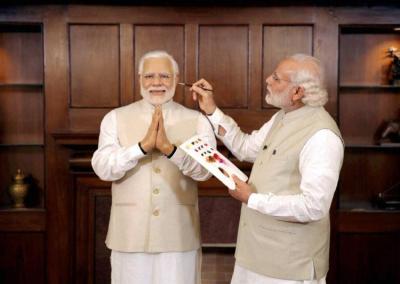
Modi and his double, image courtesy, IndiaTV news

As the crisis of fake degrees blows over I want to be the one to ask the naïve question: Why would Narendra Modi lie? I know it is a naïve question because lies are the most banal political strategy ever. There is a man in US today who repeatedly states that he will make the Mexican government pay for a beautiful, great wall on the border of US and Mexico and people believe him with a degree of sincerity that is frightening. In 2014, at least 31 percent of eligible Indian voters believed in Modi’s promises of development and some of them still do. There may be some who, at the end of the five years, actually believe that Modi has delivered on those promises. But such lies are different. My question is simply: why would he lie on an affidavit which functions as a legally-binding oath?

In his previous election affidavit filed for 2012 Gujarat elections he had left the spouse’s name column empty but following ‘strict legal advice’ he agreed to mention his wife’s name on the affidavit filed for Lok Sabha elections. Technically he had withheld information in previous affidavits which amounts to a legal offence since he had not filed his papers to ‘the best of his knowledge’ but this is not the same as actively lying as it now turns out could be the case with his educational qualifications. Legal experts will determine what is tantamount to punishable crime but if Modi did have legal counsel, who advised him to “come clean on the marriage” as this Times of India article states, why would he continue to provide inaccurate information on other aspects of life?

One speculative answer could be that he knew he was being closely watched as he made his bid for the PM’s post and that his papers would be scrutinised and compared with previous drafts. So it made sense to remain consistent with some of the information even though he had obviously been cornered on the question of his marital status. And yet, as the story of how Modi came to acknowledge the existence of his wife Jashodaben proves, if he had to reveal inconsistencies in previous records, 2014 would have been the best time to do this. No amount of exposés could have hurt the man at that time – his bhakt army, on and offline, on Twitter, were efficiently managing the show and could provide a useful media spin/misdirection to take the focus away from the affidavit that declared to the world that Jashodaben’s repeated claims regarding her marriage and abandonment were not unfounded. Even as the Gujarat Congress urged the state Election Commission, unsuccessfully, to reject his application on the grounds that he had not provided information regarding his spouse’s assets or PAN card number, Modi cruised to victory since his deliberate inconsistencies seem to matter very little to voters.

At that point Modi, indeed, seemed invincible. He was giving explosive speeches and deftly avoiding uncomfortable questions from journalists. In an interview with Rajdeep Sardesai, Modi replied to an indirect question on 2002 with this classic deflection tactic: “My best wishes are with you, Rajdeep Sardesai. You have been living off this issue for the last 10 years … I have heard that those who curse Modi get Rajya Sabha seats or Padma awards. So you have my best wishes to continue this campaign (against Modi) and reach Rajya Sabha or win Padma awards with help of your friends.” What was apparent in the interview is now widely acknowledged as the process of constructing a larger-than-life image, where the man referred to himself in third person. Continue reading Degrees of Self-Deception: Rama Srinivasan

Folk Singer Kovan Lampoons Jayalalitha’s Promise

Kovan, the Dalit-activist poet and singer and member of a revolutionary organisation PALA (People’s Arts And Literary Association), from Trichy district in Tamil Nadu, has been in the news lately. One of his anti-Jayalalitha songs earned him the ire of the state government, which slapped a Sedition case against him in December 2015.

In this video sent to us by Vinavu Thalam, Kovan lampoons Jayalalitha’s promise of “step by step prohibition” as “peg by peg de-addiction”!

Seduce the gullible voters with false promise/ File sedition cases against those who fight/ This is her game/ The game of a cheat/

In Chennai slang, “Bongu” means, a Cheat! She is the AMMA of all cheats!

Suicide of a Worker: Shankar Gopalakrishnan and Trepan Singh Chauhan

Guest post by SHANKAR GOPALAKRISHNAN and TREPAN SINGH CHAUHAN

On April 11th, a memorial meeting was held at Gandhi Park, Dehradun. You probably haven’t heard of Sadhuram, the person for whom it was held. Thousands of people have indeed heard of him. But it reflects the divided world we live in – the world that Sadhuram fought to change – that it’s very unlikely that you are one of them.

Sadhu Ram
Sadhu Ram

Sadhuram was a Dalit, a mason and a resident of Jakhan, Dehradun. He was also the vice president of the Uttarakhand Nav Nirman Mazdoor Sangh, a union of unorganised sector workers. To the daily wage workers of Jakhan, he was a daily presence at the mazdoor chowk, the place where people stand for work in the morning; some of them affectionately referred to him as “mantri-ji.” Late on the night of March 26th, Sadhuram committed suicide.

Why did he do it? That question has many partial answers. On December 5th, 2014, his wife Geeta Devi died of kidney failure. Geeta was not one to give up easily; her death came after a long battle against a painful disease and the extortions of private doctors. That very night, Sadhuram’s younger son, Ravi, lay down on the tracks outside Dehradun station and committed suicide. Sadhuram was left an angry, saddened man, having lost the two most important people in his life. His remaining son cared little for either the union or Sadhuram. They had frequent fights, and his son often beat him. Nor was that the only atrocity in Sadhuram’s life. After Ravi’s death, he was entitled to Rs. 50,000 in compensation under the Building Workers’ Act; that 50,000 might have meant the difference between continuing abuse and independence. But for an entire year the Labour Department sat on the application, notwithstanding at least twenty meetings and even a personal direction from the CM.

Continue reading Suicide of a Worker: Shankar Gopalakrishnan and Trepan Singh Chauhan

NIT and the Never Ending Story of Kashmir: Jagjit Singh

Guest post by JAGJIT SINGH

[The incidents in NIT Srinagar follow those in a number of universities and institutions of higher education and at one level, reflect a similar pattern. Yet, at another level, they – and the forces active behind them – play on a very different template of politics to achieve the same result. The story is similar and yet, radically different. The key dramatis personae are, understandably, the same. How do we make sense of what is happening in NIT Srinagar? Today’s Indian Express story by Nirupama Subramanian gives a sense of one part of the backdrop – life in NIT Srinagar before the incidents. The piece below gives us another sense of the larger history.]

NIT Srinagar non-Kashmiri students demonstrate
NIT Srinagar non-Kashmiri students demonstrate, image courtesy The Hindu

I remember when I was kid and was trying to make sense of a sport which looked very dull and boring but generated passions I had never seen in my hometown. Every time the game ends, the streets would be flooded by countless people with music and firecrackers and slogans in the background. Sometimes we could see fireworks even from our balcony, and some other times we would be locked inside our homes. Only thing we knew was ‘situation is tensed outside’. The game was Cricket and my hometown was Jammu. Jammu has always been RSS’s stronghold, and there are two Muslim-majority areas in Old City, Jammu. The whole tension surrounded these two areas only. Even that time slogan shouting was the test of your love for your country. The more violent and high-pitched your slogan is the more cheers you receive from the crowd. Continue reading NIT and the Never Ending Story of Kashmir: Jagjit Singh

Statement of Solidarity for Hyderabad Central University from UK-based academics

STATEMENT OF SOLIDARITY FOR HYDERABAD CENTRAL UNIVERSITY STRUGGLE

We, the undersigned, who are UK-based concerned scholars, express our deep dismay over the police brutality directed at students and faculty members of Hyderabad Central University, starting on March 22, 2016. We are alarmed that students and staff calling for justice at the University have had charges pressed against them, have been disappeared from the campus, and that there are reports of assaults on them in custody. We condemn the police presence on campus, the authorities’ denial of water, electricity, and food to those remaining in student accommodation, and the brutal attack on a PhD scholar for cooking in University premises.

These actions, coming in the aftermath of events culminating in the suicide of a Dalit scholar Rohith Vemula, constitute a severe assault on democratic rights of free expression and thought, assembly and association. They go against the very purpose of universities as places for critical thinking, and damage the international reputation of HCU. As scholars who admire the work of many academic colleagues and alumni at HCU, we are concerned that HCU seems to be fast descending into a campus of unrestrained repression of dissenting voices among students and staff. Continue reading Statement of Solidarity for Hyderabad Central University from UK-based academics

Medico Friend Circle Welcomes Report of Parliamentary Standing Committee to Clean up Medical Education Regulation

A statement from MEDICO FRIENDS CIRCLE

Mfc (Medico Friend Circle) wholeheartedly welcomes the 92nd Parliamentary Committee Report on the Functioning of the Medical Council of India (MCI) that was presented to the Rajya Sabha on March 8, 2016.

The Report is comprehensive, wide ranging and has come out with sound recommendations. Implementing these recommendations is in the best interests of the health of the people of India and the medical profession.

The MCI was expected to be the regulator with everything related to medical education but has ended up being the single major factor in the country responsible for the commoditization and corruption of medical education. Successive occupants of top posts at the MCI have perfected the MCI as an ATM. Every requirement of approval of a private (and public) medical college had a price and still does. We agree with the Report that unless there is a whole sale exit of vested interests that have clogged the MCI, nothing can change and it will be ‘business’ as usual. Continue reading Medico Friend Circle Welcomes Report of Parliamentary Standing Committee to Clean up Medical Education Regulation

JNUTA Statement on Suspension of Dr Shreya Bhattacharji in Jharkhand Central University

The Following is a statement from JNUTA

30 March 2016

On actions of the VC of Central University of Jharkhand

The JNUTA condemns in the strongest possible terms the suspension of Dr. Shreya Bhattacharji and her removal from administrative positions by the Vice Chancellor of Central University of Jharkand. What is simply outrageous is the action on her part that has been deemed as ‘misconduct’ – namely, inviting an eminent academic to be a Guest of Honour at a function in the University. She was assigned the responsibility to organize the event. The presumption underlying the accusation – that the credentials of the invited scholar, Professor M.N. Panini, were questionable as he is considered to be “mentor of the group of students of JNU, who were involved in anti-national activities in JNU campus recently” – would be laughable if it were not a scandal.

Clearly, the maligning of Professor Panini is simply on account of his association with JNU, where he served on the faculty with distinction for many years before his retirement, and has absolutely no relation with recent incidents in JNU.

Continue reading JNUTA Statement on Suspension of Dr Shreya Bhattacharji in Jharkhand Central University

Bhagat Singh Then and Now: Harsh Mander

Guest post by HARSH MANDER

Eighty five years ago, on 23 March 1931, Bhagat Singh walked bravely, proudly to the gallows, his two young colleagues Rajguru and Sukhdev by his side. His lustre continues undimmed as an icon for succeeding generations, so that it is easy to forget he was only 23 years old. Subhash Bose spoke then of Bhagat Singh as a ‘symbol of the new awakening among youth’. Nehru saw in him ‘a spark that became a flame in a short time and spread from one end of the country to another dispelling the prevailing darkness everywhere’. His popularity rivalled that of Mahatma Gandhi.

In the decades after his passing, in times of public ferment, despair, confusion and anger, successive generations in India have found their own inheritors of young Bhagat Singh’s mantle, men and women embodying defiant youthful idealism and dissent, young people battling for social and economic equality, for true freedom, sparks that once again set aflame a beleaguered wearied country battling the darkness of the times.

Continue reading Bhagat Singh Then and Now: Harsh Mander

Insurgent Ambedkar and a New Moment in Politics

Both the Hyderabad Central University (HCU) and Jawaharlal Nehru University (JNU) events were “ultra-Left movements” also involving a small section of “jihadis”, Finance Minister Arun Jaitley contended on Sunday.

In the case of JNU, the predominant section of those involved in the agitation was “ultra-Left” barring a small section of “jihadis”, who had their faces masked during a demonstration on the campus on February 9 in which anti-national slogans were raised, Mr. Jaitley said.

The name of Dr. B.R. Ambedkar was “unfairly used” in the case of HCU, where protests erupted after the suicide by research scholar Rohith Vemula, he told PTI. (emphasis added. See full report in The Hindu here)


Ambedkar at the barricades, Express photo, courtesy Tashi Tobgyal

Ambedkar has become an insurgent figure today, breaking out of all the pre-set molds in which he was sought to be confined all these decades. He is no longer neither a mere Dalit leader, nor is he simply the Constitution-maker and constitutionalist who taught us to have faith in the law – the two comfortable and domesticated roles in which he has been presented to us so far by all interested parties and the powers-that-be. In the face of the new Sanghist/ fascist assault, he has broken his chains to come out on the streets, as universities and colleges across the country begin to reverberate with his spirit of rebellion. Ambedkar, the name and the face, is ubiquitous by his presence in all the struggles that mark this moment. Even as the struggle of the HCU students for justice for Rohith Vemula continues and the news of the first victory – their release on bail – trickles in, the figure of Ambedkar at the barricades gives the lie to Finance Minister Arun Jaitley’s claim above: that HCU and JNU movements were ‘ultra-Left movements’ and ‘jihadis’, and that “the name of Dr Ambedkar was ‘unfairly used’ in the case of HCU. How easy it would be, Mr Jaitley, to thus pronounce the dog mad and go about your business, and how embarrassing to have to confront Ambedkar facing your police and lathis, your courts and prisons. Continue reading Insurgent Ambedkar and a New Moment in Politics

Really Mr Jaitley, so you’ve won the first round of the nationalism debate?

Union Finance Minister Arun Jaitley Saturday said the BJP has won the “first round of the nationalism debate” in the country as, according to him, “people who raised anti-India slogans till now have been forced to say Jai Hind, if not Bharat Mata ki Jai” – See full report in the Indian Express here.

Nationalism in Action, image courtesy Rahman Abbas

So, Mr Jaitley,what exactly have you won or lost? Let’s take count.

(a) First, there has been no ‘debate”, for a debate is conducted in a free environment, not with threats of sedition charges, arrests, killings and lynch mobs on the rampage. So, here is an open challenge for round  two: Join any of us in an open debate – without any of your repressive props. Field literally anyone, the best you can produce on your side, including your party president who thinks the medieval Ahomiya king, Sukapha defeated the Mughals “satrah satrah baar” when Sukapha died in 1268 and Mughal rule was established only in 1526.  Watch Amit Shah in action here:

Continue reading Really Mr Jaitley, so you’ve won the first round of the nationalism debate?

CPDR Condemns the Brutal Police Attack on the Dalit Students and Faculty at Hyderabad Central University

STATEMENT FROM CPDR, MAHARASHTRA

Yesterday, on 22 March 2016, the Hyderabad Police brutally attacked the students and faculty of the Hyderabad Central University who protested against resumption of Appa Rao Poddile, Vice Chancellor. Many students and two faculty members were badly injured in the police attack. Some 36 students along with two professors, K Y Ratnam and Tathagat Sengupta were taken into custody, the whereabouts of them remains unknown till today.

Appa Rao Poddile, the Vice Chancellor, who was sent on leave in the wake of students’ agitation that broke out over the suicide of a Dalit scholar, Rohith Vemula, joined back the University. Appa Rao’s prejudiced actions against the Dalit scholars were exposed to the world during the flare up over Rohith’s death. He, along with Bandaru Dattatreya, and Smriti Irani are clearly responsible for his institutional murder. Hyderabad Police had accordingly booked him along with the union Minister Bandaru Dattatreya, N Sushil Kumar, the HCU Unit of the ABVP and one Vishnu for abetment of suicide and also for violations of the SC/ST Atrocities Act. The cases under Section 306 of the Indian Penal Code and also the Scheduled Castes and the Scheduled Tribes (prevention of atrocities) Act were filed in Gachibowli police station under Cyberabad police commissionerate limits. In its characteristic obstinacy the HRD Ministry sent him back to take charge of the university.

Continue reading CPDR Condemns the Brutal Police Attack on the Dalit Students and Faculty at Hyderabad Central University

Statement from SC/ST Faculty Forum and Concerned Teachers, Univ of Hyderabad

 The following is a Press Release from the SC/ST Faculty Forum and Concerned Teachers on the state of affairs in the University, especially since the peculiar, staged incidents, surrounding the return of the former Vice Chancellor

We express our extreme displeasure at Prof. Appa Rao resuming office without information given even to the incharge Vice-Chancellor. Prof. Appa Rao has returned to the office when he has not yet been exonerated either by the court or by the Judicial Enquiry instituted by the MHRD based on the two member committee report which took into cognizance the very serious concerns raised by the students and the teaching fraternity.

The time period of the judicial probe is not completed and the commission has until April 30th 2016 to submit its report. In order for a fair probe to be carried on, it was not expected that Prof. Appa Rao returns to the office till he was cleared of charges. We are shocked at the manner in which Prof. Appa Rao rejoined the office. From the documents available, it can be noted that a sequence of actions to be carried out by specific individuals that include some specific sections of students, teachers and non-teaching staff and also police personnel was prepared to be implemented. For example:

  1. “Receiving” Prof. Appa Rao near Gachibowli Stadium at 8am on 22nd March 2016.
  2. “Greeting” of Prof. Appa Rao by the Life Sciences Students at the VC’s lodge upon his arrival.
  3. “Request the support” of police

Continue reading Statement from SC/ST Faculty Forum and Concerned Teachers, Univ of Hyderabad

निर्गुण देशप्रेम बनाम सगुण संघी राष्ट्रभक्ति

भारतीय जनता पार्टी की राष्ट्रीय कार्यकारिणी ने कल अपनी बैठक में एक फ़रमान जारी किया है जिसके मुताबिक ‘भारत माता की जय’ न कहना संविधान के प्रति असम्मान दिखाना है. इस कार्यकारिणी की बैठक में ‘राष्ट्रवाद’ का ढोल नगाड़ा तो खूब पीटा गया मगर कम-अज़-कम अख़बारों की खबरों से तो नहीं लगता की आंसू की एक बूद भी – घड़ियाली ही सही – किसी भी नेता की आँख से इस ‘राष्ट्रवाद’ के नाम पर चल रहे तांडव में मारे जा रहे लोगों के लिए बही हो. न ही ‘राष्ट्रवादी शोहदों द्वारा की जा रही क्रूर, घिनौनी और हिंसात्मक बयानबाज़ी पर ही कार्यकारिणी के पास कुछ कहने को था.

संघी राष्ट्रवाद का असली चेहरा. image courtesy, Mir Suhail

Continue reading निर्गुण देशप्रेम बनाम सगुण संघी राष्ट्रभक्ति

Intimidation of Pushp Sharma and the future of Indian democracy

Freelance journalist Pushp Sharma, who broke the story that AYUSH Ministry, which promotes traditional medicine systems, does not hire Muslims for short-term positions as trainers for World Yoga Day as it is against government policy, was taken in by the police for questioning on March 15th. He was released at night after interrogation, and asked to report again to the police station on the 16th.

The AYUSH Ministry had filed a formal complaint with the Delhi Police asking them to probe the alleged ‘fake’ response to an RTI query on which Sharma based his story.

The Milli Gazette which published the story, and Sharma himself, stand by the story.

For the story with updates, see this story in Huffington Post.

For an interview with Sharma just before he was taken in for questioning, see Sabrang.

After his temporary release last evening, Sharma wrote a letter to his readers in which he said that he had told the police that the internationally accepted procedure if a news story was contested, was for those challenging the veracity of the story to send the relevant documents. These documents are cross checked, and if the story turns out to be wrong, then a correction and apology are published.

Why is the AYUSH Ministry not releasing documents that prove Sharma’s claim to be false? Why has a journalist been handed over to the tender mercies of the Delhi Police, simply for writing a story? At the police station, he says, “I heard just abuses, and shouts and allegations, like: who is behind you and what is your motive?”

If the AYUSH Ministry believes that its credibility is dented by the “fake” RTI response, it needs to demonstrate that in fact it has not followed such a policy. For instance, release the original pages of the file that Sharma has allegedly falsified. There are legal routes to follow in the case of defamation, setting the police on a journalist who wrote an inconvenient story is unacceptable. It has never happened before that an RTI user has been put through police interrogation like this, says a story in The Wire. The story also says:

Meanwhile, Zafarul Islam Khan, editor of Milli Gazette – which ran Pushp Sharma’s story, told The Wire that while he had read in some newspapers about his newspaper being charged under Section 153-A of the IPC for promoting hatred among communities and Section 468 (forgery for purpose of cheating), he has neither received notice of this or a call from the police.

An overall atmosphere of intimidation and suppression of criticism of discriminatory policies of the government is being put in place. The portents are grim.

Academics Worldwide Against the Vilification of Nivedita Menon

[Expressions of support from scholars wanting to sign on are continuing to pour in. We will therefore be continuously adding the names as they come in and keep updating the statement. – AN] 

VICIOUS CAMPAIGN AGAINST FEMINIST SCHOLAR

We, the undersigned, wish to express our shock and indignation at the vicious right wing media campaign conducted over the past few days against well-known feminist scholar and Jawaharlal Nehru University professor Nivedita Menon. This media campaign mischievously decontextualizes her lecture at the public teach-in programme in JNU with the use of selective clips and inflammatory commentary. The television channel Zee has led the main campaign by branding Professor Menon as ‘anti-national’ and instigating viewers to take action. Such branding is tantamount to a television channel acting as both judge and jury, and directly placing an individual’s rights and safety under threat.

The use of television media to attack intellectuals and instigate vigilante action is a feature of authoritarian regimes worldwide.  Similar tendencies are visible in recent months in India. Singling out individuals and creating a mass-frenzy against them by using the medium of TV is a dangerous trend that directly incites and encourages violence. This is a deep disregard for any process of law. We saw Zee TV do this earlier when doctored videos became the basis of arrest and harassment of JNU students. In this case, Twitter and social media campaigns have followed attacks on Professor Menon, demanding the framing of sedition charges against her and wielding open threats of rape. Most disturbingly, there are media reports of police complaints filed by interested parties demanding ‘action’ against Professor Menon.

Professor Menon is a renowned scholar and feminist thinker; her texts are used in university syllabi worldwide. As a prominent scholar and activist she has intervened in academic and public debates for decades. Professor Menon has also been known as an inspiring teacher for thirty years, guiding generations of students who now work in India and abroad. She has never shied away from intellectual debate in academic and public forums, passionately intervening in debates on feminism and social theory. This is the first time that her own freedom to articulate her ideas has been so viciously attacked in an orchestrated media campaign.

The freedom to articulate ideas is the basis of a university. When opinions voiced in a public lecture by an academic are made part of a selective media campaign that seeks not to debate but simply to malign, both democracy and the university are under threat. What is under question are not just Professor Menon’s ideas but also the very freedom for academics and citizens. We condemn this media campaign and associated threats, urging all academics and intellectuals to stand with Professor Menon at this time.

We call on the Vice Chancellor of JNU to swiftly defend Professor Menon from such attacks and protect the sanctity of university debate. We urge the JNU administration to stand by its faculty’s right to hold individual opinions and condemn all efforts to diminish this. We call on the university to immediately ensure that freedoms that form its very academic basis are not eroded in this moment. We call further for every censure and action against the unlawful actions of the television channels in question. Finally, we urge all well wishers of a democratic India to stand by Professor Menon for their own freedoms, and not just hers. Continue reading Academics Worldwide Against the Vilification of Nivedita Menon

The Nation’s Orgiastic Fantasy and the Politics of ‘Nationalist’ Anger

The Mise en Scene

The Nationalist is angry. He wants to kill, maim and rape for his Mother’s honour. From the lawyer criminal who has a Rs 45 lakh fraud case against him to the extortionist television anchor – all are bellowing with rage. Another anchor, Mr Nation himself, whose publicly declared annual salary is Rs 5 crores, is suddenly choking with emotion at the death of the hapless army jawan, Hanumanthappa (who earned less than 120th of Mr Nation’s monthly salary and for whom the Nation never shed a tear till this collective arousal). Blood lust has taken over the land. In this scenario, the hysterical television anchor takes on the role of a lynch mob instigator and the cheer leader combined into one. He exhorts while the lynch-mob runs amok threatening, attacking and  demanding that all anti-nationals – students, teachers and intellectuals in general –  be shot, killed or sent to Pakistan. We have seen, as a consequence, all manner of angry nationalists offering prize money – Rs 5 lakhs for cutting Kanhaiya Kumar’s tongue and Rs 11 lakhs for killing him. More recently, he has been issued another death threat along with an ultimatum to leave Delhi by the end of March. Fellow Kafila-ite and feminist scholar Nivedita Menon has, for the last few weeks, been openly threatened with nationalist rape and more.

The Nation’s collective fantasy is orgiastic. And the current object of this collective fantasy is Jawaharlal Nehru University. Witness the BJP MLA who spends his free time (which is perhaps most of his time), not  only showering money on  dancing  girls, but even more, fantasizing about the orgy that he believes is JNU. According to The Indian Express:

In perhaps the most bizarre comments on the JNU controversy so far, BJP MLA from Ramgarh in Rajasthan’s Alwar district, Gyandev Ahuja, on Monday said that daily 50,000 pieces of bones, 3,000 used condoms, 500 used abortion injections, 10,000 cigarette “pieces”, among other things, are found at JNU, where girls and boys dance naked at cultural programmes.

Continue reading The Nation’s Orgiastic Fantasy and the Politics of ‘Nationalist’ Anger

Who were the masked slogan shouting men at JNU? Does the Delhi Police know?

Police plan Big-Brother cameras for JNU, we have learnt. A senior police official told The Telegraph that this measure would help in identifying

students who often raise anti-national slogans and stage protests. It will also help us in preventing clashes among students belonging to different ideologies – the Left, the far-Left and the ABVP.

Remember, dear citizens, the police were actually present at the event at JNU on February 9th. We will return to this point, but they don’t really need CCTV surveillance, they are physically present on JNU campus in civilian clothes, and with JNU ID.

This,  also recollect, is the very same police force that stood by while a mob attacked JNU students and faculty and assaulted Kanhaiya at Patiala House; the same police who cannot arrest the man who publicly, with name and phone number, offered a reward for killing Kanhaiya – they “booked him for defacing property”, and will “analyse the poster carefully” before deciding whether other provisions of the IPC apply.

When all the evidence is available – the name, picture and phone number of a man who issues a death threat, he cannot be booked for anything more serious than the actual pasting of the poster on walls, because “the posters have to be analysed”.

Violence unfolds before their very eyes, and the Delhi Police cannot act.

These guys need CCTV surveillance?

This entirely compliant police force, now acting as the private army of the BJP, is concerned about preventing clashes in JNU, which has never ever had violent clashes, when it cannot carry out the normal functions of a police force anywhere else in the city.

So what will a CCTV system establish that the Delhi Police don’t already know?

Consider the following facts, and do come to your own conclusions. We have. Continue reading Who were the masked slogan shouting men at JNU? Does the Delhi Police know?

Submission Before Inquiry Commission by Concerned Teachers and Scientists, Univ of Hyderabad

Submission by Concerned Teachers and Academics before the Roopanwal Judicial Commission at Hyderabad

 (The Roopanwal Commission came to Hyderabad on 23-25th February to enquire into the facts and circumstances leading to the suicide of Dalit research scholar Rohith Vemula. The mandate of the Commission was to review the functioning of existing grievance redressal mechanisms in the university. Concerned with the absence of in-house redressal mechanisms for marginalized students, a joint submission was made by 88 concerned teachers drawn from the state and central universities in Hyderabad. The Submission sought for a rigorous implementation of the 2012 UGC Regulation as well as the setting up a Special Commission to review the major punishments passed by Universities in the case of marginalized students.) 

The suicide of Dalit research scholar Rohith Vemula in Hyderabad Central University has brought to the fore the issue of caste discrimination in higher educational institutions. We believe that the suicide is only the tip of the iceberg of many problems that students from Dalit and other marginalized groups are experiencing. University administrations have generally attributed these deaths to personal psychology instead of initiating broad systemic and attitudinal reforms to prevent such suicides.

In 2012, in the wake of series of suicides by marginalized students in higher educational institutions, the University Grants Commission formulated two Regulations to ensure social equity and set in place grievance redressal mechanisms.  In 2013, Andhra Pradesh High Court took suomoto notice of the student suicides in Andhra Pradesh in PIL No 106/2013 and issued several directives to the Universities to prevent the recurrence of suicides. However, neither the UGC Regulations of 2012 nor the Court directives have been implemented by the Universities.   Continue reading Submission Before Inquiry Commission by Concerned Teachers and Scientists, Univ of Hyderabad

Intolerance Tracker – A Community Curated Visual Storytelling Platform: Siddharth Peter de Souza and Saba Sharma

Guest post by SIDDHARTH PETER DE SOUZA and SABA SHARMA

In a world where breaking news cycles drive our imagination and interaction with events and incidents around us, it often becomes difficult to not to have a fragmented idea of trends because they evolve and develop so rapidly. Does this volume of information necessarily imply that we become unable to view similar types of stories because they are portrayed as isolated, anomalous and disconnected? Is this also because it is much more comfortable to forget, rather than remember and reflect on an accumulation of incidents that maybe unpleasant, inglorious and inconvenient. Amartya Sen recently stated that “The problem is not that Indians have turned intolerant. In fact to the contrary we have been much too tolerant of intolerance”. Is our numbness because we are overwhelmed by these incidents or because we perceive them to be isolated without an underlying systemic pattern?

Intolerance Tracker is a visual story telling and crowd-mapping platform that seeks to engage with some of these issues. The idea of using a map is because it provides a compelling medium through which information can be consolidated, and presented across temporal and spatial boundaries.

It aims to utilize the power of the community to identify, report and map instances of intolerance across South Asia, and organically create and curate a visual storytelling database. This initiative is primarily led by students at the University of Cambridge, and has been set up on an entirely voluntary basis by people who are passionate and committed to the cause of documenting intolerance across the region. Continue reading Intolerance Tracker – A Community Curated Visual Storytelling Platform: Siddharth Peter de Souza and Saba Sharma

Why Caste is the Crux and Hindutva’s Fall Imminent: Prathama Banerjee

Guest post by PRATHAMA BANERJEE

The return of BJP to power in 2014 was the return centre-stage of the caste question. Not that caste had gone away. Far from it.But our public life had been unmistakably altered by caste radicalism in the last few decades. 1990s onwards, powerful and triumphant dalit voices – intellectual, literary and political – transformed the nature of our democracy such that questions of caste injustice and caste assertion could no longer be circumvented, passed over, as it was done in earlier decades, by both reactionaries and progressives. Nor could the dalit and the low-caste subject be any longer portrayed as mere outcast or victim. She had come into her own as an autonomous and assertive political subject, sometimes even the ruler. Christophe Jaffrelot called this India’s silent revolution, and rightly so. What we see today with the rise (and imminent fall) of Hindutva nationalism is an attempt at a counter-revolution, nothing less.

The Counter-revolution – Targeting Dalits

The signs are easy to read. Right after Modi’s win began the so-called gharvapasi campaign of the Hindutvavadis, seeking to reconvert to Hinduism those who had earlier seceded in favour of Islam and Christianity. While the issue was pitched as an issue of religion, it was clear that at the heart of the matter was caste. Continue reading Why Caste is the Crux and Hindutva’s Fall Imminent: Prathama Banerjee