All posts by Aditya Nigam

Maruti Suzuki Manesar Workers – Casteist Attack and Repression

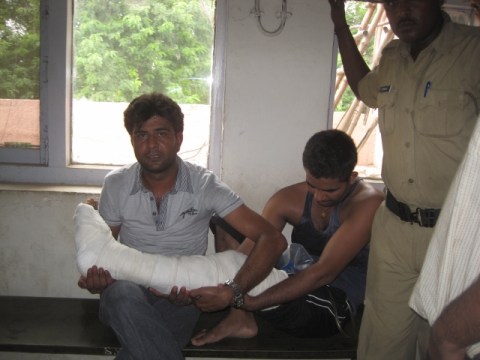
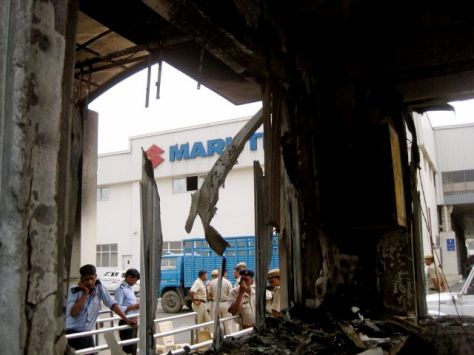
The following is a statement issued by the Maruti Suzuki Workers’ Union (MSWU) on 19 July following violence and repression at the Manesar plant yesterday.

The Manesar factory of Maruti Suzuki

The Maruti Suzuki Workers Union (MSWU) is anguished at the recent developments in Maruti Suzuki plant, IMT Manesar where the management has resorted to anti-worker and anti-Union activities in a pre-planned manner leading to violence and the closure of the factory yesterday.

We have had a long tough struggle with the strong unity of our permanent and contract workers to establish and register our Union last year, and had recently as of April 2012 submitted our Charter of Demands to the management of Maruti Suzuki, and the process of negotiation for wages and other demands was underway. However the management has done its utmost to derail the process since long and is trying to break the back of the spirit of unity of the workers and the legitimacy of the Union.

Continue reading Maruti Suzuki Manesar Workers – Casteist Attack and Repression

CPI(M)’s ‘July Crisis’ and Challenges for Rebuilding the Left

In an unprecedented move ,  the JNU unit of the SFI (SFI-JNU) has been dissolved by the ‘Delhi State Committee of the Students’ Federation of India’ [SFI is the CPI(M) student wing]. What is interesting about the press statement issued by the ‘Delhi State Committee’ following this momentous decision, is that it is signed by the Acting President and the Acting Secretary. The state secretary Robert Rahman Raman has since resigned in protest against the decision and the state president, according to him happens to be among those expelled. The state secretary in his statement has protested against the SFI Delhi state committee’s decision, ‘taken with just 12 members present and without adequate consultation or effort to retain the unit.’  The matter then, is far bigger than that of an errant SFI unit.

Clearly, leading state functionaries of the organization too are involved in the heresy that has called forth this action by the high priests of the CPI(M). Anyone who knows the command structure of the CPI(M) and how it works, can see immediately that a decision as important and unprecedented as this cannot have been taken by something as inconsequential as the Delhi state committee of the SFI. Indeed, even the Delhi state committee of the CPI(M) could not have taken this decision without the concurrence of the highest leadership – in this case Prakash Karat, the general secretary, himself. Continue reading CPI(M)’s ‘July Crisis’ and Challenges for Rebuilding the Left

जेल डायरी: अरुण फेरेरा

Guest post by ARUN FERREIRA

Translated from English by Anil Mishra

नागपुर जेल की उच्चसुरक्षित परिसीमा में स्थित अंडा बैरक बग़ैर खिड़कियों वाली कोठरियों का एक समूह है। अंडा के प्रवेशद्वार से दूसरी अधिकतर अन्य कोठरियों में जाने के लिए लोहे के पाँच दरवाज़ों, [और पैदल] एक संकरा गलियारा पार करना होता है। अंडा के भीतर कई अलग अहाते हैं। हरेक अहाते में कुछ कोठरियाँ हैं, और हर पहली कोठरी दूसरी से सावधानीपूर्वक अलगाई गई है। कोठरियों में बहुत कम रोशनी होती है और आप यहाँ कोई पेड़ नहीं देख सकते। आप यहाँ से आसमान तक नहीं देख सकते हैं। मुख्य निगरानी टॉवर के ठीक ऊपर से अहाते में एक बड़ा भारी, ठोस अंडा हवा में लटकता रहता है। लेकिन इसमें (और अन्य अडों में) एक बड़ा फ़र्क़ है। इसे तोड़कर खोलना असंभव है। बल्कि, यह क़ैदियों (के हौसलों) को तोड़ने के लिए बनाया गया है।

 अंडा वो जगह है जहाँ सबसे ज़्यादा बेलगाम क़ैदियों को, अनुशासनात्मक क़ायदों के उल्लंघन करने की सज़ा के लिए क़ैद किया जाता है। नागपुर जेल के अन्य हिस्से इतने ज़्यादा सख़्त नहीं है। अधिकतर क़ैदी पंखे और टीवी वाली बैरकों में रखे जाते हैं। बैरकों में, दिन के पहर काफ़ी इत्मिनान वाले, यहाँ तक कि आरामतलब भी हो सकते हैं। लेकिन अंडा में, कोठरी के दरवाज़े ही हवा के आने जाने का एकमात्र ज़रिया है, और ये भी कुछ ख़ास आरामदायक नहीं, क्योंकि ये किसी खुले प्रांगण में नहीं, एक ढंकेमुंदे गलियारे में खुलता है। Continue reading जेल डायरी: अरुण फेरेरा

MEGA, the recovery of Marx and Marxian path: Sankar Ray

Guest post by SANKAR RAY

In sharp contrast to the scenario of the unprecedented debt-driven crisis of neo-liberal world economic order, a new era of radiant expectations seems to open up for Marx-followers and Marxists around the international project, Marx-Engels-Gesamtausgabe or complete works of Karl Marx and Friedrich Engels (MEGA) and it’s hitherto ‘unexplored Marx’. MEGA , a collation of original texts is ‘the historical-critical edition of works of Marx and Engels’, an imperative ignored during the 20th century by official Marxists. Fifty-nine out of 114 volumes , have already been published. The MEGA editorial board, following prolonged debate decided to put together the whole of 164 volumes of original manuscripts in 114 volumes.

A critical approach to history  is essential for scholarly inquiry. Yet  scholarship alone isn’t enough where an enterprise such as this is for it also requires unbiased collation and editing. The development of Marxist studies had been throttled due to widespread vulgarisation which had dominated Marx studies from the 1890s to the end of the 20th Century. Early Marxists like Franz Mehring and Vera Zasulich – and Rosa Luxemburg – adopted a more critical approach which is a essential for the ‘Marxist temper’. Marx’s prescription, de omnibus dubitandum (doubt everything), wasn’t meant to be just a quotation. Unfortunately, Lenin and his followers often deified Marx. Lenin’s words – “Marxism is omnipotent, because it is true” – is one such instance as if Marxism represents the end of philosophy. Continue reading MEGA, the recovery of Marx and Marxian path: Sankar Ray

Swami Sahajanand Saraswati – A Contested Legacy: Manish Thakur and Nabanipa Bhattacharjee

Guest post by MANISH THAKUR and NABANIPA BHATTACHARJEE

Observers of the political scene in Bihar would have hardly failed to notice a renewed interest in the life and works of Swami Sahajanand Saraswati (1889-1950), the founder president of the All India Kisan Sabha, and arguably the most influential peasant leader of Bihar in the 1930s and 1940s. Over the last decade or so, his birth (22 February, 1889) and death (26 June, 1950) anniversaries have been celebrated with great pomp and show with full attendance of political luminaries of the state including Nitish Kumar, its present Chief Minister. Not only have glowing tributes been paid to his legacy but there has also been a spurt of writings on his life and times.

Swami Sahajanand Saraswati

New biographiesi have been released, and his collected works been published in six volumesii. In fact, there is a Swami Sahajanand Saraswati Foundation based in New Delhi as well as a Swami Sahajanand Saraswati Forum on the internet. Curiously enough, Swami Sahajanand Saraswati figures prominently on the internet in the caste-specific web-portals such as www.bhumihar.com; www.bhumiharmahasangh.com and www.bhumihar.net where his name appears along with Bhagwan Parashuram, Chanakya, Mangal Pande, Sri Babu, Ramdhari Singh Dinkar, C.P Thakur, and so forth in the long list of supposedly Bhumihar icons. Indeed, Saraswati’s legacy has always been the bone of contention between the Bhumihars and the communists. What needs explanation is the BJP’s concerted efforts in appropriating this iconic peasant leader as ‘samajik samrasta ke sant’.

Continue reading Swami Sahajanand Saraswati – A Contested Legacy: Manish Thakur and Nabanipa Bhattacharjee

Terrorism in India – Between Facts and Fiction: Imran Khan

Guest post by IMRAN KHAN

More and more concerns are being expressed by human rights activists in India today on the question of fabricated and false charges on innocent people. When Dr. Binayak Sen spent his time in jail on such charges, activist groups all over the country and abroad came out and protested. For the first time in the history of human rights movement in India, around two dozen Nobel Prize Winners came out to defend him. It should also be noted that there were even protests against such fabrication in front of Indian embassies in different parts of the world.

However, with the arrest of Binayak Sen, the contemporary history of `fabricating false cases’ by the Indian state took a new turn. The arrest took place while Dr. Sen was a national leader of India’s pioneering human rights organization, People’s Union for Civil liberties (PUCL).  The activists felt that the message was loud and clear: That even human rights defenders can be imprisoned for no reason under repressive laws of the post-independent India.

Dr. Sen was released due to public pressure. But thousands are still languishing behind bars, waiting for justice. The nameless adivasis who were arrested like Sen from different parts of Chhattisgarh, speak of an unknown territory even to the best of our human rights activists. And new messages are given. Even journalists can be grilled. Thus, K.K. Shahina, Azmi, Seema Azad, Advocate Naushad Kasimji and others have become victims of attacks on freedom of expression. Fabricating false cases has become a norm today rather than an exception, according to human rights groups. Minorities, dalits, adivasis,  people’s movements and self determination movements become an easy prey to false charges. Continue reading Terrorism in India – Between Facts and Fiction: Imran Khan

False Charges and Brutality in Prison: Mohd Amir Khan

Guest post by MOHD. AMIR KHAN

[ Mohd. Aamir Khan has spent 14 years in prison and was acquitted earlier this year]

I am in deep pain today. As though terrible, terrible memories, locked away in the deep recesses of my mind have been pried open. Heard on news that an accused in terror case was killed in judicial custody in Yerwada jail. That too in his high security cell.

I had read that the British rulers unleashed physical and mental torture on prisoners in colonial jails, but have never heard that they carried out killings of hapless convicts or undertrials in their custody. The naked truth of Abu Ghraib and Guantanamo has been brought before the world. But who will illumine the dark secrets of the netherworld of our prisons? Brutalisation and torture are routine in our jails.

I speak from experience, having lived for fourteen long and seemingly unending years in prisons in three states. There was a near fatal attack on me twelve years ago while I was lodged in the model prison of India, Tihar Jail. But when I survived the attack, a case was slapped on me. While I was thankfully acquitted in the case, not one of those who attacked me was charged until my father – who was still alive then—appealed to the court to intervene. Mercifully, the Court accepted his complaint and registered a case, which still goes on in Tees Hazari court. Continue reading False Charges and Brutality in Prison: Mohd Amir Khan

Disability Law Violations in Delhi University admissions – notes from the margins: Rijul Kochhar

Guest post by RIJUL KOCHHAR

Contrary to what they may tell you, they don’t really give a damn about the disabled in this country. Systemically flouted laws, polite terms substituted for impolite realities, and stony silences meted to those who seek to question—these comprise the working of the disability model in this nation, a model that only goes so far as the abundance of obligation and ‘feel-good’ eye-wash will take it. The juggling of words—‘disabled’ for handicapped, then annihilation of ‘crippled’, and finally that awful phrase regnant in contemporary fashionable use, ‘differently/specially-abled’—constitutes our single biggest achievement as far as dealing with the disabled as rights-bearing persons is concerned. Continue reading Disability Law Violations in Delhi University admissions – notes from the margins: Rijul Kochhar

KK Aziz and the Coffee House of Lahore: Chris Moffat

Guest post by CHRIS MOFFAT 

During a recent trip to Lahore, I visited the Sang-e-Meel bookshop on Lower Mall Road in search of K.K. Aziz’s The Coffee House of Lahore. Happily, the store was well stocked with the late historian’s final work, and I spent the afternoon reading the text at a table outside the nearby Tollinton Market. It was a betrayal, perhaps, to read the book in this way, sipping cold drinks from the Hafiz Fruit and Juice Corner rather than something appropriately caffeinated, purchased amidst a flurry of conversations in a busy café. I took some solace in the fact that I was sitting not a stone’s throw away from the former Pak Tea House, once a hub of cultural life in the city and among the many spaces of discourse and dissent mapped by Aziz in his narrative of mid-twentieth century Lahore.

Today, the Pak Tea House appears hollowed and shuttered, no longer decorated with a sign to declare its name or to suggest life inside. In spite of recent rumours of a revival, its vacant façade appears a testament to Aziz’s loud lament in The Coffee House of Lahore: that the city’s culture has “disappeared from view”, that its original landmarks “have been obliterated”. The book emerged out of the historian’s desire to capture, before it is lost, the memory of a period of free thought, argument and cultural effervescence, encapsulated in the life of institutions like the Tea House, the Indian Coffee House, the Arab Hotel, the Nagina Bakery, and other important places of assembly, all of which have now vanished from the urban fabric. Aziz chooses to focus on the particularly tumultuous period between 1942 and 1957, when he was an active participant in this culture as a student of politics and later as a lecturer in Lahore’s Government College.
Continue reading KK Aziz and the Coffee House of Lahore: Chris Moffat

Red Herrings, Red Rags and Red Flags – Once More on the Cartoon Controversy

With the recent article by Prabhat Patnaik, the controversy over the ‘Ambedkar cartoon’ issue has now moved into a different terrain. In this important statement, Prabhat undertakes the task of pointing out the numerous red herrings that have entered into the debate. These include  ‘freedom of expression’ and ‘sense of humour’ and the question of  whether Ambedkar had actually seen and let pass this cartoon. Prabhat’s point about the changed sensitivities and increased audibility of the dalit movement today is also well taken.

We must also be thankful to Prabhat for stating his views so candidly over the past few years, on a number of critical issues ranging from Nandigram and the electoral defeat of the Left to the ongoing cartoon controversy. We must thank him because  because in my opinion, all his positions on these disparate sets of issues are of a piece and take us to the very heart of the impasse, not merely in the Left but in our politics itself. But before I respond to some of the issues raised by Prabhat, let me restate my positions on some aspects of the ongoing controversy. This is also necessary in order to identify what exactly it is in Prabhat’s piece that is so disturbing.

 Dalit Response and Hurt Sentiments

In its initial phases, the cartoon issue was certainly a ‘dalit issue’ – even if it was raised only by a section of the dalit political leadership and intelligentsia. Very soon, however, it became clear that there was a more cynical game being played where the most corrupt and compromised sections of our politicians – especially those in parliament – were using Ambedkar as a shield, in order to deflect the blows that were actually aimed at them. The amazing unity of purpose and determination displayed by the parliament has rarely been seen in recent times; nor has the love for Ambedkar ever been expressed with such vigour.

These circumstances give enough reasons to suspect that the game had already changed by the time it reached the parliament. Not many people may have noticed but it was a Congress MP (an official spokesperson in Madhya Pradesh) who raked up a long dead issue of the book by Arun Shourie (Worshipping False Gods), demanding that it be banned. Continue reading Red Herrings, Red Rags and Red Flags – Once More on the Cartoon Controversy

In Defense of Critical Pedagogy: A Petition

The following is a petition initiated by a group of scholars who have been centrally involved in the debate on pedagogy and the writing of textbooks that followed National Currriculum Framework 2005

We have been watching with deep dismay the events as they have unfolded on the floor of the Indian Parliament and outside. Uproar against an individual cartoon has now snowballed into a wide-ranging attack against the new NCERT textbooks. The office of one of the Advisors of the Political Science textbooks has been ransacked, the Political Science textbooks have been withdrawn from circulation, and the Government has resolved to conduct an inquiry into the role of those who sanctioned the inclusion of the offending material in the textbooks. Clearly what is at stake here is not just the life of cartoons on the pages of school textbooks.

But the fear of cartoons is not unimportant. It tells us a lot about the democracies we now inhabit. Jawaharlal Nehru told Shankar Pillai ‘Don’t spare me Shankar’. B.R. Ambedkar saw the cartoon that is now being seen as ‘offensive’. He had no problem with it. Nehru and Ambedkar, and great democrats like them, were aware of what cartoons mean. They were aware that creative cartoonists like Shankar or Laxman can encourage us to question what is taken for granted, reveal the ambiguities and contradictions of individuals, persuade us to see things in a new light. India has a long creative tradition of satire and irony. The productive power of laughter has been used not only in movements for social justice, but in children’s literature as well. If we celebrate this tradition, we celebrate democracy. Only in non-democratic countries is there a fear of cartoons. Continue reading In Defense of Critical Pedagogy: A Petition

The Great Indian Media Hoax Of Self-Regulation: Ruchi Gupta

Guest post by RUCHI GUPTA

[This post was initially published in the Times of India and removed from their site soon thereafter.]

With a comfortable gap of time after the revelations of paid news, private treaties and the Radia tapes, the media is once again on the offensive to guard its independence. The trigger this time is a private member’s bill, the Print and Electronic Media Standards and Regulation Bill, 2012. The proposed legislation has been widely and energetically panned by the industry, with the Congress subsequently distancing itself from the Bill. The Bill is not available in the public domain; however based on news reports, some provisions could perhaps lend themselves to state censorship. While the merits of the Bill are debatable, what is striking is the complete lack of self-consciousness with which the media termed the attempt as an attack on democracy, without addressing its own corruption and its deleterious impact on democracy. Continue reading The Great Indian Media Hoax Of Self-Regulation: Ruchi Gupta

Cartoons All! Politicians and Self-Seekers

The uproar over what is being referred to as the ‘Ambedkar cartoon’ in the class XI textbook prepared by NCERT first began over a month ago, that is to say, almost six years after the books have been in circulation, been taught and received high praise for their lively style and a critical pedagogical approach (more on this below).  It was a political party – one of the factions of the Republican Party of India – that decided to kick up a ruckus over ‘the issue’ – that is, the ‘affront’ to Dr Ambedkar that the cartoon in question supposedly constitutes, and the resultant ‘hurt sentiments’ that it has caused. Very soon everyone began to fall in line, and practically every member of our august Parliament was vying with one other to prove that  they were indeed more hurt than their colleagues. One of them, Shri Ram Vilas Paswan has even demanded that the NCERT itself should be dissolved!

Good old Jurgen Habermas – and good old Habermasians  – have always invested a lot in forums like the parliament, that are to them the hallowed institutions of ‘rational-critical discourse’ where through reasoned argument people convince each other. That is how the voice of Reason ultimately prevails in democracies. I have always been suspicious of this claim and have thought that Habermas’ empirical work on the decline (‘structural transformation’) of the public sphere was more insightful than his normative fantasies. Long long ago, his empirical work on the transformation of the public sphere showed that it was the rise of political parties that had actually destroyed all possibilities of ‘rational-critical discourse’, where organized passion in the service of immediate political interests carried the day.

Continue reading Cartoons All! Politicians and Self-Seekers

Resisting Culinary Fascism: Nabanipa Bhattacharjee

 Guest post by NABANIPA BHATTACHARJEE

At the end of last month (March 2012) students of Jawaharlal Nehru University (JNU), New Delhi under the banner of a recently formed group called the New Materialists (NM) organized a public meeting to debate the issue of (dis)allowing certain kinds of food – beef and pork in particular – on the campus. The group, as one of its members Suraj Beri said, intended to petition the university administration to allow the sale of beef and pork in the canteen(s), and fight for inclusion of the same in the hostels’ menus; it was a struggle, as the NM declared, against the Brahmanical dietary impositions on Dalits and other minority community students of JNU. In fact, Francis (JNU students of the 1990’s would remember the man from Kerala) who ran a canteen at the basement of the School of Social Sciences II did serve beef curry on Saturdays, and it would not be an exaggeration to say that there would be more than a mad rush for that. However, he was pressurised – by Hindu right wing groups and other similar forces – to stop the sale of the “forbidden” food, and the canteen was eventually closed down.

Continue reading Resisting Culinary Fascism: Nabanipa Bhattacharjee

Workers Struggle in Dehradun

The following is a statement from Uttarakhand Nav Nirman Mazdoor Sangh and the Inquilabi Mazdoor Sangh received via Shankar Gopalakrishnan

Between 12 and 1 yesterday, 15 April 2012, the Uttarakhand police lathi charged more than 300 workers who have been sitting on a protest in Dehradun for the last ten days. 11 workers who have been on hunger strike (six from April 6th and five who joined them on April 9th) have been forcibly hospitalised in Doon Hospital, where they are resisting attempts to force-feed them. 326 workers have been arrested and detained in various jails in the city.

The workers have been on strike for more than three weeks now. They are employees of the Rockman and Satyam Auto plants in Haridwar, both major suppliers of Hero Motors. As in Manesar, Haryana last year, these workers are being paid extremely low wages for more than 12 hours of work a day; when they sought to form a union to demand respect for labour laws, the five leaders of the union were illegally sacked immediately and the others threatened with a similar fate. On March 19th the majority of permanent workers at Rockman came out on strike in protest at this illegal brutality, and on March 22nd they were joined by all the permanent workers at Satyam. Continue reading Workers Struggle in Dehradun

Eviction of Slum Dwellers and Repression of Anti-Eviction Demonstrators in West Bengal

[We are publishing below the following report based on materials received courtesy Sanhati, whose members were also arrested in the course of the struggle]

“If Didi could rush to the scene for one Tapashi Mallik, then she could surely hear the voices of 800 poor people and come here to see us” –Residents of Nonadanga slum in Kolkata

It is the same story once again. Cleaning up and beautification of cities in the clamour for urban space for consumption and the luxury of the rich. And as we have seen, it makes little difference whether the government/s are Leftist or Rightist, whether they claim to represent the oppressed poor or not. Thus, on 30th March, 2012 the TMC government forcefully evicted around 300 poor families from the Nonadanga slum area in South 24-Parganas, in the name of ‘development’ and ‘beautification’ of Kolkata. Their shanties were razed to ground by the Kolkata Metropolitan Development Authority. The homeless slum-dwellers have been staying in an open field and are facing constant police harassment. Despite these harsh conditions, they have refused to depart and are presently on hunger strike. Their demand has to date failed to draw any favourable attention from the government. This neglect comes on the heels of the Planning Commission agreeing to annual Bengal plan around 16 per cent more than last year’s.

Continue reading Eviction of Slum Dwellers and Repression of Anti-Eviction Demonstrators in West Bengal

Mamata’s order that stoked the media war: Independent Observer

[This is a guest post by an independent journalist journalist and in Kolkata]

How difficult is to make a choice between the Caligula and the powerful senators who plotted against him, purportedly to save Rome from the populist-turned paranoid emperor?
The question comes to one’s mind in view of the ongoing public spat between Bengal chief minister Mamata Banerjee and a powerful section of Bengal media which has virtually likened her to a female (a non-libidinous also) version of Caligula. The row, that now involves pro and anti-Mamata media blocs also, has been triggered by a recent government order asking 2500 plus state-run and aided libraries to subscribe, initially, to eight pro-government newspapers —five Bengali, two Urdu and one Hindi— barring the market leaders in these segments. The circular of the state libraries and mass education department cited the ‘promotion of free-thinking’ as the reason behind favouring the chosen newspapers.

However, the issues involved are neither limited to Mamata’s increasing attempts to browbeat critical media as the aggrieved houses are complaining about nor her well-meaning effort to support ‘small’, resource-starved newspapers against their big brothers as she herself and beneficiaries of her patronage are claiming. A closer scrutiny reveals that there are more to it beyond the binary of Oraamra (them and us), now part of Bengal’s political and media lexicon after Buddhadeb Bhattacharjee’s infamous bragging over his government’s brute majority in the state assembly in order to rubbish all opposition to his policies. Continue reading Mamata’s order that stoked the media war: Independent Observer

Life After Capitalism? A Document From Another Time

The French Marxist philosopher Louis Althusser, who perhaps reflected most on the question of ‘ideology’, once wrote that “ideology moves, but with an immobile motion that keeps it where it is”. Althusser did not make any claim about the truth or falsity of ideology. At a certain level, ideology undoubtedly refers to something that is real or true. What interested Althusser instead, was the relationship of ‘ideology’ to what he called ‘science’ – namely, that critical activity, which continuously works to take knowledge forward. Science, according to him, always lived by focusing on that which it did not know; ideology on the other hand, was that which remained with the obviousness of the already-known. Every new question that a science poses is effectively subsumed by ideology to give us something that we already knew. That is why science, he believed, was always  pursued, beseiged and occupied by ideology and had to continuously struggle to free itself from its grasp in order to live.

The CPI(M)’s ‘Draft Resolution on Some Ideological Issues’ prepared by the party for discussion and adoption at the party’s 20th Congress that began in Kozhikode today, is truly an ideological document in Althusser’s sense. It claims to move with the times and update the party thought apparatus but in reality, moves in order to stay where it is. It works to relentlessly re-present all the difficult questions of our times as if they were already known to the founders of something called ‘Marxism-Leninism’.

Continue reading Life After Capitalism? A Document From Another Time

CPI(M) shelves class struggle in action: Sankar Ray

Guest post by SANKAR RAY

[As the CPIM)’s 20th Congress began in Kozhikhode today, we bring two pieces marking the occasion. AN]

Unbelievable though it may seem even to the staunchest critic of CPI(M), ‘class struggle’ is totally missing in the 20950-plus word Draft Political Resolution (DPR) of the CPI(M), circulated and debated inside the party for over two months, that will be finalized with amendments, deletions and additions, at the 20th party Congress at Kozhikode between 4 and 9 April. The finalized political resolution is to be party’s tactical line until the 21st Congress four years later. The omission of ‘class struggle’ in the DPR, a basic document for committed struggle is stupefying as communists the world over frequently quote Marx that the history of mankind is “the history of class struggles”.

It’s not new as class struggle was omitted in the Political Resolution adopted at the 19th Congress ( Coimbatore, 29 March- 3 April 2008). But unlike at Coimbatore, the latest draft document talks of ‘people’s democracy’, CPI(M)’s main ideology, enshrined in the Updated Party Programme ( adopted at a special party conference in October 2000 at Thiruvananthapuram). But the pledge for moving forward to “a new, alternative path – towards people’s democracy and socialism” is vague.

Continue reading CPI(M) shelves class struggle in action: Sankar Ray

Politics, ‘Political Society’ and ‘the Everyday’

Politics, ‘Political Society’ and ‘the Everyday’

 Book Review 

Lineages of Political Society, by Partha Chatterjee, Permanent Black, Ranikhet, 2011. Pages: 278, hardcover, Rs 750.


Lineages of Political Society

 Over a decade ago, political theorist Partha Chatterjee embarked on what was a novel journey in the history of political thought in India and perhaps, in the postcolonial, non-Western world. Bringing together the results of decades of his own intellectual engagement with Indian politics and the question of subalternity in particular, Chatterjee began articulating a concept that has now acquired wide currency: his concept of ‘political society’. ‘Political society’, in Chatterjee’s hands, was a way of recuperating a sphere of politics that had been a permanent source of anxiety for theorists of Indian (and postcolonial) modernity and democracy – the vast domain that existed outside the designated spheres of modern politics, where the untutored masses made claims on the state and formed their own associations and organizations, unmindful of the formal grammar of rights and citizenship. A crucial part of what defines activities in this domain is ‘illegality’, or, at any rate, non-legality, where the state itself places the law in suspension in order to recognize the claims of the governed. Thus for instance, squatting by the poor on government land that is strictly speaking, encroachment in legal terms and can never acquire the status of a ‘right’, is nevertheless allowed by governments to continue through the recognition of some kind of moral claim of the poor on governments and society at large.

Continue reading Politics, ‘Political Society’ and ‘the Everyday’

FDI In Retail – What Does the Government’s Own Data Say? Shankar Gopalakrishnan

Guest post by SHANKAR GOPALAKRISHNAN

In his budget speech, Finance Minister Pranab Mukherjee declared that the government’s “decision” to allow FDI in multi-brand retail outlets “has been held in abeyance” until there is a “broad based consensus.”  In other words, it’s already a decision, but it’s just being held back until the government feels it can go ahead safely.  The question though is: why is the government so convinced of its decision?  How does Mr. Mukherjee so firmly declare that “organised retail helps in reducing costs of intermediation… benefiting both consumers and producers”?  Has the government done the homework to justify its actions?  This note looks at the government’s own data to find out.

As far as is known, there was only one study commissioned by the government in this regard (Business Standard 2007)  This was done by ICRIER in 2007, first published as a Working Paper in 2008 (Joseph et al 2008), and subsequently converted into a book – Retail in India: A Critical Assessment – in 2009, with one chapter added by other authors.[i]

Continue reading FDI In Retail – What Does the Government’s Own Data Say? Shankar Gopalakrishnan