All posts by Aditya Nigam

SMS booklets – guidelines for messaging addicts: Rafay Mahmood

SMS Books[Sent to us by S. Akbar Zaidi, this article by RAFAY MAHMOOD was first published in The News of Pakistan. We are reproducing the this brilliantly funny report of the complete absence of boundaries between different forms (sms, print, internet) and the eclectic urge to take and assemble, to crack jokes, to create poetry – all in the service of the joy of life.]

“Tum Bijli, Pani or Train ko Rote ho Faraz / Is Mulk Mae Tau Toofan Bhi Time Per Nahin Aata”… This message was circulated all over the city when cyclone Phet  proved to be an anti-climax for Karachiites by arriving late and then changing course before it hit the city’s coast. The brains behind this poetic gem is ‘Faraz’, who baptizes every new cell phone with one of his socially relevant yet romantic poetic masterpieces. He is a legend, the undisputed king created by messages being forwarded on cell phones.

The Short Messaging Service (SMS) plays a key role in our lives today and the SMS culture has not only redefined the identity of people like Faraz but has also spawned the creation of an SMS book industry. Continue reading SMS booklets – guidelines for messaging addicts: Rafay Mahmood

Beware Bigotry – Free Speech and the Zapiro Cartoons: Mahmood Mamdani

Text of talk on receiving an honorary doctorate at the University of Johannesburg, 25 May, 2010

MAHMOOD MAMDANI, Makerere University, Kampala, Uganda

This text was sent to us by Sujata Patel

It warms my heart to see these flowing gowns. I congratulate you on work accomplished! For over a millennium, these gowns have been a symbol of high learning from the Indian Ocean to the Atlantic. Should anyone ask you where they came from, tell them that the early universities of Europe – Oxford, Cambridge, le Sorbonne – borrowed them from the Islamic madressa of the Middle East. If they should seem incredulous, tell them that the gown did not come by itself: because medieval European scholars borrowed from the madressa much of the curriculum, from Greek philosophy to Iranian astronomy to Arab medicine and Indian mathematics, they had little difficulty in accepting this flowing gown, modeled after the dress of the desert nomad, as the symbol of high learning. Should they still express surprise, ask them to take a second look at the gowns of the ayatollahs in Iran and Iraq and elsewhere and they will see the resemblance. Education has no boundaries. Neither does it have an end. As the Waswahili in East Africa, which is where I come from, say: elimu haina muisho. Continue reading Beware Bigotry – Free Speech and the Zapiro Cartoons: Mahmood Mamdani

The New ‘Bush’ Doctrine: Nirmalangshu Mukherjee

Guest post by NIRMALANGSHU MUKHERJEE

A well-known left intellectual in Delhi, belonging to one of the naxalite “splinter groups”–the term is Arundhati Roy’s to distinguish the maoists from everyone else in the naxalite movement–recently advised me that, whatever be the objections to the CPI (Maoist), we must side with them in their struggle against the state. The argument obviously is that the historical choice is binary is character: either you are with the state or against it. And the underlying assumption is that those who are against the state are somehow “with” the people. Since the maoists are (apparently) against the state, they must be viewed as “with” the people, warts and all. In not siding with the maoists then, intellectuals like Apoorvanand and others in the Kafila forum are actually siding with the state, according to the doctrine.
Continue reading The New ‘Bush’ Doctrine: Nirmalangshu Mukherjee

Ethical violations of HPV vaccination trials in India: SAMA

This guest post has been sent by the SAMA team

On July 9, 2009, the Andhra Pradesh Minister for Health and Family Welfare in association with the Indian Council of Medical Research (ICMR) and PATH (Programme for Appropriate Technology in Health) International a non-profit organization based in USA launched what it described as a ‘demonstration project’ for vaccination against cervical cancer. The vaccine, against the Human Papillomavirus (HPV), which is one of the most common families of viruses and the source of a common sexually transmitted infection, was administered to 14,000 girls between the ages of 10 and 14 in three mandals – Bhadrachalam, Kothagudem and Thirumalayapalem – of Khammam district in Andhra Pradesh. In Andhra Pradesh, the vaccine used was Gardasil, manufactured by Merck Sharpe and Dohme, the Indian subsidiary of Merck and Co. Inc., a US-based pharmaceutical company.

In a similar project, on August 13, 2009, the Gujarat government launched a two-year ‘Demonstration Project for Cancer of the Cervix Vaccine’ in three blocks of Vadodara District – Dabhoi, Kawant and Shinor – to administer three doses of the HPV vaccine to 16,000 girls between 10 and 14 years. There were reports of deaths of four girls from Andhra Pradesh and two girls from Gujarat following the administration of the vaccine.
Continue reading Ethical violations of HPV vaccination trials in India: SAMA

‘The Making of a Modern Indian Artist-Craftsman – Devi Prasad’: Naman Ahuja

This is a guest post by NAMAN AHUJA, who teaches in the School of Art and Aesthetics, JNU and has recently put together this fascinating exhibition that is on in Lalit Kala Academy, Delhi till 21 May

Tempera, Santiniketan / Dehradun, 1944 (painted on the artist's 23rd Birthday)
Horse in a fit
The Making of the Modern Indian Artist-Craftsman is intended to be a biographical and critical insight into the work of the potter, painter and photographer Devi Prasad. Apart from the making of his personal history and his times, it leads us to why the act of making (art) itself takes on such a fundamental philosophical significance in his life. This, I feel, derives directly from his absorption of Gandhi’s philosophy that looked at the act of making or doing as an ethical ideal, and further back to the impact of the Arts and Crafts Movement  on the ideology of ‘Swadeshi’ and on the milieu of Santiniketan.
The exhibition and the accompanying book examine Devi’s art along with his  role in political activism which, although garnered on Indian soil made him crisscross national borders and assume an important role in the international arena  of war resistance. Devi Prasad graduated from Tagore’s Santiniketan in 1944 when he joined the Hindustani Talimi Sangh (which espoused the concept of Nayee Taleem) at Gandhi’s ashram Sevagram as Art ‘Teacher’. His political consciousness saw him participate actively in the Quit India Movement in 1942, in Vinoba Bhave’s Bhoodan and later from 1962 onward as Secretary General (later Chairman) of the War Resisters’ International, the oldest world pacifist organisation based in London. From there he was able to extend his Gandhian values internationally. All of this, while continuing with his life as a prolific artist. Rather than view them as separate worlds or professions, Devi harmonises them within an ethical and conscionable whole. He has written widely on the inextricable link between peace and creativity, on child /basic education, Gandhi and Tagore, on politics and art, in English, Hindi and Bangla. In 2007 he was awarded the Lalit Kala Akademi Ratna and in 2008, the Desikottama by Visva Bharati University, Santiniketan.

Continue reading ‘The Making of a Modern Indian Artist-Craftsman – Devi Prasad’: Naman Ahuja

From Murder Mystery to Spy Thriller: Raveena Hansa

THE CONTINUING SAGA OF THE MUMBAI TERRORIST ATTACKS

This is a guest post by RAVEENA HANSA.

A great deal of new evidence concerning the 26 November 2008 terrorist attacks in Bombay has emerged over the past year. This includes the book Who Killed Karkare: The Real Face of Terrorism in India by S.M.Mushrif, a former police officer with a distinguished record, who uses news reports during and just after the attacks to question the official story; the book To the Last Bullet by Vinita Kamte (the widow of Ashok Kamte) and Vinita Deshmukh; revelations concerning Hemant Karkare’s bullet-proof jacket and post-mortem report; the David Coleman Headley trial; and the trial of Ajmal Kasab, Fahim Ansari and Sabauddin Shaikh. I do not include the Ram Pradhan Commission report on police responses to the attack, for reasons I will explain.
The Headley Affair
The Headley affair has, predictably, grabbed a great deal of publicity. The fact that the FBI had been investigating the involvement of this American in conducting reconnaisance for the 26/11 attacks seems to have come as a revelation to the Indian investigators, who had a chance to apprehend him but instead chose to detain two Indian Muslims, Fahim Ansari and Sabauddin Shaikh, for preparing maps of 26/11 targets.
It has been established that Headley was an agent of the US Drug Enforcement Administration, and his plea bargain leads us to conclude he was also a US intelligence agent: in other words, a spy. It is also known he was involved with the Lashkar-e-Taiba (LeT), and supplied information to them about targets attacked on 26/11. There are three possible explanations that would fit these facts:
1) He started off as a US intelligence agent, but was won over by the LeT, and was acting on their behalf.
2) The US intelligence agency employing him was complicit in the 26/11 attacks. Since the most likely fallout of such attacks would be increased tension and even armed clashes on the Pakistan-India border, and since it appears to be a priority of US foreign policy to reduce such tension, this would suggest that Headley was being handled by a rogue element in US intelligence.

Tharoor-Pushkar Soap and Tabloidization of the Media: Vineetha Mokkil

This is a guest post by VINEETHA MOKKIL.

The Shashi Tharoor-Sunanda Pushkar tango has unleashed many demons. They woke up the country’s finance minister and party colleagues from a willful sleep. They are set to end Lalit Modi’s glitzy reign as IPL chief. The Tharoor-Pushkar coupling also let loose a spectre of another kind. It infected the electronic and print media with an epidemic of tabloidisation of unprecedented proportions. As soon as the first whiff of the story permeated the air, the strain of tabloid journalism that has been seeping into the Indian media scenario for over the last 15 years found the perfect setting to multiply and mutate and infect dailies, magazines and television channels across the board.

Newspapers and television channels which claim to occupy higher ground than lowly tabloids played out the entire episode like a soap opera. Headlines went overboard with the ‘wink-wink, nudge-nudge’ game. (Sample these: ‘Tharoor Unleashes Attractive Weapon,’ ‘Minister’s External Affair,’ ‘Got A Girl, Named Sue’). Sensationalism reigned supreme as columnists and hyper-ventilating television anchors marched in, flying high the flag of yellow journalism. Biased, personal opinion was paraded as fact. Unnamed sources came crawling out of the woodwork, spilling secrets of all sorts about the lead players.
Continue reading Tharoor-Pushkar Soap and Tabloidization of the Media: Vineetha Mokkil

Getting Indian Democracy Right: Rohini Hensman

Guest post by ROHINI HENSMAN

‘Far away, in that other fake democracy called India’: so said Arundhati Roy in a passing reference to India when she began her talk at the finale of the Left Forum 2010 in New York in the middle of March. Fake democracy? Yet in the same month her long essay ‘Walking With the Comrades,’ supporting the struggle of the CPI (Maoist) in the tribal areas, was published by a mainstream, corporate-controlled Indian magazine, Outlook. How would that be possible if India were just a ‘fake’ democracy? By way of a comparison, across the border in Sri Lanka, the March issue of Himal Southasian was seized by customs on account of an article of mine, despite the fact that I have always been sharply critical of the insurgencies of the LTTE and JVP, and cannot by any stretch of the imagination be described as sympathetic to terrorism or violence. Earlier editions of Himal with articles by writers critical of both the government and the LTTE have suffered the same fate. My articles have been turned down by one newspaper after another in Sri Lanka, and I do not blame their editors and owners: so many journalists, editors and owners who have been critical of the regime in power have been jailed, killed or disappeared, even if they, too, had been critical of the LTTE. Continue reading Getting Indian Democracy Right: Rohini Hensman

Tata sponsored ‘Green Hunt’ in Kalinga Nagar to destroy democratic tribal movement

[We publish below a press statement released by Prafulla Samantra and others, received via Biswajit Mohanty, which highlights just how the struggle of the tribal people in Kalinganagar is being met with the most ferocious repression by the local administration acting at the behest of the Tatas. Kalinganagar is emblematic of the many democratic mass movements and struggles that are being crushed by a predatory state in cahoots with corporate capital. – AN]

Yesterday the Collector of Jajpur district assured Dabar Kalundia, a tribal leader of Bisthapan Birodhi Jan Manch (BBJM) that he would come to Baligotha village on 28 March for a meeting with the dissenting villagers and find a solution to the prevailing conflict. But within a day the Collector has broken his word as today about 24 platoons of armed policemen have been deployed in Kalinga Nagar to suppress the democratic and non-violent movement of the BBJM. It is feared that there will be bloodshed at a larger scale than 2 Jan 06 when 14 tribal men, women & children were killed in a police shootout. The villagers fear the police will attack tomorrow morning.
Continue reading Tata sponsored ‘Green Hunt’ in Kalinga Nagar to destroy democratic tribal movement

Arrests of Activists in Gujarat

PRESS RELEASE
Date: 22nd March 2010

“Is it a crime to work in a democratic and peaceful way for the empowerment and development of Adivasis”?
– Adivasi Mahasabha Gujarat & People’s Union for Civil Liberties, Gujarat.

Mr. Avinash Kulkarni and Mr. Bharat Pawar, activists of long-standing repute, have been working relentlessly for the rights of the Adivasis of Gujarat, over the past 15 years. Based in Ahwa, Avinash and Bharat have been actively involved on issues pertaining to the empowerment and development of Adivasis, through the Dangi Lok Adhikar Samiti and the Dangi Mazdoor Union, in Dang district. Avinash and Bharat have played a significant role in the struggle for the Forest Rights Act and for people’s rights to use, manage and control forests and forest resources as part of the leadership of Adivasi Mahasabha Gujarat, both in the advocacy and struggle that brought about the Forests Rights Act and the monitoring of its implementation across the Adivasi areas of Gujarat. It is a well known fact that they have always worked for democratic and peaceful means of securing the rights and entitlements of the Adivasis and have stood by non-violent means of working for social change.
In the afternoon of 21st March, 2010, about 2 P.M  Avinash  was picked up by Dy. S. P.  Shri Patil under the pretext of questioning and took him to an undisclosed location, without giving any information to his family members or colleagues as to where they were taking him or giving him the right of contacting his advocate. Bharat Pawar also was detained the same evening in a similar fashion by policemen from the DSP office of Ahwa, Dangs. This is a clear violation of Justice D. K. Basu Guideline of Supreme Court.
Continue reading Arrests of Activists in Gujarat

The Rumour of Maoism

This essay has been published in the current issue of Seminar (No. 607, March 2010).

In his classic Elementary Aspects of Peasant Insurgency in Colonial India, Ranajit Guha outlines a certain methodological imperative for the historian who wanted to ‘get in touch with the consciousness of [peasant] insurgency’ when access to it is barred by the discourse of counter-insurgency that structures official records. How does one look beyond this discourse of the state that frames the archives in order to gain access to the voice of the rebels? Guha’s solution was relatively simple: Counter-insurgency, he argued, derives directly from insurgency and is so determined by the latter that ‘it can hardly afford a discourse that is not fully and compulsively involved with the rebel and his activities.’1

Unlike British Marxist historian E.J. Hobsbawm who had tried to track the story of ‘social bandits’ through a somewhat problematic reading of folklore,2 Guha warned that ‘folklore relating to peasant militancy can be elitist too’, for many singers and balladeers belonged to upper-caste families who had fallen on hard times and were, therefore, often suspicious of the revolt of the lower castes or tribals. Guha underlined that though the records of the colonial state and its police officials registered the voice of those hostile to the insurgents – including landlords and usurers – they could not avoid being shaped by the will of the insurgents. His conclusion therefore was that the presence of rebel consciousness could be read in the body of evidence produced by the discourse of counter-insurgency itself.

The burden of Guha’s argument was that in order to decode the language of counter-insurgency, it was often enough to simply reverse the values in the terms used by the official discourse: thus ‘badmashes’ simply meant peasant militants and not ‘bad characters’; ‘dacoit village’ would indicate an entire village involved in the resistance and ‘contagion’ would most likely refer to the solidarity generated by the uprising.

Those were happier days from the historian’s point of view. For the peasant and tribal insurgencies that Guha was discussing were organic struggles which drew their leadership from amidst the peasants or tribal communities themselves. Whether it was Sidhu Kanoo, Birsa Munda or Titu Mir – the leadership of the movements and their ‘ideologies’ derived directly from the world of the tribals. The context of colonial India was also, in a significant sense, quite clearly polarized and the possibility of written records being produced from a multiplicity of sources was simply out of the question. It may, therefore, be possible to follow Guha’s suggestion and merely reverse the values in order to get a sense of that other discourse. Continue reading The Rumour of Maoism

A Believer’s Obeisance: Soumitra Ghosh

SOUMITRA GHOSH is with the National Forum of Forest Peoples and Forest Workers (NFFPFW). A guest post received via Dilip Simeon

Does the Outlook article [by Arundhati Roy] tell us anything new? The Maoists have built a dream world in Dandakaranya, and the gun has heralded that dream. The Green Hunt is meant to shatter this dream, period…Apart from good anecdotes, there’s no political analysis of the movement, and the problematique of the Maoist movement was cursorily mentioned.

It seems rationality is banished. You oppose Green Hunt means that you see in the Maoists an unending series of dreamers and visionaries, and the making of a new world order. She doesn’t even bother to be historical, the history is what her contacts tell her.

What is utterly unacceptable is this woolly-headed,mushy and journalistic portrayal of a political movement. The Maoist movement was never,and won’t be a ‘adivasi’ movement,in the sense we use the term to describe a range of social movements.

Continue reading A Believer’s Obeisance: Soumitra Ghosh

Three Years of Nandigram Firing: An Appeal

Sumit Sarkar, Tanika Sarkar, Dilip Simeon, Aseem Srivastava, Amita Baviskar, Amit Sengupta, Nandini Sundar, Satya Sivaraman and others

Nandigram: Punish the guilty, Pay compensation to victims now!

On the third anniversary of the horrific police firing in Nandigram, which occurred on 14 March 2007, we strongly condemn the failure of various state institutions to do justice to the victims and survivors of this violent attack on a peaceful mass movement.

Till date not a single police official, government bureaucrat or CPI (M) politician involved in the wanton massacre of peasants resisting forcible takeover of their land has been prosecuted. At least 14 people were killed in the incident and hundreds injured. Several independent inquiries and tribunals found that more than a dozen women had been sexually assaulted or raped. It is a matter of deep shame for Indian democracy that the men who were responsible for the barbaric violence – including persons in uniform and out of it – continue to roam with impunity.

The Calcutta High Court’s direction to the CBI to inquire into the violence in Nandigram on 14 March and to prosecute those responsible has not been carried out under various pretexts. These include litigation in the Supreme Court against this order, launched by the West Bengal government. That no clear judgment has been pronounced on this important issue till now only serves to lower the credibility of our judicial institutions. In light of the aftermath of the anti-Sikh carnage of 1984, we fear that as time goes on, evidence will be lost and witnesses intimidated. After some years, lip service will be paid to judicial procedure and the criminals will go scot-free. Such a sabotage of justice has happened before in West Bengal.
Continue reading Three Years of Nandigram Firing: An Appeal

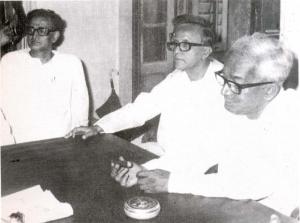
Jyoti Basu and the Passing of an Era

Jyoti Basu, Promode Dasgupta and Saroj Mukherjee

With the passing away of Jyoti Basu, the curtain comes down on an entire chapter of communist history in this country. Basu may have been the last of a generation that learnt its politics in the stormy days of the anticolonial struggle and who lived through the ups and downs of politics – from the underground days of the 1930s and 1940s to the initiation into the ways of parliamentary democracy. The long engagement with parliamentary democracy was to lead to Basu’s – and the communists’ – long stint in power. And Basu was one of those rare communists for whom democracy was not a mere strategic imperative but a value to be internalized.

Basu belonged to a generation of communists who worked their way from the bottom up. Trained in Law in England, Basu returned to India, determined to work in the communist movement. Muzaffar Ahmed, the then secretary of the undivided communist party sent him to work among the railway workers. It was there, working among and organizing the railway workers that Basu entered mass politics.  It was probably in this process that Basu developed his distinctive style of politics – a style that we have yet to understand fully.

Continue reading Jyoti Basu and the Passing of an Era

Remembering Jyoti Basu: Monobina Gupta

This is a Guest Post by MONOBINA GUPTA

Jyoti Basu
Jyoti Basu

While waiting endlessly at the CPI-M headquarters in Delhi, we, the Left-beat reporters, often used to say how incredibly dull the beat would be in the absence of Jyoti Basu, Indrajit Gupta, and Harkishen Singh Surjeet. With their distinctive personalities and distinct style, each one had livened up the tedious job of keeping track of the Left parties and their leaders. Indrajit Gupta would speak in a baritone voice, trotting out gruff answers; the ever-amiable Harkishen Singh Surjeet, never failed to pick up the phone, was always ready to share a laugh with us. But of these three colourful Communist stalwarts, it was Basu who used to keep us most preoccupied, with his ‘read-between-the-line’ one-liners, exasperatingly short, brusque replies, sometimes even with outright sarcasm or rudeness.

Continue reading Remembering Jyoti Basu: Monobina Gupta

The Žižekian Counter-Revolution

[Slovenian Lacanian-Marxist-Hegelian philosopher and cultural theorist, Slavoj Žižek is visiting India currently and will be delivering a few lectures here. This post is prompted by his visit. Interested Delhi-ites can catch him speak on

4 Jan 2010. 5 p.m. on
“Ideology in the Post-ideological World: The Case of Hollywood”
at Sarai-CSDS. 29 Rajpur Road, Civil Lines, Delhi
and
5 Jan 2010. 7 p.m.
“Tragedy and Farce”
Stein Auditorium, India Habitat Centre, New Delhi]


imaaN mujhe roke hai jo khiNche hai mujhe kufr
ka’aba mere peeche hai kaleesa mere aage

[Faith holds me back when infidelity beckons/
Behind me, the Kaaba; before me, the Church]

It is difficult to miss the immense subversiveness of the  dilemma encapsulated in Ghalib’s couplet above.  This dilemma of the believer is produced by the constant threat of corruption – the Kaaba behind the believing Muslim holds him back from indulging in, or falling prey to, the infidelities and temptations that always lie in wait.

Substitute Marxism for Kaaba  and ‘postmodernism’ for Church, and you have the perfect Žižekian incarnation of this classic Ghalibian dilemma: Not quite at home in the Faith (Lacan, jouissance, surplus-enjoyment, the Real…) and yet, not able to leave it either, for the fear of what might befall one deserting the Order. Faith is the anchor that holds one back from committing all kinds of blasphemies. Nevertheless, the seductions of infidelity force our philosopher to turn for sustenance precisely to the philosophers and ideas he mistrusts: unlike most members of the Marxist faith, he repeatedly returns to Nietzsche, Heidegger, to Derrida, Foucault, Laclau and Deleuze. He takes over their language and makes himself at home in it. Is there a hidden jouissance in thus frequenting this forbidden territory?

Continue reading The Žižekian Counter-Revolution

A Journey Into the Dark: Arati Chokshi

This is a Guest Post by ARATI CHOKSHI.

[Chhattisgarh and Dantewada have been in the news for quite some time now, as matters have reached a climax with the state on its anti-Maoist offensive after the near-failure of its stratgey to prop up Salwa Judum as a counter-insurgency outfit. All intermediate spaces stand wiped out now. Recently, Himanshu Kumar of the Vanvasi Chetna Ashram had planned a padayatra in Dantewada and around that time, a team of women’s and human rights organization visited the area apprehending trouble. This a report of that team’s experiences.]

It was night by the time we set out. Four jeeps sped carrying 39 women of diverse age, class, caste, religion, faith, ideologies, from ten states across the nation, and representing 20 women’s and human rights organisations. We sped from Raipur to Dantewada, on wide, smooth highways on a common journey, as part of our campaign to address the alarming reports of sexual violence and repression of women by the State, that were emerging, particularly from Dantewada, in Bastar region of Chhattisgarh. We were headed there both to get a first hand account and to show solidarity with victims of heinous crimes, who defying all threats and intimidation had managed to come forth and lodge complaints against their assailants – in this case, the State. This journey was to be an enquiry – a personal exploration and examination of the truth- of dark, dangerous, secret whispers that managed to trickle out from Dantewada and ooze into wider consciousness – tales of tortures, horror, and barbaric acts that our representatives, our own protectors and security forces meted out on a particular collective us, the weakest, most vulnerable, the voiceless adivasis of Bastar.

Over the next 22 hours, we were to find that our journey had become the goal, revealing to us far more from State’s desperate attempt to hide, than in our wanderings and talkings in Dantewada. In hindering us, we found how the State had repressed civil liberties of its citizens, how democratic spaces had vanished and how the authoritarian subjugation by the State had muted all voices – not just of protest, but of even posing a question.
Continue reading A Journey Into the Dark: Arati Chokshi

बीच का रास्ता नहीं होता, कॉमरेड!: ईश्वर दोस्त

This is a guest post by ISHWAR DOST

ध्रुवीकरण की खासियत यह होती है कि वह बीच की जगह तेजी से खत्म करता जाता है। चाहे वह सांप्रदायिक ध्रुवीकरण हो या अस्मिता पर आधारित या किसी और मुद्दे पर। राज्य की दमनकारी हिंसा बनाम माओवादी हिंसा एक ऐसा ही ध्रुवीकरण है। इस सरलीकरण में छिपी राजनीति पर सवाल उठाना जरूरी हो गया है। युद्ध की भाषा बोलती और बंदूक को महिमामंडित करती इस राजनीति के निशाने पर क्या जनसंघर्षों की लोकतांत्रिक जगह नहीं है? माओवादियों के सबसे बड़े दल पीडब्ल्यूजी के नाम के साथ ही जनयुद्ध शब्द लगा हुआ है। छत्तीसगढ़ सरकार ने एक सरकारी जनयुद्ध को सलवा जुडूम के नाम से प्रायोजित किया हुआ है। केंद्र सरकार ने पहली बार माओवाद के खिलाफ युद्ध की शब्दावली का इस्तेमाल किया है, फिर उस पर सफाई भी दी है। अगर माओवाद लोकतंत्र के प्रति अपनी नफरत नहीं छिपाता तो उत्तर-पूर्व से लेकर गरीब आदिवासी इलाकों तक कई सरकारें भी राजनीतिक-सामाजिक गुत्थियों को महज सुरक्षा के सवाल में तब्दील कर बंदूक की नली पर टंगे विशेष सुरक्षा कानूनों के जरिए सुलझाना चाहती हैं।

अन्याय के खिलाफ जनलामबंदी, संघर्ष और प्रतिरोध की सुदीर्घ परंपरा को युद्ध के अतिरेक में ढांपने की कोशिश की जा रही है। युद्ध सीधा सवाल करता है कि तय करो किस ओर हो तुम? यह सवाल एक-दूसरे से युद्ध करता या उसके लिए पर तौलता कोई भी पक्ष किसी से भी पूछ सकता है।
Continue reading बीच का रास्ता नहीं होता, कॉमरेड!: ईश्वर दोस्त

Notes on Comfort: Akhil Katyal

This is a Guest Post by AKHIL KATYAL

To make our point let us begin with a story of a salon. It might have all the necessary noise of being new and first-of-its-kind but finally it is quite an unremarkable story. Of ‘NYC’ in Hauz Khas market in Delhi. It sells itself as India’s first LGBT salon. Its owner S. Mehta recently filled up all possible online LGBT forums with its ads, mass mailed on to Delhi list serves and dropped tiny text-ads into unwitting facebook groups, robustly selling it as the latest asset of Delhi’s LGBT community. I am not quite interested in how an otherwise 7 month old – some say not-doing-too-great – business venture is viably repackaged as a LGBT paradise in the wake of the Delhi high court judgment. After all, post the repeal of Sec. 377 in July we are only to expect more of this happening around us, more spectacles of the pink rupee. Nor am I presently interested in how a reigning sense of an LGBT community is proffered by such spectacular announcements of things shared – be it historic events or commercial joints, shared among few or many – but instead, I am interested in the all too common rhetoric that this salon uses in its publicity. A rhetoric that is becoming so widespread as to become almost commonsensical and this is the rhetoric of comfort.
Continue reading Notes on Comfort: Akhil Katyal

Mass Politics, Violence and the Radical Intellectual

With the debate on Maoist violence and Operation Green Hunt hotting up, things are taking a disturbing turn. The danger really is that all spaces of radical political movements and indeed the entire space of the Left, part of it gradually vacated by the parliamentary ‘Left’ in recent decades and finally completely abandoned in the last few years, will now be virtually erased. In its place will be installed the phantom of an ‘armed struggle’ that threatens to completely swallow up the spaces once occupied by different shades of the CPI(ML) and the Naxalite movement and other Continue reading Mass Politics, Violence and the Radical Intellectual

Open Letter to Noam Chomsky: Nirmalangshu Mukherjee

[We publish below an open letter to Noam Chomsky, written in the wake of his endorsement of a statement against ‘Operation Green Hunt’, issued recently by a large number of intellectuals in India and in the US. Nirmalangshu’s letter is important because it raises some very serious questions that are being brushed under the carpet by sections of the radical intelligentsia.  Unlike Nirmalangshu, I would not put ‘radical’ within scare quotes, since it is precisely this that highlights the immense tragedy of our times. Radical intellectuals – truly radical intellectuals – once again find themselves caught in this situation where in order to oppose state violence, they will wilfully turn a blind eye to the violence of armed nihilist gangs, simply because these claim to speak on behalf of the oppressed – a claim that Nirmalangshu’s letter exposes in all its falsity. He lays bare how the politics that goes by the name of ‘Maoism’ (i.e. CPI-Maoist) believes in violently erasing all other voices of opposition to and criticism of the state, but that of itself. This brand of politics in fact lives in symbiosis with the state – delegitimizing all forms of mass democratic politics. At this moment one deeply misses the courageous voice of the late Balagopal – recently slightingly dubbed a ‘liberal humanist’ by a spokesperson of the Maoists, at a meeting meant to salute his memory. I cannot help recalling here the feeling of immense sadness many of us were overcome by, watching and hearing speakers at this meeting (in Delhi) for Balagopal – speakers who were ungenerous, if not carping and outright dismissive of the courage of conviction that was Balagopal. AN]

Dear Prof. Chomsky,

I saw your support to the statement issued by Sanhati in the form of a letter to the prime minister— endorsed by some intellectuals from India and abroad. Three points are transparent: (a) the Indian government is planning a massive armed operation in the tribal-hilly areas in the eastern part of the country, (b) the poorest of the poor and the historically marginalised will suffer the most in terms of loss of lives, livelihood and habitat, and (c) for whatever it’s worth, an all-out campaign by democratic forces is needed to resist the armed invasion of people’s habitat by any party. To that extent, the statement does bring out the urgency of the matter.

Continue reading Open Letter to Noam Chomsky: Nirmalangshu Mukherjee