All posts by Aditya Nigam

Stan Swamy’s Custodial Murder – Joining the Dots From Santhal Hul To the Pathalgadi Movement

Fr. Stanislaus Lourduswamy aka Stan Swamy, image by Sarah Modak, courtesy Article 14

There are just no words left to express the anger and helplessness that overcame hundreds and thousands of people like me when they heard of the custodial murder of an ailing, frail, octogenarian, Fr Stanislaus Lourduswamy, known to the world as Stan Swamy. The various issues that arise from the virtual judicial abdication of responsibility has been powerfully articulated by former Delhi High Court Chief Justice, AP Shah and one can hardly add to that. What is perhaps the most shocking is not that the judiciary abdicated in observing its duty of upholding the Constitutional rights of a citizen but that it seems to have lost even the minimum grace and human concern.

“Medical reports taken on record clearly showed that Fr Swamy had the degenerative Parkinson’s disease, and could not even do basic tasks, such as holding a spoon, writing, walking or bathing. Indeed, the court noted that he had a severe hearing problem, and was physically very weak. But even that did not move them. Every regular bail application that was filed by his lawyers was unequivocally rejected.” 

This is shocking beyond words – or used to be once upon a time. But as each day of this regime passes, our threshold of taking shock increases by leaps and bounds. Are we really surprized now, that while this was how they treated Stan Swamy, a goon who had just the other day openly called for mob violence and “shooting down anti-nationals” has now been promoted to the Central ministry?

Continue reading Stan Swamy’s Custodial Murder – Joining the Dots From Santhal Hul To the Pathalgadi Movement

Hul Dibosh Convention by Ekusher Dak (Call of 21) Marks Anniversary of Santhal Rebellion

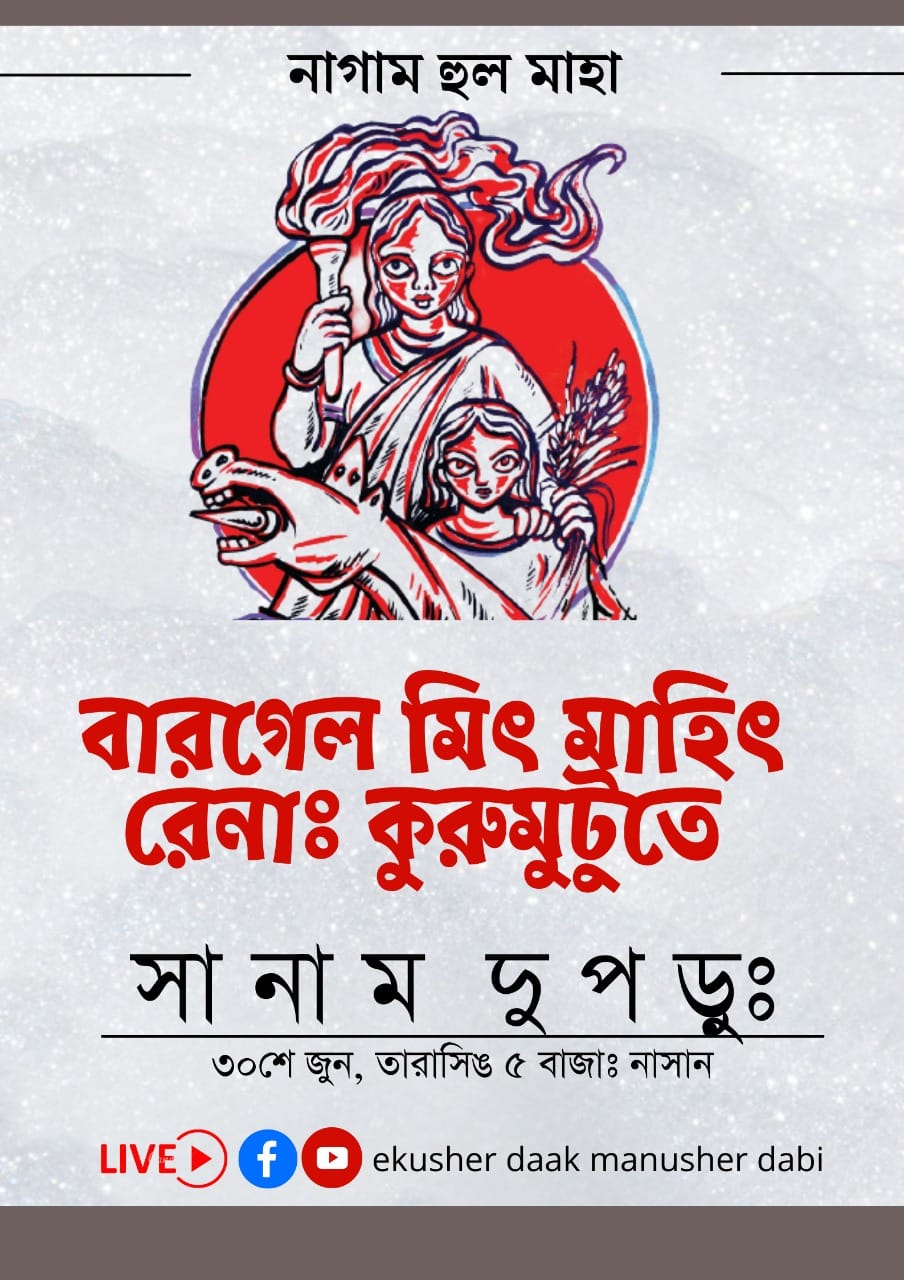
Poster in Santhali language for the Convention

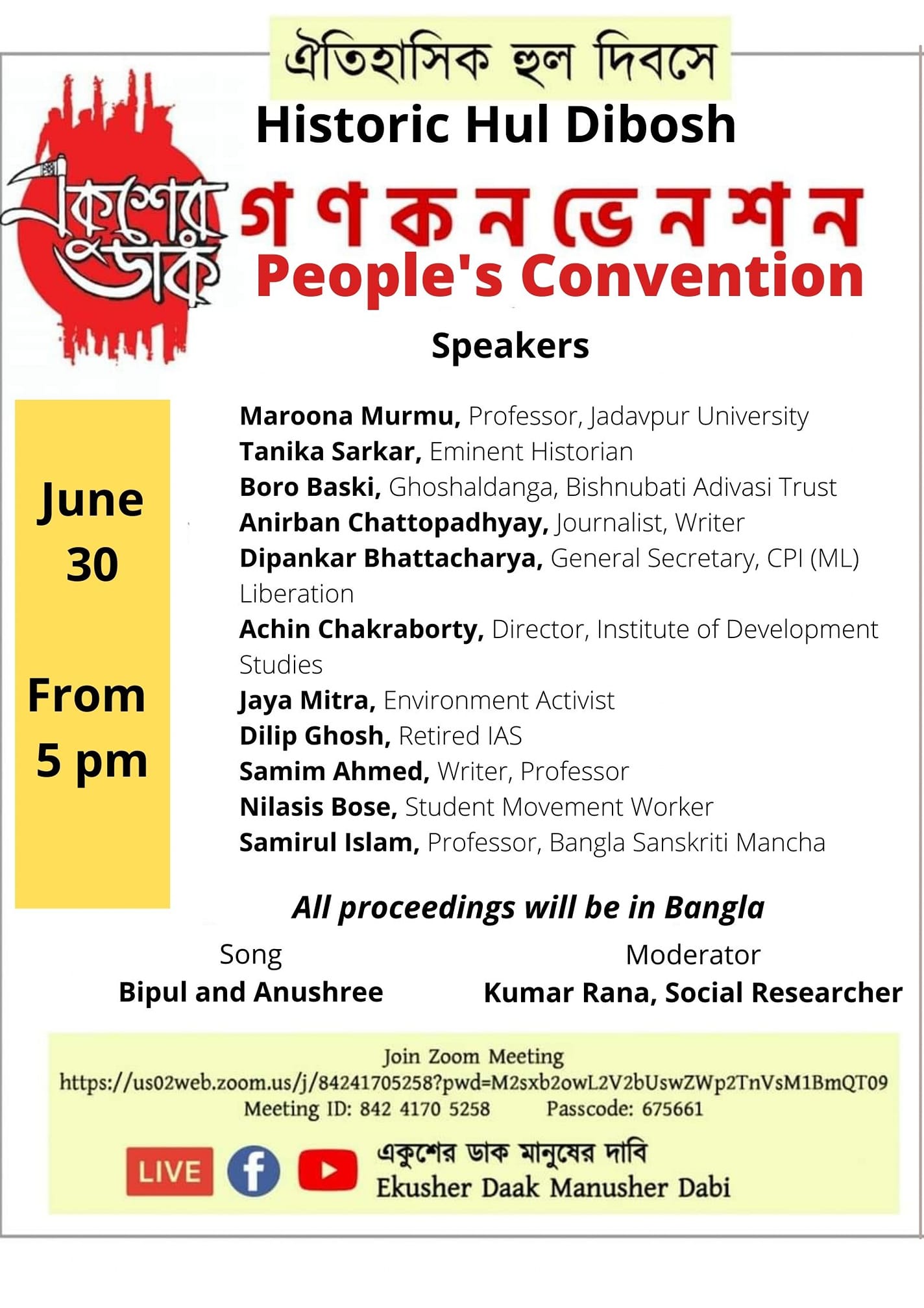
We had reported earlier on the call for a convention to commemorate the anniversary of the historic Santhal Rebellion associated the immortal names of Sidhu and Kanu. The convention was organized by the recently constituted forum in West Bengal, Ekusher DakCall of 21 – which was formed in the run up to the recently held elections in the state. ’21’ of course, refers to the year 2021 when the elections were held and the initiative for a new/ different Left platform in the state was launched. But ’21’ also recalls the date 21 February 1952, the historic day of the Bhasha Andolan (the Language Movement) in what is now Bangladesh. It recalls the assertion of Bengali identity that overrides the religious divide that the BJP made every effort to exacerbate. The convention was held yesterday and really came like a whiff of fresh air. The film we embed below is a very short but powerful telling of the story of the revolt with graphics. Ekusher Daak Film Team – Arjun, Debalina, Maroona, Boro, Laboni, Malay, Mitali, Arundhati, Saikat, Baijayanta, and Swarnava -have produced the film. For those who would like to watch the proceedings of the Convention, the YouTube streaming link is here.

The film on Hul Dibosh

क्या इस तरह भारत में कोरोना कभी ख़त्म होगा? राजेन्द्र चौधरी

Guest post by RAJINDER CHAUDHARY

पंद्रह दिन एक व्यस्क मरीज़ के साथ कोरोना वार्ड में गुज़ार के जब मैं अपने शहर पहुंचा तो पाया कि मेरे सैक्टर को ही कन्टेन्मन्ट ज़ोन बना रखा था. कन्टेन्मन्ट ज़ोन यानी ऐसा इलाका जिस में आने-जाने के रास्ते बंद किये हुए थे ताकि कोरोना पीड़ित इस सैक्टर में आवाजाही न हो सके. यह दावा कि मैंने 15 दिन कोरोना वार्ड में अपने मरीज़ के साथ गुज़ारे उन लोगों को अविश्वसनीय लग सकता है जो बड़े शहर के बड़े हस्पताल में दाखिल अपने कोरोना पीड़ित मरीज़ से संपर्क करने को तरसते रहे हैं. परन्तु यह सच है. मैंने भी सपने में भी यह नहीं सोचा था कि कोरोना मरीज़ की देखभाल के लिए मुझे उस के साथ हस्पताल में रहना पड़ सकता है.  सरकार की कोरोना नीति की बहुत सारी आलोचना मैंने पढ़ी-सुनी और की थी पर मुझे इस का अहसास नहीं था कि बाकी मरीजों की तरह हस्पताल में दाखिल अपने कोरोना मरीज़ की देखभाल भी खुद करनी होती है. सच में भारत धुर विसंगतियों का देश है. एक ओर हमारी सरकार पूरे इलाके को ‘कन्टेनमेंट ज़ोन’ (नज़रबंद इलाका) घोषित कर सकती है ताकि वहां से कोरोना पीड़ित दूसरी जगह जा कर संक्रमण को फैला न सकें और दूसरी ओर हस्पताल में कोरोना पीड़ित मरीज़ की देखभाल के लिए किसी परिजन को उस के साथ रहना पड़ता है. चौबीस घंटे तो कोई एक व्यक्ति मरीज़ की देखभाल कर नहीं सकता था. इस लिए हम दो लोग अपने परिजन की देखभाल के लिए उस के साथ शिफ्टों में रहते थे जिस के चलते हमारा कोरोना वार्ड से घर आना जाना लगा रहता था. इस से न केवल हम परिचारकों के संक्रमित होने का ख़तरा था अपितु नियमित तौर पर घर आने जाने के कारण हम और लोगों को भी संक्रमित कर सकते थे.

Continue reading क्या इस तरह भारत में कोरोना कभी ख़त्म होगा? राजेन्द्र चौधरी

The Call of ’21 (একুশের ডাক) – A Novel Campaign and a Nucleus of the New

We publish a document ‘Demands of the People’ adopted by a novel campaign Ekusher Dak in West Bengal that has the potential to emerge as the nucleus of a new Left formation in the state. The draft document in Bangla is appended at the end of this post. Tomorrow, 30 June, Ekusher Dak or the Call of 21 will be organizing a programme, recalling the great Santhal Hool or the revolt of 30 June 1855.

Continue reading The Call of ’21 (একুশের ডাক) – A Novel Campaign and a Nucleus of the New

‘Joblessness’ In The Post-Employment World – Urgent Need for Paradigm Change

Job seekers at a job-fair in Chinchwad, 2019, Image courtesy Reuters/ Danish Siddiqui

The ‘unemployment’ question, let us put it bluntly, is not just an innocent and neutral question today but a key arena of class war – the war of Capital on society at large. Capital has its plans but does “society” have one?

Enter the Post-Employment World

It was reported last week that top IT sector companies like TCS, Infosys, Wipro, HCL, Tech Mahindra and Cognizant are likely to slash 3 million jobs by next year. With large-scale resort to Artificial Intelligence (AI) based “robot process automation” (RPA), these companies, by shedding these jobs are expecting to “save a whopping USD 100 billion, mostly in salaries, annually” says the Indian Express report linked above. Citing NASSCOM (National Association of Software and Service Companies) the report tells us that the domestic IT sector employs around 16 million, of whom “around 9 million are employed in low-skill and BPO roles.”

Of these 9 million low-skilled services and BPO roles, 30 per cent or around 3 million will be lost by 2022, principally driven by the impact of robot process automation or RPA. Roughly 0.7 million roles are expected to be replaced by RPA alone and the rest due to other technological upgrades and upskilling by the domestic IT players, while it the RPA will have the worst impact in the US with a loss of almost 1 million jobs, according to a Bank of America report on Wednesday.”

Continue reading ‘Joblessness’ In The Post-Employment World – Urgent Need for Paradigm Change

‘No More Poor People In a Rich Country’ – What Will Peru’s Left Victory Mean?

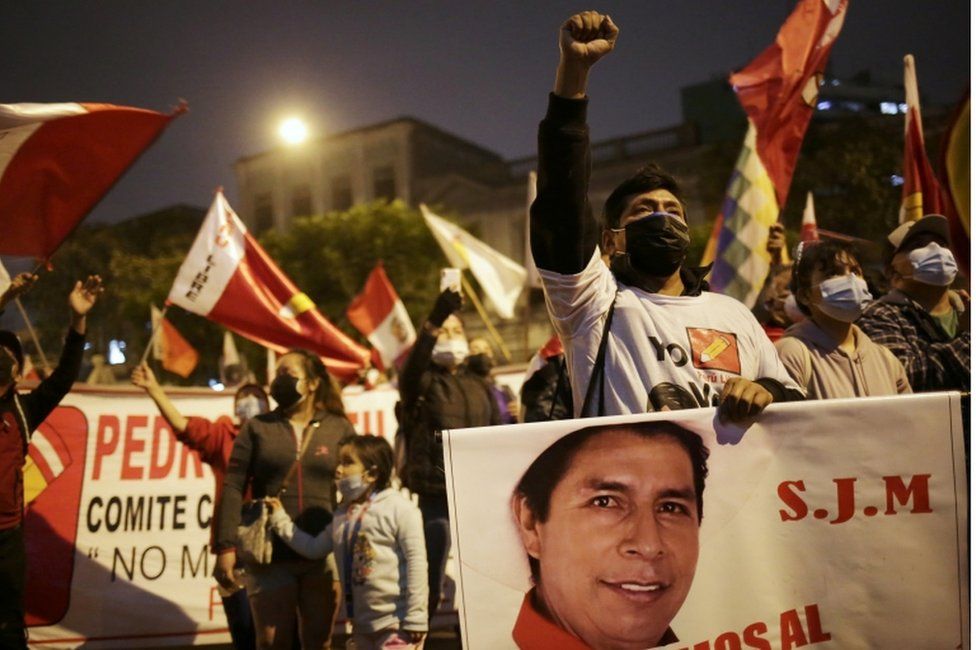
Supporters of Left Presidential candidate Pedro Castillo on the streets, image courtesy Reuters

Supporters of Left Presidential candidate Pedro Castillo take to the streets, image courtesy BBC and Reuters

It seems quite clear from the latest reports coming in from Peru that the Left-wing candidate Pedro Castillo is all set to win in what has been described as the most polarized election till date. With over 99 percent of the ballots counted, Castillo had taken a lead of approximately 80, 000 votes (50. 2 of the total) over his Right-wing rival Keiko Fujimori. The counting process, reports say, has already been considerably slowed down as ballots seem to be still arriving from abroad as well as from the remote rural areas. Votes of expatriates arriving from abroad are mostly right wing votes for Fujimori whereas the ones from the rural areas are likely to be overwhelmingly for Castillo. There also seem to be a huge number of contested votes that might need to be recounted, further slowing down the process.

Continue reading ‘No More Poor People In a Rich Country’ – What Will Peru’s Left Victory Mean?

CPI (M)’s History of Moving Away from Committed Leftism from its Birth: Sankar Ray

Guest post by SANKAR RAY

History apparently allows freaks, whims and hypocrisy, but only temporarily. After all, Hegel as very succinctly stated, ‘History is a slaughter house’. It spares none, not excluding India’s once most powerful Leftist party in the parliamentary arena, Communist Party of India (Marxist) that once had 44 MPs in the lower house of Indian parliament, Lok Sabha. It now faces  a crisis of identity and existence. Hypocrisy and falsehood in politics and ideological positions have been two main reasons for the vertical decline of party’s influence and image.
Ten years ago,  Indranil Chakraborty in his Master’s thesis –“The Market Odyssey: Why and How Was ‘The Market’ Discourse Incorporated in the Party Program of the Communist Party of India (Marxist) During the Days of the Communist Party of China’s ‘Market Socialism’?” referred to CPI(M)’s open criticism of ‘the development of the personality cult of Mao( Tse Tung) , and the problem of left adventurism during the Cultural Revolution. He pointed out that the criticism evaded ‘the question of the relationship between socialism and democracy, and the role of the Chinese people in deciding policy matters of the state’.  He quoted Harkishan Singh Surjeet’s article in the party’s theoretical monthly, The Marxist in 1993 commemorating Mao’s birth centenary – ‘We cannot make a subjective analysis of a personality in cases where errors have been committed in the application of the theory to practice.’

Continue reading CPI (M)’s History of Moving Away from Committed Leftism from its Birth: Sankar Ray

Six Months of the Farmers’ Struggle – Looking Ahead

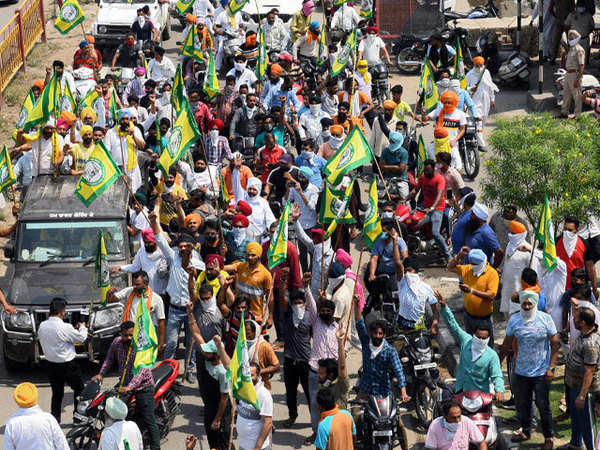
Farmers observe ‘Black Day’ as struggle completes six months on 26 May, image courtesy Economic Times

The farmers’ struggle at the Delhi borders completed six months yesterday, the 26th of May. The day was observed as a Black Day all over the country, at the call of the Samyukta Kisan Morcha (SKM).

Braving unprecedented cold, followed by rains and storm, the struggle has now moved into the cruelest part of Delhi’s summer. In the process, it has lost 470 of its people, thanks to the obstinacy of the government. If one dates the beginning of the struggle from June, when it began in Punjab, soon after the farm laws were stealthily, under cover of the pandemic, promulgated as ordinances by the Central government, the struggle has been on for ten months now. In other words, it is incorrect to go on referring to it as a protest – which we routinely do for many lost causes – for it is now a ‘do or die’ struggle. It became so from the time it shifted its venue to lay siege to Delhi.

Periodically, the government, its police and its minions in the media try and zero in on this epic struggle of the farmers for its ignoring, if not violating of Covid19 protocols. All this even as they look the other way while lakhs of people are thrown into the jaws of death, brought about by the mass murderers who have pushed populations in four states into prolonged election campaigns, played cynical games with precious oxygen and vaccine supplies and allowed all kinds of mass religious gatherings of the Hindus to take place in complete disregard of any protocol whatsoever.

Continue reading Six Months of the Farmers’ Struggle – Looking Ahead

Why Federalism Must Become the Fulcrum Of Politics In Coming Days

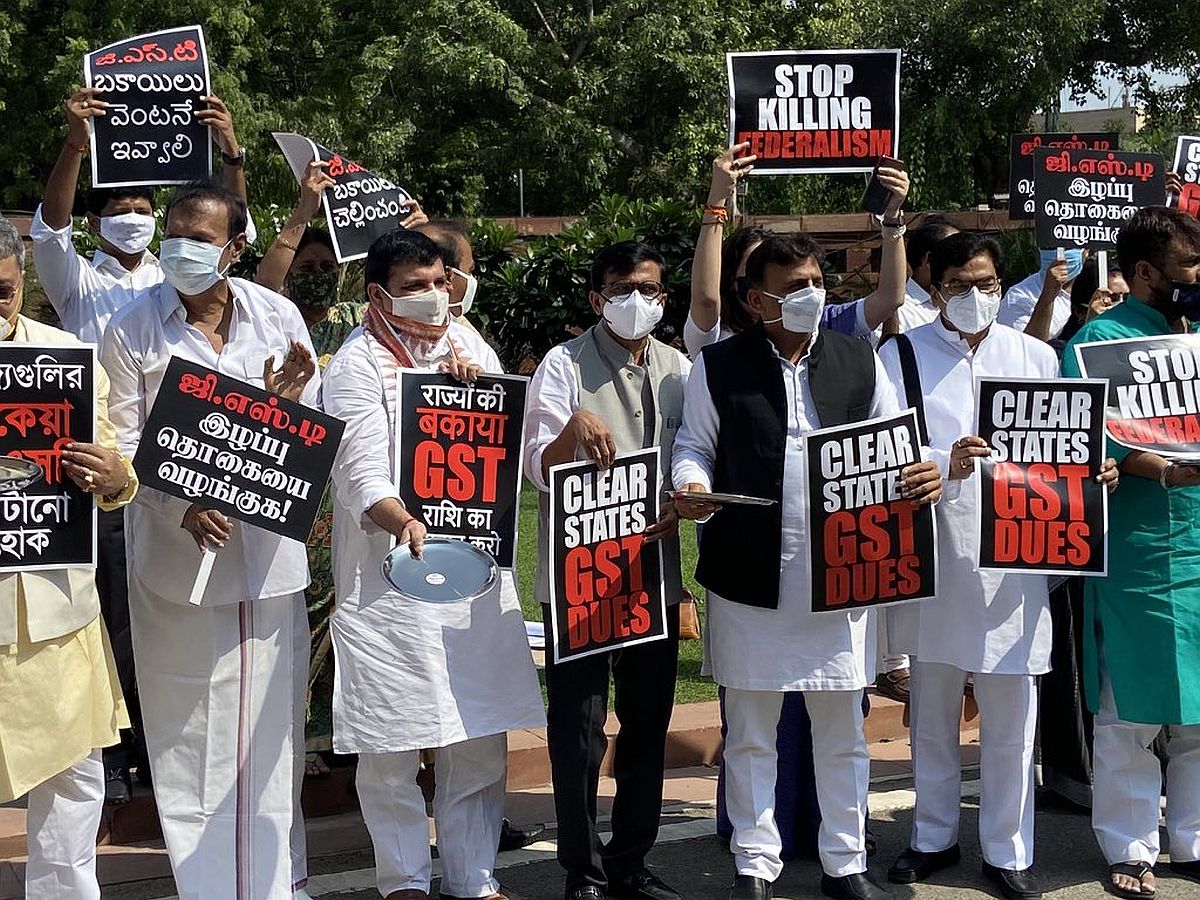
MPs demonstrtate in parliament for states' GST dues
MPs demonstrtate in parliament for states’ GST dues, 17 September 2020, Photo: Twitter/@priyankac19, courtesy The Statesman

A shorter version of this article appeared in Bangla earlier in Sahomon.

The question of federalism and Centre-State relations has been on many people’s minds lately, given that the Centre in the Modi dispensation has been hell bent on usurping the powers of the states while slyly thrusting all responsibility on to their shoulders. As a matter of fact, it was precisely during the outbreak of Covid19, when there should have been maximum cooperation between the Centre and the States, that the strains started showing in a glaring manner. Very early on, it became clear that the Centre was intent upon using the pandemic to usurp more and more powers, while riding roughshod not only on the rights of ordinary citizens but also of the States. In dealing with the pandemic, not only were the mandatory  consultations with the States not held, they were in fact simply handed over decisions. The most dramatic of all these, of course, was the completely bizarre manner in which the Lockdown was declared last year, at just four hours notice. The huge tragedy that followed was totally avoidable had there been prior consultations and had the Prime Minister, just for one moment, behaved like one. As a matter of fact, the record of this government over the past seven years has been pretty consistent in this regard at least. Continue reading Why Federalism Must Become the Fulcrum Of Politics In Coming Days

पितृसत्तात्मक हिंसा के प्रति शून्य सहिष्णुता की नीति अपना कर अपने संघर्षों को मज़बूत करें! – नारीवादी व महिला संगठनों के बयान

टिकरी बॉर्डर पर युवा महिला कार्यकर्त्ता के साथ यौन हिंसा और अपहरण पर सार्वजनिक बयान, 9 मई, 2021

बंगाल से आयी असोसियेशन फॉर प्रोटेक्शन ऑफ़ डेमोक्रेटिक राइट्स (एपीडीआर), श्रीरामपुर की 26 वर्षीय कार्यकर्त्ता के 30 अप्रैल 2021 को बहादुरगढ़, हरियाणा में हुए निधन पर हमें गहरा अफ़सोस है। यह युवती किसान आंदोलन से बेहद प्रेरित हुई और 2 से 11 अप्रैल को बंगाल में आन्दोलन का प्रचार कर रहे किसान सोशल आर्मी के साथ टिकरी बॉर्डर पर आंदोलन के प्रति अपना समर्थन दर्ज कराने आयी थी। उसे खोने का शोक मनाते हुए, हम टिकरी बॉर्डर पर उसके द्वारा बिताये चंद दिनों के दौरान उसके साथ हुए घटनाक्रम के बारे में सुन कर भी बेहद चिंतित और परेशान हैं।

Continue reading पितृसत्तात्मक हिंसा के प्रति शून्य सहिष्णुता की नीति अपना कर अपने संघर्षों को मज़बूत करें! – नारीवादी व महिला संगठनों के बयान

Strengthening our Struggles through Zero Tolerance to Patriarchal Violence: Statement by Women’s organizations

Public Statement on the Sexual Assault and Abduction of a Young Woman Activist at Tikri Border issued on 9 May 2021

We deeply mourn the death of a 26-year old activist from APDR (Sreerampur) in West Bengal, who passed away on 30th April, 2021 at Bahadurgarh in Haryana. She was deeply inspired by the farmers’ movement and had gone to express her solidarity at the Tikri border with the Kisan Social Army who had been campaigning around Bengal from 2nd April to 11th April, 2021. As we mourn her loss, we are also deeply troubled and concerned on hearing the events that had unfolded during her short stay at the Tikri border.

Continue reading Strengthening our Struggles through Zero Tolerance to Patriarchal Violence: Statement by Women’s organizations

Yogi Model of Fighting COVID Second Wave – Attacking People Rather Than Virus: Himanshu Shukla

Guest post by HIMANSHU SHUKLA

As India updated its COVID cases on April 30th, it became the first country to register over 4 lakh infection in a single day. This record breaking second-wave spike in the country opened the Pandora’s Box of the Modi-led central government’s claim of defeating the pandemic. The government patted itself for successfully defeating the virus and bringing normalcy in the country, without getting hit very hard like many other countries. The second wave of virus has showed up the naked picture of the hollow claims that the government made about their preparedness to tackle COVID.

India is now the epicentre of infection, accounting for 46% of world’s total cases and quarter of deaths. The ravaging crisis brought about cries for oxygen countrywide. Mass deaths due to unavailability of medical care is the new picture that India portrays of its incompetence in dealing with the second wave. The recent editorial of Lancet slammed Modi government, mentioning that the second wave is a ‘self inflicted national catastrophe’.

Continue reading Yogi Model of Fighting COVID Second Wave – Attacking People Rather Than Virus: Himanshu Shukla

Post-Election Musings -Federalism to the Fore: Nakul Singh Sawhney

Guest post by NAKUL SINGH SAWHNEY

Some observations and takeaways from State Assembly elections in Kerala, Tamil Nadu, West Bengal, and Assam in May 2021 – from an original Facebook post. The observations are in the form of informal reflections but they point towards certain developments that might open up new, anticipated spaces for the struggle for a democratic India.

Federalism: The Election verdicts of May 2, 2021, from Tamil Nadu, West Bengal, and Kerala scream ‘federalism’. The election results are so vastly different in the State Assemblies and Lok Sabha. The election outcomes of Delhi, Maharashtra, Haryana, West Bengal, Kerala are important examples of this phenomenon.

India is a country that naturally lends itself to federalism and greater state autonomy. While the Congress, by and large, didn’t allow for it, the BJP is hell-bent on a deeply centralized structure and crushing any aspiration for regional autonomy. If progressive forces don’t take up the question of federalism and state autonomy, then it runs the risk of slipping into the hands of crude chauvinists and xenophobes like Shiv Sena of yesteryears or secessionists like Khalistanis.

Continue reading Post-Election Musings -Federalism to the Fore: Nakul Singh Sawhney

Ominous Dark Clouds Over Bengal’s Skies…

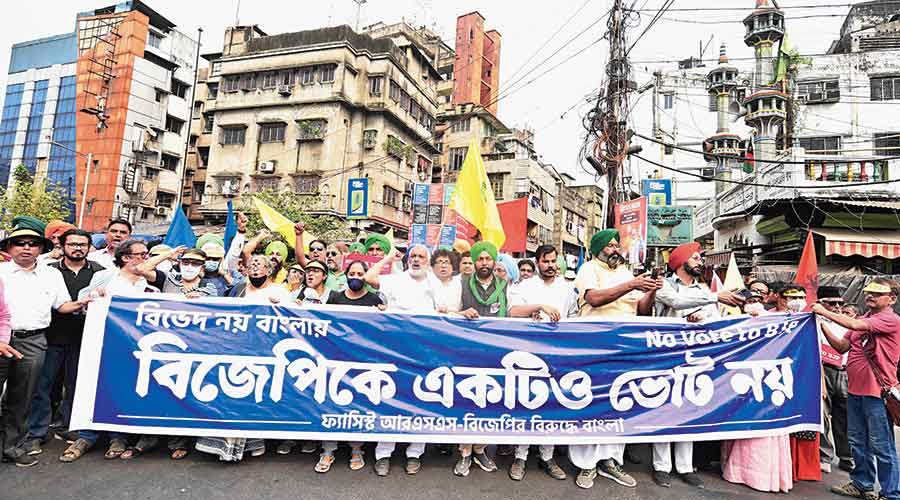
A demonstration by the ‘No Vote to BJP’ campaign in Kolkata, (older image) courtesy The Telegraph

As close to 8.5 lakh voters spread over 35 Assembly constituencies go to vote today in the last phase of Bengal’s elections, the line from the famous jatra Nabab Siraj-Ud-Doula from which the title of this post is extracted, haunts. The original ‘jatra pala’, written by Sachin Sengupta was staged in 1938 had a dialogue that announced the dark clouds collecting at Bengal’s horizons. The lines ‘Banglar akashe aaj durjoger ghanaghata/ Taar shyamal prantore rakter alpona’ have since resounded in the many iterations of the play, over the decades. The figures of Siraj-Ud-Daula and the traitor Mir Jafar have generally become part of Bengal’s political vocabulary but this time round the sense of Bengal being under attack from ‘outsiders’ has been pervasive. Along with that other episode of political folklore – repeated attacks by the borgis or the plunderous cavalrymen of the Maratha Empire, on Bengal has been recalled often. The attacks by the borgis were followed, only a few years later, by the Battle of Plassey (Palashi), in which Siraj-Ud-Daula was defeated after Robert Clive bribed Mir Jafar, his army commander, to betray the Nawab. 

This time round too, it is widely believed, the aggression by ‘outsiders’ cannot and will not succeed but for the Mir Jafar’s who collaborate with the aggressors.

Continue reading Ominous Dark Clouds Over Bengal’s Skies…

Sitalkuchi And After – A Flashback to CPI-M Rule in West Bengal

Graves of the four young men killed in Sitalkuchi, courtesy Newslaundry

As the news of the killings of four youth in Sitalkuchi in Cooch Behar district by the Central Industrial Security Force (CISF) came in on 10 April, reactions of horror and anger became evident all around. This reaction among politically informed sections was only natural, for anybody with a little bit of common intelligence will tell you that the BJP is making an all out bid to capture power in the state. And anyone who has watched the Modi-Shah duo in action over the past few years, does not need to be told what this means. It is always ‘Heads I win; Tails you lose’ with them. It doesn’t matter what dirty trick you have to play, all is fair in this game of capturing power with them. They will form the government, no matter who wins but first, every effort has to be made to ‘win’ by any means. And that means by ANY means, ranging from killing people by engineering violent communal incidents to buying off opposition parties’ winning legislators. Despite the full battery of BJP’s star campaigners ranging from Narendra Modi and Shah to Yogi Adityanath making repeated visits to the state, their rallies have seen very low turnout and in some instances meetings had to be cancelled. So the desperation is growing. The first four of the unprecedented eight rounds in the state’s elections were to be in the areas where TMC is relatively weak. But even in these areas the reports were not very encouraging for the BJP. Thus, every child in Bengal could see what these killings meant. Except the CPI-M that is.

Soon the story of the killings was being given a typically BJP IT Cell spin: a mob of Muslim TMC people surrounded the CISF and tried to snatch their rifles. This was followed by identical tweets by a range of people describing how they could not sleep all night because of the sounds of the explosion of bombs, suggesting that things had been going on all night – and the CISF action in the morning was therefore, only justified.

Seasoned CPI-M stalwarts on Twitter apparently neither saw those tweets or more likely, jumped at them to immediately amplify the BJP narrative of provocation by TMC (Muslim mob is often implied). It is certainly not possible that anybody with a little bit of common sense would not have immediately seen this copy paste job for what it was – a BJP IT Cell operation. The CPI-M leaders and their social media warriors went on, willfully, to reinforce the ‘provocation’ narrative that was being circulated by the BJP.

Meanwhile, many people including poll analysts and former bureaucrats started asking that if there really was an irate mob attacking the CISF party, where was the footage? Was there any video evidence? No such question crossed the CPI-M leaders’ minds and from all appearances, from Biman Bose to Mohd Salim (and the pathetic Sujan Chakrabarty) pushed ahead with not-so-subtle ways of relaying the BJP narrative and indeed, it was not difficult to discern that they were in fact, gloating.

Continue reading Sitalkuchi And After – A Flashback to CPI-M Rule in West Bengal

Nandigram – An Introduction to Political Analysis

Nandigram 2007, Image courtesy Kolkata24x7

Mamata Banerjee recently stirred up a fresh new controversy by accusing her former party colleague Suvendu Adhikari, now adversary in the Nandigram Assembly seat as BJP candidate, of being complicit in the 14 March 2007 violence. Had it not been for the complicity of the ‘father-son duo’ (Suvendu and his father Sisir Adhikari, both in the BJP now), she claimed in the heat of the electoral campaign, the police could not have entered Nandigram. She also asked rhetorically how it came to be that these two were spared by the police? To my mind, the claims seem difficult to sustain, if only because, the CPI(M) was at the height of its power and would have had little to do with these Trinamool Congress leaders. Listening to her speak, it did seem that she was quite rattled. Who would not be – with Amit Shah and central government on one side, the aggressive BJP goons in the state, her erstwhile collaborators now on the BJP side and, to cap it all, the aggressive, misogynist, patriarchal campaign against her from the CPI(M)? One meme by people obviously linked to the CPM, for instance, portrayed her witch-like, with a haggard and wicked expression, which was counter-posed to the young beauteous CPI(M) candidate Meenakshi Mukherjee. The meme describes Meenakshi as the ‘beloved daughter of Bengal’, while Mamata is described as the ‘old hag spinster sister-in-law’. (After a lot of hue and cry, this meme was taken off though the page continues to be on Facebook).

Continue reading Nandigram – An Introduction to Political Analysis

Exploring ‘Hindu’ and ‘Muslim’ Through Medieval Sanskrit Narratives: Rahul Govind

In this guest post, RAHUL GOVIND gives us, by way of a review of Audrey Truschke’s book, a glimpse of the world of medieval Sanskrit and what they tell us about ‘Hindu’ and ‘Muslim’ identity in their own time.

The Language of History – Audrey Truschke

Why Audrey Truschke’s The Language of History is essential reading for every Indian (and Pakistani and Bangladeshi)

There is the view that the medieval period of Indian history witnessed an all-consuming battle between Hindus (who were native to India) and Muslims (who came to India as conquerors).  This originated as a typical colonial strategy of ‘divide and rule’ in the 19th century, but then transformed into a communal politics that ultimately led to Partition. In India today this very view is becoming a dominant one, where the medieval period is assumed to be nothing but the destruction of an ancient indigenous Sanskritic culture by invading Muslims.

Continue reading Exploring ‘Hindu’ and ‘Muslim’ Through Medieval Sanskrit Narratives: Rahul Govind

Loss of Hindustan – A Symposium III: Hilal Ahmed

This article by HILAL AHMED is the third and final contribution in the set of three reviews/ comments on Manan Ahmed Asif’s Loss of Hindustan. The first contribution by Dwaipayan Sen can be read here and the second by Dilip M. Menon can be accessed here.

A Political Reading

Loss of Hindustan – Manan Ahmed Asif

This is a provocative book in two different ways. It provokes us to interrogate the supposedly foundational propositions that constitute the very first article of the Indian Constitution: ‘India that is Bharat’. The book destabilizes the very language—the concepts, categories, frames—by which we are trained to envisage India as a historic entity and/or as a civilization.

The author does not merely engage in producing a deconstructionist version of India’s past. He, unlike others, incites us to imagine the unimaginable: the idea of Hindustan. The book introduces us to a rich archive of Persian scholarship and explores the ways in which Hindustan as a concept as well as a geo-political reality is erased to pave the way for a new intellectual imagination, India.

The Loss of Hindustan is also provocative in an overtly political sense. The book cannot be described as an intellectual-historical project. It raises a few powerful political questions especially in relation to the placing of modern history in postcolonial projects of nation building. Continue reading Loss of Hindustan – A Symposium III: Hilal Ahmed

Loss of Hindustan – A Symposium II: Dilip M. Menon

This article by DILIP M. MENON is the second of the three pieces that comprise the symposium on Manan Ahmed Asif’s Loss of Hindustan. The first contribution by Dwaipayan Sen can be read here. The final contribution by Hilal Ahmed can be accessed here.

The Loss of Longing

Loss of Hindustan – Manan Ahmed Asif

“Nostalgia is not what it used to be.” – Simone Signoret

To look back these days evokes less anger or longing and more a sense of gazing on ruins. Like the Angel of History, so evocatively described by Benjamin, we are being blown with our backs to an unknown future, gazing at the relentless pile of wreckage that accumulates behind us. The idea of a nation that we once imagined together is buried somewhere in the debris, our residual idealism detects its gleam sometimes. This sense of melancholy propels different shades of politics, one of which does a fine combing through the rough texture of history to recover lost visions. The other seeks to resist the lure of the past and think exigently within the horizon of the present. A hard headed engagement with contemporary times comes rooted in the belief that there is no space of authenticity or of an archive of resistance awaiting us in the past: there is no ‘there’ there. However, the mode of thinking that informs the historical discipline requires us to look back, and see the filiations with the present as much as the future. The fact that we occupy a future past (that is to say, we live in a moment that was once imagined as a future, utopian or otherwise) can be an occasion for cynicism as much as a fillip for renewed action. Continue reading Loss of Hindustan – A Symposium II: Dilip M. Menon

Loss of Hindustan – A Symposium I: Dwaipayan Sen

Manan Ahmed Asif’s recent book Loss of Hindustan: The Invention of India* has aroused considerable interest that goes beyond academic readers. Since the book deals with a matter that concerns not just our past but also how we imagine our future, we at Kafila decided to try out a symposium on it – on an experimental basis, since we do not generally carry book reviews as such. We will be serially publishing three reviews/ comments on the book, by DWAIPAYAN SEN, DILIP M. MENON and HILAL AHMED, over the next few days, in the hope of provoking some discussion. We also hope to get the author’s response to these contributions. This first piece is by DWAIPAYAN SEN. The second contribution by Dilip M. Menon can be read here. You can read the final piece by Hilal Ahmed here.

Loss of Hindustan – Manan Ahmed Asif

This book is the most recent addition to a growing tradition of precolonial history-writing that depicts India as a land of milk and honey before the coming of the colonial flood.  Evidently, a European understanding of India as Hindu replaced an earlier, native understanding of India as Hindustan, rendered a home for all faiths.  Such arguments are based on the close reading of Muhammad Qasim Firishta’s Tarikh-i Firishta, and its appropriation by scholar-administrators in the employ of the East India Company.

Continue reading Loss of Hindustan – A Symposium I: Dwaipayan Sen

Marxism’s Long March in the Global South

Arab Spring composite image, courtesy Middle East Eye ( and AFP, Reuters, Creative Commons)

It is interesting that though Marxism was born in Europe, it has found its most enduring habitat in the Global South, but this has meant very little in terms of its overall theoretical formation and structure. Thinking about this encounter of ‘Marxism’ and the ‘Global South’ – the continents of Africa, Asia and Latin America – is a daunting task for the sheer range of experiences and questions it has thrown up. It has thrown up fundamentally new concerns as well as produced, in practice, some of the most grotesque outcomes.  But the task is also daunting because despite the range of experiences that Marxism has gone through and has put us through, it has not so far given us any serious body of theoretical knowledge that reflects this experience. It has not given us anything like the way, say,  Tibetan, Chinese, Japanese and Sinhala Buddhism have produced their own versions of Buddhist philosophy. One could also perhaps say the same thing about Christianity in Europe, where – at least up to a point – its philosophy was elaborated and innovated or transformed by the best minds of their time.

Continue reading Marxism’s Long March in the Global South