All posts by Nivedita Menon

Coallateral: Research Collective of Programme for Social Action

Executive Summary by RESEARCH COLLECTIVE of Programme for Social Action, of the Report of the Independent People’s Tribunal on the MoU between Rajmahal Pahad Bachao Andolan and PANEM Coal Mines.
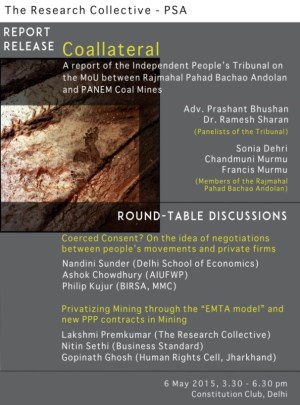
Press Invite

Release of the Report and Panel Discussion on May 6, 2015 at Constitution Club

The Independent People’s Tribunal, held on 16 November 2014 in Ranchi, established that PANEM Coal Mines repeatedly violated human rights of Adivasis, used violence against them to force their consent to operationalise the project, and has not adequately resettled and rehabilitated project affected families. PANEM Coal Mines, which acquired Adivasi lands in 2002 in Pakur district of Jharkhand, violated the Santhal Parganas Tenancy Act, 1949 and the rights of Adivasi (indigenous) people granted under the fifth schedule of the Indian Constitution.

PANEM Coal Mines, a Joint Venture company between Punjab State Electricity Board (now PSPCL) and EMTA Group, required land from Adivasi communities in Alubera and Pachwara panchayats in Pakur to operationalise the Pachwara Central Coal Block mining project. Fearing that the large-scale mining project would ultimately destroy their homeland, the Santhal and Pahadia people did not consent to the acquisition of their land. They organized themselves as the Rajmahal Pahad Bachao Andolan (RPBA) and militantly opposed the project between 2000 and 2006. In an unexpected turn of events, on 30 November 2006, RPBA signed a Memorandum of Understanding (MoU) with PANEM and allowed the company to acquire land and mine coal.

Continue reading Coallateral: Research Collective of Programme for Social Action
The Body-politic and Death of the Farmer: R Umamaheshwari

Guest Post by R. UMAMAHESHWARI

Until now suicides happened in an almost invisible ‘intimate’ ‘psychic’ space of the farmer and his (almost always it was a male) loneliness and pain and anguish; we only got to know of it after the act was committed. But for the first time, a farmer committed suicide in full public view, and his body was consumed by the world at that moment of his committing the act. In a leading Hindi newspaper, the following day, there was a photograph, on the front page. The images showed the gradual metamorphosis of a living man, with a profession (that of a farmer), with a history and a family turning into a mere dead body. The photographer had actually recorded this metamorphosis, image by image in sequence, second by second. Not a moment had been left out. (See Amar Ujala, dated 23rd April 2015) With one loop the man, named Gajendra, became yet another body; yet another dispensable body, to be consumed by the entire nation through photographs and TV images. It was the signifier of our times: an act in the theatre of the absurd that democracy has come to be. The farmer will increasingly be ‘seen’ when he dies. Continue reading The Body-politic and Death of the Farmer: R Umamaheshwari

Lessons learnt from the misdeeds of Paralympic Committee of India – Continuing to speak up: Pragya Deora

Guest post by PRAGYA DEORA

The 15th National Para-Athelitic Championship held in Ghaziabad in March 2015 was my first national-level athletic competition that I was participating in. I did not know much about the world of sports, the associated pressures for sportsmen, politics at different levels and most importantly the amount of compromises that the participants had been making in all these years.

Our team left for Ghaziabad and even before we reached we were a little surprised. The condition of roads leading to the stadium was so terrible that we were confused if we were reaching the right place. After we reached, we realized there was worse to come. Working on issues of accessibility in my campus for making our campus barrier free for persons with disabilities, there was an expectation from the organizers that this would be a model of the way a sports competition should be organized in terms of infrastructure, procedures and attitudes. But it was a far cry from it. What screamed at each step was complete insensitivity towards persons with disabilities. Continue reading Lessons learnt from the misdeeds of Paralympic Committee of India – Continuing to speak up: Pragya Deora

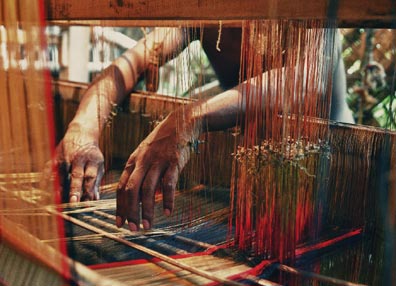
Save Handlooms – Don’t Repeal the Handloom Reservation Act!

Please sign this petition to the Prime Minister drafted by LAILA TYABJI  of Dastkar Delhi, appealing against the proposed repeal of  The Handloom Reservation Act, which protects both an ancient body of knowledge and skill, as well as the livelihoods of hundreds of thousands of handloom weavers.

16040_S_handloom-tant-weaver

Image courtesy Facenfacts

SIGN THE PETITION HERE. TEXT OF PETITION BELOW

Handlooms are India’s unique heritage and the livelihood of lakhs of skilled handloom weavers.

A move is on to repeal The Handloom Reservation Act, which since 1985 has been protecting traditional Handloom weaves, especially saris, from being copied by their machine-made and powerloom competitors. It was a small but important protection for Handloom weavers, who otherwise struggle to survive. Their yarn, their designs and their markets are under attack.

Now the influential powerloom lobby has agitated successfully that this Act be withdrawn. To say that because we have powerlooms, we don’t need handlooms does not make sense. The handloom can create thousands of distinctive regional weaves and designs that no powerloom can replicate, and a tactile wonderful drape that is also irreplaceable by mechanised means. Globally too, more and more ecologically sensitive international buyers look to India as a source for the hand made.

Each weave has a cultural tradition and a story, each linking us to our social and cultural roots. If we remove the protection and incentives for handloom weavers to continue weaving their traditional products and saris, we would suddenly be bereft of both our past and our future.

Handloom lovers, it’s time to raise your voice! Join us in lobbying against the repeal of The Handloom Reservation Act.

SIGN THE PETITION HERE.

Bangladesh – Stifling A Country: Mahmud Rahman

Guest Post by MAHMUD RAHMAN

Mahmud Rahman is a writer and translator from Bangladesh who lives in California. He is one of 23 persons  who are facing possible contempt of court charges from the International Crimes Tribunal 2 in Dhaka for having signed a statement expressing concern over the same tribunal’s contempt of court sentence on the journalist David Bergman for some of his blog posts.

When I think about the state of free speech in the land of my birth, my memories take me back to 1970-71 when I was a higher secondary student in Dhaka, a time of upheaval when East Pakistan was making its way towards independent Bangladesh. Officially we were still under martial law, Ayub’s decade-long dictatorship deposed in favor of Yahya’s rule that came with the promise of elections. Political parties could organize, detainees were set free, the press could publish with fewer restrictions, and people began to launch new magazines and newspapers.

Every stripe of opinion found expression in print. Pushing aside the go-slow conservatism of existing newspapers, new ones emerged. Bengali nationalism, socialism, communism of various hues – all found expression in print. The main Islamist party’s paper acquired a modern press. Books were not that widespread, but you could easily get your hands on Russell and English socialists, and Marx, Engels, Lenin, or Mao. I remember engaging in a mix of agnostic, atheist, socialist, and liberal discussions.

There is something in that sort of ‘spring’ that beckons the young to amplify their voice. Two friends and I wanted to publish a magazine. We came up with a name – The Rebel – and of course, a logo. We split the writing among us. I can’t remember much other than we were inclined towards independence for East Bengal. Our perspective was no doubt seditious but we couched our language with a bit of caution. Did we even know that British-era laws required that publications be registered? In that climate, we felt the state wasn’t looking all that carefully.

Continue reading Bangladesh – Stifling A Country: Mahmud Rahman

All that is solid melts into air – the hologram protests in Spain: Geeta Seshu

Guest post by GEETA SESHU

The recent hologram protest projected on the street before Spain’s Parliament is an innovative attempt to subvert the country’s ‘citizen security’ provisions that criminalises public protest.

The video of the hologram protest is riveting and surreal, as ghostly figures of women and men march shouting slogans amidst night-time traffic. The figures are clearly distinguishable, the faces discernible. This isn’t computer-aided animation. It’s the real thing.

Or as close to real as a virtual thing can be.

The website ‘hologramasporlalibertad’ (Holograms for Freedom) provides for the subscriber to record her own message and, with a click, a hologram is created. An online petition explains that the ‘citizen security laws’, which obtained final assent in Spain in March, will ‘repress the freedom of peaceful assembly’.

Screen Shot 2015-04-22 at 11.13.01 pm

Continue reading All that is solid melts into air – the hologram protests in Spain: Geeta Seshu

Are We Legit? Roanna Gonsalves

ROANNA GONSALVES writes in Southern Crossings, a new blog run by a writers’ collective based in Australia, which aims “to reimagine Australia, South Asia, and the world, through South Asian bodies and minds.”

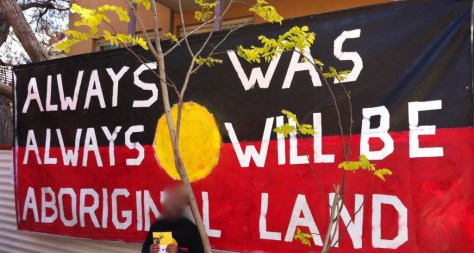
Aboriginal-flag-1-1024x548

One rainy Mumbai day, sitting in an Udipi restaurant, chai cup in hand, I told a dear friend I would soon leave for Australia.

“I’ll never leave India and be a second class citizen in another country”, my friend said. My chai turned colder and a crinkly skin formed on its surface.

Seventeen years later, I realise that in perceiving a hierarchy of citizens in Australia, my friend was right, but in a manner that he did not intend…

…[T]here were certain fundamental truths that I did not grasp before I got here: Indigenous people i.e. Aboriginal people and Torres Strait Islanders, are the First Peoples of this land and the waters that surround it; they formed the First Nations of this continent; this always was and always will be Aboriginal land.

We are not the perpetrators, the ones who wielded the guns in the forgotten wars between invading white settlers and Indigenous Peoples. We are not the victims. However, as mainly economic migrants from South Asia (I acknowledge the many South Asian refugees from the conflict zones of Afghanistan and Sri Lanka), we are not absolved of complicity.

We are beneficiaries of the genocide of Aboriginal people, the dispossession of their land, the loss of their homes, their families, their cultural values, their tongues, their songs. It is such soil that we step on when we first step into Australia, soaked not just with the promise of a ‘first world lifestyle’, but squelchy with the memory of massacre.

Read the rest of this uncompromising and challenging set of reflections here.

Media and the Death of Democracy: Nissim Mannathukkaren

Guest Post by NISSIM MANNATHUKKAREN

We live in a world where there is more and more information, and less and less meaning—Jean Baudrillard

Recently, there has been an outpouring of scathing critique against Arnab Goswami and his television programme, The Newshour in some sections of the English-language Press. One magazine cover story called him, “The Man Who Killed TV News.” The immediate context of this critique is Goswami’s branding of some prominent ecological and political activists as “anti-national” and his calling for a ban on the Nirbahaya documentary and legal action against a competing channel which was supposed to be air the documentary. This unprecedented and shockingly ironic position against free speech by a leading media personality was rightfully termed by a critic “as low as a journalist can sink.”

While these criticisms of the “murderous rage” evoked by Goswami draped in the nationalist tri-colour every night and the punishment he metes out to his opponents in a “medieval-style kangaroo court,” also known as an “open debate,” are entirely apt and necessary, they also miss the forest for the trees. Goswami is only a symptom of the post-liberalization corporatized and privatized media landscape of India. If Goswami did not exist, he would have been created. It is not Goswami alone who has killed news, it is the vast majority of the media, especially, television that has done so. What is more obscene than Goswami’s execrable theatrics is how he is deeply enmeshed in the structures of capital and power that he seemingly rails against every night. These structures have not just enmeshed him, but the others as well who are aghast at his aesthetics (or the lack of it).  Continue reading Media and the Death of Democracy: Nissim Mannathukkaren

Why are we always Encroachers? Tribal farmers in Khammam District, Telangana: Vasudha Nagaraj

Guest Post by VASUDHA NAGARAJ

Korsa Subba Rao, a man from Koya tribe, cultivates about three acres of forest land in a village in Khammam district. His family has been doing so for several generations. Subba Rao has a ration card, voter identity card, Aadhar Card and a NREGA job card. However, for the land that he tills, he has no papers whatsoever. Ironically the only evidence he has is an FIR issued by the Forest department. For committing a forest offence of encroaching into the forest – cutting down trees and putting it to podu cultivation.

Like Korsa Subba Rao, in Khammam district, there are thousands of farmers belonging to Koya, Konda Reddis and Lambadi tribal communities cultivating one to four acres in forest lands. Most of them have been cultivating since the times of their forefathers. Often this is their only income. However, factors such as scanty rain, untimely rain or pest can drastically reduce this income. The prevalence of malaria and other mosquito borne diseases also adds to the toll.

Here, it needs to be understood that forest lands do not always imply green forests. A forest land can be dense forest, moderate forest, shrub growth and also barren land. In Khammam district, thousands of acres of forest lands have been put to cultivation since several decades. But any cultivation of forest land is considered to be illegal, as it is an offence as per the AP Forest Act, 1967. In this scheme of things, the tribal farmers are seen as “encroachers”. The irony is that they are encroachers inspite of being the original inhabitants of the land. Because of this illegality and because of the power of the Forest Department to register criminal cases, the tribal farmers live in a constant fear of eviction from their lands. Continue reading Why are we always Encroachers? Tribal farmers in Khammam District, Telangana: Vasudha Nagaraj

Ambedkar’s Ideology – Religious Nationalism and Indian Constitution: Ram Puniyani  

Guest Post by RAM PUNYANI

In order to gain larger legitimacy, RSS has been making claims of sorts. One of that which was made few months back was that Gandhi was impressed by functioning of RSS. Now on the heels of that comes another distortion that Ambedkar believed in Sangh ideology (Feb 15, 2015). This was stated recently by RSS Sarsanghchalak, Mohan Bhagwat. There cannot be bigger contrasts between the ideology of Ambedkar and RSS. Ambedkar was for Indian Nationalism, Secularism and social justice while the RSS ideology is based on two major pillars. One is the Brahmanic interpretation of Hinduism and second is the concept of Hindu nationalism, Hindu Rashtra.

Where does Ambedkar stand as for as ideology of Hinduism is concerned? He called Hinduism as Brahminic theology. We also understand that Brahmanism has been the dominant tendency within Hinduism. He realized that this prevalent version of Hinduism is essentially a caste system, which is the biggest tormentor of untouchables-dalits.

Continue reading Ambedkar’s Ideology – Religious Nationalism and Indian Constitution: Ram Puniyani  

Ban-man on the prowl again: Malvika Sharad

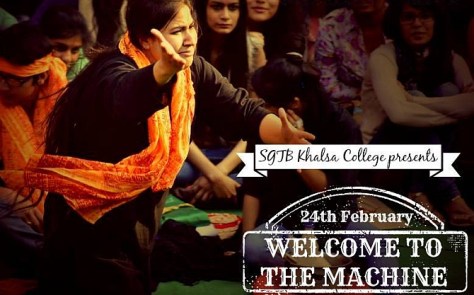
Guest Post by MALVIKA SHARAD on the recent call by Delhi University Students’ Union for a ban on the street play by Khalsa College theatre group, Ankur.

24lead6

Image courtesy rediff.com

One evening in 2013, a group of ‘street play seniors’ as we call them, visited us in the front lawns of my college, Lady Shri Ram College for Women. They were from various colleges across DU who had been actively involved in street theatre, and had been invited to give the newly formed street play team of that year, an introduction to the art form. Among those seniors was a dynamic young chap from Khalsa College, who reiterated several times that street theatre fills you with such immense courage that you end up doing things you never thought you would, for that courage comes from the sheer truth and brutal honesty that street theatre is based upon. He said that freedom of expression is taken to a whole new level when you perform amidst crowds, and state the truth looking directly into their eyes. A fire is born within you that cannot be extinguished, it burns brighter with every performance of the play. You become fearless in voicing your opinions and thoughts, so fearless that you don’t even realize how far you have pushed your own limits and emerged triumphant.

After a whole year dedicated to doing street plays in Delhi, I have learnt how right he was, that young student not much older than us. I find I have come out of my shell, shedding my inhibitions at a pace and scale I had never imagined. Torn chappals don’t bother me anymore, my sun-burned skin makes me look beautiful, I don’t flinch with embarrassment while sitting, sometimes lying, on the floor of the metro station out of sheer weariness, though co passengers stare at me with judgemental eyes, I can’t bring myself to stop romanticizing the mud and the dirt that hug me every time I wear my soiled street play kurta… But above all, I can articulate my thoughts properly now, I am not scared of speaking in public unlike the times when I was a meek docile person, cocooned in the comforts of home and parental pampering. I owe this change in my attitude and personality to street theatre, which taught me what it is to live confidently and fearlessly.

Continue reading Ban-man on the prowl again: Malvika Sharad

People’s Union for Democratic Rights Condemns Bans on Cow Slaughter

Statement by People’s Union for Democratic Rights 
On March 16th 2015, the Haryana Government unanimously passed Haryana Gauvansh Sanrakshan and Gausamvardhan Bill with main opposition parties INLD and Congress supporting the Bill. The new bill passed by the Haryana Government bans cow slaughter and sale of beef and imposes a punishment of rigorous imprisonment of not less than three years extending up to 10 years and fines ranging from Rs. 30,000 to Rs. one lakh. The Haryana Government’s move comes just days after the President’s assent to Maharashtra Animal Preservation (Amendment) Bill 1995 early this month. Maharashtra Animal Preservation (Amendment) Bill 1995 not only banned beef but also extended the prohibition to slaughter of bulls and oxen. There was already a ban on slaughter of cows in Maharashtra since 1976.  The new amended act imposes a fine of Rs. 10,000 and a maximum prison term of five years for selling or even possessing beef.
What needs to be underlined here is that these bans on cow slaughter are not new; they were in existence in many of the states for many-many years. For example in Delhi, Bihar, Andhra Pradesh, slaughter of cows and calves is totally prohibited. In Goa and Andhra Pradesh, ‘cow’ is defined to include heifer, or a male or female calf of a cow under the Goa, Daman and Diu Prevention of Cow Slaughter Act 1978 and Andhra Pradesh Prohibition of Cow Slaughter and Animal Preservation Act 1977, respectively. In some states like Karnataka, Andhra Pradesh, Goa and Madhya Pradesh slaughter of bulls, bullocks and adult buffalos is permitted on ‘fit for slaughter’ certificate if the cattle is over 12 or 15 years of age, is not likely to become economical for draught, breeding or milk. Assam and West Bengal provides for slaughter of all cattle which includes bull, bullocks, calves, cows and buffalo on ‘fit for slaughter’ certificate. Meghalaya and Nagaland have no legislation to this effect.

Continue reading People’s Union for Democratic Rights Condemns Bans on Cow Slaughter

Tribute to Tahira Mazhar Ali: Kavita Panjabi

Guest Post by KAVITA PANJABI

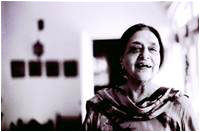
Kavita Panjabi honours the memory of a South Asian feminist from Pakistan who effortlessly produced an ” ‘us’ across generations, contexts and movements”, an ‘us’ across “Kolkata, Dhaka and Delhi, Lahore, Peshawar and Karachi.”

Begum Tahira Mazhar Ali Khan

Just read about Tahira Mazhar Ali passing away, feeling really sad, hence this short piece.

I met her only thrice, and it was like I carried her within me all these years.

The first time was in 2001 at a seminar organized by ASR in Lahore on the 30th anniversary of the genocide in Bangladesh. She came up to chat after my presentation on the Mahila Atma Raksha Samity (MARS) and the Tebhaga women’s movement, excited. It had taken her on a nostalgia trip, and she said she remembered the MARS on a collection drive for the Bengal Famine in Lahore too; many, including she, had taken off the gold bangles they were wearing and contributed on the spot.  Continue reading Tribute to Tahira Mazhar Ali: Kavita Panjabi

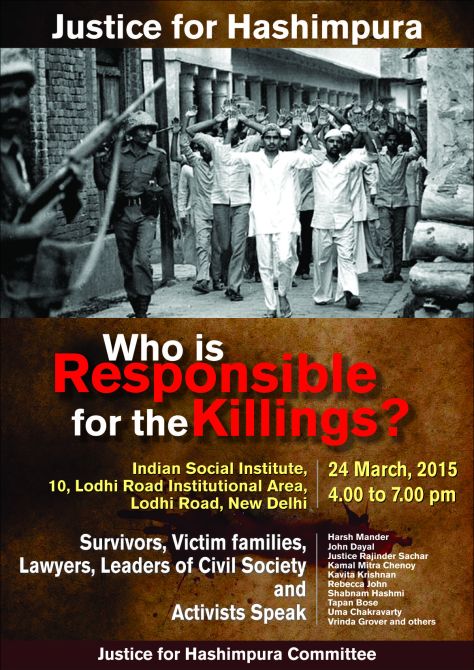
Justice for Hashimpura!

hashmipura killing Poster (1)

Remembering Nishith Bhattacharya, unsung revolutionary hero: Basu Acharya

Guest pots by BASU ACHARYA

The morning of February 15th this year was exceptionally grim. The sun looked pale, its rays mangled, as if somebody had scratched its face with a scalpel blade of tempered steel. Ramakrishna Naskar lane, an obscure by-lane in Beleghata area of Kolkata, was suddenly bustling with unusual activity. A number of people, quite a few in fact, irrespective of the nature of the red flags they carry, had gathered before a modest dwelling; assembled to bid adieu (with clenched fists and the ‘Internationale’ on their lips) to an old man, an octogenarian, wrapped in a crimson cloth with a crossed hammer and sickle in white. Prof. NB, our very own Nishith-da, Comrade Nishith Bhattacharya was no more. Leaving his mortal remains for the pyre to consume and his comrades to weep over, he had left for the final voyage—journey ‘to the undiscovered country from whose bourn no traveller returns’.

My association with Nishith-da dates back to the early years of the past decade when India, like many other ‘developing countries’ of the world, was passing through the initial days of the second information revolution. I, then an activist of a tiny student-youth organisation, met him on the book-fair ground at Maidan and asked scores of questions about Naxalbari and related topics. Most surprisingly, he, without a slightest mark of impatience on his face, answered each question with brutal accuracy and won my heart. From then onwards I was his admirer, also his disciple, who could even dispose of his own thumb—if asked. There are so many fond memories such as this, and as I scribble this piece, old thoughts crowd my mind and the panorama of our decade-long association appear before my eyes. But honestly speaking, it will be absolutely criminal if we limit a man of Nishith-da’s stature to any personal reminiscence. Rather, it is better to tell the story of his life and time in considerable length and as dispassionately as possible, for history should be impartial nay objective.

Continue reading Remembering Nishith Bhattacharya, unsung revolutionary hero: Basu Acharya

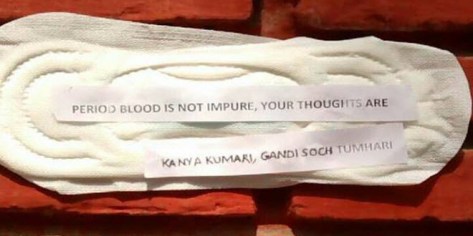
#PadsAgainstSexism campaign at Jamia Milia, Delhi

padsagainstsexism-3

Sanitary pad with message against sexism on Jamia campus

19-year-old Elona Kastrati started the #PadsAgainstSexism campaign in her hometown of Karlsruhe, Germany.

“I thought about how society gets offended by a normal pad. I thought about it so much, the idea came to me to write quotes on them,” she says. So she did.

c5a546f0-cd6d-11e4-93da-f5c367e4b24e_Pads-Against-Sexism-Elona-

Continue reading #PadsAgainstSexism campaign at Jamia Milia, Delhi

Politicians Say the Darndest Things: The Ladies Finger

THE LADIES FINGER gives the finger to politicians and their charming attitudes towards women.

Yesterday in Parliament, Sharad Yadav, head of the Janata Dal (United) and member of the Rajya Sabha, tried to prove he was cool. During a debate on the Insurance Bill, he broke off to talk about south Indian women. What this had to do with the matter at hand is questionable, but here’s what the Indian Express reported from Parliament:

The women of the south are dark but they are… their bodies…”
At this point members sitting around him tried to bring him back to the topic at hand with cries of “Sharadji Bill”. But, Yadav was not finished yet and talked about the “dancing skills” of south India women.

Soon, Trinamool Congress’s Derek O’Brien frantically waved at Yadav to stop.

Want to bet that when he spoke of “dancing skills”, this is what he had in mind?

sridevi-206x300

But it didn’t end there.

Read the rest of this devastating take down at The Ladies Finger.

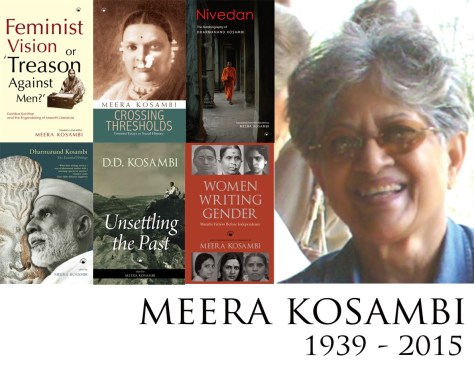
Paying tribute to Meera Kosambi: Uma Chakravarty

kosambiobit

Image courtesy Permanent Black

Meera Kosambi, best known for her scholarship on Pandita Ramabai, passed away at the end of February. Uma Chakravarty, feminist historian, writes on FeministsIndia about the work of Meeratai, as she sternly admonished me to address her, when I casually called her Meera! I met her only once, a few years ago, and was enthralled through the lovely Maharashtrian dinner she had prepared, by her personal warmth and sharp intellect. ‘I dont like these Western ways of addressing older people’, she had said, ‘We have such lovely words of respect and affection, why not use them?’

Meeratai, you will live through your work. Salaam.

And here is Uma Chakravarty: 

Many years ago, before Meera Kosambi began to write on women in 19th Century Western India, a region that I wrote on in my work on Pandita Ramabai, the only Kosambi on my intellectual horizon was D.D. Kosambi, her father, who towered over the history writing scene.

So it was not surprising that when I first met her sometime in the 1990s, a lot of our conversation was about her father and also about her grandfather Dharmanand Kosambi because of my interest in Buddhism. Belonging to such an illustrious family it would have been difficult to carve a distinctive space for herself as Meera Kosambi certainly did.

Read the rest of this tribute here.

Indian feminists, ‘India’s daughter’, and sexual violence: The issues at stake*

International-women-s-day

Today, on International Women’s Day I am proud to acknowledge the deeply contested terrain that we call feminism in India, in which no claim goes unchallenged, no issue is undisputed (and some might say, no good deed goes unpunished!) In which over the decades, every stand and every understanding on practically every issue, has been painfully rethought and reformulated in the face of intense questioning from newer claims and voices.

In the clamour of feminist responses both to Leslee Udwin’s documentary ‘India’s Daughter’, as well  as to the Indian state’s crackdown on it, some themes have emerged that reflect profound fault lines in our (feminist) understanding – not so much of sexual violence itself – but of what to do about it; how to act upon the knowledge of widespread misogyny and pervasive masculinist violence; how to acknowledge that sexual violence cannot be understood except as refracted through prisms of caste, class, Indian state militarism and… a list that will inevitably end in ‘etc’ regardless of how long it is; and in this particular case, above all, what sorts of representations of sex and sexual violence will further our ethical ambitions, and what others will undo decades of work.

In what follows, I will try to uncover some of these themes, on the explicit understanding that I do not claim to have resolved any of the debates, nor even to have highlighted all of them. This is a partial, personal attempt to make sense of the recurring ideas in a tumult of intelligent, concerned and strongly articulated opinions, in the course of which I will of course, make my own views explicit too.

First, perhaps I should state immediately that I saw ‘India’s Daughter’ and liked it very much. This is just to get it out of the way, because my opinion on the film is irrelevant to my belief that freedom of speech and expression ought to be a value that feminists defend at all costs. I did not hold such a strong view on freedom of expression in an earlier decade, but I do now, at the beginning of the 21st century, when it has become increasingly clear that the silencing of uncomfortable voices, even unto murder, has become the preferred mode of snuffing out debate globally.

Continue reading Indian feminists, ‘India’s daughter’, and sexual violence: The issues at stake*

The only New York we see: Juhi Tyagi and Karn Kowshik

Guest Post by JUHI TYAGI AND KARN KOWSHIK

When most tourists visit New York City, what they see is the New York that you see on TV – Times Square, Carnegie Hall, a Broadway Show and maybe a visit to the Legendary Soup Nazi. Our view of the City, though, was vastly different. As one of the authors visited New York for the first time, in the wake of cop killings of young black men in Ferguson, Staten Island and East NY, what we saw was the transformation of neighbourhoods into armed police camps, and a city torn by sharp racial divide.

Maybe our experience of New York was coloured by where we lived and spent most of our time. A tiny apartment on the same street as the 79th Precinct in Brooklyn; not far from where two NYPD officers were shot dead by a mentally unstable man in December 2014. In many of these neighbourhoods, the first piece of advice you got wasn’t about the coolest neighbourhood bar. It was: “On the streets, don’t run, don’t make sudden movements. If a cop stops you, keep your hands out of your pockets and don’t talk back. You don’t want to get shot.”

Continue reading The only New York we see: Juhi Tyagi and Karn Kowshik

The Land Ordinance (now Bill) is Bringing Back the Colonial Legacy: NAPM

Statement from National Alliance of People’s Movements

The Real Battle is between Farmers and Land Grabbing Corporates and BJP, not between Bharat and Pakistan!

16633316162_2fcb9a5538_n

Protest Against Land Ordinance, February 2015 Delhi

Image courtesy Joe Athialy

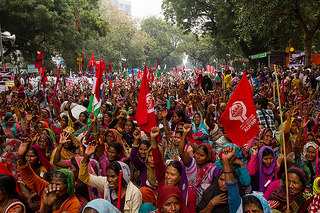
Forcible land acquisition has always been an issue of life and death for millions of people in India, not only farmers but also agricultural laborers and fish workers. With the Land Ordinance it has become a political hot potato. More than 350 people’s organizations gathered at Parliament Street on February 24th, with 25,000 people from Gujarat to Orissa to Assam, and from Himachal Pradesh to Tamil Nadu and Kerala. This show of strength has forced the political parties to take a stand on the issue, leading to heated debates and discussion on the floor of the Parliament. The Ordinance, now Bill, reflects the anti-farmer and anti-poor move of un-democratically amending the 2013 Act on Land Acquisition and Rehabilitation, killing its very spirit and purpose.

The Ordinance brought in by the NDA government just after the Winter session of the Parliament came to an end was an obvious imposition on the country’s common people, of the colonial legacy of a perverted vision of development through an unjust and undemocratic modus operandi. The Ordinance is an attempt to open up the land that is the life support, source of livelihood and shelter for India’s toiling masses, to wealthy investors, including big corporations and builders. Its intention is to forcibly divert India’s agricultural land at the cost of food security, giving a free hand with no ceiling to the private companies as well as private entities i.e. private trusts and expensive profit-making educational and health institutions. The intention is to benefit private interests in the name of public interest.
Continue reading The Land Ordinance (now Bill) is Bringing Back the Colonial Legacy: NAPM