All posts by Nivedita Menon

Memories of Drought: Bharat Patankar

Guest post by BHARAT PATANKAR

English translation of Marathi article published in Sakal

Some years had passed since the completion of the Koyna dam which was the basis for the all-round development of Maharashtra.   Electricity had begun to be produced from the water stored in the dam.   The campaign to bring electricity to the villages had begun.  An increase in industrial development also began to be felt; however the situation of agriculture was as shown in the film, “Mother Krishna is flowing calmly”.   The situation is described in the song, “Mother Krishna is flowing calmly, unaware of happiness or sorrow on her banks/ Limitless water flows without a break; nobody diverts it for irrigating the land/ how can this Ganges become fruitful to the lazy people?”   Such was the situation.  It was not only true for the Krishna.  It was also the case for the Godavari and Tapi.  Agriculture was still dependent on wells and rainfall for irrigation.  Aside from Mulshi, Rajewadi, Bhatghar and other dams of the British period and a few dams after independence, all of Maharashtra was like this.

The 1972-3 drought was general.  Continue reading Memories of Drought: Bharat Patankar

Notes from the warfront: Maruti workers ‘on trial’: Rakhi Sehgal

Guest post by RAKHI SEHGAL

Friday, 17 August 2012  – Gurgaon Civil court

There is a ‘list of 162’ workers that has not been disclosed but which forms the basis for the police to either arrest or let go of Maruti workers once they are picked up. The family members of these 162 are being harassed and intimidated and being visited thrice a day by local police, sometimes accompanied by Gurgaon police – at times 12-15 police show up.

After they pick up one of the workers (who is on this list of 162) he is processed as an accused under the same FIR 184 under which the union leaders and the earlier batch of 91 workers were arrested.  The FIR names 55 workers and then says ‘500/600 others’, so anyone being picked up is being processed as part of this unnamed 500/600 others.

Under intense questioning by Advocate Rajender Pathak, the SHO Manesar PS, Om Prakash Bishnoi, admitted that the ‘list of 162’ is based on a list given by management. Although Adv. Pathak requested that the judge note this point, the judge did not do so. Instead the judge merely directed that the statements of the SHO are unsatisfactory and has asked him to come back on 22 August with more satisfactory explanations. Continue reading Notes from the warfront: Maruti workers ‘on trial’: Rakhi Sehgal

We have lost to the judicial machine, but still we have won: Pussy Riot

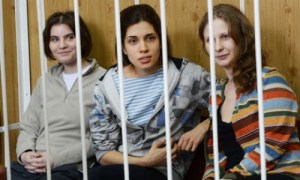
On February 21 this year, Maria Alyokhina (24) Nadezhda Tolokonnikova (22) and Yekaterina Samutsevich (30) of the punk band Pussy Riot, stormed into Moscow’s Christ the Saviour Cathedral and belted out a ‘punk prayer’, asking the Virgin Mary to “Throw Putin out!” They were charged with hooliganism motivated by religious hatred.

The three have been held more than five months at Pre-Trial Detention Facility No. 6, near Pechatniki metro station in Moscow.

In her defiant and thoughtful closing statement at the trial a couple of days ago, Yekaterina Samutsevich  said:

In the closing statement, the defendant is expected to repent, express regret for their deeds or enumerate attenuating circumstances. In my case, as in the case of my colleagues in the group, this is completely unnecessary. Instead, I want to voice my thoughts about the reasons behind what has happened to us. Continue reading We have lost to the judicial machine, but still we have won: Pussy Riot

Rejoinder to story on Soni Sori in Indian Express: International Alliance for Defence of Human Rights in India

The  International Alliance for Defence of Human Rights in India (IADHRI) is based in the US and has participated in the campaigns for the release of Dr. Binayak Sen, Kopa Kunjam and now more recently Soni Sori and Lingaram Kodopi.

On August 5th, The Indian Express published a disturbing, supposedly investigative story on Soni Sori, implying both that she was guilty of the charge of being a Maoist as well as casting doubt on the activists in India and outside who support her, and who are mainly responsible for bringing into the open the fact that she was and continues to be tortured in prison.

The IADHRI has written this response to the story, rebutting it point by point.

That the media often compromises its integrity for corporate interests and the political elite is not news any more. The recent Sunday Express report titled ‘Soni’s Story’ is symptomatic of a belief that if a lie is repeated often, it becomes the accepted truth.  The report talks of Soni Sori, the Adivasi school teacher from Dantewada, Chhattisgarh, who has been arrested and accused of being a Maoist conduit. With a clever sprinkling of truth, a report can seem unbiased- the reporter appears to be the warrior fighting to find facts and settling for nothing less. It is, however, imperative that fallacies be broken down, and the casual picking and choosing of facts be exposed for what it is. Let us use the same structure that the story uses. Continue reading Rejoinder to story on Soni Sori in Indian Express: International Alliance for Defence of Human Rights in India

“It would have been better if you had given me Death Penalty” : Soni Sori

Translation of letter in Hindi written by Soni Sori from Raipur Prison on July 28, 2012.

(From kracktivist)

Letter in name of Supreme Court Judge  from Raipur Jail

Your Honour ,

Today I am alive , because of your verdict. You gave the order at the right time so that  I could be  medically treated again.  I was very happy during my treatment at AIIMS hospital in New Delhi, but  Your Honour ,  I have to pay for it now. I am being  harassed and tortured here, I request you to have mercy on me . Your Honor I am  suffering mentally .

1. I am made to sit on the Ground  ”Naked”

2. I am suffering from Hunger

Continue reading “It would have been better if you had given me Death Penalty” : Soni Sori

“Sexism is as common as sweat at the London Olympics”

Annie-Rose Strasser draws our attention to some delicious instances of sexism at the Olympics, from  from female boxers being asked to wear skirts to differentiate them from the men, to women’s teams taking coach while men’s fly first class.

Meanwhile 18 year-old British Olympic weightlifter Zoe Smith responded sharply on her blog to Twitter-brains tweeting or chirping that she is too manly:

[We] don’t lift weights in order to look hot, especially for the likes of men like that. What makes them think that we even WANT them to find us attractive? If you do, thanks very much, we’re flattered. But if you don’t, why do you really need to voice this opinion in the first place, and what makes you think we actually give a toss that you, personally, do not find us attractive? What do you want us to do? Shall we stop weightlifting, amend our diet in order to completely get rid of our ‘manly’ muscles, and become housewives in the sheer hope that one day you will look more favourably upon us and we might actually have a shot with you?! Cause you are clearly the kindest, most attractive type of man to grace the earth with your presence.

Oh but wait, you aren’t. This may be shocking to you, but we actually would rather be attractive to people who aren’t closed-minded and ignorant. Crazy, eh?! We, as any women with an ounce of self-confidence would, prefer our men to be confident enough in themselves to not feel emasculated by the fact that we aren’t weak and feeble.

Having fun yet?

Why the Maldivian ski team is good in short bursts (and other reflections on the Olympics): Sajan Venniyoor

Guest post by SAJAN VENNIYOOR

Now that the 2012 London Olympics has established its progressive republican credentials by recruiting former cold-war assassin, James Bond, to hurl Britain’s 86 year old Queen from a helicopter, following it up with tributes to labour unions, suffragettes, people of colour and the National Health Service (or as the Tories say, ‘leftie multicultural crap’), could we ask some fundamental questions like, what the hell is an ‘Olympic sport’ and how does a 71 year old man in a top-hat sitting on a very expensive horse exemplify the virtues of going faster, jumping higher and being stronger, unless the medal goes to the horse?

Continue reading Why the Maldivian ski team is good in short bursts (and other reflections on the Olympics): Sajan Venniyoor

Review: ‘Impeachment’ by Anjali Deshpande

Guest post by KIRAN SHAHEEN

Impeachment by Anjali Deshpande, published by Hachette India, is a well-told fictional narrative skilfully woven around the aftermath of the shameful disaster commonly known as the Bhopal Gas Tragedy.

The novel is dedicated to Dr Heeresh Chandra, a name we have seldom heard in the 28 years since the tragedy. Who is this doctor to whom the book is dedicated? The author, in a conversation says that for her, this doctor of the dead is not simply unsung but the only true hero of Bhopal.

While reading Impeachment it is difficult to decide whether it is history claiming to be fiction or fiction masquerading as history. The novel recounts actual incidents that still haunt us, intertwined with the fictional private lives of activists that are also the arena of intense gender and caste politics.

Continue reading Review: ‘Impeachment’ by Anjali Deshpande

The year climate change became common sense: Jacob Sebastian

Guest post by JACOB SEBASTIAN

 Is 2012 the watershed year for climate change? The year it ceases to be a ‘dodgy concept’ and transforms into painful reality?

Some facts to consider:

 *The United States – particularly the food basket that is the American Midwest, is facing its “worst drought” since the 1950s, and is expected to last all summer. US agricultural secretary Tom Vilsack told the media: “If I had a rain prayer or a rain dance I could do, I would do it.” The US is the world’s second biggest food producer, after China, but more importantly, one of the biggest exporters of food.

*Prices of the four key crops: Corn, wheat, sugar and soybean have risen 44%, 48%, 22% and 26% over the last month. The United States produces 41% of the world’s corn and 38% of the world’s soybeans. The two crops comprise two of the four largest sources of caloric energy produced and are thus critical for world food supply. Continue reading The year climate change became common sense: Jacob Sebastian

A blow to reproductive rights in Pakistan: Ayesha Asghar

Guest post by AYESHA ASGHAR

Early in July, Kashmala Tariq, Member of the National Assembly (MNA) of Pakistan, whom Wikipedia describes as “actively involved in women’s rights”, opposed the tabling of the Reproductive Health Bill 2012, saying that it was not in conformity with Islamic laws. The Bill was introduced by another MNA, Atiya Inayatullah, with the purpose of providing reproductive health services, including legal access to abortion,  to women in Pakistan.

Tariq accused the Bill of following the agenda of foreign NGO’s and stated that such proposals that might be in contravention of Islamic injunctions should be sent to the Council of Islamic Ideology and every party’s opinion should be sought. The Bill has been sent to the Cabinet Division for further deliberations.

Does this mean that our women representatives don’t know what reproductive rights include? The responsibility of women parliamentary representatives in Pakistan is more challenging than that of men, as women are more often made victims of oppression either in the name of culture or religion.

Continue reading A blow to reproductive rights in Pakistan: Ayesha Asghar

On bodies and gender, and what Pinki Pramanik teaches us

The story of Pinki Pramanik and her partner can be pieced together like any other story of intimacy gone bad. After all, human beings invariably encounter pain and betrayal in intimate relationships, just as they encounter joy and desire. No relationship is free of power, whether produced by individual personalities or by social structures — patriarchy, the assumption of heterosexuality as natural, caste, class, race. Why then has Pinki’s story become about something else altogether? Because we assume that our bodies are “naturally” male or female.

But would anyone pass a gender test?

(Here’s the rest of this short piece published in Indian Express yesterday).

Last year I had posted The disappearing body and feminist thought on kafila, raising very much the same issues.

Fallacious perceptions of development – a tribal view from Jharkhand: Richard Toppo

Guest Post by RICHARD TOPPO

Almost a century ago, Katherine Mayo published a book titled ‘Mother India’ that criticized the Indian way of living, and Rudyard Kipling  spoke of the ‘White Man’s Burden’. These writings reflected the colonial perspective that what colonizers did was in the best interest of the colonized people. Consequently, most well-meaning citizens of colonial powers were alienated from the horrible plight of the colonized. Purpose well served – unopposed exploitation.

Years later, independent India seems to walk the same line. The tribal communities in central areas of Jharkhand, Orissa and Chhattisgarh have faced rampant exploitation, displacement and dispossession from their resources at the hands of the state. However, the government has successfully produced  an illusionary perception of ‘development’ that has alienated the middle classes of India from the miseries of tribals. As a result, the government in alliance with corporate interests ruthlessly exploits the tribal population, almost unchallenged by other sections of  society. Continue reading Fallacious perceptions of development – a tribal view from Jharkhand: Richard Toppo

Girls, Science and Sexism

Thanks to friends on feministsindia list for these links. The first is a how-not-to and the second, an alternative vision – essentially, just pictures of women actually doing science!

EU made this demeaning and sexist video to encourage women to do science. Take a look at the outraged comments that follow from women scientists.  It was taken down from their website after the negative feedback they received.

(Courtesy Sangeeta Chatterji)


And the alternative:

Girls Doing Science via the blog Feminist Philosophers

(Courtesy Sana Contractor)

Consent, Age and Agency: reflections on the recent Delhi High Court judgement on minors and marriage: Flavia Agnes

This is a guest post by FLAVIA AGNES

I am responding to the sense of despair expressed by some women’s groups and more specifically to the press conference called by Bharatiya Muslim Mahila Andolan (BMMA)  to condemn the judgment of the Delhi High Court which permitted a minor (almost 16-year old) girl to marry the man of her choice rather than restore her back to her parental authority.  In their campaign for codification of Muslim law, BMMA has asked for laying down 18 as the minimum age of  marriage for girls (and 21 for boys), the underlying presumption being that all underage marriages must be declared as void.

Before we come up with a knee jerk response to the hype created by the media and bite the bait,  we need to have greater clarity on whose side we (feminists) are batting in this confrontation between  parental authority and the active  agency expressed by a teenaged girl. Also I wish to raise a connecting question — if the Muslim law was codified and minimum age for marriage was stipulated, as has been done under the Hindu Marriage Act, would the High Court have responded differently?  Would the judges have sent the girl back to her parental custody?  And the last question – could that have been construed as a ‘progressive ruling’ by us, those claiming to be “feminists”? Continue reading Consent, Age and Agency: reflections on the recent Delhi High Court judgement on minors and marriage: Flavia Agnes

Cartoon controversy – In conversation with Satyanarayana: Sharmila Rege

Guest post by SHARMILA REGE

Satyanarayana’s interview addresses the crucial issue of a sharp division between the dalit and the left/liberal viewpoint on the NCERT textbook cartoon controversy. Clearly, Satyanarayana’s foregrounding of this difference is not a denial of the differences between the positions taken by dalit intellectuals in this debate. Further, Satyanarayana is referring not just to responses by dalit academicians but to the presence of critical viewpoints in the larger dalit public sphere – the very perspective/viewpoints that Liberal/Left/feminists have in a sense not seriously engaged with, equating them to ‘manipulations by opportunistic dalit leadership’ or /and ‘always and already emotional iconisation of Ambedkar’.  In fact, despite   important differences between the arguments put forth by Satyanarayana, Gopal Guru, Anoop Kumar, Harish Wankhede, Raj Kumar and other dalit intellectuals; all of them interrogate these hasty conclusions about irrational or manoeuvred dalit publics. Gopal Guru  contends   that the controversy has created a field of power in which even the supporters of Ambedkar and Dalits have ended up reproducing the compounded insult  through two assumptions –that Ambedkar belongs to the dalits and that dalits are pathologically emotional and thus not capable of rational independent views.

Continue reading Cartoon controversy – In conversation with Satyanarayana: Sharmila Rege

Foregrounding Insult: Gopal Guru

Guest post by GOPAL GURU

Let me at the very beginning make it clear that I do not want to discuss insult in the context of the recent cartoon. Although I think that a progressive interpretation of that recent cartoon may not lead to the feeling of insult and hurt.

I would like to discuss here who should feel insulted and under what subjective conditions? Those who have inherited insult from the past, not invented it for the present, are the ones who should feel insulted. The past which continues to unfold in a series of social interactions necessarily insults, and gets reproduced through rigid and regressive assumptions.

The gut level or unmediated reaction finds quick expression because those who express it know that it would yield desired reaction from the dalit community which has graduated only in thick emotionalism. Those who offered this unmediated reaction exactly had the same background assumption that Ambedkar exclusively belongs to dalits and dalits have heavy emotional attachment to Babasaheb.

This assumption is insulting for two reasons: Continue reading Foregrounding Insult: Gopal Guru

Ambedkar’s Cartoon and the Caste question: Rajkumar

Guest post by RAJKUMAR

A harrowing monologue is in vogue in the popular media and academic forums apropos a cartoon of Dr. Ambedkar in a Political Science textbook prepared by NCERT for its Class XI students. Apparently, in the cartoon, Ambedkar is depicted being whipped by Jawaharlal Nehru for delaying the framing of the constitution. The cartoon was first published in 1949 and was drawn by cartoonist Shankar Pillai. Though in interior Dalit circles, the cartoon was being despised for denigrating ‘Baba Saheb’ as they lovingly call him, no heed was paid to their sentiments till the issue was raised in the Parliament and taken up by Bahujan Samaj Party chief Mayawati. Government had to concede and the cartoon was removed from the textbook and HRD minister made a public apology for the goof-up followed by resignation of two academicians involved with the curriculum committee.

Continue reading Ambedkar’s Cartoon and the Caste question: Rajkumar

Humiliation condemned to remain ‘Hurt’ – Notes from a talk by Gopal Guru: Parth Pratim Shil & Ankita Pandey

Guest post by PARTH PRATIM SHIL and ANKITA PANDEY

Unni [a cartoon character] asks:

“Am I just a figurehead or am I asking real questions? Did the textbook writers give me power to ask questions I wish to ask or am I asking questions they have in their mind?” [Page 85, Chapter 4: Executive, Indian Constitution at Work, for class XI]

This cartoon appears in the context of the discussion on the powers of the President of India in the political science textbook of NCERT. It seems this question has a function far wider than the limited task of revealing the institutional blueprint of Indian politics. It pushes the student to ask something very uncomfortable. Am I really the one asking the questions I ask? Or am I rehearsing questions that someone else has decided for me?

As teachers of political science, our constant effort is to understand the ways in which power operates. None of the themes of our syllabi can be taught without reference to the resistance, critique and offending positions taken by groups who challenge the status quo. Sanitizing the history of critique and resistance that is encapsulated in satirical modes of representation like cartoons, can only be at the cost of keeping the discipline of political science uprooted from its very object of study. In the recent cartoon controversy, however, the issues at stake are many more than a defence of critical pedagogy.

Continue reading Humiliation condemned to remain ‘Hurt’ – Notes from a talk by Gopal Guru: Parth Pratim Shil & Ankita Pandey

National Appeal on Koodankulam Becomes a Rallying Point for Solidarity Actions Across India

The “Urgent Appeal to the Conscience of the Nation on Koodankulam” open for signatures on DiaNuke.org was released yesterday, May 20th,  in New Delhi, Mumbai and Kolkata. Concerned people and activists are planning release events and readings of the appeal

India Gate, Delhi

in Chennai, Bangalore, Pune, Hyderabad and other cities in coming weeks. Grassroots organisations are distributing the appeal as pamphlet, translated in regional languages.

This Sunday, Vandana Shiva, renowned environmentalist and eco-feminist, released the national appeal on Koodankulam at the India Gate in New Delhi. Releasing the appeal, she expressed her anguish on the undermining of democracy by the Indian government in its pursuit of nuclear energy. Inviting NIMHANS doctors to ‘treat’ the mindset opposing nuclear energy projects is reflective of the nuclear-obsessed government’s contempt for its own people and their concerns, she said. Continue reading National Appeal on Koodankulam Becomes a Rallying Point for Solidarity Actions Across India

[UPDATED] Urgent Appeal to the Conscience of Nation on Koodankulam

Statement issued from the struggle against the Koodankulam nuclear power plant.

This statement is a reflection of our collective frustration and instead of being sent to the Government, it will be presented before people of India on May 20th (6 pm) at the India Gate, New Delhi.

It is already endorsed by prominent figures like Prashant Bhushan, Vandana Shiva, Lalita Ramdas, Partha Chatterjee, Parful Bidwai, Achin Vanaik, Gnani Sankaran, John Dayal, Meher Engineer, Sandeep Pandey.

Please send the e-petition on DiaNuke.org.

Endorsements can also be directly sent to cndpindia@gmail.com

Dear Fellow Citizens of India,

On the occasion of our Parliament, the pinnacle of democratic governance, celebrating its 60th anniversary, our hard earned democracy is being ruthlessly repressed and violently suppressed. Within the accelerated race towards ‘destructive development’ and the generation of nuclear power to fuel such ‘development,’ entirely peaceful mass protests voicing people’s legitimate dissent are brutally put down. The common man, woman and child are unheard. In utter desperation, people at large are surrendering their ‘Voter ID cards,’ the ultimate symbol of ‘people’s power,’ which is the essence of any genuine democracy. Can there be a more ominous way to dissent?

Continue reading [UPDATED] Urgent Appeal to the Conscience of Nation on Koodankulam

Memories of Cricket: Sameer Khan

Guest post by SAMEER KHAN

My 8th standard final exams were nearing and they coincided with the1992 World Cup cricket match between India and Pakistan. It was the most important match for India, much more important than the final – defeating Pakistan was no less than winning the world cup.  As I sat studying in the bedroom, I could hear Ratan’s peculiar whistle, and I rushed to the balcony. It was drizzling, and Ratan stood there in the shelter of the bus stop along with Uday,  smiling sheepishly.

Abbajan  sat on his armchair in the hall, fortunately he seemed to have dozed off watching TV, I sneaked past him. It was still drizzling, I was glad to see that Uday actually carried an umbrella with him. All three of us huddled under the black umbrella as we made our way towards Ratan’s house which was about 15 minutes walking distance from my house.

Continue reading Memories of Cricket: Sameer Khan