All posts by Nivedita Menon

On bodies and gender, and what Pinki Pramanik teaches us

The story of Pinki Pramanik and her partner can be pieced together like any other story of intimacy gone bad. After all, human beings invariably encounter pain and betrayal in intimate relationships, just as they encounter joy and desire. No relationship is free of power, whether produced by individual personalities or by social structures — patriarchy, the assumption of heterosexuality as natural, caste, class, race. Why then has Pinki’s story become about something else altogether? Because we assume that our bodies are “naturally” male or female.

But would anyone pass a gender test?

(Here’s the rest of this short piece published in Indian Express yesterday).

Last year I had posted The disappearing body and feminist thought on kafila, raising very much the same issues.

Fallacious perceptions of development – a tribal view from Jharkhand: Richard Toppo

Guest Post by RICHARD TOPPO

Almost a century ago, Katherine Mayo published a book titled ‘Mother India’ that criticized the Indian way of living, and Rudyard Kipling  spoke of the ‘White Man’s Burden’. These writings reflected the colonial perspective that what colonizers did was in the best interest of the colonized people. Consequently, most well-meaning citizens of colonial powers were alienated from the horrible plight of the colonized. Purpose well served – unopposed exploitation.

Years later, independent India seems to walk the same line. The tribal communities in central areas of Jharkhand, Orissa and Chhattisgarh have faced rampant exploitation, displacement and dispossession from their resources at the hands of the state. However, the government has successfully produced  an illusionary perception of ‘development’ that has alienated the middle classes of India from the miseries of tribals. As a result, the government in alliance with corporate interests ruthlessly exploits the tribal population, almost unchallenged by other sections of  society. Continue reading Fallacious perceptions of development – a tribal view from Jharkhand: Richard Toppo

Girls, Science and Sexism

Thanks to friends on feministsindia list for these links. The first is a how-not-to and the second, an alternative vision – essentially, just pictures of women actually doing science!

EU made this demeaning and sexist video to encourage women to do science. Take a look at the outraged comments that follow from women scientists.  It was taken down from their website after the negative feedback they received.

(Courtesy Sangeeta Chatterji)


And the alternative:

Girls Doing Science via the blog Feminist Philosophers

(Courtesy Sana Contractor)

Consent, Age and Agency: reflections on the recent Delhi High Court judgement on minors and marriage: Flavia Agnes

This is a guest post by FLAVIA AGNES

I am responding to the sense of despair expressed by some women’s groups and more specifically to the press conference called by Bharatiya Muslim Mahila Andolan (BMMA)  to condemn the judgment of the Delhi High Court which permitted a minor (almost 16-year old) girl to marry the man of her choice rather than restore her back to her parental authority.  In their campaign for codification of Muslim law, BMMA has asked for laying down 18 as the minimum age of  marriage for girls (and 21 for boys), the underlying presumption being that all underage marriages must be declared as void.

Before we come up with a knee jerk response to the hype created by the media and bite the bait,  we need to have greater clarity on whose side we (feminists) are batting in this confrontation between  parental authority and the active  agency expressed by a teenaged girl. Also I wish to raise a connecting question — if the Muslim law was codified and minimum age for marriage was stipulated, as has been done under the Hindu Marriage Act, would the High Court have responded differently?  Would the judges have sent the girl back to her parental custody?  And the last question – could that have been construed as a ‘progressive ruling’ by us, those claiming to be “feminists”? Continue reading Consent, Age and Agency: reflections on the recent Delhi High Court judgement on minors and marriage: Flavia Agnes

Cartoon controversy – In conversation with Satyanarayana: Sharmila Rege

Guest post by SHARMILA REGE

Satyanarayana’s interview addresses the crucial issue of a sharp division between the dalit and the left/liberal viewpoint on the NCERT textbook cartoon controversy. Clearly, Satyanarayana’s foregrounding of this difference is not a denial of the differences between the positions taken by dalit intellectuals in this debate. Further, Satyanarayana is referring not just to responses by dalit academicians but to the presence of critical viewpoints in the larger dalit public sphere – the very perspective/viewpoints that Liberal/Left/feminists have in a sense not seriously engaged with, equating them to ‘manipulations by opportunistic dalit leadership’ or /and ‘always and already emotional iconisation of Ambedkar’.  In fact, despite   important differences between the arguments put forth by Satyanarayana, Gopal Guru, Anoop Kumar, Harish Wankhede, Raj Kumar and other dalit intellectuals; all of them interrogate these hasty conclusions about irrational or manoeuvred dalit publics. Gopal Guru  contends   that the controversy has created a field of power in which even the supporters of Ambedkar and Dalits have ended up reproducing the compounded insult  through two assumptions –that Ambedkar belongs to the dalits and that dalits are pathologically emotional and thus not capable of rational independent views.

Continue reading Cartoon controversy – In conversation with Satyanarayana: Sharmila Rege

Foregrounding Insult: Gopal Guru

Guest post by GOPAL GURU

Let me at the very beginning make it clear that I do not want to discuss insult in the context of the recent cartoon. Although I think that a progressive interpretation of that recent cartoon may not lead to the feeling of insult and hurt.

I would like to discuss here who should feel insulted and under what subjective conditions? Those who have inherited insult from the past, not invented it for the present, are the ones who should feel insulted. The past which continues to unfold in a series of social interactions necessarily insults, and gets reproduced through rigid and regressive assumptions.

The gut level or unmediated reaction finds quick expression because those who express it know that it would yield desired reaction from the dalit community which has graduated only in thick emotionalism. Those who offered this unmediated reaction exactly had the same background assumption that Ambedkar exclusively belongs to dalits and dalits have heavy emotional attachment to Babasaheb.

This assumption is insulting for two reasons: Continue reading Foregrounding Insult: Gopal Guru

Ambedkar’s Cartoon and the Caste question: Rajkumar

Guest post by RAJKUMAR

A harrowing monologue is in vogue in the popular media and academic forums apropos a cartoon of Dr. Ambedkar in a Political Science textbook prepared by NCERT for its Class XI students. Apparently, in the cartoon, Ambedkar is depicted being whipped by Jawaharlal Nehru for delaying the framing of the constitution. The cartoon was first published in 1949 and was drawn by cartoonist Shankar Pillai. Though in interior Dalit circles, the cartoon was being despised for denigrating ‘Baba Saheb’ as they lovingly call him, no heed was paid to their sentiments till the issue was raised in the Parliament and taken up by Bahujan Samaj Party chief Mayawati. Government had to concede and the cartoon was removed from the textbook and HRD minister made a public apology for the goof-up followed by resignation of two academicians involved with the curriculum committee.

Continue reading Ambedkar’s Cartoon and the Caste question: Rajkumar

Humiliation condemned to remain ‘Hurt’ – Notes from a talk by Gopal Guru: Parth Pratim Shil & Ankita Pandey

Guest post by PARTH PRATIM SHIL and ANKITA PANDEY

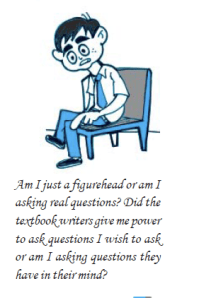
Unni [a cartoon character] asks:

“Am I just a figurehead or am I asking real questions? Did the textbook writers give me power to ask questions I wish to ask or am I asking questions they have in their mind?” [Page 85, Chapter 4: Executive, Indian Constitution at Work, for class XI]

This cartoon appears in the context of the discussion on the powers of the President of India in the political science textbook of NCERT. It seems this question has a function far wider than the limited task of revealing the institutional blueprint of Indian politics. It pushes the student to ask something very uncomfortable. Am I really the one asking the questions I ask? Or am I rehearsing questions that someone else has decided for me?

As teachers of political science, our constant effort is to understand the ways in which power operates. None of the themes of our syllabi can be taught without reference to the resistance, critique and offending positions taken by groups who challenge the status quo. Sanitizing the history of critique and resistance that is encapsulated in satirical modes of representation like cartoons, can only be at the cost of keeping the discipline of political science uprooted from its very object of study. In the recent cartoon controversy, however, the issues at stake are many more than a defence of critical pedagogy.

Continue reading Humiliation condemned to remain ‘Hurt’ – Notes from a talk by Gopal Guru: Parth Pratim Shil & Ankita Pandey

National Appeal on Koodankulam Becomes a Rallying Point for Solidarity Actions Across India

The “Urgent Appeal to the Conscience of the Nation on Koodankulam” open for signatures on DiaNuke.org was released yesterday, May 20th,  in New Delhi, Mumbai and Kolkata. Concerned people and activists are planning release events and readings of the appeal

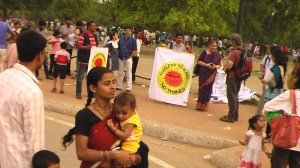
India Gate, Delhi

in Chennai, Bangalore, Pune, Hyderabad and other cities in coming weeks. Grassroots organisations are distributing the appeal as pamphlet, translated in regional languages.

This Sunday, Vandana Shiva, renowned environmentalist and eco-feminist, released the national appeal on Koodankulam at the India Gate in New Delhi. Releasing the appeal, she expressed her anguish on the undermining of democracy by the Indian government in its pursuit of nuclear energy. Inviting NIMHANS doctors to ‘treat’ the mindset opposing nuclear energy projects is reflective of the nuclear-obsessed government’s contempt for its own people and their concerns, she said. Continue reading National Appeal on Koodankulam Becomes a Rallying Point for Solidarity Actions Across India

[UPDATED] Urgent Appeal to the Conscience of Nation on Koodankulam

Statement issued from the struggle against the Koodankulam nuclear power plant.

This statement is a reflection of our collective frustration and instead of being sent to the Government, it will be presented before people of India on May 20th (6 pm) at the India Gate, New Delhi.

It is already endorsed by prominent figures like Prashant Bhushan, Vandana Shiva, Lalita Ramdas, Partha Chatterjee, Parful Bidwai, Achin Vanaik, Gnani Sankaran, John Dayal, Meher Engineer, Sandeep Pandey.

Please send the e-petition on DiaNuke.org.

Endorsements can also be directly sent to cndpindia@gmail.com

Dear Fellow Citizens of India,

On the occasion of our Parliament, the pinnacle of democratic governance, celebrating its 60th anniversary, our hard earned democracy is being ruthlessly repressed and violently suppressed. Within the accelerated race towards ‘destructive development’ and the generation of nuclear power to fuel such ‘development,’ entirely peaceful mass protests voicing people’s legitimate dissent are brutally put down. The common man, woman and child are unheard. In utter desperation, people at large are surrendering their ‘Voter ID cards,’ the ultimate symbol of ‘people’s power,’ which is the essence of any genuine democracy. Can there be a more ominous way to dissent?

Continue reading [UPDATED] Urgent Appeal to the Conscience of Nation on Koodankulam

Memories of Cricket: Sameer Khan

Guest post by SAMEER KHAN

My 8th standard final exams were nearing and they coincided with the1992 World Cup cricket match between India and Pakistan. It was the most important match for India, much more important than the final – defeating Pakistan was no less than winning the world cup.  As I sat studying in the bedroom, I could hear Ratan’s peculiar whistle, and I rushed to the balcony. It was drizzling, and Ratan stood there in the shelter of the bus stop along with Uday,  smiling sheepishly.

Abbajan  sat on his armchair in the hall, fortunately he seemed to have dozed off watching TV, I sneaked past him. It was still drizzling, I was glad to see that Uday actually carried an umbrella with him. All three of us huddled under the black umbrella as we made our way towards Ratan’s house which was about 15 minutes walking distance from my house.

Continue reading Memories of Cricket: Sameer Khan

Please Sir, may I take a newspaper into my class?

At last, the real anxieties lurking behind what has come to be called the “Ambedkar cartoon” controversy are out in the open. It is hideously clear by now that MPs “uniting across parties” are acting as one only to protect themselves from public scrutiny, debate and criticism. It turns out, as some of us suspected all along, that the “sentiments” that have been “hurt” this time are the easily bruised egos of our elected representatives.
(By the way, you may have noticed that “MPs unite across party lines” is not a headline you will ever see after a massacre, a natural calamity, brazen public acts of sexual violence  against women and so on.  Oh no. Such unity is reserved only for utterly self-serving and anti-democratic interpretations of  “Parliamentary privilege”).*

Artist: Abu Abraham

Declared HRD minister Kapil Sibal – “Much before the issue came to parliament, I had already taken action. I called for the NCERT text books and I looked at other cartoons. I realised that there were many other cartoons that were not in good taste and disparaging in nature. They were not sending the right message to our children in classrooms”.

Continue reading Please Sir, may I take a newspaper into my class?

Good woman=Mother/Bad woman=Sex worker/Sex worker mother =? Amrita Nandy

Guest post by AMRITA NANDY

The math of this morality can be puzzling. Why should “sex worker mother” sound like an oxymoron to so many?

It was Mother’s Day recently –  judgment time on who can be a mother, what makes a good mother. Time magazine’s provocative current cover shows a young Los Angeles mother breastfeeding her three year old son (standing on a stool to reach mommy’s breast) as the headline asks “Are you mom enough?” The accompanying article on “attachment parenting”, as put forward by “parenting expert” Bill Sears in his The Baby’s Book, encourages parents to keep their infants in constant bodily contact with the parent by wearing a baby sling, let their children wean themselves from the breast when they are ready and allow “co-sleeping” which aids a child to grow up to be well-adjusted adults.

Attachment parenting has been widely criticized for setting the bar for good parenting impossibly high, especially for parents who have to work full-time, but it is a bar quite easily reached by Radha – she is very “mom enough”.  Amidst the din of the Delhi brothel where she works, she continues to suckle her four year old daughter. But if the judges of “good mothering” were policemen in Satara, Radha would not qualify. For them, a sex worker mother is a “shame”. This is why they dared to kick Anu Mokal, a four-months pregnant sex worker, leading to bleeding and an eventual miscarriage.

Continue reading Good woman=Mother/Bad woman=Sex worker/Sex worker mother =? Amrita Nandy

Solidarity March: Justice for sex worker mothers

Press statement issued by Mitra Sanghatana (Collective of children of sex workers )and Veshya Anyay Mukti Parishad (VAMP), a collective of sex workers, Maharashtra.

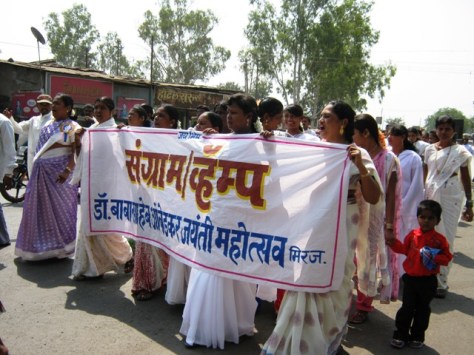
File photograph of members of SANGRAM and VAMP, collective of sex-workers, celebrating Dr Ambedkar Jayanti

Women’s groups and progressive organisations in India are shocked that Ms. Anu Mokal, a pregnant sex worker in Satara, was beaten up by police inspector Dayanand Dhome on April 2, along with her friend Ms. Anjana Ghadge. Three days later, on 5th April, she suffered a miscarriage. The incident occurred on 2nd April 2012, around 7.30 pm, when Anu Mokal, who was four months pregnant, and Anjana Ghadge were bringing dinner for their friend who was admitted in the civil hospital. Near the Satara bus stand area, senior Police Inspector Dayanand Dhome accused them of soliciting and when they refuted it abused them and called them liars. Dhome and his subordinates started beating Anu and her friend Anjana. Dhome repeatedly kicked them and said that women like Anu are a ‘shame’. Her pleas that she was four months pregnant fell on deaf ears. Anu and Anjana were detained and put in a lockup. They were eventually released on April 3.

Continue reading Solidarity March: Justice for sex worker mothers

Abortion as a feminist issue – who decides, and what?

The recent post by Shohini Ghosh on the first episode of Satyameva Jayate has raised key questions around the complicated relationship between abortion as such and the selective abortion of female foetuses. This dilemma is one with which the women’s movement in India has been grappling since the late 1980’s. In this post, I would like to move away completely from the television programme, especially because there the focus was on women who were forced to have abortions after sex determination, on which there is little to debate. I am concerned here with the more troubling question that Shohini also raises, of how to understand a situation in which women themselves decide to have sex selective abortions. I outline here the main contours of feminist debate and activism over close to three decades, that have circled around complex understandings of ethics and agency in the context of women’s control over their bodies. I conclude by stating my own position on the issue, which is not necessarily the position taken by the movement as such.

Continue reading Abortion as a feminist issue – who decides, and what?

Supreme Court judgment on Pathribal case a lost opportunity: Warisha Farasat

Guest post by WARISHA FARASAT

The recent Supreme Court judgment on the Pathribal case is a lost opportunity. In the Pathribal encounter killing, five innocent civilians were picked up and killed in a staged encounter by the 7th Rashtriya Rifle of the army. At the time, the then Union Home Minister L.K. Advani had gone on record to say that five Lashkar militants who were responsible for the Chittisinghpora massacre of the Sikhs in the Kashmir Valley had been killed in an encounter. After investigation by the CBI, a chargesheet was filed before the Chief judicial Magistrate, Srinagar, implicating army personnel of the 7th Rashtriya Rifle. In 2006, the army was given the option by the CJM to choose the forum of trial, and to either face court martial or be tried by a regular criminal court. Showing contempt for the CJM, the army personnel refused to face any trial, and asked the CJM to return the chargesheet back to the CBI.

Continue reading Supreme Court judgment on Pathribal case a lost opportunity: Warisha Farasat

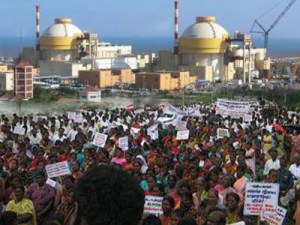
Koodankulam – Anti-nuclear Struggle Continues: Deepa Rajkumar

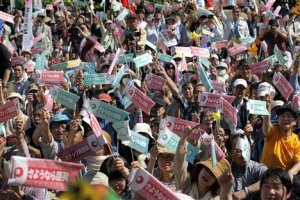
As Japan shut down its last reactor, the Koodankulam project is to go critical in ten days.  Because Japan depends on local consensus for its nuclear decisions, unlike the World’s Largest Democracy, the views of Japanese people counts for something. Thousands of Japanese marched in celebrations to celebrate  the switching off of the last of Japan’s 50 nuclear reactors on Saturday May 5th. 
Traditional ‘koinobori’ fish-shaped banners for Children’s Day have become a potent symbol of the Japanese anti-nuclear movement, symbolizing the commitment to leave a safe and clean earth to children.

Meanwhile, back home in Koodankulam, as  this guest post by DEEPA RAJKUMAR reminds us, unrelenting state repression continues of the massive, non-violent struggle against the proposed nuclear plant there.

6,800 people in Koodankulam face charges of sedition and/or waging war against the state, possibly the largest number so charged ever, in colonial or independent India, in just one police station.

Sathish Kumar and R. S. Muhilan began an indefinite hunger strike from 25th April in Tiruchirapalli prison, Tamil Nadu. They were demanding a fair trial, stoppage of new charges being filed against them and the withdrawal of existing false charges against them. Continue reading Koodankulam – Anti-nuclear Struggle Continues: Deepa Rajkumar

A Statement Supporting the Delhi HC Judgment on Section 377: Ruth Vanita

Guest post by RUTH VANITA, Professor at the University of Montana. This statement was written in the context of the teachers’ intervention in the Supreme Court in the appeal by religious groups against the Delhi High Court judgement on Section 377 . This statement does not form part of court documents. You can read Shivaji Panikkar’s statement here

I belong to a middle-class family of educationists, various members of which migrated to Delhi from Rangoon and Lahore at Partition. I was educated entirely in Delhi, first at Springdales School, and then at Miranda House. I got my Ph.D.  from Delhi University. I started teaching at the age of 20 at Miranda House; I taught there for 18 years and then for two years as a Reader in the English Department, Delhi University, before taking early voluntary retirement in 1997.

Continue reading A Statement Supporting the Delhi HC Judgment on Section 377: Ruth Vanita

A Statement Supporting the Delhi HC Judgment on Section 377: Shivaji Panikkar

Guest post by SHIVAJI K PANIKKAR,  art historian and Dean, School of Culture & Creative Expressions, Ambedkar University, Delhi. This statement was written in the context of the teachers’ intervention in the Supreme Court in the appeal by religious groups against the Delhi High Court judgement on Section 377 . This statement does not form part of court documents.

You can read Ruth Vanita’s statement here.

I was born in a traditional, upper caste Hindu family and lived in Kerala till I was 22 years old, and since then shifted to study, work and live inBaroda,Gujarat. In 1975c I completed a B.A in Kerala with Economics and History as my subjects. InBarodathrough 1980s, at MS University I did another B.A. in Dance (Bharatanatyam), an M.A. and Ph. D in Art History as specialization. I was appointed as Professor in 1998. Till recently I was Head of Department of Art History & Aesthetics, Faculty of Fine Arts, M.S. University of Baroda. I have an experience of teaching at the University of about 25 years.

Since childhood    I knew I had homosexual inclinations, and lived it secretively till the age of about 43/45 years. Since then I lived an openly gay life; a fact that I couldn’t any more hide in my personal life as well as in my professional life. It was a matter of emotional and intellectual honesty and integrity that I accepted in public my sexual orientation, and no more live a life of fear and oppression.

Continue reading A Statement Supporting the Delhi HC Judgment on Section 377: Shivaji Panikkar

Teachers’ Intervention in the Supreme Court on Section 377

The Delhi High Court judgement reading down Section 377 to decriminalize consensual sex between adults was appealed against in the Supreme Court by several religious groups. However during the appeal, the Government of India withdrew its objections to the High Court judgement. In addition, there were some parties that intervened to support the judgement – parents, medical practitioners and teachers, among others. The Supreme Court judgement is awaited, but meanwhile, I am posting below the  position of the 16 teachers who intervened in this matter. This statement does not form part of court documents.

As teachers we essentially wanted to make the argument that Section 377 vitiates for everybody (and not just for gay people) the general atmosphere of free expression, learning, enquiry, and dignity that an academic environment should ensure.  That we oppose Sec 377 because its existence on the statute books legitimizes an atmosphere that runs counter to the spirit of openness and acceptance of difference that should mark modern academic spaces.  Its existence is not only an affront to those who are non-heterosexual, but it is an affront to each and every person in the academy who believes that every teacher and student has dignity that should be respected, and that learning is a continuous and life-long process, in which fixed ways of thinking are continuously challenged and reshaped by winds of change.

  Continue reading Teachers’ Intervention in the Supreme Court on Section 377

Updates from Koodankulam

Via NITYANAND JAYARAMAN

Koodankulam: Curb on Free Speech

Video Interviews with  eminent legal scholar Dr. Usha Ramanathan and Adv. R. Vaigai, a senior lawyer from the Madras High Court.

Since March 19, 2012, when Tamil Nadu Chief Minister Jayalalithaa announced that work on the controversial Koodankulam nuclear plant could be resumed, and even before that actually, the protesting villagers have been at the receiving end of a vicious state led campaign to paint their non-violent struggle as a violent one, and to crush their campaign into silence by using harsh sections of the Indian Penal Code. More than 7000 cases of “sedition” and “waging war against the Government of India” have been filed just in the Koodankulam police station just between September and December 2011. These are part of 107 cases filed against 55,795 people during the same period. That is probably more than in any other police station in India. Certain sections of the media too have played the role of a willing partner in propagating the State’s propaganda. In pursuing this counter-campaign against its own people, the State Government has placed itself above the law of the land and pursued an openly anti-democratic agenda.

See interviews in two parts at at 

1. chaikadai.wordpress.com

2. chaikadai.wordpress.com

PRESS RELEASE

Cases against K-protestors a parody of law: Fact Finding Team

18 April, 2012. CHENNAI – A fact-finding team headed by senior journalist Sam Rajappa confirmed that the Government had indeed restricted movement of essential goods and people in the days following the Chief Minister’s March 19th declaration announcing her support to the nuclear plant. The report, which was released at a press conference in Chennai, noted that the spirit of opposition to the nuclear power plant was very high, and warned that arresting the leaders could lead to a serious law and order problem in the region.

Continue reading Updates from Koodankulam