All posts by Nivedita Menon

Please Sir, may I take a newspaper into my class?

At last, the real anxieties lurking behind what has come to be called the “Ambedkar cartoon” controversy are out in the open. It is hideously clear by now that MPs “uniting across parties” are acting as one only to protect themselves from public scrutiny, debate and criticism. It turns out, as some of us suspected all along, that the “sentiments” that have been “hurt” this time are the easily bruised egos of our elected representatives.
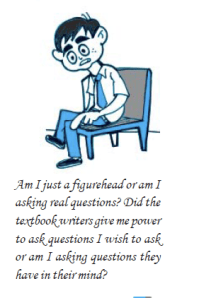
(By the way, you may have noticed that “MPs unite across party lines” is not a headline you will ever see after a massacre, a natural calamity, brazen public acts of sexual violence  against women and so on.  Oh no. Such unity is reserved only for utterly self-serving and anti-democratic interpretations of  “Parliamentary privilege”).*

Artist: Abu Abraham

Declared HRD minister Kapil Sibal – “Much before the issue came to parliament, I had already taken action. I called for the NCERT text books and I looked at other cartoons. I realised that there were many other cartoons that were not in good taste and disparaging in nature. They were not sending the right message to our children in classrooms”.

Continue reading Please Sir, may I take a newspaper into my class?

Good woman=Mother/Bad woman=Sex worker/Sex worker mother =? Amrita Nandy

Guest post by AMRITA NANDY

The math of this morality can be puzzling. Why should “sex worker mother” sound like an oxymoron to so many?

It was Mother’s Day recently –  judgment time on who can be a mother, what makes a good mother. Time magazine’s provocative current cover shows a young Los Angeles mother breastfeeding her three year old son (standing on a stool to reach mommy’s breast) as the headline asks “Are you mom enough?” The accompanying article on “attachment parenting”, as put forward by “parenting expert” Bill Sears in his The Baby’s Book, encourages parents to keep their infants in constant bodily contact with the parent by wearing a baby sling, let their children wean themselves from the breast when they are ready and allow “co-sleeping” which aids a child to grow up to be well-adjusted adults.

Attachment parenting has been widely criticized for setting the bar for good parenting impossibly high, especially for parents who have to work full-time, but it is a bar quite easily reached by Radha – she is very “mom enough”.  Amidst the din of the Delhi brothel where she works, she continues to suckle her four year old daughter. But if the judges of “good mothering” were policemen in Satara, Radha would not qualify. For them, a sex worker mother is a “shame”. This is why they dared to kick Anu Mokal, a four-months pregnant sex worker, leading to bleeding and an eventual miscarriage.

Continue reading Good woman=Mother/Bad woman=Sex worker/Sex worker mother =? Amrita Nandy

Solidarity March: Justice for sex worker mothers

Press statement issued by Mitra Sanghatana (Collective of children of sex workers )and Veshya Anyay Mukti Parishad (VAMP), a collective of sex workers, Maharashtra.

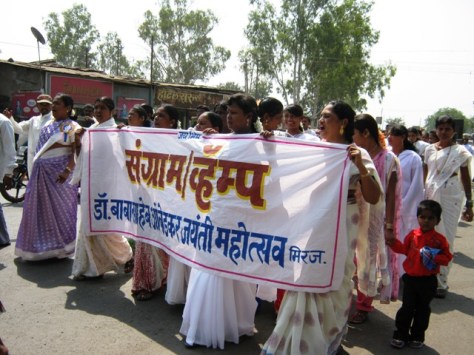
File photograph of members of SANGRAM and VAMP, collective of sex-workers, celebrating Dr Ambedkar Jayanti

Women’s groups and progressive organisations in India are shocked that Ms. Anu Mokal, a pregnant sex worker in Satara, was beaten up by police inspector Dayanand Dhome on April 2, along with her friend Ms. Anjana Ghadge. Three days later, on 5th April, she suffered a miscarriage. The incident occurred on 2nd April 2012, around 7.30 pm, when Anu Mokal, who was four months pregnant, and Anjana Ghadge were bringing dinner for their friend who was admitted in the civil hospital. Near the Satara bus stand area, senior Police Inspector Dayanand Dhome accused them of soliciting and when they refuted it abused them and called them liars. Dhome and his subordinates started beating Anu and her friend Anjana. Dhome repeatedly kicked them and said that women like Anu are a ‘shame’. Her pleas that she was four months pregnant fell on deaf ears. Anu and Anjana were detained and put in a lockup. They were eventually released on April 3.

Continue reading Solidarity March: Justice for sex worker mothers

Abortion as a feminist issue – who decides, and what?

The recent post by Shohini Ghosh on the first episode of Satyameva Jayate has raised key questions around the complicated relationship between abortion as such and the selective abortion of female foetuses. This dilemma is one with which the women’s movement in India has been grappling since the late 1980’s. In this post, I would like to move away completely from the television programme, especially because there the focus was on women who were forced to have abortions after sex determination, on which there is little to debate. I am concerned here with the more troubling question that Shohini also raises, of how to understand a situation in which women themselves decide to have sex selective abortions. I outline here the main contours of feminist debate and activism over close to three decades, that have circled around complex understandings of ethics and agency in the context of women’s control over their bodies. I conclude by stating my own position on the issue, which is not necessarily the position taken by the movement as such.

Continue reading Abortion as a feminist issue – who decides, and what?

Supreme Court judgment on Pathribal case a lost opportunity: Warisha Farasat

Guest post by WARISHA FARASAT

The recent Supreme Court judgment on the Pathribal case is a lost opportunity. In the Pathribal encounter killing, five innocent civilians were picked up and killed in a staged encounter by the 7th Rashtriya Rifle of the army. At the time, the then Union Home Minister L.K. Advani had gone on record to say that five Lashkar militants who were responsible for the Chittisinghpora massacre of the Sikhs in the Kashmir Valley had been killed in an encounter. After investigation by the CBI, a chargesheet was filed before the Chief judicial Magistrate, Srinagar, implicating army personnel of the 7th Rashtriya Rifle. In 2006, the army was given the option by the CJM to choose the forum of trial, and to either face court martial or be tried by a regular criminal court. Showing contempt for the CJM, the army personnel refused to face any trial, and asked the CJM to return the chargesheet back to the CBI.

Continue reading Supreme Court judgment on Pathribal case a lost opportunity: Warisha Farasat

Koodankulam – Anti-nuclear Struggle Continues: Deepa Rajkumar

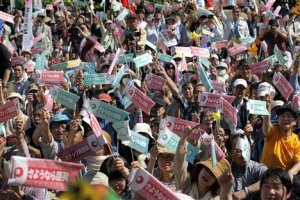
As Japan shut down its last reactor, the Koodankulam project is to go critical in ten days.  Because Japan depends on local consensus for its nuclear decisions, unlike the World’s Largest Democracy, the views of Japanese people counts for something. Thousands of Japanese marched in celebrations to celebrate  the switching off of the last of Japan’s 50 nuclear reactors on Saturday May 5th. 
Traditional ‘koinobori’ fish-shaped banners for Children’s Day have become a potent symbol of the Japanese anti-nuclear movement, symbolizing the commitment to leave a safe and clean earth to children.

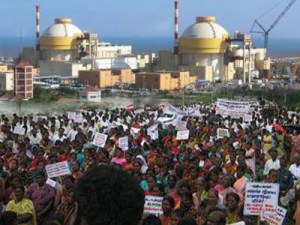
Meanwhile, back home in Koodankulam, as  this guest post by DEEPA RAJKUMAR reminds us, unrelenting state repression continues of the massive, non-violent struggle against the proposed nuclear plant there.

6,800 people in Koodankulam face charges of sedition and/or waging war against the state, possibly the largest number so charged ever, in colonial or independent India, in just one police station.

Sathish Kumar and R. S. Muhilan began an indefinite hunger strike from 25th April in Tiruchirapalli prison, Tamil Nadu. They were demanding a fair trial, stoppage of new charges being filed against them and the withdrawal of existing false charges against them. Continue reading Koodankulam – Anti-nuclear Struggle Continues: Deepa Rajkumar

A Statement Supporting the Delhi HC Judgment on Section 377: Ruth Vanita

Guest post by RUTH VANITA, Professor at the University of Montana. This statement was written in the context of the teachers’ intervention in the Supreme Court in the appeal by religious groups against the Delhi High Court judgement on Section 377 . This statement does not form part of court documents. You can read Shivaji Panikkar’s statement here

I belong to a middle-class family of educationists, various members of which migrated to Delhi from Rangoon and Lahore at Partition. I was educated entirely in Delhi, first at Springdales School, and then at Miranda House. I got my Ph.D.  from Delhi University. I started teaching at the age of 20 at Miranda House; I taught there for 18 years and then for two years as a Reader in the English Department, Delhi University, before taking early voluntary retirement in 1997.

Continue reading A Statement Supporting the Delhi HC Judgment on Section 377: Ruth Vanita

A Statement Supporting the Delhi HC Judgment on Section 377: Shivaji Panikkar

Guest post by SHIVAJI K PANIKKAR,  art historian and Dean, School of Culture & Creative Expressions, Ambedkar University, Delhi. This statement was written in the context of the teachers’ intervention in the Supreme Court in the appeal by religious groups against the Delhi High Court judgement on Section 377 . This statement does not form part of court documents.

You can read Ruth Vanita’s statement here.

I was born in a traditional, upper caste Hindu family and lived in Kerala till I was 22 years old, and since then shifted to study, work and live inBaroda,Gujarat. In 1975c I completed a B.A in Kerala with Economics and History as my subjects. InBarodathrough 1980s, at MS University I did another B.A. in Dance (Bharatanatyam), an M.A. and Ph. D in Art History as specialization. I was appointed as Professor in 1998. Till recently I was Head of Department of Art History & Aesthetics, Faculty of Fine Arts, M.S. University of Baroda. I have an experience of teaching at the University of about 25 years.

Since childhood    I knew I had homosexual inclinations, and lived it secretively till the age of about 43/45 years. Since then I lived an openly gay life; a fact that I couldn’t any more hide in my personal life as well as in my professional life. It was a matter of emotional and intellectual honesty and integrity that I accepted in public my sexual orientation, and no more live a life of fear and oppression.

Continue reading A Statement Supporting the Delhi HC Judgment on Section 377: Shivaji Panikkar

Teachers’ Intervention in the Supreme Court on Section 377

The Delhi High Court judgement reading down Section 377 to decriminalize consensual sex between adults was appealed against in the Supreme Court by several religious groups. However during the appeal, the Government of India withdrew its objections to the High Court judgement. In addition, there were some parties that intervened to support the judgement – parents, medical practitioners and teachers, among others. The Supreme Court judgement is awaited, but meanwhile, I am posting below the  position of the 16 teachers who intervened in this matter. This statement does not form part of court documents.

As teachers we essentially wanted to make the argument that Section 377 vitiates for everybody (and not just for gay people) the general atmosphere of free expression, learning, enquiry, and dignity that an academic environment should ensure.  That we oppose Sec 377 because its existence on the statute books legitimizes an atmosphere that runs counter to the spirit of openness and acceptance of difference that should mark modern academic spaces.  Its existence is not only an affront to those who are non-heterosexual, but it is an affront to each and every person in the academy who believes that every teacher and student has dignity that should be respected, and that learning is a continuous and life-long process, in which fixed ways of thinking are continuously challenged and reshaped by winds of change.

  Continue reading Teachers’ Intervention in the Supreme Court on Section 377

Updates from Koodankulam

Via NITYANAND JAYARAMAN

Koodankulam: Curb on Free Speech

Video Interviews with  eminent legal scholar Dr. Usha Ramanathan and Adv. R. Vaigai, a senior lawyer from the Madras High Court.

Since March 19, 2012, when Tamil Nadu Chief Minister Jayalalithaa announced that work on the controversial Koodankulam nuclear plant could be resumed, and even before that actually, the protesting villagers have been at the receiving end of a vicious state led campaign to paint their non-violent struggle as a violent one, and to crush their campaign into silence by using harsh sections of the Indian Penal Code. More than 7000 cases of “sedition” and “waging war against the Government of India” have been filed just in the Koodankulam police station just between September and December 2011. These are part of 107 cases filed against 55,795 people during the same period. That is probably more than in any other police station in India. Certain sections of the media too have played the role of a willing partner in propagating the State’s propaganda. In pursuing this counter-campaign against its own people, the State Government has placed itself above the law of the land and pursued an openly anti-democratic agenda.

See interviews in two parts at at 

1. chaikadai.wordpress.com

2. chaikadai.wordpress.com

PRESS RELEASE

Cases against K-protestors a parody of law: Fact Finding Team

18 April, 2012. CHENNAI – A fact-finding team headed by senior journalist Sam Rajappa confirmed that the Government had indeed restricted movement of essential goods and people in the days following the Chief Minister’s March 19th declaration announcing her support to the nuclear plant. The report, which was released at a press conference in Chennai, noted that the spirit of opposition to the nuclear power plant was very high, and warned that arresting the leaders could lead to a serious law and order problem in the region.

Continue reading Updates from Koodankulam

A State of ‘Encounters’: Madhumita Dutta

This guest post has been written by MADHUMITA DUTTA, a Chennai-based activist and writer, in conversation with Savukku Shankar, a former employee of the police department and a freelance journalist

“This state has witnessed more than 90 encounters in the last 15 years.  Tamil Nadu is a state of encounters!” laments ‘Savukku’ Shankar. ‘Encounters’, a euphemism for extra-judicial killings, began in the state in the 1980s when the government started cracking down on members of Maoist organisations around Dharmapuri district of Tamil Nadu.

On April 9th of this year, a Division Bench constituted by the Madras High Court was to commence its final hearing on PILs filed by Advocate Puzhalenthi, asking filing of murder charges against policemen involved in the recent ‘encounter’ deaths of five alleged bank robbers in Velachery; and questioning the magisterial enquiry ordered by the government under Cr. P.C. 176 (1A). Said Shankar, “That section applies only to custodial deaths, but this is an encounter killing”. The matter finally got adjourned to 5th of June. It is not uncommon for cases like this to drag on for years in the Courts. A special bench constituted by the court to hear 26 ‘encounter’ cases that took place in Tamil Nadu between 2006 and 2010 is yet to commence its hearings. Continue reading A State of ‘Encounters’: Madhumita Dutta

Does your misogyny have enough racism in it? Fairer vaginas for all

The recent advertisement on television for fairer vaginas has done its bit to engage, enrage and amuse. What more can a little ad do, after all?
Rupa Gulab “shamefully confessed” to not being outraged by the ad, she was so busy rolling on the floor with mirth. In any case, it’s not advisable, she sagely counsels, to look down your nose on fairness cream manufacturers:

“they may notice that your nostrils resemble black holes and cannily invent a specialized fairness cream to lighten them up.”

Lindy West is thrilled:

“Splendid! God, I was just saying the other day that my misogyny didn’t have enough racism in it.”

Continue reading Does your misogyny have enough racism in it? Fairer vaginas for all

Occupy Monsanto!

Some good news for a change…

Peru Passes Monumental Ten Year Ban on Genetically Engineered Foods

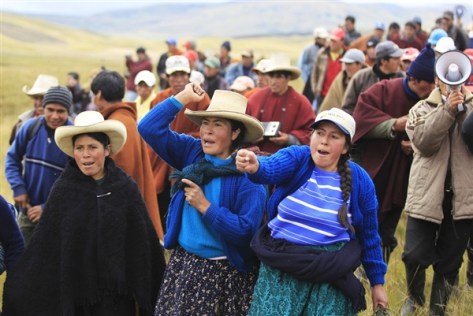
In a massive blow to multinational agribiz corporations such as Monsanto, Bayer, and Dow, Peru has officially passed a law banning genetically modified ingredients anywhere within the country for a full decade before coming up for another review. Peru’s Plenary Session of the Congress made the decision 3 years after the decree was written despite previous governmental pushes for GM legalization due largely to the pressure from farmers that together form the Parque de la Papa in Cusco, a farming community of 6,000 people that represent six communities. They worry the introduction of genetically modified organisms (GMOs) will compromise the native species of Peru, such as the giant white corn, purple corn and, of course, the famous species of Peruvian potatoes. Anibal Huerta, President of Peru’s Agrarian Commission, said the ban was needed to prevent the ”danger that can arise from the use of biotechnology.”

Read the rest of this story here.

Set Top Boxes: State-Corporate Nexus (Again)

When I came across this headline over my morning coffee, “Set-top boxes a must from July for greater choice“, I was very excited.  More choices always make my little heart beat very hard.

So this is the deal:

Starting July, every household in Delhi will need a set-top box to be able to view channels of one’s liking. The information and broadcasting ministry is planning to implement a ‘must-provide clause’ for cable operators to enable TV viewers in the four Metro cities to ask for their favourite channels as a right. After July 1, the sub-divisional magistrates across Delhi will take action against all cable operators who are found violating the new norms, which mandate provision of set-top box enabled digital facilities to all viewers.

Hold on, so I can no longer go with the local cable operator who already provides me with all the channels I want legally, at a very low cost, but will be forced to pay larger amounts directly to the big companies (Tata, Reliance)?

This is more choice?

Continue reading Set Top Boxes: State-Corporate Nexus (Again)

Modesty of Dress and Indian Culture: Suchi Govindarajan

Widely circulating just about everywhere, but for the unfortunate few who may have missed it…

I for one want to kiss the hem of her salwar/sari/jeans/other modest outfit.

Sir/Madam,
I write to complain about the abysmal standards of modesty I am noticing in Indian society. All bad things – sensationalist TV, obscene movies, diabetes among elders, pickpocketing, dilution of coconut chutney in Saravana Bhavan – are a result of Evil Western Influences. However, to my surprise, in this issue of modesty, even the Great Indian Culture (we had invented Maths and pineapple rasam when westerners were still cavemen) seems to encourage this.

The problem, sir/madam, is that revealing attire is being worn. Deep-neck and sleeveless tops, exposed legs–and these are just the middle-aged priests! Some priests are even (Shiva Shiva!) doing away with the upper garment. And I am told some temple managements even encourage this.

Read the rest of this brilliant and biting piece here.

Feminism and the Family – Thoughts on International Women’s Day

Excerpts from my forthcoming book Seeing Like a Feminist (Penguin India/Zubaan Books).

Have you heard of ‘nude make-up’?

This is what it is:

‘Nude makeup looks are all about your skin looking fresh and dewy, without looking like you’re even wearing any makeup. All you need is eyeliner, mascara, nude lipstick, and a highlighting blush that will give your skin a natural-looking glow.’[1]

The whole point of nude makeup clearly, is to spend hours painting your face in order to make it look like you never touched it at all.

The maintaining of social order is rather like that. It requires the faithful performance of prescribed rituals over and over again throughout one’s lifetime. Complex networks of cultural reproduction are dedicated to this sole purpose. But the ultimate goal of all this unceasing activity is to produce the effect of untouched naturalness.

When one ‘sees’ the world like a feminist though, with the gaze of a feminist, it’s rather like activating the ‘Reveal Formating’ function in Microsoft Word (what an earlier generation of WordPerfect users knew as ‘Reveal Codes’). The feminist gaze reveals the strenuous, complex formatting that goes on below the surface of what looked smooth and complete. Continue reading Feminism and the Family – Thoughts on International Women’s Day

Joint Statement on police atrocities and state repression on anti-POSCO struggle

See names of signatories below; please send your endorsement to asit1917 at gmail dot com

We strongly condemn the attack on and illegal abduction by the Odisha police of Umakanta Biswal, a famer belonging to Dhinkia village of Odisha, and an active member of POSCO Pratirodh Sangram Samiti (PPSS), that has been engaged over the last six years in resisting the forcible acquisition of their land by the Odisha government for handing over to the South Korean multinational corporation POSCO. This incident, which occurred on 2nd March 2012, is the latest in the series of atrocities inflicted by the Odisha government and by hired goons associated with the government and the POSCO company, on the people of these villages. Umakanta Biswal, who was engaged in agricultural activity in his paddy field at the time of his abduction, was pursued by a group of armed plainclothes policemen on a motorbike, and shot at when he tried to escape. He has reportedly been kept in Paradip prison, and has not been produced in front of a magistrate within 24 hours of his arrest, as is required under law. We have cause to fear that he is being tortured in police custody, and are gravely concerned about his safety. Continue reading Joint Statement on police atrocities and state repression on anti-POSCO struggle

UGC’s point system – Why should we care? Pratiksha Baxi and Umesh O

Guest post by PRATIKSHA BAXI and UMESH O

Is it really surprising that Jawaharlal Nehru University has implemented the controversial UGC guidelines on the Career Advancement Scheme (CAS) with effect from its date of announcement in 2008 (rather than date of notification in 2010, thereby benefiting Associate Professors rather than Assistant Professors? Is it really shocking that JNU did not register protest with the UGC about the case of CAS, dubbed by some as the Comic and Sad Guidelines? Perhaps not?

This scheme does not merely impact all academics already hired, especially at the rank of lecturers/assistant professors, but will also impact all those who will apply for the many vacancies now advertised, especially senior doctoral students, now looking for teaching jobs.

However there has been little concern about how does a scheme, which prolongs promotions for Assistant Professors from 5 years to 12 years (9 odd years in JNU), impact junior academics?

Continue reading UGC’s point system – Why should we care? Pratiksha Baxi and Umesh O

Gujarat genocide – the state, law and subversion: R B Sreekumar

Guest post by R B SREEKUMAR, former Director General of Police, Gujarat, who deposed before the Nanavati Commission.

Gujarat riot victims prevented from protesting against Narendra Modi during his sadbhavna fast in September 2011.

The Gujarat genocide in 2002, resulting in killing of nearly 1,500 innocent citizens, mostly from India’s major minority community and subsequent pervasive subversion of governmental machinery to sabotage justice delivery to riot victims, has to be understood as a man-made disaster. A disaster broughtabout by lack of professionalism and lack of integrity and commitment to the letter, spirit and ethos of the Constitution of India, on the part of all officials of the state, from the Chief Minister Narendra Modi to the police constables.

An analysis of the sequence of events from the time of the gruesome killing of 59 Hindu passengers in the train burning incident on 27 February, 2002 to this day, will bring up many unambiguous facts and data on deliberate acts of omission and commission by political leaders, bureaucrats and policemen, aiming at the actualization of the anti-Muslim carnage in Gujarat in 2002, and since then, the lopsided justice delivery to riot victims.

Continue reading Gujarat genocide – the state, law and subversion: R B Sreekumar

Delhi Police Special Cell – Encounters, Frame-ups, Impunity: Manisha Sethi

Guest post by MANISHA SETHI

An RTI enquiry has revealed that Delhi Police Special Cell’s conviction rate is a paltry 30 per cent. Nearly 70 per cent of the accused it charge-sheeted over the past five years were acquitted for want of credible evidence. Do these figures tell us something? A news story in a leading English daily bemoans this trifling record and quotes a senior police officerattributing this to the fact that “police sometimes get tangled in cross evidences and it becomes tough when you rely more on circumstantial evidences”. [i] This evokes the image of a bumbling policeman, reminiscent almost of Jacques Clouseau, tripping over reams and strings of evidences, in an impossible attempt to build a watertight case against the villains. But Special Cell couldn’t be farther from this sort of cute sloppiness. Continue reading Delhi Police Special Cell – Encounters, Frame-ups, Impunity: Manisha Sethi

Screening Jashn-e-Azadi at Presidency University, Kolkata: Waled Aadnan

Guest post by Waled Aadnan

It can be said that 86/1 College Street, Calcutta, has seen a microcosm of the history of modern India unfold within its walls. Since 1874 when the already fifty-nine year old Presidency College shifted to its current address, future Presidents and Prime Ministers of  India, Pakistan and Bangladesh; Nobel Laureates, freedom fighters, an Academy Award winner, Bharat Ratnas; the leadership of the Naxalite movement of the 60s and 70s; and eminent judges, writers, journalists, scientists and actors, have spent their student days at 86/1.

Two years ago, soon after I joined the institution, the Left Front government upgraded Presidency College to the status of a state University in a last-gasp bid to hold on to the votes of the bhadralok intellectuals. 2012 dawned with no Student Union elections having been held the previous year, and it is in this backdrop that the following events unfold.

Salman Rushdie’s well-publicised ostracism from the Jaipur Literature Festival was met not with outrage in Presi’s canteen addas, but with the absence of even a poster put up in protest. News filtered in of a seminar in Symbiosis University being “threatened.” But little awareness existed among students who were more inclined to read tabloid-like, unputdownable newspapers than their relatively austere counterparts, including The Hindu which broke the story.

Continue reading Screening Jashn-e-Azadi at Presidency University, Kolkata: Waled Aadnan