All posts by Nivedita Menon

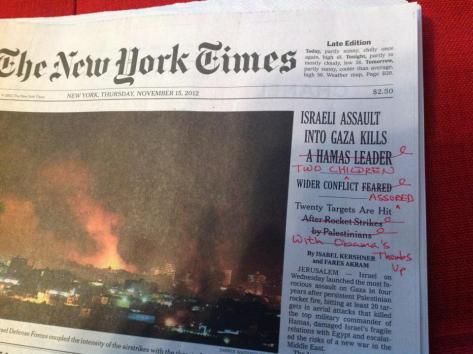
Proof-reading The New York Times

Sherry J. Wolf writes: Am sending my resume to the New York Times along with this clip. Clearly, they are in need of a copy editor…and a soul.

Worldwide protests as Israel attacks Gaza

List of world-wide protests from Bethlehem to Quebec, November 14-17, 2012

Child wounded in Israeli air strike on November 14th

[From The Electronic Intifada]

Yesterday Israel ended an effective truce with armed groups in Gaza, and carried out the extrajudicial execution of Ahmed al-Jabari, the commander of the military wing of Hamas.

Israeli attacks today killed at least seven people including two young girls in Gaza.

Aside from the fact that it almost always violates truces and ceasefires, seeking escalation where instead there could be calm, what motives might Israel have?

Israel’s “Minister of Home Front Defense” [Avi Dichter] says Gaza must be “reformatted” as if it were a computer hard drive, just like Israel did in the West Bank in 2002 during a series of massacres it called “Operation Defensive Shield.”

Israel’s Ynet reported in Hebrew that Dichter

said in a closed meeting, in the course of his visit in the south under the escalation, that “there is no other choice, Israel must carry out a formatting action in Gaza, actually format the system and clean it out, the way we did in Judea & Samaria during Operation Defensive Shield.” 

Protest in London over Israeli airstrikes in Gaza in 2009

“We may weep but we will stay”: Women resist evictions in Palestine: Kalyani Menon Sen

Guest post by KALYANI MENON SEN

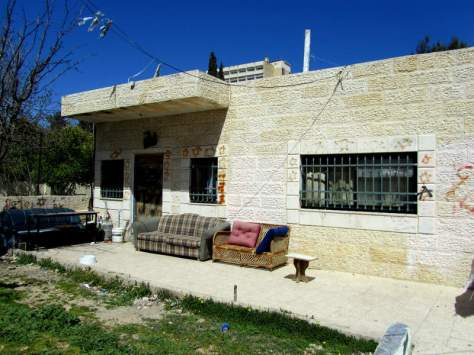
Umm Nabil’s settler-occupied house is painted with Israeli symbols. (Photo: Aruna Rao)

Umm Nabil al Kurd is 82 years old. She is tiny and frail – her hands tremble as she takes the mike. But her voice is steady as she describes how she lost her home.

“We came to Jerusalem from Haifa as refugees in 1948” she says. “The Jordanians allotted us our house. We have lived there for 60 years – my children were born there. It was small and broken when we moved in – we extended it and improved it as our family grew. We planted a garden. When my son got married and the grandchildren came, we built a separate unit for him at the back of the main house. We built with our own money, with our own hands. Then, two years ago, the Israelis came with the police and told us to leave. They said the house was theirs. They pushed me to the ground, called me filthy names, turned their dogs on me. They threw out our furniture and moved into the house. We went to court but the judge said we were occupying the house illegally – he told us to pay 100,000 shekels as rent for the years that we had lived in the house. We had to pay – my husband would have been imprisoned if we did not. We are still fighting the case – the next hearing is in July but I don’t know if we will ever get the house back.” Continue reading “We may weep but we will stay”: Women resist evictions in Palestine: Kalyani Menon Sen

Israeli Apartheid and Palestinian Resistance II – Living the Occupation

Planning to visit Palestine? Good news, Indian citizens don’t need a visa to enter Palestine. One small thing though. Palestine is occupied, and you cannot enter Palestine except through Israeli border control. The occupied Palestinian territories (OPT) have no control over their external borders.

Entry to Ayda refugee camp in the West Bank, established in 1950. The key is the symbol of the Right of Return of Palestinians. (Photo AN/NM) 

Whether you fly in through Ben Gurion airport in Tel Aviv, or enter by road from Jordan or Egypt – it’s an Israeli visa that is required – there is no such thing as a visa to Palestine. Indeed, from the point of view of the occupying state, there is no Palestine, only Palestinian Territories – that is, West Bank and Gaza, the two green bits in the fourth map reproduced in the previous post. (There are also no Palestinians, according to Israeli state classifications – there are Israelis and there are bureaucratically differentiated Arabs, as we’ll see below). Continue reading Israeli Apartheid and Palestinian Resistance II – Living the Occupation

Friends of Palestine Respond to InCACBI Call to Boycott the Cameri in Delhi

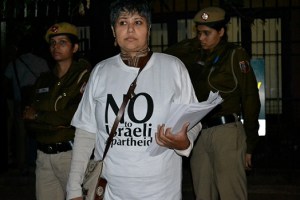
On Sunday evening, November 4th, about 60 friends of Palestine — theatre persons, writers, artists, film makers, academics, students and activists — gathered outside Delhi’s Siri Fort auditorium, the venue for the Israeli state-sponsored performance by The Cameri Theatre. Their form of protest was an unusual one.  All of them wore T shirts which said, in bold black letters on white, No to Israeli Apartheid. There were no slogans or placards. Instead, they stood around the entrance, distributing leaflets and talking to theatre goers about the boycott. A few theatre goers actually responded and did not go in. A couple even joined the protest. One woman, who took a T shirt to wear inside, found a different form of discrimination being practiced in the auditorium; the Israeli theatre goers were let in, but the Indians had to wait. She read the leaflet in her hand, came out to join the protestors. Read more

Israeli Apartheid and Palestinian Resistance I – Nakba and Sumoud

[In September 2012, Aditya Nigam and I had the incredible good fortune to visit Palestine. This post is the first of a series in which we reflect on our experience and what we learnt there. We stayed in Ramallah, visited and interacted with colleagues at Birzeit University and spoke at a conference organized by Muwatin, a research institute based in Ramallah. We met  a large number of inspiring people who pushed the frontiers of our minds, and we came away humbled and moved by the dignity of a people living through the brutal occupation of their lands by the  Zionist state of Israel, with limitless courage and sense of humour intact.

Deepest gratitude to Rema Hammami of Birzeit who drove us around Jerusalem, and whose inimitable commentary gave us a live historical sense of  her country.

Words are inadequate to thank our friends Magid Shihade and Sunaina Maira, whose passionate love of Palestine and determination to help us make the most of our brief stay there, expanded our horizons continually.]

On the 15th of May 1948, the state of Israel was born, dispossessing Palestinians who had lived on that land for centuries. Fleeing terror and genocide in Europe, and anti-semitism globally, Jews from all over the world poured into Palestine.

Why Palestine? Why was Palestine given to the Jews as their home? And whose property was Palestine, that it could be given away? Why were people who had never done any harm to the Jewish people made to pay the price for European anti-semitism? It was Germany and Italy and Poland that had in fact, run concentration camps; it was any number of other countries of Europe that could boast of centuries-old histories of violent anti-semitism. Why were not parts of these countries carved out to make a country for the people they had wronged?

Maps showing the gradual obliteration of Palestine by Israel

Continue reading Israeli Apartheid and Palestinian Resistance I – Nakba and Sumoud

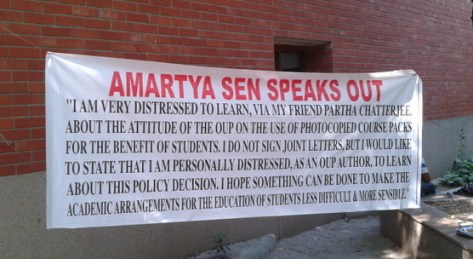
Authors and academics for equitable access to learning material

Three large academic publishers – Oxford University Press, Cambridge University Press and Taylor & Francis – have filed a petition in the Delhi High Court claiming copyright infringement with regard to the course packs used by students of Delhi University in a number of disciplines.  It is clear from DU’s stance in court that they are  distancing themselves from the  photocopier, thus clearing the way for the Court to pass an injunction staying the sale of course packs. It is absolutely critical now  for academics and authors to step up our campaign in support of our students’ access to learning materials:

Please sign the on-line petition at the link below:

“…As authors and educators, we would like to place on record our distress at this act of the publishers, as we recognize the fact that in a country like India marked by sharp economic inequalities, it is often not possible for every student to obtain a personal copy of a book. In that situation the next best thing would have been for multiple copies of the book to be available in the library so that students are able to access these books without any difficulty. But given the constraints that libraries in India work with, they may only have a single copy of a book and in many instances, none at all. The reason we make course packs is to ensure that students have access to the most relevant portions of the book without which we would be seriously compromising their education….”

Zero tolerance for democracy – Kudankulam, Omkareshwar, Aseem Trivedi

Which of these three images brings dishonour to India?

This one?

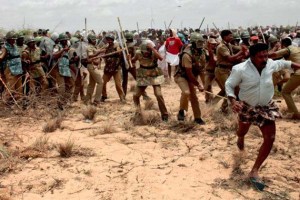
The full coercive force of the state slams down on villagers who have been so far peacefully protesting the location of a nuclear power plant in Kudankulam, Tamil Nadu.

Charges of sedition have been laid on hundreds of protesters in Kudankulam.

The women of Kudankulam wrote recently in a moving message to their fellow citizens:

When we carried the dead body of democracy and burnt it in the outskirts of our village on Aug 15th, 2012, little did we realize that so soon we would witness the real death of democracy. As this last nail is being tightened on our lives, we realize how insignificant has been our voice. But this has only strengthened our vow to be together.

(Read the latest update from Kudankulam below)

Continue reading Zero tolerance for democracy – Kudankulam, Omkareshwar, Aseem Trivedi

Petition to Chief Justice of India – Remove Justice Bhaktavatsala of Karnataka High Court

On August 9, during the hearing of a matrimonial dispute, Karnataka High Court Judge K Bhaktavatsala told a young woman lawyer that she was unfit to argue the matter since she was unmarried. “Family matters should be argued only by married people, not spinsters. You should only watch. Bachelors and spinsters watching family court proceedings will start thinking if there is any need to marry at all. Marriage is not like a public transport system. You better get married and you will get very good experience to argue such cases,” he advised her.

Last week, hearing a case between a separated couple, in which the woman accused her husband of regularly beating her, the judge told the woman, “Women suffer in all marriages. You are married with two children, and know what it means to suffer as a woman. Yesterday, there was a techie couple who reconciled for the sake of their child. Your husband is doing good business, he will take care of you. Why are you still talking about his beatings?”

Justice Bhaktavatsala has shown grave disrespect towards the Indian Constitution, which he is sworn to protect, and which guarantees equal rights to all citizens, men and women. As such, he has revealed himself to be utterly unfit for his high office of responsibility.

Sign the petition asking the Chief Justice of India, Hon’ble Mr. Justice S.H. Kapadia, to remove Justice K Bhaktavatsala from his post for these appalling statements.

News pornography and mediated cultures of violence: Anirban K. Baishya, Shaheen S. Ahmed and Amit R. Baishya

Guest Post by ANIRBAN K. BAISHYA, SHAHEEN S. AHMED and AMIT R. BAISHYA

Satyamev Jayate, the popular Aamir Khan-helmed TV show, aired an episode in May this year that praised northeast India [an unfortunate “directional category” (Barbora) that homogenizes a complex, polyglot region] for its virtual absence of dowry-related crimes and its general “liberalism” on gender issues.  Subsequently, one saw a virtual deluge of “Proud to be from the northeast”- type of messages on social networking sites such as Facebook.  June and July, though, were cruel and dispiriting months that belied such declarations of identitarian pride, especially for people from Assam. Continue reading News pornography and mediated cultures of violence: Anirban K. Baishya, Shaheen S. Ahmed and Amit R. Baishya
Another Onam – MB Manoj on Dalits, Onam and Malayali identity

Today is the first day of Onam – and MB Manoj reminds us about other histories of Kerala and other Malayali voices than those of the dominant Nair community.

The interview is entirely in Malayalam. But here’s a short account of what Manoj says in both videos below:

Reading Onam through the eyes of Dalits, the festival loses its “natural” association with the Malayali identity. In fact, in the words of Manoj – “Onam is a black day for Dalits, a day of murder, even as it is a day of happiness for the upper castes”. The coming of Onam also marks the coming of the caste system and slavery in Kerala. Manoj talks about Dalit cultural life in Kerala and its relation to Onam. There are folk songs which criticise the upper-caste nature of Onam and its vegetarianism. Similarly, there are songs which criticise the temple entry proclamation of Kerala. There is a realisation among Dalits that Onam is a celebration of the murder of their king by the upper castes. As part of this realisation, Dalit movements, and especially the Indian Dalit Federation, have observed hunger strikes during Onam days. Manoj reminisces participating in one of these hunger strikes in Idukki town in Kerala during his college days. Manoj stresses that most Dalits, tribals and backward castes eat meat during Onam and their culture fall outside the cultural milieu of Onam. Therefore, for the lower-castes, Onam is neither a cultural nor a national festival, but a festival of the upper-castes.


Memories of Drought: Bharat Patankar

Guest post by BHARAT PATANKAR

English translation of Marathi article published in Sakal

Some years had passed since the completion of the Koyna dam which was the basis for the all-round development of Maharashtra.   Electricity had begun to be produced from the water stored in the dam.   The campaign to bring electricity to the villages had begun.  An increase in industrial development also began to be felt; however the situation of agriculture was as shown in the film, “Mother Krishna is flowing calmly”.   The situation is described in the song, “Mother Krishna is flowing calmly, unaware of happiness or sorrow on her banks/ Limitless water flows without a break; nobody diverts it for irrigating the land/ how can this Ganges become fruitful to the lazy people?”   Such was the situation.  It was not only true for the Krishna.  It was also the case for the Godavari and Tapi.  Agriculture was still dependent on wells and rainfall for irrigation.  Aside from Mulshi, Rajewadi, Bhatghar and other dams of the British period and a few dams after independence, all of Maharashtra was like this.

The 1972-3 drought was general.  Continue reading Memories of Drought: Bharat Patankar

Notes from the warfront: Maruti workers ‘on trial’: Rakhi Sehgal

Guest post by RAKHI SEHGAL

Friday, 17 August 2012  – Gurgaon Civil court

There is a ‘list of 162’ workers that has not been disclosed but which forms the basis for the police to either arrest or let go of Maruti workers once they are picked up. The family members of these 162 are being harassed and intimidated and being visited thrice a day by local police, sometimes accompanied by Gurgaon police – at times 12-15 police show up.

After they pick up one of the workers (who is on this list of 162) he is processed as an accused under the same FIR 184 under which the union leaders and the earlier batch of 91 workers were arrested.  The FIR names 55 workers and then says ‘500/600 others’, so anyone being picked up is being processed as part of this unnamed 500/600 others.

Under intense questioning by Advocate Rajender Pathak, the SHO Manesar PS, Om Prakash Bishnoi, admitted that the ‘list of 162’ is based on a list given by management. Although Adv. Pathak requested that the judge note this point, the judge did not do so. Instead the judge merely directed that the statements of the SHO are unsatisfactory and has asked him to come back on 22 August with more satisfactory explanations. Continue reading Notes from the warfront: Maruti workers ‘on trial’: Rakhi Sehgal

We have lost to the judicial machine, but still we have won: Pussy Riot

On February 21 this year, Maria Alyokhina (24) Nadezhda Tolokonnikova (22) and Yekaterina Samutsevich (30) of the punk band Pussy Riot, stormed into Moscow’s Christ the Saviour Cathedral and belted out a ‘punk prayer’, asking the Virgin Mary to “Throw Putin out!” They were charged with hooliganism motivated by religious hatred.

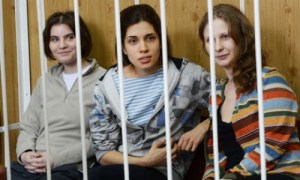
The three have been held more than five months at Pre-Trial Detention Facility No. 6, near Pechatniki metro station in Moscow.

In her defiant and thoughtful closing statement at the trial a couple of days ago, Yekaterina Samutsevich  said:

In the closing statement, the defendant is expected to repent, express regret for their deeds or enumerate attenuating circumstances. In my case, as in the case of my colleagues in the group, this is completely unnecessary. Instead, I want to voice my thoughts about the reasons behind what has happened to us. Continue reading We have lost to the judicial machine, but still we have won: Pussy Riot

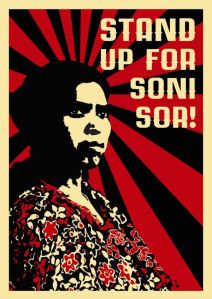
Rejoinder to story on Soni Sori in Indian Express: International Alliance for Defence of Human Rights in India

The  International Alliance for Defence of Human Rights in India (IADHRI) is based in the US and has participated in the campaigns for the release of Dr. Binayak Sen, Kopa Kunjam and now more recently Soni Sori and Lingaram Kodopi.

On August 5th, The Indian Express published a disturbing, supposedly investigative story on Soni Sori, implying both that she was guilty of the charge of being a Maoist as well as casting doubt on the activists in India and outside who support her, and who are mainly responsible for bringing into the open the fact that she was and continues to be tortured in prison.

The IADHRI has written this response to the story, rebutting it point by point.

That the media often compromises its integrity for corporate interests and the political elite is not news any more. The recent Sunday Express report titled ‘Soni’s Story’ is symptomatic of a belief that if a lie is repeated often, it becomes the accepted truth.  The report talks of Soni Sori, the Adivasi school teacher from Dantewada, Chhattisgarh, who has been arrested and accused of being a Maoist conduit. With a clever sprinkling of truth, a report can seem unbiased- the reporter appears to be the warrior fighting to find facts and settling for nothing less. It is, however, imperative that fallacies be broken down, and the casual picking and choosing of facts be exposed for what it is. Let us use the same structure that the story uses. Continue reading Rejoinder to story on Soni Sori in Indian Express: International Alliance for Defence of Human Rights in India

“It would have been better if you had given me Death Penalty” : Soni Sori

Translation of letter in Hindi written by Soni Sori from Raipur Prison on July 28, 2012.

(From kracktivist)

Letter in name of Supreme Court Judge  from Raipur Jail

Your Honour ,

Today I am alive , because of your verdict. You gave the order at the right time so that  I could be  medically treated again.  I was very happy during my treatment at AIIMS hospital in New Delhi, but  Your Honour ,  I have to pay for it now. I am being  harassed and tortured here, I request you to have mercy on me . Your Honor I am  suffering mentally .

1. I am made to sit on the Ground  ”Naked”

2. I am suffering from Hunger

Continue reading “It would have been better if you had given me Death Penalty” : Soni Sori

“Sexism is as common as sweat at the London Olympics”

Annie-Rose Strasser draws our attention to some delicious instances of sexism at the Olympics, from  from female boxers being asked to wear skirts to differentiate them from the men, to women’s teams taking coach while men’s fly first class.

Meanwhile 18 year-old British Olympic weightlifter Zoe Smith responded sharply on her blog to Twitter-brains tweeting or chirping that she is too manly:

[We] don’t lift weights in order to look hot, especially for the likes of men like that. What makes them think that we even WANT them to find us attractive? If you do, thanks very much, we’re flattered. But if you don’t, why do you really need to voice this opinion in the first place, and what makes you think we actually give a toss that you, personally, do not find us attractive? What do you want us to do? Shall we stop weightlifting, amend our diet in order to completely get rid of our ‘manly’ muscles, and become housewives in the sheer hope that one day you will look more favourably upon us and we might actually have a shot with you?! Cause you are clearly the kindest, most attractive type of man to grace the earth with your presence.

Oh but wait, you aren’t. This may be shocking to you, but we actually would rather be attractive to people who aren’t closed-minded and ignorant. Crazy, eh?! We, as any women with an ounce of self-confidence would, prefer our men to be confident enough in themselves to not feel emasculated by the fact that we aren’t weak and feeble.

Having fun yet?

Why the Maldivian ski team is good in short bursts (and other reflections on the Olympics): Sajan Venniyoor

Guest post by SAJAN VENNIYOOR

Now that the 2012 London Olympics has established its progressive republican credentials by recruiting former cold-war assassin, James Bond, to hurl Britain’s 86 year old Queen from a helicopter, following it up with tributes to labour unions, suffragettes, people of colour and the National Health Service (or as the Tories say, ‘leftie multicultural crap’), could we ask some fundamental questions like, what the hell is an ‘Olympic sport’ and how does a 71 year old man in a top-hat sitting on a very expensive horse exemplify the virtues of going faster, jumping higher and being stronger, unless the medal goes to the horse?

Continue reading Why the Maldivian ski team is good in short bursts (and other reflections on the Olympics): Sajan Venniyoor

Review: ‘Impeachment’ by Anjali Deshpande

Guest post by KIRAN SHAHEEN

Impeachment by Anjali Deshpande, published by Hachette India, is a well-told fictional narrative skilfully woven around the aftermath of the shameful disaster commonly known as the Bhopal Gas Tragedy.

The novel is dedicated to Dr Heeresh Chandra, a name we have seldom heard in the 28 years since the tragedy. Who is this doctor to whom the book is dedicated? The author, in a conversation says that for her, this doctor of the dead is not simply unsung but the only true hero of Bhopal.

While reading Impeachment it is difficult to decide whether it is history claiming to be fiction or fiction masquerading as history. The novel recounts actual incidents that still haunt us, intertwined with the fictional private lives of activists that are also the arena of intense gender and caste politics.

Continue reading Review: ‘Impeachment’ by Anjali Deshpande

The year climate change became common sense: Jacob Sebastian

Guest post by JACOB SEBASTIAN

 Is 2012 the watershed year for climate change? The year it ceases to be a ‘dodgy concept’ and transforms into painful reality?

Some facts to consider:

 *The United States – particularly the food basket that is the American Midwest, is facing its “worst drought” since the 1950s, and is expected to last all summer. US agricultural secretary Tom Vilsack told the media: “If I had a rain prayer or a rain dance I could do, I would do it.” The US is the world’s second biggest food producer, after China, but more importantly, one of the biggest exporters of food.

*Prices of the four key crops: Corn, wheat, sugar and soybean have risen 44%, 48%, 22% and 26% over the last month. The United States produces 41% of the world’s corn and 38% of the world’s soybeans. The two crops comprise two of the four largest sources of caloric energy produced and are thus critical for world food supply. Continue reading The year climate change became common sense: Jacob Sebastian

A blow to reproductive rights in Pakistan: Ayesha Asghar

Guest post by AYESHA ASGHAR

Early in July, Kashmala Tariq, Member of the National Assembly (MNA) of Pakistan, whom Wikipedia describes as “actively involved in women’s rights”, opposed the tabling of the Reproductive Health Bill 2012, saying that it was not in conformity with Islamic laws. The Bill was introduced by another MNA, Atiya Inayatullah, with the purpose of providing reproductive health services, including legal access to abortion,  to women in Pakistan.

Tariq accused the Bill of following the agenda of foreign NGO’s and stated that such proposals that might be in contravention of Islamic injunctions should be sent to the Council of Islamic Ideology and every party’s opinion should be sought. The Bill has been sent to the Cabinet Division for further deliberations.

Does this mean that our women representatives don’t know what reproductive rights include? The responsibility of women parliamentary representatives in Pakistan is more challenging than that of men, as women are more often made victims of oppression either in the name of culture or religion.

Continue reading A blow to reproductive rights in Pakistan: Ayesha Asghar