All posts by Nivedita Menon

Condemn the Supreme Court’s denial of relief from arrest for Anand Teltumbde and Gautam Navlakha: Campaign Against State Repression

Statement by Committee Against State Repression (CASR)

On March 16th 2020, the Supreme Court of India rejected the anticipatory bail plea of civil rights activists, Prof. Anand Teltumbde and Gautam Navlakha, asking them to surrender by April 6th 2020. The review petition heard on April 8th 2020 cited the COVID-19 pandemic as reason to extend the period of reprieve from arrest by another seven weeks. Today, the petition has been rejected giving Prof. Anand Teltumbde and Gautam Navlakha one week to surrender before the Bombay High Court stating, “we make it clear that there shall not be any further extension of time.” This order disregards the COVID-19 pandemic and displays a lack of concern over the health of persons over 65 years of age and the over-crowding of prisons at a time of a global health crisis. The order shows how inconsiderate the courts are to the realities of the people of this country. Rejection of the bail plea and issuance of an order to surrender amidst a pandemic reiterates the nature of Indian judiciary as subservient to the interests of the Brahmanical Hindutva Fascist State. Both civil rights activists are charged under the draconian Unlawful Activities (Prevention) Act (UAPA) and various other sections of the Indian Penal Code (IPC) for their alleged involvement in the ‘violence’ at Bhima Koregaon, Maharashtra on January 1, 2018. Notably, neither were present at Bhima Koregaon on that date nor had any connection to the Bhima Koregaon Shaurya Din Prerna Abhiyan organised by the Elgaar Parishad. Continue reading Condemn the Supreme Court’s denial of relief from arrest for Anand Teltumbde and Gautam Navlakha: Campaign Against State Repression

Covid-19, the Climate Crisis and Lockdown – an opportunity to end the war with nature: Vishwas Satgar

This post written by VISHWAS SATGAR was first published in Daily Maverick

With the coronavirus, we are really trying to mitigate the revenge blow from nature. It’s a moment to be humble and realise our finitude in a wondrous and infinite natural order.

Covid-19 has pushed an already weak and crisis-ridden global economy over the edge. Massive value has been erased from crashing stock market prices. Many commentators are talking about the return of economic conditions similar to the great financial crash of 2007-2009. The most powerful countries in the world from China to the US have ground to a halt.

This pathogen, possibly from delicate creatures like a pangolin or a bat, has engendered the worst global pandemic since the Spanish flu (1918-1920), which killed 100-million people. Death rates are going up globally. Right-wing nationalists in Europe and the USA have been confused as this virus has jumped racist border regimes, and infected all populations. Citizens are no longer concerned about their racist messages, but rather about how to survive.

Continue reading Covid-19, the Climate Crisis and Lockdown – an opportunity to end the war with nature: Vishwas Satgar

An Inquiry in to the Anti-Muslim Violence in Northeast Delhi: Progressive Medicos and Scientists Forum

Progressive Medicos and Scientists Forum is a team of doctors that visited the area.

Members of the medical team [1] 

  1. Dr Vikas Bajpai – Assistant Professor, Centre for Social Medicine and Community Health, Jawaharlal Nehru University, New Delhi (Ph: 9717820427).
  2. Dr Harjit Bhatti – Former President, Resident Doctors Association, All India Institute of Medical Scientists (AIIMS) (Ph: 8586848479).
  3. Dr Sumitran – A consultant radiologist with a government hospital in Delhi.
  4. Five doctors from the All India Institute of Medical Sciences

It took a 25 to 30 km drive from AIIMS (All India Institute of Medical Sciences), to the violence affected areas of Northeast Delhi. We were visiting the area in the context of the massive communal violence, primarily directed against Muslims living in the area, in the wake of their resistance to the CAA Act passed recently by the parliament along with NRC-NPR which threaten to rob millions of Muslims of their Indian citizenship and render them illegal in their own country.

The effort to send this medical team was initiated in the context of massive scale of medical emergency that arose as a result of this violence. In this report, apart from reflecting on the medical suffering of the people, we shall also try to provide a snapshot of the violence that was unleashed and the role of the political-administrative machinery to address the same and its consequences, as were narrated to us by the people we met.

Continue reading An Inquiry in to the Anti-Muslim Violence in Northeast Delhi: Progressive Medicos and Scientists Forum

Over one thousand women write to Chief Ministers opposing NPR

Given that the updation of the National Population Register (NPR) is scheduled to begin from April 1, 2020 along with house listing for the Census of India 2021, women rights activists released a letter at Delhi’s Press Club on March 17, 2020, that was sent to every Chief
Minister in the country by over one thousand individual signatories and 18 organizations. The signatories include activists, writers,
academics, lawyers, doctors, farmers, professionals, anganwadi workers and women from all walks of life from more than 20 states.

LETTER TO CMs from Women’s* Groups and individuals_

Dear Chief Minister,

 *Subject: NPR PRESENTS A CLEAR DANGER TO WOMEN.*
*DE-LINK NPR FROM CENSUS HOUSE LISTING.*

  1. *We write to you as Indian women [1] who are opposed to the proposed National Population Register (NPR) [2]*. Women constitute nearly 50% of India’s population, and this opposition is based on clear evidence from our own lives.
  2. Section 14 A of the Citizenship Act, the accompanying 2003 Rules, and official reports of the Ministry of Home Affairs, all provide for using NPR data to compile the National Register of Indian Citizens (NRIC). The NRIC will be prepared by local registrars scrutinizing information of individuals in the Population Register and marking people as ‘Doubtful Citizens’.

Continue reading Over one thousand women write to Chief Ministers opposing NPR

Muslims held hostage by a criminal state apparatus in UP – a report on Sambhal

Sustained reportage by dogged and principled journalists and investigation by citizens’ groups have gradually begun to illuminate the terrible darkness around anti CAA protests in UP over December 2019. Every single one of these has exploded the narrative fostered by the UP government, police and compliant local media, of violent mobs destroying public property and attacking police.

We have all noted that massive marches against the CAA have taken place all over the country, but have “turned violent” only in BJP ruled states. The various reports that are now emerging, reveal the extent to which the UP police either acted as a violent mob itself, or used police informers or local RSS organizations to start stone pelting and other such acts to disrupt non-violent marches, and to provide an excuse for violent police action.

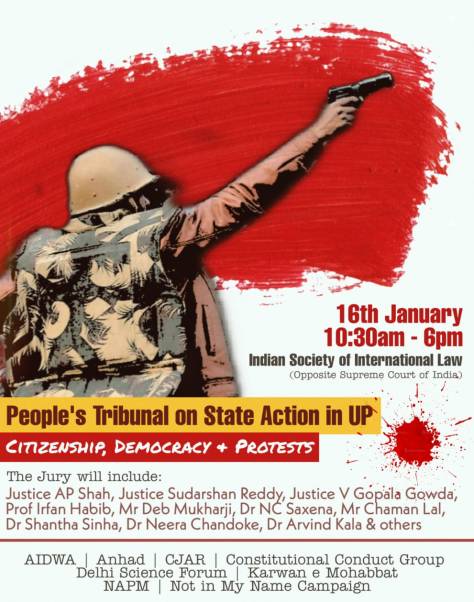
A public hearing on state action in UP will be held in Delhi on January 16th, 2020, bringing together all the information collected by different groups of people who have visited different parts of the state.

Here we present the report on Sambhal.

SAMBHAL

A team went to Sambhal from Karwan-e-Mohabbat on 2 January, 2020, consisting of Ayesha Kidwai, Farida Khan, Navsharan Singh, Nivedita Menon, Sandeep Yadav, Sumit Gupta, Tanika Sarkar and Varna Balakrishnan. Continue reading Muslims held hostage by a criminal state apparatus in UP – a report on Sambhal

Hope, solidarity and struggle in JNU: Women of Sabarmati

WOMEN OF SABARMATI WRITE:

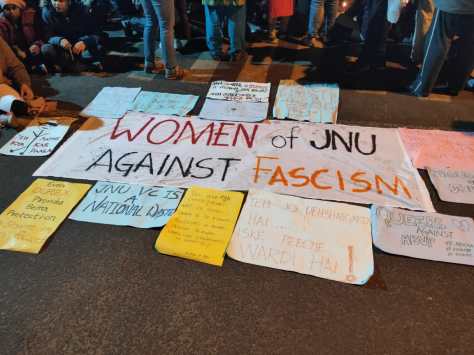
The outpouring of solidarity and generosity on the JNU campus, since the attack of 5th January 2020 has been overwhelming.

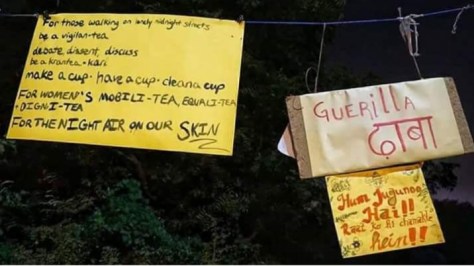
Hostels have organised guerilla dhabas at Sabarmati. They have sung revolutionary songs while making pans of maggi and distributing jhal muri and peanuts.

Men from the hostel that distributed peanuts, worried about the mess of the peanut shells at our hostel entrance, even offered to sweep up the place, brooms at the ready.

Three women in the women’s wing in Sabarmati threw all the women in the hostel a party two nights ago.

During and after the events of the 5th, neighbours have become friends.

Our teachers have been coming to meet us every day. Some have brought bags full of snacks. Some have organised trauma sessions for us. Some have just held us.

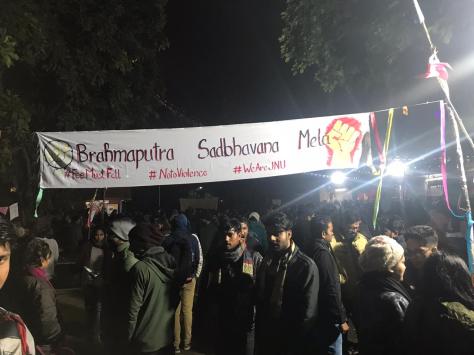
And tonight Brahmaputra hostel organised a Sadbhavna mela for the campus. Free snack stalls all around, dholak music to dance to and a large Lohri bonfire.

As some of us women from Sabarmati were walking back towards Ganga dhaba tonight, discussing how this is the first time our hostel has no Lohri celebrations, the men from Kaveri stopped us to offer popcorn from their Lohri celebrations.

JNU was home, is home, and will remain home.

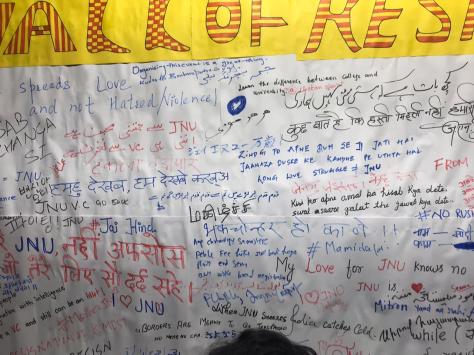
Wall of resistance at Brahmaputra

It’s We the People, not we the Citizens, of India!

Image courtesy News 18

People, Persons, Citizens

When the idea of citizenship is wielded like a deadly weapon to deprive people of basic rights rather than to empower them, it’s time to think about the basis of rights differently.  While in the Preamble to the Constitution, ‘we the people’ resolve to secure to all its ‘citizens’ justice, liberty, equality and fraternity; Article 14 of the Fundamental Rights ensures equality before the law to all “persons”, not only to citizens.

The people of a land precede the creation of “citizens”, and we the people of India must think seriously at this moment in our history, about how justice is to be secured to all persons, and whether citizenship is an emancipatory idea any longer.

Consider the revealing and tragic irony of one of the accused arrested for his alleged role in violence during protests against the Citizenship Amendment Act 2019 (CAA) , in East Delhi’s Seemapuri. Through his counsel, in a Delhi court, he claimed to be a juvenile, and to prove this, produced certificates from the madarsa at which he studies.

Delhi Police, however, claimed that these documents were insufficient to establish his age, and requested permission for a bone ossification test. The counsel of the accused argued that according to central government notifications, madarsa certificates are sufficient to prove age, but the Delhi court permitted police to carry out the ossification test.

Imagine the claim of such a person to  citizenship and to inclusion in the National Register of Citizens (NRC)! Continue reading It’s We the People, not we the Citizens, of India!

Dayaar-E-Shauq Mera – Land of my Hopes: Faiz Ullah

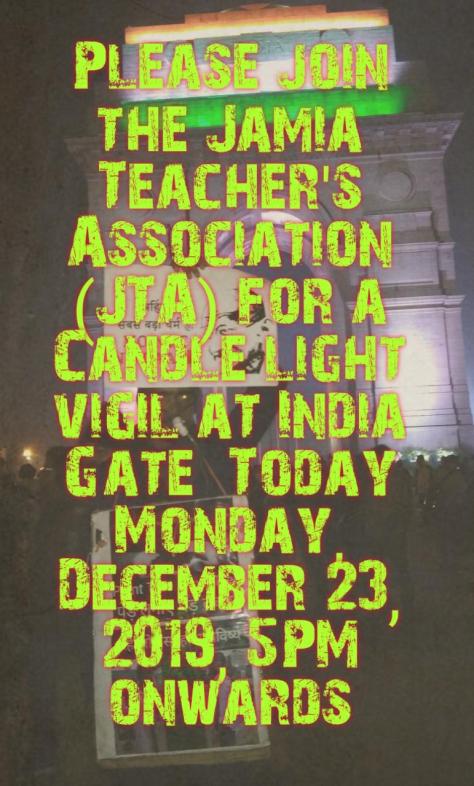
As Jamia Teachers Association calls for a candelight vigil at India Gate TODAY at 5 pm (December 23, 2019), we are publishing an earlier Facebook post by FAIZ ULLAH on Jamia written soon after the police violence at the university during the anti-CAA protests there.

Dayaar-e-shauq mera is the anthem of Jamia Milia Islamia. Translation of the lyrics at this link.

http://https://www.youtube.com/watch?v=gDbusktsKcg

FAIZ ULLAH writes:

Jamia Millia Islamia for me, and many like me who grew up in the small neighbourhoods around it, is not just a institution of higher education. It is our nursery, our playground, and where we came of age. My family moved from Bara Hindu Rao to Jamia Nagar area in the mid 1980s because my father thought living in the vicinity of an educational institution would be good for us. I am not very sure if the anti-Sikh violence of 1984 Delhi was a decisive reason for him to move us to a place he thought would be safe, but looking back I think he did kind of foresaw the shape of things.

Over the next couple of decades my elder brother studied History, My sister Social Work, and I, Mass Communication at Jamia. My niece will graduate this year from the same university in which her grandfather also enrolled for a while for his fourth degree – he had to drop out in the first year because he was already running a small primary school with my mother and practicing law on the side.

My brother was active in the students’ politics circles and served as the joint secretary of the university’s students’ union. This often translated into arguments between him and my father, not over his politics but that he would be too involved in it and would disappear for days without any information.

Continue reading Dayaar-E-Shauq Mera – Land of my Hopes: Faiz Ullah

The Philadelphia Coalition Against Fascism in India Protest Against CAA and NRC


The Philadelphia Coalition Against Fascism in India held a protest
Against CAA and NRC on December 19, 2019. 

Students from several colleges in the Philadelphia area and beyond, including UPenn, Drexel, Temple, Villanova, and Rutgers; working professionals, and business graduates gathered in solidarity with student protests in India and against the imposition of the CAA and the NRC.

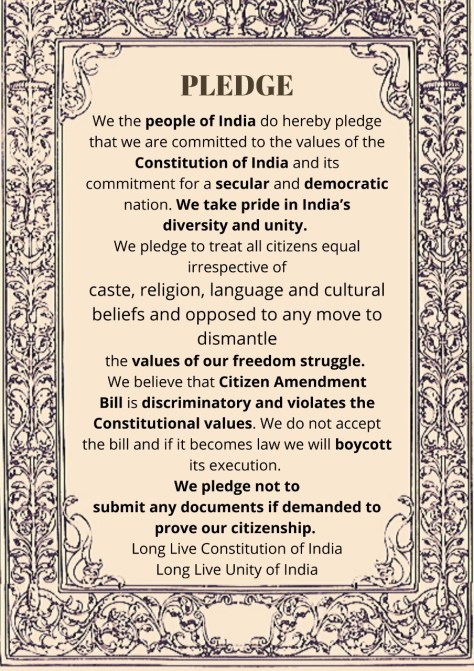
We read the preamble to the Indian constitution together and also took a pledge vowing to reject the CAA, the NRC, and the project of the RSS and BJP that seeks to turn India into a Hindu Rashtra.

Nearly 150 Philadelphians have signed this petition which affirms that

We will never accept these unconstitutional and unconscionable moves, and today join Indians from all over the country, and from every religion, caste, and region, to stand against any and all assaults on the idea of India as a secular, democratic republic.” It also points out that “there are many of Indian origin and heritage in the U.S. who are both concerned about events in India and condemn them. We have a responsibility to speak up in support of those resisting on the ground. … Those of us who live in Philadelphia, and believe in building a more free and just world, cannot stand by as fascist forces execute their programs of violence and exclusion. We stand proudly with the people of India against these excesses.

Two international statements in solidarity with anti CAA protests in India

  1. From UMASS and Five Colleges

We, the undersigned members and alumni of the University of Massachusetts, Amherst and the Five College Area write in solidarity and support of the protests in India and elsewhere against the Citizenship Amendment Act 2019, and express our complete rejection of this act.

We are deeply concerned about the violence against students in India’s universities, particularly at Jamia Milia Islamia, Delhi and at Aligarh Muslim University. The crackdown on universities has produced shocking images of violence, including tear-gassing hostel rooms and libraries, brutal and illegal violence in police detention, communally charged comments against students, and assault on female protestors. We condemn both the illegal crackdown on dissent, and the particularly communal and gendered nature of this crackdown, unequivocally support and admire the protesters who continue to take to the streets.

We are also extremely dismayed by the ongoing repression in the states of North-East India and Kashmir, and call on the Indian state to cease its internet shut-down. While this internet shut down has made communications and precise reports of the situation on the ground difficult, the news that has filtered through, regarding repression of protests in Tripura, Manipur, Assam, Meghalaya and Arunachal Pradesh is extremely troubling. In this light, we also express our serious concern over the recent detainment and torture of Assam activist Akhil Gogoi, a sustained and vocal critic of the Citizenship Amendment Bill/Act, under the UAPA and NIA acts.   

Read the full statement here.  

2. From students, faculty and alumni of Syracuse University, Hamilton College, Colgate University, SUNY College of Environmental Science & Forestry and Ithaca College, and the broader Central New York community.

As members of the Central New York community concerned about the brutal police violence against students at Jamia Milia Islamia and Aligarh Muslim University, two public universities with a predominantly Muslim minority student body, we join millions of students in at least 15 cities across India to express our solidarity with students protesting the Bharatiya Janata party’s
anti-Muslim Citizenship Amendment Act (CAA) 2019.

#SOSJamiaAMU and #RejectCAA represent the grassroots student movement protesting the CAA, recently passed by the upper and lower houses of the Indian parliament. The CAA grants
Indian citizenship to non-Muslim persecuted minorities seeking refuge in India from selected neighboring countries. This combined with the National Register of Citizens of India (NRC),
which is aimed at the disenfranchisement and detention of undocumented immigrants, equips the Hindu nationalist government to institutionalize ethnic cleansing of Muslim minorities. This systematic targeted violence is carried alongside increasing instances of lynchings of Muslims and caste-oppressed people. Further, the seemingly spontaneous resistance to the CAA out of Aligarh Muslim University and Jamia Millia Islamia must be understood with respect to the history of these two universities as post-Partition Muslim-serving institutions.

Read the full statement here.

Why the JNU #FeesMustFall is a Mass Intersectional Movement: Paresh Hate

Guest Post by PARESH HATE

It has been more than a month that students in JNU have been protesting against the new IHA Hostel Manual. The fight had initially begun against the exorbitant fee hikes, introduction of curfew timings and dress codes, lack of reservations and deprivation points in the manual, and the undemocratic manner in which the manual was passed. At this juncture, the movement has become broader, and articulates its resistance to the National Education Policy and its defence of the idea of public university and what it stands for.

While there have been many attempts to characterize the students’ movement as anti-national and free-loading as usual by the right-wing media, it is clear that the political articulation of students has managed to transcend these limited dimensions offered by the discourse set by the public perception. Even the propagandists are this time at a loss as to how to demonise the movement. All they have been able to come up with is that the protests ‘disrupted traffic’ and that the protests are ‘political’. One is unable to understand how the latter is a jibe, when protests are obviously always political in nature, especially this one. The demonization of JNU is not simply about the social sciences, or left-oriented student politics, but also a manufacturing of consent toward the commercialization and a legitimizing of this government’s agenda to destroy public avenues of welfare. However, due to the developments that have taken place in the last few weeks, politics itself of the campus is churning, wherein what is emerging is a cultivated intersectional discourse that has resulted in the breathing of new life into the campus. Continue reading Why the JNU #FeesMustFall is a Mass Intersectional Movement: Paresh Hate

Faculty Feminist Collective, JNU, condemns police violence on students

December 11, 2019

We, members of Faculty Feminist Collective, Jawaharlal Nehru University, condemn in the strongest terms the unprovoked police brutality on the peaceful protest marches of JNU students against the illegal adoption of a revised Hostel Manual by the JNU administration and the proposed steep rise in fees. Three times since November 11, 2019, the day of the JNU Convocation, the police have lathi-charged assembled and marching students. The first time, students were expressing a legitimate demand to meet the Vice Chancellor who now conducts all business outside the campus and has not met any member of the JNU community for some time now. On the second occasion it was a march to Parliament, to meet the elected representatives of this country; and the third time, to meet the President of India who is also the Visitor of JNU, to press upon them the urgency of the situation in which nearly half of the current students of JNU will not be able to come back next semester if the IHA Manual and the fee hike is not rolled back. Continue reading Faculty Feminist Collective, JNU, condemns police violence on students

Withdraw the Citizenship Amendment Bill! Not in My Name

JOIN THE PROTEST ORGANIZED BY ‘NOT IN MY NAME’ AGAINST THE CAB ON 14TH DECEMBER 3 TO 5 PM AT JANTAR MANTAR, DELHI.

WHAT IS THE CAB?

The Citizenship Amendment Bill proposes to offer Indian citizenship to Hindu, Sikh, Jain, Buddhist and Christian refugees from Afghanistan, Bangladesh and Pakistan. Muslims have been excluded. It is the Government’s argument that minorities of these three countries face persecution on the basis of religion.

WHAT DOES THE INDIAN CONSTITUTION SAY?

The framers of our Constitution made sure that religion and citizenship were delinked. Put together in the immediate aftermath of Partition, which witnessed the barbaric killing of lakhs of people and the uprooting of millions, the Constitution of India chose to strike out in a direction that surprised the world: our constitution guarantees citizenship irrespective of religion or any other identity. India was to be a country that belonged to all who were born here – and irrespective of their other identities. It is this sense of belonging that has kept India together.

WHY IS CAB DANGEROUS?

In the next few days Parliament will decide whether we continue to be an India that belongs to all. With the CAB we are being dragged back by more than seventy years, to follow the path of nations with a narrow minded view of citizenship, with the inevitable consequence of further divisions, partitions, enmity and violence. Continue reading Withdraw the Citizenship Amendment Bill! Not in My Name

We the people of India, Reject the Citizenship Amendment Bill

Remembering December 6 – A letter to the people of India: Constitutional Conduct Group

Statement by CONSTITUTIONAL CONDUCT GROUP

We, a collective of retired civil servants deeply committed to the values and guarantees of the Indian constitution, share with our fellow Indians our extreme grief and deep concern about where India stands today, 27 years after the demolition of the Babri Masjid in Ayodhya on 6 December, 1992.

We recall that 6 December is also the anniversary of the day on which the man who led the creation of one of the finest constitutions in the world, Dr Bhimrao Ambedkar, left this world.

The battle for the land on which the medieval mosque in Ayodhya stood was at its core a battle for the defence of the highest values of this constitution.

This was not simply a title dispute over a tiny piece of land in a dusty small town. It was not even a contest between a medieval mosque, now razed, with a grand temple, still imagined. It was a dispute about what kind of country this is and will be in the future, to who does it
belong, and on what terms must people of different identities and beliefs live together in this vast and teeming land.
4. We feel intense anguish because 27 years after the mosque was demolished, those who were responsible for this crime which tore India apart and led to the highest levels of communal bloodletting after the Partition riots, have still not been punished, even though
the Supreme Court directed that this criminal case be heard on a day-to-day basis. Instead, many of those who led and participated in this assault not just on a mosque but on India’s constitutional morality, have held some of the highest offices in this country.

We worry also that the recent judgment of the Supreme Court of India in effect rewards this grave crime. It also creates a false and illusory notion that a verdict favouring those who claim to speak for the majority community can result in peace and reconciliation and
everyone should move on, injustice notwithstanding. Continue reading Remembering December 6 – A letter to the people of India: Constitutional Conduct Group

Solidarity Statement by TISS Alumni with Students of JNU

We the undersigned, are alumni of the Tata Institute of Social Sciences.

We are appalled at the complete lack of sensitivity shown by the JNU administration and concerned government officials to the issues raised by the students on the recent proposal of irrational 999% hike in their fee structure. We also strongly condemn the inappropriate use of brute force by the police officials towards the peaceful protest of university students when they were demanding a roll back of this policy to keep higher education accessible for all, and to oppose imposing of regressive restrictions on the clothing and movement of students in the university.

Not just insensitive, the state has also used condemnable tactics to deal with the legitimate demands of the protesting students. Instead of using questionable means to stop students from peacefully protesting and approaching the policymakers, the government should have facilitated a dialogue with the students and paid heed to their demands. Continue reading Solidarity Statement by TISS Alumni with Students of JNU

Women Of The World Stand With Kashmir

Statement issued on 27 September 2019.
NEW DELHI. NEW YORK
 

On 30 August 2019,the United Nations’ International Day of the Victims of Enforced Disappearances, Parveena Ahangar, mother of Javaid, a 16 year old who was ‘disappeared’by paramilitary forces in Kashmir in 1990 mourned again.

Every year, the families of APDP (Association of Parents of Disappeared Persons) come together on 30 August. This is our way of reassuring each other that we are not alone in our grief. Yet this year we have been strangled, and there was no coming together because through its siege, India has denied us even the right to mourn.

Kashmir under siege. Kashmir caged. Kashmir imprisoned. Analogies abound for of the Indian Government‘s actions of August 5, 2019 when it unilaterally terminated the semi-autonomous Constitutional status granted to the region as a condition of its accession to India, and bifurcated it into two directly ruled Union Territories. This action was preceded in the previous week by a military blockade, a state of undeclared emergency, and an unprecedented media and communications clampdown. An estimated 4,000 Kashmiris have been arbitrarily detained including politicians, business leaders, lawyers, human rights defenders, chartered accountants, journalists, teachers, and students. Some are being held without charges or trial, under administrative detention laws such as the Public Safety Act, 1978 while the grounds of detention and whereabouts of a large number, including children as young as ten, remain unknown. An unknown number of people have been moved to prisons outside the state of Jammu & Kashmir.The Indian government continues to declare that all is ‘normal’ in the face of credible and mounting evidence of a healthcare and humanitarian crisis, civilian deaths and blindings and other injuries in pellet gun attacks by Indian security forces, torture, molestations, and the severe curtailment of freedom of opinion, expression, and information; assembly and movement; and religious freedoms. Continue reading Women Of The World Stand With Kashmir

Everyday Tips for Surviving Tyranny: Anonymous

Guest Post by ANONYMOUS

Suspected Banksy mural in London in support of environmentalist protest. 

As authoritarian right-wing populist leaders across the world unleash a reign of tyranny and hate, there is a need to think together about everyday strategies of survival. As an individual, it can get a bit overwhelming. Everything could look pointless. Many friends talk about how they find it impossible to write or work in an atmosphere of hate and violence. However, it is important to remember that what might look invincible today may not last for even half a decade. But while it lasts, how does one live under tyranny and what are the ways of building non-violent resistance? Continue reading Everyday Tips for Surviving Tyranny: Anonymous

Kashmir’s information bloackade: The Network of Women in Media, India and The Free Speech Collective

Report from Kashmir by a team from the Network of Women in Media, India (NWMI) and the Free Speech Collective (FSC) .

A month after the 5 August abrogation of Article 370 of the Constitution of India, which granted special status to Jammu and Kashmir, the continuing shutdown of communication in the Kashmir valley has resulted in the throttling of independent media. As journalists continue to face severe restrictions in all the processes of news-gathering, verification and dissemination, the free flow of information has been blocked, leaving in its wake a troubled silence that bodes ill for freedom of expression and media freedom.

In this, the latest and most intense phase in the ongoing conflict on Kashmir, the government of India has pulled out all the stops – political, legislative, militaristic and punitive. It has detained and arrested scores of people, including leaders of mainstream political parties. No other democratic government has attempted a communication blockade of this scale in Kashmir.

In an effort to determine the impact of the severe crackdown on communication on the media in Kashmir, a two-member team from the Network of Women in Media, India (NWMI) and the Free Speech Collective (FSC) spent five days in the Valley between 30 August and 3 September. The team spoke* to more than 70 journalists, correspondents and editors of newspapers and news-sites in Srinagar and South Kashmir, members of the local administration and citizens.

Key findings : Curbs on the media and its implications

Kashmir, a phone call away? Ramnik Mohan

Guest post by RAMNIK MOHAN

“The number you are calling is currently switched off. Please try again later.” This has been the stock computerized response I have heard on calling a friend in Jammu and Kashmir over the last twenty odd days, and still counting. The chirpy, happily surprised voice I heard across our mobiles when I informed my young friend about my sudden arrival in Srinagar last January is too stark a contrast to register today. ‘Lockdown’ is the new buzzword for Kashmir these days.

All links of communication with the rest of the country having been snapped in one fell swoop, it doesn’t quite require much of an effort for any sensitive human being to imagine how life must be for all the folk out there. Nor should it take much of an imagination for such a human being to think of the plight of Kashmiris in the rest of the country dying to hear the voices of near and dear ones separated thus.

Continue reading Kashmir, a phone call away? Ramnik Mohan

Queerness as disease – a continuing narrative in 21st century India: Kaushal Bodwal

Guest post by KAUSHAL BODWAL

In August 2018, it came to my knowledge that a few of my pictures wearing sarees were circulating in my extended family’s WhatsApp group. Phone calls from home regarding my “obscene” behaviour were followed by a shift in the entire conversation towards my having some illness that needed to be cured. At some point my mother called me to tell that one of my aunts knew a doctor who can heal me. My first thought was that she was joking; unfortunately, she was only too serious. Once I registered the gravity of the situation, I panicked. Even though I was staying in a closed campus, I was not sure of my family’s potential to do what they claimed they wanted to.

The issue was with both my gender expression and my sexuality. I was a male assigned at birth walking in a saree and they thought that it was because of my interest in men. One of my aunts assured my mother that my love for sarees will end once my homosexuality is cured. The next time I went home, I was anxious and terrified. I knew I had to speak to them and explain what was going on. There were going to be a lot of questions. It’s not as I had ready-made answers for them, especially since the understanding of gender and sexuality that I had was not easy to articulate in my native language of Haryanvi. Through whatever words I could, I came out to my parents. My mom cried and my father stood numb. But mostly, confused. Despite their anger and other emotional expressions, the overall emphasis was on going to a doctor to get me fixed. After all, I was sick. Continue reading Queerness as disease – a continuing narrative in 21st century India: Kaushal Bodwal