All posts by Nivedita Menon

Faculty Feminist Collective, JNU, condemns police violence on students

December 11, 2019

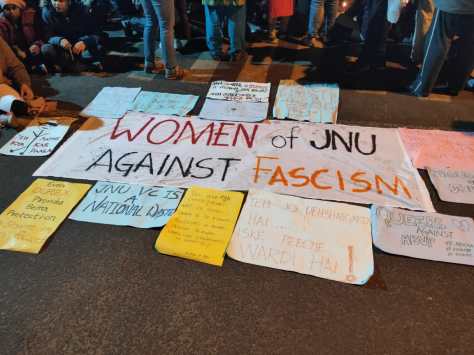
We, members of Faculty Feminist Collective, Jawaharlal Nehru University, condemn in the strongest terms the unprovoked police brutality on the peaceful protest marches of JNU students against the illegal adoption of a revised Hostel Manual by the JNU administration and the proposed steep rise in fees. Three times since November 11, 2019, the day of the JNU Convocation, the police have lathi-charged assembled and marching students. The first time, students were expressing a legitimate demand to meet the Vice Chancellor who now conducts all business outside the campus and has not met any member of the JNU community for some time now. On the second occasion it was a march to Parliament, to meet the elected representatives of this country; and the third time, to meet the President of India who is also the Visitor of JNU, to press upon them the urgency of the situation in which nearly half of the current students of JNU will not be able to come back next semester if the IHA Manual and the fee hike is not rolled back. Continue reading Faculty Feminist Collective, JNU, condemns police violence on students

Withdraw the Citizenship Amendment Bill! Not in My Name

JOIN THE PROTEST ORGANIZED BY ‘NOT IN MY NAME’ AGAINST THE CAB ON 14TH DECEMBER 3 TO 5 PM AT JANTAR MANTAR, DELHI.

WHAT IS THE CAB?

The Citizenship Amendment Bill proposes to offer Indian citizenship to Hindu, Sikh, Jain, Buddhist and Christian refugees from Afghanistan, Bangladesh and Pakistan. Muslims have been excluded. It is the Government’s argument that minorities of these three countries face persecution on the basis of religion.

WHAT DOES THE INDIAN CONSTITUTION SAY?

The framers of our Constitution made sure that religion and citizenship were delinked. Put together in the immediate aftermath of Partition, which witnessed the barbaric killing of lakhs of people and the uprooting of millions, the Constitution of India chose to strike out in a direction that surprised the world: our constitution guarantees citizenship irrespective of religion or any other identity. India was to be a country that belonged to all who were born here – and irrespective of their other identities. It is this sense of belonging that has kept India together.

WHY IS CAB DANGEROUS?

In the next few days Parliament will decide whether we continue to be an India that belongs to all. With the CAB we are being dragged back by more than seventy years, to follow the path of nations with a narrow minded view of citizenship, with the inevitable consequence of further divisions, partitions, enmity and violence. Continue reading Withdraw the Citizenship Amendment Bill! Not in My Name

We the people of India, Reject the Citizenship Amendment Bill

Remembering December 6 – A letter to the people of India: Constitutional Conduct Group

Statement by CONSTITUTIONAL CONDUCT GROUP

We, a collective of retired civil servants deeply committed to the values and guarantees of the Indian constitution, share with our fellow Indians our extreme grief and deep concern about where India stands today, 27 years after the demolition of the Babri Masjid in Ayodhya on 6 December, 1992.

We recall that 6 December is also the anniversary of the day on which the man who led the creation of one of the finest constitutions in the world, Dr Bhimrao Ambedkar, left this world.

The battle for the land on which the medieval mosque in Ayodhya stood was at its core a battle for the defence of the highest values of this constitution.

This was not simply a title dispute over a tiny piece of land in a dusty small town. It was not even a contest between a medieval mosque, now razed, with a grand temple, still imagined. It was a dispute about what kind of country this is and will be in the future, to who does it
belong, and on what terms must people of different identities and beliefs live together in this vast and teeming land.
4. We feel intense anguish because 27 years after the mosque was demolished, those who were responsible for this crime which tore India apart and led to the highest levels of communal bloodletting after the Partition riots, have still not been punished, even though
the Supreme Court directed that this criminal case be heard on a day-to-day basis. Instead, many of those who led and participated in this assault not just on a mosque but on India’s constitutional morality, have held some of the highest offices in this country.

We worry also that the recent judgment of the Supreme Court of India in effect rewards this grave crime. It also creates a false and illusory notion that a verdict favouring those who claim to speak for the majority community can result in peace and reconciliation and
everyone should move on, injustice notwithstanding. Continue reading Remembering December 6 – A letter to the people of India: Constitutional Conduct Group

Solidarity Statement by TISS Alumni with Students of JNU

We the undersigned, are alumni of the Tata Institute of Social Sciences.

We are appalled at the complete lack of sensitivity shown by the JNU administration and concerned government officials to the issues raised by the students on the recent proposal of irrational 999% hike in their fee structure. We also strongly condemn the inappropriate use of brute force by the police officials towards the peaceful protest of university students when they were demanding a roll back of this policy to keep higher education accessible for all, and to oppose imposing of regressive restrictions on the clothing and movement of students in the university.

Not just insensitive, the state has also used condemnable tactics to deal with the legitimate demands of the protesting students. Instead of using questionable means to stop students from peacefully protesting and approaching the policymakers, the government should have facilitated a dialogue with the students and paid heed to their demands. Continue reading Solidarity Statement by TISS Alumni with Students of JNU

Women Of The World Stand With Kashmir

Statement issued on 27 September 2019.
NEW DELHI. NEW YORK
 

On 30 August 2019,the United Nations’ International Day of the Victims of Enforced Disappearances, Parveena Ahangar, mother of Javaid, a 16 year old who was ‘disappeared’by paramilitary forces in Kashmir in 1990 mourned again.

Every year, the families of APDP (Association of Parents of Disappeared Persons) come together on 30 August. This is our way of reassuring each other that we are not alone in our grief. Yet this year we have been strangled, and there was no coming together because through its siege, India has denied us even the right to mourn.

Kashmir under siege. Kashmir caged. Kashmir imprisoned. Analogies abound for of the Indian Government‘s actions of August 5, 2019 when it unilaterally terminated the semi-autonomous Constitutional status granted to the region as a condition of its accession to India, and bifurcated it into two directly ruled Union Territories. This action was preceded in the previous week by a military blockade, a state of undeclared emergency, and an unprecedented media and communications clampdown. An estimated 4,000 Kashmiris have been arbitrarily detained including politicians, business leaders, lawyers, human rights defenders, chartered accountants, journalists, teachers, and students. Some are being held without charges or trial, under administrative detention laws such as the Public Safety Act, 1978 while the grounds of detention and whereabouts of a large number, including children as young as ten, remain unknown. An unknown number of people have been moved to prisons outside the state of Jammu & Kashmir.The Indian government continues to declare that all is ‘normal’ in the face of credible and mounting evidence of a healthcare and humanitarian crisis, civilian deaths and blindings and other injuries in pellet gun attacks by Indian security forces, torture, molestations, and the severe curtailment of freedom of opinion, expression, and information; assembly and movement; and religious freedoms. Continue reading Women Of The World Stand With Kashmir

Everyday Tips for Surviving Tyranny: Anonymous

Guest Post by ANONYMOUS

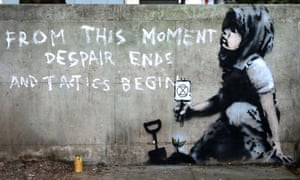
Suspected Banksy mural in London in support of environmentalist protest. 

As authoritarian right-wing populist leaders across the world unleash a reign of tyranny and hate, there is a need to think together about everyday strategies of survival. As an individual, it can get a bit overwhelming. Everything could look pointless. Many friends talk about how they find it impossible to write or work in an atmosphere of hate and violence. However, it is important to remember that what might look invincible today may not last for even half a decade. But while it lasts, how does one live under tyranny and what are the ways of building non-violent resistance? Continue reading Everyday Tips for Surviving Tyranny: Anonymous

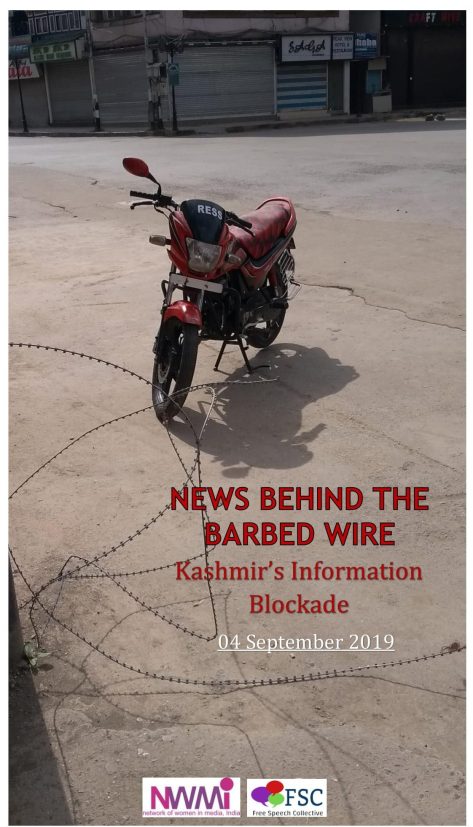
Kashmir’s information bloackade: The Network of Women in Media, India and The Free Speech Collective

Report from Kashmir by a team from the Network of Women in Media, India (NWMI) and the Free Speech Collective (FSC) .

A month after the 5 August abrogation of Article 370 of the Constitution of India, which granted special status to Jammu and Kashmir, the continuing shutdown of communication in the Kashmir valley has resulted in the throttling of independent media. As journalists continue to face severe restrictions in all the processes of news-gathering, verification and dissemination, the free flow of information has been blocked, leaving in its wake a troubled silence that bodes ill for freedom of expression and media freedom.

In this, the latest and most intense phase in the ongoing conflict on Kashmir, the government of India has pulled out all the stops – political, legislative, militaristic and punitive. It has detained and arrested scores of people, including leaders of mainstream political parties. No other democratic government has attempted a communication blockade of this scale in Kashmir.

In an effort to determine the impact of the severe crackdown on communication on the media in Kashmir, a two-member team from the Network of Women in Media, India (NWMI) and the Free Speech Collective (FSC) spent five days in the Valley between 30 August and 3 September. The team spoke* to more than 70 journalists, correspondents and editors of newspapers and news-sites in Srinagar and South Kashmir, members of the local administration and citizens.

Key findings : Curbs on the media and its implications

Kashmir, a phone call away? Ramnik Mohan

Guest post by RAMNIK MOHAN

“The number you are calling is currently switched off. Please try again later.” This has been the stock computerized response I have heard on calling a friend in Jammu and Kashmir over the last twenty odd days, and still counting. The chirpy, happily surprised voice I heard across our mobiles when I informed my young friend about my sudden arrival in Srinagar last January is too stark a contrast to register today. ‘Lockdown’ is the new buzzword for Kashmir these days.

All links of communication with the rest of the country having been snapped in one fell swoop, it doesn’t quite require much of an effort for any sensitive human being to imagine how life must be for all the folk out there. Nor should it take much of an imagination for such a human being to think of the plight of Kashmiris in the rest of the country dying to hear the voices of near and dear ones separated thus.

Continue reading Kashmir, a phone call away? Ramnik Mohan

Queerness as disease – a continuing narrative in 21st century India: Kaushal Bodwal

Guest post by KAUSHAL BODWAL

In August 2018, it came to my knowledge that a few of my pictures wearing sarees were circulating in my extended family’s WhatsApp group. Phone calls from home regarding my “obscene” behaviour were followed by a shift in the entire conversation towards my having some illness that needed to be cured. At some point my mother called me to tell that one of my aunts knew a doctor who can heal me. My first thought was that she was joking; unfortunately, she was only too serious. Once I registered the gravity of the situation, I panicked. Even though I was staying in a closed campus, I was not sure of my family’s potential to do what they claimed they wanted to.

The issue was with both my gender expression and my sexuality. I was a male assigned at birth walking in a saree and they thought that it was because of my interest in men. One of my aunts assured my mother that my love for sarees will end once my homosexuality is cured. The next time I went home, I was anxious and terrified. I knew I had to speak to them and explain what was going on. There were going to be a lot of questions. It’s not as I had ready-made answers for them, especially since the understanding of gender and sexuality that I had was not easy to articulate in my native language of Haryanvi. Through whatever words I could, I came out to my parents. My mom cried and my father stood numb. But mostly, confused. Despite their anger and other emotional expressions, the overall emphasis was on going to a doctor to get me fixed. After all, I was sick. Continue reading Queerness as disease – a continuing narrative in 21st century India: Kaushal Bodwal

The RSS coup d’etat in India, and a collage of solidarity actions for Kashmir

Protest in Philadephia on abrogation of Article 370

Since the 5th of August, the now abolished state of Kashmir has been under de facto military rule, as shown both by news reports of the numbers of troops stationed there currently, as well as by a fact-finding report released after a visit to Kashmir by Jean Dreze, Kavita  Krishnan, Maimoona Mollah and Vimal Bhai, which begins:

When we arrived in Srinagar on 9 August, we found the city silenced and desolated by curfew, and bristling with Indian military and paramilitary presence. The curfew was total, as it had been since 5th August.

The intention of this post was initially only to put together a quick collage of some news items and statements of solidarity and protests across India and the world, on the abolition of the state of Jammu & Kashmir, bringing the two newly formed Union Territories directly under the rule of the Hindutva formation currently in power at the centre.

However, this move can only be understood in the context of the fact that since May 23, 2019, India is barely any longer even the formal democracy it claimed to be.  Effectively, a coup d’etat was carried out on that date by the RSS (now under the complete control of Modi-Shah), through the extremely dubious “sweeping victory” of the BJP.  We begin therefore with a section on RSS and The Lie as Political Strategy.

The second section is the compilation and in the third, some reflections on democracy in India today. Continue reading The RSS coup d’etat in India, and a collage of solidarity actions for Kashmir

Mujh se integration karogi? Sanghvaad and its war on women

Determined, defiant – not the Kashmiri women of Sanghi fantasies

Protest in Srinagar against the abrogation of Article 370 on August 11, 2019, despite the clampdown by the Indian government. Image courtesy The Wall Street Journal.

When trolls on social media started circulating photographs of young Kashmiri girls, gloating, “now we can marry them”, it was only the overt manifestation by Sanghis of the real spirit behind abrogating Article 370. While Prime Minister Narendra Modi held forth at length on development, rights to education, rights for women and for Dalits, all of which the people of J&K were deprived of because of Article 370, the truth of course, is that J&K stands in the top 10 to 15 states on  different indicators ranging from life expectancy, people served per government doctor, poverty rate and infant mortality rate, to human development index.

Or as Haseeb Drabu puts it:

The level of economic empowerment is evident from the fact that more than 25% of the household earnings in J&K are from own cultivation. In “prosperous” Punjab, it is only 18%, in “vibrant” Gujarat, it is less than 16% and in “terrific” Tamil Nadu, it is only 3%. And yet, J&K is being portrayed as a “sick” state.

Continue reading Mujh se integration karogi? Sanghvaad and its war on women

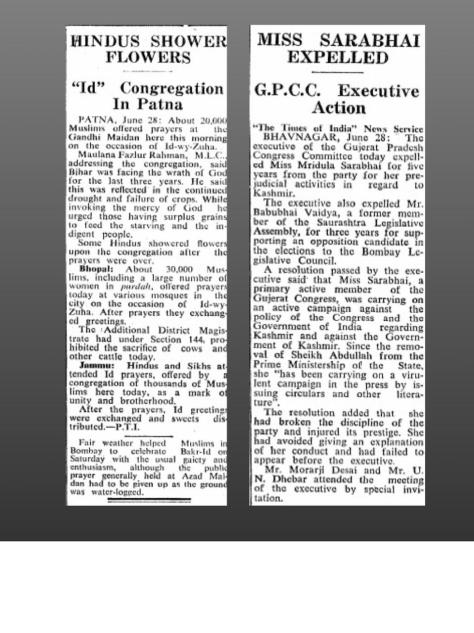
On Eid, two stories in Times of India June 28, 1958: Ayesha Kidwai

Guest post by AYESHA KIDWAI


On the same page of the Times of India of June 28, 1958 are two news items. The one on the left is a report of how Bakrid was celebrated the day before in various cities, including Jammu, where Hindus and Sikhs offered namaz along with their Muslim brethren. On the right  is another story that reports the expulsion of Ms. Mridula Sarabhai from the Congress party for her ‘anti-party activities’ in opposing the arrest of Sheikh Abdullah in 1953 and the muzzling of democratic rights in Kashmir.

Continue reading On Eid, two stories in Times of India June 28, 1958: Ayesha Kidwai

More lies from the Election Commission – good job, The Quint!

Previous posts on the stealing of the 2019 Lok Sabha Elections on Kafila, which have links to many other substantiated stories in other journals and news portals:

The “massive mandate” of 2019 and the role of the Election Commission  – Nivedita Menon

Update On “Tally Mismatch” In 2019 Lok Sabha Elections: Ravi Nair

Lok Sabha Elections 2019 – Calling The Election Commission To Account: Statement By Retired Civil Servants, Veterans, Academics And Concerned Citizens

EC Misleads Public With Bogus RTI Reply On VVPAT Count: Poonam Agarwal

RTI Reveals Pvt Consultants Have EVM Access, Why is EC Denying It? POONAM AGARWAL in The Quint.

The Election Commission of India has always maintained that no private company or outsourcing in any form is involved in the election process. But The Quint’s investigation has found this to not be true.

An RTI in The Quint’s possession shows that the Electronics Corporation of India Limited (ECIL), a PSU that manufactures EVMs and VVPAT machines, engaged private engineers as “consultants” and that these private engineers have worked with the Election Commission in Assembly Elections since 2017 and even in the 2019 Lok Sabha election.

Their job was extremely sensitive – to check and maintain EVMs and VVPATs, starting from First level Checking (FLC) right up till and including the Counting Day, which means they had easy access to EVMs through the course of the elections.

Read the full article here.

From revered icon to unruly subject – Irom Sharmila and the politics of gender: Panchali Ray

Guest Post by PANCHALI RAY

In the month of August, 2016, Irom Sharmila Chanu, also known as the ‘Iron Lady’ and ‘Mengoubi’ (the fair one) announced that she would break her 16 year long hunger fast, which she commenced  as a protest against the imposition of AFSPA (Armed Forces (Special Powers) Act) by the Indian state on the tiny hilly state of Manipur. While some cheered, others were curious, and many shocked and angry at what they perceived as her betrayal of the Manipuri cause. The backlash from her community was quick and ferocious, and newspaper headlines carried titillating stories of how she was rejected by her ‘own’.[1]

While much has been written on Sharmila’s hunger strike, her breaking of the fast, and entry into electoral politics, there has not been an equal amount of discussion on the politics of gender. For instance, the fact that Sharmila’s location in the North-Eastern part of the country has been central to her marginalization and non-acknowledgement[2], or that the mainstream media’s highlighting of her predicament, post-hunger strike, reinforced stereotypes of Manipur as the ‘wild’ and ‘savage’ North East[3] has received considerable attention.

Continue reading From revered icon to unruly subject – Irom Sharmila and the politics of gender: Panchali Ray

Immigrant Detention Centres in India – need for transparency: Paresh Hate

Guest post by PARESH HATE

From what knowledge we have so far, it seems clear that the issue of citizenship and migration in South Asia is not any less complicated or politically charged than in Global North. Assam Accord and National Registry of Citizenship were already polarizing individuals across the political spectrum.  The demonisation of Bangladeshi immigrants continues throughout the country. But the entering of BJP in Assam politics has complicated the matter even further. Beyond the stories of deportation and violence at the border between India and Bangladesh, now we are also witnessing a rise of detention centres all over India which has put the lives of many migrants effectively into a state of limbo where they are designated for deportation but do not know when they will meet this fate.

Continue reading Immigrant Detention Centres in India – need for transparency: Paresh Hate

EC Misleads Public With Bogus RTI Reply on VVPAT Count: Poonam Agarwal

Evidence mounts of something extremely rotten in the state of India and the recent Lok Sabha elections.

We have raised this question on Kafila for a while now, see The Massive Mandate and Open Letter to Election Commission of India by civil servants, the serious charges in which have been met with total silence.

Now POONAM AGARWAL writes in The Quint, which has been investigating the issue for some time.

The current state of India’s Election Commission (EC) raises doubts about its transparency and fairness, especially when we find that it is misleading the public in its RTI replies.

The EC was constituted in 1950 to conduct free and fair elections, and was established as an autonomous body solely so that it can work independently. Is that what it’s doing?

The Quint filed an RTI seeking information and documents on the VVPAT count data during the Lok Sabha elections 2019. In reply, the EC refused to share the documents on the grounds that the VVPAT data is not available with the Commission (which means, at the EC headquarters in Delhi).

Here’s How the EC Is Misleading Citizens.

Read the full article at The Quint.


The Politics of Piety in Naya Pakistan: Afiya Zia

Guest Post by AFIYA ZIA

A year ago, Pakistan’s national elections brought in a new government led by the Pakistan Tehreeq e Insaf (PTI) and headed by the former-cricketer-turned politician, Imran Khan. Khan had been drifting in the political wilderness for 22 years, waiting for providence to appoint him Prime Minister. As the 2018 elections loomed, this was not looking possible. However, a series of legal cases of corruption started being levelled against the serving PM, Nawaz Sharif, and efforts were made to atrophy others from the major parties of the PML-N and PPP (who had signed the ‘charter of democracy’ to prevent military intervention in civilian governance). The methods of these moves made it clear that the ‘establishment’ was betting on a new horse. Khan was not taking any risks though.

Six months before the national election, he entered marriage for the third time (with no less controversy than his previous marriages) to Bushra Maneka who was also his spiritual guide or pirni. A mother and a grandmother, there was speculation that Bushra divorced her husband for the higher cause of marrying the PM-in-waiting. In the days prior to the summer election, Khan performed Umrah in Mecca with Bushra, and was seen prostrating at a shrine in Pakistan and accessorised with rosaries and amulets in preparation for the polls.

Continue reading The Politics of Piety in Naya Pakistan: Afiya Zia

Why I Celebrate the Wedding of Nusrat Jahan: Zakia Soman

Guest post by ZAKIA SOMAN 

The wedding of Nusrat Jahan the TMC MP to Nikhil Jain is refreshing news. It is heartening to see two young Indians from different faith backgrounds uniting and celebrating their marriage in the times of religious hate and division.

The mixing of politics and religion has led to a climate where marrying a person from another faith has become extremely difficult specially for young people. The case of Hadiya may have been highlighted in the media but it is certainly not the only instance where a couple had to undergo tremendous hardships for falling in love. The self-appointed guardians of religion who seem omnipresent in family, community, police, judiciary, government, media would walk great lengths to prevent inter-faith marriages from taking place. Continue reading Why I Celebrate the Wedding of Nusrat Jahan: Zakia Soman

Lok Sabha Elections 2019 – Calling the Election Commission to account: Statement by retired civil servants, veterans, academics and concerned citizens

Letter to the Election Commission of India written by 64 former civil servants, endorsed by 83 veterans, academics and other concerned citizens.

Shri Sunil Arora, Chief Election Commissioner, Shri Ashok Lavasa,  Election Commissioner, and Shri Sushil Chandra, Election Commissioner.

Election Commission of India.

Sirs,

Serious Irregularities in the Conduct of General Elections, 2019  

  • We are a group of former civil servants that takes up, from time to time, matters of exceptional national interest, seeking to remind our cherished democratic institutions of their responsibility to uphold the lofty ideals of the Constitution. We write to you today to draw your attention to the several very troubling and still unexplained issues pertaining to the conduct of the General Elections, 2019, by the Election Commission of India (ECI).
  • From time to time, the media has reported on various irregularities in the conduct of the 2019 General Elections. While we accept that not every media report is accurate or true, the ECI’s non-rebuttal of an untrue or inaccurate story leaves the public to draw its own conclusion: that the ECI has no valid explanation to offer. The mere dismissal of the allegations as baseless, without an explanation as to why they should be so considered, is unsatisfactory. As the custodian of the most precious commodity in a democracy – the people’s mandate – it is your duty to be transparent, and accountable to the Constitution and the people of India. Continue reading Lok Sabha Elections 2019 – Calling the Election Commission to account: Statement by retired civil servants, veterans, academics and concerned citizens