All posts by Sunalini Kumar

Innocence Interrupted: Arshie Qureshi

Guest post by ARSHIE QURESHI

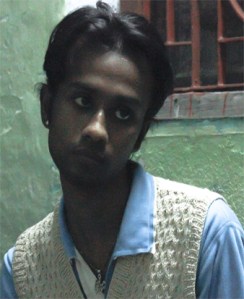
For a child born in Kashmir, the chances of living a normal life and even survival vary greatly from one region to another. Suppose you are born in the seemingly volatile stretch of Downtown. You may well turn out to be someone whose pictures are flashed on social media as the epitome of bravery, someone whose demise is imminent, and someone ready to wear the ‘Shaheed’ label. I arrived at this place at 4:30 on a cold evening. The room was crowded by women sitting with only one recognizable face; Shehzaad’s mother, Rubeena Akhter. Nobody spoke. The air smelled like rain. After a short while, a tall man in a brown-checkered pheran appeared. Leaning on the walls, he helped himself to one corner of the dimly lit but spacious room. He did not want himself to be identified as a ‘victim of conflict’.

For Shehzaad, life had been altogether different before. He had spent happy summers with his family in the town where violence, as it existed, had never appeared to him naked. By now, he is 23. He has become larger and properly bearded. The one thing which you can’t miss about Shehzaad is that he has giant brown eyes like a dairy cow. That’s what prompts my most idiotic lines of inquiry. Could someone who looks like that really pelt stones on streets? Idiotic, I know. “Do I have to tell you how I was supposed to have been killed that day?” he says, sounding like a gull. I hear a slow whimpering strangled with ache. This soon changes into full-throated babbling—a cascade of terrible, terrified pleading wails as he continued naming those who had been killed during the 2010 agitations.

Continue reading Innocence Interrupted: Arshie Qureshi

An Election of Hope Versus Fear

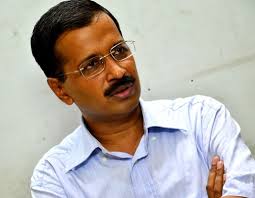
Yes it’s a simplistic dichotomy, but there is really no better way to describe the current Delhi elections. On the one hand, a little ragtag army of Davids behind “Mufflerman”, as his faithful supporters affectionately call him, a person in baggy sweater and sneakers, one you wouldn’t look at twice if you passed him on the road.

Mufflerman Business Standard

  Kejriwal

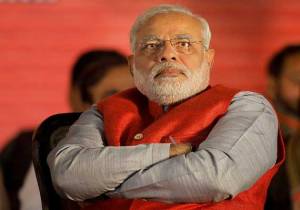
On the other hand, a massively funded, aggressively confident Goliath, openly backed by the corporate bodies and full-page ads, riding a  national “Wave” higher than most Tsunamis, topped by the 56-inch chest of “Modiman”, even if recently modestly covered by a 12-lakh rupee vest.

56-inch Modi78c0d4d3-be9e-4afb-b034-1247529df720wallpaper1

On the one hand, a fearful and awed media establishment donating PR for free to the seemingly invincible King of Gujarat, and on the other, an aam aadmi, a volunteer-cadre run campaign and a palpable vibe of trust and openness on the ground. I know I know, some will say it’s all ‘perception management’ and PR, but barring the googly of the 2 crores party donation thrown at the opportune moment, if Mufflerman’s party was any cleaner, it could have given Lalita ji’s Surf a run for its money. Whatever the result on the 10th (and there is reason to be hawk-eyed about the possibility of tampering as Nivedita Menon’s post has urged), how does anybody not get what a miracle this alone is, in a political economy with a black economy of a size that is higher than the GDPs of most smaller countries? Perhaps this is in fact about hope and fear after all, however clichéd that sounds.

Continue reading An Election of Hope Versus Fear

‘Attica, Attica, You Put Them Guns Down!’ Ipsita Barik

On a day when we woke up to the seemingly incomprehensible barbarism of a woman being beheaded in Saudi Arabia, we may do well, apropos Nivedita Menon’s post on MLK, to remember the barbarism that hides in broad daylight within seemingly civilised societies. One such floodlit hideout, so bright it blinds us, is the state of our prisons. Before Guantanamo and Abu Ghraib inaugurated a new era of dehumanisation in the American “correctional system”, there was Attica, and hundreds others like it that continue in the U.S and around the world to this day. We may also remember Professor G.N Saibaba of Delhi University who, despite being 90% disabled, has been not only imprisoned but kept in solitary confinement for almost two years on mere suspicion in an Indian jail somewhere. Really, what more does it take these days?!

This is a guest post by Ipsita Barik

Attica 9

When Al Pacino’s character Sonny Wortzik yells and hollers “Attica – Attica” in the film Dog Day Afternoon, the cops and the FBI officers are left stunned & dumbfounded, but the civilian population collected at the scene, behind the police barricades began to cheer & applaud. The air is soon filled by the chants of the noun and Sonny in his soaked white shirt, flaying his arms and stomping on the ground, gestures at the cops and adds “you put them guns down; you put them down – “AATTICA aattica”. So what was happening here? Why were these people cheering and supporting a man who had come to rob a local bank and was holding hostages inside! And what was Attica all about?

Attica 5

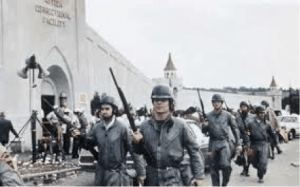
Attica prison riots/uprisings happened at the Attica Correctional Facility, New York, United States; when the prison cells and yards were seized by the inmates, who also held hostages, on September 9th 1971, opening a series of negotiations and dialogues between the establishment and the inmates, which included civilian observers, Tom Wicker of the New York Times, Republican State Senator John Dunne, radical lawyer William Kunstler and Black Panther’s Bobby Seale, on the request of the inmates. The primary demands of the inmates were related to the inadequacies and brutalities within Attica, such as related to insufficient food and medical care, racial discrimination, physical abuse, restricted access to educational and training facilities, all a serious indictment of the prison rules and environment, as the New York State Special Commission on Attica/McKay Commission (set up by the state) subsequently went on to assert and highlight. Continue reading ‘Attica, Attica, You Put Them Guns Down!’ Ipsita Barik

Make in India – A critical examination of an economic strategy: Leila Gautham

This is a guest post by LEILA GAUTHAM

‘Make in India’ is now an all-pervasive catchphrase – every newspaper and television channel trumpeting the Modi’s ‘clarion call’ to investors – but surprisingly empty in terms of substance. The website is flashy and vastly different from the run-of-the-mill government-of-India websites one is used to – but one has a hard time imagining the ‘captains of industry’ who attended the Make in India launch on September 25th finding any use for it. One begins to wonder, who exactly is the campaign aimed at? Is it the Indian public? An impressive farce, an ad campaign, the neoliberal dream of the efficient state come true – Make in India is not some brilliant brainwave of Modi’s: it is the culmination of very intensive campaign of worldwide propaganda that has been launched by global corporate capital.

I tried to probe deeper, to tease out concrete details if any – and the following article reflects my understanding, incomplete though it may be.

Continue reading Make in India – A critical examination of an economic strategy: Leila Gautham

We, or our Nationhood, Redefined.

A couple of weeks ago, filmmaker Anand Patwardhan was invited by the Editors’ Guild to deliver its annual lecture. Patwardhan’s speech, titled We or our Nationhood Redefined, was marked by his characteristically cool tone, systematically reassembling facts that have a tricky habit of leaking from national memory. Facts like the twentieth century’s worst genocidal dictator Adolf Hitler and his programme of racial cleansing has a respectable and massive following in India in the form of the Rashtriya Swayamsewak Sangh. That the RSS has at least 50,000 branches across the country with over 40 million members, and runs a network of 18,000 schools across India. That one such child, recruited from the age of 8 from a relatively poor family, is Prime Minister Modi; and another is Party Chief Amit Shah. That just before the recent reshuffle, 5 Chief Ministers and 17 of the 23 Cabinet-level senior ministers were current or former RSS members. That the assassins of Gandhi are really the RSS, not the lone lunatic Godse who merely carried out what others dreamed about. That RSS’s poisonous communal agenda was roundly condemned by Sardar Patel, of whom PM Modi has promised to build the world’s tallest statue. Or more obscure but equally revealing facts, like the letter written by RSS chief Balasaheb Deoras from jail during Emergency, praising Indira Gandhi and especially her programme of sterilisation of Muslims. And those truly mind-boggling-in-their-irony facts, like the widespread involvement of the RSS in the 1984 anti-Sikh pogrom, when the BJP cynically says “1984” every time somebody says “2002”.

On a day when the Nanavati Commission has termed the 2002 anti-Muslim pogrom in Gujarat as a purely communal reaction to Godhra, and cleared then Chief Minister Modi’s government of any wrongdoing, or even inaction, it is critical we re-read Patwardhan’s speech, to remind ourselves exactly what we are up against if we believe in a non-communal, non-divided, heterogenous India. As Patwardhan put it, given the history of the RSS in this subcontinent, if a Modi didn’t exist, he would have to be invented. Read more.

On a Long Road to Justice: Simin Akhter

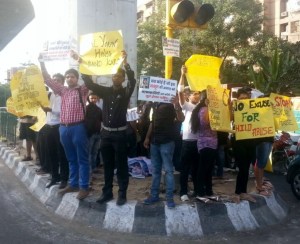
This is a Guest post by Simin Akhter, with inputs from Kamal Pant, Naina Singh and Vikas – 16 December Kranti

(Notes from the ongoing protests in the child sexual abuse case against Toddlers International Playschool, Rohini)

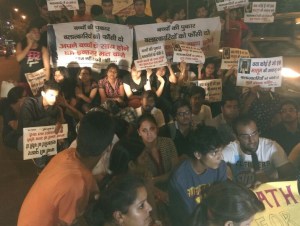
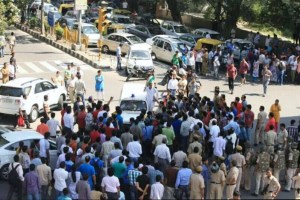
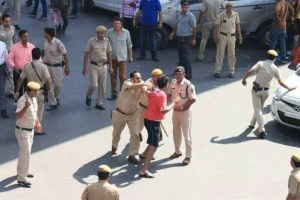
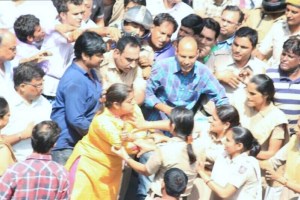
In a heinous and unfortunate show of power and violence, a two and a half year-old girl was raped by a male attendant at Toddlers International playschool (Rohini). Though the parents could manage to file an FIR, the management has threatened them with dire consequences. The principal has been openly shielding the accused, Amit Kumar, despite prior complaints of inappropriate behaviour by aggrieved parents and was allegedly shameless and audacious enough to tell the parents, ‘The police have been fed too well enough to open their mouths’! It also came to light during the protest yesterday that a similar FIR was filed two years back too but no police records could be found for the same; no wonder!

Almost 30 other girls have been detected with a certain strain of bacterial urinary infection, indicating the said two-year old is not the only victim. Many other children have been suffering from mouth-ulcers and a general loss of appetite too, reflecting also on the general lack of health and hygiene practices in the school. A group of parents, grandparents and concerned citizens, mostly young women and men, from in and around Rohini have got together for a relay protest but parents of other victims have not been forthcoming with formal complaints. Needless to say, the greater the delay in filing the complaints, the more legal intervention will get delayed.

Continue reading On a Long Road to Justice: Simin Akhter

Long Years Ago We Made a Tryst, with…Mathematics

I thought it wasn’t that complicated. When you make a new nation, make sure everybody gets a place. A roughly equal place. When you undertake any development in that new nation, make sure the benefits equal the costs. These are easy equations, easy maths. Maa-tha-maa-tics, my school maths teacher would say portentously, full of meaning and threatening.

This summer, quietly, safe from the media’s attention, 17 more metres were added to the biggest dam of the Sardar Sarovar Project, a dam that was already 400-plus metres high. Being ‘weak at maths’, I hesitate to calculate the catchment area of this big big dam, only one of many big dams in the web of waterworks created by the Sardar Sarovar project. I am getting goosebumps writing these words – the Sardar Sarovar project. As I did way back in school, as a fifteen-year old with a mind like an occupation zone for textbooks. Nehru’s photo radiates in waves out from that mind, that iconic Bhakra Nangal photo with him pointing to something in the far distance. The blazing sun, the deep shadows, the monumental respectability of it all…now the photo is fused with a different, equally iconic image – that of Sunil Dutt’s youthful strides across a dam site in Hum Hindustani. Continue reading Long Years Ago We Made a Tryst, with…Mathematics

‘My Heart says Yes, but the Head says No’: Economizing Politics in the Scottish Referendum: Akshaya Kumar

Guest post by AKSHAYA KUMAR

I

About two months ago, while walking by the roadside in Glasgow, a middle-aged man handed me out a pamphlet. In an endorsement of UKIP, the pamphlet declared ‘Our government pays GBP 55 million a day in fees to the EU’ (emphasis added). It went on to inform that in return, the EU gives ‘us’ accounts riddled with fraud, no control over ‘our’ own borders – putting pressure on our health, education and welfare services – and a super-government that makes more than 70% of ‘our’ laws. The pamphlet intrigued me a fair bit, not in the least because as an international student in the UK, I wondered if my case was a bigger or smaller burden on the UK defined thus – their UK. But who are they? One might rubbish them as a deviant community, or one might consider them a threat to yet another definition of us – the liberals or suchlike. But what intrigued me was not the neatness of these boundaries, or the speculations about how many of ‘us’ and ‘them’ there are. I was intrigued by the language of the starkly political proposition. Let us tentatively assume that in the pamphlet, ‘us’ meant the citizens of UK and it constructs an antagonistic position vis-à-vis other national citizens who are entitled to living and working within the UK. Surely the two are politically distinguishable? Or are there too many of them living next to us, so they cannot exactly be identified as such? Continue reading ‘My Heart says Yes, but the Head says No’: Economizing Politics in the Scottish Referendum: Akshaya Kumar

A civil-war is on the doorstep of India: Interview with Kancha Ilaiah by Mahmood Kooria

This is a guest post by Mahmood Kooria

We are publishing an English translation of an important interview of the intellectual and academic Kancha Ilaiah, conducted by Mahmood Kooria for the Malayalam weekly Mathrubhumi. While what I see as Professor Ilaiah’s underestimation and perhaps misreading of the historic role of the Communists in Indian politics leaves me severely uncomfortable, especially when he exonerates the right from commensurate charges of elitism, his framing of Hindustva and Modi’s appeal within the great stream of caste in the subcontinent is brilliant and thought-provoking, as always. 

Kooria conducted the interview as well as translated it in to English. His introduction is as follows, “At a time when there was no any such discussion, in 2002 Professor Kancha Ilaiah predicted that Narendra Modi will be the prime-ministerial candidate of Baratiya Janata Party. It has come true and now Modi is in the office. At this point, I talked with him at Moulana Azad Urdu University Hyderabad where he chairs the Centre for the Study of Social Exclusion and Inclusive Policy. In the conversation, he talked about the future of Modi government and he predicted that a civil war is going to break out in India if Modi does not cater the needs of backward classes. A Malayalam-version of this interview was published in the Mathrubhumi Illustrated Weekly (August 24, 2014).”

Mahmood Kooria: Ten years ago you wrote that Modi will be the prime ministerial candidate of BJP. What would be your response as your prediction has come true?

Kancha Ilaiah: Well, at that time I was predicting that based on the Left parties’ indifference to understand the caste question. The caste question is not been seriously taken by the Left parties. And, after Mandal, the BJP and the RSS wings started looking at caste-question seriously because when Babari Masjid was demolished they mobilized a lot of backward classes. Though they oppose Mandal reservation, they wanted the backward classes to be part of the Hindu religion. Around 1994, a non-Brahmin called Rajju Bhaiya became the Sarsanghchalak of the RSS. Then he recruited a large number of backward classes, large number of youth, and he promoted the people like Narendra Modi, Uma Bharati at that time. Earlier, the first backward-class chief minister of Uttar Pradesh was a BJP man: Kalyan Sing. He was the chief minister in 1992 when the Babri Masjid was demolished.

The Sangh Pariwar was responding to the backward class demands more. But the Left or the Congress was not responding to the OBCs. The Congress was responding to the Dalits and Muslims. There was upper caste all the time on the top. So, when Narendra Modi became the chief minister and this whole atmosphere was created, I was writing a column in The Hindu. I thought that this seems to be cause/course of India, since the Hindu religion is surviving because of the backward classes. It is inevitable for the Hindutva organizations that they will have to project an OBC for the prime-ministership. But there was resistance from within itself. It is not that the Brahmins have given up the principle of varna-dharma. After that article came and of course after my writing Why I am not a Hindu itself, the backward classes even within RSS seemed to use that material for their advantage. The communists did not use or recognize it. The question of labour and caste which I have been consistently raising, which was also part of their theory, they did not care about. So the Communist Party remained tightly under the control of upper castes.

Continue reading A civil-war is on the doorstep of India: Interview with Kancha Ilaiah by Mahmood Kooria

Delhi Protests Gaza Bombing: 9 August 2014

Let it not be said that nobody cried when the news came. Let it not be remembered by the children that India “stood with” Israel through the Gaza bombings of August 2014 (God, let it not continue beyond August 2014). Let no-one assume that all 1.3 billion of us continued – as the bombs fell on fields and courtyards and washing hung up to dry in Gaza – that we in India defined our ethical positions purely within the unholy triad of family, community, nation. Let there be a tiny record of protest. A tiny record of a tiny protest, given the monstrosity of the crime. But we are in the business of remembering, since they are profiting from our forgetting. They profit from our forgetting language, since we can’t name what is going on in Gaza as war. They profit from our not being able to remember our mythologies, because this is a war in which one side is David and the other Goliath, but Goliath is winning, because the world has been told he is David. In a nation without language, without myths, without memory, without ethics, jealously holding a tattered banner, with a single word on it – ‘development’ – some Indians protested.

Global Day of Rage against Gaza, Jantar Mantar, New Delhi August 2014:

WP_20140809_001

Continue reading Delhi Protests Gaza Bombing: 9 August 2014

The Anatomy of a Massacre: The Mass Killings at Sailan, August 1998

This was sent to us by Shrimoyee Nandini Ghosh

front cover_final

On the night of 3-4 August 1998, 19 people including 11 children ranging in age from about 4 to 15 years old, and 5 women (including one woman in an advanced state of pregnancy) were shot at point blank range in their homes in Sailan, in the highly militarized ‘border district’ of Poonch, which is divided by the Line of Control between Pakistani and Indian Administered Kashmir. The bodies were thereafter mutilated with axes and sharp instruments. A total of thirteen female and six male members of three closely related families were killed by personnel of 9 Paratroopers, Indian army, and ‘SPOs’ (Special Police Officers) armed state back local operatives recruited to the police and affiliated to the 9 Para Army Camp. The police establishment was involved with attempting to bury the dead clandestinely, registration of a fabricated FIR, destruction of evidence, and the criminal cover up of the case. The Anatomy of a Massacre recounts the dismembered and silenced history of the Sailan Massacre through voices of family members, eye witnesses, local residents and the analysis of court, police and Right to Information documents. The legal and oral histories of Sailan illustrate how the Indian occupation of Jammu and Kashmir is made real, not just through the control of physical territory, but by deep social penetration, acts of spectacular violence and collective terrorisation, and the active collaboration of all state institutions in the illusion of legal procedures and rule of law. The Report is part of the struggle of all victims of human rights violations in Jammu and Kashmir, to articulate their demands for truth and justice in their own words, when the very language to speak of the truth has been rendered anti-national, and therefore unspeakable. It commemorates the lives lost in the massacre at Sailan, and is dedicated to them, on the anniversary of their untimely deaths.

Read the statement about the release of the report in Srinagar, by JKCCS and the Survivors of the Sailan Massacres as well as the full text of the report here.

Need to re-enact Juvenile Justice Act – Myths and Realities: Kishore

This is a guest post by KISHORE

In a significant move, the Ministry of Women and Child Development has decided to repeal and re-enact Juvenile Justice (Care and Protection of Children) Act 2000. Along with its claims to streamline adoption and foster care procedures, it also proposes that juveniles above 16 years of age involved in heinous crimes should be tried as adults under the Indian Penal Code.

This is not first time that such an amendment has been advocated. One senior leader of ruling party had already gone to the Supreme Court last year with a petition for lowering the age under the law. However his petition was refused and the Supreme Court opined that there was no need for amendment as the present law (JJ act 2000) holds constitutional validity. Now this leader’s party is in power and they do not need to go to the judiciary for changes as they themselves can do it in Parliament. It is also believed that the government is not even waiting for the report of the expert committee appointed by the Law Commission of India to examine the issue. The proposal however, has always been contested by the premier child rights body NCPCR, which said there cannot be any “compromise” on the age of a child as defined by the UN and in other international conventions. We wonder if the governments’ desperation to change the law is based on popular “sentiments” and not on “facts”. Continue reading Need to re-enact Juvenile Justice Act – Myths and Realities: Kishore

(How) Does the Sovereign Speak?: Akshaya Kumar

This is a guest post by Akshaya Kumar

In a recent piece, entitled The Modi Wave, I analyzed the orientations of the Modi campaign, and argued that crucial to Modi’s repackaging was his ‘sovereignty effect’. In this case, entirely a property of the media narratives that pitched Narendra Modi as someone from outside history, he was offered as an intervention into national history. I have suggested that this was a masterstroke to the extent that the subject within history has a compromised agency. The continuities – of forces, events, rationales and time as a whole – blunt the provenance of the outsider. In order for the subject to act upon history, he must stand entirely outside it. In this way, he cannot be accessed from within historical time. Modi not only offered a historical narrative of an unending Congress rule, infested with corruption, appeasement and misrule, but also that of him observing this lingering malady from outside the fence. His story of his own rise goes from being a tea-seller to the Chief Minister of Gujarat, from a not-yet to a fully sovereign. He is never a deputy, never a peg within the system; he suffers till his agency is still being shaped, and appears as already the incumbent. This fundamental separation from the substance of historical progression is needed to project oneself as unsullied, unlike those defiled by the their political existence within history.

Continue reading (How) Does the Sovereign Speak?: Akshaya Kumar

Autonomy for what, from whom, and for whom?

It seems the unthinkable has happened – the Vice Chancellor of Delhi University has resigned over the UGC’s pressure to withdraw the Four-Year Undergraduate Programme (FYUP). I won’t go into the debate on the FYUP, which has been covered extensively on Kafila and elsewhere [1]. See particularly this post by Professors at the University. I am only interested in two issues that arise from the news coverage of the event as it has unfolded through the day.

One, the question of autonomy. Prima facie, as Apoorvanand and Satish Deshpande have argued comprehensively on Kafila, the resignation of a VC over pressure from the UGC seems to be evidence of bureaucratic or ministerial over-reach. Questions have been raised (rightly) over the timing of this pressure, coming as it does on the heels of a political shift of colossal proportions at the national level. It doesn’t take a rocket scientist (I find myself in agreement with Congress spokesperson Manish Tewari’s language on this) to figure out that the change in Delhi University has political backing. For one, rollback of the FYUP was on the BJP’s agenda/manifesto – that is as political as it gets! Second, it was this very UGC that had been so coy about commenting on the FYUP for the past one and a half years, a coyness that amounted to tacit support. Only very recently had it moved its mammoth bureaucratic feet on the matter, constituting a committee to look into complaints from students and teachers that had finally reached its mammoth bureaucratic ears. The VC, being well acquainted with elephants, would be able to explain the mammoth temporality of this apex organisation better than any of us, having benefited from it for a goodly amount of time. Even after the constitution of the committee, the VC continued to be lauded by the UGC for his efforts at implementation of former HRD minister Kapil Sibal and his successor Pallam Raju’s efforts at radical educational reform. The committee met at a leisurely pace, no doubt fortified by several hundred samosas and robust air-conditioning in the UGC’s Bahadur Shah Zafar Marg office in central Delhi, while anti-FYUP protestors enjoyed the blazing sun or freezing cold outdoors, as they had been enjoying for a year and a half.

Continue reading Autonomy for what, from whom, and for whom?

A Renegade’s People: Rupam Sindhu Kalita

This is a guest post by Rupam Sindhu Kalita

What unites anti-homophobia campaigners, defenders of the poor’s right to clean water, university student collectives, women rights’ groups and academics under a premature summer sun in New Delhi on the 30th of March earlier this year? It is the unacceptable means employed by the Indian state in response to armed rebellions in North east India and the threat to civilian life that it has precipitated. The contagion of a military approach to a largely political problem was promulgated as an ordinance in 1958 under the presidency of Dr Rajendra Prasad to help quell the Naga movement and was developed into the Armed Forces Special Powers Act (Assam and Nagaland) later in the same year. The Armed Forces Special Powers Act (from here on AFSPA) persists in violating human rights in Kashmir and North east India despite its incompatibility with national and international human rights declarations. Over the years this Act has been sanctified in the inner sanctum of India’s centralised quasi-military administration. The government has been extremely guarded in its approach to growing popular demands for annulling this Act. The civil leadership’s reluctance to temper with the ritualized provisions of this Act has raised the disquieting question of who runs the country.

On 30th March central Delhi woke up to a motley group of protestors unified by a concern for violation of human rights under AFSPA. [Photo credit: V Arun Kumar].

Continue reading A Renegade’s People: Rupam Sindhu Kalita

Queer Eye for Narendra bhai – Affect, Memory, and Politics in Desperate Times: Pronoy Rai

This is a guest post by Pronoy Rai

There is something awfully nostalgic about May 16. The election results brought with them a sense of melancholy-laden déjà vu. For the queers and allies on the political Left, the sinking feeling that May 16 brought with it, was reminiscent of yet another day, December 11, 2013; the day the Indian Supreme Court reversed the decision of the Delhi High Court decriminalizing homosexuality in India. It was once again criminal to be gay in India; once again the legal State apparatus had rendered queer bodies vulnerable to violence, from the State and from the political Right. There was a sense of desperation and disheartening injustice; what avenues remained to be sought when the country’s highest courts had us disappointed?

The Rashtriya Swayamsevak Sangh (RSS) and the Bharatiya Janata Party (BJP) had vehemently welcomed the Supreme Court judgment then, but our incoming Prime Minister, Narendra Modi, remained silent. It was perhaps too trivial an issue for him to address; when were rights anyway a matter of importance for him? If the indigenous people and forest dwellers of Gujarat could make the Indian mass media listen to them, they would tell us the story of Gujarat’s abysmal performance in settling land claims and distributing title deeds. Rights, especially of the fragments, are a roadblock for the Modi-style Development machine.

Continue reading Queer Eye for Narendra bhai – Affect, Memory, and Politics in Desperate Times: Pronoy Rai

Bittersweet Gujarat: Reena Patel

This is a guest post by REENA PATEL

I looked around the room and my gaze was met with the kohl lined eyes and stares of bewilderment and distrust. My heart pounded as I listened to three Muslim women describe their latest attempt to find their father and brother after they disappeared in the riots. They were speaking to Rahidbhai* from a local NGO who was accompanying me into the Ahmedabad relief colonies for the first time. Why was I so scared? Why was my heart pounding? The eldest woman of the home disrupted my thoughts, she asked me for my name. I looked around and looked at Rahidbhai, who looked back uneasily. “Mera naam Reena hai.” I said, almost choking on the words, knowing what the next question would be. “Aap ka surname kya hai?” The room grew thick with silence. “Patel.”

As far back as I could remember, I was taught to regard Muslims differently from the rest of the general population. My parents, both from Surat, Gujarat moved and met in the United States in their twenties. They both lived in England and spent time in Gujarat, and had families that were deeply involved in the Gujarati community. My brother and I were born in Long Beach California. I went to Gujarati school on Sundays, went to every function, picnic, and cultural show put on by the Leuva Patidar Samaj in Southern California. Many of my family members were apart of the organization. In fact, my great grandfather Vallabhai Patel was one of the first Patels to land upon the shores of the United States, now estimated at a population of over 140,000. We went to religious camps that were meant to teach us about Hindu ideology, handed out saffron prayer books and modeled how to become ideal Hindu men and women for our communities.

Continue reading Bittersweet Gujarat: Reena Patel

The curious case of Reliance Industries Ltd’s gravity defying stock price – Or, how you should learn to stop worrying about gas prices and buy RIL stock now: Vineeth Sukrithan

This is a guest post by VINEETH SUKRITHAN

The stark contrast between RIL’s latest march quarter performance and the almost- three-year highs that its stock price is perched on top, merits a deeper analysis. On April 18th, 2014, RIL released its quarterly data showing disappointing results that were entirely in line with industry expectations. Petrochemical business revenues fell 3.7%, while oil and gas turnover dropped 18.2% q-o-q. Net profit growth in its January-March quarter (Q4FY14) was at Rs 5,631 crore – only 0.7 per cent higher than Rs 5,589 crore it earned a year ago. The petrochemicals business’s Ebit was lower than in the December quarter and the company’s outstanding debt over shot its cash and equivalents. (Rs 89,968 crore against cash, and equivalents of Rs 88,190 crore.)

Yet, for a company that has always been known to be reticent about taking on high levels of debt, RIL has gone on what can only be called a remarkable splurge in capital expenditure. Its capital expenditure during the year was the highest ever. The company reported net addition to fixed assets of Rs 35,210 crore in FY14. In FY09, when the company commissioned its second refinery and K-G basin gas production, its capex was only Rs 24,907 crore. So, on all accounts, RIL’s actions and stock price seem counter to the predicaments of its current financial health, which begs the question, where does Reliance derive this level of confidence in its future profitability to be willing to take on tremendous amounts of debt?

Continue reading The curious case of Reliance Industries Ltd’s gravity defying stock price – Or, how you should learn to stop worrying about gas prices and buy RIL stock now: Vineeth Sukrithan

Lesser Citizens: Trapped in a Queer world of Dystopia: Indrani Kar, Shuvojit Moulik & Somya Tyagi

This is a guest post by Indrani Kar, Shuvojit Moulik & Somya Tyagi

Any dominant, mainstream model undoes the very idea of multiple modes of living and diversity which excludes the real demands of the minority groups and contributes to their social exclusion. Whereas everyone is entitled to equal and inalienable rights and opportunities set forth in the Preamble to the Constitution of India without distinction of any kind, such commitments are yet to be translated into action. Although Article 21 of the Constitution guarantees ‘Right to life and personal liberty’ to all, of which the Right to Healthcare forms an integral part, a large section of the society is still insensitive to the healthcare needs of the transgender community.

n1

The transgender population faces grave misunderstanding, prejudice, harassment, ridicule, rejection and even exploitation at the hands of health service providers as they do not fit into the society’s prescribed, rigid gender roles. Though the transgender community is hardly a homogeneous entity and is considerably diverse in terms of gender identity and livelihoods, in public imagination such complex identities of gender ranging from hijra to transgender are all lumped into one category, which becomes extremely problematic. Unfortunately, government policies also seem to feed on these generalisations, making use of such umbrella terms rather than focus on the specific needs of different groups.

Continue reading Lesser Citizens: Trapped in a Queer world of Dystopia: Indrani Kar, Shuvojit Moulik & Somya Tyagi

Dalit Students and Journalists – from Classroom to Newsroom: Shivnarayan Rajpurohit

This is a guest post by SHIVNARAYAN RAJPUROHIT

The conscious or unconscious exclusion of Dalits (SC/ST) from the Indian mediascape has given way to a lopsided public sphere which hardly manages to generate comprehensive debates. Corporate interests have aggravated this malaise, given the indifference of the corporate sector towards fomenting a diverse media, cutting across caste, religious and class lines. The following paper looks at the absence of Dalit journalists and students from English press and journalism schools. The primary conclusion of my research is that English-language media as an institution has been undemocratic because it draws its workforce from a homogenous set of people, overlooking the urgent need for diversity. In that sense it is hostile to opposing viewpoints and diversity of arguments. The paper is primarily divided into five parts: counting Dalit journalists, reason for exclusion, classroom to newsroom, need for Dalits in media and Blacks in USA.

Continue reading Dalit Students and Journalists – from Classroom to Newsroom: Shivnarayan Rajpurohit

Ruins of the Living: the Rohingya Refugees: Akshita Nagpal

This is a guest post by Akshita Nagpal

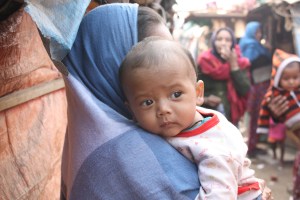
A tree with deep roots, if uprooted and planted in alien soil, might live but often sans its vigour. The same can be said for refugees. A couple of weeks ago, along with a bunch of my classmates, I visited the refugee camp of Burmese Rohingya Muslims at Kalindi Kunj in the vicinity of our university campus. The visit was part of an initiative to help them with old winter clothing after hearing about the unliveable conditions of the camp.

IMG_3912

The Rohingyas, an ethnic group hailing from Myanmar (Burma), chiefly from its Rakhine (Arakan) State, happen to be one of the most oppressed people in the Asian sub-continent.

Continue reading Ruins of the Living: the Rohingya Refugees: Akshita Nagpal