
A short fragment of video, fifty seven seconds long, taken from behind a window in a building in the Gaza Strip which was aired last night on Al Jazeera television brought home (once again) the sheer horror of the Israeli Defence Forces’ (IDF) brutal, ongoing offensive against the people of Palestine with devastating clarity.
Category Archives: Bad ideas
An Endless Budget Session, Even Before it Begins: Shambhu Ghatak
Guest post by SHAMBHU GHATAK
“You can fool some people some times but you can’t fool all the people all the time”
So goes one of the famous lines of Bob Marley’s song that draws upon statement by Lincoln. Perhaps the same can be said about the new BJP government because it seems that this time there will be nothing new left to be presented during the upcoming Union Budget. Most of the things to be presented by the Finance Minister have gradually been placed even before the actual budget could see the light of the day (on 10 July). In fact, the entire stretch since the Government took power can be termed as a long, extended budget session – a session in slow motion.
Just think about the policy decisions announced or showcased by the new Government so far—allowing 100% foreign direct investment (FDI) in defence sector (to boost technology transfer and employment growth, so to speak); reforming environmental clearance (to avoid discrepancies, end red-tapism and ensure transparency) by making the process online; raising import duties on sugar by more than double and extension of existing sugar export subsidy of Rs 3,300 per tonne (to help the sugar mills) till September besides raising the mandatory level for blending cane-based ethanol in petrol from 5% to 10%; allowing hike in price of non-subsidized cooking gas (LPG) by Rs 16.50 per cylinder (which is partly attributed to the crisis situation in Iraq); and raising train fares by 14.2% & freight rates by 6.5% in the month of June prior to the just-presented Rail Budget, among other things. Continue reading An Endless Budget Session, Even Before it Begins: Shambhu Ghatak
Seriously, who writes Modi’s blogs?
While I would promptly concur with any sane person who thinks that this is the least of our worries, I have to return to a suspicion I expressed in an earlier post – at least one of the writers of blog posts attributed to ‘Narendra Modi’ is someone based in the USA who basically lifts American political idiom wholesale, regardless of its relevance to the Indian situation. The posts sound absurd, or should, to any reasonably aware person, but the Indian media seems to lack even one such person in its ranks. Hence the brain-dead way in which these blogs are reported, with much enthusiasm and empathy for the PM.
The first one I noticed was a blog post reported at the end of polling, in which ‘Narendra Modi’ said :
Lets place people over politics, hope over despair, healing over hurting, inclusion over exclusion and development over divisiveness. It is natural for the spirit of bipartisanship to get temporarily lost in the midst of an election campaign but now is the time to resurrect it.
We’ll come to those phrases I have emphasized in a minute, but first, the term ‘bipartisanship’ rang oddly in my ears. This is what bipartisan means:
representing, characterized by, or including members from two parties or factions
That’s the US party system, not India. For example, Reagan is said to have had a “bipartisan spirit”, reaching across the aisle to Democrats. Or take this essay ‘What is “bipartisanship” ‘? in The Economist in a section titled Democracy in America, which discusses this term in its specific context.
In India it would have to be multipartisan, for there are not just two parties. And there never has been a “spirit of multipartisanship” in Indian politics, where there are still real differences between parties, unlike the US, where the Republicans and the Democrats pretty much mirror each other. Continue reading Seriously, who writes Modi’s blogs?
3 ways to speak English: Jamila Lyiscott
While Rita Kothari’s post on Hindi and the politics of language is being debated, take a look at this performance by JAMILA LYISCOTT that makes you fundamentally rethink what ‘being articulate’ means.
How Wikipedia Works: Bishakha Datta
BISHAKHA DATTA is on the Wikimedia Foundation Board of Trustees. In the wake of the shocking distortions found in the Wikipedia entry on Bhanwari Devi by an alert reader, Bishakha gives us a tutorial on how Wikipedia works.
1. Wikipedia is the world’s 5th biggest website, visited by almost 500 million readers each month – but created entirely by volunteers. We (meaning the Wikimedia Foundation in San Francisco/wikimedia chapters in 40 countries) do not pay writers or anyone to contribute to wikipedia; anyone contributing to wikipedia is called an ‘editor’. Currently, there are about 80,000 editors around the world creating wikipedias in 285 languages, of which 20 are Indian languages. To see English wikipedia being created in real time, click this link: https://en.wikipedia.org/wiki/Special:RecentChanges
Each line represents a change being made to an article. If you refresh the page, you’ll see how quickly new content keeps getting added.
2. This model of open knowledge has its own pros and cons. Biggest pro: it is a bottom-up grassroots model of gathering knowledge, based on the assumption that each of us has some knowledge (or ‘expertise’) that we can share with the world. The site is designed such that anyone who knows how to use a wiki can add content. So if you know how you can add facts, make it more accurate, correct spellings, add new information etc. This is how Wikipedia lives and grows and becomes better each day, through volunteer efforts. Continue reading How Wikipedia Works: Bishakha Datta
The untold tale of Soorpanakha: Drishana Kalita
DRISHANA KALITA’s subversive imagining of Soorpanakha’s version of the events that befell her, was one of the top 5 entries for June’s ‘Muse of the Month’ on Women’s Web.
I am Soorpanakha. My name is synonymous with Sin for many, encased for eternity in the pages of the epic Ramayana. I am not the role model parents would point their daughters towards. Why is that? You may ask. Because I admitted to lust. My name was pitted against Sita, the embodiment of purity and womanly virtues. She was everything I was not and I was everything she was not.
She was beautiful and so was I. Do not believe those terrible sketches of me with sharp fangs and blood shot eyes. I was a peerless beauty with large fish shaped eyes, for which my mother had named me ‘Minakshi’ at birth. A single woman, independent enough to roam the forests alone. I was free.
My freedom was my sin, as was my open sexuality. I dared to invite a man, the exiled king of Ayodhya, to make love to me.
Read this wonderful retelling here.
And as a bonus, watch Harinarayana Ehat Edneer performing Shoorpanakha in Yakshagana – ‘Main swachhand bhraman karti hoon!” she declares – I wander at my will!
Collective struggle strengthens autonomy: Saroj Giri
Guest post by SAROJ GIRI, continuing the discussion on roll-back of FYUP in Delhi University.
Earlier posts on this issue are listed and linked to here.
Here is one way to make sense of the core issue at stake in Delhi University today – this piece by Nandini Sundar arguing that the UGC directive amounts to hampering institutional autonomy of DU.
But this is a flawed position in the present context. It conflates the autonomy of DU with the autonomy of the VC. It construes DU’s autonomy in narrow institutional terms, overlooking the larger movement of teachers and students which is also ‘DU’ and which has consistently opposed the FYUP.
Sundar suggests withdrawal of the UGC directive, the setting up of a DU committee to overhaul the programme, and deliberation in the Academic Council, this time taking proper heed of anti-FYUP views. But do we need a fresh round of discussion on the pros and cons of FYUP?
Absolutely not. For there have been tons of deliberations over the FYUP. Just go back to the minutes and records of the many different meetings and Committees, or recall the many demos and dharnas. There is ample evidence of deliberation where the members of the University have given sound reasons why the FYUP is bad.
Indeed, the picture presented that it is the Ministry or the UGC imposing its diktat from above is simply not true. It is not some committee in the UGC or Ministry which on their own have decided to stall the FYUP. For it is force of the movement against FYUP and the many, many voices active since the last few years who have prevailed now – it is this which is reflected in the UGC directive. Continue reading Collective struggle strengthens autonomy: Saroj Giri
The Hindi Imbroglio – Videshi Nationalism? Rita Kothari
Guest post by RITA KOTHARI
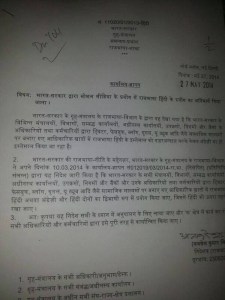
We live with multiple Hindis – one for instance, in railway and flight announcements, the other in cinema, a mixture of Hindi and Urdu, or Hindustani, the kind Gandhi wanted India to adopt as its national language. The former kind – sarkari Hindi – survives only in its ceremonial avatar. This was acknowledged in a rare moment of honesty when the Rajbhasha unit of Ministry of Home Affairs issued an order in December 2011 to provide relief to beleaguered translators who came up with words like ‘Misil’ (for file) and sanganak (for computer). It suggested using English words or words from Indian languages instead of coining new ones but to be written in the Devangari script. It is interesting that this remained unnoticed, for it was business as usual when it happened. How is language both incidental and central at the same time? I wondered.
Government Order dated May 27, 2014 on use of Hindi
Continue reading The Hindi Imbroglio – Videshi Nationalism? Rita Kothari
Autonomy for what, from whom, and for whom?
It seems the unthinkable has happened – the Vice Chancellor of Delhi University has resigned over the UGC’s pressure to withdraw the Four-Year Undergraduate Programme (FYUP). I won’t go into the debate on the FYUP, which has been covered extensively on Kafila and elsewhere [1]. See particularly this post by Professors at the University. I am only interested in two issues that arise from the news coverage of the event as it has unfolded through the day.
One, the question of autonomy. Prima facie, as Apoorvanand and Satish Deshpande have argued comprehensively on Kafila, the resignation of a VC over pressure from the UGC seems to be evidence of bureaucratic or ministerial over-reach. Questions have been raised (rightly) over the timing of this pressure, coming as it does on the heels of a political shift of colossal proportions at the national level. It doesn’t take a rocket scientist (I find myself in agreement with Congress spokesperson Manish Tewari’s language on this) to figure out that the change in Delhi University has political backing. For one, rollback of the FYUP was on the BJP’s agenda/manifesto – that is as political as it gets! Second, it was this very UGC that had been so coy about commenting on the FYUP for the past one and a half years, a coyness that amounted to tacit support. Only very recently had it moved its mammoth bureaucratic feet on the matter, constituting a committee to look into complaints from students and teachers that had finally reached its mammoth bureaucratic ears. The VC, being well acquainted with elephants, would be able to explain the mammoth temporality of this apex organisation better than any of us, having benefited from it for a goodly amount of time. Even after the constitution of the committee, the VC continued to be lauded by the UGC for his efforts at implementation of former HRD minister Kapil Sibal and his successor Pallam Raju’s efforts at radical educational reform. The committee met at a leisurely pace, no doubt fortified by several hundred samosas and robust air-conditioning in the UGC’s Bahadur Shah Zafar Marg office in central Delhi, while anti-FYUP protestors enjoyed the blazing sun or freezing cold outdoors, as they had been enjoying for a year and a half.
Continue reading Autonomy for what, from whom, and for whom?
स्वायत्तता की फिक्र किसे है? अपूर्वानंद, सतीश देशपांडे
पिछला एक हफ्ता भारत के शैक्षणिक समुदाय के लिए, खासकर उनके लिए जो किसी न किसी रूप में दिल्ली विश्वविद्यालय और विश्वविद्यालय अनुदान आयोग से जुड़े रहे हैं, सामूहिक शर्म का समय रहा है. यह अकल्पनीय स्थिति है कि आयोग एक सार्वजनिक नोटिस जारी करके किसी विश्वविद्यालय के पाठ्यक्रम में दाखिले की प्रक्रिया के बारे में निर्देश जारी करे. आयोग ने दिल्ली विश्वविद्यालय के स्नातक पाठ्यक्रम में दाखिले के सिलसिले में अभ्यर्थियों को कहा है कि वे विश्वविद्यालय द्वारा विज्ञापित चार वर्षीय स्नातक पाठ्यक्रम में प्रवेश न लें. उसने विश्वविद्यालय प्रशासन को फौरन यह पाठ्यक्रम वापस लेने और 2013 के पहले के पाठ्यक्रम को बहाल करने का आदेश दिया है. उसने विश्वविद्यालय के सभी कॉलेजों को भी सीधे चेतावनी दी है कि उसका आदेश न मानने की सूरत में उन्हें अनुदान बंद किया जा सकता है. किसी विश्वविद्यालय को नज़रअंदाज कर उसकी इकाई से उससे सीधे बात करना अंतरसांस्थानिक व्यवहार के सारे स्वीकृत कायदों का उल्लंघन है. व्यावहारिक रूप से यह दिल्ली विश्वविद्यालय का अधिग्रहण है.यह भारत के विश्वविद्यालयीय शिक्षा के इतिहास में असाधारण घटना है और सांस्थानिक स्वायत्ता के संदर्भ में इसके अभिप्राय गंभीर हैं. Continue reading स्वायत्तता की फिक्र किसे है? अपूर्वानंद, सतीश देशपांडे
A Renegade’s People: Rupam Sindhu Kalita
This is a guest post by Rupam Sindhu Kalita
What unites anti-homophobia campaigners, defenders of the poor’s right to clean water, university student collectives, women rights’ groups and academics under a premature summer sun in New Delhi on the 30th of March earlier this year? It is the unacceptable means employed by the Indian state in response to armed rebellions in North east India and the threat to civilian life that it has precipitated. The contagion of a military approach to a largely political problem was promulgated as an ordinance in 1958 under the presidency of Dr Rajendra Prasad to help quell the Naga movement and was developed into the Armed Forces Special Powers Act (Assam and Nagaland) later in the same year. The Armed Forces Special Powers Act (from here on AFSPA) persists in violating human rights in Kashmir and North east India despite its incompatibility with national and international human rights declarations. Over the years this Act has been sanctified in the inner sanctum of India’s centralised quasi-military administration. The government has been extremely guarded in its approach to growing popular demands for annulling this Act. The civil leadership’s reluctance to temper with the ritualized provisions of this Act has raised the disquieting question of who runs the country.
![On 30th March central Delhi woke up to a motley group of protestors unified by a concern for violation of human rights under AFSPA. [Photo credit: V Arun Kumar].](https://kafila.online/wp-content/uploads/2014/06/afspa.jpg?w=300&h=198)
दीनानाथ बत्रा और उदार बुद्धिजीवी
दीनानाथ बत्रा की आलोचना में एक और टिप्पणी पहुँचने से किसी भी सम्पादक को कोफ़्त होगी:आखिर एक ही बात कितनी बार की जाए!लेकिन खुद दीनानाथ बत्रा और उनके ‘शिक्षा बचाओ आंदोलन’ को कभी भी वही एक काम बार-बार करते हुए दुहराव की ऊब और थकान नहीं होती. इसीलिए कुछ वक्त पहले वेंडी डोनिगर की किताब ‘एन अल्टरनेटिव हिस्ट्री ऑफ़ हिंदुइज्म’ के खिलाफ मुकदमा दायर करके और प्रकाशक पर लगातार उसे वापस लेने का दबाव डाल कर ‘आंदोलन’ ने जब पेंगुइन जैसे बड़े प्रकाशक को मजबूर कर दिया कि वह उस किताब की बची प्रतियों की लुगदी कर डाले और भारत में उसे फिर न छापे, तो आपत्ति की आवाजें उठीं लेकिन उसके कुछ वक्त बाद ही जब उन्होंने ‘ओरिएंट ब्लैकस्वान’ को 2004 में छापी गई शेखर बन्द्योपाध्याय की किताब From Plassey to Partition: A History of Modern India पर कानूनी नोटिस भेज दी और उस दबाव में मेघा कुमार की किताब(Communalism and Sexual Violence: Ahmedabad Since 1969) ,कई और किताबों के साथ,रोक ली गई तो कोई प्रतिवाद नहीं सुनाई पड़ा. यानी आखिरकार अभिव्यक्ति की आज़ादी के पैरोकार थक गए लगते हैं. Continue reading दीनानाथ बत्रा और उदार बुद्धिजीवी
Statement on the Murder of Three Young Persons in Badaun and Pune: P.A.D.S.
People’s Alliance for Democracy and Secularism (P.A.D.S.) Statement on the murder of three young persons in Badaun and Pune
While introducing the Draft Constitution in the Constituent Assembly, Dr B. R. Ambedkar had observed, “Democracy in India is only a top-dressing on an Indian soil, which is essentially undemocratic.” The same continues to hold true sixty four years later. A few weeks ago the people of India participated in the largest-ever election of their representatives in a largely free and fair process. However, other events since then have revealed the shallowness of this democratic top-dressing along with the tyrannical side of our society and polity.
On 27 May two girls aged 12 and 14 from an oppressed caste family of Katra Sadatganj in Badaun district of UP were sexually assaulted and killed when out to answer nature’s call. The rapists, belonging to the local dominant caste, hung their bodies from a tree in a public display of their power.
On 2 June in Pune, twenty-eight year old Mohsin Shaikh, an information technology professional was beaten to death by a group of men belonging to an outfit called Hindu Rashtra Sena. The killers even celebrated their cruelty in messages declaring that the ‘the first wicket is down’.
Continue reading Statement on the Murder of Three Young Persons in Badaun and Pune: P.A.D.S.
#youhadonejob: Or, A Quick Legal Primer for Publishers. Or, What (Not) to Do When Dinanath (and other busybodies) Strike
This post is co-authored by Aarti Sethi and Shuddhabrata Sengupta
Dinanath Batra is at it again. Not content with having bullied Penguin and Aleph into withdrawing Wendy Doniger’s “The Hindus: An Alternative History”, and “On Hinduism”, respectively, he has now trained his guns on Orient Blackswan. And, in what seems to be emerging as a frighteningly predictable pattern, Orient Blackswan has succumbed to Dinanath Batra’s “legal suits”, not just by agreeing to consider the withdrawal of a book that had attracted Batra’s attention, but also by withdrawing another book, on sexual violence during communal riots in Gujarat, as a ‘preventive measure’ regardless of the fact that it had not even been targeted by Batra and his organization. Clearly these are interesting times for publishing in India.
There is no need to rehash arguments on the importance of free speech and the circulation of books and words and texts. These have been extensively discussed here on Kafila, and everywhere else. At this stage it might be useful to simply clarify some pressing “legal” matters as there seems to be a bewildering confusion rife amongst publishers as to what exactly a legal notice is. Thus, to begin:
What a Legal Notice Is:
A Legal Notice is a grouse sent by registered post and has the same legal standing. Namely, none whatsoever. Any crank with half an hour, a typewriter and money for postage can send a legal notice to anyone about anything. You do not even have to get a lawyer to draft it. You just need a few minutes on the internet where pre-drafted forms are available for free. Or, just for fun, try drafting one yourself. Since it has no legal validity anyway, be creative! Continue reading #youhadonejob: Or, A Quick Legal Primer for Publishers. Or, What (Not) to Do When Dinanath (and other busybodies) Strike
Statement on the Hate Crime in Pune: Concerned IT professionals
Circulated by Concerned IT professionals from Pune
We, the undersigned express our deep shock at the gruesome incident of hate crime reported in the city of Pune earlier this week. A 28 year old IT professional Shaikh Mohsin Sadiq was thrashed to death by a group of people suspected to be connected with a radical Hindu outfit called Hindu Rashtra Sena.
Mohsin was reportedly returning home after offering namaz at a mosque on Monday night when he found himself caught by the mob. As is the case in every hate crime, a skull cap on head and beard were enough for the killers to pounce on him with deadly intentions. The city was witnessing bandh and violent street protests by Shiv Sena, BJP and other radical Hindu organizations in the wake of Facebook post(s) with allegedly derogatory references to Shivaji and former Shiva Sena Chief Bal Thackeray. The assailants were apparently involved in similar protests when they spotted Mohsin on Monday night in Bankar colony in Hadapsar area of Pune.
One cannot help seeing this incident vis-à-vis forthcoming assembly elections in Maharashtra. As a run-up to the elections which are due in a few months, an attempt to polarize the masses on communal lines with the sheer intention of electoral gains, as we have seen elsewhere, seems to be on the cards. We appeal to the state government to thwart any such attempts with alacrity while ensuring safety to every citizen; we also appeal to the people of Maharashtra to not fall prey to such hideous designs and uphold the progressive tradition of the state that has seen peaceful co-existence of various sects, religions and cultural groups with no place for hatred.
While offering our deepest condolences to the bereaved family members and friends of Mohsin, we extend our heartfelt solidarity to each and every member of minorities/disadvantaged communities in struggle to preserve the values of democracy, secularism and justice.
Sd/—
Neeraj Kholiya
Dhanesh Birajdar
Bharatbhooshan Tiwari
Nitin Agarwal
Vinod Pillai
Kamesh
Gokul Panigrahi
Rajat Johari
Ujjwal Barapatre
Kshitij Patil
Sanind Shaikh
Akbar Ali
Prince Shelley
Mohamed Shazad
Shaikh Asfaque Hossain
Some Good News for Planet Earth

Two planets meet.
Oh hello, says one, long time no see. How are you?
Not doing so well, says the other. I think I have Homo Sapiens.
That’s terrible, responds the first planet, I had that too. But dont worry, it doesn’t last long.
(Popular climate change joke, courtesy Goran Fejic. Bottom line? The earth doesn’t need us, we need it.)
Footsoldiers in Search of an Icon

“The epitaph for the RSS volunteer will be that he was born, he joined the RSS and died without accomplishing anything.”-V. D. Savarkar
(D.V.Kelkar, “The R.S.S.” Economic Weekly ( 4 Feb 1950: 132) Page 36, The Brotherhood in Saffron,The RSS and The Hindu Revivalism, Andersen and Damle,Vistaar, 1986, Delhi)
Veer Savarkar was a Veer Purush who was not scared of death. He was a Shastra Upasak and Shaasrta Upasak: Shri Narendra Modi
May 29, 2013 Author: admin (http://www.narendramodi.in/)
I
Celebrations at the central hall of Parliament are a marker of the political ambience in the country.
The change of guard at the centre was very much visible at the place recently where the entire top brass of BJP including PM Narendra Modi were present to celebrate the birth anniversary of Savarkar. Modi described Savarkar as a prolific writer, poet and social reformer. “Tributes to Veer Savarkar on his birth anniversary. We remember and salute his tireless efforts towards the regeneration of our motherland.” Continue reading Footsoldiers in Search of an Icon
नेहरू कौन?
“नेहरू के बाद कौन ?” आज से पचास साल पहले यह सवाल रह-रह कर पूछा जाता था. भारत के राजनीतिक पटल पर ही नहीं, उसके दिल-दिमाग पर नेहरू कुछ इस कदर छाए थे कि अनेक लोगों के उनकी अनुपस्थिति की कल्पना करना कठिन था. लेकिन किसी भी मरणशील प्राणी की तरह नेहरू की भी मृत्यु हुई और लालबहादुर शास्त्री ने उनकी जगह प्रधान मंत्री का पद संभाला. यह बात बहुत कम लोग जानते हैं कि खुद नेहरू ने शास्त्रीजी का नाम अपने उत्तराधिकारी के रूप में सुझाया था और उनके गुण गिनाते हुए कहा था कि उनकी कद काठी और विनम्र व्यक्तित्व से इस भ्रम में न पड़ना चाहिए कि उनके अपने विचार नहीं हैं, वे स्वतंत्र मत के मालिक हैं और अत्यंत ही दृढ़ स्वभाव के व्यक्ति हैं. दूसरे, उनमें भिन्न प्रकार के लोगों को साथ लेकर चलने का गुण है, जो नेहरू के मुताबिक भारत का नेतृत्व करने के लिए अनिवार्य शर्त थी.
नेहरू के बाद कौन के साथ ही बार-बार यह सवाल भी उठता था कि उनके बाद क्या होगा. कवि मुक्तिबोध, जो मार्क्सवादी थे, इस आशंका से इस कदर पीड़ित थे कि स्वयं अपनी मृत्यु शय्या पर भी नेहरू के स्वास्थ्य के समाचार के लिए व्याकुल रहते थे. ‘अंधेरे में’ कविता में वे सैन्य शासन की आशंका व्यक्त करते हैं. Continue reading नेहरू कौन?
Can NaMo do a Harper – Yesterday Maher Arar, Today Akshardham Six !
How many people remember today Canadian-Syrian Maher Arar, a softward engineer, whose travails and tribulations at the hands of the US government’s extraordinary rendition programme had shaken many people then.
Just to recapitulate he was seized by CIA operatives during a stopover at New York in 2002 and was secretly sent to Syria.Lodged in a grave like cell in Syria, Arar was repeatedly tortured to extract information which he did not know. Ultimately his tormentors released him within a span of year and half without ever being charged with a crime. As we can gather Maher Arar became a victim of the Islamophobia manufactured by the likes of Bush-Blair in the immediate aftermath of 9/11.
All those people who are familiar with the stigmatisation and terrorisation of a people and a community in the immediate aftermath of 9/11 attack can recount many such stories of miscarriage of justice, innocents being lodged in jail for years together and the tragedies which befell their families.
The case of Maher Arar was unique in many ways in the sense that because of the tremendous uproar in the Canadian society over this issue, Stephen Harper, then Prime Minister of Canada sought public apology for the ordeal which Maher went through and for the role played by Canadian officials in the whole affair . Continue reading Can NaMo do a Harper – Yesterday Maher Arar, Today Akshardham Six !
Remembering Adv. Mukul Sihna: Mahtab Alam
Guest post by MAHTAB ALAM
On 12th of May, while I was still trying to cope with the sad demise of noted human rights lawyer Advocate PurushothamPoojary, from Mangalore in Karnataka, I was informed of yet another loss. But this time, the loss was more personal and tragic. “Mukul Sinha passed away,” informed a friend who was calling from Delhi. The news shook me to the core and for a few hours, I went numb with disbelief and was unable to respond properly. In fact, it is still difficult for me to talk of him in the past tense.
Dr. Mukul Sinha, a physicist by training, a trade unionist and human rights activist by passion, and a lawyer by practice, succumbed to lung cancer in Ahmedabad, the former capital of Gujarat. His diagnosis with cancer was revealed to us a year ago. But the news had to be kept under wraps as it would ‘unnecessarily concern’ his distant friends and well-wishers. In the last one year, while he had almost stopped participating in public functions, he was very active on social media, especially Twitter. Continue reading Remembering Adv. Mukul Sihna: Mahtab Alam
Beyond the Elections – Need for a Vibrant and Credible Left
The Peaceful Counter-revolution
It may not be an exaggeration to say that what has just transpired is nothing short of a peaceful counter-revolution. Counter-revolution, not because there was an imminent threat of revolution that has been put down, but because the big bourgeoisie has finally put an end to the challenge from mass struggles that corporate interests had been facing. Struggles around land acquisition, the pressures for environmental clearance that held-up corporate projects, social welfare programmes that came in the way of the most unbridled pursuit of profit, and subsidies that supposedly introduced market distortions – all these had been greatly troubling the corporate sector and their ideologues. A campaign was built up, gradually over the past few years, to install a strong leader with a solid majority, who would give the bourgeoisie a free hand. And it must be admitted today that most of us failed to see where and how that threat was building up. We failed to see that for at least three, perhaps four years, the idea of the ‘Gujarat model’ was being put in place as a shorthand for an unrestrained play to private big capital.
Even when we realized that Modi was being pushed seriously, our eyes were still fixed on the older question of Modi’s culpability or otherwise in the 2002 carnage in Gujarat. The dream of the Gujarat model was sold over the years in many different ways, among precisely those sections whose support the Left (in its broadest sense) would have liked to enlist. The UPA government, of course, left no stone unturned in alienating itself from its popular support. Thus while important social welfare programmes, formulated under pressure from popular and social movements lagged behind in implementation, the neoliberal axis of Manmohan Singh, Chidambaram and Montek Singh Ahluwalia pushed relentlessly on matters like abolishing subsidy on cooking gas and direct cash transfers. The UPA government’s experience, in fact, showed that you cannot be all things to all people; that the interests of the big bourgeoisie and those of common people stand in irreconcilable contradiction. The balancing act cannot really go on for very long. Continue reading Beyond the Elections – Need for a Vibrant and Credible Left
 KAFILA - COLLECTIVE EXPLORATIONS SINCE 2006