Category Archives: Bad ideas

Why Delhi University’s Four Year Undergraduate Programme Should Not be Implemented with Irresponsible Haste


A Note Prepared at the Request of the Department of Higher Education, MHRD, Govt of India

Preamble:

Universities are meant to educate, that is, to teach students how to identify, understand and evaluate multiple points of view. Therefore, dissent, debate and argument are the core concerns of a University – they cannot be regarded as irrelevant irritations or acts of sedition. Debate cannot continue indefinitely, and must be responsible. But what constitutes responsible and well-considered criticism is inevitably a matter of judgement – it cannot be decided through assertion and counter-assertion. It is also inevitable that motives will be called into question. This is once again a matter of judgement, based on available evidence on who is speaking (what is their wider credibility beyond the immediate dispute?) and why (what do they stand to gain or lose by what they are saying?), and an overall sense of what is at stake in the issue. We invite such judgements.

Facts which are NOT disputed:

1. The proposed FYUP is the biggest, most far reaching change of curriculum in the recent (i.e., last 30-40 years) history of DU – it will replace every existing undergraduate course of study in every college and every discipline (professional courses & some other low-enrolment courses may be exceptions).

2. The first time that the FYUP was placed before any statutory body of the University was at the Academic Council meeting of Monday, 24 December, 2012. This meeting – to discuss the biggest curricular reform in several decades – was an Extraordinary meeting, called at 3 days’ notice, which was issued on Friday, 21 December, 2012 and delivered over the weekend, giving Departments no time to consider the proposal and formulate an informed response.

3. The structure of the FYUP presented to the Academic Council on 24 December had not been sent to the Committees of Courses at the Faculties or Departments, or to the Staff Councils of Colleges.

4. The Academic Council meeting of 24 December approved the FYUP with 6 dissents, including a written submission by the Dean, Faculty of Social Sciences, specifically requesting that the University take more time to think through this major change, and that a detailed White Paper on the FYUP be prepared and made public to enable the University community to respond to it.

5. The Executive Council meeting at which the AC approval of the FYUP was presented was held on Wednesday, 26 December, 2012, i.e. the next working day after the AC meeting of 24 December.
Continue reading Why Delhi University’s Four Year Undergraduate Programme Should Not be Implemented with Irresponsible Haste

1984: Gauri Gill

This pamphlet, titled 1984, has been released by GAURI GILL

GAURI GILL writes: This pamphlet contains photographs of the ongoing impact of the 1984 anti-Sikh pogrom in New Delhi – taken by me for Tehelka magazine in 2005 (after the release of the Nanavati Commission report) and Outlook magazine in 2009 (to mark the 25th anniversary of the event); in Trilokpuri, Tilak Vihar and Garhi, as well as at protest rallies in the city. The captions that appear below them are as they were inscribed in the media then. Last month, I decided to ask some artist friends, who were living in Delhi at the time, or have since or prior, or see themselves as somehow participants of the city, to write a small comment alongside each photograph. It could be about the image or a more general observation related to the event; it could be abstract, poetic, personal, fictional, factual or nonsensically true in the way that were Toba Tek Singh’s seminal words on the partition. Continue reading 1984: Gauri Gill

Why censorship is the greatest threat to India: Michael Edison Hayden

Guest post by MICHAEL EDISON HAYDEN: An editorial published earlier this month in India Today bemoans India’s willingness to placate religious fundamentalists through artistic censorship. The author, Peter V. Rajsingh, makes the familiar point in “Censorship a slur on India’s ethos” that religious zealots have become “purveyors of infantilising values of Victorian colonial missionaries”. What he says is true, but India’s real problem with censorship extends far beyond removing images of bare breasts from movie screens. There is possibly no issue today – including the vile treatment of women and the relentless threat of terrorism – that poses a greater threat to the happiness and security of Indian citizens than that of censorship. And I believe that it is extremely important for those of us who live here, and love this country to comprehend the weight of this situation before it is too late. Continue reading Why censorship is the greatest threat to India: Michael Edison Hayden

Chit-funded media

With the Sarandha chit fun scam in West Bengal, a side-effect has been the going bust of its media investments. Seema Guha, Delhi bureau chief of the recently shut down Bengal Post writes in The Hoot:

The executive editor Ranabir Roychowdhury and several of the core journalist team were known to us, but none of us had ever heard the name of Sudipta Sen, the owner. We in Delhi were far away, but our colleagues in Kolkata too did not know anything about him, except that he was a real estate tycoon with a land bank of 100 acres or more. He was also into chit funds. It was much later that we came to know that this was his main business, our money was basically derived from the collections Saradha made from the poorest people in Bengal and other eastern states. He had business in the north east as well as in Odisha. [Read the full article]

On the social fabric in Narendra Modi’s Gujarat: Nilanjan Mukhopadhyay

This is an excerpt from the chapter, ‘The Enemy Within’ in NIIANJAN MUKHOPADHYAY’s book, Narendra Modi: The Man, The Times.

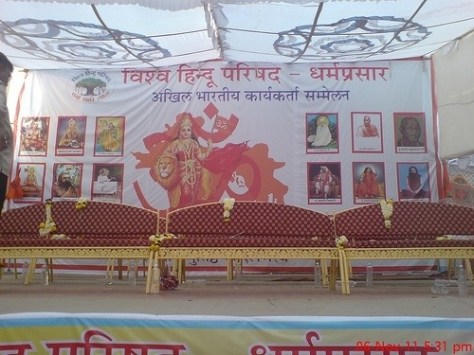
20130420-121828.jpg
Stage set for a Vishwa Hindu Parishad function next to the Pirana shrine in Ahmedabad, 2011. Photo via twocircles.net

From the label of “Master Divider” in India Today in January 2003 to the tag of “The Great Polariser” in the Outlook in July 2012 — Narendra Modi’s image remained static: self-declared champion of one community of people. But the strain Gujarat faced in the course of his tenure has increased manifold. Wherever I travelled in Gujarat, there was a clear distinction between “us” and “them”. This difference was articulated by several Hindus every time the conversation veered in this direction. In contrast, counterparts among Muslims denied this. The disagreement with the hypothesis stemmed not from a belief and perception that they faced no discrimination but because of a “fear” that accepting such a viewpoint could be interpreted as levelling an allegation that they were being targeted — a risk no Muslim is willing to take after the post-Godhra violence.

Continue reading On the social fabric in Narendra Modi’s Gujarat: Nilanjan Mukhopadhyay

Another rape, still more incompetence: Time to teach Delhi Police a Lesson?

A five year old girl is now in a critical condition in a Delhi hospital after being brutalized and raped by a neighbour. The Delhi police, which has dealt with the situation with its characteristic incompetence, first refused to file an FIR when her parents went to the police station, and then, tried to bribe the girls parents with two thousand rupees so as to ‘hush them up’. Subsequently,a young woman who tried to protest against the behaviour of the police at the Dayanand Hospital were the girl was initially taken for treatment was slapped by a policeman, an Assistant Commissioner of Police, in full public view. His actions have been recorded on video. It is believed that the policemen who tried to bribe the victim’s parents and the policeman who slapped the young woman have been suspended.

But can the suspension of a few individuals address what is obviously a deep rooted culture of misogyny and class prejudice (what else is it but class prejudice – would a policeman in a thana, say in an affluent South Delhi colony be able to offer two thousand rupees as ‘hush money’ to parents of an assaulted child with the same ease with which they could in Gandhi Nagar in East Delhi) within the Delhi Police? Is more severe and strict action that goes right to the top and to the source, not necessary in order to send a signal that this kind of behaviour within the police force cannot be tolerated? Must Delhi’s police commissioner not be compelled to resign, for his abysmal failure in terms of dealing with sexism and for failing to address the contempt for citizens who are not affluent that is now clearly endemic to the Delhi Police’s work culture?

Continue reading Another rape, still more incompetence: Time to teach Delhi Police a Lesson?

The urban-rural divide in Modi’s Gujarat

Christophe Jaffrelot gives us perspective on why Gujarat’s development numbers don’t look as impressive as Gujarat’s economic growth – it’s about Modi’s neglect of the rural:

Modi’s policy, over the last 10 years, has benefited the urban middle class more than anybody else. If Gujarat ranks only 11th out of 23 states in terms of the human development index, it’s because groups in rural Gujarat continue to lag behind. Indeed, Gujarat is a case of social polarisation with the new rich in the cities and most of the groups that are at the receiving end concentrated in the villages. There, the number of families below the poverty line has jumped from 23.39 lakh in 2000 to 30.49 lakh in July 2012, according to the rural development commissioner. Unsurprisingly, 9 lakh of the 11 lakh houses without electricity, according to the Gujarat 2011 census, are in rural areas. In terms of education, the excellent report of the NGO, Pratham, shows that rural Gujarat was lagging behind states like Haryana.

Dalits and Adivasis (11.3 and 16.5 per cent of the state population, respectively) are particularly affected. For instance, the percentage of tribal underweight children (0-5 years old) is much higher in Gujarat than the tribal average at the national level (64.5 per cent compared to 54.5 per cent). The under-five mortality rate of tribal children is also much higher. Similarly, the percentage of Dalit participation in the NREGA programme is three times less in Gujarat (7.83 per cent) than in India at large (22.67 per cent). In fact, development has meant socio-economic polarisation, because Gujarat is a typical case of growth without development for all. The Gujarat chapter of the India Human Development Report of 2011 concluded that “the high growth rate achieved by the state over the years has not percolated to the marginalised sections of society, particularly STs and SCs, to help improve their human development outcomes”. [Full article here]

More on Gujarat from Kafila archives: Continue reading The urban-rural divide in Modi’s Gujarat

We are all Hari Sadu: Veena Venugopal

VEENA VENUGOPAL writes: Saw the ad about the horrible boss? The one in which the employee comes in with a new idea and in return he gets a load of sarcasm? And even when the boss likes the idea, he reveals it with an air of impudent superiority. Seen that one? What was it called? Hari Sadu?

Well, no. This ad is for a new brand of cookies; Gold Star, it is called. A male “attendant”/“peon”/“employee” comes in to a plush white room and serves a plate of cookies to Amitabh Bachchan. On biting into one, he realizes these are not his regular cookies. “Arre suno,” he calls because come on, he isn’t expected to know the name of all the people who serve him cookies at home. The employee admits they are new. “Maine socha ki…” (I thought…) he says at which Bachchan rolls his eyes and says, “aaj kal aap sochne bhi lag gaye?” (you have even started thinking now?). But then he realizes he likes the new ones and instructs the man, “ayenda yeh sochna band karo,” (please stop thinking in the future). Continue reading We are all Hari Sadu: Veena Venugopal

Because Presidency is an Idea – All You Need to Know About What Happened at Presidency University: Waled Aadnan

Image

Guest post by WALED AADNAN: On 10th April, 2013, an unprecedented incident happened at Presidency University (erstwhile Presidency College), Kolkata. Now, unprecedented is a strong term when it relates to Presidency College, because it has, over its 196- year- long history,  seen much. It has been broken in by rioting mobs in 1926; in the 1960s and 70s, it was the so-called headquarters of the Naxal movement in Bengal; it has nurtured Indian Nobel Prize and Oscar winners and consistently over its history. It has been one of India’s elite colleges and a hotbed of left-wing politics.

Continue reading Because Presidency is an Idea – All You Need to Know About What Happened at Presidency University: Waled Aadnan

Mining in Goa and Odisha and the CPI, Then and Now: Hartman de Souza

Guest post by HARTMAN DE SOUZA. The article was written a few days before April 12, the CPI’s day of solidarity with Odisha mine workers.

When the Goa State Committee of the erstwhile Communist Party of India (CPI) and its national secretary, our very own Comrade Christopher Fonseca, tells you that April 12th will be observed all over India as a day of solidarity with the Adivasi people of Odisha struggling for seven years to save more than 4000 acres of their ancestral lands from falling to mining conglomerates as rapacious as their Goan counterparts, ageing leftists in the village bar are not too sure whether they should laugh or just weep.

Perhaps one needs to paint the larger picture to highlight the irony that lurks in the shadows.

There was a time it needs to be said, when the CPI ran a long, hard and lonely battle in Goa, led by Comrade George Vaz who it is hard to believe was once Comrade Fonseca’s mentor. He was a short, somewhat portly, soft-spoken, widely-travelled man fluent in at least four languages. Not many Goans would know that Comrade Vaz ran a free kitchen in his home at Assenora open to anyone in need of a simple, nourishing meal, or that some of us who now want to weep in our glasses have eaten there several times…

Continue reading Mining in Goa and Odisha and the CPI, Then and Now: Hartman de Souza

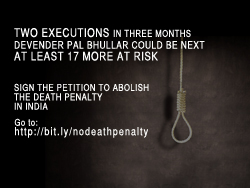
Sign this petition to abolish death penalty in India

AMNESTY INTERNATIONAL lists some reasons why death penalty should be abolished in India:

amnesty2

Inconsistency: Three people, Harban, Kashmira and Jeeta were sentenced to death for a crime in which they played similar roles. But they met different fates. Kashmira Singh’s petition to the Supreme Court was accepted and his sentence commuted to life imprisonment. Harbans Singh was recommended by the court for clemency from the President. Jeeta Singh’s petition was dismissed and he was hanged.

Flaws: In August 2012, 14 retired judges wrote to the President of India, pointing out that the Supreme Court had wrongly awarded the death sentence to 13 people. They called the execution of two wrongly sentenced prisoners in 1996 and 1997, “the gravest known miscarriage of justice in the history of crime and punishment in independent India”.

Bias: “I thought I should get all these (capital punishment) cases examined from a normal citizen’s point of view in terms of the crime, intensity of the crime and the social and financial status of the individuals who were convicted and awarded capital punishment. This study revealed to my surprise that almost all the cases which were pending had a social and economic bias.” APJ Abdul Kalam.

To sign their petition to the Prime Minister of India, go here.

On the Supreme Court of India’s rejection of the mercy plea of Devinder Pal Singh Bhullar: PUDR

Press statement put out by the PEOPLE’S UNION FOR DEMOCRATIC RIGHTS on 12 April 2013.

PUDR strongly denounces the Supreme Court’s dismissal this morning of Devinder Pal Singh Bhullar’s plea for commutation of the death sentence awarded to him to life. The issues at stake in this dismissal are multiple, that of clemency, death penalty, miscarriage of justice and precedence.

Bhullar was sentenced to death in 2003 for carrying out a bomb blast outside the Delhi Youth Congress office which killed nine people in 1993. He has been deemed mentally unstable. The High Court’s decision of upholding the death sentence was not a unanimous decision. After he was given the death sentence by the Supreme Court, he appealed to the then President of India for clemency in 2003. The President, after a lapse of over eight years, dismissed his mercy plea in 2011. Bhullar had sought commutation of his death penalty to life sentence by the Supreme Court on the ground that there was inordinate delay by the President over his plea for clemency. Continue reading On the Supreme Court of India’s rejection of the mercy plea of Devinder Pal Singh Bhullar: PUDR

Lethal Lottery: A study on death penalty in India, 1950-2006

Do you know why Aadhaar is NOT compulsory: Ram Krishnaswamy

This is a guest post by Ram Krishnaswamy For the last three years activists opposing Aadhaar/UID have argued that it can lead to communal targeting, can aid illegal migrants, can invade privacy, is unconstitutional, does not have parliamentary approval, is illegal, etc. Yet all such objections and more have been successfully stonewalled by UIDAI and UPA leaders.

Further, Aadhaar is not compulsory and so such allegations are considered invalid. The middle and upper class Indians have remained silent about the UID debate, as it does not affect them in the least. The long lines of persons stretching before UID enrollment centers must be proof, then, of the popularity of this concept.

Nandan Nilekani and UIDAI Director General R.S Sharma have repeatedly told the nation that UID, now called Aadhaar, is not mandatory. Yet, over a period of time, they say, it could become ubiquitous, if service providers insist upon it compulsorily, in order to receive their services. To quote UIDAI Chairman, Nandan Nilekani, “Yes, it is voluntary. But the service providers might make it mandatory. In the long run I wouldn’t call it compulsory. I’d rather say it will be come ubiquitous.”

Continue reading Do you know why Aadhaar is NOT compulsory: Ram Krishnaswamy

DU’S 4-year degree course: Reforms at reckless speed

(This piece has been  published by the Times of India in its Delhi City section on 14 April, 2013. We are reproducing it here, given the importance of the issue involved. It is  somewhat disappointing that it is being treated as a local , internal issue by the media. What we read there are uninformed reports and stories which do not give us the real picture of the academic scene of  DU. 

Please read and react. We are looking for solidarities of all kinds, Apoorvanand)

The unnecessary and yet frantic haste with which Delhi University is introducing a new Four-Year Undergraduate Programme (FYUP) brings to mind the advice that autorickshaws often offer on their bumpers: Jaldi mat kar, der ho jayegi (Don’t hurry, or you will be late!). Given the longstanding need for reforms in Indian higher education, the FYUP could be worth examining as a possible option. It could also pilot test the XIIth Five Year Plan strategy for “re-crafting undergraduate education” through FYUPs. But the reckless speed of implementation at DU threatens to wreck all positive potential and derail the national reforms process. At stake here is the future of every college-aspiring Indian, not just the quarter million who will apply to DU this June. Continue reading DU’S 4-year degree course: Reforms at reckless speed

The lives of documents: on the sorrows of AADHAR: Rijul Kochhar

This is a guest post by Rijul Kochhar

Combining field and event, camp is in effect spatial practice.[…] Camps are spaces where states of emergency or legal exception have become the rule. [They offer] the setting for the normative permanence of a suspended rule of law.

~Charlie Hailey, Camps: A Guide to 21st Century Space

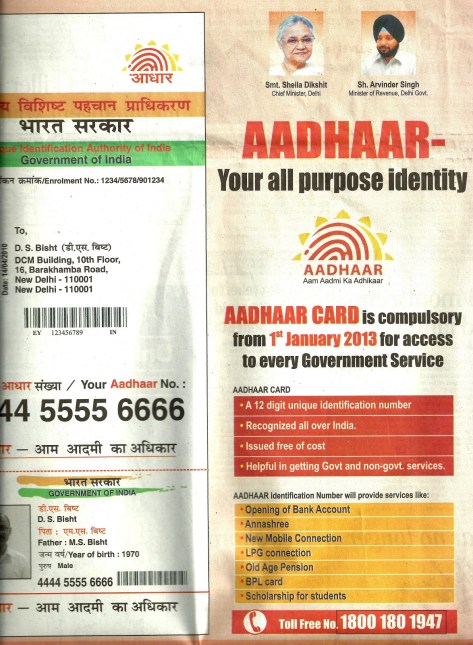
Delhi govt advert compulsory aadhar

The story of Aadhar is not unknown—a new, cutting edge piece of documentary practice jack-booted for this 21st century, it seeks to cull out fraudulent persons tied to dubious places or circumstances (words like ‘ghosts’, ‘fakes’, ‘frauds’, ‘duplicates’ abound in its context). Paeans to the powers of biometrics have been sung from numerous citadels of power—the project’s uniqueness lies in its capacity to channel biological anatomy to a singular fantasy of individually-determined (and fixed) citizenship; its ability to weed out duplication and duplicity in favour of fool-proof individuality; its promise to identify seamlessly; its realization of that ultimate bureaucratic fantasy that seeks to eliminate the noisiness of personhood and the messiness of individual lives by inaugurating a system of identity constructed and at once accomplished through a 12-digit number tied to the bedrock of fingerprints and iris-scans. These seductive powers of identity and technology, long wished for by visions and bureaucratic pursuits of rationality, contrast against fears of the invasion of privacy, the dangers of centralising data, and the abuse of powers and of information by functionaries of government, as well as—by no means less important—prospects of technological malfunction in the field of civic services or anatomical recalcitrance.

Continue reading The lives of documents: on the sorrows of AADHAR: Rijul Kochhar

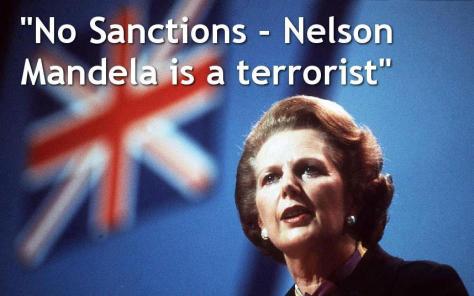
Margaret Thatcher – RIP

524356_379428788839386_1501923291_n

Image from Hope for Africa

The Silence of the Protector: Anonymous

This is a guest post by Anonymous

It is over two months since policemen and others allegedly molested women students of Delhi University as they protested against Narendra Modi’s presence at a college event within the University Campus. Not a word of support or concern has emerged from the Vice Chancellor. Instead, cases have been filed by the police against students and teachers who participated in the protest. The Vice Chancellor’s silence is probably among the less hypocritical responses that he could have had. At least students don’t have to hear assurances about their safety once more, and that lie has been laid to rest.

Sometime last year I happened to be present at an interaction between the local Delhi police and women hostel residents of Delhi University. The police had informed three hostels of a ‘meet the public’ programme at which we were required to be present and urge students to attend as well.  The students, who were preparing for exams at the time, attended the event somewhat reluctantly, but in the course of the evening, provided the feedback that was asked for with unexpected vigour. A woman DCP and other police representatives who had been called to address us, chose to assure us that the city was in fact safe despite a lot of media noise to the contrary, and that the reliability of the police could be counted on in all instants. This did not go down well. Various students asked what they should do when the police leered at them, exposed themselves to the women, urinated deliberately in front of them, lolled in their chairs chatting with security guards while cars slowed down threateningly in front of the hostel gates. The DCP, flummoxed by this flood of complaints, finally said that the police were after all a part of society and would reproduce its problems. This rare if honest admission should be taken seriously as a sign of how women should regard the question of their own safety.

Continue reading The Silence of the Protector: Anonymous

Communal Fascism in Action: Coopting the Dalits, Terrorising the Minorities

Ur-Fascism [Eternal Fascism] is still around us, sometimes in plainclothes. It would be much easier for us if there appeared on the world scene somebody saying, “I want to reopen Auschwitz, I want the Blackshirts to parade again in the Italian squares” Life is not that simple. Ur-Fascism can come back under the most innocent of disguises. Our duty is to uncover it and to point our finger at any of its new instances – everyday, in every part of the world.

-Umberto Eco


Introduction

Politics in this part of South Asia unfolds itself in very many ways. We have before us a spectrum of regimes ranging from electoral democracies at one end to countries which could be said to be unambiguously authoritarian at the other, and some others with varying  mixes of electoral democratic and authoritarian features ‘packed in between.’ Since early 1980s we have also been witness to an emergence of right-wing populist parties and movements throughout a growing number of these countries. Appealing to public anxieties in the wake of rapid economic change, these movements have succeeded in mobilizing and exploiting popular resentments against immigrants, minorities, and the political establishment.

The eighty seven plus year journey of Rashtriya Swayamsevak Sangh (RSS) – loosely translated as ‘National Volunteer Corps’ – an organisation of Hindu males, working for Hindutva and which wants to usher into Hindu Rashtra can also be looked at in this context. Continue reading Communal Fascism in Action: Coopting the Dalits, Terrorising the Minorities

Making Mockery of Panchayati Elections : Shivnarayan Rajpurohit

This is a guest post by SHIVNARAYAN RAJPUROHIT : A school teacher in Rayapuram village of Mehabubnagar district (Andhra Pradesh) summed up the sentiment of the village: “Without a sarpanch [an elected village-chief], this village is like a rudderless ship. The implementation of government schemes has gone from bad to worse. The government has appointed special officers, who hardly have any bonding with villagers in each panchayat.” Recently, the state government of Andhra Pradesh (AP) decided to conduct the panchayati elections in April-May 2013, which have been overdue since July-August 2011. What were the reasons for this postponement? Continue reading Making Mockery of Panchayati Elections : Shivnarayan Rajpurohit

When an April Fool’s Day joke is not funny: Zahir Janmohamed

A colony of 2002 riot affected families in Ahmedabad. Photo by Zahir Janmohamed

This is a guest post by ZAHIR JANMOHAMED: This morning, April 1, Google announced its latest product: Gmail blue. It is email except for one critical difference—everything is blue.

 “I can’t believe I waited so long for this,” a hilarious Google video says.

It works because it is funny and so obviously absurd—you would have to be, well, a fool to believe this April fool’s day joke. But the Google prank is also something else: harmless. It does not hurt anyone nor it does not trigger painful memories.

When does an April fool’s day cross the line? Continue reading When an April Fool’s Day joke is not funny: Zahir Janmohamed