Category Archives: Bad ideas

A petition to end tensions at the Line of Control from citizens on both sides of the LoC

Signatures given at the end. Should you want to add your signature to this petition, write to Anuradha Bhasin at anusaba[at]gmail[dot[com]. The petition with the final list of signatories will be sent to the heads of state in both India and Pakistan.

To,
Indian Prime Minister Manmohan Singh and Pakistan President Asif Ali Zardari,

Dear Sirs,

We, the people of Jammu and Kashmir on both sides of the Line of Control, have been observing with great concern the escalation of tensions at the LoC that have been building up gradually since June 2012 and have suddenly taken an ugly turn since the first week of January, 2013.

We express grave concern at the loss of lives of the soldiers and any casualties to civilians on both the sides. At the same time, we are also concerned about the safety and security of the people of Jammu and Kashmir, particularly the people living at the borders, who are directly hit by sporadic incidents of shelling and firing. Continue reading A petition to end tensions at the Line of Control from citizens on both sides of the LoC
Suran: A poem by Uzair

This guest post is a poem by UZAIR, who grew up near the Indian side of the ‘Line of Control’ in Poonch

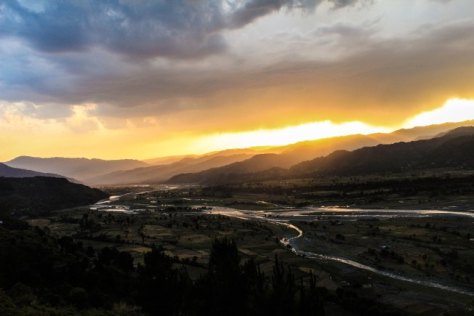
The poet took this photograph in Poonch by the river Suran last summer.Across the second ridge lies the Line of Control. Taken from the Indian side, the photo captures the sun setting on the Pakistani side.
The poet took this photograph in Poonch by the river Suran last summer. Across the second ridge lies the Line of Control. Taken from the Indian side, the photo captures the sun setting on the Pakistani side.

The river carries with it
Snow of distant peaks,
Floating memories
Twigs, leaves.

Only a few miles west
it would be stripped
at the border, asked
to produce a permit,
shot dead or may be not.

Waters were negotiated upon;
so the river travels seamlessly
only a few miles west
to another country.

On its bank, I heard
a cuckoo speak
“The sun shines during day
and stars illuminate the night sky
even across the border”

“And a few collect the twigs
like memories of childhood;”

“smell of dead wood, so familiar
grief and longing, so natural
decades of hope; still alive,
even across the border”

One day the river would flow
eastwards, said the old man
whose corpse floated across,
only a few miles west
and met his children
across the border.

(Uzair blogs at Untitled Untitled.)

See also:

Breaking the Collective – Notes from Jantar Mantar & Koodankulam: Vivek Vellanki

Guest Post by Vivek Vellanki

The death of the young girl brought incommensurable grief for the ‘Indian’ people. A national angst ensued with divergent voices seeking divergent ends: justice, death penalty, fast track courts, end to patriarchy, chemical castration, and a long list that cannot be spelt out here. There was a glimmer of hope that the discursiveness would ensue a quintessentially democratic process of debate, discussion, and deliberation amongst the people. The Indian state with its long-standing reputation wouldn’t allow for that to happen. It had to continue on its pet peeve of Breaking the Collective! The people’s movement in Koodankulam, the anti-corruption movement, the movement for seperate Telangana are some of the many instances that remind us of this pet avocation of the Indian state being pursued in recent times, almost, vocationally. However cynical it may sound, amidst the entire candle lighting and sloganeering, we failed to realise that the protest in Delhi was happening on the terrain that the government decided, in a manner that it wished for it to play out, and was party to the people it wanted to see there. I wish to argue that the closing down of the metro stations has a relation to the nature of the protests at Jantar Mantar. Furthermore it concurs with the tactics of chocking people’s movements logistically and stifling the collective by pathologizing the everyday life of masses. The tragedy of this lies in the fact that such actions of the state have become so recurrent that they have entered our common sense and they present themselves as normal and logical responses. Albeit they have been rationalized by invoking a specious reference to law, order, and safety, there is a need to unpack such a rationalization. My attempt is to extract these actions from that location of common sense and present them for public scrutiny. Through this essay, I would like to draw the connections between the democratic protests happening in locations across the country and state action in dealing with them. In doing so, I hope to bring to notice how the Indian state uses its machinery to purge protests of their democratic tenor and eventually, at least, attempts to break the collective. Continue reading Breaking the Collective – Notes from Jantar Mantar & Koodankulam: Vivek Vellanki

Indians and Pakistanis Condemn Exchange of Fire and Killings on LoC

List of signatories from both countries given at the end.

We, the undersigned Indians & Pakistanis, are deeply disturbed with the recent exchange of firings and killing of two Indian and one Pakistani soldier across the Line of Control (LoC). The incidence as reported is highly deplorable and no sane person or society can accept such unwarranted and gruesome incidences. The said incidences have a potential to derail the ongoing peace process that has shown remarkable progress in recent times in easing the visa regime, improving trade relations and securing many other confidence building measures that hold great promise for both the countries.

We are happy that the Director Generals of Military Operations (DGMOs) of both countries have spoken to each other after the incidents. We urge that suitable mechanisms must be evolved and implemented immediately to ensure that the concerned authorities on both sides are in constant touch to avert recurrence of any such incidence rather than meet after some damage is done. Continue reading Indians and Pakistanis Condemn Exchange of Fire and Killings on LoC

Now that Owaisi is in jail, how about Praveen Togadia?: Mahtab Alam

Guest post by MAHTAB ALAM

Akbaruddin Owaisi, an MLA of Andhra Pradesh Legislative Assembly, who belongs to a Hyderabad-based political party All India Majlis-e-Ittihad al-Muslimin, better known as MIM, and its floor leader in the Assembly made an inflammatory speech against Hindus on 24 December 2012 at a public meeting in Adilabad District. The speech attracted widespread condemnation by Muslim activists, rightly so, apart from left, liberal individuals and organizations. Dr. Zafarul Islam Khan, President, All India Muslim Majlis e Mushawarat (AIMMM), an umbrella body of prominent Indian Muslim organizations termed it ‘a hate and rash speech’ arguing, ‘words that should never have been uttered by a responsible person, let alone a political leader, were used’.

Shabnam Hashmi, a prominent social activist and who has been relentlessly working on the issue of minority rights registered an FIR in Delhi against Owaisi stating, ‘the whole speech is highly objectionable, inflammatory and against the values of our constitution, democracy and secular values’. Similarly, FIRs were also registered in the State invoking section 295 A (for deliberate and malicious acts intended to outrage religious feelings) and 153 A (promoting enmity between different groups) of Indian Penal Code (IPC). Owaisi was arrested finally arrested on Tuesday (8th January) and sent to 14-day judicial custody. Continue reading Now that Owaisi is in jail, how about Praveen Togadia?: Mahtab Alam

The Bitter Truth Regarding Delhi Police’s Womens’ Help-Line: Kavita

Guest post by KAVITA, an activist with the Stree Mukti League

Translated from Hindi by Shuddhabrata Sengupta

It would be natural to expect that in the wake of the barbaric Delhi gang-rape of December 16 and subsequent popular upsurge of anger the police and the state machinery would betray a modicum of sensitivity and alertness. The reality is just the opposite of what you expect. We have heard this from many women in the past few days, and a few evenings ago, came face to face with this sad fact ourselves.

For the last few days, we (activists of the Stree Mukti League) have been going to different places in Delhi to hold meetings, demonstrations and to distribute leaflets against sexual violence. The leaflet has a contact phone number for the Stree Mukti League. Since the evening of the 1st of January this year a perverted male individual has been continuously ringing that number, abusing us, threatening us, using obscene and unprintable language. He even said ‘I know all you girls, and you cannot escape me. What I will do to you will terrify people…’, and several other things which cannot be repeated. Continue reading The Bitter Truth Regarding Delhi Police’s Womens’ Help-Line: Kavita

Akbaruddin Owaisi – You are an Enemy of Muslims (and Hindus)

Guest post by IRSHADUL HAQUE
Translated from Hindi by Shuddhabrata Sengupta

Akbaruddin Owaisi, you are an enemy of Muslims. You are the kind of adversary who lurks like a snake in the grass, ready to strike at the person who cares for that patch. Your desire to provoke a confrontation between India’s 25 crore Muslims and 100 crore Hindus reminds us of Muhammad Ali Jinnah. This is why Javed Akhtar has gone to the extent of calling you ‘the greatest enemy of Muslims’. I know that I am not alone when I find myself agreeing with this view. Many other Indian Muslims will be in agreement with me. Continue reading Akbaruddin Owaisi – You are an Enemy of Muslims (and Hindus)

Notes from a bachelorette party in New India: Swathi Sukumar

Guest post by SWATHI SUKUMAR

Last week, I went to a bachelorette party. The party props were unbelievable to the point of being ridiculous—shot-glasses shaped like body parts, kinky trinkets, balloons in unmentionable shapes and sizes—and other items that would have made many women of another generation collapse in horror.

At the end of the party, everyone was slightly drunk and a good deal of time had been spent asking the bride-to-be embarrassing questions and cracking dirty jokes.  I realized that our revelry had a close parallel in the cult classic “The Hangover”, a story of four men who go to Las Vegas to celebrate a very eventful bachelor’s party. Our party shared common themes from the script of the movie, including inebriation and the obsession with bodies, both perfect and imperfect. We missed the tiger and the stripper from the movie, but I am told that strippers are a very common feature in bachelorette parties in India.

Tigers are not common, I hope. Continue reading Notes from a bachelorette party in New India: Swathi Sukumar

RSS Supremo Mohan Bhagwat’s Thoughts on Rape

The RSS supremo Mohan Bhagwat (or to call him out in the way he is referred to in the Sangh – Sarsanghchalak Param Pujya Shri Mohan-ji Bhagwat-ji) has now joined the pavilion of eminent Bharatiya moustachioed misogynists. In a breathtakingly revealing statement, he has told us that rapes happen in India, not in Bharat. What he means is that rape only occurs in urban areas where the influence of Paschatya Sanskriti (western culture) leads women astray into being raped by men unable to help or control themselves in the face of the assault of women, out and about, by day and night, defying Mohan Bhageat’s Sangh-mandated Lakshman Rekha.

When an upper-caste landlord in a village claims his ‘droit de seigneur’ (land-owner’s claim) with a Dalit woman, it is not rape, it is a yagya, a time honoured shastric ritual. When husbands persuade minor wives on their ‘suhaag raat’ with a few disciplinary measures that leave them with black eyes and sore limbs, it is not rape, it is the carrying out of an Upanishadic injunction. When swamijis, babajis, acharyas and prachaks have their way with ignorant and nabalik shishyas, it is not rape, it is the partaking of the naivedyam of a woman’s body. It is the realisation of a ‘pushp ki abhilasha’, even if the pushp gets pushed around a little bit in the process. Continue reading RSS Supremo Mohan Bhagwat’s Thoughts on Rape

Run with Gender, Hunt with Class: Prachee Sinha

Guest post by PRACHEE SINHA

The curious Ways of Indian Democracy,from India Gate to the Slum Habitat

It has taken a horrific tragedy and a precious young life to stir the conscience of a nation. Or so one would like to believe! Reality may not still cater to our wishes. Our grand old civilization is also a culture of billion brutalities on its women and countless other victims. One can only hope that it changes for the better, even if a little, after what it has witnessed through the last fifteen days of the last year. Greater probability, however, is for such hopes to be belied yet again. It may take a lot more to lift the weight of an age-old way of life. After all, one would not have expected that rapes and molestations would be reported from across the country, and even from Delhi itself, right in the middle of anger, sorrow and protests that seemed to engulf the country. One would expect that the rapists and the criminals would lie low for a while till the situation returns to normal. Least of all would have one expected that women would be harassed, and one or two would even be molested, during those very protests that were taking place at the India Gate and Jantar Mantar. Continue reading Run with Gender, Hunt with Class: Prachee Sinha

Your rapists and ours

Two interesting articles:

Emer O’Toole in the Guardian CiF:

There’s something uncomfortably neocolonial about the way the Delhi gang-rape and subsequent death of the woman now known as Damini is being handled in the UK and US media. While India’s civil and political spheres are alight with protest and demands for changes to the country’s culture of sexual violence, commentators here are using the event to simultaneously demonise Indian society, lionise our own, and minimise the enormity of western rape culture. [Full article]

And Ananth Krishnan in The Hindu:

The rape case was one of the most discussed topics in Chinese microblogs over the past week, prompting thousands of posts and comments. By Sunday, however, the authorities appeared to move to limit the debate: on Monday, a search for the topic triggered a message on Sina Weibo – a popular Twitter-equivalent used by more than 300 million people – saying the results could not be displayed according to regulations. The message is usually seen as an indicator of a topic being censored by the authorities. [Full article]


Desires of planning and the planning of Desires: Vignettes of a Rape Culture and Beyond: Rijul Kochhar

Guest post by text by RIJUL KOCHHAR photos by CHANDAN GOMES

Each person, withdrawn into himself, behaves as though he is a stranger to the destiny of all the others. His children and his good friends constitute for him the whole of the human species. As for his transactions with his fellow citizens, he may mix among them, but he sees them not; he touches them, but does not feel them; he exists only in himself and for himself alone. And if on these terms there remains in his mind a sense of family, there no longer remains a sense of society.

~Alexis de Toqueville (Epigraph to Richard Sennett, The Fall of Public Man)

Friends! You drank some darkness

and became visible

~Tomas Tranströmer (“Elegy”)

An hour is what it took for a band of six males to show a woman, a paramedic, ‘her place’ in contemporary Delhi. Often, in our pathological public places, it takes a mere moment. This case is different because it compels us to think through the limits of brutality of the living; it compels us to confront the limits of our capacity to inflict violence. But the night of December 16, 2012 also confronts us with the kind of cities we are building and the kind of places we want to inhabit. It is a different, by no means less important, matter that this woman—from whatever one has gathered these past weeks through the periodic medical bulletins—has battled to compel us to confront all of this and more, for the pain of her body and the brutality of an experience that she had survived for two weeks, serves a specular role—through it, we bear witness to ourselves, or so one hopes.

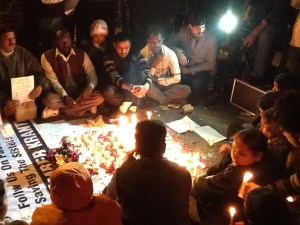
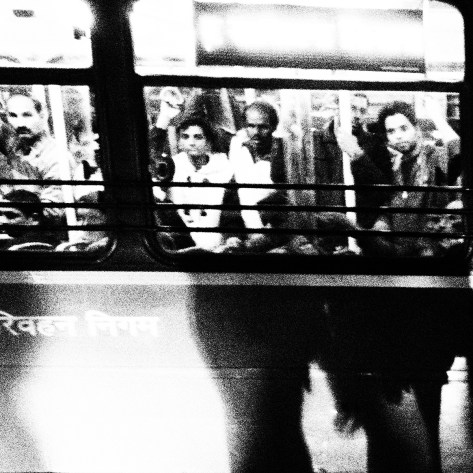
Passengers in a DTC bus try and catch a glimpse of the candle light vigil organised outside Safdarjung Hospital. Thousands of commuters became witness to today’s meet – some got down from their buses to join the vigil. Some joined their hands when their gaze fell on the bed of candles. An old woman took out her hair clip that was shaped like a flower and threw it towards us.

Continue reading Desires of planning and the planning of Desires: Vignettes of a Rape Culture and Beyond: Rijul Kochhar

Evening at Jantar Mantar.

Candles at,Jantar Mantar
The Wake
The Wake
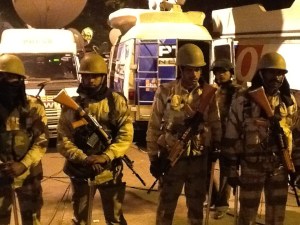
Armed, Cold, Bored
Armed, Cold, Bored

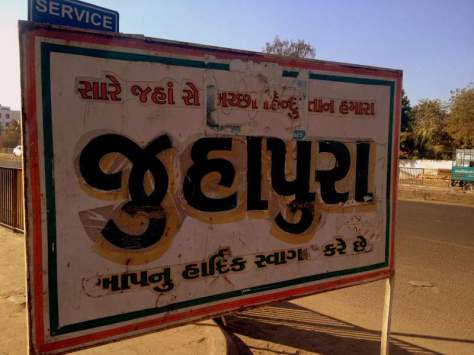
Seeing Pakistan from Juhapura: Zahir Janmohamed

Guest post by ZAHIR JANMOHAMED

Since I started conducting research in March 2011 about the aftermath of the 2002 Gujarat riots, I have learned that the worst way to begin a conversation with a Muslim here in Ahmedabad is to ask about the 2002 riots. I was an eye-witness to the riots in 2002 and I thought my experiences might make some Muslims in Gujarat feel more comfortable speaking with me. I was wrong.

Sometimes I had to interview a person four or five times before they felt comfortable speaking about the 2002 riots. The reasons are varied. Some feel there is no use speaking about the riots as they know justice will never come under Narendra Modi’s watch. Others feel exploited by NGOs and Islamic groups who have used their stories to raise funds for their organizations abroad. And others, as one rape survivor told me, do not want to “relive the trauma.”

But if you ask Muslims in Ahmedabad about Pakistan, chances are you will walk home with a notebook full of comments. Earlier this week I went around my neighborhood of Juhapura—an area pejoratively known as “mini Pakistan”—and asked residents for their comments on Pakistan. The answers are telling. Continue reading Seeing Pakistan from Juhapura: Zahir Janmohamed

Justice for Women Now: Protest in New Delhi

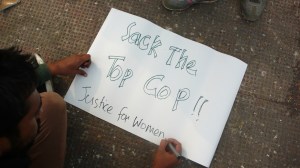
Sack the Top Cop
Sack the Top Cop

On a day when the Prime Minister put his foot in his mouth by saying that ‘footlose migrants’ were responsible for heinous crimes like rape. On a day when the S.O.P – ‘son of a president / sign of a pervert’ – Abhijit Mukherjee said that the protestors were ‘dented and painted’ women, on a day when yet another gang rape was reported in Delhi, and a young woman ended her life in Patiala because the police harassed her in Patiala following her complaint of rape  – hundreds of young women and men, and many not so young and women and men, gathered under the single banner of ‘Justice for Women Now’ at noon in New Delhi, at the Nizamuddin ‘Sabz Burj’ with an intention to march to India Gate. They were stopped at the intersection of Zakir Husain Marg and Subramania Bharati Marg by several cordons of police. The police were arrayed across two intersections, several layers deep. The gathering was unarmed, peaceful, angry, joyous and disciplined. They were faced by a sullen array of police, armed with sticks and tear gas. The police did not let the gathering move towards India Gate, and the peacable, orderly gathering sat on the street for around two hours. There were several television and media crews.The primary demands articulated by the demonstration included ‘fast track’ processes for the 100,000 pending rape and sexual assault cases, the resignation of the police commissioner of Delhi, the drafting of gender sensitive and non-sexist laws, a call for a special session of parliament and a time bound commitment towards a massive expansion of safe public transport for women in metros. Continue reading Justice for Women Now: Protest in New Delhi

Merry Copyright to you – A jingle for the Oxford v. Rameshwari Case

A group of publishers (Oxford and Cambridge University Press and Francis & Taylor) have sued Delhi University & its agent, Rameshwari Photocopy Service for compiling short extracts from different textbooks into a digest for students to use as part of their study (commonly referred to as “course packs”).

Naturally, students, teachers and even authors of these text books have protested this aggressive law suit, particularly since this is perfectly acceptable under the Indian Copyright Act, which allows for “fair use” and permits any reproduction of copyrighted works, so long as it is done in the course of educational instruction.


This is not mala fide use, nor is anyone selling these ‘course packs’ for profit. Publishers going after students, many of them from economically disadvantaged communities, despite the high cost of textbooks, really begs the question – whither our constitutionally guaranteed fundamental right to education? Continue reading Merry Copyright to you – A jingle for the Oxford v. Rameshwari Case

Cash Transfers and UID: Essential Demands

Statement by citizens (signatures below)

We support cash transfers such as old age pensions, widow pensions, maternity entitlements and scholarships. However, we oppose the government’s plan for accelerated mass conversion of welfare schemes to UID-driven cash transfers. This plan could cause havoc and massive social exclusion. We demand the following:

1. No replacement of food with cash under the Public Distribution System. 

The PDS is a vital source of economic security and nutrition support for millions of people. It should be expanded and consolidated, not dismantled.

2. Immediate enactment of a comprehensive National Food Security Act, including universal PDS.

Instead of diverting the public’s attention with promises of mass cash transfers before the 2014 elections, the government should redeem its promise to enact a National Food Security Act (NFSA).  Continue reading Cash Transfers and UID: Essential Demands

Bakht Arif, from Pakistan, sings Zinda Lash for Patronizing Indian Politicians (No, Don’t Listen to Honey Singh)

UPDATED : December 28, 2012

Don’t be a zombie. Never be a Zinda Lash.

No. Don’t Listen to Honey Singh talking about what he wants to do to the bodies of young women.

No. Don’t listen to Sushma Swaraj of the BJP talking about what she thinks is the zinda lash when she talks about the body of a young woman. Continue reading Bakht Arif, from Pakistan, sings Zinda Lash for Patronizing Indian Politicians (No, Don’t Listen to Honey Singh)

Stop Shielding Criminals in the Army and Security Forces in Assam: Bondita and Anjuman

This press release was issued on 23 December by BONDITA and ANJUMAN of WING and WSS, Guwahati

Aggravated sexual violence in Guwahati in July 2012 and gang rape in Delhi this month have led to public outrage and anger, compelling the media and the government to take serious note of the rampant sexual violence against women.  Even as the current attention on sexual violence on women raises several questions over laws, their enforcement and policing, there continues to be absolute silence and complete denial about sexual violence by the Army and the Central Armed Police Forces. It is high time to review and repeal laws and practices that promise complete impunity to the armed forces for sexual assault in counter insurgency conflict areas. Continue reading Stop Shielding Criminals in the Army and Security Forces in Assam: Bondita and Anjuman

Rape is allowed because most people don’t know what it is: Anonymous

Guest post by ANONYMOUS

Rape is allowed because most people don’t know what it is.

To say that victims understand it is assuming too much. The immediate affect will be a deep, invisible wound. After years of counselling it will still hurt and terrorise. All the strength in the world, at the individual and existential levels, will fall short. Very often the crime will remain unreported. Rather than empowering women, the legal system will manage so few convictions that it will itself be the greatest perpetrator.

The perpetrators, as in the actual rapists, know as much or as little as the victims. They will go unarrested, unnoticed, unashamed, and this will fuel their psychopathy. They may or may not realise that rape is not about sex but power.

Continue reading Rape is allowed because most people don’t know what it is: Anonymous

How the God of Death Changed His Mind: Images from the Protest Against Rape at Jantar Mantar

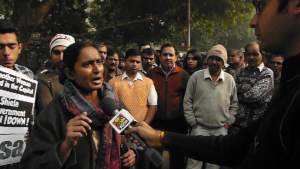
Kavita Krishnan, AIPWA speaking at Jantar Mantar
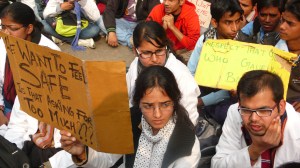
Wanting Safety
Wanting Safety

Protests against sexual violence continued for the third day in Delhi. The venue had shifted from the India Gate-Rajpath environs to Jantar Mantar. Despite the fact that the government had closed metro stops in central New Delhi (from Rajiv Chowk to Khan Market) so that Vladimir Putin was spared the embarrassment of having to encounter protestors against rape, even as he sold gas and guns, a motley crowd of mostly young women and men were able to make their way to Jantar Mantar. Here are a few images and vignettes from this afternoon. Continue reading How the God of Death Changed His Mind: Images from the Protest Against Rape at Jantar Mantar