
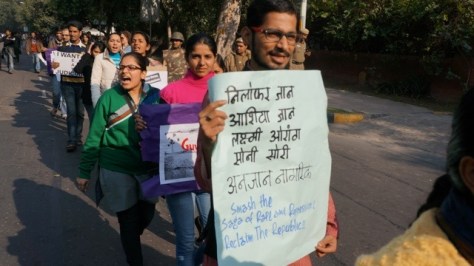
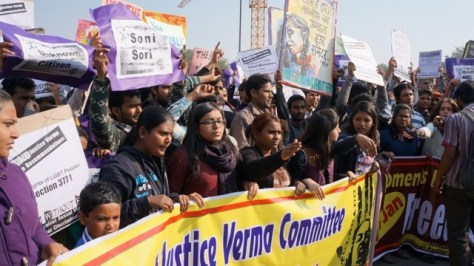
In the last month the streets of Delhi have echoed with a slogan familiar to many in Kashmir – ‘Hum Kya Chahtey ? – Azaadi !’ (‘What do we want ? – Freedom !’). Thousands of young women and men have chanted this slogan in Delhi while protesting against rape and sexual violence, and while doing so, they have also spoken out, with great courage and integrity, and carried explicit banners and signs about the fact that women in Kashmir have had to face rape and sexual assault by the AFSPA protected armed forces (the army, police, irregular counter-insurgents and paramilitary forces) of the Indian state. And no, the young people carrying these signs, and chanting these slogans, that talk about Nilofar and Aasiya Jaan, that name the atrocities and rapes that took place in Shopian and Kunan Poshpora have not been all Kashmiris. Some of them are Kashmiri students studying in Delhi University, JNU and Jamia Millia Islamia. But along with them, several of the young people who have been weaving the reality of Kashmir into the fabric of the protests in Delhi are not from Kashmir. Each time that they have walked with these signs and chanted these slogans – (and I have seen them in every gathering and every demonstration – their numbers are growing – as more young people in Delhi use the protests as sites of learning about the many complex realities of power and oppression) – they risk being branded as ‘traitors’ by the mainstream of Indian nationalist opinion, which can never question the Indian state’s conduct in Kashmir. They have tempered their sense of justice and deepened it with the substance of solidarity. Continue reading Azaadi (Freedom) for ‘Pragaash’, an All Female Band from Kashmir

 Ironically, the random arrest of people for tweets or Facebook postings made some of us happy—happy that, at last, citizens have started showing concern about internet censorship. But lock-up gates had to clang at night on the faces of a few people before we realised that, in our pompous democracy, the might of the state is Ctrl-Alt-Deleting opinion with such serious zeal. The arrests have been made under Section 66A of the Information Technology (Amendment) Act, 2008, notified in October 2009. This section makes punishable with up to three years’ imprisonment anything that is perceived as “grossly offensive” but does not set out the parameters of how to decide on that—even if we were to believe that could at all be done. Questions about these arrests are deflected: the government blames the police, the police says a vague law is the problem, and those who file the complaints that lead to such arrests say that they are free to seek enforcement of an existing law.
 The village of Majure, in Chitradurga district, Karnataka, is once again in the news. It made the national headlines in 1998 when dalits in the village lodged a police complaint against members of the dominant Vokkaliga and Lingayat castes for an attack on their hamlet. As a consequence, several people were
