Category Archives: Bad ideas

Does your misogyny have enough racism in it? Fairer vaginas for all

The recent advertisement on television for fairer vaginas has done its bit to engage, enrage and amuse. What more can a little ad do, after all?

Rupa Gulab “shamefully confessed” to not being outraged by the ad, she was so busy rolling on the floor with mirth. In any case, it’s not advisable, she sagely counsels, to look down your nose on fairness cream manufacturers:

“they may notice that your nostrils resemble black holes and cannily invent a specialized fairness cream to lighten them up.”

Lindy West is thrilled:

“Splendid! God, I was just saying the other day that my misogyny didn’t have enough racism in it.”

Continue reading Does your misogyny have enough racism in it? Fairer vaginas for all

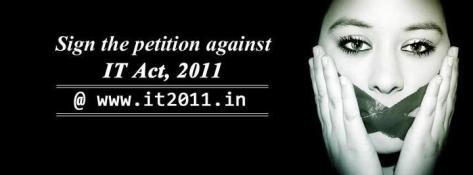
Support the annulment of IT Rules 2011, protect internet freedom in India

Given below is the text of a petition put out by SFLC.in. You can sign it here. Do urge others to sign it too. Please also consider writing directly to your or any or all Members of Parliament urging them to annul IT Rules 2011. You can read SFLC.in’s very brief primer on the IT Rules here. The web address www.IT2011.in also redirects you to the petition page.

Image credit: Aseem Trivedi / saveyourvoice.in. Please consider making this image your Facebook 'cover' picture or Twitter background image or your blog header till the end of April.

Dear Member of Parliament,

The Constitution of India praovides the citizens of this country the fundamental right to freedom of speech and expression subject to reasonable restrictions as laid down in the Constitution itself. Now, with the spread of the Internet and the availability of tools like blogs and social networks we are able to enjoy this freedom to the fullest and have a true participatory democracy.

You, as legislators recognised the importance of intermediaries like Google, Facebook, Twitter and Internet Service Providers for e-commerce as well as for free expression, helping us to express ourselves and provided them protection from any legal liability that could arise out of content generated by users. Such a protection provided in the Information Technology Act, 2000 was important for these intermediaries to operate freely without threats of frivolous legal action. Continue reading Support the annulment of IT Rules 2011, protect internet freedom in India

The Many Uses of a U.P Election

I live in Noida, which is the child of an extra-legal union between Delhi and Uttar Pradesh. Noida is not-quite Delhi, not-quite U.P, not quite itself on most days. Living in a cusp has several advantages, however, the main one being that one can look either way, up at Delhi and right down over U.P’s scruffy head. I found myself doing both in the recently-concluded U.P election. Curiously it seemed, for Delhi people, U.P’s 2012 elections were flush with new meaning. For decades the favourite whipping boy of Delhi, U.P had overnight become its favourite gap-toothed angel. For Pratap Bhanu Mehta of the Delhi-based Centre for Policy Research, the U.P election was a historic battle between empowerment and patronage, the future and the past, performance and rhetoric, sincerity and cynicism, and (this is my favourite) ‘rootedness over disembodied charm’. Mehta believes that while voters ‘carefully assessed’ candidates through the ‘prism of local circumstances’, they were no longer prisoners of their identity. Most confounding is Mehta’s view of democracy, “In a democracy, where you are going should be more important than where you are coming from”. These U.P elections “redeemed that promise” according to Mehta, since they were “without a trace of community polarisation: no one felt on the edge or under siege, all could exercise options without being unduly burdened by the past.”

Continue reading The Many Uses of a U.P Election

Kerala and Kudankulam: The Media Sleeps

It is amazing how the very same Malayalees and their media, which made Mount Everest out of that molehill of Mullaperiyar, remain sweetly calm in comparison at the events unfolding in Kudankulam. In fact the amnesia is so complete that it is as if few remember (except the anti-nuclear activists in Kerala who have been consistently supporting the struggles of the local people) that it was common knowledge in the late 1980s that the plant would affect both Tamil Nadu and Kerala.There was far greater awareness of the special problems of locating the plant in Kudankulam for Kerala, where natural radiation levels are already very high. The violence too had an early start, with the police firing on a people’s rally against the plant in 1989, which killed one person.

Continue reading Kerala and Kudankulam: The Media Sleeps

Set Top Boxes: State-Corporate Nexus (Again)

When I came across this headline over my morning coffee, “Set-top boxes a must from July for greater choice“, I was very excited.  More choices always make my little heart beat very hard.

So this is the deal:

Starting July, every household in Delhi will need a set-top box to be able to view channels of one’s liking. The information and broadcasting ministry is planning to implement a ‘must-provide clause’ for cable operators to enable TV viewers in the four Metro cities to ask for their favourite channels as a right. After July 1, the sub-divisional magistrates across Delhi will take action against all cable operators who are found violating the new norms, which mandate provision of set-top box enabled digital facilities to all viewers.

Hold on, so I can no longer go with the local cable operator who already provides me with all the channels I want legally, at a very low cost, but will be forced to pay larger amounts directly to the big companies (Tata, Reliance)?

This is more choice?

Continue reading Set Top Boxes: State-Corporate Nexus (Again)

Does democracy stop at the doorstep of the women’s hostel?

This appeal comes to us via MAYA JOHN

Friends,

Since January of 2012, residents of Delhi University’s largest postgraduate women’s hostel, University Hostel for Women (UHW) have been waging a battle against outright suppression of their democratic rights by, both, their hostel authorities and the University’s Proctorial Committee. Since the hostel’s Chairperson is also the Proctor of the University, the Proctorial Committee has been intervening in the matter, not as a neutral party, but in complete connivance with the hostel authorities. There are two issues which are central to the ongoing struggle of the women students, namely, the imposition of a union constitution by the authorities, and the existence of archaic and conservative rules in the hostel.

Continue reading Does democracy stop at the doorstep of the women’s hostel?

How India made it easy for everyone to play internet censor: A primer from SFLC.in

This FAQ has been put out by the Delhi-based SFLC.in

The Central Government notified the Information Technology (Intermediaries Guidelines) Rules, 2011 in April, 2011.  The rules which seek to control the intermediaries end up controlling the actions of users. As these rules attempt to cover a wide range of activities through a duplicate, complicated structure, neither the industry nor the end users are able to understand the boundaries of their rights and duties.

This FAQ aims at making these rules easy to understand and at sensitising the beneficiaries to the problems that the rules raise.

Who are intermediaries? Continue reading How India made it easy for everyone to play internet censor: A primer from SFLC.in

Artists protest against coup in Maldives

Here is a report on artists protesting against a coup in our neighbourhood that landed in my inbox recently. You would have thought that the Indian media would be as interested in what happens in the Maldives as it is in what happens in some of our other neighbouring countries. But sadly, that is not the case, and so, one gets to hear little of what happens in the Maldives, even though you get to see it often as an unnamed exotic locale or a little beach side remance in Bollywood films.

Continue reading Artists protest against coup in Maldives

On Sri Sri Ravi Shankar’s views about government-run schools

This press statement comes via Kavita Srivastava; see full list if signatories at the end.

PRESS RELEASE

Jaipur, 21st March, 2012: We are shocked and strongly condemn the statement made by the Global Corporate Brand “Art of Living” businessman, Ravi Shankar in Jaipur on 20th March, 2012, wherein he states that “Government schools are breeding grounds of violence and Naxalism ….that is why Government run schools and colleges must be handed over to private bodies….and that ‘Adarsh schools’ must reach all areas”. We would like to demand evidence from Ravi Shankar that Government schools, in which 16 crore children of the age group 6 to 14 years are studying are breeding grounds for violence and Naxalism. An army of Indian engineers, doctors, nurses, computer professionals, government servants army and police personnel and factory workers come from government schools. It would appear that this human resource that is the backbone of this country is wholly ‘Naxalite’ in the eyes of this completely irrational guru.

Continue reading On Sri Sri Ravi Shankar’s views about government-run schools

Let’s not count the poor (seriously)

As someone recently commented on a Kafila post, we live in a post-fact world where there are no facts. Everyone believes what they want to. So depending on your  ideology, poverty in India has reduced or increased. But such is the debate on poverty that the definition of poverty itself is subject to debate. How poor do you have to be, so that the government will say you are poor? This poverty debate has been on around the same lines for about ten years now, with the economic left arguing that India isn’t shining, and the economic centre-right arguing that millions of people have been lifted out of poverty by India’s super-successful economic growth. The debate will go on forever, there will be no certainty in numbers, and perhaps there shouldn’t be – perhaps counting the poor cheapens the issue of poverty. Counting the poor leads us to ask, what about the only -slightly-better-than-the-poor? Counting the poor leads us to compare poverty numbers and give us relief. Ah, only 30% Indian poor now, as opposed to 50% in such and such decade, nice! Great job India! No, this is not what the poor deserve, whether they are 30% or 50%. Perhaps we should stop counting the poor. Continue reading Let’s not count the poor (seriously)

On the low morale of Gujarat Police: RB Sreekumar

This guest post by former Gujarat DGP RB SREEKUMAR is a letter to the Union Minister of Home Affairs.

Dear Shri P. Chidambaram,

I belonged to Gujarat cadre of Indian Police service (IPS)-1971 batch-and retired from service on 27.2.2007 in the rank of Director General of Police (DGP), Gujarat state.

2. As a senior citizen (age-65 years) staying in Gujarat since 1970s, I am constrained to write the following for your kind consideration and urgent remedial action.

3. The morale, self esteem and image of the Gujarat Police in general and of IPS officers giving leadership to police force in the state in particular, have been in steady decline since 2002 anti-minority genocide. The media, reputed human rights activists and national bodies like the National Human Rights Commission, the National Commission for Minorities and the National Commission for Women have thrown light on serious intentional acts of commission and omission by Gujarat government functionaries (except in cities like Surat, Bhavnagar and a few districts in South Gujarat and Saurashtra), that facilitated extensive and gruesome mass violence against minorities.

Continue reading On the low morale of Gujarat Police: RB Sreekumar

Modesty of Dress and Indian Culture: Suchi Govindarajan

Widely circulating just about everywhere, but for the unfortunate few who may have missed it…

I for one want to kiss the hem of her salwar/sari/jeans/other modest outfit.

Sir/Madam,
I write to complain about the abysmal standards of modesty I am noticing in Indian society. All bad things – sensationalist TV, obscene movies, diabetes among elders, pickpocketing, dilution of coconut chutney in Saravana Bhavan – are a result of Evil Western Influences. However, to my surprise, in this issue of modesty, even the Great Indian Culture (we had invented Maths and pineapple rasam when westerners were still cavemen) seems to encourage this.

The problem, sir/madam, is that revealing attire is being worn. Deep-neck and sleeveless tops, exposed legs–and these are just the middle-aged priests! Some priests are even (Shiva Shiva!) doing away with the upper garment. And I am told some temple managements even encourage this.

Read the rest of this brilliant and biting piece here.

75 Years of Bhonsala Military School: Militarising Minds, Hindutvaising the Nation

Image

..to bring about military regeneration of the Hindus and to fit Hindu youths for undertaking the entire responsibility for the defence of their motherland.

to educate them in the ‘Sanatan Dharma’, and to train them “in the science and art of personal and national defence”

– From the aims of ‘Central Hindu Military Education Society,’ NMML, Munje Papers, subject files, n 24, 1932-36)

This training is meant for qualifying and fitting our boys for the game of killing masses of men with the ambition of winning victory with the best possible causalities (sic) of dead and wounded while causing the utmost possible to the adversary.

– Preface to the scheme of the Central Hindu Military Society and Its Military School’NMML, Munje Papers, subject files, n 25, 1935

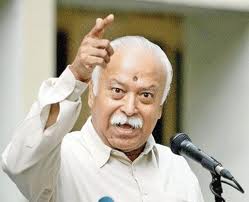
Nashik: Expressing concern over the dominance of ‘rich and powerful people’ in politics, besides the soaring inflation rate, Rashtriya Swayamsewak Sangh (RSS) chief Mohan Bhagwat said that India’s situation was better during the British rule…Speaking at a function organized by Bhonsala Military School (BMS) to celebrate its platinum jubilee year in Nashik on Monday, Bhagwat …laid stress on the need for imparting military education to students, citing rising threat to the nation.

– ‘India was better off under British rule: Mohan Bhagwat’, Times of India, Feb 22, 2012

Continue reading 75 Years of Bhonsala Military School: Militarising Minds, Hindutvaising the Nation

Romancing War

Guest post by NEERJA DASANI

Can 611 people represent a country of a billion? According to the recent Gillette ‘Salutes the Soldier in You’ campaign, they certainly can, especially if two out the 611 are Bollywood stars. Here’s another question – if a national news channel dedicates several half-hour segments to this campaign, lending their own in-house anchor for credibility, discussing how every woman in India wants a military man for a life partner, should it still be called a news channel? So much for self-regulation.

While the compromised nature of the programme, left no more than the now-customary bitter aftertaste, what lingered on was the implicit coding at work. We were being told that courage, confidence, camaraderie, grooming and integrity are copyrighted ‘soldier values’, that clean-shaven men are ‘manlier’, ergo soldiers are ‘manlier’ and that men with ‘soldier values’ have a better chance of being chosen as a ‘groom for your daughter/sister’. These people took themselves so seriously that they wanted to petition the President to ‘rededicate’ the Gateway of India to soldiers – presumably because India Gate isn’t visible from Bollywood. All this to sell a razor.

Continue reading Romancing War

The Unique Identity of a Standing Committee – The UID in Parliament: Taha Mehmood

This long guest post by TAHA MEHMOOD, who has been independently  researching surveillence, biometrics and identification techonologies for a long time dissects the discussion and discourse around the Unique Identification Database scheme of the Government of India

  1.   The Discreet Charm of UID

The January 2012 issue of The Economist, a magazine published from London, has an article on India’s national ID card scheme, titled, The Magic Number. The article focuses on how UID is progressing. The  brave hero of the story is of course Nandan Nilekani and villain is ‘India’s stubborn home minister, P. Chidambaram,’ who ‘is now blocking a cabinet decision to extend the UID’s mandate, which is needed for the roll-out to continue’. According to the unnamed author of the article, ‘Indian politics hinge on patronage—the doling out of opportunities to rob one’s countrymen. UID would make this harder. That is why it faces such fierce opposition, and why it could transform India.’ This article appeared in The Economist days after the report of Standing Committee of Finance was released. What went on in the deliberations of this standing committee?

Continue reading The Unique Identity of a Standing Committee – The UID in Parliament: Taha Mehmood

Stop the Cycle of Revenge and Violence in West Bengal

This public statement is for immediate release. Please see the names of the signatories at the end. 

The news of continuous violence on a daily basis coming from West Bengal is deeply disturbing. Journalists have been attacked by the members of the ruling party, school teachers are being asked to prove their loyalty to the new ruling dispensation failing which they are being barred from doing their duty and are made target of systematic physical violence.

People suspected of affiliation with the CPM  are facing extortion threats and cases have been reported where they have been denied access to the means of their livelihood. Legitimate oppositional politics is not tolerated. Not only are ordinary members of the CPM  being attacked, even senior leaders are not spared . Recently an ex-MLA of the CPM along with another leader was killed in a mob-violence led by the members of the ruling  Trinamul Congress. Processions are not allowed. There have been incidents of intimidation by the ruling party to the supporters of the recent bandh call given by different trade unions. Continue reading Stop the Cycle of Revenge and Violence in West Bengal

What does Gunnar Toresen know about children?: Suranya Aiyar

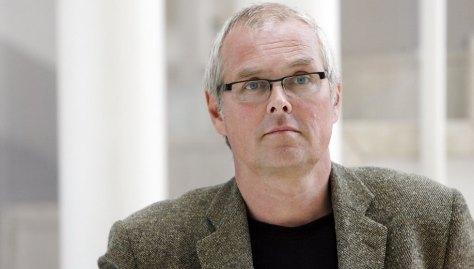
Gunnar Toresen (Photo credit: Marie von Krogh / http://www.rogalandsavis.no/)

Guest post by SURANYA AIYAR

Much has been made of the differences between Indian and western parenting in the wake of the removal of two small children from their Indian family in Norway by the Norwegian Child Welfare Service. But there is something more invidious than racism at work here?

The children were two and a half and four months old at the time of their removal to foster care. Observe any mother with children, babies rather, of this age, and you will see that the mother is the centre of a small child’s world. For a young breast-fed infant of the age of four months, as was Aishwarya, the mother is almost her entire world. That is how infants and toddlers experience the world. So let us, first and foremost bring to centre stage this very un-adult, unscientific, but immutable truth of a baby’s reality before we start to speak of its rights.

Let us also make a distinction between adults and babies. Babyhood has its own unique set of needs – physical and emotional; its own personality, quite separate from adult needs and perceptions. You cannot apply adult co-ordinates of well-being to an infant or young child. Continue reading What does Gunnar Toresen know about children?: Suranya Aiyar

Delhi Police Special Cell – Encounters, Frame-ups, Impunity: Manisha Sethi

Guest post by MANISHA SETHI

An RTI enquiry has revealed that Delhi Police Special Cell’s conviction rate is a paltry 30 per cent. Nearly 70 per cent of the accused it charge-sheeted over the past five years were acquitted for want of credible evidence. Do these figures tell us something? A news story in a leading English daily bemoans this trifling record and quotes a senior police officerattributing this to the fact that “police sometimes get tangled in cross evidences and it becomes tough when you rely more on circumstantial evidences”. [i] This evokes the image of a bumbling policeman, reminiscent almost of Jacques Clouseau, tripping over reams and strings of evidences, in an impossible attempt to build a watertight case against the villains. But Special Cell couldn’t be farther from this sort of cute sloppiness. Continue reading Delhi Police Special Cell – Encounters, Frame-ups, Impunity: Manisha Sethi

What the Wall Street Journal Can’t See in India’s Forests: Aruna Chandrashekhar

 Guest post by ARUNA CHANDRASEKHAR

If we cut the entire forest down, where will we live?’- Muria adivasi, Warangal, Andhra Pradesh 

I don’t even know how to begin addressing a story as blindly biased in its premise as this one in the Wall Street Journal, which draws an obtuse line between loss of forest cover and land usage by adivasis, when it is land grab by industrialization that is endangering all we have left.

So I’m going to do this paragraph by paragraph.

India’s forest cover decreased by 367 square kilometers between 2007 and 2009, and it was primarily tribal and hilly regions that were to blame.

The tribal and hilly regions are the last vestiges of India’s forests.  How can you blame entire regions, without casting any aspersions on institutions or practices responsible? Continue reading What the Wall Street Journal Can’t See in India’s Forests: Aruna Chandrashekhar

Screening Jashn-e-Azadi at Presidency University, Kolkata: Waled Aadnan

Guest post by Waled Aadnan
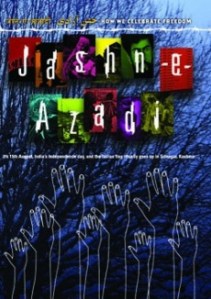
It can be said that 86/1 College Street, Calcutta, has seen a microcosm of the history of modern India unfold within its walls. Since 1874 when the already fifty-nine year old Presidency College shifted to its current address, future Presidents and Prime Ministers of  India, Pakistan and Bangladesh; Nobel Laureates, freedom fighters, an Academy Award winner, Bharat Ratnas; the leadership of the Naxalite movement of the 60s and 70s; and eminent judges, writers, journalists, scientists and actors, have spent their student days at 86/1.

Two years ago, soon after I joined the institution, the Left Front government upgraded Presidency College to the status of a state University in a last-gasp bid to hold on to the votes of the bhadralok intellectuals. 2012 dawned with no Student Union elections having been held the previous year, and it is in this backdrop that the following events unfold.

Salman Rushdie’s well-publicised ostracism from the Jaipur Literature Festival was met not with outrage in Presi’s canteen addas, but with the absence of even a poster put up in protest. News filtered in of a seminar in Symbiosis University being “threatened.” But little awareness existed among students who were more inclined to read tabloid-like, unputdownable newspapers than their relatively austere counterparts, including The Hindu which broke the story.

Continue reading Screening Jashn-e-Azadi at Presidency University, Kolkata: Waled Aadnan

Some pictures from Occupy the World

Continue reading Some pictures from Occupy the World