Category Archives: Bad ideas

The People

Not enough people are asking what is motivating people to go to Ramlila Maidan in such large numbers. People like Ghazala Jamil and Anish Ahluwalia are not asking this question because for them the whole thing is an elite, middle-class conspiracy that is anti-Dalit, anti-OBC, anti-Muslim, anti-justice, anti-equality, anti-peace, anti-love and anti-sex.

These saviours of the marginalised, the poor and the vulnerable make the point that Anna Hazare’s means are showing contempt for the people by not letting people’s chosen representatives delay anti-corruption measures. They are making the point that unless Anna Hazare’s movements takes up issues of land reforms and justice for Gujarat’s Muslims, he should not be supported.  Continue reading The People

An open letter on the ‘Harud’ literary festival

Srinagar-based photojournalist Showkat Shafi is seen in this photograph being assaulted by the Jammu and Kashmir Police on 19 August 2011. He was carrying out his professional duties, as is clear from the camera in his hand that the police is trying to snatch away. He and his Mexican photographer colleague were detained at the police station and beaten up, allowed to go and be hospitalised only five hours later. The police said they mistook them for stone-pelters. Photo credit: Faisal Khan

*
Given below is an open letter signed by fourteen of us. Should you want to add your name to it, please do so in the comments section of this post. I shall update the names of the signatories on the post itself. Please clearly indicate that you want your name added, and write your full name and profession.

Continue reading An open letter on the ‘Harud’ literary festival

Three Questions to Friends

I have been taking my time to reflect on the positions that have emerged in the fairly polarised debate on the on-going anti-corruption struggle in Delhi. I take very seriously the questions raised by critics on the right-wing inclinations evident in the movement’s leadershi, but I think it is both a strategic mistake and a disawoval of responsibility on the part of those of us on the left of the political spectrum to stay out of it. We should engage with the movement from the inside, strategically and persistently, and this means thinking afresh on the means by which we may support the larger binding issue with clear awareness of the risks involved. In this connection, I want to raise three questions:

First, when did we start to be so reluctant to acknowledge the fact that any civil social movement is bound to be contaminated by regressive positions and ideologies and so we cannot avoid thinking of ways of participating in them guided by awareness of the risks? I have recently been trying to collect narratives remembering the fourth national conference of the Indian women’s movement held at Kozhikode, Kerala, in 1990. The participants who spoke to me often pointed to a contrast between the dominant left parties who opposed the conference from the outside, and many, many groups who participated in the conference fully, but raised sharp criticisms which were quite like those of the former. They remarked that these critics were listened to with considerable respect because they were inside, unlike the dominant left.The participant who mentioned this, a well-known radical activist here, still remembers their arguments vividly. Another participant remembered sharp disagreements between urban feminists and rural participants on the question of justice to rape victims. While the former were opposed to the ‘solution’ of marrying the victim off to the rapist, a senior participant from a rural area who spoke up approved of it. This was shocking and unexpected to the urban feminists, but then purity of positions wasn’t, apparently, an overwhelming concern then — and at that place.

Continue reading Three Questions to Friends

The Fallacy of Progressive Yearnings: Ghazala Jamil

Guest post by GHAZALA JAMIL

I suppose some clarifications are in order. I do doubt that Anna’s Lokpalmobilisation is a movement. Just as Anti-Mandal was, just as Ramjanmbhoomi is, but not the way Dalit Panthers was or NBA and MKSS are.  I also want to clarify that my position is not of frivolous dismissal of this mobilisation as a middle class picnic but one of grave concern against what I feel is a uni-dimensional, one point demand around which an entirely regressive and casteist politics can be and is being wrapped up. A collectivity of SC/ST and Minority groups yesterday organised a protest march in Central Delhi. It was reported in many dailies- highlighted as having affected traffic in the area for 45 minutes thus dismissed as not being any valid counterpoint to ‘I am Anna’ wave.

Continue reading The Fallacy of Progressive Yearnings: Ghazala Jamil

Anna’s ‘Second Azadi Movement’ via Satyakam and Rang De Basanti

At first Anna reminded me of this very unreasonable, uncompromising, ‘dry honest’ (a delicious Indianism, I guess) character of Satyakam in the eponymous film created by Hrishikesh Mukherjee in the late Sixties. He is so pathologically and pathetically honest that he does not even borrow the chair from the office downstairs when his boss, Sanjeev Kumar visits him. Dharmendra climbs stairs to meet Sanjeev Kumar at his residence only after having finished his work.

Transposed in the current scenario, the equation would be something like this:

Sanjeev Kumar = any one of us; Anna = Dharmendra. Historically of course we know that only Gandhi could be Gandhi, and not even Nehru could ever aspire to that special position in the people’s hearts even while we remind ourselves that a whole mass of little (good, bad, ugly) Gandhis contributed to the making of the one and only, most famous, Gandhi. Continue reading Anna’s ‘Second Azadi Movement’ via Satyakam and Rang De Basanti

Reading Ur-Fascism in our times

When people are marching to barricades, I go back to my library . I know that streets across India are now re-educating many of us and we are keen to get enrolled in this university of action. Yet I want first to understand this moment of action we are being advised to be part of.

Continue reading Reading Ur-Fascism in our times

A Case for Fractured Solidarities and Skepticism: Ghazala Jamil in response to Nivedita Menon on Anna Hazare

Guest post by GHAZALA JAMIL

On August 17 at 5:30 in the morning I sat up to follow the latest developments on Hazare front (for sleepless nocturnal souls like me it helps that Ramzan are on). Logged into my facebook account and found that I have been labelled ‘a cynic’ for my status updates and posts on Hazare mobilisation. Got into a facebook ‘discussion’ argument with a friend abroad (All my homesick friends abroad have been smelling wafts of the ‘Arab Spring’ in all this).

Continue reading A Case for Fractured Solidarities and Skepticism: Ghazala Jamil in response to Nivedita Menon on Anna Hazare

Many Halves of a Split Screen

I’ve been struggling to write on the Hazare moment but in her piece here, Nivedita Menon has begun going where I wanted to so I shall just add to her conversation with a second set of experiences and questions. Forgive the fragments.

In a post earlier that was written after the first stirrings in Egypt, I had asked a set of questions about politics, protests and publics:

“Could reclaiming public space for conversations, debates and voices – regardless of what these voices want to say and whether “we” agree with “them” or not – become a single point agenda for a movement of our own? Could the idea of the public bring urban residents together – regardless of what we want to do once we’re in that space? Could public space be an answer that rallies people together – the more voices, the more noise, the more debates, the more antagonism that come, from any point of view, would that noise not represent a resistance to the single story being told about India today?

Could such spaces be created? Would anyone come? How can they be sustained? How can we use new forms of information flows and technologies in this process? What are the new sites and spaces of struggle open to us?”

I believe, in one sense, this moment has been brought to us. I had been speaking about “inequality” in that post as an ideal broad concept that brings people together. It isn’t what has happened here and that is not something to forget. It is “corruption” – narrowly defined, poorly understood but deeply felt. So be it. The Noise is here. Now what?

I was walking through hordes of people last week in Jantar Mantar, on India Gate. It was the first time I’ve been among publics in this city with city streets so alive and full of people and yet felt totally emotionally, politically and intellectually disconnected from them. It was an uncomfortable, strange feeling. After years of thinking about what it would take to get people onto the streets in anger, seeking change, how could the moment feel so empty? Is Nivedita right – are “we” missing something? Am I? How is one meant to engage?

Continue reading Many Halves of a Split Screen

Resisting The Popular

The drama that is being enacted in Delhi for the last one week, rather five months, has thoroughly exposed the intellectual hollowness of the political life of India. This moment would also be remembered as the lowest to which collective intelligence of a people can descend to. Critiquing people is not the job of the politicians or the media, not in our times at least . Gone are the days when you had a Mohan Das Karamchand Gandhi who could stand up to the masses and withdraw a popular movement risking their wrath or a Jawaharlal Nehru who commanded the authority to chide his own people. The days of Rabindra Nath Tagore are also over who had the courage to openly challenge, criticize a saint like Gandhi and write ‘anti-people’ novels like Ghare baire. If we have time and patience to turn the pages of our history , we would find that their criticism was an integral part of their long and continuous engagement with their people. Theirs was not a utilitarian relationship . People knew that they love them and care for them and that is why they never turned away from them.

The names we have mentioned above belong to an era when the grammar and vocabulary of popular politics were being transformed. They refrained from simplifying things and devised a language which people were challenged to learn. It was their inexhaustible trust in the intelligence of their people that encouraged them to constantly innovate and complicate rather than simplify. It was this air which a young man Bhagat Singh was breathing, who, going against the grains, wrote that violent methods were no substitute to popular political mobilisation, who knew that the appeal of Subhas Chandra Bose was dangerous and it was Nehru, with a scientific and internationalist outlook, he advised the youth to follow.

Continue reading Resisting The Popular

We should be there: The Left and the Anna moment

My head has been in a whirl the past few days with a single question – how do we on ‘the Left’ manage so unerringly to be exactly where ‘the people’ are not, time after time?

At this moment I don’t mean the organized Left, for the Left parties  have been cautious about criticizing  the current upsurge; they strongly defended the right to democratic protest when Anna Hazare and his colleagues were arrested, and now have launched a Third Front initiative on the issue of corruption and the Lokpal Bill; the students’ front of CPI (ML), AISA, has been organizing militantly on the issue for a very long time now, and is very much part of the campaign.

I mean the few hundreds who form my own community, the people with whom I have organized protests and run campaigns and sat on dharna and drafted petitions;  struggled against communal violence and sexual harassment,  for queer freedom and workers’ rights, against the nuclear bomb and nuclear energy, in support of reservations and against the moves in our universities to hold up appointments to reserved posts. Many of these people I know personally, some are among my closest friends, and many more I know as part of the broad Left/secular non-party tendency in the country’s politics, where I feel most at home.

Continue reading We should be there: The Left and the Anna moment

Benaam Shahidon ke Naam – शेहला मसूद के लिए: Tanzil Rahman

Guest post by Tanzil Rahman

Benaam shaheedoN ke naam (बेनाम शहीदों के नाम )

तंजील रहमान

For Shehla Masood, Niyamat Ansari , Amit Jethwa and many like them who are killed everyday across the world for daring to speak out the truth.

Ye Jang ruki thi kab  ये जंग कब रुकी थी

Ye jang to jaari hai  ये जंग तो जारी है

Ye jang hamaari hai  ये जंग हमारी है

Ye jang hamee’at ki  ये जंग हमी’अत की

Insaan ki qeemat ki  इंसान की कीमत की

Har ahl-e-hawas se hai  हर अहले-हवास से है

Har ahl-e-hakam se hai  हर अहले-हकम से है

Har zuml-o-sitam se hai हर ज़ुल्म-ओ-सितम से ही

Har jhoot se, nafrat se हर झूठ से, नफरत से ही

Auhaam se dahshat se औहाम से दहशत से है

Har rang ki zulmat se हर रंग की ज़ुल्मत से है

Ye jang to jaari hai ये जंग तो जारी है

Ye jang hamaari hai ये जंग हमारी है

Continue reading Benaam Shahidon ke Naam – शेहला मसूद के लिए: Tanzil Rahman

जोश मलीहाबादी की एक नज़्म – आज के नाम

जोश मलीहाबादी की नज़्म ‘रिश्वत’ के कुछ टुकड़े, इस स्वाधीनता दिवस के नाम.

[Apologies for some missing nuqtas, despite my best efforts.]

लोग हमसे रोज कहते हैं ये आदत छोडिये
ये तिजारत है खिलाफे-आदमियत छोडिये
इससे बदतर लत नहीं है कोई, ये लत छोडिये
रोज अखबारों में छपता है की रिश्वत छोडिये

भूल कर भी जो कोई लेता है रिश्वत, चोर है
आज कौमी पागलों में रात-दिन ये शोर है. Continue reading जोश मलीहाबादी की एक नज़्म – आज के नाम

A Messiah for our Moderate Liberatti – Guest Post by Brinda Bose and Prasanta Chakravarty

The Indian liberal establishment has found a new hero in Kumar Sangakkara. For his now-famous Cowdrey lecture at the MCC on the ‘Spirit of Cricket’ is not just about remedying corruption and decay in cricket (and by extension, in modern sports), but also crucially a rumination on pluralism and integration in postcolonial societies like Sri Lanka. In his speech he had referred to the1983 July riots, the JVP-led insurgency, LTTE terrorism and the heavy price paid by the military to defeat the LTTE. The Sri Lankan Defence Secretary, Gotabhaya Rajapaksa, had a word of praise for Sangakkara for solidly backing the country’s successful war effort against the LTTE, at a time when a section of the international community is seeking accountability from the Sri Lankan military establishment for its questionable practices during the last few decades.

The speech has also stirred the reformer-liberals of New India, who are not only enthralled by Sangakkara’s refined, rhetorical eloquence but also by his civic, character-building arguments. Mukul Kesavan calls Sangakkara’s first-person-narrative at once a cricketer’s prescription and a citizen’s creed. V. Anantha Nageswaran finds in the speech the unfolding of a triad of competence, integrity and conscience, a ‘lesson’ for our political-reformers. Others rave about how his outstanding legal mind subtly seeks administrative transparency and good governance.

Continue reading A Messiah for our Moderate Liberatti – Guest Post by Brinda Bose and Prasanta Chakravarty

The question we are not asking about Fai, Tramboo and Shawl

GN Fai

(Please see two updates at the end of this post.)

‘Gotcha!’ That is the sound I hear in the Indian media and amongst patriotic fellow-Indians in response to the arrest of Syed Ghulam Nabi Fai, an American citizen of Indian origin, by the Unites States Federal Bureau of Investigation.

Most analyses of the Fai arrest say it’s part of the ongojng tussle between the American CIA and the Pakistani ISI but some in India think it’s part of the American reward to India for opening up its nuclear energy and other markets to American corporations, thus creating jobs for Americans. This may have some truth in it, considering that the Americans asked their ambassador to take a flight to Srinagar four months ago to pat Omar Abdullah on the back for successfully presiding over the killing of 120 Kashmiris the previous summer, and for halting the killings when President Obama was in Delhi, so that the media attention on the President’s visit is not diluted. (And then Americans wonder why ‘Muslims hate us’). Continue reading The question we are not asking about Fai, Tramboo and Shawl

Dear Manmohan Singh: BPL households don’t think cash transfers will be better than the PDS

Given below is the text of a letter written by research scholars and student volunteers to the Prime Minister of India. Given below the letter is a table listing the findings of the survey that the letter speaks about.

21 July 2011

Dr. Manmohan Singh
Prime Minister of India

Respected Prime Minister,

We are a group of research scholars and student volunteers who have just spent three weeks surveying the Public Distribution System (PDS) around the country. We are writing to share a few thoughts on the National Food Security Act in the light of this experience.  Continue reading Dear Manmohan Singh: BPL households don’t think cash transfers will be better than the PDS

A note of protest to Aditya Sinha, editor, DNA

To: asinha at dnaindia dot net

Aditya Sinha,
Editor,
DNA, Mumbai.

Dear Sir,

I have long been a fan of your column, tweets and have admired The New Indian Express and DNA under your editorship. I am, however, saddened to se that you chose to publish Subramanian Swamy’s column that is Islamophobic in the extreme, presumes the people behind the Mumbai blasts were Muslims without evidence, and in hardly veiled terms calls for violence against Muslims. Continue reading A note of protest to Aditya Sinha, editor, DNA

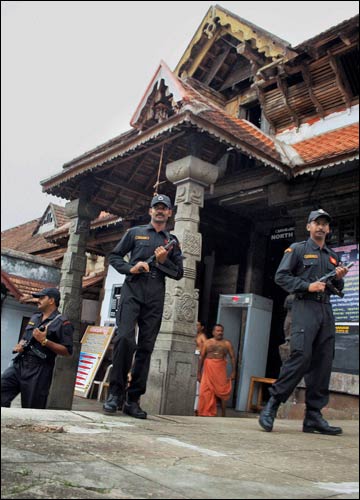
The Lord’s riches are not the Lord’s riches

Photo credit: Press Trust of India

Giving a historical background of why the Sree Ananta Padmanabha Swamy temple in Thiruvananthapuram came to have these riches, Malavika Velayanikal writes in DNA:

True, the bags of gold coins, diamonds, precious stones, 18-feet-long gold necklaces, jewellery weighing many kilograms, and solid-gold statues of gods and goddesses landed in the vault via the king. But in reality, the temple treasury was nourished by the sweat and blood of the masses as well.

One of the main sources of the royal income was taxes. They were incredibly high for the lower castes, with marriages, childbirth and even death being taxed. Country boats, ploughs, carts, umbrellas, headscarves, why, even a moustache, were taxed. Mothers were allowed to breastfeed their newborns only after they paid the ‘mulakaram’ (breast-tax) to the local lord, who would then grant permission. [Must read]

But you won’t hear this said too often because, as Appu Esthose Suresh reports in Mint:

“If the government makes any move, then the believers will protest and BJP will support the people,” he (a temple staff member) was quoted as saying by news agency PTI.

It is precisely the fear of antagonizing a section of the Hindus that is forcing the state government to be cautious.

“This government does not have the courage to go against Hindu sentiments,” said P.R.P. Bhaskar, a political observer. “It will move in a direction which will accommodate the royal palace.”

“The Left Front gained Hindu votes for two reasons. Firstly, its traditional vote base consists of Hindus and a perception that Christian and Muslim votes are moving towards the Congress and its allies had led to a consolidation of Hindu votes. This might help the government change that perception a bit,” he added. [Link]

Hindu appeasement. That’s what will come in the way of a just, fair, pro-people decision about what should be done wit the temple wealth.

#AgainstIndianCulture

Twitter hash-tag doing the rounds, becoming a meme with thousands of tweets. Small selection for you only:

http://twitter.com/#!/namansaraiya/status/89288072197443584

Continue reading #AgainstIndianCulture

JKCCS welcomes Supreme Court order for disbanding SPOs

A press release from the JAMMU AND KASHMIR COALITION OF CIVIL SOCIETY
8 JULY 2011: Jammu and Kashmir Coalition of Civil Society (JKCCS), welcomes the recent judgment delivered by the Supreme Court of India in which it has struck down as ‘unconstitutional’ the practice of arming local tribal youth of Chattisgarh as Special Police Officers (SPOs) in order to fight the Maoists. It has asked the Chattisgarh state government to:
·         immediately stop using SPOs,
·         recall all firearms distributed to them,
·         desist from funding the recruitment of any other vigilante groups,
·         ensure the filing of FIRs into criminal activities committed by them, and
·         offer protection to those who need Continue reading JKCCS welcomes Supreme Court order for disbanding SPOs

Mental Health Professionals Criticise Union Health Minister’s Statement on Homosexuality

PRESS STATEMENT: MENTAL HEALTH PROFESSIONALS CRITICISE UNION HEALTH MINISTER’S STATEMENT ON HOMOSEXUALITY

6 July 2011: We are a group of highly qualified mental health professionals who are practicing as psychiatrists, clinical psychologists and behavioural psychologists from across the country. We regret the statement made by Union Health Minister Ghulam Nabi Azad on Monday where he called homosexuality a “disease”, as being “unnatural”, and a having “come from western shores”. Scientific evidence shows that homosexuality is a natural variant of human sexuality and is not a mental disorder or disease. Homosexuality as a specific diagnostic category was removed from the World Health Organisation’s ICD-10 Classification of Mental and Behavioural Disorders published in 1992, and from the American Psychiatric Association’s DSM-IV Guidelines in 1973. Continue reading Mental Health Professionals Criticise Union Health Minister’s Statement on Homosexuality

To Manmohan Singh from a Bangladeshi: Jyoti Rahman

Guest post by JYOTI RAHMAN
In a Q&A session with five newspaper editors recently, India’s Prime Minister Manmohan Singh had this to say about the Indo-Bangladesh relations:

With Bangladesh, we have good relations. Bangladesh government has gone out of its way to help us in apprehending the anti-Indian insurgent groups which were operating from Bangladesh for a long time. And that is why we have been generous in dealing with Bangladesh. We are not a rich country. But we offered it a line of credit of one billion dollars, when Sheikh Hasina came here. We are also looking at ways and means of some further unilateral concessions. We are also looking at ways and means of finding a practical and pragmatic solution to the sharing of Teesta waters. I plan to go there myself. The external affairs minister is planning to go later this week. So, Bangladesh, our relations are quite good. So with Bangladesh, our relations are quite good. But we must reckon that at least 25 per cent of the population of Bangladesh swears by the Jamiat-ul-Islami and they are very anti-Indian, and they are in the clutches, many times, of the ISI. So, a political landscape in Bangladesh can change at any time. We do not know what these terrorist elements, who have a hold on the jamiat-e-islami elements in Bangladesh, can be upto.

There are more errors here than one would have found in the balance sheets of Lehman Brothers. Let me note a few. Continue reading To Manmohan Singh from a Bangladeshi: Jyoti Rahman