
These are happy days in which everyone in Kerala wants too settle the land dispute at Chengara. A happy consensus between the Left and the Right seems to be growing there, after the Congress leader of the Opposition, Oommen Chandy, decided to take on Godfathership of the land struggle. The very language of the struggle had changed – interestingly, from ‘we are landless squatters’ to ‘we are settlers’! Now, it is well-known in Kerala that these terms have had different sorts of political associations – ‘squatter’ with the Left, and ‘settler’ with (largely) the Right. Indeed, this was inevitable perhaps, given the fact that the New Left didn’t look very keen on ‘squatters’. However, it is clear that neither dalit or tribal organisations are going to be part of the negotiations towards the final package –today’s newspapers report that prominent tribal and dalit leaders have protested against the state’s reluctance to negotiate with them. It would be very convenient for both the Left and the Right to delegitimize – indeed criminalize – tribal and dalit organizations. And what luck that precisely that boon has been granted to them by the sudden eruption of a ‘lower-caste terrorist group’ (according to the police), the ‘Dalit Human Rights Movement’!
Category Archives: Bad ideas
Canal Vision
A longer version of my story for the Hindustan Times.It takes off from a post that I did for Kafila two years ago. Predictably, nothing has changed, but people in the Government are now beginning to think about this.
Khandwa, Madhya Pradesh: The sight of the Narmada bursting through the gates of the Indira Sagar Dam makes for great photographs, but the river’s churning wake blurs a truth that the government is eager to hide. Despite spending Rs 142,269 crore on major and medium irrigation projects in a fifteen year period, from 1991-92 to 2006-07, canal-fed irrigation in India has not increased a single hectare.
Ab aap police station se samachar suniye
(And now, the news read from the police station)
I am absolutely appalled by the new levels of unethical reporting reached every day. I could bear it if it were a race to the bottom that we see in the English media, because at some point we could have heard the thud of crashing skulls. But it appears the bottom is bottomless…
Take this “news story” on the front page of the Indian Express yesterday:
Shadowy Kerala outfit preaches hate in Dalit ghettos
It begins – “Police in Kerala have stumbled upon a shadowy extremist Dalit outfit that they suspect is working clandestinely to radicalise Scheduled Caste and Scheduled Tribe communities in the state.”
Do prisoners’ human rights stand suspended?
“What a state of society is that which knows of no better instrument for its own defense than the hangman, and which proclaims . . . its own brutality as eternal law? . . . Is there not a necessity for deeply reflecting upon an alteration of the system that breeds these crimes, instead of glorifying the hangman who executes a lot of criminals to make room only for the supply of new ones?”– Karl Marx, 1853
The letter sent by an undertrial Mukesh Kumar, as present lodged in Karnal Jail (Haryana) through his counsel to the Chief Justice of India makes depressing reading. The letter talks about the manner in which he was brutalised by the Jail staff for disobeying their orders. It is learnt that the Jail wardens compelled him to clean the toilets calling him names and ‘reminding’ him of his ‘caste profession’. His refusal to continue the dehumanising work led to his public thrashing and tonsuring/shaving of his head and moustache.
According to the administration, Mukesh Kumar is one of those persons who were arrested from different parts of Haryana from April to June 2009 as part of the state campaign ‘to curb Maoist activity’. Continue reading Do prisoners’ human rights stand suspended?
On Austerity
In the 1990s, when I first understood economics, austerity was a word that scared me. It represented a paradigm that I associated with the story of Zambia in the late 1980s. Zambia had one of the more functional public health systems in Africa in the late 70s and early 80s. It then became IMF’s test case for user fees in health care and the rest of the story is familiar one of user fees, loss of access and a systemic worsening of care in an already incredibly poor country. “Austerity” was [and is] in economics of a certain tune, not about economy class travel and eliminating excess photocopying. It was about tightening state expenditure, usually to pay off large scale debts. It was part of Structural Adjustment and the attack on “big” African government, part of the shock transitions of Eastern Europe.
In one of its shades, then, austerity is the slow dismantling of the welfare state. It is not the stance — as the UPA would have you believe — that one takes in some notion of deference to the reality of poverty, it is the cause of some of that poverty in the first place. Every time one government or any other calls for “austerity drives” of any kind, the shadow of this austerity still haunts them. The austerity that causes poverty is also rooted within these calls, though more quietly.
This Whole Business of Childhood
“To all who come to this happy place – welcome. Disneyland is your land. Here age relives fond memories of the past and here youth may savor the challenge and promise of the future. Disneyland is dedicated to the ideals, the dreams, and the hard facts that have created America … with the hope that it will be a source of joy and inspiration to all the world. Thank you.”
Walt Disney’s father helped build the grounds of the World’s Columbian Exposition of 1893 in Chicago. In the 1950s as the population of America for the first time shifted West into desert climes on a mass scale, Walt Disney started receiving letters from people about visiting the Disney Studio, located in Los Angeles. Walt realized that a functional movie studio had little to offer to visiting fans. He began to dream about a site near the studios for tourists to visit; ideas that evolved into the first Disneyland Park located in Anaheim, California. The first Disneyland opened to the public on Monday, July 18, 1955 and crowds started to gather in line to enter as early as 2 a.m. Walt’s brother Roy O’Disney had arranged to pre-purchase ticket number 1, so an adult named David MacPherson became the first official visitor to Disneyland, with ticket number 2. For a park that had to become iconic with children all over the world, MacPherson’s historic ticket was potentially disastrous from a marketing point of view, and recognised as such by the ever-alert Mr. Disney. In a masterstroke of foresight and damage control, he had an official photo taken with two children instead, Christine Vess Watkins (age 5 in 1955) and Michael Schwartner (age 7 in 1955). The photo was captioned, “Walt Disney with the first two guests of Disneyland.” Continue reading This Whole Business of Childhood
The Khirki and the Begumpur Mosques
This is to be read as a sequel to my earlier post, A Tale of Two Mosques.
First published in Landmark. Photographs by DEVNDRA CHAUHAN. Credit for the map drawings: NITIN SAINI.

With the exception of Humayun’s tomb, and it is an exceptional structure, I have up to now stuck to my brief of talking about lesser known monuments of Delhi and will hopefully continue doing so as long as some monuments continue to exist incognito or till I am told to layoff. Considering that some of the readers have reacted favourably to my output I hope to continue to tread on what used to be a lonely trail.
Of late I have discovered fellow travellers on my jaunts, this path is no longer as lonely as it was when I began to see them in my teens in the company of my father who had strayed into archaeology from furniture designing, interior decoration and draughtsmanship. Continue reading The Khirki and the Begumpur Mosques
Breaking Rules: Reflections on Knowledge
This story of the birth of a new language raises some significant questions for our understanding of how bodies of knowledge are transformed. After the Sandinista revolution in 1979, for the first time in the history of Nicaragua, a huge nation-wide effort was made to educate deaf children. Hundreds of deaf students were enrolled in two schools. They had never been introduced to any of the world’s existing sign language systems, and came to the schools with only the simplest kind of gestural signs they had developed within their families. Their teachers were new and inexperienced, and found it difficult to communicate with their students, but the students themselves had no problem at all in “talking” to one another. With great rapidity they began to build on the common pool of signs, and a complex new language began to emerge, which has come now to be called Nicaraguan Sign Language (NSL). Some years down the line, an even more interesting development is noticed. As younger children enter the school system, they not only pick up the language their seniors had developed, but they confidently break the existing language rules. They invent new signs and deform old ones, and these new signs that do not obey the old rules filter back into the language, making it more complex, richer and more varied.
Search No More
A new search engine ImHalal.com promises a more spiritually cleansed experience of the internet (“Search Halal, I am Halal!”). With three levels of Haram content defined, the search engine either throws up no results or warns you that a particular search term is rated at 2 and could and have potentially haram content before you proceed at your own moral peril
The (‘Quotation’) Gangs of Kerala
The media in Kerala is in a tizzy these days over ‘quotation’ gangs and their influence on everyday life. Like evil spirits dancing upon the bodies of fallen heroes in abandoned epic battle-fields, ‘quotation gangs’, it seems, now dance upon the dead political heroism of the Malayalees. Suddenly, the media finds, they are everywhere, settling every kind of dispute. The institutions of law and order are turning, slowly, into adjuncts or versions of ‘quotation gangs’. The recent murder of the real-estate businessman Paul Muthoot, who was apparently traveling with two of the most notorious ‘quotation gang’ leaders in Kerala, has brought matters to a head. The papers are clogged these days with advertisements feeding Onam-time consumer-frenzy and news of the Paul Muthoot murder and they don’t see any connections between the two.
Editors and Journalists Must Declare Their Assets As Well
On 15 August, our favourite newspaper, the Indian Express, carried a lead article on the edit page by its editor, Shekhar Gupta. The learned editor tells his readers, in case they are feeling depressed with the drought scenario, to drive down to Punjab – to Shimla, Chandigarh or Amritsar. ‘Just drive out’ he says… don’t fly’.
For then you will like Ali Baba be able to enter the magic cave and lo and behold! you will see ‘Totally lush, bounteous fields of paddy stretch endlessly into the horizon on both sides of the highway.’ And he goes on: ‘So where is the drought? Where are the caked, cracked and dried mud-flats with withered saplings that characterise drought? And mind you, Punjab and Haryana are among the worst hit states this year, notching up a rainfall deficit of 50 to 70 percent…’
Lord’s Own Voice, speaking through its prophet, tells us that why this is so:
Continue reading Editors and Journalists Must Declare Their Assets As Well
Dronacharyas All?
We will have to repent in this generation not merely for the hateful words and actions of the bad people but for the appalling silence of the good people.
He who passively accepts evil is as much involved in it as he who helps to perpetrate it. He who accepts evil without protesting against it is really cooperating with it.
– Martin Luther King
I
Few years back a study commissioned by Ken Livingstone, the then Mayor of London had discovered how ‘Black teachers face bullying and racism’ in the school and had linked the plight of the black teachers to the ‘continuing problem of underachivement among black pupils’. The landmark report had called for a formal investigation – akin to the Stephen Lawrence inquiry into policing – to address concerns that black teachers are isolated, maligned and robbed of proper pay and status. (Hugh Muir, Friday September 8, 2006, The Guardian). There were also calls for a public inquiry into racism in schools.
One is yet to come across a comprehensive study of a similar nature to know how ‘apartheid of different kinds’ unfolds itself in schools in this part of the earth and whether teachers coming from – socially oppressed communities- are similarly ‘.isloated, maligned and robbed of proper pay and status..’and how does it impact the performance of the students coming from similar sections of society.Ofcourse, one does get an inkling of the state of affairs through related studies, reports and investigations. Continue reading Dronacharyas All?
My Name is Not Khan
Migration is a matter of my life. I first moved to Delhi to pursue my education. Later, I had to often leave my country to work. Immigration grew, and increasingly became tiring for me – various counters, security checks, scanning, and questions began scaring me. I carry a few baggages, but I think my family and I must carry all our rights with them when I move. I am a human being, whether I am documented or not. Immigration systems and detentions need reforms and alternatives to ensure that I am treated with full respect for my rights and human dignity. We need to support each other – tens of thousands of individuals will be harassed and detained tonight, tomorrow, and the next day in the present system.
A Tale of Two Mosques

Ferozeshah Tughlaq (1351-1388), the last significant ruler of the Tughlaq Dynasty, built his capital of Ferozabad on the banks of the river Yamuna. The ruins of the city, that came to be called Ferozeshah Kotla in later centuries, are located behind the Indian Express building and the perpetually under-renovation Ferozeshah Kotla Cricket grounds that derive their name from this 5th capital at Delhi. Continue reading A Tale of Two Mosques
Balmiki, Bawaria, Garg, Chauhan: Proclaimed offenders all

The Haryana Police website has a list of proclaimed offenders. Great. E-governance and all. But how does it help them to record the caste of every ‘proclaimed offender’? Perhaps because caste is such a valuable marker of identity that it helps nabbing them – after all, where would a Chauhan hide if not in the house?
Or perhaps there is more to it.Is it merely incidental that most proclaimed offenders seem to be Balmiki Dalits in a state known for atrocities against Dalits, in which the upper castes act with impunity in collusion with the Haryana police?
Browse through and you will see, fortunately or unfortunately, that they haven’t been able to find the caste of many, and for very few Muslims have they any caste detail.
“China should break up India”
That’s the view of a Chinese strategic expert. The funniest part is:
China can give political support to Bangladesh enabling the latter to encourage ethnic Bengalis in India to get rid of Indian control and unite with Bangladesh as one Bengali nation; if the same is not possible, creation of at least another free Bengali nation state as a friendly neighbour of Bangladesh, would be desirable, for the purpose of weakening India’s expansion and threat aimed at forming a ‘unified South Asia’. [DS Rajan]
Deora Uncle, this ain’t fair
Read this post by Girish Shahane before it’s removed under the threat of a legal notice:
At the start, I reported to a gentleman on deputation from Intel, but he was soon replaced by a gang of four youngsters whose designations were never made clear. Three of them had a parent on the board of Reliance Industries, while the fourth, Milind Deora, was the son of the politician Murli Deora. Continue reading Deora Uncle, this ain’t fair
Eclipsed by Western News Orientalism
In the apparently historic ongoing battle of the Asian Tigers that generates so much interest and anxiety amongst corporate types and policymakers all over the world, the recent solar eclipse may have ruined the chances of the Indians. Here’s a video on the eclipse that leaves no doubt as to who’s leading the race for the twentieth century. Please note the difference in reactions within India and China to the eclipse. If msn news is to be believed, when the sun turned black, an all-Hindu India erupted in a frenzy of religious and superstitious activity, while the Chinese and Japanese calmly took their children out to parks to see the celestial event through those cute eclipse goggles – a kind of pleasantly scientific national pastime. Enjoy this little snippet of orientalist reporting… Or is it the truth about ‘us’?
Fanatic Dalits, Empowered Dalits? The Not-So-Fascinating World of Dalit-Hindutva Engagement
Fascinating Hindutva: Saffron Politics and Dalit Mobilisation
Badri Narayan, 2009, Sage, pages 195
—the Negro is a sort of seventh son, born with a veil, and gifted with second-sight in this American world, —a world which yields him no true self-consciousness, but only lets him see himself through the revelation of the other world. It is a peculiar sensation, this double-consciousness, this sense of always looking at one’s self through the eyes of others, of measuring one’s soul by the tape of a world that looks on in amused contempt and pity. One ever feels his twoness,—an American, a Negro; two souls, two thoughts, two unreconciled strivings; two warring ideals in one dark body, whose dogged strength alone keeps it from being torn asunder. Continue reading Fanatic Dalits, Empowered Dalits? The Not-So-Fascinating World of Dalit-Hindutva Engagement
Historic Mandate, Historic Turning Point or More of the Same? Gail Omvedt on Elections 2009
Guest post by GAIL OMVEDT
The 2009 Lok Sabha elections in India were projected to be a historical turning point just as the 2008 Presidential elections in the U.S. were a turning point. But the nature of that expected turning point was very different.
Five years ago, even two years before the elections, no one in the U.S. would have expected that a “Black” man with two Muslim names and one African name could have been elected President of the United States. Yet it happened, and it happened not simply because Barack Husain Obama ran a brilliant campaign and is proving the most effective president in dealing with the economic and social crises besetting the world today, but also because of the racial transformation the U.S. has undergone in recent decades. Continue reading Historic Mandate, Historic Turning Point or More of the Same? Gail Omvedt on Elections 2009
The Day After the Judgement
So now that we have one group of criminals less to deal with, I have a proposal: Criminalize English TV news channels.
-
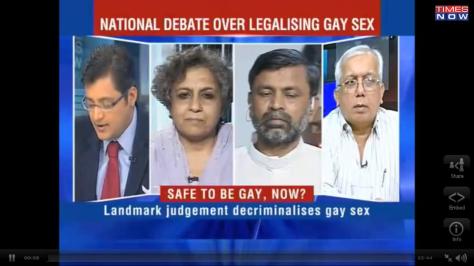
- ‘Debate,’ the Times Now way
Watching Times Now yesterday after the Delhi High Court ruling on Section 377, I was overcome by a growing sense of bewilderment. I could hear Dominic Emmanuel (Director of the Delhi Archdiocese of the Roman Catholic Church) and Kamal Farooqui (Chairman of the Delhi Minorities Commission), saying quite cearly and more than once, to my surprise, that they welcome the decriminalization of homosexuality, that homosexuals should not be treated as if they were criminals. Okay, correct that – I could barely hear these statements over the insistent, aggressive and disruptive interruptions of the anchor Arnab Goswami, who had obviously pre-set this “discussion” rigidly as a face-off between Reactionary Clerics/Minorities and Gay Rights Activists, while he himself was super hero, Anchorman. So each time they said “we welcome” etc., Anchorman would swoop in, bellowing, “So are you saying that they dont have rights, Sir, are you saying they should not have rights. Over to Anjali Gopalan (Naz) – Anjali, they say homosexuals should not have rights, what do you say?”
 KAFILA - COLLECTIVE EXPLORATIONS SINCE 2006