Category Archives: Capitalism

Democracy and the Politics Around NREGA: Ruchi Gupta

Guest post by RUCHI GUPTA

Subverting Democracy [1]

It took 47 days of a protest sit-in in Jaipur to make the State budge[2]. It’s notable that the objective of this protracted protest wasn’t to coerce the government for an extra share of State resources but to hold the government accountable to the Constitution and its own laws. The protest, “mazdoor haq satyagraha” was staged by workers employed under the National Rural Employment Guarantee Act (NREGA) to demand enforcement of their constitutional right to earn minimum wage. Even now after some initial encouraging signs, the matter seems to have stalled. Continue reading Democracy and the Politics Around NREGA: Ruchi Gupta

Contract Workers in IIT Kanpur: Raj Sahai

Link to full fact-finding report by RAJ SAHAI.

Link and background note below sent to us by AMIT SINGH.

[This follows the report by Rashmi Singh on the condition of contract workers in JNU – another institution of higher learning.]

Background

The practice of employing contract workers by IIT Kanpur started increasing at the expense of direct regular employees during the past two decades and presently the figure of the contingent workforce is estimated to be around 2,500. For its normal functioning, the Institute relies upon these contract workers not only for temporary construction works but also for perennial
works such as messing (food preparation, serving and cleaning of kitchen and dishes), civil maintenance, electrical maintenance, horticulture, sanitation and sewer cleaning. The Ministry of Labor and Employment, Government of India, views that inferior labor status, casual nature of employment, lack of job security and poor economic conditions are the major characteristics of contract labor.[1] These most vulnerable workers have been provided unequivocal legal protection by different laws, mainly,
Contract Labor (Regulation and Abolition) Act, 1970 [CL(R & A) Act, 1970], Minimum Wages Act, 1948 [MW Act, 1948], The Payment of Wages Act, 1936 [PW Act, 1936], Workmen Compensation Act & Apprentices Act 1961, and Inter-state Migrant Workmen Act, 1979 [ISMW Act, 1979].

Continue reading Contract Workers in IIT Kanpur: Raj Sahai

800 new Radia tapes!

It keeps getting better. The promise of more emperors losing their clothing, the promise of more political gossip and media wars and conspiracy theories. More light will be thrown at crony capitalism, sorry I mean economic growth. Outlook is putting out another 800 Radia tapes in the next few hours. There are a total of 5,000 and they’ve already put out 140.

Of those 140, some 36 yet to be transcribed.

Conditions of contract labourers in JNU: Rashmi Singh

This is a guest post by RASHMI SINGH. This article is based on the research conducted by the author on informal labour, for AMAN Trust.

The recently concluded Commonwealth Games have exposed the government’s contempt towards the working class in Delhi.Even though some sections of the media did highlight the terrible working conditions of the labourers, much of it got lost in the noise about corruption scandals and nationalist jingoism. In the aftermath of the games, the so-called fourth estate continues to focus its energies on the question of corruption, while everyone seems to have forgotten about the lakhs of construction workers who built the very edifice of the Games. Indeed, the dusty secrets of labour code violations during the Games have been relegated to just that – the dust of the city.

Continue reading Conditions of contract labourers in JNU: Rashmi Singh

The Media Barons and the Radia Tapes: Monobina Gupta

Guest post by MONOBINA GUPTA

The first formal discussion on the Radia-Media nexus by a section of top media professionals this Friday revealed the media’s general reluctance to put themselves through the same wringer of criticality that they so love to put others through. Barring Manu Joseph, editor of  Open Magazine, which put out in the public domain the tapes which had been lying  for days in the ‘safe’ custody of most media organizations, majority of the speakers argued that the controversy was not about Vir Sanghvi and Barkha Dutt; that there was no proof whether Sanghvi had actually written his ‘most read’ column as he had assured Nira Radia; that we do not know if Barkha Dutt had kept her word to Radia and passed on the message of the DMK’s internal dissensions to the Congress; that pressured by the minute-by-minute  demands of 24/7 TV channels, journalists have to make random promises (which they do not intend to honour!); that they have to play along with their sources to extract news etc. The list of extenuating circumstances offered by the media, now getting a taste of its own treatment, was quite revolting.

Continue reading The Media Barons and the Radia Tapes: Monobina Gupta

‘Editors as Powerbrokers’?: Vinitha Mokkil

Guest post by VINITHA MOKKIL

The good news first. On the morning of November 26, the Foundation for Media Professionals (an independent, not-for-profit organization) decided it was time to break the polite silence and hold a panel discussion on the topic, ‘Editors as Powerbrokers’ at the India International Centre (IIC), Delhi. The Nira Radia tapes, whose transcripts were first published by Open magazine a week ago, was the trigger for the discussion. The panelists included editors from prominent print and electronic media houses.

The auditorium was packed. Clearly, the nexus between the media, politicians and PR honchos, as revealed by the transcripts, had shocked people enough to bring them out of the comfort of their homes to the venue.

Continue reading ‘Editors as Powerbrokers’?: Vinitha Mokkil

25,000 Maheshwar dam oustees march in Madleshwar: Narmada Bachao Andolan

Thousands demand revoking of clearance and scrapping of dam

Press note from NBA

The Mandleshwar town resounded with the voices of 20,000 to 25,000 people (over 50% of them women) affected by the Maheshwar dam who marched through the town today, in defence of their rights despite the heavy rain, asking for rehabilitation and land, or scrapping of the dam. After marching through the main roads of Mandleshwar town, the oustees reached the Narmada River and after affirming and renewing their resolve to struggle against all odds, the people congregated in a huge public meeting at the local “Krishi Upaj mandi” in Mandleshwar. Continue reading 25,000 Maheshwar dam oustees march in Madleshwar: Narmada Bachao Andolan

Volunteers needed to transcribe all 104 Radia tapes

See Reading Radia

As you know, Open and Outlook magazines have put out legally taped telephone conversations of several people with lobbyist Niira Radia. Open put out only a few audios, and transcribed them all, where as Outlook put out a somewhat different set. However, Outlook was kind enough to put out all the audios they had on their website. There’s a lot of muck in there, and it’s not just about Barkha Dutt and Vir Sanghvi, it’s not just about the 2G scam. It’s very crucial that we transcribe ALL these tapes so that the words are on Google, se we can access the content of all tapes more easily. The media should have done this by now but the media is silent to save the skin of their own. So we need to become the media, you and I. Just 15 minutes of your time needed. To volunteer, please leave a comment on any post which says a volunteer is required to transcribe this one.

Thanks!


The Fuhrer Reacts to the Radia Tapes

Hope you’ve listened to all the Radia tapes?

If you haven’t, you’ve missed out on a lot. These five links lead you to all the phone calls, and you can even download them. This is history. The tapes are revelatory about the corporate media, but more than that, about the corporates. They have come out due to corporate wars. Internecine corporate wars seem to be our only hope for transparency and accountability in this nation. Please listen to every pause in every audio to for a clear insight into what today’s India is. And lament this Manmohan yug, ghor Manmohan yug. Also see Sevanti Ninan’s excellent analysis of the media black-out of the story.

Four transcripts that were submitted to the SC along with a total of eight recordings in May 2009 covering the cabinet formation, DMK politics and who’d get telecom portfolio
The conversations with M.Karunanidhi’s daughter M. Kanimozhi about keeping Dayanidhi Maran out from negotiations with the Congress and to get the telecom portfolio for A. Raja
In these Radia wants Sanghvi to tell the Congress not to negotiate with Dayanidhi Maran. He tells her that while he has been meeting Rahul and can’t “get into Sonia in the short term” he would “try and get through to Ahmed”
Recordings of conversations with the likes of Ratan Tata, Ranjan Bhattacharya, Barkha Dutt, Shankar Aiyar, Sunil Arora etc
The other big ‘national resource’ story involves the virtual who’s who: Ambani V/s Ambani V/s Tata, gas and power sector war involving big name journos, politicians, babus, corporates – this has the largest number of tapes, and perhaps the most important ones.

Before We Tape Our Mouths Forever…

It’s always better to begin with a caveat. Sets the tone, and prepares readers for what not to expect. I am one of those self-obsessed people who seldom see beyond their existence. I google my name twice a week, and inevitably find other people getting enriched when conversing with me. It’s an achievement if I could rescue their names from these conversations for my memory. So, you can imagine now my level of awareness.

But once in a while something gets my goat and then I start reading about it. One of those things has been the Nira Radia tapes recently. I first saw a mail from a friend in my inbox with the transcripts and links to the audio versions. I read the scripts and followed the audio links. It led me to more links. And soon I found it was all over the virtual world. First it was Nira Radia and Barkha Dutt, then Nira Radia and Vir Sanghvi, then Nira Radia and Ratan Tata, then Nira Radia and A. Raja, then… I don’t know what else is there. I was like what the f*#@? They just kept stumbling out. I thought Amar Singh was the most tapped guy but then I stopped following politics long back. I am told now that these days he doesn’t even make it to the 7th page. Continue reading Before We Tape Our Mouths Forever…

“Inside the networks of lobbyists and power brokers that dictate how this country is run”

This is explosive – you’ve heard of Niira Radia’s role in the 2G spectrum scam for months, and also that of two high profile journalists. Now, Open magazine has put out the phone transcripts, and even the audio, for all of us to listen in and know, as they put it, “how this country is run”. Many must have had the tapes with them for some time now, and god knows how many hundreds of hard disks have the CBI papers that made these allegations to begin with. But it takes courage to put this out.

For context, also read this profile of lobbyist Niira Radia, also in Open. Also see this April 2010 post from a media blog.

Revisiting Obama’s Visit: Suvrat Raju

Guest post by SUVRAT RAJU

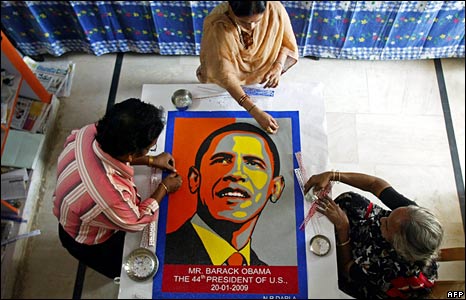
January 2009: Indian artist Darla Nageswara Rao (left) has used more than 33,000 coloured stickers on his portrait of Barack Obama. The work has taken 160 hours to complete.

Although the Indian media collectively swooned on President Obama, and breathlessly informed its audience about how many rooms he had booked at various five-star hotels, there was surprisingly little discussion on two key questions. What is Obama’s foreign policy record? Moreover, what impact will his visit have on most Indians?

Continue reading Revisiting Obama’s Visit: Suvrat Raju

Protesting FTII students write to Ambika Soni

Studnets at the Film and Television Institute of India, Pune, have been protesting against the commercialisation of India’s best known film school. In letters to the Union Information and Broadcasting Minister Ambika Soni, they write:

In the proposal, made by Hewitt at the behest of your ministry for the ‘up-gradation of FTII to international standards’, refers to FTII as a ‘brand’. What this company fails to understand that this ‘brand value’ it refers to has come into being because of the diploma films that the students of the ‘3 year subsidized course’ have made it in the last 50 years. The other ‘self sustained courses’ that exist today (with its self sustainence) exists and has any value, if at all, because of these 3 year diploma courses. Continue reading Protesting FTII students write to Ambika Soni

Greed-Kerala Express, Anyone?

The panchayat elections in Kerala are over and the dust has settled in the battle-field. In the past weeks, I have been repeatedly asked, why aren’t you writing something on the elections? Well, I told them, I have many failings but I do not suffer from Schadenfreude.

Continue reading Greed-Kerala Express, Anyone?

The Shock Doctrine

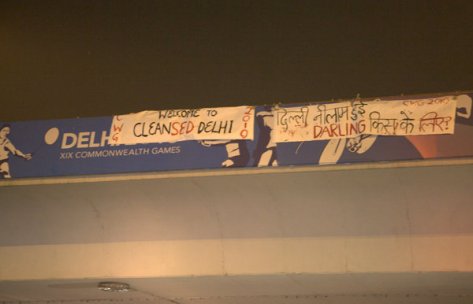
Seen in Delhi

Scorched by Blind-spots – Prabhat Babu and the CPI(M): Andaleeb Mondal

Guest post by ANDALEEB MONDAL

[Recently Prabhat Patnaik published an article “Dial M for modernity” in The Telegraph, about what is right about the CPI(M). This piece is a response to that article. There are some very elliptical Bengal-specific references in the piece that have been retained as they add to the flavour. AN]

The CPI(M) regime is alive in West Bengal and Kerala. As the numbers go, it could hardly be more alive in Bengal, its throbbing vitality being underscored by a now-famous comparison of assembly seats between the CPI(M) led Left Front and the principal opposition – “Amra 235, ora 35” ( We are 235, they are 35).This famous phrase was uttered by a self-proclaimed progressive writer with supreme empathy for toiling masses, who incidentally is the nephew of another writer-poet whose progressive credentials and dedication to people’s causes resonated in Bengal and beyond, without having the honour of being propped up by state sponsorship. Of course I am being snide and I do not intend to embark on a comparative literary analysis. To look for evidence of continuity among them is absurd – the filial accident being least of the reasons. However, conjuring up continuities do serve some purpose, occasionally.

Times shape people vice versa and such mutual shaping has always happened – sometimes imperceptibly, sometimes vigorously. They do bear the imprint of past times and ethos and hence in the absence of observable points of radical change, one may fall into the trap of assuming a kind of “historical” continuity. This idea of continuity can obfuscate continuous drifts in time. In the life of political organizations and ideologies , such feigned continuities primarily have a three-pronged way of self-maintainance. Let me call them – rituals, manifestos and lastly, for lack of a better epithet, kula-devatas ( clan deities). This permeates most political formations in the Indian landscape – the present discussion is about the CPI(M). However, a semblance of similarity in these Three Great cliches can be kept up.

Continue reading Scorched by Blind-spots – Prabhat Babu and the CPI(M): Andaleeb Mondal

A Twist in the Tale, Or, the New Copernican Revolution

Even as the rejection of Vedanta’s application to mine in Niyamgiri is being widely hailed as a victory for tribal rights, there is of course one set of very predictable voices, which has leapt in to start damage control for their corporate heroes. Thus one such cheerleader of Capital tells us that the ‘real twist’ in the script is that the ‘denial of bauxite mining in Niyamgiri’ can mean disaster for the future of a poor region and a poor state!

On the other hand, a statement by the Campaign for Survival and Dignity – a platform of tribal and forest dwellers’ organizations from all over the country has hailed the decision, arguing that: “The project’s main problem was that it violated the Forest Rights Act’s provisions requiring ‘recognition of habitat and community forest rights’ and the consent of the gram sabha prior to taking forest land. This sounds like technical legalisms. But the basic point is that, under the law, the Dongria Kondhs have the power to protect and manage their forests and lands. Simple, but unprecedented; it has never happened before.”

For our scribe however, the “really nuanced” stories of Niyamgiri are not those of the tribals and forest dwellers. They come from “the likes of Raju Sahu who came from Bihar to Kalahandi 10 years ago and runs four tea/food stalls on the state highway that links Lanjigarh – where Niyamgiri and the Vedanta factory are situated – to Bhawanipatna, the district HQ”.  Sahu apparently told our journalist-investigator that his business has more than trebled in the last four years since Vedanta started operations there. This is true for any big economic enterprise that gets set up – a large number of small businesses sprout up around it. There would be as many stories about poor people who benefited from the life that grew up around say, giant public sector units – the end of which is celebrated by these cheerleaders of Capital.  Will the perishing of those small businesses as a fall-out of the closure of PSU’s be accepted by our nuanced story-teller as a justification for the continuation of PSU’s? Never. For we know that there are always different standards for judging the merits of corporate marauders. You can tell even before you start reading a column by a Shekhar Gupta or a Tavleen Singh or a Saubhik Chakrabarti, what is coming – be it Niyamgiri, Bhopal and Union Carbide, the loot of the Commonwealth Games or the studied silence on matters relating to DIAL and GMR. And sometimes, just sometimes, we happen to know why…

Continue reading A Twist in the Tale, Or, the New Copernican Revolution

Socialism of the New Century: Sunil

Guest post by SUNIL

[Sunil is the national vice-president of Samajwadi Jan Parishad. This  article was written for a special issue of Janata weekly. The essay is an important statement from one of the leading activist-theorists of the socialist movement (i.e. non-Marxist socialism) which does not simply disavow the marxist legacy but engages with that experience as an essential component of socialist practice. AN]

The tussle between capitalism and socialism as alternative visions of human society is not yet over. It is like the old fable of the race between a hare and a tortoise. At times one seems to be the winner. At other times the other seems to be leading. Capitalism is like the hare of the story. It looks fast, impressive and dynamic but after some time it is tired and resting with its own contradictions. In the end, we know it is the tortoise of socialism which will prevail. But that end is yet to be arrived at.

Capitalism looked supreme and unchallengeable in the later decades of the past century. With the disintegration of USSR, reverting of China, Vietnam and many other communist countries to the path of capitalism, and downfall of social democracy in Europe, there was no challenge to capitalism. Thus ‘end of history’ was arrogantly announced. Market fundamentalism of Reagan and Thatcher varieties started ruling over the world. But soon many crises arrived. Ecological crisis with the dangers of climate change and global warming on the one hand, and the global financial crisis with the worst recession since the thirties on the other, shook the faith in the supremacy and immortality of capitalist civilization. Added to these were the growing crises of hunger, malnutrition, homelessness, violence and war. The number of hungry people in the world kept growing and crossed the figure of 100 cores in the first decade of the twenty first century i.e. every sixth person on the earth today remains underfed and starved. This is perhaps the biggest and the most glaring failure of capitalism. Even after more than two centuries of the industrial revolution and miraculous progress of science and technology, it is unable to fulfill even the most basic need of the humankind.

Continue reading Socialism of the New Century: Sunil

POSCO Pratirodh Sangram Samiti to Jairam Ramesh

This is a press release issued last week by PPSS, pointing out the illegalities   being committed by the Orissa government and the Central Ministry of Environment and Forests in connection with the POSCO project.

POSCO PRATIRODH SANGRAM SAMITI

Dhinkia, Nuagaon, Gadkujang; Jagatsinghpur District, Orissa

11.08.2010

To:

Shri Jairam Ramesh

Minister of Environment and Forests

Paryavaran Bhavan

New Delhi

Sub: Regarding POSCO project – need for withdrawal of illegal final clearance; new Meena Gupta Committee clearly aimed at delaying matters Continue reading POSCO Pratirodh Sangram Samiti to Jairam Ramesh