Category Archives: Centre watch

A civil-war is on the doorstep of India: Interview with Kancha Ilaiah by Mahmood Kooria

This is a guest post by Mahmood Kooria

We are publishing an English translation of an important interview of the intellectual and academic Kancha Ilaiah, conducted by Mahmood Kooria for the Malayalam weekly Mathrubhumi. While what I see as Professor Ilaiah’s underestimation and perhaps misreading of the historic role of the Communists in Indian politics leaves me severely uncomfortable, especially when he exonerates the right from commensurate charges of elitism, his framing of Hindustva and Modi’s appeal within the great stream of caste in the subcontinent is brilliant and thought-provoking, as always. 

Kooria conducted the interview as well as translated it in to English. His introduction is as follows, “At a time when there was no any such discussion, in 2002 Professor Kancha Ilaiah predicted that Narendra Modi will be the prime-ministerial candidate of Baratiya Janata Party. It has come true and now Modi is in the office. At this point, I talked with him at Moulana Azad Urdu University Hyderabad where he chairs the Centre for the Study of Social Exclusion and Inclusive Policy. In the conversation, he talked about the future of Modi government and he predicted that a civil war is going to break out in India if Modi does not cater the needs of backward classes. A Malayalam-version of this interview was published in the Mathrubhumi Illustrated Weekly (August 24, 2014).”

Mahmood Kooria: Ten years ago you wrote that Modi will be the prime ministerial candidate of BJP. What would be your response as your prediction has come true?

Kancha Ilaiah: Well, at that time I was predicting that based on the Left parties’ indifference to understand the caste question. The caste question is not been seriously taken by the Left parties. And, after Mandal, the BJP and the RSS wings started looking at caste-question seriously because when Babari Masjid was demolished they mobilized a lot of backward classes. Though they oppose Mandal reservation, they wanted the backward classes to be part of the Hindu religion. Around 1994, a non-Brahmin called Rajju Bhaiya became the Sarsanghchalak of the RSS. Then he recruited a large number of backward classes, large number of youth, and he promoted the people like Narendra Modi, Uma Bharati at that time. Earlier, the first backward-class chief minister of Uttar Pradesh was a BJP man: Kalyan Sing. He was the chief minister in 1992 when the Babri Masjid was demolished.

The Sangh Pariwar was responding to the backward class demands more. But the Left or the Congress was not responding to the OBCs. The Congress was responding to the Dalits and Muslims. There was upper caste all the time on the top. So, when Narendra Modi became the chief minister and this whole atmosphere was created, I was writing a column in The Hindu. I thought that this seems to be cause/course of India, since the Hindu religion is surviving because of the backward classes. It is inevitable for the Hindutva organizations that they will have to project an OBC for the prime-ministership. But there was resistance from within itself. It is not that the Brahmins have given up the principle of varna-dharma. After that article came and of course after my writing Why I am not a Hindu itself, the backward classes even within RSS seemed to use that material for their advantage. The communists did not use or recognize it. The question of labour and caste which I have been consistently raising, which was also part of their theory, they did not care about. So the Communist Party remained tightly under the control of upper castes.

Continue reading A civil-war is on the doorstep of India: Interview with Kancha Ilaiah by Mahmood Kooria

Reading the Debate on the Planning Commission

I find it hard to think through the current debate on the Planning Commission (PC) outside a few things. The first is a clear centralisation of power at and within the PMO which I cannot help but be alarmed by. It’s all well and good when the decisions are those you agree with and all to easy to forget what centralisation does in the hands of, let’s please not forget so easily, a man whose IMHO has no H.

Its faults are easy to list but the PC (when it worked) did remain a space for thinking through a centre-state relationship and a development vision outside the government. It was a moment of articulation of intent with an (albeit diminishing) ability to put some weight behind it. I can’t quite bring myself to defend it because of what it refused to become in the more recent years, and the fights it refused to fight, but the need for such an autonomous voice remains. I don’t believe this new body will be anything other than a rubber stamp for a deeply authoritative PMO. In that, I am cautious of what will come. And by cautious, I mostly mean afraid.

Continue reading Reading the Debate on the Planning Commission

If Gail Omvedt is Katherine Mayo, then Sugatha Kumari is …? Thoughts on Salman’s Predicaments

Salman Zalman is a young man from Kerala who has recently been arrested for an alleged act of disrespect towards the Indian National Anthem. As an observer in Kerala, I think young people like him who choose to get involved in public struggles for justice face a number of predicaments that were perhaps not so severe for my generation when we were young. For this reason, I do feel that members of my generation, those of us alive to public issues, need to be more open to the challenges that public-minded younger people face today. Continue reading If Gail Omvedt is Katherine Mayo, then Sugatha Kumari is …? Thoughts on Salman’s Predicaments

Creeping Dictatorship: Concerns from Kerala

Guest post by THUSHAR NIRMAL SARATHY

 Are we living in a democratic dictatorship? ‘Democratic dictatorship’ is a much debated concept in Kerala.  I am referring not to that here but to the dictatorship of the executive led by democratically-elected politicians. Recent incidents seem to indicate that this is now an ever-growing tendency in our democracy.

A few months back, a notice with the photos of well-known public figures, which identified them as Maoists, appeared in the Mananthavady police station at Wayanad.  These were pictures of senior, very well-known activists who have fought battles for democracy in Kerala.  Following widespread protests, the police was forced to remove the notice. On 28th July this year, Jonathan Baud, a Swiss citizen was arrested by Valappad police for attending a commemoration meeting of a Maoist leader, Sinoj, who died in an accidental explosion at the forested Kerala- Karnataka border. Mr Baud was in India on a tourist visa. His arrest was big news in the media which had happily swallowed policespeak, and so he was also projected as a Maoist. The reports claimed that he had come here with the express purpose of attending the meeting, and that he delivered a solidarity speech there. Later, when the Commemoration Committee made public its own version of events, the police sensationalism was refuted and had to be withdrawn. The charge against Mr Baud are apparently limited to violation of visa conditions and it was admitted that he had no Maoist links. Continue reading Creeping Dictatorship: Concerns from Kerala

The Anatomy of a Massacre: The Mass Killings at Sailan, August 1998

This was sent to us by Shrimoyee Nandini Ghosh

front cover_final

On the night of 3-4 August 1998, 19 people including 11 children ranging in age from about 4 to 15 years old, and 5 women (including one woman in an advanced state of pregnancy) were shot at point blank range in their homes in Sailan, in the highly militarized ‘border district’ of Poonch, which is divided by the Line of Control between Pakistani and Indian Administered Kashmir. The bodies were thereafter mutilated with axes and sharp instruments. A total of thirteen female and six male members of three closely related families were killed by personnel of 9 Paratroopers, Indian army, and ‘SPOs’ (Special Police Officers) armed state back local operatives recruited to the police and affiliated to the 9 Para Army Camp. The police establishment was involved with attempting to bury the dead clandestinely, registration of a fabricated FIR, destruction of evidence, and the criminal cover up of the case. The Anatomy of a Massacre recounts the dismembered and silenced history of the Sailan Massacre through voices of family members, eye witnesses, local residents and the analysis of court, police and Right to Information documents. The legal and oral histories of Sailan illustrate how the Indian occupation of Jammu and Kashmir is made real, not just through the control of physical territory, but by deep social penetration, acts of spectacular violence and collective terrorisation, and the active collaboration of all state institutions in the illusion of legal procedures and rule of law. The Report is part of the struggle of all victims of human rights violations in Jammu and Kashmir, to articulate their demands for truth and justice in their own words, when the very language to speak of the truth has been rendered anti-national, and therefore unspeakable. It commemorates the lives lost in the massacre at Sailan, and is dedicated to them, on the anniversary of their untimely deaths.

Read the statement about the release of the report in Srinagar, by JKCCS and the Survivors of the Sailan Massacres as well as the full text of the report here.

Need to re-enact Juvenile Justice Act – Myths and Realities: Kishore

This is a guest post by KISHORE

In a significant move, the Ministry of Women and Child Development has decided to repeal and re-enact Juvenile Justice (Care and Protection of Children) Act 2000. Along with its claims to streamline adoption and foster care procedures, it also proposes that juveniles above 16 years of age involved in heinous crimes should be tried as adults under the Indian Penal Code.

This is not first time that such an amendment has been advocated. One senior leader of ruling party had already gone to the Supreme Court last year with a petition for lowering the age under the law. However his petition was refused and the Supreme Court opined that there was no need for amendment as the present law (JJ act 2000) holds constitutional validity. Now this leader’s party is in power and they do not need to go to the judiciary for changes as they themselves can do it in Parliament. It is also believed that the government is not even waiting for the report of the expert committee appointed by the Law Commission of India to examine the issue. The proposal however, has always been contested by the premier child rights body NCPCR, which said there cannot be any “compromise” on the age of a child as defined by the UN and in other international conventions. We wonder if the governments’ desperation to change the law is based on popular “sentiments” and not on “facts”. Continue reading Need to re-enact Juvenile Justice Act – Myths and Realities: Kishore

(How) Does the Sovereign Speak?: Akshaya Kumar

This is a guest post by Akshaya Kumar

In a recent piece, entitled The Modi Wave, I analyzed the orientations of the Modi campaign, and argued that crucial to Modi’s repackaging was his ‘sovereignty effect’. In this case, entirely a property of the media narratives that pitched Narendra Modi as someone from outside history, he was offered as an intervention into national history. I have suggested that this was a masterstroke to the extent that the subject within history has a compromised agency. The continuities – of forces, events, rationales and time as a whole – blunt the provenance of the outsider. In order for the subject to act upon history, he must stand entirely outside it. In this way, he cannot be accessed from within historical time. Modi not only offered a historical narrative of an unending Congress rule, infested with corruption, appeasement and misrule, but also that of him observing this lingering malady from outside the fence. His story of his own rise goes from being a tea-seller to the Chief Minister of Gujarat, from a not-yet to a fully sovereign. He is never a deputy, never a peg within the system; he suffers till his agency is still being shaped, and appears as already the incumbent. This fundamental separation from the substance of historical progression is needed to project oneself as unsullied, unlike those defiled by the their political existence within history.

Continue reading (How) Does the Sovereign Speak?: Akshaya Kumar

Whose Ambivalence – Modi’s or Varshney’s? Jyoti Punwani

Guest post by JYOTI PUNWANI

What is it about Narendra Modi that makes people suspend disbelief? Ashutosh Varshney in his Modi’s Ambivalence, Indian Express, June 28, actually considers it possible that the new Prime Minister has a chance of going  down as “one of the greatest leaders of independent India”.  Surely anyone qualifying for such a status must be acceptable to the majority of Indians? Last we heard, the magic of Modi had left almost two-thirds of the electorate untouched, not to forget the fact that he doesn’t exactly inspire respect among our largest minority.

Varshney makes some bewildering assertions in his evaluation of Modi’s first month as PM. From a “novel policy language for poverty alleviation”  to a new acceptance of Mahatma Gandhi as the Father of the Nation,  to his RSS-defying portfolio distribution,  Varshney sees signs of a new Modi, quite different from the man cursed forever with the burden of Gujarat 2002.

Continue reading Whose Ambivalence – Modi’s or Varshney’s? Jyoti Punwani

Collective struggle strengthens autonomy: Saroj Giri

Guest post by SAROJ GIRI, continuing the discussion on roll-back of FYUP in Delhi University. 

Earlier posts on this issue are listed and linked to here.

Here is one way to make sense of the core issue at stake in Delhi University today – this piece by Nandini Sundar arguing that the UGC directive amounts to hampering institutional autonomy of DU.

But this is a flawed position in the present context. It conflates the autonomy of DU with the autonomy of the VC. It construes DU’s autonomy in narrow institutional terms, overlooking the larger movement of teachers and students which is also ‘DU’ and which has consistently opposed the FYUP.

Sundar suggests withdrawal of the UGC directive, the setting up of a DU committee to overhaul the programme, and deliberation in the Academic Council, this time taking proper heed of anti-FYUP views. But do we need a fresh round of discussion on the pros and cons of FYUP?

Absolutely not. For there have been tons of deliberations over the FYUP. Just go back to the minutes and records of the many different meetings and Committees, or recall the many demos and dharnas. There is ample evidence of deliberation where the members of the University have given sound reasons why the FYUP is bad.

Indeed, the picture presented that it is the Ministry or the UGC imposing its diktat from above is simply not true. It is not some committee in the UGC or Ministry which on their own have decided to stall the FYUP. For it is force of the movement against FYUP and the many, many voices active since the last few years who have prevailed now – it is this which is reflected in the UGC directive. Continue reading Collective struggle strengthens autonomy: Saroj Giri

Autonomy for what, from whom, and for whom?

It seems the unthinkable has happened – the Vice Chancellor of Delhi University has resigned over the UGC’s pressure to withdraw the Four-Year Undergraduate Programme (FYUP). I won’t go into the debate on the FYUP, which has been covered extensively on Kafila and elsewhere [1]. See particularly this post by Professors at the University. I am only interested in two issues that arise from the news coverage of the event as it has unfolded through the day.

One, the question of autonomy. Prima facie, as Apoorvanand and Satish Deshpande have argued comprehensively on Kafila, the resignation of a VC over pressure from the UGC seems to be evidence of bureaucratic or ministerial over-reach. Questions have been raised (rightly) over the timing of this pressure, coming as it does on the heels of a political shift of colossal proportions at the national level. It doesn’t take a rocket scientist (I find myself in agreement with Congress spokesperson Manish Tewari’s language on this) to figure out that the change in Delhi University has political backing. For one, rollback of the FYUP was on the BJP’s agenda/manifesto – that is as political as it gets! Second, it was this very UGC that had been so coy about commenting on the FYUP for the past one and a half years, a coyness that amounted to tacit support. Only very recently had it moved its mammoth bureaucratic feet on the matter, constituting a committee to look into complaints from students and teachers that had finally reached its mammoth bureaucratic ears. The VC, being well acquainted with elephants, would be able to explain the mammoth temporality of this apex organisation better than any of us, having benefited from it for a goodly amount of time. Even after the constitution of the committee, the VC continued to be lauded by the UGC for his efforts at implementation of former HRD minister Kapil Sibal and his successor Pallam Raju’s efforts at radical educational reform. The committee met at a leisurely pace, no doubt fortified by several hundred samosas and robust air-conditioning in the UGC’s Bahadur Shah Zafar Marg office in central Delhi, while anti-FYUP protestors enjoyed the blazing sun or freezing cold outdoors, as they had been enjoying for a year and a half.

Continue reading Autonomy for what, from whom, and for whom?

A Renegade’s People: Rupam Sindhu Kalita

This is a guest post by Rupam Sindhu Kalita

What unites anti-homophobia campaigners, defenders of the poor’s right to clean water, university student collectives, women rights’ groups and academics under a premature summer sun in New Delhi on the 30th of March earlier this year? It is the unacceptable means employed by the Indian state in response to armed rebellions in North east India and the threat to civilian life that it has precipitated. The contagion of a military approach to a largely political problem was promulgated as an ordinance in 1958 under the presidency of Dr Rajendra Prasad to help quell the Naga movement and was developed into the Armed Forces Special Powers Act (Assam and Nagaland) later in the same year. The Armed Forces Special Powers Act (from here on AFSPA) persists in violating human rights in Kashmir and North east India despite its incompatibility with national and international human rights declarations. Over the years this Act has been sanctified in the inner sanctum of India’s centralised quasi-military administration. The government has been extremely guarded in its approach to growing popular demands for annulling this Act. The civil leadership’s reluctance to temper with the ritualized provisions of this Act has raised the disquieting question of who runs the country.

On 30th March central Delhi woke up to a motley group of protestors unified by a concern for violation of human rights under AFSPA. [Photo credit: V Arun Kumar].

Continue reading A Renegade’s People: Rupam Sindhu Kalita

All Is Not Well at AUD: Natasha Narwal

Guest post by NATASHA NARWAL

Ambedkar University Delhi, a recently established State University in the NCR, has become the new buzz in the academic circles of the Capital. It is seen as space full of creative opportunities by an academic community exhausted by bureaucratic regimes and the sheer weight of established institutions stifling any real creativity and innovations in most central Universities. In a recent article in Economic and Political Weekly, Janaki Nair described AUD as a ‘viable, vibrant space of thinking and learning, striving to provide affordable and yet sustainable fee structures and encouraging creativity and non-hierarchical structures of learning.’ To be fair, such perceptions are not entirely baseless. As it is a recently established University, almost everything, from the various schools, courses, syllabus even physical infrastructure is in the making without very rigid contours. All this gives one a sense of an innovative and fluid space. Many of the faculty members indeed do strive hard to design courses in consultation with students and give them space to express themselves. But beneath this, on the grounds, all is not well at AUD. Continue reading All Is Not Well at AUD: Natasha Narwal

A Chronicle of an Event Foretold? Sankaran Krishna

Guest Post by SANKARAN KRISHNA 

As journalists, academics and other pundits scramble to make sense of the just concluded elections to the Indian parliament, one can discern a few broad strands of opinion. One group – lets call them the Optimists – point to India’s almost seven-decades long experiment with electoral democracy and aver that we have the institutional strength and resilience in civil society to keep Prime Minister Narendra Modi and his Bharatiya Janata Party confined to a moderate middle that will be, ultimately, not very different from other regimes (single-party or coalition) that have ruled from Delhi. Prominent voices among the Optimists are Ashutosh Varshney, Ram Guha and Pratap Bhanu Mehta.

A second group – lets call them the Alarmists- see the BJP’s clear parliamentary majority (albeit arising from a mere 31% of the popular vote) as inaugurating an era of unapologetic Hindu majoritarianism that could severely strain and irreparably damage the plural fabric of Indian society. They are especially concerned about the fate of the Muslim minority and regard the 2002 pogrom in Gujarat as a foretaste of things to come.  The Alarmists range across activists like the late Asghar Ali Engineer, politicos like Mani Shankar Aiyar and intellectuals such as Akeel Bilgrami.  Continue reading A Chronicle of an Event Foretold? Sankaran Krishna

Queer Eye for Narendra bhai – Affect, Memory, and Politics in Desperate Times: Pronoy Rai

This is a guest post by Pronoy Rai

There is something awfully nostalgic about May 16. The election results brought with them a sense of melancholy-laden déjà vu. For the queers and allies on the political Left, the sinking feeling that May 16 brought with it, was reminiscent of yet another day, December 11, 2013; the day the Indian Supreme Court reversed the decision of the Delhi High Court decriminalizing homosexuality in India. It was once again criminal to be gay in India; once again the legal State apparatus had rendered queer bodies vulnerable to violence, from the State and from the political Right. There was a sense of desperation and disheartening injustice; what avenues remained to be sought when the country’s highest courts had us disappointed?

The Rashtriya Swayamsevak Sangh (RSS) and the Bharatiya Janata Party (BJP) had vehemently welcomed the Supreme Court judgment then, but our incoming Prime Minister, Narendra Modi, remained silent. It was perhaps too trivial an issue for him to address; when were rights anyway a matter of importance for him? If the indigenous people and forest dwellers of Gujarat could make the Indian mass media listen to them, they would tell us the story of Gujarat’s abysmal performance in settling land claims and distributing title deeds. Rights, especially of the fragments, are a roadblock for the Modi-style Development machine.

Continue reading Queer Eye for Narendra bhai – Affect, Memory, and Politics in Desperate Times: Pronoy Rai

Shazia Ilmi – Why Her Exit is Such a Blow: Jyoti Punwani

Guest post by JYOTI PUNWANI

Shazia Ilmi’s exit marks a real blow for AAP supporters. Her frequent TV appearances as AAP spokesperson made her out to be an articulate, confident woman who didn’t need to assert her religious identity to prove a point, which is a rare thing in today’s politics. Her participation in the Anna andolan was as much a pointer to its inclusive nature as it was to the emergence of a new kind of Muslim in public life: one who had no hesitation plunging into a mass movement which had strong nationalist overtones, was avowedly against the political system and had little to do with minority concerns.

When Shazia almost won from Delhi’s R K Puram constituency, it suddenly came home – for the first time in years, a Muslim candidate had been fielded from a Hindu-dominated constituency, and the Hindus had voted for her. In Mumbai, a Muslim political activist who’s friendly with every political party, has for long told Shiv Sena leaders that the moment they field a Muslim from any of their strongholds, he would join them. “The ability to take the other community along, that’s the test of a secular politician,’’   a senior Congress Muslim in Nanded  told me, rueing the fact that Muslims who could do this were ignored by his leader Ashok Chavan (one of the two Congressmen to win in the state this time). Continue reading Shazia Ilmi – Why Her Exit is Such a Blow: Jyoti Punwani

Dead Men (of Gujarat) Tell No Tales: Madhumita Dutta and Jagdish Patel

Guest Post by  MADHUMITA DUTTA AND JAGDISH PATEL 

Amidst a plethora of articles published, trying to explain Mr Narendra Modi’s nation-wide popularity leading to BJP’s eventual electoral win in the 2014 parliamentary elections, a column by Mr Swaminathan S Anklesaria Aiyar in Times of India caught our attention. In his usual style, exuding confidence, Mr Aiyar attributed Mr Modi’s victory in states like Uttar Pradesh and Bihar to “the message carried home by migrant workers in Gujarat”

Apparently Mr Aiyar found his “biggest, credible explanation” (for Modi’s win) while on a pre-election tour in these states where he quizzed the villagers about Modi. Villagers who were otherwise skeptical of the “vultures who came around promising the moon at election time” were swayed by the ‘tales of good governance’ that migrant workers brought home from Gujarat.

While Mr Aiyar doesn’t explain what these ‘tales’ are since he confesses that these are ‘not very detailed or specific’, one wonders who are these migrant workers that Mr Aiyar refers to?  And might it be possible that there are other ‘tales’ that are never fully told by the workers when they come visiting families after long periods of time? Continue reading Dead Men (of Gujarat) Tell No Tales: Madhumita Dutta and Jagdish Patel

So Who Has Won the Election?

The sweep is certainly breathtaking. Way beyond what most surveys and exit polls predicted. To be sure, our commitment to the democratic spirit demands that we recognize the mandate for what it is – at least on the face of it. And on the face of it, it is a triumph of the Modi-led BJP. Behind it, of course, lies the organizational machinery of the RSS and its familial organizations.

However, it will be a mistake to think that the election was fought and won by any of these outfits. From 1998 onward, the BJP, backed by the same RSS parivar, has continuously registered a decline in vote share, irrespective of whether it was in power or out of it. From 25.6 percent in 1998, it declined to 22.2 percent in 2004 and further to 18.8 percent in 2009. The presence of younger people in RSS shakhas too has been significantly on the decline in this period and in particular, after 2004. In period of the run-up to the elections, the BJP was a ramshackle and directionless party – its top leaders like LK Advani and Jaswant Singh disgraced and then brought back; Atal Behari Vajpayee knocked out of action for quite some time by then and practically all state units riven with internal dissension. As a consequence, it was also a party therefore, with completely demoralized ranks.

How then did the change come about? As long as our eyes remain fixed on the supposedly ‘political’ domain, we are unlikely to be able to see what exactly has been going on. The fact of the matter is that Narendra Modi was neither BJP’s candidate of choice nor that of the RSS. This election was fought by the corporate sector directly, along with the Big Media – the surrogates of the corporate sector. The plan to set up Modi was put in place by these players. And in this process, the emergence of the Big Media as a full-fledged propaganda machine of Modi’s constitutes a significant moment. It is a moment that actually awaits a more detailed study of how exactly the game plan was put into operation but one thing can be said right away. What brought about this result was not just the machinery of the Sangh parivar but the mobilization of a whole range of opinion makers to serve what was to be a clearly Hindutva framed political formation. Most of these intellectuals and opinion-makers are economically right-wing (neoliberal fundamentalists) although not Hindu-communal, but while they do not seriously believe that Modi has shed his Hindutva skin, they are prepared to join the propagation of lies, lies and lies in the service of corporate capital, disguised as the ‘greater good of humanity’. Continue reading So Who Has Won the Election?

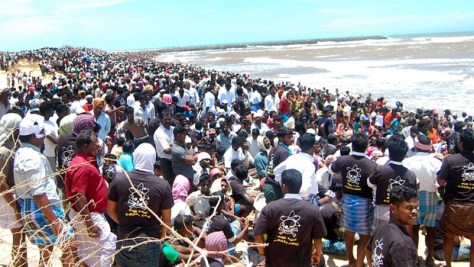
Accident at Koodankulan Nuclear Reactor, at least 6 Injured

An Urgent Alert has been posted by NITYANAND JAYARAMAN in DiaNuke.org on an accident that occurred in Koodankulan sometime in the afternoon today.

Koodankulan protest, courtesy New Indian Express

After initially flashing news about the incident, the media is now reportedly playing NPCIL’s statements denying and downplaying the incident. If NPCIL’s past record is anything to go by, truth will be a while in coming. Dr. APJ Abdul Kalam was unavailable for comment.

Today’s accident comes less than a week after the Honourable Supreme Court ruled that it was satisfied with the safety features installed at the plant. Read the rest of the report here.

Koodankulan protest 2, image courtesy The Hindu

We have reported earlier in Kafila on the ongoing struggle of the local people against the establishment of the nuclear reactor in Koodankulan here, here and here.

The UAPA in Madhya Pradesh – The JTSA Report in Perspective, and Beyond: Sharib Ali

Guest Post by SHARIB ALI

REPEAL UAPA: JTSA REPORT IN PERSPECTIVE, AND BEYOND

The state fabricates terror. There is enough evidence to take it to court on that count. Yet, how does one construe ‘fabrication’- what is implied by it? First, that the state has orchestrated elaborate attacks- violence to terrorize its people for certain legal, electoral and political ends. Second, that it has, through the use of laws like Unlawful Activities Prevention Act (UAPA)  against specific segments of its population has consciously manufactured a state of terror- a collectively imagined perception of threat that the nation faces from a particular people. The ends, always remain the same.

Though there is evidence of the agencies of the state, or actors within them, expressly participating in orchestrating large scale terror attacks (think col. Purohit), it is the latter- where terror within specific communities is manufactured in the eyes of the law and the people- that I deal with here, today. ‘Guilt by Association’The JTSA (Jamia Teachers Solidarity Association) report on UAPA cases in Madhya Pradesh, is a crucial case in point.

Continue reading The UAPA in Madhya Pradesh – The JTSA Report in Perspective, and Beyond: Sharib Ali

भगाणा कांड के पीड़ितों ने इंसाफ की मांग की: भगाणा कांड संघर्ष समिति

Press statement issued by the BHAGANA KAAND SANGHARSH SAMITI in New Delhi, 11 May 2014


Latthmar Mahila Sena
A call for direct action – an armed women’s squad – Latthmar Mahila Sena

हरियाणा के भगाणा गांव में सामूहिक बलात्कार की शिकार हुई चार नाबालिगों के हक में न्याय की मांग के समर्थन में आज पीड़ितोंके साथ भारी संख्या में दिल्ली के सामाजिक कार्यकता, बुद्धिजीवी और विद्यार्थी भी जुटे। यहां दिल्ली में पंत मार्ग पर स्थित हरियाणा के मुख्यमंत्रीआवास पर धरना देते हुए आंदोलनकारियों ने पीड़ितों के प्रति हरियाणा सरकार के रवैए की तीखी आलोचना की और कहा कि ऐसा लगता है कि हरियाणा सरकार सामंती उत्पीड़नकर्ताओं के पक्ष में खड़ी हो गई है और दलितों-पीड़ितों की आवाज को जानबूझ कर दफन किया जा रहा है।

बड़े पैमाने पर जुटेलोगों ने यहां दिल्ली में सरकार और प्रशासन से यह मांग की कि पीड़ितों पर जुल्म ढाने वाले दोषियों को  सख्त सजा दी जाए और फास्ट ट्रैक अदालतों का गठन कर पीड़ितों को जल्द से जल्द इंसाफ दिलाई जाए। Continue reading भगाणा कांड के पीड़ितों ने इंसाफ की मांग की: भगाणा कांड संघर्ष समिति

There’s a G on my Neck (again): Simran Kaur

Guest post by SIMRAN KAUR

Shekhar Gupta is at it again: lacing an insidious agenda with just enough actual facts that even the targets of his vitriol become eager to swallow. Aspiring Indian Journos, this is how a good Sardar Joke—and while you are at it, jibe at the poor, the rural, the unemployed, the mourning—is done, while earning your paycheck yet again as an esteemed Editor-in-Chief, at best with head-in-clouds, at worst, a stake-in-oppression.

Shekhar G’s latest thesis: The rest of the country has moved on but Punjab has become a prisoner of its boisterous old stereotype. It has forgotten its entrepreneurial energy, its competitive spirit and slipped into a complacent, decadent trance of perpetual balle-balle.

His first argument for the thesis of Punjab’s decline: “the Punjabification”…of Punjab. He bemoans that signs and posts are in Punjabi, in Punjab.

The 50s and 60s saw Punjabi Hindus becoming the unique community to denounce their own mother-tongue. Upping the ante, G. ridicules Punjabis who use Gurmukhi, the script developed in the time of the Sikh Gurus. He finds tell-tale signs over Punjab (he notes his fieldwork of actually travelling on the Grand Trunk Road and flying over Punjab by helicopter recently) of the people being un-couth:  signage on Punjabi establishments, in poor English.

You will take a minute figuring out what the “burgars” and “nudles” painted on so many fast-food shops mean, or why Lily is always spelt “Lilly”, whether it be the name of a restaurant in Phagwara or a beauty parlour in Bathinda…If you haven’t figured out already that this, indeed, is Singh’s English.

Brilliant two-birds strike, Shekhar G. Continue reading There’s a G on my Neck (again): Simran Kaur