Democracy Dialogues Series 32
Theme : ‘Decoding the Verdict’
Continue reading ‘Decoding the Verdict’ : Prof Zoya Hasan and Dr Ajay Gudavarthy
Democracy Dialogues Series 32
Theme : ‘Decoding the Verdict’
Continue reading ‘Decoding the Verdict’ : Prof Zoya Hasan and Dr Ajay GudavarthyThe model of vigilante justice, i.e, bulldozer politics, by the State itself is a phenomenon that has gained fresh legitimacy during the past decade under Modi.

“Under what law can they demolish a house for an offence that hasn’t been proved?”
..police cannot, “under the guise of investigation”, bulldoze anyone’s house without permission, and if such practices continue then “nobody is safe in this country” ..: “Show me from any criminal jurisprudence that for investigating the crime, the police, without any order, can uproot a person, apply a bulldozer. .”
There are interventions of courts which are considered to be ‘breaking new grounds’.
The Gauhati High Court’s judgement in the ‘illegal demolitions’ at Salonabari (May 2022) was one such occasion.
The two-judge bench of the high court led by Chief Justice RM Chhaya and Justice Soumitra Saikia had come down heavily on the demolitions executed without following any procedure and declared such actions ‘illegal’ and compared the police actions akin to a ‘gang war’ and ordered compensation to the victims as well as actions against guilty officials.
Two years later, this issue was again before high courts recently, as the affected families had approached it for the government’s dilly dallying on compensation and actions against officials.
Much water has flown down the Brahmaputra and its tributary rivers during this period. ( Read the full article here : https://www.newsclick.in/when-state-breaks-its-own-laws)

Democracy Dialogues Lecture 31 :
Speaker:
Dr Parakala Prabhakar
Author, economist and public intellectual
Theme :
The Political Economy of New India
Time :
6 PM (IST), Sunday, 26 th May 2024
Join Zoom Meeting
https://us02web.zoom.us/j/85326195073?pwd=UE4yeGxaU1RLWkhJMWZTTG1aamZIZz09
Meeting ID: 853 2619 5073
Passcode: 134090
The lecture will also be livestreamed on facebook : facebook.com/newsocialistinitiative.nsi
About the Speaker and His Talk :
Dr. Parakala Prabhakar, is an author, economist, and public intellectual.
He served as Communications Advisor, held a cabinet rank position in Andhra Pradesh Government between July 2014 and June 2018. He was also a former spokesman and one of the founding general secretaries of Praja Rajyam Party.
For several years he presented a current affairs discussion programme on television channels of Andhra Pradesh. His programmes included Pratidhwani on ETV2 and Namaste Andhra Pradesh on NTV .
His book of essays ‘The Crooked Timber of New India : Essays on a Republic in Crisis‘ was widely discussed.
Dr Parakala completed his doctorate from the London School of Economics. He did his Master of Arts (M.A.) and Master of Philosophy (M.Phil.) from Jawaharlal Nehru University (JNU), New Delhi.
About the Talk :
Relentless in exposing the sinister nature of the communal politics of the current ruling dispensation and meticulous in exposing the voodoo economic policies pursued by them which are disastrous to the Indian economy, Dr Parakala Prabhakar is going to speak on ‘The Political Economy of New India’ in this lecture.

..‘Agnipath’ Still Simmers ..
‘The anger and anxieties over ‘Agnipath’ scheme – have not died down.
Gone is the period of open protests by youth and students and other ordinary people which rocked when the scheme was hastily announced (June 2022).
It does not mean that the youth are now happy about this scheme.
In an ambience of rising unemployment how is it possible to be happy about the fact that “[d]ue to the implementation of the Agniveer scheme, around 1.5 lakh candidates selected for the Indian Army, Air Force and Navy between 2019 and 2022 were allegedly denied joining.( 2)and all future possibilities of such an employment being closed forever.
Anyone who is keen to know how Agnipath has literally ‘destroyed’ thousands of jobs in military can take a tour of Kuchman City in Nagour ( Rajasthan) once a hub of more than 200 defence coaching academies preparing students from Rajasthan, Haryana and neighbouring parts of Western UP for entrance exams in Military..
…The anger and discontent of the Youth will continue to harm the ruling dispensation – whatever gloss they try to apply over the scheme.
( Read the complete article here : https://countercurrents.org/2024/04/what-is-stopping-the-government-from-scrapping-the-agnipath-scheme/)
How BJP dreams to Usher In Hindu Rashtra Democratically ?
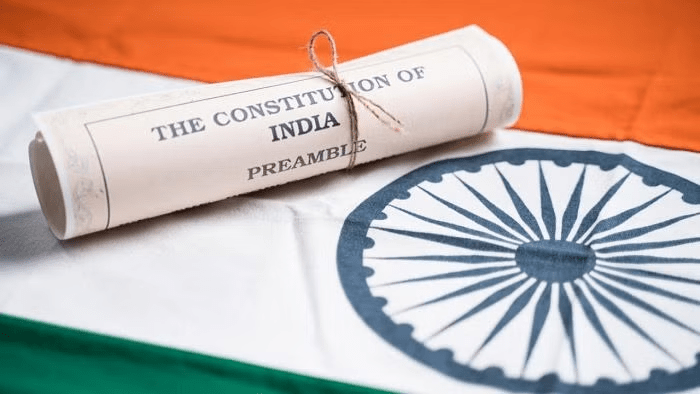
Representative image. Credit: iStock Photo( courtesy Deccan Herald)
Anantkumar Hegde, BJP MP from Uttari Karnataka, is again in the news.
Close on the heels of his controversial statement about demolition of a mosque and his invoking of Hindu community who would not rest ‘until more mosques are reclaimed ‘ (1) he has delivered another explosive statement.
This time the whole edifice of Constitution is under his attack, which according to him has ‘distortions introduced by the Congress to suppress Hindu society’. (2) ..
..Critics have rightly said how this suggestion exhibits real intentions of the saffron regime which wants to usher us into Hindu Rashtra, end reservation for scheduled and backward communities, reinforce caste system and also replace Constitution drafted by Dr Ambedkar with a worldview inspired by Manusmriti. The main opposition party Congress has expressed fear that all such statements, steps just go to vindicate how a ‘cloud of dictatorship’ now hovers over India. (3)
It is a different matter that neither BJP top guns nor PM Modi – who had famously declared way back in 2014 that for him ‘Constitution is the most sacred book’ deemed it important to condemn Hegde’s statements or ordered him to seek apology for his claim.
One learns that it has merely distanced itself from Hegde’s controversial statement to convey an impression that what he said was his ‘Mann ki Baat’ and not BJP’s Dil ki Baat’ .
Whether Modi will get a third term in 2024 or these elections can spring a surprise?

India at the beginning of the year stands at the cusp of a Momentous Change
The biggest question before everyone is whether the elections for the Parliament – the lower house – which will be over by end of May ( if they are not advanced by the ruling dispensation) would be able to disturb the stranglehold of the BJP-RSS over the levers of power at the Centre, whether it will lead to loosening of sorts of the grip it holds over the various institutions of Democracy ( critics even call that they have been subverted, weaponised) or it will slide the Indian Democracy further into the electoral autocracy mode much to the chagrin of well wishers of democracy everywhere.
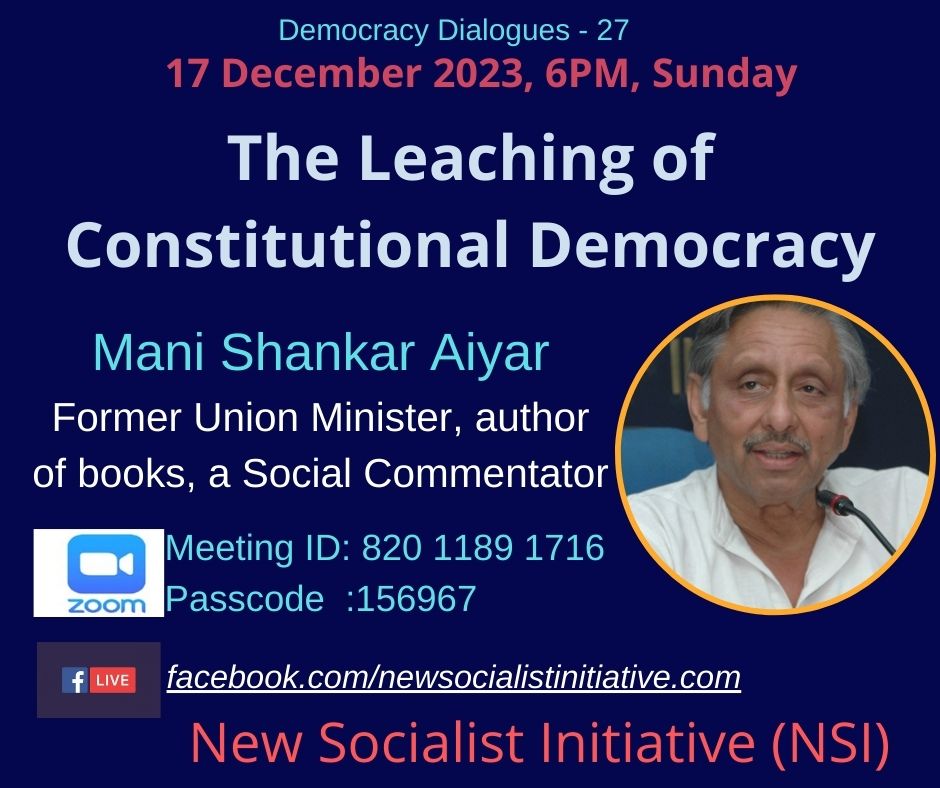
Mr Mani Shankar Aiyar, Ex Union Minister, author and eminent political personality will be delivering the 27th lecture in the
Democracy Dialogues Series,organised by New Socialist Initiative (NSI)
Theme : The Leaching of Constitutional Democracy
Speaker : Mani Shankar Aiyar
Former Union Minister, author of books, a Social Commentator,
Time : 6 PM ( IST)
Sunday, 17 th December 06.00 PM (IST)
Join Zoom Meeting
https://us02web.zoom.us/j/82011891716?pwd=bExFdmY1eHVDdHovR3ZzVWh4VE1LZz09
Meeting ID: 820 1189 1716
Passcode: 156967
facebook.com/newsocialistinitiative.com
NEW SOCIALIST INITIATIVE
Theme:
On the face of it, we are an on-going democracy. We have a Constitution which has been honoured by the present government declaring 26 November as Constitution Day. We have regular elections at national, State and panchayat levels. We have the various institutions of democracy in place: an elected Parliament; an independent judiciary; an accountable executive; and a functioning, non-governmental media. Yet, there is fear all around. a new fear, a fear not seen since the Emergency, that has been spreading over the past decade. Why? Is it perhaps because the “spirit of constitutionalism”, as Fali Nariman has put it in his latest work, missing? Can we continue to be the nation envisaged by Gurudev Rabindranath Tagore: “Where the mind is without fear/And the head is held high”? Are we progressing towards or in retreat from that “Heaven of Freedom” of which Tagore sang?. Are the institutions of democracy functioning? Is the Preamble being venerated or violated? Are our civil servants really free? Is our civil society being muzzled? Is the media glowing in the light of freedom of expression? Is the investigative and judicial process being made the punishment? Is the economy in any meaningful sense “socialist” as enjoined by the Preamble? Is the Constitution being reduced in practice to a non-justiciable set of Directive Principles of State Policy? Above all, are we as a nation still ‘secular” – again as enjoined by the Preamble? Is Hindutva compatible with the basics and parameters of the Constitution? Is our ‘unity in diversity” threatened or is it being revered?What are the challenges ahead that need to be addressed before we cease being the world’s largest democracy?
Speaker :
Mani Shankar Aiyar
Author of many books and a regular social commentator, Mani Shankar Aiyar, has had a distinguished foreign service career , he was Union Ministers during Congress led government (2004 till 2009) and has handled different ministries. Ministry of Petroleum and Natural Gas, ( 2004-06) Youth Affairs and Sports (2006-08), and Development of North Eastern Region ( 2008-09).
Here is a list of few of his publications :Memoirs of a Maverick Juggernaut, 2023 ; A Time of Transition: Rajiv Gandhi to the 21st Century, Penguin, 2009 ; Confessions of a Secular Fundamentalist, Penguin, 2004; Rajiv Gandhi’s India, 4 vols. (General Editor), UBSPD New Delhi, 1997, Knickerwallahs, Silly-Billies and Other Curious Creatures, UBS Publishers, 1995 . Pakistan Papers, UBSPD, New Delhi, 1994 ; One Year in Parliament, Konark, New Delhi, 1993 ; Remembering Rajiv, Rupa & Co., New Delhi, 1992 ; Rajiv Gandhi: The Great Computer Scientist of India, Mughal Publishers, New Delhi, 1991 ; How To Be A Sycophant, NBS, New Delhi, 1990
When I read the Supreme Court Bench’s disappointing judgment on same-sex marriage, it was a line from Lalithambika Antharjanam’s autobiography that came to my mind. Remembering her youthful struggles against the barbaric oppression of women in the traditional Malayala brahmin caste, she wrote: “Never had my heart trembled so hard than when I placed my hand on that forbidding door”. She was referring to the terrifying, dehumanising, violent structure of restrictions under which Malayala brahmin women lived. Over centuries, she says, innumerable women had battered it with their heads. Until one day it collapsed at a small push, soaked with their blood and tears.
Continue reading Same Sex Marriage, Welfarism and the Indian Supreme Court: Thoughts from Kerala25th Lecture ( Sunday, 15 th October 2023)
Theme: India’s Democratic Longevity and its Hugely Troubled Trajectory
Speaker: Professor Ashutosh Varshney ( Sol Goldman Professor of International Studies and the Social Sciences at Brown University )
Theme :India’s Democratic Longevity and its Hugely Troubled Trajectory
Summary
India celebrated 75 years of its independence last year with a lot of enthusiasm.
Celebrations did not hide the fact it is also one of the leading countries which is passing through what is popularly known as ‘democratic backsliding’.
A country which, like many others, is using democratic processes to secure undemocratic outcomes, where freely contested elections are being deployed for the purpose of expressing, cultivating, or enhancing majoritarian prejudices—to target minorities and turn them into lesser citizens.
In this scenario, there is an urgent need to unpack this journey of democratic India further , there is a need to make a distinction between India as an electoral democracy and India as a liberal democracy.
Background Reading for the talk :
# India’s Democratic Longevity and its Hugely Troubled Trajectory ( Attached with this mail)
#. How India’s Ruling Party Erodes Democracy
Ashutosh Varshney
Journal of Democracy, Volume 33, Number 4, October 2022, pp. 104-118 (Article)
Click to access project_muse_866645.pdf
Prof Ashutosh Varshney is Sol Goldman Professor of International Studies and the Social Sciences and Professor of Political Science at Brown University, where he also directs the Center for Contemporary South Asia. Previously, he taught at Harvard (1989-98) and the University of Michigan, Ann Arbor (2001-2008).
His books include Battles Half Won: India’s Improbable Democracy (2013), Collective Violence in Indonesia (2009), Ethnic Conflict and Civic Life: Hindus and Muslims in India (Yale 2002), India in the Era of Economic Reforms (1999), and Democracy, Development and the Countryside: Urban-Rural Struggles in India (Cambridge 1995)
क्या बुद्धिजीवी वर्ग को पालतू बनाए रखने की सरकार की कोशिश या विश्वविद्यालयों में इंटेलिजेंस ब्यूरो को भेजने की उनकी हिमाक़त उसकी बढ़ती बदहवासी का सबूत है, या उसे यह एहसास हो गया है कि भारत एक व्यापक जनांदोलन की दहलीज़ पर बैठा है.
So you are the little woman who wrote the book that made this great (American) civil war’
( ‘‘‘तुम हो वह महिला जिसने उस किताब को रचा जिसने इस महान /अमेरिकी/ गृह युद्ध को मुमकिन बनाया)
[गुलामी प्रथा की समाप्ति के लिए छेड़े गए गृह युद्ध के खात्मे के बाद तत्कालीन अमेरिकी राष्टपति अब्राहम लिंकन द्वारा गुलामी प्रथा के खिलाफ लिखे गए उपन्यास ‘अंकल टाॅम्स केबिन’ / 1852/ की लेखिका हैरियट बीचर स्टोव Harriet Beecher Stowe से मिलने पर प्रगट उदगार]
लेखक, कलाकार, विद्वान आदि से हुक्मरान हमेशा ही चिंतित रहे हैं।
मिसाल के तौर पर क्रांतिपूर्व फ्रांस के बारे में यह बात मशहूर है कि वहां की राजशाही ने अपने पुलिस महकमे को अपने दौर के अहम लेखकों, कलाकारों की जासूसी करते रहने के निर्देश दिए थे। हम अठारहवीं सदी के पुलिस महकमे की मुलाजिमों की मुश्किलों को समझ सकते हैं जिन्हें ‘खंूखार अपराधियों और राजनीतिक व्यक्तियों’ के अलावा लेखकों, कलाकारों पर अपनी फाइल रखनी पड़ती थी। (द स्टेटसमैन, हिन्दुस्तान टाईम्स, नई दिल्ली, 26 सितम्बर 2006)
एक क्षेपक के तौर पर बता दें कि इस जासूसी का विधिवत विवरण जनाब ब्रूनो फुल्गिनी की किताब में मिलता है जिसका शीर्षक है ‘राइटर्स पुलिस’ – दरअसल फ्रेंच संसद के इस कर्मचारी को यह जिम्मेदारी मिली कि वह पार्लियामेंट लाइब्रेरी के पुराने दस्तावेजों को खंगाले और इस बेहद उबाउ काम के दौरान उसे यह ‘खजाना’ मिल गया था।
अगर हम अपने यहां निगाह दौड़ाएं तो मौजूदा हुक्मरानों का रूख इस मामले में कोई अलग नहीं दिखता, बल्कि वह ढाई सौ सदी पहले के फ्रांसिसी सम्राटों से कभी कभी एक कदम आगे ही दिखते हैं। ( Read the full text here)
Comments for the Washington DC Diaspora Program on “Karnataka Election Outcome and the Two Contesting Ideologies”
Guest Post by Dr Ravi Sinha
I must begin with a disclaimer. I am no expert on how elections are won or lost. Nor can I claim any competence in deciphering an electionresultfor what has worked and what has not. I will not be offering, therefore, any fresh insights into the results of recently concluded Assembly elections in Karnataka beyond what is already well-known from the media reports and analyses. I plan to focus primarily on the latter half of the title of the discussion today – the Two Contesting Ideologies.
The question of ideologies too is not easy to pose, let alone answer, especially when it comes to the muddy fields of politics on the ground. It is one thing to draw a clear ideological line on paper; it is quite another to do so on the actual ground of politics. In the normal course of politics – at least in a polity that has managed to settle into a normal course – ideological lines are seldom clearly drawn. Those whoinsist ondrawing a clear ideological line in all circumstances are invariably pushed to the margins of thenormal mode of politics.
There are times, however, when politics must undergo a paradigm shift. Ideological battle lines are,more or less,clearly drawn under such conditions, and sometimes, even if rarely, revolutionary transformations ensue from such shifts. The ideological lines may or may not be clearly visible during the actual political turbulence, but one can decipher them in hindsight after the polity and the society settle into a new normal.
One cannot say that India today sits on the brink of a political paradigm shift that promises a revolution. In fact, a shift of decidedly regressive kind has taken place with the rise of Hindutva. Nearly a decade after 2014, it is clear now, at least to those who would care to see, what a disaster India has brought upon itself. The damage done to the economy, to the social fabric, to theinstitutions of governance, and to the democratic process itself,is being felt in the bones of the country. India has been pushed back by decades in what has been at best a slow advance to a reasonably enlightened democratic republic with a moderately prosperous and not too uncaring economy. It will take many decades to recover what has been lost in just one decade. And yet, there is no guarantee that we will stop hurtling towards an even greater disaster in 2024.
Under these circumstances,one should not be considered naïve or conservative if one were to wish fora restorative kind of paradigm shift. One realises now that merelyturning the political clock back by a decade would bring a huge sigh of relief to the country. In times of disasters like this one, it is not a crime to hope for a kind of restoration, especially when revolutions are nowhere on the horizon. It is for this reason that the success of Rahul Gandhi’s Bharat Jodo Yatra followed by the resounding victory of Congress Party in the Karnataka Assembly elections have come as a big sigh of relief and a desperately needed ray of hope in the aware citizenry and, to a significant extent, even among the suffering masses and oppressed communities across the country.
One must, however, ask the question: has the Karnataka outcome resulted from clearly drawing an ideological line at the ground level? Disappointing as it may sound, the answer is largely in the negative. Actually, it should not be as disappointing as it sounds. As I said,drawing such a line in the muddy fields of electoral politics is not a simple or at times even a desirable thing to do. Insisting on this in all circumstances may in fact be counter-productive. One can however ask the converse question: do these results shed some useful light on how to draw an ideological dividing line on the ground? The answer to this question is clearly affirmative. I will be dwelling mostly on this apparently paradoxical situation.
First thing to be noted in the Karnataka outcome is that Congress, which confronted the BJP and the saffron brigade directly, did score a decisive victory, but it is far from the case that Hindutva has suffered a fatal blow. The BJP maintained its vote percentage of roughly 36 percent it had garnered in 2018. At this aggregate level of electoral analysis, the gains of Congress appear to have come at the cost of Janata Dal Secular (JDS),a regional party whose vote percentage has declined by the same 5 percentage points.Despite its name, this party has clearly moved closer to the BJP in the aftermath of the elections.
But one should not rush to conclusions just on the basis of aggregate numbers. Congress has not won only because of its gains in the Mysore region where JDS has been strong. It has won most of the seats in northern Karnataka adjacent both to the Telugu states and to Maharashtra. It has made gains in the rural areas all over the state. The point to note, however, is that not only has the BJP maintained its aggregate vote percentage, it has also made gains in many areas. It has gained ground wherever communal divide has been pronounced and Hindutva is entrenched. In the coastal region of Udupi-Mangalore it has stood its ground and even improved its vote percentage. Same is the case with the urban conglomerate of Bengaluru where it has won 15 out of 28 seats. Spectacular is the case of Srirangapatna where its vote share skyrocketed from 6.4 percent in 2018 to 22.8 percent in 2023. This is the place where an intense communal campaign has been around claims of yet another mosque being a temple. It will be foolhardy to think that Hindutva has lost its ground in Karnataka.
A tell-tale sign of the hold of Hindutva was in the episode of Bajrang Dal and Bajrang Bali. When none other than the Prime Minister himself equated the hooligans with the monkey god, and sought help from the muscle power of one and the blessings of the other, many across the country laughed at this mockery. And yet, it was not a laughing matter. Many leaders of Congress bent over backwards to put on display their religious credentials – even D K Shivakumar, a key architect of Karnataka victory, made well-publicized visits to temples and Congress campaigners began to count how many Hanuman temples Mallikarjun Kharge, the Congress President, had built in his native Hyderabad region of Karnataka. Those who knew the situation on ground, and those who knew a thing or two about how elections are won and lost in India, did not take this matter lightly.
In the electoral analyses splattered across the media, the victory of Congress has been attributed to multiple factors, but three among them stand out – the so-called anti-incumbency of an exceptionally corrupt government, the economic hardships of the poor who area vast majority of the population, and a relatively strong organizational presence of the Congress Party in Karnataka. Such analyses also factor-in the role ofvote bankssupposedly based on castes and communities – Lingayats, Vokkaligas, Kurubas, Dalits, Muslims and so on. But, managing such vote banks is a necessary detail of any electoral strategy – often expressed in the euphemistic phrase of social engineering. It does not define an ideological dividing line. If one tries hard to extract some such line from the enormous complexity of Indian politics, two large conglomerates of factors stand out – Hindutva, cultural nationalism, religious and other traditional identities form one such conglomerate and the issues of poverty, class, basic security of life and material well-being form the other.
Given the history of the 20th century, class has been the centre-piece of the canonical definition of ideological dividing line. Many who swear by this definition and reject the possibility of any other definition would underline the fact that the Karnataka election was won because the poor, especially in the rural hinterlands, supported Congress. While this underlines the fact that the class factor hasn’t gone away anywhere, it does not explaina far more effective presence of the other factors. As I have already mentioned, the victory of Congress does not mean that Hindutva has been defeated in Karnataka and it is not the case that the poor have voted for Congress because they detest Hindutva.
Fact of the matter is that there seem to exist two different axes along which ideological dividing lines can be drawn in today’s politics. The class axis has been the canonical one, but there seems to be another axis.For want of a well-thought-out nomenclature let us call it the cultural axis.It includes identities based on religion, caste, race, ethnicity, community, languages and even civilisations.This axis has become far more operational in the arena of democratic and electoral politics. Actually, part of the question can be posed even more sharply. Why is it that the ever-present class axis almost never gives rise to a politically operational class identity? (The same question can be posed in relation to the gender axis too, even if in a different way.) As many a leftist trade unionist would testify, the class that comes together on the factory floor seldom remembers the class identity and solidarity in the voting booth. Here I would not even try to get into the high theory of relationship between class and culture. For the purpose at hand, I will take a pragmatic tack and treat these two realms as relatively autonomous even if connected at some deep subterranean layer.
The rise of culture in politics is not confined to the so-called Third World. Samuel Huntington, the Harvard don famous for his Clash of Civilizations, can be easily chastised by other dons of the progressive kinds, especially after he showed his true colours by prodding the Americans to ask the question – Who Are We? – and encouraged them to be wary of the Latino immigrants who pose a threat, in his reckoning, to the American national identity. Chastising him is the easy part. But how does one explain the rise of Donald Trump in American politics which has happened more or less along the same lines Huntington theorised? Trumps do not arise just because the likes of Huntington construct their theories. The sources of Trumpism lie in the deeper layers of American society. Similarly, the political traction of Hindutva arises, at least in parts, from the deeper layers of the Indian social mind.
To add to the puzzle and to the tragedy, democracy itself, especially of the fiercely competitive kind, plays a role in bringing the worst out of the hidden layers of the social mind. Who in the world can claim to have a better alternative to democracy? And yet, there are examples galore of democracy landing itself in very strange places. The example of Hitler coming to power through democracy may sound hackneyed except that the phenomenon is far more ubiquitous in the world today. You in the United States had your Trump and I am told that Trumpism hasn’t gone away anywhere. We in India haveNarendra Modi; Turkey just re-elected Erdogan who has been in power since 2003, first as Prime Minister and subsequently as President; Bolsanaro of Brazil was barely defeated; Putin is too well-known an example to forget. One can go on and on and cite examples where democracy finds curious ways to commit suicide. But one thing would be common in all such examples.The cultural axis playsa crucially important political role.
In saying all this I am aware of the fact that the cultural axis does not become operationalon its ownin the political arena. Popular democracy with competitive elections is not exclusively a cultural phenomenon. After all, this whole exercise is for constituting a State and electing a government for running an economic and a political system. This system constitutes itself in the political arena and ostensibly operates in that arena, but competitive electoral processes force it to dig into the cultural unconscious of the social mind. In analogy with depth psychology, I often describe it as depth politics. The cultural unconscious of the Indian social mind, whose layers have been deposited over centuries and millennia, becomes operational in modern politics through competitive electoral democracy.
In the case of the United States,one often hears about the deep state that pulls the wires of democracy while itself remaining beyond the reach of constitutional and democratic powers and procedures. In India the deep state may not be as deep, but it is definitely there and the existence of a cultural unconscious comes very handy to it. In fact, the Indian deep state does not feel the necessity to remain invisible and confined to the depths. There are examples galore of unconstitutional, undemocratic and unscrupulous acts on the part of the political as well as economic forces and agents. All that is being done to the Indian economy, to the public resources, to the constitutional and democratic institutions, is not very hidden. But the point to note is that the state, whether deep or otherwise, finds it handy to manipulate the cultural unconscious and democracy itself becomes an accomplice in this exercise.
Michael Walzer, the Princeton political philosopher, has drawn attention to another curious phenomenon in which, I suspect, the cultural axis is deeply implicated. In his book, The Paradox of Liberation, he points out examples of national liberation movements that led to independence from foreign rule and to establishment of secular, liberal and enlightened democracies, but within a few decades the secular revolutionsmade way forreligious counter-revolutions. The irony is that the counter-revolutions were brought about through the same democratic process which had been instituted by the founding fathers for the purpose of erecting a secular, democratic and enlightened republic. India figures prominently in Walzer’s Paradox, although being a large and complex country the replacement of “revolution” by “counter-revolution” has taken its time. It took half a century after the departure of Jawaharlal Nehru for someone like Narendra Modi to come to power and replace the Nehruvian hegemony with the hegemony of Hindutva.
In saying all this my purpose is to underline the obvious that is often ignored by those who are accustomed to drawing the ideological dividing line only across the class axis. The dividing line on the actual ground of politics cuts across both the axes of class and of culture. In the rough and tumble of competitive electoral politics one is no wiser if one can prove that the latter is a derivative of the former. If class were to be the only operational axis, the Left would have conquered the world rather easily. On the other hand, if culture were to be the only operational axis,it would become impossible to ward off the ascendance of the right-wing. Fortunately, this is not the case on the ground. Even the Sangh Parivar cannot live by Hindutva alone. Even Narendra Modi has to see beyond the Hindu-Muslim divide and talk – at least talk – of Sabka Saath, SabkaVikaas.
It is in this light that the lessons of Karnataka should be read off. By and large the cultural axis was tilted against Congress while the class axis was tilted in its favour. The art of drawing an ideological line on the actual ground requires navigating the political topography along both these axes. Congress managed to do this in Karnataka this time. The BJP lost primarily because the class axis became steeply tilted against it. Hardships faced by the poor had been greatly exacerbated by corruption and misrule.
One should not, however, read too much into the relative importance of class in the Karnataka example. As I have mentioned already, Hindutva has not disappeared from Karnataka. Congress managed to hit the sweet spot because it could take advantage of the class dimension without hurting itself along the culture axis. This situation can be contrasted with a hypothetical situation if the Left were to be the principal opponent of BJP. An equally strong Left would not have fared as well as Congress mainly because it does not know how to navigate itself along the cultural axis which is tilted too steeply against it in most places on the subcontinent.
At the same time, one should not take the eyes off the absolute necessity of drawing a clear ideological line. In the situation that has arisen in India after nearly a decade of Modi Rule, this has become a must even for electoral battles. Given the importance of two axes and the uneven-ness of the political topography, such a line may not be straight, but it must be clear. One can see its importance in the example of the Janata Dal (Secular) debacle. It failed to take up a clear ideological position and planned for winning enough seats through its traditional influence and regular vote-bank politics to be in the position of a king-maker. This tactic has worked in the past but it backfired in the present situation. People were wary of its lack of ideological commitment.
Beyond uplifting the morale of forces opposed to Hindutva and in addition to appearing as a ray of hope in the distressing political atmosphere in India, Karnataka results also have reasonably clear lessons for the all-important battle of 2024. But there are no strong indications that these lessons are being learnt by the entire opposition. In theloud clamours for opposition unity, parties and leaders areadopting negotiating positions as if they are already on the table for seat-sharing. Everyone seems to be angling for the largest piece of the opposition cake. There are talks of putting up one candidate of united opposition against each BJP candidate. There is much advice to Congress to be large-hearted and make sacrifices for the sake of opposition unity.
The obvious necessity of drawing a clear ideological line is getting lost in this noise of opposition unity. There are only two political forces with a relatively unblemished record of fighting against Hindutva – the Congress and the Left. The record of every other force is tainted in varying degrees. Some have been confused or short-sighted while there are many who have been downright opportunists.
There are problems with the two resolute fighters too. Left, as mentioned already, has been especially inept at fighting along the axis of culture. This adds to its handicaps arising out of other ailments such as dogmatism, sectarianism or unthinking populism. Congress, on the other hand, is a much larger political force, but it also has had much bigger problems. Given its long and complicated history, and its more recent omissions and commissions in the political arena, it cannot entirely be absolved from accusations of paving the way for Hindutva. It has often functioned as a half-way-house between secularism and Hindutva and has had leaders and cadres who can cross over to the other side without batting an eye-lid. Congress has never been a shining example of a clear ideology or a cadre-based party. And yet, things have been changing for the better in recent months and years. There has been much internal churning and Congress has emerged as the central force around which all other anti-Hindutva forces could be mobilised for the battle at hand.
Emergence of Rahul Gandhi as an ideological leader and a resolute fighter has been a turning point in the recent history of Congress. Bharat Jodo Yatra has changed the political atmosphere in the country. And yet, Rahul’s Congress is not in a strong enough position to bring about an ideological unity among the disparate political forces of the opposition. The problem is further complicated by the fact that many of the regional parties stand to lose if Congress gains ground in their part of the country. Nearly everyone wants Congress to be strong elsewhere but weak or non-existent in their own areas.
People like us cannot really chart out the course for the opposition in India. We are neither at the drawing board nor at the negotiating table. All we can do is to have a reasonable wish-list.But we have to be receptive to complexity when it comes to larger strategies. One corner of India is so different from another. In Kerala, for example, where Congress and Left are faced with each other, it will be alright if they continue to be at each other’s neck provided they keep the doors shut for BJP. In West Bengal on the other hand, it is not unthinkable that Congress and Left together fight against Mamta Banerjee’s TMC but in such a way that they snatch the ground from BJP and become the main opposition to TMC. In that part of India, this may be the most effective way to fight BJP at the national level. There are other parts of the country where, for example, opposing BJP by putting up one united opposition candidate in each constituency will be tantamount to ensuring that BJP gets more than 50 percent of the votes. One could go on and on about the complexities of India’s political geography.
Ideological line must be drawn but we cannot expect it to be very straight. We should expect Congress to play the lead role in the battle at hand and yet we should not expect it to bind its hand and feet with ideological ropes in such a way that it becomes as ineffective in fighting the real battle against Hindutvaas, for example, Left has become.
In the end, we should also remember that fascists may come to power through elections but they are not very amenable to being dislodged from power through elections. January 6th in the United States had a happy outcome thanks to the relative robustness of American institutions. The Indian analogue of the January 6thwould more likely be a death knell for Indian democracy which is already under a great deal of stress.
On that depressing note, let me stop here.
June 10, 2023
( Ravi Sinha is an activist-scholar who has been associated with progressive movements for nearly four decades. He is one of the founders and a leading member of New Socialist Initiative.)
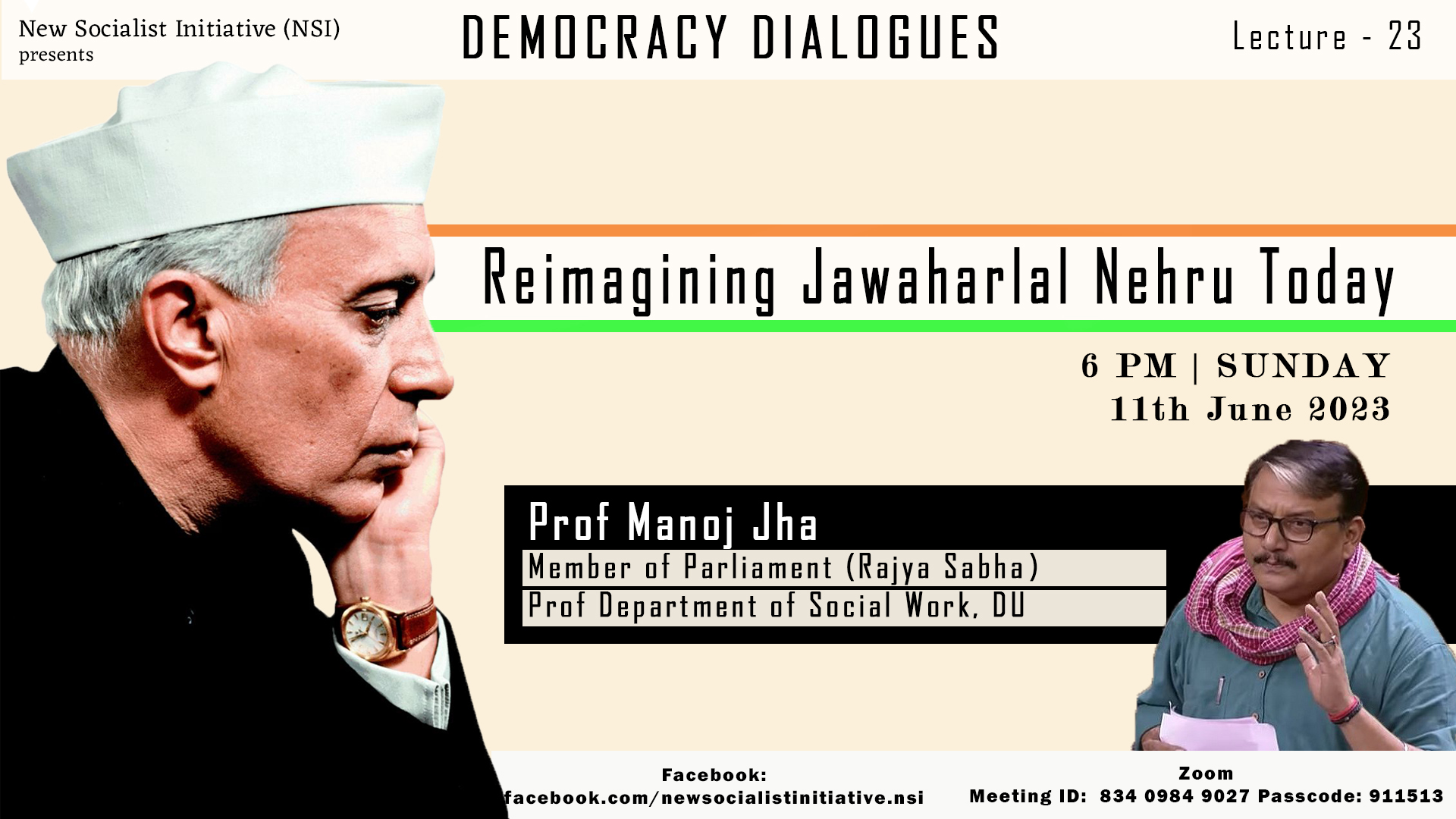
Prof Manoj Kumar Jha, who is a National Spokesperson of the Rashtriya Janata Dal, (RJD), and a Member of Parliament in Rajya Sabha ( upper house of the Parliament) who works as a Professor at the Department of Social Work, Delhi University, Delhi has kindly agreed to deliver the 23 nd lecture in the Democracy Dialogues Series , organised by New Socialist Initiative.
He will be speaking on ‘Reimagining Jawaharlal Nehru Today’ on Sunday, 11 th June, 2023 at 6 PM.
The lecture will also be live streamed at facebook.com/newsocialistinitiative.nsi
Topic :
Reimagining Jawaharlal Nehru today would involve examining his legacy and contributions in the context of the present day. Nehru, the first Prime Minister of India, played a crucial role in shaping the country’s political, economic, and social landscape after its independence in 1947. While we reimagine today presuming he was here we shall have to look at our parliamentary democracy and the core policy issues which have undergone so much of change that he would disown. The idea is to speak about some of the critical concerns we face as a nation through the Nehruvian lens.
Speaker:
Prof Manoj K Jha, who is a National Spokesperson of the Rashtriya Janata Dal, (RJD), and a Member of Parliament in Rajya Sabha is a leading voice of the opposition.
A consistent votary of the idea of social justice and a strong opponent of the politics of majoritarian authoritarianism, his debates and interventions in the Upper House of the Parliament are appreciated across the political spectrum and are widely watched.
Prof Jha, is a very popular teacher in the Delhi University, was also head of the Department of Social Work, Delhi University , for a few years.
The list of people associated with Hindutva outfits caught in damning revelations keeps growing.
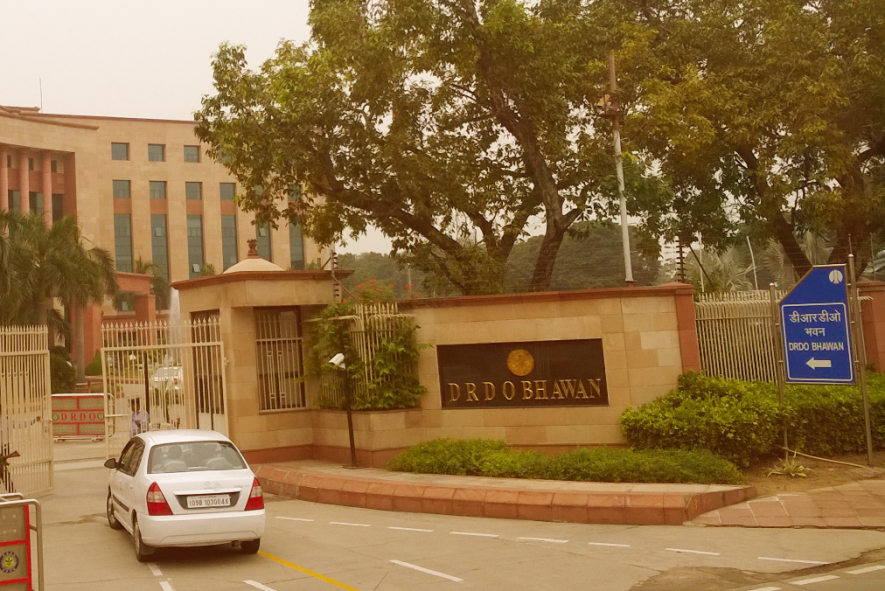
Recent revelations involving alleged espionage involving Prof Pradeep Kurulkar at the Defence Research and Development Organisation should have shaken up the establishment. After all, Kurulkar is said to have handled crucial projects related to India’s defence and reportedly was the lead designer or team leader for projects on missile launchers and subsonic cruise missiles.
Reports say Kurulkar was in contact, over WhatsApp, with a Pakistani Inter-Services Intelligence (ISI) agent late last year. His suspicious activities were reported to the police by DRDO, and in January, his laptop and two mobile phones were seized. The Maharashtra Anti-Terrorism Squad (ATS) is now handling the case. Kurulkar’s foreign trips are also under the scanner.
Such discoveries have long-term implications for India’s national security. Initial reports from ANI, a news agency known for its proximity to the ruling regime, did not mention Kurulkar’s name. The news agency did not initially mention his name in its tweets, though pictures of his face were circulating on social media and news outlets. The sequence of events left many wondering if the tweets deliberately concealed his name to create a doubt over his identity.
No doubt, Indian investigators will examine if the neighbouring country’s sleuths have penetrated India’s defence research sector and the extent to which Kurulkar has compromised India’s secrets. But it’s worth noting this case has not been handed over to the National Investigation Agency. Formed in the immediate aftermath of the 2008 Mumbai terrorist attack and supposedly more equipped and experienced to handle cases with cross-border ramifications, this agency has been busy filing plenty of cases—so, why not this one? ( Read the full article here)
New Socialist Initiative ( NSI) South, recently organised two lectures by one of its senior Comrades Dr Ravi Sinha in Hyderabad.
First lecture was on ‘Fascism and Democratic Polity : How Did India Land in This Crisis ?‘ and the second lecture was on ‘How Does Democracy Undermines Itself ?‘
Here is a YouTube Link of the first lecture.
Topic – Fascism and Democratic Polity : How Did India Land in This Crisis
Speaker : Dr Ravi Sinha
Date : 17 th February 2023
Place : Tarnaka, Hyderabad
Organised by : New Socialist Initiative ( South)
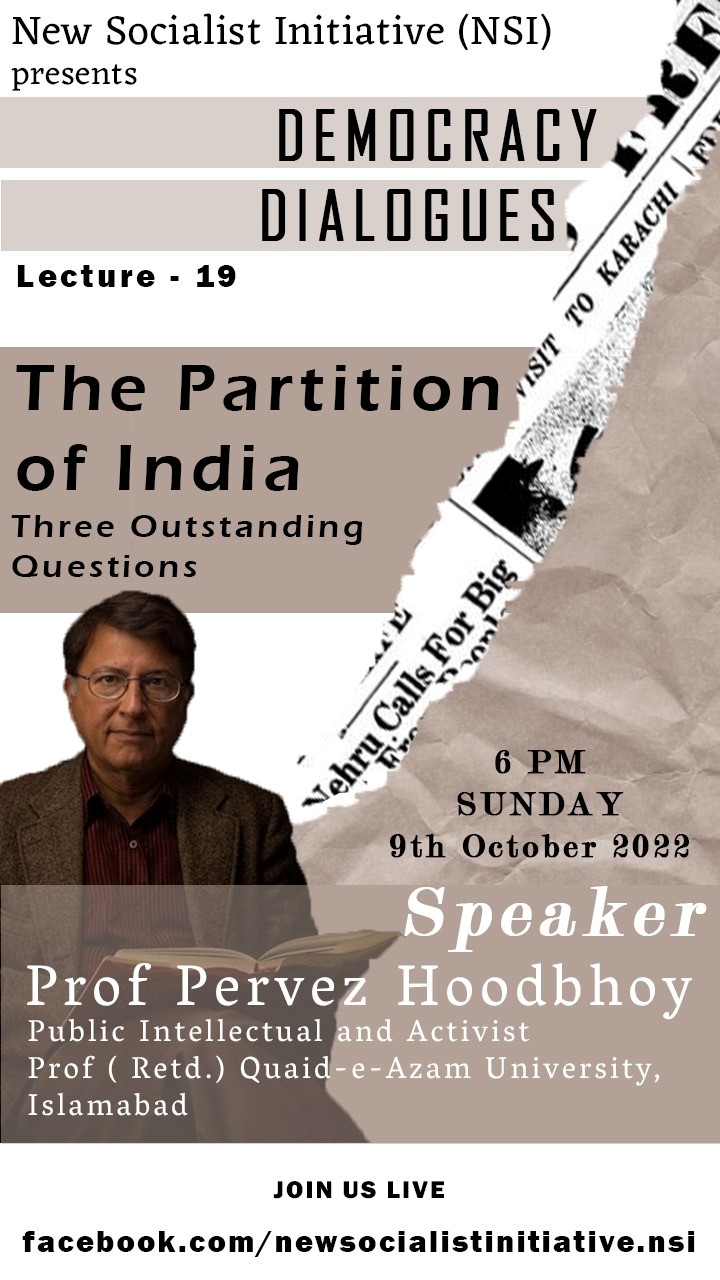
Professor Pervez Hoodbhoy, eminent physicist, author, public intellectual and a forceful voice for reason, science and democracy will be delivering the 19th Democracy Dialogues lecture on Sunday, October 9th, 2022 at 6 PM (IST)
The Partition of India: Three Outstanding Questions
Seventy five years after the communal storm of 1947 countless important questions still remain. From among them I will concentrate upon three which are particularly important in understanding the past but which, in addition, continue to influence current trajectories.
Speaker:
Pervez Hoodbhoy is a nuclear physicist, a frequent commentator on Pakistani television channels, founder-director of The Black Hole in Islamabad, and an author. He received his undergraduate and graduate degrees from MIT and taught physics at Quaid-e-Azam University for 47 years.
The lecture will be held on zoom and for security reasons the link will be shared individually only closer to the event. Please write to us at democracydialogues@gmail.com if you want to join the lecture online.
It will also be live streamed at facebook.com/newsocialistinitiative.nsi
Eminent author and rights activist Aakar Patel will be delivering the 17 th lecture in the Democracy Dialogues Series, organised by New Socialist Initiative, at 6 PM (IST), Sunday, 3 rd July, 2022.
He will speak on ‘The role of individuals in resisting the majoritarian state’. You can also watch it live at facebook.com/newsocialistinitiative.nsi
About the Speaker :
Aakar Patel is a syndicated columnist, author and rights activist and is Chair, Amnesty International India
He has edited English and Gujarati newspapers. His translation of Saadat Hasan Manto’s Why I Write was published in 2014 ( Tranquebar). His study of majoritarianism in India ‘ Our Hindu Rashtra : What It Is. How We Got There came out in 2020 ( Westland) and his next book which seeks to explain data and facts on India’s performance under Narendra Modi, titled ‘Price of ‘The Modi Years‘ was published in 2021 ( Westland). His forthcoming book is on protest and participation by citizens
Abstract :
The role of individuals in resisting the majoritarian state.
India is going through a transformational period when many feel constitutional values have been undermined, an oligopoly has been handed control over large parts of the economy and the secular and pluralist basis of the nation are being eroded.
What can the individual do in these circumstances? A talk on the ways of meaningful resistance

Prof Zoya Hasan, Professor Emerita, Jawaharlal Nehru University and Distinguished Faculty, Council for Social Development, New Delhi, will be delivering a Special lecture in the Democracy Dialogues Series, organised by New Socialist Initiative, at 6 PM, (IST) Sunday, 24 th April, 2022.
She will be speaking on ‘‘How did UP Decide: Identities, Interests and Politics”
Join Zoom Meeting
https://us02web.zoom.us/j/81240964790?pwd=OEd1OU00ejA5d1ZxYWlMRzFaOGNkdz09
Meeting ID: 812 4096 4790
Passcode: 975399
Facebook Live on – http://fb.com/newsocialistinitiative.nsi
Abstract
How did UP Decide: Identities, Interests and Politics
Uttar Pradesh has just seen an intensely contested assembly election which resulted in a second straight victory for the Bharatiya Janata Party in this politically crucial state. This momentous outcome is the subject of intense debate among analysts and indeed the public at large. There was a premise this time, particularly in UP, that communal polarisation wasn’t working because of acute economic discontent which could trigger electoral change. However, the large-scale discontent over many economic issues, including jobs, did not translate into a decision to vote out the government. Many analysts have attributed BJP’s reelection to welfare measures and free rations to the poor during the lockdown. This cannot explain BJP’s persistent success which extends beyond this election. The welfarist argument ignores the compelling logic of long term communalism and the systematic construction of the Hindu vote in UP politics since the time of the Ramjanmabhoomi movement centered in UP and the communal campaigns in the last five years, its impact is reflected in the election results.This construction of the Hindu vote also trumped the caste-based politics of the regional Samajwadi Party and Bahujan Samaj Party through a mobilization of upper caste and non-dominant backward and lower caste communities. Communal polarization and identity politics is the keystone of their strategy and the decisive factor driving electoral choices.
Why the Corporate Czars are Silent over increasing attacks on Social Fabric and rising Communalism
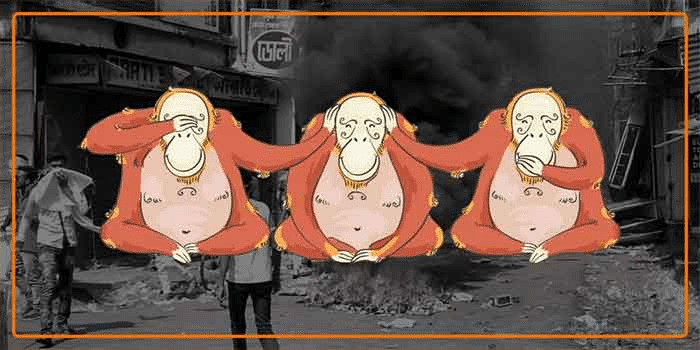
Celebrity actors and players share an interesting commonality in this part of South Asia.
Their moral compass normally veers towards the ‘righteousness’ of the rich, powerful and the influential.
Lynching of innocent people on the streets for their faith, social and governmental hounding of lovers belonging to different communities, call for genocide of religious minorities from public forums and similar hate filled acts, nothing normally impinges on their conscience.
Corporate elites are qualitatively no different.
Occasionally, there are feeble voices of disagreements also.
What Kiran Mazumdar Shaw – founder of India’s largest biopharmaceutical company Biocon – did was exactly this only. She expressed her indignation about growing religious divide in the country and underlined how it would be detrimental to India’s global leadership in ITBT ( Information Technology and Bio Technology)
Definitely her statement which was couched in ‘economic terms’ was very mild, but it did not stop attacks by right-wing trolls.
( Read the full article here)
Prof Zoya Hasan, Professor Emerita, Jawaharlal Nehru University and Distinguished Faculty, Council for Social Development, New Delhi, will be delivering the 16 th lecture in the Democracy Dialogues Series, organised by New Socialist Initiative, at 6 PM, (IST) Sunday, 27 th March, 2022.
She will be speaking on ‘Challenges to India’s Democracy‘
Prof Zoya Hasan has written and edited many books on state, political parties, ethnicity, gender and minorities in India and society in north India and has been a visiting Professor to the Universities of Zurich, Edinburgh and Maison des Sciences de L’Homme, Paris.
Her most recent publications include Forging Identities : Gender, Communities And The State In India ( edited) , Agitation to Legislation – Negotiating Equity and Justice in India , Congress after Indira: Policy, Power and Political Change (1984–2009), Politics of Inclusion: Castes, Minorities and Affirmative Action, (2009) and a collection of essays titled Democracy and the Crisis of Inequality
Abstract
Challenges to India’s Democracy
The 75th anniversary of Indian Independence is a landmark event in the history of our democracy. It is for this reason a significant moment to assess the state of India’s democracy. As the largest democracy in the non-western world, India is a success story. Its success, however, has primarily been recognized as an electoral democracy, with regular free and fair elections registering high voter participation, and also peaceful transfer of power. Elections certainly are a climactic moment of the democratic process but by no means the only important one. Politics between elections is central for understanding the challenges facing Indian democracy, and it is important, therefore, to contextualize democracy.
Three years since the Bhartiya Janata Party government was re-elected has seen the consolidation of the process begun in 2014 – the establishment of a Hindu state. This process has been facilitated by the combination of majoritarianism and authoritarianism which has resulted in democracy becoming thinner, not accidentally, but deliberately. This does raise certain questions about the relationship between Hindu nationalism and democracy which seems to weaken the idea of democracy moderated by institutions.
This paper tries to make sense of these shifts through a thematic exploration of the trajectory of Indian democracy since 2014 focusing on three overlapping developments -the consolidation of a majoritarian brand of politics, the decline of independent institutions and the shrinking space for political dissent and protests -which has undermined democracy. Each of these issues distinct and significant in its own right when taken together constitutes a major risk to Indian democracy. However, public protests in the last few years have emerged as a major bulwark against authoritarian rule and the erosion of democratic dissent. For the Opposition it’s a moment of reckoning but there are signs of churning among the Opposition as well.
When Government itself Does Not Have Any Qualms in rationalising Drona Mindset
[H]istory has come to a stage when the moral man, the complete man, is more and more giving way, almost without knowing it, to make room for the . . .commercial man, the man of limited purpose. This process, aided by the wonderful progress in science, is assuming gigantic proportion and power, causing the upset of man’s moral balance, obscuring his human side under the shadow of soul-less organization.
—Rabindranath Tagore, Nationalism, 1917
( Quoted in ‘Not for Profit – Why Democracy Needs Humanities, Martha Nussbaum, Princeton University Press, 2010)
A single story is sometimes enough to tell how an institution functions and how it needs to be overhauled.
Aruna’s long struggle to get overseas scholarship is one such story.
Son of landless agricultural labourers from Orissa, this bright student, belonging to a socially oppressed community, had applied to get a overseas scholarship via the National Overseas Scholarship – which awards scholarships to students from SC, ST, Denotified tribes etc – and even had lost two years in bureaucratic wrangling despite the fact that he had already got admission into Essex University.
Thanks to the timely intervention of a group of Ambedkarite thinkers from Nagpur, who filed a petition in the Delhi Highcourt on his behalf , which ultimately ruled in the student’s favour.
It would be cliche to say that Aruna’s struggle is an exception.
Story of Vishal Kharat is qualitatively no different who is still trying to get a scholarship for the last two years and has discovered to his dismay that the scholarship portal itself does not work properly.
Instances galore how this ambitious scheme which was launched in the wee hours of India’s independence when Nehru was the Prime Minister and a great scholar and freedom fighter Maulana Abul Kalam Azad was a Cabinet Minister for education, has been left to go slowly into oblivion.
The latest decision by the Union ministry of social justice and empowerment, to not to fund scholarships for marginalised students keen to study India’s history, culture abroad, is just another indication of how it is being implemented.
We can recall that it was the year 2012 when UPA government led by Congress was in the saddle this scheme was extended to Humanities as well and every year 100 students from the socially deprived, oppressed communities started receiving it but with the change of power at the centre things started changing drastically.
Like many of its earlier decisions, this decision to axe scholarship to study humanities abroad was taken without consulting the stakeholders involved in the process or without even giving a hint of how the government wants to proceed in this unique empowerment initiative. The fact that the final date to apply for this scheme is to expire on 31 st March and when there was hardly anytime left to young scholars who are keen to study abroad, to search for alternate path to fulfill their dreams.
The rationale being provided by the powers that be appears unconvincing.
It talks of utilising rich availability of repositories, records as well as books available in Indian institutions and various experts on this subject of India’s culture, civilisation etc and divert the resources thus saved to study other subjects like Science, technology.
It is rather difficult to believe this claim but even if for the sake of discussion we concede, can it be said with certainty that the existing faculty and these institutions would be sensitive to the issue or the concerns of emerging talents from the oppressed, exploited sections of our society, and would be accommodating as well! Fact is that even Higher Educational Institutions are not free from exclusions, discrimination on the basis of caste, gender, community and despite constitutional provisions for affirmative action existing since decades, the character of the academia in most of these institutions is very much exclusive mainly dominated by the so called upper castes.
Cases of discrimination faced by students from such Institutions keep piling up leading even to many unfortunate incidents – rightly called as ‘institutional murders’ of many such talents.
The stories of suicides of the likes of of RohithVemula, ( HCU, Hyderabad) ; Payal Tadvi ( Medical College, Mumbai,) or Fathima Latheef ( IIT Madras) and many of their ilk cannot be seen as exceptions.
A related point is the status of academic freedom in India.
With the ascendance of right-wing politics world over the very idea of academic freedom has come under attack globally – including India
Thanks to the majoritarian turn in the Indian politics where religious minorities are being further marginalised and invisibilised – the ambience which exists here within the academia itself is a pale shadow of its earlier situation. It is becoming increasingly difficult nay impossible to have a critical, open minded discussion on themes, topics which are found not palatable to the ruling dispensation which is a prerequisite for any healthy educational institution.
We have before us cancellation of international seminars on innocuous themes even like Scientific Temper or teachers being hauled to courts after taking up discussions about ‘Kashmir within the class ‘ or for engaging in open ended discussion about nationalism inside class or students-teachers being charged with sedition for protesting about highhandedness of the government.
Secondly, with the rightwing holding reins of power with a brutal majority, has also led to radical changes in the content of humanity studies playing mythology over facts e.g. there are allegations how the draft history syllabus pushed by the UGC presents a theory of the origin of caste system which relates to the advent of the ‘Muslim rule’ here.
Can we ever accept that these bright students opting for scholarships abroad who have themselves experienced caste, community or class based deprivation, discrimination in their younger days, would be ever ready to easily gulp down such trash as intellectual discourse.
Definitely not.
This decision to axe funds to socially oppressed sections to study humanity abroad very much gels with the overt concerns of the people in power which are evident in the New Education Policy 2020 which envisions restoring the the role of India as a ‘Vishwa Guru’ and interestingly remains silent on caste and other discriminations and even does not talk about reservations. It clubs SC / ST, OBC and minority communities as an acronym SEDGs – Socially and Economically Disadvantaged Groups.
What needs to be underlined that this step by the Ministry has raised concerns among the members of the international academic community, and scholars of India spread all over the world as well and in an open letter addressed to the Ministry of Social Justice and Empowerment they have demanded that the government withdraws this immediate changes in the policy.
It emphasises how ‘[t]he argument that one need not go abroad to study India is intellectually flawed and will only serve to isolate Indian scholarship from the rest of the world.’ and these amendments attest to a lack of understanding of how interdisciplinary research is conducted today, where natural sciences, law, history, sociology and the humanities work together beyond national boundaries.
Another important point which it make that how it will further negatively impact women recipients of this scholarship who are already ‘disproportionately under-represented in scientific and technological disciplines and tend to more easily find opportunities in the Social Sciences and Humanities’
Last but not the least it also displays the great hiatus between the outwardly, strong image of the ruling dispensation and how paranoid, insecure it is about deeper fault lines of the Indian society.
Perhaps it worries that with increasing interest of the academia of the west in what is happening to the largest democracy in the world, and the study of caste and its attendant asymmetries receiving special attention by them, and also dalit activists, scholars there pursuing it at various levels there, these exclusivist hierarchies have rapidly attracted attention. Not some time ago the California State University system added caste to its non-discrimination policy, prohibiting caste-based discrimination or bias across its 23 campuses.
The ruling dispensation knows very well that the more students from dalit, adivasi and other deprived sections of society go out to study abroad, it will have to be ready to face many such embarassing moments because whereas it itself is keen to invisibilise caste once for all, and even clubbed all these sections – the SC / ST, OBC and minority communities as an acronym SEDGs – Socially and Economically Disadvantaged Groups; the reality as it exists would continue to haunt it.
The 14 th Lecture in the Democracy Dialogues Series organised by New Socialist Initiative was delivered by Prof Irfan Habib, Famous Historian, Public Intellectual and Marxist Thinker, on Sunday 30 th January 2022 at 6 PM (IST).
Prof Habib spoke on ‘Doctored History : From Ancient Times till Today’
About the Speaker :
Prof Irfan Habib ( Professor of History at the Aligarh Muslim University, Retd) is a well-known historian and author of the The Agrarian System of Mughal India ( 1963), An Atlas of the Mughal Empire ( 1982), Essays in Indian History : Towards a Marxist Perception ( 1985) , The Economic History of Medieval India : A Survey ( 2001) , Medieval India : The Study of a Civilisation ( 2008), a multivolume study titled ‘People’s History of India’ etc and has edited many books
The lecture was live on facebook.com/newsocialistinitiative.nsi.
Please write to us at democracydialogues@gmail.com if you are interested in getting updates about coming lectures.
– New Socialist Initiative
p.s. Here is a playlist of lectures in the series :
: https://www.youtube.com/playlist?list=PLtXBfoS5KZ78UFI_aYzROjUss8ZzhUKxy.
 KAFILA - COLLECTIVE EXPLORATIONS SINCE 2006