Category Archives: Countryside

Silent changes amidst terror in the Jungle Mahal of West Bengal: Kumar Rana

Guest post by KUMAR RANA

Nothing seems to have changed in the past quarter decade. Past Jhargram, the town in the woods, the metal road connecting Lodhasuli to National Highway No. 6 wraps itself in a shady serenity. At occasional intervals, the artificiality of a clamour, emitted by a motor engine, creates an unquiet irritation, murdering the resonance of the forest and interrupting its slumber. The bus-stops at Kalabani and Boria are as lonely as they used to be; Gar-Salboni, a roadside village, is stuck in its eternal search for a path to survival. The mud road that breaks from the main road to meet the villages Sirsi, Joalbhanga and Lab-Kush, is as tranquil as it had been 25 years ago. Past the lush green rice fields by the road begins the forest that hems the horizon. The leaves that have just had a splash of shower glistens with the brilliance of the sun.

— Last year it was different, whispered the road.

— Yes, I have heard of it – there had been a drought. And it was the same in the year before the last. It used to follow a cycle like this 25 years ago. Rain ensures the crop. Hunger rides free when there is a drought.

Continue reading Silent changes amidst terror in the Jungle Mahal of West Bengal: Kumar Rana

Nutritional Neglect: Starving Our Future: Priyanka Nandi

Guest post by PRIYANKA NANDI

Urja aehi, swadha aehi, sunrita chirawatyehiti
[Come nutrition, come food, come truth, come security]
– Atharvasamhita 8.10.4

“Come nutrition, come food, come truth, come security”, invites the Atharvasamhita. Clearly, this is not the expensive military view of security we are encouraged to take these days. What, then, is this security?

This is the security that comes from having access to regular and adequate nutrition. From not having to starve, or suffer chronic hunger. There is no violence in this idea of security, except the quiet, steady violence done to generations of ‘common’ people by making something as basic as daily nutrition unavailable to them. Continue reading Nutritional Neglect: Starving Our Future: Priyanka Nandi

‘Jan Sansad demands a Development Planning Act not an Act to Facilitate Land Acquisition’

This release comes via the NATIONAL ALLIANCE FOR PEOPLE’S MOVEMENTS

Nellore, September 18 : “Government of Andhra Pradesh has given licenses to 28 companies to establish thermal power plants with a total capacity of 32,000 MW. How can a fragile coastal zone can take up so much of ecological pressure ? Is this the way to plan the needs of electricity for development ?” asked the delegates who had come from different parts of the State and joined by eminent social activists Medha Patkar, Sandeep Pandey, Banwari Lal Sharma, Gabriele Dietrich, Sister Celia, Manoj Tyagi, Viveknanad Mathane, P Chennaiah, Ramakrishnam Raju and others. Jan Sansad was hosted by NAPM and Jana Vigyan Vedika at the premises of Nehru Yuva Kendra, Nellore. Continue reading ‘Jan Sansad demands a Development Planning Act not an Act to Facilitate Land Acquisition’

Out of Development’s Waiting Room, Out of Democracy: The Continuing Agony of the DHRM

[with inputs from Baiju John]

Faced with the never-ending agony to which the members of the Dalit Human Rights Movement (DHRM) in Kerala seem to be subject to, it appears that that the more familiar ways of marginalizing of dalit people in Malayalee people do not work anymore. The past few days have seen horrendous attacks on these people near the town of Varkala in Thiruvanathapuram district. The DHRM has accused the Siva Sena and the BJP of violence, but it appears that both the authorities and the press are equally and irremediably deaf. Continue reading Out of Development’s Waiting Room, Out of Democracy: The Continuing Agony of the DHRM

In Allahpur, a Moment of Truth

(First published in Untold Stories)

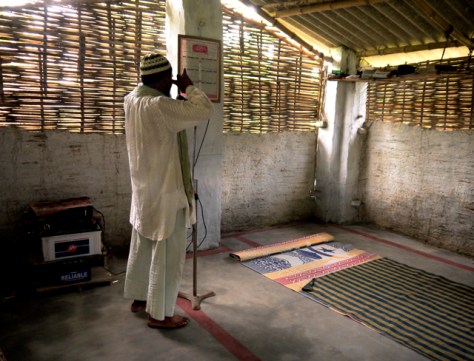
Imam Shamsuddin calls for prayer. Photo credit: Shivam Vij

Like nearly every village in South Asia, Allahpur, in the east Indian state of Bihar, is geographically divided on the lines of caste. On one side of a dirt track live the upper-caste Muslims (Syeds, Sheikhs and Pathans) and on the other side live the lower-caste Muslims (Ansaris, Dhunias and Raains). There are only four Hindu families in Allahpur, and they are all lower castes, their houses amid the low-caste Muslim houses.

For five years now, the low caste Muslims have been praying at a ramshackle mosque they built, boycotting the mosque in the upper-caste Muslim area, a stone’s throw away.

Continue reading In Allahpur, a Moment of Truth

POSCO and the People: Ayush Ranka and Arati Choksi

This is a guest post by ARATI CHOKSI with photographs by AYUSH RANKA

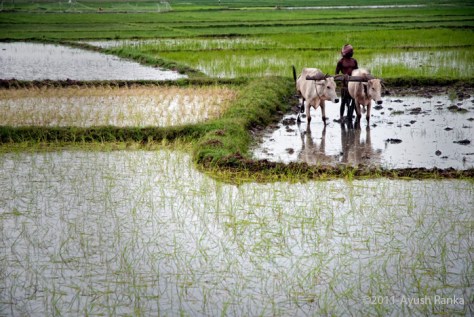
01. Odisha is scarcely known to most people as the state of rich agriculture. It is more famous for it's floods and droughts which occur once in a while. However, the entire state, barring a few small regions, is rich with fertile soil and apart from betel leaves and cashew, food grains like rice, wheat, jowar and pulses are also grown

POSCO catapulted out of nowhere into the periphery of my imagination last year. On May 15, 2010, in a brutal show of aggression and violence, armed police battalions attacked unarmed protesters at Balitutha opposing a forceful takeover of their lands by the state for a POSCO steel plant. Members of police force set fire to shops, eateries and thatched homes, including the dharna site of people’s peaceful protest. Police fired upon unarmed protesters with rubber bullets. One person died, and hundreds were severely injured in this firing, many of these were women and the elderly. Continue reading POSCO and the People: Ayush Ranka and Arati Choksi

No One Killed Meena Khalkho?: Akhil Katyal

Guest post by AKHIL KATYAL

Now that the Anna Hazare Show is over, will the Indian media go back to looking at India as also existing outside Delhi? On 6 July 2011, Meena Khalkho, a sixteen year old tribal girl from Karcha village in the state of Chhattisgarh was raped and murdered by the local police and it barely made a dent on our news universe. A search for her name on most television news websites returns nothing. The police in Chattisgarh immediately hit upon a strategy that has now long been in circulation. They subsume Meena’s horrible rape and murder within what goes these days as a laudable mission, one that manages to neutralize all rage against police atrocities, by claiming Meena to be a Naxal and by claiming her to be fatally wounded in an encounter that night against a larger party of Naxallite cadres.

Continue reading No One Killed Meena Khalkho?: Akhil Katyal

Few Hearts to Live for

This slideshow requires JavaScript.

Photographs by Amruta Mehta

Just when Shantuben held her meditative poise at a Vipassana camp at Igatpuri on the morning of January 26, 2001, her dream turned to rubble back home in Bhuj. When she reached home, her labour of love of the last 5 years was gone, razed to the ground. It all had to start afresh. Continue reading Few Hearts to Live for

Dear Manmohan Singh: BPL households don’t think cash transfers will be better than the PDS

Given below is the text of a letter written by research scholars and student volunteers to the Prime Minister of India. Given below the letter is a table listing the findings of the survey that the letter speaks about.

21 July 2011

Dr. Manmohan Singh
Prime Minister of India

Respected Prime Minister,

We are a group of research scholars and student volunteers who have just spent three weeks surveying the Public Distribution System (PDS) around the country. We are writing to share a few thoughts on the National Food Security Act in the light of this experience.  Continue reading Dear Manmohan Singh: BPL households don’t think cash transfers will be better than the PDS

The Singur Act and the Deontological Reaction: Prasanta Chakravarty

Guest post by PRASANTA CHAKRAVARTY

The remarkable Singur Land Development and Rehabilitation Bill, passed in the West Bengal Assembly on June 14 became an Act on June 20. The Act scrapped the previous Left Front government’s deal with Tata Motors and has provisions to return land to unwilling farmers. Consequently, Singur land was taken over by the State government prompting Tata Motors to legally challenge the whole Act and a judicial battle has ensued between them and the newly elected State government. The State government may continue to return land in right earnest since there is no legal bar to that as of now. One would think that by many standards, this is a landmark bill that challenges and confronts policy consensus in issues of land transfer, models of enclosing and a concomitant notion of development that marks our nation at this point of time.

Reactions to this enactment have been thick and fast—alarmist and cautious to generous and triumphant. Continue reading The Singur Act and the Deontological Reaction: Prasanta Chakravarty

Six Dead Villagers and a Lost Road: This did not happen at Baba Ramdev’s ‘Yoga Camp’ at Ramlila Ground in Delhi

Sometimes, thankfully, one does not need to write an over-long post to make a point.

Everybody knows how the entire television media has been giving enormous airtime to BJP and its allies giving vent to their outrage on the condemnable police action on Baba Ramdev’s ‘Yoga Camp’ in the Ramlila Maidan in New Delhi. One woman, named, Rajbala is still seriously injured. No casualties have been reported so far.

Though it must be said that Acharya Balkrishna, Baba Ramdev’s right hand man, seems to have had the pitch of his voice transposed a few octaves higher, giving his heartfelt statements at press-conferences the timbre of a dulcet castrati. I suppose, depending on how you look at the fate of Acharya Balkrishna’s vocal cords and other organs, that is a casualty. Continue reading Six Dead Villagers and a Lost Road: This did not happen at Baba Ramdev’s ‘Yoga Camp’ at Ramlila Ground in Delhi

On Lathicharging a Satyagraha: Dilip D’Souza

Guest post by DILIP D’SOUZA

So what do you think happened when the police assaulted a gathering of satyagrahis with lathis? Here’s what happened to some people I met from such a gathering.

  • Tulsibai, 45+, was hit on her stomach and wrist.
  • Manglubai, about 40, was hit on her buttocks.
  • Rajkumaribai, who didn’t know her age, had a deep wound on the upper part of her thigh that she showed us shyly.
  • Jiggelal, 60, was hit so hard on his arms and legs that he blacked out. Continue reading On Lathicharging a Satyagraha: Dilip D’Souza

POSCO: Lies, Crimes and Atrocities

This statement about today’s events in Jagatsinghpur, Odisha, comes from the CAMPAIGN FOR SURVIVAL AND DIGNITY

Today, more than a thousand armed police besieged the gram panchayat of Dhinkia in Jagatsinghpur District of Orissa to crush the resistance to the POSCO steel plant. For the entire day thousands of people sat in the heat, where several people (including children) and even two policemen fainted. At noon the Collector declared their protest “unlawful” and subsequently loudspeakers blared threats about use of tear gas, lathi charges, “those engaging in unlawful protests being dispersed” continuously for four hours. Efforts were made to divide the protesters as well. The protesters remained firm. Eventually, perhaps afraid of the heavy media presence and unable to break the will of the people, the police withdrew. The people have left some of their number on guard, fearful of the police’s return at any time.  Continue reading POSCO: Lies, Crimes and Atrocities

Action Alert – Imminent Police Attack on POSCO Affected Villages

Update of anti-POSCO People’s Movement as on 10th June 2011, 12 noon. 

· Police and protesting public are face to face now: Twenty platoon police forces with officers have already reached at the boarder of Govindpur village where more than 2000 villagers are protesting against the forceful land acquisition by government of Odisha for POSCO through 24X7 vigil.

· Protesters are determined to resist any use of force by the government and police forces. Even women and children have come to the forefront as they form the first two shields of protection.

· Senior police officers, with arms and weapons, are threatening people to dismantle through loud speakers. We will let you know the development here

Kindly call the following authorities to lodge your protest.

In solidarity,
Prashant Paikray
Mobile – 09437571547 Continue reading Action Alert – Imminent Police Attack on POSCO Affected Villages

Growing Inequality and Deprivation in Telangana – Questions evaded by Srikrishna Committee: Bhim Reddy

Guest post by BHIM REDDY

[The movement for a separate Telangana state has been raging now for quite some time. At Kafila, we have not yet had the occasion for a discussion on the pros and cons of the issue. This post deals with one aspect – that of agricultural economy and its relationship to the perceptions of discrimination. We hope that this post will lead to some debate on a very important issue. AN]

Rural Telangana has experienced income declines for ninety percent of its population, increase in inequality and a drastic decrease in the class-size of cultivators accompanied by an increase in the class-size of agricultural labourers since early 1990s.  This revealing evidence is presented in Srikrishna Committee (Committee for Consultations on the Situation in Andhra Pradesh, headed by Justice B.N. Srikrishna) Report based on NCAER (National Council of Applied Economic Research, New Delhi) surveys conducted once in the year 1993-94 and another in 2004-05. The Committee’s concern over this scenario, despite the purpose of its constitution being to study the situation in Andhra Pradesh state in the context of unrest in Telangana region, has not attracted any attention beyond its worry that the vulnerability of the deprived masses can be ‘used’ by political groups: “…most of the deprived communities in Telangana are facing hardship and therefore are vulnerable to mass mobilization on one pretext or the other, including political mobilization with promises which may or may not be met”. Beyond this shallow concern the Committee is indifferent to such evidence that any study characterised by objectivity and rigorous interrogation would be compelled to undertake a critical examination of the trajectory of economic development and state’s policy, and attempt to explain the cause of such deprivation and growing inequity.

Continue reading Growing Inequality and Deprivation in Telangana – Questions evaded by Srikrishna Committee: Bhim Reddy

Har Qadam pe Zamin Tang Hoti Jayegi… (The Land Will Shrink With Every Step)

For the last few days, a few lines from Sahir Ludhianivi’s long poem Parchhaiyan, have been repeatedly coming back to me. A poem that I had read ever so often in my early youth and thought I had long forgotten, suddenly reappeared in a flash. Here go some of the lines (not really in the order in which they appear in the poem, but in the order in which they came to me):

Noida farmers clash with police over land acquisition
Villages turned into police camps

चलो कि चल के सियासी मुक़ामिरों से कहें/ कि हमको जंगो-जदल के चलन से नफ़रत है

कहो कि अब कोई क़ातिल इधर अगर इधर आया/ तो हर क़दम पर ज़मीन तंग होती जाएगी

हर एक मौजे-हवा रुख़ बदल के झपटेगी…

ये खेत जाग पड़े, उठ खड़ी हुईं फ़सलें/ अब इस जगह कोई क्यारी न बेची जाएगी

[Roughly translated: Come let us tell the political gamblers/ that we hate the business of war and strife

Let us tell them that if a murderer dares to come hither/ The land will shrink with each step

Every wave of the air will turn turn against you

These fields have come alive, with the crops swaying on them

No more shall even a bed (of the field) be sold]

Though Sahir’s poem was written as a protest against war, some of these lines resonate with other, more immediately relevant matters. Ironically, Sahir was protesting against the war mongers pillaging civilain populations but here we are, with the new war mongers of our times: what else is the neo-liberal dream but that of pillage and loot of civilian populations by armed forces of civilian governments. And as they, ‘is hammam mein sab nange hain‘! [All are naked in this  in this bathhouse]:  From Buddhadev Bhattacharya of West Bengal to Mayawati of Uttar Pradesh – spokespersons all of the oppressed! And it makes little difference whether it is a BJP-led NDA government in power at the Centre or a Congress-led UPA.

Continue reading Har Qadam pe Zamin Tang Hoti Jayegi… (The Land Will Shrink With Every Step)

Punjabi Qissas and the Story of Urdu

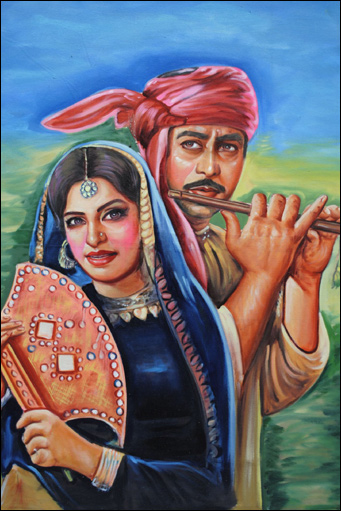
Heer-Ranjha
Heer-Ranjha in a Pakistani film poster, circa 1970s

The Social Space of Language: Vernacular Literature in British Colonial Punjab
by Farina Mir
Permanent Black, Ranikhet, 2010.
ISBN-817824307-5
pp-277, price Rs 695

This book straddles several anomalies that are rather obvious once stated but are rarely formulated as such. How is it that the world of Urdu literature becomes so dominated by people from the Punjab in a span of fifty years, beginning circa 1900s, and in a sense, continues to remain so? Iqbal, Faiz, Meeraji, Rashid, Bedi, Manto, Krishan Chander and down to our times Mushtaq Ahmed and Zafar Iqbal, a top twenty or top fifty list of modern Urdu litterateurs would likely contain eighty percent Pubjabis. And how is it that Punjabi, which produced such a brilliant and varied repertoire of stories, epics and poems until the late medieval era by such extraordinary luminaries as Baba Farid, Bulle Shah, Waris Shah, Haridas Haria seems to drop out of our horizon in the modern era, where all we know of is an Amrita Pritam or, less likely, a Surjit Patar. Where such poverty after such riches, where such preponderance from such invisibility? And yet, how is it that Punjabi still continues to enjoy immediate and even aural connotations that transcend nationality, religion and, even as it defines a community, a specific ethnicity. What then is a Punjabi community and where and how has it existed specifically in the colonial era but, in many resilient ways, down to our times? Continue reading Punjabi Qissas and the Story of Urdu

Who Killed Jugni? Shiraz Hassan

Guest post by SHIRAZ HASSAN

It was many summers ago. I was visiting my village on the banks of the Jhelum. I saw the people of my village go towards the Eidgah, across the chappaD, or the pond. When I asked my grandfather about them, he said. “Ajj mela ay putter!” [Son, today is a fair!] The mela ground was bustling with makeshift shops and people thronging them. At one end of the mela a circus had come up. The mithai stalls were packed with customers and curious on-lookers, some of them were buying and eating. And that’s when I heard the sound of their music. There they were, surrounded by a circle of spectators. A couple of local artists sang a song I had not heard before. I couldn’t understand a word, other than ‘O mereya Jugni, O mereya Jugni’ – which they chorused, over and over again.

That was my introduction to Jugni. I had no idea who Jugni was, and for I long time I didn’t care. Continue reading Who Killed Jugni? Shiraz Hassan

Two statements on the Environment Ministry’s ‘forest clearance’ to POSCO

In response to the Union Environment Ministry’s decision, given below are two press releases, from POSCO Pratirodh Sangram Samiti and Campaign for Survival and Dignity

POSCO PRATIRODH SANGRAM SAMITI

(based out of villages Gadkujang, Nuagaon and Dhinkia in Erasama block of Jagatsinghpur district, Odisha. )

A Mercenary Minister and a Lying Government Cannot Crush Our People
Money Worth More to Government than Truth, Law and Justice; but the Corrupt and the Criminal Will Not Triumph

2 MAY 2011: Today, in a sanctimonious order riddled with lies and distortions, the Environment Ministry allowed thePOSCO project to proceed. The livelihoods of 4000 families (over 20000 people) and the laws of the land have been sold to the highest bidder. Certain facts should be brought to the notice of the public: Continue reading Two statements on the Environment Ministry’s ‘forest clearance’ to POSCO

The afterlife of a massacre

Aman Sethi/ The Hindu

I just finished a long essay for the cover of the May 2011 issue of Caravan  magazine. In “At the Bloody Crossroads”,  I plot the fate of the village of Tarmetla in the course of a year of ‘counterinsurgency”.

At 5:55 AM ON 6 APRIL 2010, Golf Company of the 62nd battalion of India’s Central Reserve Police Force [CRPF] radioed field headquarters at Chintalnar to report they were receiving small-arms fire in the “Tarmetla sector” and had sustained one injury. Golf Company was conducting a three-day area-domination exercise in the forests of Dantewada…

Operation Khanjar (“Dagger” in Hindi) was Golf’s last manoeuvre before the company was rotated out of Chintalnar to a less sensitive post. They were accompanied by their replacements from Alpha Company, who had just arrived from battalion headquarters in Barsur. The objective was to make their presence known in the district’s scattered hamlets: they were to spend three days sanitising the sector of guerrilla presence and acquainting the men of Alpha Company with the rolling hills and dry riverbeds that surround the CRPF camp at Chintalnar….

At 7:45 am, Golf Company’s deputy commandant, Satyawan Yadav, made a phone call from the vortex of the ambush to say that his company had been completely surrounded—and then the phone went silent.

Read the full story on Caravan’s website. I will be happy to answer questions/comments on Kafila

The Making of an Authority: Anna Hazare in Ralegan Siddhi

(I am posting a much longer version of my previous article that will also respond to some of the queries and comments. This article is based on my research, field work and interviews in Ralegan Sidhi since 1991.)

This article is focussed mainly on understanding how exactly the rural environmental works in the journey of Anna Hazare and Ralegan Sidhi are articulated within a coherent ideological framework, to acquire their legitimacy and authority, which are fed by, and fed into, some dominant political cultures of the state. Any political theory and practice, built on this framework, can open the possibilities of a strengthening of the conservative and nationalist forces. Certainly, the ideology of a rural organisation or a movement and its appeal is not based on a single plank. In the case of Anna Hazare and his programme, though the developmental and the environmental works form the core of its ideological structures, it includes other issues as well. At times it provides a different scale of activities to its audience, but eventually reinforces its principal ideological framework. Some understanding of the ideological DNA of the green villagers and the fellow environmental travellers also gives us an idea as to what elements of this endeavour and ideology motivate villagers and environmentalists.

The Historical Context of Maharashtra
Anna Hazare and Ralegan Siddhi are not a new addition to the social history of the Maharashtra state. Indeed, the movement has borrowed many features from the historical evolution of the region, and the political culture of the state, with which it negotiates at different levels. There are many factors at play, though three are of prime importance in the context of this paper: (i) nativism and regionalism in Maharashtrian culture and politics (ii) structure and nature of caste and class and (iii) agrarian economy and local environmentalism.
Continue reading The Making of an Authority: Anna Hazare in Ralegan Siddhi