
The latest assault on the Kiss Of Love movement, the last in the long list of assaults against its activists over the past one year in Kerala, involves the arrest of two former KOL activists, Rahul Pasupalan and Resmi Nair, over sex trafficking charges. While the media has been mixing up this case with that of a pedophilia FB page in a rather unwarranted way , the media has been screaming about the pair’s connection with KOL and some reports almost imply that their actions were because of their associations with KOL. Others, including the arch-conservative newspapers, have asked whether the KOL was a cover for sex work markets! Continue reading Two Trees Don’t Make a Forest: Leave KOL Alone
Category Archives: Culture
New Epidemics in Kerala – Ephebiphobia and Losing-Control Anxiety
“Torture isn’t new to us, ” quipped my seventeen-year-old daughter. We were discussing the future of Indian democracy.She had just quit regular school and got herself enrolled in the Kerala State Open School.
I turned to look at her, surprised. She held me in her gaze, questioning that surprise. “In school, we were watched constantly through CCTV cameras … We were summoned to the Principal’s room whenever they thought they saw or heard something wrong. My friend was questioned by nine people, teachers and non-teaching staff. They sat in a circle with her standing in the middle. The more she denied their accusations, the more they pressed charges, threatening and insulting her… So why should we feel illegal interrogation to be abnormal? It is utterly normal to us!” I could only stare blankly. “And the punishments … do you know how humiliating they are? They even maintain ‘reports’ – gossip by teachers – which they pass on to the next school you’d join.” Continue reading New Epidemics in Kerala – Ephebiphobia and Losing-Control Anxiety
Nehru: Inconsistent without discrepancy
“You are able to discard your halo occasionally. You are capable of saying, ‘when I saw the sea for the first time’ when others would say ‘when the sea saw me for the first time…’. I should like to have known you better. I am always attracted to people who are integral enough to be inconsistent without discrepancy and don’t trail vicious threads of regret behind them. You are not hard. You have got a mellow face. I like your face, it is sensitive, sensual and detached at the same time.” Amrita Shergill
It is heart-warming to see that “mellow, sensual and detached” face on posters on the streets of Delhi after a long time. There is something soothing about it replacing that boastful, nationalist gaze that had been looking down on us for the last two years. Bihar could not stand that image. India would do well to follow Bihar’s lead.
2015 could well be the year of Nehru’s return. Just when the final death of Nehru was being announced in India’s political and intellectual circles, the nation seems to have turned back to him, reposing faith in the secular politics of anti-majoritarianism. Just when secularism was thought to be replaced by development, it became the fulcrum of the electoral discourse in Bihar. Continue reading Nehru: Inconsistent without discrepancy
So that the Beating of Your Heart Kills No One: Statement of the First ICGE, Thiruvananthapuram
Below is the joint statement issued by the International Conference on Gender Equality that concluded today at Thiruvananthapuram in Kerala, organised by the Gender Park, supported by the Department of Social Justice, Government of Kerala. The Gender Park represents a unique attempt to address gender inequality — understood in non-binary, inclusive terms — through skill-building and entrepreneurial innovation. It is refreshingly free from the burden of cultural ageing that is ubiquitous in Kerala now, and has a very young, dynamic team. The theme of the conference was ‘Gender, Governance, and Inclusion’, and that was not lip-service, as the statement clearly shows. The Statement embodies a vision that seeks to bring back questions of gender freedom and equality back into the heart of development interventions, but speaks of all marginalized genders, and not just women.
The Kerala Government’s Transgender Policy, pioneered by the Department of Social Justice was released the conference and transgender people were a major presence at all sessions. Speaking at the occasion, Kerala’s Minister for Social Justice, M K Muneer, declared that he would monitor the implementation of the policy personally and also fight to end Section 377 on all platforms of the government and outside, at state and national levels.
Their remarkable interventions worked magic: if the pressure of neoliberal discourse is to continuously tie all development to the imperatives of market-led growth and gesture to its Promised Never-Never Land, transgender people’s questions cut through such instrumentalism to join it again with freedom and equality … and the aesthetic in the fullest sense of the world. For the aesthetic does involve a heightened attention to the sensuous and to rhythm, to difference and to fit, to the entire range of kaleidoscopic formations!
And it brought back into the heart of development, Love. Love as understood and celebrated by Alice Walker:
love is not concerned/with who you pray to/or where you slept/the night you ran away/from home/love is concerned/that the beating of your heart/should kill no one.
How the Hindutva Propaganda Machine Manufactures Lies
Did you know that the return of awards by writers, film-makers and scientists was a plot hatched jointly by the United States of America, Saudi Arabia and Pakistan? Well, if you did not, you will probably not ever understand why the ‘tolerant’ multitude that turned out at Anupam Kher’s March for India rally today, could so vilely abuse and attack NDTV’s Bhairavi Singh and Aaj Tak’s Mousmi Singh. After all, it is one thing for the netas to simulate their anger and laughter on TV channels and elsewhere, but how do you actually get ordinary people to go crazy? How and why does the ordinary Hindutva footsoldier act the way he or she does? Basically, he (and occasionally, she) is made to believe things that most people would know to be false. So why does as innocuous an act as the returning of awards by writers become such a big threat to India’s position in the world and to the very existence of the government of the day? Well, because, it is not a simple matter of some writers acting out of their conscience but already a part of an international conspiracy plotted by the US-Saudi Arabia-Pakistan nexus!
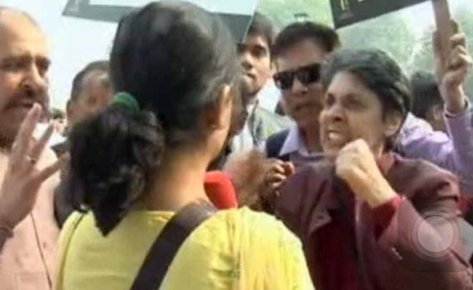
Published below is the text of a note that has been circulating over different social media platforms. We have left the typographical and printing errors as they are in the original. Paranoid in its content, it is also illustrative of the way the RSS ‘rumour-machine’ works to produce lies. In earlier days, it used to start circulating from the morning shakhas via the shakha participants. Nowadays it moves from one social media platform to another, with lightning speed. Continue reading How the Hindutva Propaganda Machine Manufactures Lies
A Memory from the 1970s
This is from a long time back.
I was eight or nine, a child obsessed with day-dreaming and playing alone with the tiny grass-flowers that grew abundantly in our yard. Memories of those times are coloured a brilliant green because that was the colour that overwhelmed all the seasons of the year. Our home at Muthukulam in Kerala comes back to the mind’s eye in greens of all shades, browns, rich reds, bright blues, silver of the ponds,canals, and the lake, the bright yellow of the mangoes and jackfruit, and innumerable flower- and fruit-hues. Continue reading A Memory from the 1970s
An ‘Anti National’ Response from JNU to the ‘Nationalist’ RSS: Pratim, Gargi and Lenin
Guest Post by Pratim, Gargi and Lenin.
As writers, historians, scientists, film makers, poets, actors and others return their awards in protest against the rising intolerance and anti-rational climate in this country, we in JNU keep stocking up accolades of a different kind. These accolades are ones which are very generously gifted to us from the RSS and its affiliates. These accolades come in more than fifty shades, only highlighting the deep seated trouble that these folks have in seeing this University up to them, despite their attempts to tarnish it. A few days back the ever-so-absurd/islamophobic/irrational Subramaniam Swamy endowed JNU students with the honours of being ‘Jehadis’, ‘Naxal’ and ‘Anti-National’.
Statement by Academics Against Intolerance
In light of the recent spate of killings of noted writers and intellectuals M M Kalburgi, Govind Pansare, and Narendra Dabholkar, and the Dadri lynching incident followed by forced nation-wide attempts at cultural policing, we feel that the current political dispensation headed by the Prime Minister is mandating an atmosphere of violence and fear. Continue reading Statement by Academics Against Intolerance
जो पहले नहीं हुआ: किशोर कुमार
Guest Post by KISHORE KUMAR
लगभग चालीस लेखकों के पुरुस्कार लौटाने के बाद अब फिल्म निर्देशकों ने भी पुरुस्कार लौटने शुरू कर दिए. यह पुरुस्कार बढती असहनशीलता और अभिव्यक्ति की स्वंत्रता के दमन के विरोध में लौटाए जा रहे हैं.
बी.जे.पी की राय में यह राजनीति से प्रेरित कदम है और यह सब बी.जे.पी के खिलाफ हो रही साजिश का हिस्सा है. बी.जे.पी के अनुसार आज कुछ ऐसा नया नहीं हुआ जो पहले ना हुआ हो और इन लोगों ने उस समय यह पुरूस्कार वापस क्यों नहीं लौटाए? बी.जे.पी. के अनुसार पुरुस्कार लौटना छदम धर्मनिरपेक्ष लोगों का नाटक है और असहनशीलता इतनी नहीं बढ़ी और माहौल इतना ख़राब नहीं हुआ कि इतना शोर मचाया जाए. Continue reading जो पहले नहीं हुआ: किशोर कुमार
A Dalit Employee’s Death and Its Aftermath – in a Central University: Solidarity for Amar Singh
The following is a guest post by SOLIDARITY FOR AMAR SINGH
We are writing this quite late. On 27 July 2015, a Monday, a young person named Amar Singh passed away in Lucknow. We came to know it very late, only on the other day, since we no longer reside in the city and, to confess, do not remain in regular touch with the happenings there. A leading Hindi daily’s Lucknow edition had reported this death two days later in a small column which we have just recovered. The report provided information about his father as well as about his native place, Faizabad. Though the daily did not state his caste in its description of what could be discerned like an accident, it made a note of his name, his age, his father’s name, and the job he was doing. But we knew Amar’s background. Amar was a dalit. He was Hela by caste and hailed from a poor family. His death could well be an accident, though what exactly happened remains mysterious. People who know a little about the incident are however emphatic that it was not suicide. But what appeared very intricate is how his death was reported and how the whole incident was handled since then, in the well-known public spheres—not only of Lucknow but also of other places.
The daily, Dainik Jagran, indeed reported it on 29 July 2015, stating that on Monday night at Nishatganj, a young man passed away under mysterious circumstances, and that he was a sanitation worker at the Moti Mahal lawns. It also informs that his relatives had asked for an investigation by the police. The report reads further like this: “Originally from Faizabad, the son of Ram Ratan, Amar Singh (23) had gone to his employer’s house at Nishatganj on Monday. Soon after leaving the premise there, he was found on the road in a state of unconsciousness. The passersby took him to a private hospital where he passed away.” The report ends there. It had appeared as an insignificant column at the left bottom of page 9 of the daily, with one of the most common headings one can come across, “a young man dies under suspicious circumstances”. But who was this employer here? Who were the passersby? Continue reading A Dalit Employee’s Death and Its Aftermath – in a Central University: Solidarity for Amar Singh
Sursuri: Swaang
SWAANG is a Mumbai based cultural group, whose members include actors, writers, directors, singers and composers primarily working with the Hindi Film Industry in Mumbai. The members come from different parts of India and have been associated with progressive arts in the past.
Sursuri, their melodious new song, its melody in stark contrast to the bitterness of the lyrics, reflects on the indifference to growing injustice and intolerance in our country. It asks – What do you do when freedom, pluralism and rationalism are under relentless attack? Relax, don’t speak up, slurp up that hot tingling tea…and fall asleep.
Girl, Get Back your Dignity NOW: Indulekha Writes to Sumathikkuttyamma
Dear great-great granddaughter Sumathikutty
I am sure you never expected this missive. Yes, you may even think it impossible. But here am I, writing to you, from the other side of J Devika’s computer screen at which she is staring now, mouth open and goggle-eyed, right now. I don’t have to introduce myself – most Malayalees know me as Chandu Menon’s Soul-Daughter, and the Grand (Old) Lady of Modern Kerala (alas, some of the youngest know of Indulekha hair oil only!). Continue reading Girl, Get Back your Dignity NOW: Indulekha Writes to Sumathikkuttyamma
Statement by Artists, Curators and Critics Against Rising Intolerance in India
Text of a Statement by Artists, Curators and Critics in India against a Climate of Rising Intolerance in India
(Followed by Names of the 300 + Signatories, in Alphabetical Order)
The artist community of India stands in firm solidarity with the actions of our writers who have relinquished awards and positions, and spoken up in protest against the alarming rise of intolerance in the country. We condemn and mourn the murders of MM Kalburgi, Narendra Dabholkar and Govind Pansare, rationalists and free thinkers whose voices have been silenced by rightwing dogmatists but whose ‘presence’ must ignite our resistance to the conditions of hate being generated around us.
We will never forget the battle we fought for our pre-eminent artist M.F. Husain who was hounded out of the country and died in exile. We remember the rightwing invasion and dismantling of freedoms in one of the country’s best known art schools in Baroda. We witness the present government’s appointment of grossly unqualified persons to the FTII Society and its disregard of the ongoing strike by the students of this leading Institute. We see a writer like Perumal Murugan being intimidated into declaring his death as a writer, a matter of dire shame in any society.
While the Prime Minister of the country has been conspicuously reticent in his response to the recent events, the reactions of BJP ministers in his government reveal their ignorance and prejudice. Mahesh Sharma, Minister of State for Culture, has made abhorrent comments about mob lynching and murder. His remarks suggesting that writers should stop writing to prove their point are alarming – empowered as he is to take policy decisions in the domain of culture. Arun Jaitley, Minister of Finance, Information & Broadcasting, has mocked the actions of our respected writers as a manufactured ‘paper rebellion’. He asks for scrutiny of the political and ideological affiliations of those who are protesting.
To these and other such provocations there is a clear answer: while the actual affiliations of the protesting writers and artists, scholars and journalists may be many and varied, their individual and collective voices are gaining cumulative strength. It is this that the ruling party will have to reckon with: the protestors’ declared disaffiliation from a government that encourages marauding outfits to enforce a series of regressive commands in this culturally diverse country.
The scale of social violence and fatal assaults on ordinary citizens (as in Dadri, Uttar Pradesh; Udhampur, Jammu and Kashmir; Faridabad, Harayana) is escalating. The contemptuous comments about the religious minorities and Dalits made by those within the government confirm that there is little difference between the RSS-BJP mainstream and supposed ‘fringe’ elements. The perfunctory warnings and regrets issued by ruling party ideologues – to defend the agendas of ‘development’ and ‘governance’ advanced by Mr Narendra Modi – are merely expedient. The Sangh Parivar and its Hindutva forces operating through their goon brigades form the support base of this government; they are all complicit in the attempts to impose conformity of thought, belief and practice. Continue reading Statement by Artists, Curators and Critics Against Rising Intolerance in India
Lessons in Religious Bigotry from Pakistan and America: Fatima Tassadiq
Guest Post by Fatima Tassadiq
The last few months have been quite intense for Muslims in the US. The Syrian refugee crisis gave us gems like ‘hey, these people have smart phones! They cant possibly be fleeing a deadly war’ from twitter analysts. Then Donald Trump, the rising Republican star, informed us that some serious TV watching had led him to conclude that the presence of more men than women in the televised images of the refugees was ground for suspicion.
It took a heart-breaking picture of a dead Syrian toddler on a beach to compel conservatives to tone down their rabid xenophobia. And then there was the Ahmad Muhammad episode. The reaction to the arrest of the 14 year old for bringing a home made clock to school showed the best and worst of America. While many public figures including the president supported the teen, Atheist and Christian crusaders like Bill Maher and Bobby Jindal thanked the police for keeping them safe from a high school student. Continue reading Lessons in Religious Bigotry from Pakistan and America: Fatima Tassadiq
A Letter to Modi from a Former Supporter: Bhawni Mehrotra
Guest post by BHAWNI MEHROTRA
Dear Modiji,
I’m glad you spoke. Even though it was devoid of any personal remorse and limited to calling the Dadri lynching an “unfortunate and unwarranted” incident at Sasaram. Even though it was to cash in on ‘communal harmony’ during an election rally in Bihar. Even though it was a mere paraphrasing of the President’s quote once before at Nawada (we know of your limited vocabulary beyond acronyms and your “may-the-force-be-with-you” love for quoting). Still, I’m glad that you managed something! However, the one thing that you have failed miserably to manage (and let’s leave the ambling economy and your familial relations out of this) is the ‘fringe elements’ that come as part of the ‘BJP family pack’ offer. Sadly, under your ‘good governance’, the fringe has been asserting itself as the mainstream. Even sadder is that under ‘you’, the fringe is the mainstream.
The icing on the cake are your own MPs and ministers. Initially, what I thought of as verbal diarrhea on their part is actually proving to be a string of comments that are a part of a larger orchestrated communication message. Each message has a defined audience suited to their language and idioms. They all suffer from a dangerous saffron strain, exactly the kind that has fathered the ISIS, the Taliban and so on. Whether it be Yogi Adityanath’s remark, calling on Hindus to organize themselves; or Sadhvi Niranjan Jyoti’s unparalleled comparison between a “Ramzaada” and a “Haramzada”; or Nitin Gadkari’s reminder of the government being one of “Rambhakts”- all seem to be competing for being the most ridiculous. Did you mean “Hindutva First” and not “India First”? I’m sorry that I was so awestruck by your gazillion rupee election campaign (the one thing that you managed brilliantly) that I didn’t read the fine print. Therefore, it is not your failure, it’s mine. Had I voted sensibly, Mohammad Akhlaq wouldn’t be dead today. Continue reading A Letter to Modi from a Former Supporter: Bhawni Mehrotra
आज़ादी और विवेक के पक्ष में प्रलेस, जलेस, जसम, दलेस और साहित्य-संवाद का साझा बयान
देश भर में चल रहे लेखकों व साहित्यकारों के विरोध के सन्दर्भ में लेखकों के पांच संगठनों – प्रगतिशील लेखक संघ, जनवादी लेखक संघ, जन संस्कृति मंच, दलित लेखक संघ व साहित्य-संवाद – ने आज दिल्ली में निम्नलिखित बयान जारी किया :
देश में लगातार बढ़ती हुई हिंसक असहिष्णुता और कट्टरपंथ के ख़िलाफ़ पिछले कुछ समय से जारी लेखकों के प्रतिरोध ने एक ऐतिहासिक रूप ले लिया है. 31 अगस्त को प्रोफेसर मल्लेशप्पा मादिवलप्पा कलबुर्गी की हत्या के बाद यह प्रतिरोध अनेक रूपों में प्रकट हुआ है. धरने-प्रदर्शन, विरोध-मार्च और विरोध-सभाएं जारी हैं. इनके अलावा बड़ी संख्या में लेखकों ने साहित्य अकादमी से मिले अपने पुरस्कार विरोधस्वरूप लौटा दिए हैं. कइयों ने अकादमी की कार्यकारिणी से इस्तीफ़ा दिया है. कुछ ने विरोध-पत्र लिखे हैं. कई और लेखकों ने वक्तव्य दे कर और दीगर तरीक़ों से इस प्रतिरोध में शिरकत की है.
दिल्ली में 5 सितम्बर को 35 संगठनों की सम्मिलित कार्रवाई के रूप में प्रो. कलबुर्गी को याद करते हुए जंतर-मंतर पर एक बड़ी प्रतिरोध-सभा हुई थी. इसे ‘विवेक के हक़ में’ / ‘इन डिफेन्स ऑफ़ रैशनैलिटी’ नाम दिया गया था. आयोजन में भागीदार लेखक-संगठनों – प्रलेस, जलेस, जसम, दलेस और साहित्य-संवाद — ने उसी सिलसिले को आगे बढाते हुए 16 सितम्बर को साहित्य अकादमी के अध्यक्ष विश्वनाथ प्रसाद तिवारी को एक ज्ञापन सौंपा जिसमें उनसे यह मांग की गयी थी कि अकादमी प्रो. कलबुर्गी की याद में दिल्ली में शोक-सभा आयोजित करे. विश्वनाथ त्रिपाठी, मुरली मनोहर प्रसाद सिंह, चंचल चौहान, रेखा अवस्थी, अली जावेद, संजय जोशी और कर्मशील भारती द्वारा अकादमी के अध्यक्ष से मिल कर किये गए इस निवेदन का उत्तर बहुत निराशाजनक था. एक स्वायत्त संस्था के पदाधिकारी सत्ता में बैठे लोगों के खौफ़ को इस रूप में व्यक्त करेंगे और शोक-सभा से साफ़ इनकार कर देंगे, यह अप्रत्याशित तो नहीं, पर अत्यंत दुखद था. अब जबकि अकादमी की इस कायर चुप्पी और केन्द्रीय सत्ता द्वारा हिंसक कट्टरपंथियों को प्रत्यक्ष-परोक्ष तरीके से दिए जा रहे प्रोत्साहन के खिलाफ लेखकों द्वारा पुरस्कार लौटाने से लेकर त्यागपत्र और सार्वजनिक बयान देने जैसी कार्रवाइयां लगातार जारी हैं, यह स्पष्ट हो गया है कि लेखक समाज इन फ़ासीवादी रुझानों के विरोध में एकजुट है. वह उस राजनीतिक वातावरण के ख़िलाफ़ दृढ़ता से अपना मत प्रकट कर रहा है जिसमें बहुसंख्यावाद के नाम पर न केवल वैचारिक असहमति को, बल्कि जीवनशैली की विविधता तक को हिंसा के ज़रिये कुचल देने के इरादों और कार्रवाइयों को ‘सामान्य’ मान लिया गया है. Continue reading आज़ादी और विवेक के पक्ष में प्रलेस, जलेस, जसम, दलेस और साहित्य-संवाद का साझा बयान
The Indian Unconscious : Ravi Sinha
Guest Post by Ravi Sinha
There is yet another head on the political platter of the world’s largest democracy. This head is not metaphorical. It does not signify a disgraced leader or a government that has fallen. It is a literal head dripping with literal blood – battered with bricks that supported a leg-less bed. The bed belonged to one Muhammad Akhlaq who lived in a village called Basehara in Dadri, Uttar Pradesh, not too far from the national capital of India. The head too belonged to him.
It has been only a few days but this latest episode in the long-running Indian serial is already well-known to the world. On a late September night it was announced over the loudspeakers of the village temple that there was going to be beef on Akhlaq’s dinner plate. A mob hundreds-strong – some say thousands – gathered within no time. It attacked the family killing Akhlaq on the spot and badly injuring his son, Danish.
In the meantime, meat-loafs confiscated from the family fridge have been sent for forensic examination. The system of justice must check whether it actually was beef, although, as one commentator points out, “…mere possession of beef isn’t illegal in Uttar Pradesh.”[1] Shedding helpful light on feebly lit corners of the Hindu moral universe, a prominent Hindutva ideologue wrote in a national daily, “Lynching a person merely on suspicion is absolutely wrong, the antithesis of all that India stands for and all that Hinduism preaches.”[2] The lynch-mob should have waited till the forensic reports came.
A few suspects have been apprehended for the murder. This has made the village livid with anger. There are protestations that those arrested are innocent. Journalists have been attacked for making such a big thing out of a small matter and bringing a bad name to the village. Cameras have been broken and OB vans damaged. There is a pertinacious wall of angry women guarding the village against any further intrusion by outsiders who can neither understand the village mind nor the Indian culture.
It is not easy to understand the collective mind of an Indian village. Even learned anthropologists are of little help. Their ethnographic techniques of studying a form of life from its internal standpoint are particularly susceptible to the rationalizations of a complex cultural species. If anyone has a chance, it would, perhaps, be a villager who has stepped out – an Archimedean Point created out of the same cultural universe. Ravish Kumar, by now a near iconic journalist and anchor of a prominent Hindi news channel, stood out for this very reason.[3] His eyes could see the natural rhythm and the instinctual response of an Indian village in the immediate aftermath of a collective crime. Nearly everyone had disappeared from the village. Whoever could be found claimed that he was miles away at the time of the incident. The lynch-mob had materialized instantaneously out of thin air. It had as quickly melted away after the job was done. Everyone has now returned to defend the honor of the village and strategize about how to deal with the unwarranted intrusions of modernity including that of the law. Continue reading The Indian Unconscious : Ravi Sinha
House of Cards
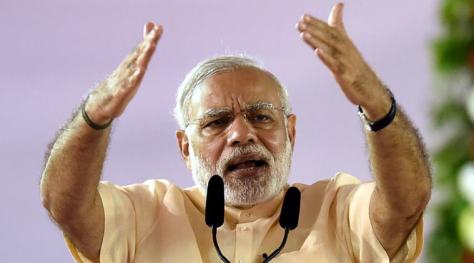
Anybody with a passing interest in consistency or coherence might be forgiven for being stumped at the political spectacle unfolding right now. Yesterday, Prime Minister Narendra Modi assured us that his government was committed to reservations. The statement was made at a ceremony to inaugurate the Ambedkar memorial at the Indu Mills compound in Mumbai. The fact that ordinary Dalits, in the habit of thronging any joyous celebration on Ambedkar in big numbers, were kept out of the ceremony, is possibly irrelevant. After all, officialese is officialese, and no political party – certainly not the BJP – has a monopoly on stiff-necked commemorations of people’s leaders that want nothing to do with the people. It is Modi’s commitment to reservations and the Indian constitution that is of interest. In some ways a statement of this nature made at the inauguration of an Ambedkar memorial, makes perfect sense. Apart from the occasion and locale, also not coincidental was the timing of Modi’s statement – one that he himself alluded to, when he referred to the bitterly fought Bihar elections now underway, “With a BJP government in power and polls getting under way, a malicious propaganda is being spread that the government is against reservation…”. The fact that the anti-BJP mahagathbandhan (grand alliance) in Bihar has made reservations one of their chief planks, with Lalu Prasad Yadav declaring in his inimitable style that he will kill himself if reservations are removed, is relevant.
Zooming back from the Ambedkar memorial event, the PM was clearly also responding to the threat to his Sabka Saath Sabka Vikas model begun a couple of months ago by the irrepressible Hardik Patel. Patel – erstwhile BJP supporter, self-styled Patidar-Patel revolutionary and a wild child in imminent danger of being silenced (or coopted) by the BJP – was temporarily subdued by the Gujarat administration following the wave of violence over his first call for reservation, but resurfaced a couple of days ago to be the nightmare Modi hadn’t dreamed yet – saying his aim was to expose the “Gujarat model of development”. This is for the current party nothing short of the youngest born of a rambling illustrious family running into the street from the family mansion saying our house is made of mud! our house is made of mud!
Modi’s Speech, his Silence and Dadri Redux in Mainpuri
Every newspaper in India carried the same headline on Friday, the 9th of October: ‘Modi breaks silence on Dadri lynching.’ It says something about the breathless desperation of the Indian press to hear the prime minister say something, anything, that could be interpreted as his disapproval of political barbarism, that there wasn’t, in fact, a word in his speech about the Dadri lynching. – Mukul Kesavan in ndtv.com
You know what has been agitating the minds of millions of us, Indians — the future of our pluralism. You have stated your position in terms of ‘sabka sath, sabka vikas‘. And this is quoted and cited on your behalf repeatedly as a mantra. But, Pradhan Mantriji, this is certainly not adequate. We need to hear you, our Prime Minister, directly and clearly and with an urgent reference to the present situation, which is nothing less than a tragedy. Over the last few months we have had more than one tragedy. Can we really not see the connections between the so-called stray incidences all over the country, from the murders of Dabholkar, Pansare and Kalburgi to that of Mohammad Akhlaq. Your direct voice needs to be heard now, unless you do not consider this an event of significance. And now, the ambiguity of what you said yesterday only makes me send you this appeal for your truthful intervention. TM Krishna’s Open Letter to the Prime Minister
While Modi’s cheer leaders in the media were telling us that the prime minister had finally ‘broken his silence’ (see Apoorvanand’s piece on this here), there were others who read the meaning of his speech far more accurately.They knew exactly what Modi was saying; they knew without having to do a content analysis of His speech that, if anything, despite being shamed to an extent by the President, Pranab Mukherjee’s statement the previous day, he actually refused to say anything about the Dadri incident let alone condemn the crime or its perpetrators. They understood clearly that his speech was merely a continuation of his sinister and devious silence. They understood like no media commentator or analyst did that what he said in Munger was a green signal for them to go ahead with their activities. Thus what happened in Mainpuri today is nothing to be surprised about.

Continue reading Modi’s Speech, his Silence and Dadri Redux in Mainpuri
Open Letter to FB : Change the Authentic Name Policy — Nameless Coalition
Nameless Coalition, a group of NGOs, has written an open letter to Facebook demanding justice for individuals who have been affected by it’s ‘authentic identity’ policy. Please read it at the Electronics Frontier Foundation Action Centre.Those interested in supporting this effort are requested to sign the petition.
In Kerala, the abuse of women online became a hotly-discussed issue over the heavy online abuse suffered by Preetha G P, which provoked a wider debate on FB policy and strong responses in support of Preetha from other women politically active on FB. The campaign For A Better FB was initiated by them.
I add below reflections by Anila Balakrishnan expressed on FB, on her support for the campaign. They have been translated from the Malayalam and posted here with her permission:
Facebook has never given me the feeling that it is a space where I can behave and speak out my views freely. On the contrary, it has always reminded me that I am a woman and must therefore tread carefully. That is the reason why I decided to reduce myself into someone who had nothing to say in public, someone who spoke only in the presence of friends. I just decided that I will not sacrifice my peace for the misogyny and hate-speech of the hordes who know nothing of me or my politics; I was not willing to spend time and energy on confronting them. When my posts became public because of sheer necessity or even by mistake, these hordes reminded me quickly that they should be confined to friends alone. Those were not ideological confrontations; they were vicious attacks the female gender itself. And so I have not felt brave enough to say anything that could invite public comment on FB. Women who have showed the courage to say such things have not been spared by the hordes, for sure.
But this was never my choice. I do believe that opinions ought to be public; that one must engage with each and every person in the crowd. But I am not willing to take on myself from the social media personal wounds that go beyond differences and diversity in views . So the decision to reduce myself is not my choice – it was imposed on me. I have not heard of any man who makes his views public being abused because of his body. I do not know of any man who has to maintain constant vigilance against such attacks. That’s how Facebook remains as patriarchal as any other social media, as society itself. And that’s precisely why I am part of this campaign for a better FB.
Another One Bites the Dust: “Cultural Pollution” and the Nehru Memorial Museum & Library: Niyati Sharma and Snigdha Kumar
This is a guest post by NIYATI SHARMA AND SNIGDHA KUMAR

The latest in a line of institutions to fall victim to the BJP government’s campaign against “cultural pollution” is The Nehru Memorial Museum and Library (NMML). The agenda is loud and clear – anything which ‘pollutes’ the current government’s preferred way of life and thinking will be done away with. Bans such as the recent ones on porn and meat are the most obvious instruments at the disposal of the government to achieve this goal. The more effective interventions, however, are not those which instantly deny people their choices and freedoms. Presented instead as minor improvements and renovations, interventions in art, history and academic institutions allow the government to introduce subtle long term changes – changes with the capacity to access and alter our very being.
Given the enormity of these interventions in the long run then, it is particularly curious how the clear recent attempts to take over academic institutions such as the ICHR, FTII and now NMML have managed to raise only a few eyebrows while the bans on porn (and meat to an extent) have met with much protest and were subsequently lifted. Perhaps this is because such spaces appear to be remote islands inhabited only by those interested in history, film and/or academic research. Only such an impression can explain the rather meek public debate and outcry that these clearly targeted changes have generated.

