Category Archives: Culture

September 5 as Teachers’ Day – The Dalit Critique: Abhay Kumar

Guest post by ABHAY KUMAR

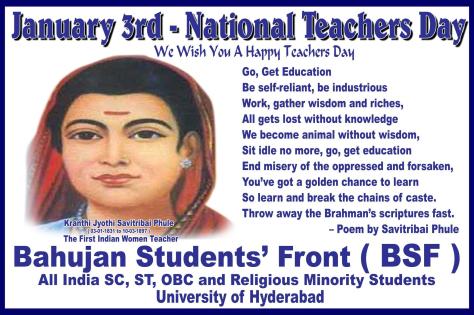
While the schools and educational institutions of the country have been observing September 5 as Teachers’ Day since 1962, on the birth anniversary of the first Vice-President and second President of independent India Dr. Sarvepalli Radhakrishnan (1888-1975), a section of Dalits, mostly students, activists and intellectuals at public universities, are increasingly denouncing its observance. They contend that the birthday of Radhakrishnan, a Brahmin, should no longer be held as Teachers’ Day because he had made no contribution to the educational uplift of lower castes and classes. Instead they exhort people to observe National Teachers’ Day on January 3, the birth anniversary of the nineteenth century social reformer, and teacher from backward caste, Savitribai Phule (1831-1897).

national_teachers_day

According to the biographer of Savitribai Phule, M. G. Mali (Krantijyoti Savitribai Phule, 2005), she was taught by her husband in a school run under the shade of a mango tree. Access to education enabled her to become aware about egalitarian movements at global level as she managed to read the biography of Thomas Clarkson (1760-1846), who fought for liberation of the Black. Later when she became a teacher, it was vehemently opposed by reactionary Brahmins who pelted stone and threw dung on her in order to “save” orthodox Hindu religion. When frustrated Brahmins were unable to deter the zeal of Phules about imparting education, they succeeded in reasoning with her father-in-law, Govinda Rao, to force them to leave home. She preferred eviction with her husband from home to giving up her mission on education. Despite the opposition, they continued to persuade parents to send their daughters to schools. As a result of their hard work, 18 schools were opened from 1848 to 1852. Her dedication to spread education, particularly among subalterns is self-evident from a few lines of her poem. ‘All gets lost without knowledge… We become animal without wisdom…So learn and break the chains of caste….Throw away the Brahman’s scriptures fast.’   Continue reading September 5 as Teachers’ Day – The Dalit Critique: Abhay Kumar

Rape and Rakhi – Patriarchal-Communal Narratives: Kavita Krishnan

Guest Post by KAVITA KRISHNAN

Even as the communal cauldron in UP is kept on the boil, there is news that the RSS has launched a campaign to tie Rakhis to lakhs of Hindu men, asking them to pledge to protect their sisters from Muslim men and “love jehad.” The VHP has been running a helpline urging Hindus to approach them “if your daughter is being harassed by Muslim boys.” And a khap panchayat in Muzaffarnagar has imposed a ban on mobile phones and jeans for girls, claiming that these result in ‘eve-teasing’.

Woven into the above events is an old, familiar theme – that of patriarchal restrictions packaged as ‘protection’. In the wake of the anti-rape movement that followed December 16 2012, the streets of Delhi and many other parts of India had resounded with the voices of women declaring ‘Don’t take away our freedoms in the name of ‘protection’ – protect our right to fearless, fullest freedom instead’. Those women had raised their voice demanding freedom from sexual violence – and also freedom from rape culture that advices women to dress decently to avoid rape; and freedom from the khap panchayats, freedom even from the restrictions imposed by one’s own fathers and brothers.

Continue reading Rape and Rakhi – Patriarchal-Communal Narratives: Kavita Krishnan

स्तब्धता और खामोशी

स्तब्धता क्या हमेशा भाषा के लोप या उसकी असमर्थता की अवस्था है? ऐसे अवसर होते हैं जब स्तब्धता अपने आप में भाषिक प्रतिकार या भर्त्सना बन जाती है.अगर चीखना एक छोर है भाषा-व्यवहार का, तो खामोश हो जाना दूसरा छोर. यह भी होता है चीख इतनी तेज़ हो और इतनी तीव्र कि साधारण श्रवण-क्षमता के बाहर हो जाए.

जिसे चुप्पी कहा जाता है, वह कुछ मौकों पर एकतरफा और कई बार दोतरफा फैसले का नतीजा होती है. खामोशी,मौन या स्तब्धता प्रायः इस बात का सूचक होती है कि भाषा के लिए जिस सामाजिक पर्यावरण की व्याप्तता को सहज माना जाता है,वह छिन्न-भिन्न हो गया है.यह नहीं कि बोलने को कुछ नहीं है, लेकिन बोलने वाला जान चुका होता है उसका बोलना व्यर्थ है क्योंकि उसे सुनने की पात्रता सामने का पक्ष खो बैठा है. Continue reading स्तब्धता और खामोशी

Women Have Been Branded Liars!

Guest Post by ANUBHA SINGH and SURABHI SHUKLA

The recent Supreme Court judgment in the case of Arnesh Kumar v. State of Bihar & Anr. (Criminal Appeal No. 1277 of 2014) has once again brought to light the concern shared by the larger society about the ‘misuse’ of Section 498-A of the Indian Penal Code (hereinafter “IPC”) and the Dowry Prohibition Act, 1961. This concern has been raised many times in the past (and present) and the judiciary has gone to the length of labeling this ‘misuse’, especially that of Section 498-A, IPC,  ‘legal terrorism’ (in Sushil Kumar Sharma v. Union of India JT 2005 (6) SC 266.)

However, what has changed this time is that through this judgment the Supreme Court has endorsed and legitimized the common stereotype that women exaggerate and fabricate stories of violence to seek vengeance against their husbands and matrimonial families. Continue reading Women Have Been Branded Liars!

Anti-Semitism Cannot be the Response to Israeli Attacks on Gaza

Extremely disturbing reports of anti-Israeli sentiments spilling over into generalized attacks in France have been coming in lately.  This is completely unacceptable. The just cause of the Palestinian people is about occupation of their land by Zionists and all Jews are by no means responsible for the brutality that Israel is exhibiting in its attacks on Gaza, sparing no one and even specifically targeting small children. This is not a religious or a racial issue but one of political justice. Let us make no mistake that any attempt to make it into either a religious or race issue will only harm the Palestinian cause in the long run. Here is an extract from a report in Huffington Post:

France’s politicians and community leaders have criticised the “intolerable” violence against Paris’ Jewish community, after a pro-Palestinian rally led to the vandalizing and looting of Jewish businesses and the burning of cars.

It is the third time in a week where pro-Palestinian activists have clashed with the city’s Jewish residents. On Sunday, locals reported chats of “Gas the Jews” and “Kill the Jews”, as rioters attacked businesses in the Sarcelles district, known as “little Jerusalem”…

Religious leaders gathered for an interfaith service on Monday to call for calm, and Haim Korsia, the chief rabbi of France, and Hassen Chalghoumi, the imam of Drancy shook hands on the steps of the synagogue.  Read the full report here

That said, it also needs to be underlined that in this no-holds-barred war, Zionists themselves have been keen and eager to see that the anti-Zionist feeling is transformed rapidly into an anti-Semitic one. Thus Mondoweiss published a Youtube video along with a report that showed that the attack on the synagogue was actually provoked by members of the Jewish Defense League. Mondoweiss’ story has since been confirmed by the President of the Synagogue de la Roquette. His words:

In an interview broadcast Friday on the 24-hour news channel i-Télé, Serge Benhaïm said that there was “not a single projectile thrown at the synagogue” and that “at no moment, were we ever physically in danger.” (“Pas un seul projectile lancé sur la synagogue”. “A aucun moment, nous n’avons été physiquement en danger.”)

While Benhaïm did not describe the street fight outside as resulting from a JDL “provocation”, he did say that the extremist group smashed up a cafe on Rue de la Roquette (“le président de la synagogue de la rue de la Roquette confirme également que la LDJ a ‘cassé des chaises et des tables’) in order to confront pro-Palestinian demonstrators (“pour aller livrer ce face-à-face”). He added that he did not condone the action, and described the JDL as having a “bad reputation” using a French phrase – “une renommée un peu sulfureuse — that is not done justice by a literal translation. Read the full Mondoweiss report here.

There will be – as there are – desperate attempts to drown the groundswell of anti-Israeli sentiment in a flood of outcries of anti-Semitism, by all interested quarters. There is need therefore to see that no quarter is yielded to those who wish to transform the present mood of anti-Zionism into anti-Semitism.


The Sheepification of Bakistan: Mina Malik-Hussain

We are reproducing this piece by Mina Malik-Hussain, which appeared in The Nation (Pakistan) as it deals with an important issue which concerns the changes that are taking place within subcontinental Islam. The piece underlines the great cultural battle underway within Islam which, in the final analysis is about being Muslim in many different ways. Mina Malik-Hussain is a feminist based in Lahore.

When we were small, there was a month and it used to be called Ramzan. It was Ramzan on television, it was Ramzan in the newspaper with the sehr-o-iftar timings and while nobody had a cell phone or Facebook to wish anyone, it would have been Ramzan Mubarik nonetheless. Sometimes if one was being quite linguistically adventurous it would be Ramazan, but nobody seemed to mind.
And then, insidiously, The Arabs crept up on us. It wasn’t like the return of Muhammad Bin Qasim, but somehow Ramzan became Ramadan. Nobody knew exactly how it happened, but almost overnight our crisp z’uad sound became a lisping Arab burr, and we—a nation of language speakers with no apparent consonant pronunciation difficulties—were flung into the downward spiral of an affectation obsession. Now it was cool to sound Arab, and soon enough it began to be increasingly desirable to look it. Cue Al Huda, cue our streets being lined with gangly palm trees that do nothing, either in terms of beauty or shade, cue the availability of the most bling Islamic cover-up gear you’ll see this side of Dubai.

Still, as a nation we were still fairly open-minded about this, so we fasted year after year and didn’t really pay attention to the semantics of it. We were busy trying to live our lives and be regular Pakistanis, but The Arabs kept making inroads onto our cultural minds. One year ‘khuda-hafiz’, that old and comfortable way of saying goodbye and Godspeed, became ‘Allah hafiz’ with the dubious reason of having to specify which deity to whose protection one was recommending you. Because here in multi-religious, multi-cultural and secular Pakistan there was actual leeway where one would wonder who exactly Khuda is, and perhaps not want to be entrusted to a pagan god. Some people resisted, and continue to resist Allah hafiz and keep saying khuda-hafiz with the logic and hope that whatever His name, He will still protect and love them. Also if it was good enough for one’s grandfather and great-grandfather, it was just fine for them too. Read the full article here

Sunni Muslims Must Reject ISIS ‘Caliphate’: Irfan Al-Alawi

Even as Israeli bombings and ground attacks on Gaza continue, there are no less disturbing reports of ISIS attacks on Christians, the last of whom are reportedly fleeing Mosul. One of the oldest churches has been attacked and reduced to ashes. The rise of ISIS is not only a danger signal for non Muslim or even non Sunni minorities, it represents one of the most serious threats in recent times to the entire heritage of Islam and the diversity within it as well. We reproduce below a piece by Irfan Al-Alwai argues that Sunni Muslims must reject the ISIS’ new ‘Caliphate’. Irfan Al-Alawi is the executive director of the Islamic Heritage Research Foundation and international director of Centre for Islamic Pluralism in the United States. Here are some extracts from the article:

On July 5, the pan-Arab television channel Al-Arabiya, Saudi-owned but based in Dubai, reproduced images of vandalism by the “Islamic State,” using bulldozers against Sunni and Sufi shrines, and dynamite to blow up Shia meeting houses, or husseiniyat, in the Iraqi province of Nineveh, which the marauders seized in June. The pictures were released by the “Islamic State.” Four Sufi shrines and six Shia husseiniyat had been leveled.

Shia mosque being dynamited by ISIS

In addition, Chaldean Christian and Syrian Orthodox cathedrals in Mosul, the capital of Nineveh province, were found emptied by the fanatics, who removed their crosses then hung black “Islamic State” flags on them.

The “Islamic State,” through its supposed caliph, declared, “rush O Muslims to your state. Yes, it is your state. Rush, because Syria is not for the Syrians, and Iraq is not for the Iraqis. The earth is Allah’s… Muslims everywhere, whoever is capable of performing hijrah [emigration] to the Islamic State, then let him do so, because hijrah to the land of Islam is obligatory… We make a special call to the scholars, fuqahā’ [experts in Islamic jurisprudence], and callers [to religion], especially the judges, as well as people with military, administrative, and service expertise, and medical doctors and engineers of all different specializations and fields… their emigration is wājib ‘aynī [an individual obligation], so that they can answer the dire need of the Muslims for them.”
This demand reveals the cynical nature of the “Islamic State” and its bid for jurisdiction over all Sunnis. Although it has seized parts of Syria and Iraq, it cannot defeat the bloodthirsty regime of Bashar Al-Assad in Damascus, and it certainly cannot protect Muslims in Burma. Regardless of its bluster, it cannot “conquer Rome,” as it threatens. Therefore, the “caliph” pleads for a supposed religious duty by Sunnis throughout the world to travel to the “Islamic State” and reinforce it. Read the full article here.

Why its hard for me to accept the killing of Mohsin Sheikh in Pune: Sameer Khan

Guest Post by SAMEER KHAN

The nation was outraged with the news of the murder of Mohsin Shaikh in Pune following the riots after the suspected defaming face book post. Many people were horrified by the killings of the young techie. The news media and the social media used the word Pune in a very generic manner but the fact was much of Pune remained unaffected with the violence. The initial protest that started on the day of FB rumors took place mainly in selected places and appeared to have been clearly organized by some group that was closely coordinating its cadres by use of social media and other communication by circulating fake planted stories and directing the mobs to target specific places.

The place Mohsin Shaikh was murdered, and where the worst damage occurred was the Hadapsar area of Pune which is actually on the outer limits of Pune towards the Sholapur road.Hadapsar was a sleepy town couple of decades ago. It is Hadapsar that is the native place of the author of this article. My father was raised in Hadapsar and completed his primary education from the local Bunter School, one of the oldest surviving schools in the region

I was born and raised in South Mumbai and my world came crashing down when my father decided to move back to his native Hadapsar in mid 1980’s. I was in 7th grade and my transition from a south Mumbai boy to sleepy Hadapsar town was a very painful one. It took my very long to reconcile the fact that Hadapsar the sleepy semi rural town was now my new home. Continue reading Why its hard for me to accept the killing of Mohsin Sheikh in Pune: Sameer Khan

To Understand the Mind of NDA II, turn to Singhal and the Sangh: Teesta Setalvad

Guest post by TEESTA SETALVAD

I do not expect there to be any outrage, comment or protest over the most recent rants of Ashok Singhal, senior RSS leader and patron of the Viswa Hindu Parishad (VHP), an RSS offshoot in an interview published in the July 17,2014 of The Hindustan Times  daily. We have as a nation and a polity become sinisterly and compliantly accustomed and accepting of aggressive hatred spilt by the majority and hypocritically touchy and outraged by similar rantings by so-called leaders of the minority. How deep this hypocrisy of majoritarianism has spread is evident in the coverage and depiction of hate speech by our electronic media that picks and chooses what to show, how often and when. So the hate ridden rantings of an Owaisi, or a Qader Rana will be run and re-run across networks and channels but equally insidious and as or more dangerous ravings of politicians who play on the identity of the majority are glossed over, hidden and remarkably, not even commented upon.

Singhal tells us through this interview today, that he welcomes with all his heart the first RSS pracharak as Prime Minister of India but, adding the proverbial sting to the tale, says that what is truly historical and remarkable about NDA II’s victory is that this electoral win was ensured without Muslim votes or support. Barefacedly lending voice to what more sophisticated faces in government including the now maun PM would presently rather leave unsaid, Singhal gloats on the disenfranchisement of India’s largest minority during democratically conducted elections. A time-tested tactic of the octopus-like sangh that generates terror and intimidation in the public sphere by the mutterings of a Singhal and a Togadia and allows the flag bearer beneficiaries of this hate-splitting in governance, the luxuries of convenient, intermittent,  silences.  The Advani-Vajpayee duo in the first NDA were a fine example of this. [Though,  Advani often relapsed into expressing well trained views especially after the brutal burning alive of Graham Staines and his sons (Orissa, January 1999).] NDA II has witnessed some interesting role reversals with many of the flag bearers of hate mongering now at the helm: a cabinet full of hate mongers are in the government’s driving seat. Singhal also emphasises and welcomes – undoubtedly for the reassurance of the sangh support base — all those being chosen for post of Governors are sanghis,  Ram Naik or a  Kesari Nath Tripathi. Continue reading To Understand the Mind of NDA II, turn to Singhal and the Sangh: Teesta Setalvad

The ‘Patriots’ of Our Times !

India is a land of surprises, say many.

And how can Bihar, which they say has been witness to a glorious past, be an exception. Of course nobody could have imagined that ‘surprise of surprises’ or (should I call) ‘mother of all surprises’ would be reserved for the Bihar police. In fact it was one life time experience for all of them there where they found how ‘Rs 50,000 can balloon into Rs 1.14 crore’.

The central character in the still unfolding drama is Giriraj Singh, a RSS activist since his childhood days, and a senior leader in the state, who has already carved out a name for himself nationally for his controversial statements. People would remember how he proposed to Modi opponents to go to Pakistan during election campaign or how he eulogized Brahmeshwar Singh, leader of Ranveer Sena, the private army of landlords which had been allegedly responsible for hundreds of killings of innocents as ‘true Gandhian of our times’ when the dreaded figure was killed in a gang war. As an aside it needs be mentioned here that Giriraj Singh was one of the first in the state who had vouched for Mr Narendra Modi’s PM candidature also. Continue reading The ‘Patriots’ of Our Times !

Chhering – A Guiding Star

This article has appeared in the June issue of Terrascape

Travelling with a knowledgeable guide makes a trip worth it. And if the guide is someone like Chhering, you’ll cherish the trip all your life.

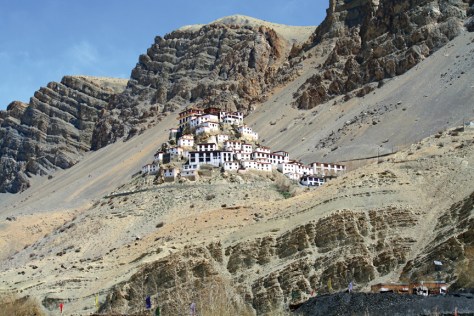
Kee Monastery, Spiti

Broadly speaking there are two kinds of human beings, the inquisitive and the conformist. It is the inquisitive kinds who try new things; experiment, ask questions, make most discoveries, travel to unchartered territories and constantly venture into terrain, geographic and cephalic, where angels fear to tread. The conformist does none of the above. They travel only the well-trodden path, visit places where the food, the hotel, the weather, in fact nothing whatsoever has the potential of throwing up a surprise.

The world cannot exist without either. The inquisitive opens up the world, both physically and in terms of ideas, while the conformist fashions new territories – geographical and cerebral – habitable and familiar for others and prepares the ground for the next generation of the inquisitive to venture beyond what has by then become familiar.

It is a fact that I am not one of those who can be included among the ‘inquisitive’, not in the sense in which I use the term here. It is equally true that I do not want to belong to the category that I have chosen to describe as the ‘conformist’. Why I do not want to be placed in the second category will be revealed once you go through this episode placed below. Your perusal of the same would perhaps justify my reluctance to be counted among the second category. Continue reading Chhering – A Guiding Star

नचैया,गवैया और पढ़वैया

‘कहीं रिहर्सल के लिए जगह दिला दो,’आफ़ताब ने कहा. हमारी मुलाकात लंबे अरसे बाद हो रही थी. मैं जानता था कि आफ़ताब इप्टा के साथ व्यस्त है. इधर कोई नाटक तैयार हो रहा है, यह खबर भी थी. लेकिन मालूम यह भी था कि इप्टा का अभ्यास पार्टी दफ़्तर  में चलता रहा है.कई महीने पहले अजय भवन की सबसे ऊपरी मंजिल पर नगीन तनवीर के साथ एक बातचीत में हिस्सा लेने भी गया था.इसलिए मैंने पूछा,‘अजय भवन तो है ही!’ ‘निकाल दिया,’ आफ़ताब ने मुस्कराते हुए कहा, ‘….. का कहना है कि पार्टी का दफ्तर राजनीति जैसे गंभीर काम के लिए है, नाच-गाने की प्रैक्टिस के लिए नहीं.’ ‘औरों ने क्या कहा?’मेरी जिज्ञासा अबोध बालक जैसी थी क्योंकि उत्तर मुझे भी पता था.बहुत शोर होता है, तरह-तरह के लड़के-लड़कियाँ आते हैं जो देखने में ही भरोसे लायक नहीं जान पड़ते.वे नाचते-गाते हैं, एक ही संवाद को बार-बार बोलते जाते हैं. इससे दसियों बरस से पार्टी दफतर में बने मार्क्सवाद के इत्मीनान के माहौल में खलल पड़ता है. दूसरे कॉमरेड ने थोड़ी तसल्ली देने को कहा कि अभी वहाँ पार्टी क्लास चल रहा है. हो सकता है, उसमें डिस्टर्बेंस के चलते ही मना किया हो. मालूम हुआ कि पार्टी क्लास के सामने इप्टा को वह नाटक पेश करना है जो अभी वह तैयार कर रही है.हफ़्तों तक जो विचारधारात्मक बौद्धिक श्रम वे करेंगे, उसके बाद उन्हें विश्राम देने के लिए और उनका मनोरंजन करने के लिए शायद इप्टा के नाटक का इंतजाम किया गया हो!

अक्सर राजनीतिक दल अपने सम्मेलनों के अंत में गीत-संगीत या नाटक का आयोजन चाहते हैं. उनकी समझ है कि मुख्य काम तो वे कर चुके ,अब आनंद या विनोद की बारी है. शुभा मुद्गल ने इसी प्रवृत्ति से खीजकर मुझसे कहा था कि जब तक उनके संगीत की राजनीति को ‘एक्टिविस्ट’नहीं समझेंगे,वे उनके बुलावे पर आना पसंद नहीं करेंगी. Continue reading नचैया,गवैया और पढ़वैया

The Crisis of Devendran’s Father Muthu P.


One question I have faced umpteen times in my career as a Malayali feminist academic is the following: what is peculiar about patriarchy in Kerala? I have offered many answers to non-Malayalis but it is time now, I feel, to offer one which is non-technical makes unique sense to Malayalis. Why? Because the most conspicuous thing in Kerala’s contemporary cultural scene is the insecurity of the Malayali patriarchal-male, now bulging out like the paunches gifted to us by our recent prosperity. Like a feminist colleague once commented, patriarchy in Kerala is so ubiquitous, it is almost like air, all over the place. But a whole new generation of Malayali women have, mostly unwittingly,have caused it to condense into threatening dark clouds of male insecurity. What if the monsoon has been playing truant over my fair land, from these ominous clouds we now receive the copious showers of misogyny. Continue reading The Crisis of Devendran’s Father Muthu P.

How History Was Unmade At Nalanda! D N Jha

This response to Arun Shourie by DN JHA is the complete original, of which a shorter version was published in The Indian Express today.

Ruins of Ancient Nalanda University

Ruins of Nalanda University

I was amused to read  ‘How History was Made up at Nalanda’ by Arun Shourie who has dished out to readers his ignorance masquerading as knowledge –  reason enough to have pity on him and sympathy for his readers! Since he has referred to me by name and has  charged  me with fudging evidence to distort the historical narrative of the destruction of  the ancient Nalandamahavihar,  I consider it necessary to rebut his allegations and set the record straight instead of ignoring his balderdash.

My presentation at the Indian History Congress in 2006 (and not 2004 as stated by Shourie), to which he refers, was not devoted to the destruction of ancient Nalanda per se – his account misleads  readers and pulls wool over their eyes.  It was in fact focused on the antagonism between the Brahmins and Buddhists  for which I drew on different kinds of evidence including myths and traditions. In this context I cited the tradition recorded in the 18th century Tibetan  text, Pag-sam-jon-zang by Sumpa Khan-Po Yece Pal Jor,mentioned by B N S Yadava in his Society and Culture in Northern India in the Twelfth Century (p.346) with due acknowledgement, though in his pettiness, Shourie is quick to discover plagiarism on my part! I may add that “Hindu fanatics” are not my words but  Yadav’s which is why they are in quotes. How sad that one has to point this out to a Magsaysay awardee journalist! Continue reading How History Was Unmade At Nalanda! D N Jha

Whose Ambivalence – Modi’s or Varshney’s? Jyoti Punwani

Guest post by JYOTI PUNWANI

What is it about Narendra Modi that makes people suspend disbelief? Ashutosh Varshney in his Modi’s Ambivalence, Indian Express, June 28, actually considers it possible that the new Prime Minister has a chance of going  down as “one of the greatest leaders of independent India”.  Surely anyone qualifying for such a status must be acceptable to the majority of Indians? Last we heard, the magic of Modi had left almost two-thirds of the electorate untouched, not to forget the fact that he doesn’t exactly inspire respect among our largest minority.

Varshney makes some bewildering assertions in his evaluation of Modi’s first month as PM. From a “novel policy language for poverty alleviation”  to a new acceptance of Mahatma Gandhi as the Father of the Nation,  to his RSS-defying portfolio distribution,  Varshney sees signs of a new Modi, quite different from the man cursed forever with the burden of Gujarat 2002.

Continue reading Whose Ambivalence – Modi’s or Varshney’s? Jyoti Punwani

3 ways to speak English: Jamila Lyiscott

While Rita Kothari’s post on Hindi and the politics of language is being debated, take a look at this performance by JAMILA LYISCOTT that makes you fundamentally rethink what ‘being articulate’ means.

http://http://www.youtube.com/watch?v=k9fmJ5xQ_mc

The untold tale of Soorpanakha: Drishana Kalita

DRISHANA KALITA’s subversive imagining of Soorpanakha’s version of the events that befell her, was one of the top 5 entries for June’s ‘Muse of the Month’ on Women’s Web. 

I am Soorpanakha. My name is synonymous with Sin for many, encased for eternity in the pages of the epic Ramayana. I am not the role model parents would point their daughters towards. Why is that? You may ask. Because I admitted to lust. My name was pitted against Sita, the embodiment of purity and womanly virtues. She was everything I was not and I was everything she was not.

She was beautiful and so was I. Do not believe those terrible sketches of me with sharp fangs and blood shot eyes. I was a peerless beauty with large fish shaped eyes, for which my mother had named me ‘Minakshi’ at birth. A single woman, independent enough to roam the forests alone. I was free.

My freedom was my sin, as was my open sexuality. I dared to invite a man, the exiled king of Ayodhya, to make love to me.

Read this wonderful retelling here.

And as a bonus, watch Harinarayana Ehat Edneer performing Shoorpanakha in Yakshagana – ‘Main swachhand bhraman karti hoon!” she declares – I wander at my will!

The Hindi Imbroglio – Videshi Nationalism? Rita Kothari

Guest post by RITA KOTHARI

Bqkh32sCcAAodoA

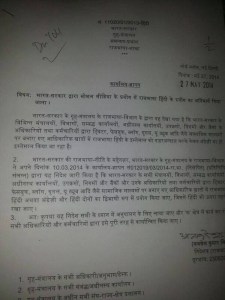
We live with multiple Hindis – one for instance, in railway and flight announcements, the other in cinema, a mixture of Hindi and Urdu, or Hindustani,  the kind Gandhi wanted India to adopt as its national language. The former kind – sarkari Hindi – survives only in its ceremonial avatar. This  was acknowledged in a rare moment of honesty when   the Rajbhasha unit of Ministry of Home Affairs issued an order in December 2011 to provide relief to beleaguered translators who came up with words like ‘Misil’ (for file) and sanganak (for computer). It suggested using English words or words from Indian languages instead of  coining new ones but to be written in the Devangari script. It is interesting that this remained unnoticed, for it was business as usual when it happened. How is language both incidental and central at the same time? I wondered.


Government Order dated May 27, 2014 on use of Hindi

Continue reading The Hindi Imbroglio – Videshi Nationalism? Rita Kothari

Growing up with the Cup (Part Two): Hartman d Souza

Second Part of Growing Up With the Cup by HARTMAN DE SOUZA.

Part One can be read here.

cliberofootball.com_garrincha-urss

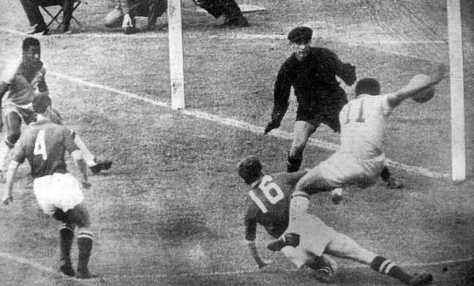
Brazil playing the Soviet Union in the 1958 World Cup, ‘stamping their imprint on the game’, as Hartman puts it below. (Image from here).

It is an interesting coincidence that my mother ended her part of the scrap book for me, with the World Cup in Sweden 1958: while I ended that scrap book in 1963 with the World Cup in Chile in 1962.

In both tournaments, for contrasting reasons, Brazil played an important role. So, at the outset, it ought to be said that the style of playing they gave the world – by virtue of stamping their imprint on the game in 1958 – continues to be the universal model aspired to.  You can always find reasons to deny this, rationalize matters, but when push comes to shove the whole world knows who plays authentic football!

This is largely because the Brazilians continue to bring their gifts and place them on a football field where everyone partakes, rival players as well as spectators. The élan with which they play is an inspiration that is duly acknowledged, respected, bowed to and imitated, in every single part of the world where they learn to love playing with a ball and get to see re-runs of Brazil’s old matches. While rival players may hate them with a vengeance, no spectators whose teams have lost to them ever bear them a grudge. Continue reading Growing up with the Cup (Part Two): Hartman d Souza

Eta Kolkata (This is Kolkata): Kaveri Gill

Guest post by KAVERI GILL

Today comes the surreal news that anyone painting their house or apartment white or sky blue in Kolkata can claim a waiver on property tax for a full year, a horror conjuring up a city that looks like a crumpled weave of Mother Teresa’s saree. Now, towns of Regency England and the Cornwall coast have uniform building and color restrictions to maintain historical continuity, but this idea is more in the perverse vein of babus suggesting that the burning ghats at Varanasi be “white-washed” for “freshness”.

The Chief Minister's radio and music in public places scheme
The Chief Minister’s radio and music in public places scheme

Thankfully, another Humphrey shot that idea down, yet the decimation of the architectural integrity of the façade of these famous ghats continues apace, with sealed air-conditioned buildings overlooking the burning bodies at Manikaran. Bengal’s Chief Minister has been known to remark that the colours “promote happiness” and accordingly, the Trinamool Congress (TMC) Mayor has incentivised citizens to embrace the “theme colours of the city”[1]. Coming on the heels of a general election, where the TMC won 34 seats out of 42, up from 19 in 2009, and compared to only 2 each for the Communist Party of India (Marxist) and the Bharatiya Janata Party (with 18% of the vote share, not to mention an almost win in the city), even discounting for dirty tricks appropriated by their cadres from the Left of old, the scorn must be tempered by what this result says about the contemporary citizen of this state and city. Continue reading Eta Kolkata (This is Kolkata): Kaveri Gill

Growing up with the Cup: Hartman De Souza (Part I)

Guest post by HARTMAN DE SOUZA

49c3c50e7

Boys playing football in Bangladesh. The only thing this has to do with Hartman’s post is that it has boys playing football. Also, it’s a lovely picture. (From the UNCHR Bangladesh website)

I only knew there was something called the World Cup courtesy an eccentric mother who kick-started a thick scrap book dedicated to football, to get me to start reading the newspaper. I was ten years old, and lived in Mombasa, on the coast of Kenya.

In it, my mother had gummed various newspaper and magazine articles and features on football. In 1960 when she handed it to me to continue, the last entry was her exhaustive coverage of the World Cup in Sweden in 1958, with reports of every one of the qualifying rounds and all the internationals friendly matches leading up to it. The very last clippings were news-items and commentaries talking about the next World Cup in Chile, in just two years time.

My tasks were cut out. Armed with a dictionary, I may have been one of the first ten year olds in Kenya if not the so-called Commonwealth, to discover Brian Glanville, a very bright and daring football columnist; a man who still writes about the game as if it was the only pleasure worth pursuing with passion.

I spent days and nights reading and re-reading my scrap book. I replayed countless matches in my head so that I could tinker with them and change the results. I always changed the results in my head, so logically the teams I supported always won. Continue reading Growing up with the Cup: Hartman De Souza (Part I)