Category Archives: Debates

Media Studies Group’s Statement on Internet Neutrality

Media Studies Group demands that TRAI place Consultation document in Indian languages and extend deadline for feedback on Net Neutrality. 

New Delhi: April 20, 2015: Media Studies Group, a Delhi based think tank on communication studies, held a marathon meeting on Sunday on internet neutrality in the light of TRAI’s consultation paper on over-the-top (OTT) services. The meeting discussed various technical, legal and social aspects emerging out of Airtel’s Plan Zero and the internet.org venture of Facebook.

There was complete unanimity that the issue of net neutrality is complex in nature and that the masses need to be educated in simple and non-technical language so that a fair opinion can be generated on the functioning of the internet as the present move, if successful, will pose a serious challenge to the principle of equality and democratic character of the internet.

The meeting took a critical view of Telecom Regulatory Authority of India (TRAI) for its failure to present the consultation document in Indian languages. To have chosen to make the document available only in English is a move which has the potential of altering the fair access to internet by large numbers of users of Hindi and other regional languages. Media Studies Group also felt that the deadline of April 24 is unreasonable and should be extended.

It has been decided that a representation will be given to TRAI to demand presentation of the consultation document in Indian languages in easy to understand language and to set a new reasonable deadline for feedback . Media Studies Group has also decided to give a detailed representation to TRAI on the issue of Net Neutrality with a holistic view seeking protection of fundamental principles and rights enshrined in the Constitution of India.

On behalf of MSG,

Anil Chamadia, Chairman, Media Studies Group.

Email – msgroup.india@gmail.com
Frontline’s Calculus of Caste: C. K. Raju

Guest post by C. K. RAJU

[Frontline carried a historically ill-informed article on Indian calculus which also had mathematical and casteist errors. When the errors were pointed out, the magazine ignored it, contrary to journalistic ethics. Here is Prof Raju’s response to that article.]

Frontline (23 Jan 2015) published an excessively ill-informed article by Biman Nath on “Calculus & India”. The article suppressed the existence of my 500 page tome on Cultural Foundations of Mathematics: the Nature of Mathematical Proof and the Transmission of Calculus from India to Europe in the 16th c. (Pearson Longman, 2007). This suppression was deliberate, for Nath and Frontline ignored it even after it was pointed out to them. They also refused to correct serious mathematical and casteist errors in the article. That is contrary to journalistic ethics. To understand my response, some background is needed.

According to my above book and various related articles, the calculus developed in India and was transmitted to Europe. The second part of the story is lesser known. As often happens with imported knowledge, calculus was misunderstood in Europe. Later that inferior misunderstanding was given back to India through colonial education, and continues to be taught to this day just by declaring it as “superior”. That claim of superiority was never cross-checked to see if it is any different from the other flimsy claims of superiority earlier made by the West, for centuries, for example the racist claim that white-skinned people are “superior”. Continue reading Frontline’s Calculus of Caste: C. K. Raju

An Interview on the Continuing Relevance of Marx

The following is an interview with PRADIP BAKSI, an independent Marx scholar based in Kolkata. He has translated and edited some of the notes and manuscripts of Karl Marx on mathematics and on the history of land relations in India. He has also written on Marx’s study of some of the natural sciences and technologies of his time. The interview was conducted by SANKAR RAY, a senior journalist based in Kolkata.

Sankar Ray [SR]: What are your views on the relevance of Marx for India today, in the context of the financial crisis continuing since 2008, a certain renewal of interest in Marx’s Capital and, of late in Piketty’s Capital for the 21st Century?

Pradip Baksi [PB]: Despite the echo of the title of Marx’s famous book in the title of Piketty’s bestseller, the latter is an exercise within one of the currently fashionable strands of Marx-innocent political economy. In contrast Marx’s Capital is a part of an unfinished and incomplete program of critique of political economy, proposing a continuous reconstruction of it as a science.

While marshalling a very large and interesting dataset on growing inequality within contemporary capitalism, Piketty proposes to make that inequality bearable through taxation within future capitalism, and thereby holds a brief for that very capitalism. Marx, it is true, left his critique of political economy incomplete and unfinished, but he never held any brief for capitalism.

The ongoing financial crisis has triggered some interest in these two books in some quarters. This financial crisis and this interest may or may not last long. I do not wish to speculate about that. The questions of relevance or otherwise of Marx for India, and for the rest of the world, however, are questions of a different order. Continue reading An Interview on the Continuing Relevance of Marx

Being Empowered the Vogue Way – Is There Anything Left to be Said?

Really, nothing. It’s been more than a week since the Vogue Empower video directed by Homi Adajania and featuring Deepika Padukone amongst others, has appeared, been watched, digested, commented upon, counter-videoed, spoofed and counter-spoofed. And a week on the internet constitutes nothing less than a geological age of course, so there’s been a veritable melting Ice Age of responses. To list just some of the reactions to the video – the female fan responses, that say kudos to Deepika for “saying it like it is”. Uncritically starry-eyed as they are, they point to the real chord struck by the video with thousands of young women fighting, thinking, arguing and surviving their way through a breathtakingly conflicted urban India. This is an India that by all appearances works hard and parties hard, in the process occupying a fraught and frequently violent terrain of interaction between the sexes.

Continue reading Being Empowered the Vogue Way – Is There Anything Left to be Said?

An Open Letter to the Protestors at the National Law University: Space Theatre Ensemble

Guest post by SPACE THEATRE ENSEMBLE

Thank you for renewing this much needed dialogue on freedom of expression.

We happen to be, by sheer coincidence, a four-piece all-women theatre group that performs poetry, and have been following the correspondence over the sexist performance of stand-up comedian Avish Matthew with some interest – all the more so since we are now touring in Delhi and its environs.

The protestors are absolutely right when they point out that domestic violence is not a laughing matter and we completely endorse their views on why Avish’s jokes just weren’t funny.

We do not believe in laughter as just therapy to laugh off the stress of living the good life.

However, as a professional theatre ensemble we also strongly disagree with the predictable, and frankly irrelevant form of agitprop used by the protestors against Avish.  Protest need not be chaotic, so far more vehemently we condemn the supposedly liberal students and others who heckled, booed, poked and shoved but stopped just short of physically molesting the protestors. Continue reading An Open Letter to the Protestors at the National Law University: Space Theatre Ensemble

Ban-man on the prowl again: Malvika Sharad

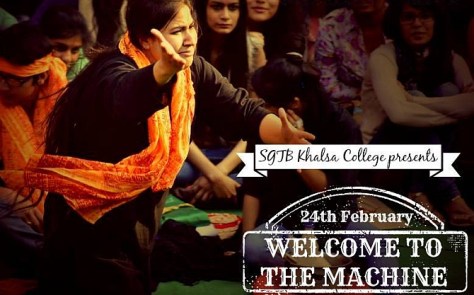
Guest Post by MALVIKA SHARAD on the recent call by Delhi University Students’ Union for a ban on the street play by Khalsa College theatre group, Ankur.

24lead6

Image courtesy rediff.com

One evening in 2013, a group of ‘street play seniors’ as we call them, visited us in the front lawns of my college, Lady Shri Ram College for Women. They were from various colleges across DU who had been actively involved in street theatre, and had been invited to give the newly formed street play team of that year, an introduction to the art form. Among those seniors was a dynamic young chap from Khalsa College, who reiterated several times that street theatre fills you with such immense courage that you end up doing things you never thought you would, for that courage comes from the sheer truth and brutal honesty that street theatre is based upon. He said that freedom of expression is taken to a whole new level when you perform amidst crowds, and state the truth looking directly into their eyes. A fire is born within you that cannot be extinguished, it burns brighter with every performance of the play. You become fearless in voicing your opinions and thoughts, so fearless that you don’t even realize how far you have pushed your own limits and emerged triumphant.

After a whole year dedicated to doing street plays in Delhi, I have learnt how right he was, that young student not much older than us. I find I have come out of my shell, shedding my inhibitions at a pace and scale I had never imagined. Torn chappals don’t bother me anymore, my sun-burned skin makes me look beautiful, I don’t flinch with embarrassment while sitting, sometimes lying, on the floor of the metro station out of sheer weariness, though co passengers stare at me with judgemental eyes, I can’t bring myself to stop romanticizing the mud and the dirt that hug me every time I wear my soiled street play kurta… But above all, I can articulate my thoughts properly now, I am not scared of speaking in public unlike the times when I was a meek docile person, cocooned in the comforts of home and parental pampering. I owe this change in my attitude and personality to street theatre, which taught me what it is to live confidently and fearlessly.

Continue reading Ban-man on the prowl again: Malvika Sharad

And then they came for Oyasiqur Rahman Babu !

Courtesy : m.bangladeshtime.com

….It is not the young who are writing obituaries for the old,…I have seen the blood shed by so many young people steadily mounting up until now I am submerged and cannot breathe. All I can do is take up my pen and write a few articles, as if to make a small hole in the mud through which I can draw a few more wretched breaths. What sort of world is this ? The night is so long, the way so long….

( Lu Xun, Written for the Sake of Forgetting, P 234, Selected Works of Lu Xun, Vol III, Beijing)

Md Oyasiqur Rahman Babu , aged 27 years is dead. A travel agency executive by profession and a secular blogger by passion he was killed by radical Islamists in Tejgaon, Dhaka when he was going to office in Motijheel. The three assailants – who did not personally know each other – met just for planning the murder and then executed it with military precision.

Thanks to the courage exhibited by trans genders living nearby who caught hold of these murderers while the locals who watched the act before their eyes just dithered to move. Zikrullah, a student of Hefazat-e-Islam’s Hathazari Madrasa in Chittagong, and Ariful, student of Mirpur Darul Uloom Madrasa – were caught while the third member of the team, Abu Taher of Mirpur Darul Uloom, managed to flee the spot. The arrestees said they had killed Oyasiqur for writing on religious issues. It is a different matter that none of them had read his blog, they even did not know what blogging is, they  just executed the order issued by some mastermind. Continue reading And then they came for Oyasiqur Rahman Babu !

People’s Union for Democratic Rights Condemns Bans on Cow Slaughter

Statement by People’s Union for Democratic Rights 
On March 16th 2015, the Haryana Government unanimously passed Haryana Gauvansh Sanrakshan and Gausamvardhan Bill with main opposition parties INLD and Congress supporting the Bill. The new bill passed by the Haryana Government bans cow slaughter and sale of beef and imposes a punishment of rigorous imprisonment of not less than three years extending up to 10 years and fines ranging from Rs. 30,000 to Rs. one lakh. The Haryana Government’s move comes just days after the President’s assent to Maharashtra Animal Preservation (Amendment) Bill 1995 early this month. Maharashtra Animal Preservation (Amendment) Bill 1995 not only banned beef but also extended the prohibition to slaughter of bulls and oxen. There was already a ban on slaughter of cows in Maharashtra since 1976.  The new amended act imposes a fine of Rs. 10,000 and a maximum prison term of five years for selling or even possessing beef.
What needs to be underlined here is that these bans on cow slaughter are not new; they were in existence in many of the states for many-many years. For example in Delhi, Bihar, Andhra Pradesh, slaughter of cows and calves is totally prohibited. In Goa and Andhra Pradesh, ‘cow’ is defined to include heifer, or a male or female calf of a cow under the Goa, Daman and Diu Prevention of Cow Slaughter Act 1978 and Andhra Pradesh Prohibition of Cow Slaughter and Animal Preservation Act 1977, respectively. In some states like Karnataka, Andhra Pradesh, Goa and Madhya Pradesh slaughter of bulls, bullocks and adult buffalos is permitted on ‘fit for slaughter’ certificate if the cattle is over 12 or 15 years of age, is not likely to become economical for draught, breeding or milk. Assam and West Bengal provides for slaughter of all cattle which includes bull, bullocks, calves, cows and buffalo on ‘fit for slaughter’ certificate. Meghalaya and Nagaland have no legislation to this effect.

Continue reading People’s Union for Democratic Rights Condemns Bans on Cow Slaughter

An Open Letter by the Protestors at National Law University, Delhi

An open letter from students at National Law University

Abish Mathew, comedian of the AIB Roast fame, performed at NLU Delhi on the 22nd of March for our annual fest, Kairos. Early in the show, Matthew cracked a joke on domestic violence, at which point, two women students who found the jokes to be extremely misogynistic, walked out, showing him the middle finger. The audience reacted with some tittering, and Abish Mathew fumbled momentarily, before resuming. The audience asked him to carry on and to ignore the protesters. In the mean time, a group of female students marched into the auditorium holding placards reading “Get Out, Sexist Pig”, and also used expletives such as ‘fuck off’.

The auditorium erupted in shouts of “fuck you guys” and the protesters were booed and heckled by the audience members who demanded that the protestors either leave or move to the side. They eventually did move to the side of the auditorium, where they continued to hold their placards up and attempted to interrupt him. Abish was greeted by a standing ovation when he stated that he was an artist and recognized the right of the protesters, and subsequently when he ended his show by stating he had overstayed his welcome.

Continue reading An Open Letter by the Protestors at National Law University, Delhi

Dealing with ‘sexist pigs’? Reflections on the feminist protest against AIB’s Avish Mathew at National Law University, Delhi: A Statement

A statement from concerned students and teachers

What does one do sitting in the middle of an audience roaring with laughter at jokes that one might find downright humiliating? Laugh along, retire hurt, or ask people to stop? It’s a dilemma that many of us on the ‘wrong’ side of various lines of privilege (caste, class, gender, race) and those sensitive to these divisions often find ourselves in. Some students at the National Law University, Delhi seem to have been put in a similar situation when during their annual college fest, comedian Avish Mathew of AIB Roast fame would not stop amusing his audience with one offensive joke after another. They first decided to walk out and then came back with a placard saying, “Get out you sexist pig!”

Continue reading Dealing with ‘sexist pigs’? Reflections on the feminist protest against AIB’s Avish Mathew at National Law University, Delhi: A Statement

While “Exposing 300 days of Modi’s Rule”, Let us not fall into the Trappings of Old Congress Style Politics: Nayan Jyoti

Guest Post by Nayan Jyoti

SOME QUESTIONS IN THE CONTEXT OF MASS ORGANISATIONS OF CPI(ML)LIBERATION, CPI, CPI(M) & OTHERS INVITING CONGRESS, RJD, JD(U) TO DEFEND ‘SECULARISM, INDIAN CONSTITUTION, INDIAN NATIONALISM’

Janta Dal (United) leader Ali Anwar, in an ‘united’ program in Jantar Mantar on 19th March had a frank admission to make in the first 15 minutes of his speech: “Elections ki hi baat se shuru kare, to haan, hum sab milkar Modi ko harayenge” (“If we begin with the question of elections, yes, we will unite to defeat Modi together”). He was indicating a plain and simple ‘unity’ of convenience for elections, of a converging pole in Indian politics. He indicated: “Bihar assembly elections are waiting to happen.” He of course, remembered the theme of ‘secularism’ for the event and said, “now I will say a few ideological things” and did utter a few lines against the BJP-RSS.

Delhi’s Jantar Mantar on 19th March thus saw a (not very?) strange unity. Various “civil society and secular political parties, victims, artists, intellectuals” came together to organize an Exposing 300 days of Modi’s Rule program. Many of the organizers included mass organisations of the Left like AISA, AICCTU, AIPWA connected with CPI(ML)Liberation, and SFI, AIDWA, CITU, DYFI, AILU connected with CPI(M), and AITUC, NFIW, PWA related to CPI, among others. In these dark times of achhe din, where unity and collaboration of various left, democratic and progressive forces has come up with renewed necessity to fight the present regime, it becomes important for us to interrogate such attempts without any sectarianism. An important question that requires asking here is the basis of these ‘Unities’ and Forums being variously attempted. ‘Unity’ is definitely required in these times of combined attack of brutal neoliberal and communal attack, but standing on what ground, and in what direction? Continue reading While “Exposing 300 days of Modi’s Rule”, Let us not fall into the Trappings of Old Congress Style Politics: Nayan Jyoti

Kill it Before it Hatches, Attack it Before it Grows – On State Sanctioned Vandalism against Contemporary Art in Kashmir: Syed Mujtaba Rizvi

Guest Post by Syed Mujtaba Rizvi

A Work of Art Vandalized at Gallerie One, Srinagar

On the opening day of Gallerie One, I was in a conversation with Rajendra Tickoo, Masood Hussain, Shabbir Mirza, M A Mehboob, Shaiqa Mohi and several other senior artists from Jammu and Kashmir. The opening of the first ever centre for contemporary arts and research in Kashmir was a dream come true for all of them. They told me that they had waited all their lives for such an initiative and how several great artists had died with the dream of having an art gallery in Kashmir. They were all very excited. They shook my hand again and again and hugged me before and after. Continue reading Kill it Before it Hatches, Attack it Before it Grows – On State Sanctioned Vandalism against Contemporary Art in Kashmir: Syed Mujtaba Rizvi

On The Interrelationship between Bovine and Human Beings

”in our religious scriptures ( Puranas) life of a cow is more important than any number of people” ( Puranon me insaan se jyada gay ko mahtv diya jata hai)

– Giriraj Kishore, Vice President of VHP,

On the public lynching of five dalits, October 2002

BJP Haryana chief Ram Bilas Sharma has promised to treat cow slaughter as a crime as heinous as murder. If elected, he said at the manifesto release function…

 TNN | Oct 3, 2014, 05.06AM IST

There is a competition of sorts between BJP ruled states to fulfil what a Haryana leader said ‘ to fulfil Modiji’s dream’. Close on the heels of Maharashtra government’s getting clearance to ban cow slaughter, there is news in a section of the press that the government in Haryana would table a similar bill in the assembly.

Sharing few snippets of the bill and comparing it with punishment of other offences, a newspaper report tells us that if the offence is insult to modesty of women the maximum jail sentence would be one year or fine, if it is molestation then it would be two years or fine, for theft the maximum jail term would be three years, for assault it would be 3 months or fine,  and for causing grievous hurt it would be maximum seven years. (Times of India, 14 th March 2015) and if it is beef in any form then it would be punishable by upto ten years in jail. Continue reading On The Interrelationship between Bovine and Human Beings

Goodbye Secularism ! Enter Theocracy !!

Understanding the yet unfolding ‘Dietary Fascism’

Image : Courtesy – bollypedia.in

To the question whether the Hindus ever ate beef, every Touchable Hindu, whether he is a Brahmin or a non-Brahmin, will say ‘no, never’. In a certain sense, he is right. From times no Hindu has eaten beef. If this is all that the Touchable Hindu wants to convey by his answer there need be no quarrel over it. But when the learned Brahmins argue that the Hindus not only never ate beef but they always held the cow to be sacred and were always opposed to the killing of the cow, it is impossible to accept their view…

B. R. Ambedkar 1

“Did the Hindus never eat Beef?” Dr Ambedkar has dealt with this specific issue holistically in his various writings and has also tried to link it with emergence of ‘untouchable’ castes.

At a time when the saffrons are keen to appropriate Ambedkar  – who had time and again cautioned his followers about the dangers of Hindu Raj 2 and appealed to them to fight the twin enemies of  Brahminism and Capitalism – and present him as someone who not only endorsed the Hindutva project but also opposed beef eating as cow was sacred to Hinduism, it would be opportune to pose this question afresh before them. Continue reading Goodbye Secularism ! Enter Theocracy !!

Nation’s Honour, ‘IBIs’ and the Dimapur lynching : Bonojit Hussain

Guest Post by BONOJIT HUSSAIN

naga

Photo courtesy: ABPLive

On 5th of March a mob of few thousands stormed the Dimapur central jail and after having dragged jail inmate Syed Sarif Uddin Khan, brutally lynched him while a gleeful lot clicked photographs of the lynching with mobile phone cameras.

Since the night of 5th March photographs of the brutalized dead body and a video of the lynching has gone viral on social media and activists across the country has rightfully condemned this horrific act of mob lynching. But most activists are under the impression that the outrage and subsequent lynching was because a Sumi Naga woman was allegedly raped by Syed Sarif Uddin Khan on the night of 23rd February. But one needs to understand that the outrage and the lynching of Khan wasn’t primarily about rape of a woman, it was more about how an outsider, more so a ‘lowly’ IBI (a very popular acronym for Illegal Bangladeshi Immigrant), has violated  the Naga nation’s honour reposited in the bodies of its women by raping one of its ‘daughters’. Continue reading Nation’s Honour, ‘IBIs’ and the Dimapur lynching : Bonojit Hussain

Indian feminists, ‘India’s daughter’, and sexual violence: The issues at stake*

International-women-s-day

Today, on International Women’s Day I am proud to acknowledge the deeply contested terrain that we call feminism in India, in which no claim goes unchallenged, no issue is undisputed (and some might say, no good deed goes unpunished!) In which over the decades, every stand and every understanding on practically every issue, has been painfully rethought and reformulated in the face of intense questioning from newer claims and voices.

In the clamour of feminist responses both to Leslee Udwin’s documentary ‘India’s Daughter’, as well  as to the Indian state’s crackdown on it, some themes have emerged that reflect profound fault lines in our (feminist) understanding – not so much of sexual violence itself – but of what to do about it; how to act upon the knowledge of widespread misogyny and pervasive masculinist violence; how to acknowledge that sexual violence cannot be understood except as refracted through prisms of caste, class, Indian state militarism and… a list that will inevitably end in ‘etc’ regardless of how long it is; and in this particular case, above all, what sorts of representations of sex and sexual violence will further our ethical ambitions, and what others will undo decades of work.

In what follows, I will try to uncover some of these themes, on the explicit understanding that I do not claim to have resolved any of the debates, nor even to have highlighted all of them. This is a partial, personal attempt to make sense of the recurring ideas in a tumult of intelligent, concerned and strongly articulated opinions, in the course of which I will of course, make my own views explicit too.

First, perhaps I should state immediately that I saw ‘India’s Daughter’ and liked it very much. This is just to get it out of the way, because my opinion on the film is irrelevant to my belief that freedom of speech and expression ought to be a value that feminists defend at all costs. I did not hold such a strong view on freedom of expression in an earlier decade, but I do now, at the beginning of the 21st century, when it has become increasingly clear that the silencing of uncomfortable voices, even unto murder, has become the preferred mode of snuffing out debate globally.

Continue reading Indian feminists, ‘India’s daughter’, and sexual violence: The issues at stake*

Reading the Power Struggle in AAP

There is no way of discussing the ongoing crisis in AAP without being blunt and frank. The terrain of politics is, after all, a brutal and treacherous one. So let me put it without mincing words. The ongoing crisis in AAP is not just about ‘differences of opinion’ or ‘toleration of dissent’ but a power struggle. And before squeamish liberal stomachs start churning, let me also add – power struggles are not always only about power in and of itself. Sometimes they are, but quite often they have to do with alternative visions, imaginations and of course, contrary interests. It is only likely that every serious political party or organization will, if it has any life in it, be faced with a struggle over any or all of these matters, for what is politics if not about steering the party/ movement in the direction one understands to be the best course. And these alternative visions, imaginations, policies and interests are inseparable from the position of individual personalities involved. Individual ambitions are pretty much the stuff of politics and it is unrealistic to expect to see a politics without all of this. The will to power is not exactly a self-effacing virtue.

For this reason, factions and platforms are inevitable in all political formations and it is best to recognize them as legitimate entities and have open public debate, on matters at stake. These cannot be matters of concern to only a small group of leaders in the National Executive and Political Affairs Committee (in AAP’s case) or in Politburos and Central Committees (in the case of communist parties). So, if collective deliberations are important in the apex committees, they would do well to be preceded by a public debate among different tendencies within the organization. At one level, this means moving away from the party-form itself to the form of a platform or coalition, where the different groupings and ideological currents are honestly and openly recognized, as are the personal inclinations and angularities of each individual leader.

This longish preface should make it very clear that my concerns here have nothing to do with the usual liberal platitudes about ‘amicably and democratically’ resolving ‘difference of opinion’. A political movement or party is not an academic seminar. Every such struggle, in the final analysis, is a power struggle – so is the current one in AAP. And there can be no doubt that both sides in this conflict are deeply involved in it. Decoding the stakes in the absence of a clear public debate, apart from selective leaks in the press, is not an easy task. But it does not involve rocket science either. One can read the signs, one can read between the lines of the narratives from both sides that have emerged, howsoever partially, in the media. What follows below, though, is a reading quite different from the ones inundating the media about intolerance of dissent. Continue reading Reading the Power Struggle in AAP

We are all Mukto-Mona

 ‘Our aim is to build a society which will not be bound by the dictates of arbitrary authority, comfortable superstition, stifling tradition, or suffocating orthodoxy but would rather be based on reason, compassion, humanity, equality and science’.

– Avijit Roy

 “Dr Dabholkar who was fighting against superstition was assasinated because he was a rationalist. All such people who have embarked upon a path of reason and rationalism, propagated these ideas, had to make tremendous sacrifices. Dr Dabholkar was not the first and would not be the last person who sacrificed himself on the altar of rationalism. This unending struggle between rationalism and irrationalism is going on since ages and it is for you to decide whether it needs change or not.”

– Comrade Pansare

Words, ideas scare fundoos rather fundamentalists of every kind, colour and stripe.

The mere possibility that a free mind can question, challenge and ultimately upturn the ‘ultimate truth’ the faithful  have received through their ‘holy books’ rather unnerves them and they react in the only way they are familiar with. Resort to machetes to take on ideas or use meat cleavers to deal with unchained minds, quoting sanction from the same ‘books of wisdom’. Continue reading We are all Mukto-Mona

That Elusive Thing with Feathers – After the Killing of Avijit Roy: Abdul Bari

Guest Post by ABDUL BARI

Avijit Roy was brutally murdered in Dhaka a few days ago. His wife, after heroically trying to shield his person with her own body, now lies in an ICU bed, fighting for her life.  I was an infrequent visitor to his website, Muktomona. Visiting it was like running your tongue over that tooth you’re missing, or reflexively checking whether you had your keys with you in the morning. Its presence was a reminder that, no matter how circumscribed, the nation-state of Bangladesh still had men and women who liked to think unconventional thoughts; give expression to unpopular ideas; endeavored to stand, as it is, in the very edge of what the societal limit of what could be expressed, and then take another firm step, not back, but forward. Continue reading That Elusive Thing with Feathers – After the Killing of Avijit Roy: Abdul Bari

India’s Obsession with Elitism is Leading it to Ignore the Marginalized: Rupande Mehta

Guest post by RUPANDE MEHTA

Chances are you have heard about Sureshbhai Patel, a 57 year old man, beaten and left temporarily paralyzed by Alabama police. His only crime: while he was out for a walk, a neighbor reported a ‘suspicious’ and ‘skinny black guy’ in the neighborhood causing him extreme distress and nervousness to leave his wife alone at home.

Several elements of this case bring back the ghosts of Trayvon Martin and Eric Garner, two black lives taken away by police brutality – despite being unarmed, Sureshbhai was subjected to “extreme force” and suspected not because he was Indian but because he resembled a black guy – but also bring to the forefront the enormous emotional and financial support generated not only from Indians but also Americans who rallied behind Sureshbhai and the injustice meted out to him. In a matter of six days, donations worth $190,000 were garnered to help the Patel family with medical bills. The incident also provoked Alabama’s governor to apologize for police’s use of “excessive force” and to initiate an investigation by the Alabama Law Enforcement Agency, along with the one being conducted by the FBI. Continue reading India’s Obsession with Elitism is Leading it to Ignore the Marginalized: Rupande Mehta

Reading Between the Lines – A Critique of the UAPA: Avani Chokshi

Guest post by AVANI CHOKSHI

It seems ludicrous that in a civilised democratic society like India, a citizen may be practically abducted by police, charged with perfunctory offences and incarcerated without bail on mere suspicion for an indefinite period of time.  But this is indeed the situation in present-day India, with duly passed legislation sanctioning the inhumane state of affairs.

The validity of unjust or immoral laws has long been debated, with two major schools of thought emerging- the positivist school and the naturalist school. The positivist school does not recognise any correlation between the legal system of a society and notions of what ought to be justice. The positivist framework mandates that the law is that ordained by the valid legislator, whereas the naturalist school of thought envisages some rights to be inherent by virtue of humanity of a person. Thus, an unjust law, as per the school of naturalist thought, would be no law at all; positivistic thought, on the other hand, would posit such law to be valid by virtue only of being ascribed to the law-making process. The Hart- Fuller debate  devolved around the law made by Hitler; with Hart contending that laws passed using proper procedure would always be valid and Fuller maintaining that no unjust rule could ever be law. India allows “procedure established by law ” to deprive people of their Fundamental Rights; a state of affairs which reflects positivistic thought in the founders of India. India’s judiciary has slowly moved from this strictly positivist setting to a more naturalistic and liberal interpretation  of the term. This shift has placed India closer to the guarantee of “due process of law” in the United States of America. Continue reading Reading Between the Lines – A Critique of the UAPA: Avani Chokshi