A Work of Art Vandalized at Gallerie One, Srinagar
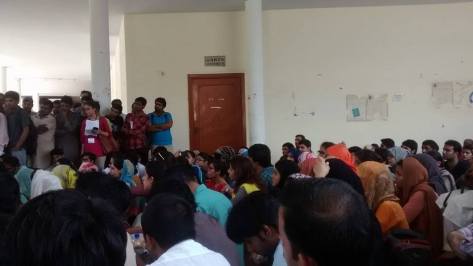
On the opening day of Gallerie One, I was in a conversation with Rajendra Tickoo, Masood Hussain, Shabbir Mirza, M A Mehboob, Shaiqa Mohi and several other senior artists from Jammu and Kashmir. The opening of the first ever centre for contemporary arts and research in Kashmir was a dream come true for all of them. They told me that they had waited all their lives for such an initiative and how several great artists had died with the dream of having an art gallery in Kashmir. They were all very excited. They shook my hand again and again and hugged me before and after. Continue reading Kill it Before it Hatches, Attack it Before it Grows – On State Sanctioned Vandalism against Contemporary Art in Kashmir: Syed Mujtaba Rizvi→
”in our religious scriptures ( Puranas) life of a cow is more important than any number of people” ( Puranon me insaan se jyada gay ko mahtv diya jata hai)
– Giriraj Kishore, Vice President of VHP,
On the public lynching of five dalits, October 2002
BJP Haryana chief Ram Bilas Sharma has promised to treat cow slaughter as a crime as heinous as murder. If elected, he said at the manifesto release function…
TNN | Oct 3, 2014, 05.06AM IST
There is a competition of sorts between BJP ruled states to fulfil what a Haryana leader said ‘ to fulfil Modiji’s dream’. Close on the heels of Maharashtra government’s getting clearance to ban cow slaughter, there is news in a section of the press that the government in Haryana would table a similar bill in the assembly.
Sharing few snippets of the bill and comparing it with punishment of other offences, a newspaper report tells us that if the offence is insult to modesty of women the maximum jail sentence would be one year or fine, if it is molestation then it would be two years or fine, for theft the maximum jail term would be three years, for assault it would be 3 months or fine, and for causing grievous hurt it would be maximum seven years. (Times of India, 14 th March 2015) and if it is beef in any form then it would be punishable by upto ten years in jail. Continue reading On The Interrelationship between Bovine and Human Beings→
To the question whether the Hindus ever ate beef, every Touchable Hindu, whether he is a Brahmin or a non-Brahmin, will say ‘no, never’. In a certain sense, he is right. From times no Hindu has eaten beef. If this is all that the Touchable Hindu wants to convey by his answer there need be no quarrel over it. But when the learned Brahmins argue that the Hindus not only never ate beef but they always held the cow to be sacred and were always opposed to the killing of the cow, it is impossible to accept their view…
B. R. Ambedkar 1
“Did the Hindus never eat Beef?” Dr Ambedkar has dealt with this specific issue holistically in his various writings and has also tried to link it with emergence of ‘untouchable’ castes.
At a time when the saffrons are keen to appropriate Ambedkar – who had time and again cautioned his followers about the dangers of Hindu Raj 2and appealed to them to fight the twin enemies of Brahminism and Capitalism – and present him as someone who not only endorsed the Hindutva project but also opposed beef eating as cow was sacred to Hinduism, it would be opportune to pose this question afresh before them. Continue reading Goodbye Secularism ! Enter Theocracy !!→
On 5th of March a mob of few thousands stormed the Dimapur central jail and after having dragged jail inmate Syed Sarif Uddin Khan, brutally lynched him while a gleeful lot clicked photographs of the lynching with mobile phone cameras.
Since the night of 5th March photographs of the brutalized dead body and a video of the lynching has gone viral on social media and activists across the country has rightfully condemned this horrific act of mob lynching. But most activists are under the impression that the outrage and subsequent lynching was because a Sumi Naga woman was allegedly raped by Syed Sarif Uddin Khan on the night of 23rd February. But one needs to understand that the outrage and the lynching of Khan wasn’t primarily about rape of a woman, it was more about how an outsider, more so a ‘lowly’ IBI (a very popular acronym for Illegal Bangladeshi Immigrant), has violated the Naga nation’s honour reposited in the bodies of its women by raping one of its ‘daughters’. Continue reading Nation’s Honour, ‘IBIs’ and the Dimapur lynching : Bonojit Hussain→
Today, on International Women’s Day I am proud to acknowledge the deeply contested terrain that we call feminism in India, in which no claim goes unchallenged, no issue is undisputed (and some might say, no good deed goes unpunished!) In which over the decades, every stand and every understanding on practically every issue, has been painfully rethought and reformulated in the face of intense questioning from newer claims and voices.
In the clamour of feminist responses both to Leslee Udwin’s documentary ‘India’s Daughter’, as well as to the Indian state’s crackdown on it, some themes have emerged that reflect profound fault lines in our (feminist) understanding – not so much of sexual violence itself – but of what to do about it; how to act upon the knowledge of widespread misogyny and pervasive masculinist violence; how to acknowledge that sexual violence cannot be understood except as refracted through prisms of caste, class, Indian state militarism and… a list that will inevitably end in ‘etc’ regardless of how long it is; and in this particular case, above all, what sorts of representations of sex and sexual violence will further our ethical ambitions, and what others will undo decades of work.
In what follows, I will try to uncover some of these themes, on the explicit understanding that I do not claim to have resolved any of the debates, nor even to have highlighted all of them. This is a partial, personal attempt to make sense of the recurring ideas in a tumult of intelligent, concerned and strongly articulated opinions, in the course of which I will of course, make my own views explicit too.
First, perhaps I should state immediately that I saw ‘India’s Daughter’ and liked it very much. This is just to get it out of the way, because my opinion on the film is irrelevant to my belief that freedom of speech and expression ought to be a value that feminists defend at all costs. I did not hold such a strong view on freedom of expression in an earlier decade, but I do now, at the beginning of the 21st century, when it has become increasingly clear that the silencing of uncomfortable voices, even unto murder, has become the preferred mode of snuffing out debate globally.
There is no way of discussing the ongoing crisis in AAP without being blunt and frank. The terrain of politics is, after all, a brutal and treacherous one. So let me put it without mincing words. The ongoing crisis in AAP is not just about ‘differences of opinion’ or ‘toleration of dissent’ but a power struggle. And before squeamish liberal stomachs start churning, let me also add – power struggles are not always only about power in and of itself. Sometimes they are, but quite often they have to do with alternative visions, imaginations and of course, contrary interests. It is only likely that every serious political party or organization will, if it has any life in it, be faced with a struggle over any or all of these matters, for what is politics if not about steering the party/ movement in the direction one understands to be the best course. And these alternative visions, imaginations, policies and interests are inseparable from the position of individual personalities involved. Individual ambitions are pretty much the stuff of politics and it is unrealistic to expect to see a politics without all of this. The will to power is not exactly a self-effacing virtue.
For this reason, factions and platforms are inevitable in all political formations and it is best to recognize them as legitimate entities and have open public debate, on matters at stake. These cannot be matters of concern to only a small group of leaders in the National Executive and Political Affairs Committee (in AAP’s case) or in Politburos and Central Committees (in the case of communist parties). So, if collective deliberations are important in the apex committees, they would do well to be preceded by a public debate among different tendencies within the organization. At one level, this means moving away from the party-form itself to the form of a platform or coalition, where the different groupings and ideological currents are honestly and openly recognized, as are the personal inclinations and angularities of each individual leader.
This longish preface should make it very clear that my concerns here have nothing to do with the usual liberal platitudes about ‘amicably and democratically’ resolving ‘difference of opinion’. A political movement or party is not an academic seminar. Every such struggle, in the final analysis, is a power struggle – so is the current one in AAP. And there can be no doubt that both sides in this conflict are deeply involved in it. Decoding the stakes in the absence of a clear public debate, apart from selective leaks in the press, is not an easy task. But it does not involve rocket science either. One can read the signs, one can read between the lines of the narratives from both sides that have emerged, howsoever partially, in the media. What follows below, though, is a reading quite different from the ones inundating the media about intolerance of dissent. Continue reading Reading the Power Struggle in AAP→
‘Our aim is to build a society which will not be bound by the dictates of arbitrary authority, comfortable superstition, stifling tradition, or suffocating orthodoxy but would rather be based on reason, compassion, humanity, equality and science’.
– Avijit Roy
“Dr Dabholkar who was fighting against superstition was assasinated because he was a rationalist. All such people who have embarked upon a path of reason and rationalism, propagated these ideas, had to make tremendous sacrifices. Dr Dabholkar was not the first and would not be the last person who sacrificed himself on the altar of rationalism. This unending struggle between rationalism and irrationalism is going on since ages and it is for you to decide whether it needs change or not.”
– Comrade Pansare
Words, ideas scare fundoos rather fundamentalists of every kind, colour and stripe.
The mere possibility that a free mind can question, challenge and ultimately upturn the ‘ultimate truth’ the faithful have received through their ‘holy books’ rather unnerves them and they react in the only way they are familiar with. Resort to machetes to take on ideas or use meat cleavers to deal with unchained minds, quoting sanction from the same ‘books of wisdom’. Continue reading We are all Mukto-Mona→
Avijit Roy was brutally murdered in Dhaka a few days ago. His wife, after heroically trying to shield his person with her own body, now lies in an ICU bed, fighting for her life. I was an infrequent visitor to his website, Muktomona. Visiting it was like running your tongue over that tooth you’re missing, or reflexively checking whether you had your keys with you in the morning. Its presence was a reminder that, no matter how circumscribed, the nation-state of Bangladesh still had men and women who liked to think unconventional thoughts; give expression to unpopular ideas; endeavored to stand, as it is, in the very edge of what the societal limit of what could be expressed, and then take another firm step, not back, but forward. Continue reading That Elusive Thing with Feathers – After the Killing of Avijit Roy: Abdul Bari→
Chances are you have heard about Sureshbhai Patel, a 57 year old man, beaten and left temporarily paralyzed by Alabama police. His only crime: while he was out for a walk, a neighbor reported a ‘suspicious’ and ‘skinny black guy’ in the neighborhood causing him extreme distress and nervousness to leave his wife alone at home.
Several elements of this case bring back the ghosts of Trayvon Martin and Eric Garner, two black lives taken away by police brutality – despite being unarmed, Sureshbhai was subjected to “extreme force” and suspected not because he was Indian but because he resembled a black guy – but also bring to the forefront the enormous emotional and financial support generated not only from Indians but also Americans who rallied behind Sureshbhai and the injustice meted out to him. In a matter of six days, donations worth $190,000 were garnered to help the Patel family with medical bills. The incident also provoked Alabama’s governor to apologize for police’s use of “excessive force” and to initiate an investigation by the Alabama Law Enforcement Agency, along with the one being conducted by the FBI. Continue reading India’s Obsession with Elitism is Leading it to Ignore the Marginalized: Rupande Mehta→
It seems ludicrous that in a civilised democratic society like India, a citizen may be practically abducted by police, charged with perfunctory offences and incarcerated without bail on mere suspicion for an indefinite period of time. But this is indeed the situation in present-day India, with duly passed legislation sanctioning the inhumane state of affairs.
The validity of unjust or immoral laws has long been debated, with two major schools of thought emerging- the positivist school and the naturalist school. The positivist school does not recognise any correlation between the legal system of a society and notions of what ought to be justice. The positivist framework mandates that the law is that ordained by the valid legislator, whereas the naturalist school of thought envisages some rights to be inherent by virtue of humanity of a person. Thus, an unjust law, as per the school of naturalist thought, would be no law at all; positivistic thought, on the other hand, would posit such law to be valid by virtue only of being ascribed to the law-making process. The Hart- Fuller debate devolved around the law made by Hitler; with Hart contending that laws passed using proper procedure would always be valid and Fuller maintaining that no unjust rule could ever be law. India allows “procedure established by law ” to deprive people of their Fundamental Rights; a state of affairs which reflects positivistic thought in the founders of India. India’s judiciary has slowly moved from this strictly positivist setting to a more naturalistic and liberal interpretation of the term. This shift has placed India closer to the guarantee of “due process of law” in the United States of America. Continue reading Reading Between the Lines – A Critique of the UAPA: Avani Chokshi→
Even though, according to a series of Gallup and Pew Research polls, Bangladeshi society is now perhaps most illiberal in its history of existence, most informed readers know that a strong secular discourse led by a group of academics, creative writers and artists still continues to flourish and resisting the illiberalism to be the main discourse of the country.
After the independence, the 1972 constitution of the country have endorsed secularism, socialism and democracy as key founding principles among others. However, it is unclear to me as a Bangladeshi who is in his thirties whether these principles were propounded within the constitution with mass support or influential elite intellectuals who were close to the power-base asserted these values because they had the luxury to construct Bangladesh in paper the way they wanted to. May be the latter is true. If secularism was a value held close to the hearts of Bangladeshi masses, it does not make sense now why there is a huge mass support-base for the center-right party Bangladesh Nationalist Party (BNP) or the growing shift to Islam by the ruling Awami League (AL).
In this article, I want to revisit the role of a group of intellectuals who were instrumental in shaping a secular discourse for Bangladesh when Bangladesh was known as the East Pakistan. I call my approach as a second reading to Bangladesh history simply because I haven’t come across any narratives that looks into the thought process of the key constructors of secular discourse in Bangladesh. In this lieu, I shall try to point out to the motivational forces of key actors behind the secular discourse of Bangladesh. Continue reading The Genealogy of the Secular Discourse of Bangladesh – A Second Reading to Bangladesh History: Mubashar Hasan→
“Phool shaakhon pe khilne lagey” tum kaho, “Jaam rindon ko milne lagey” tum kaho, “Chaak seenon kay silne lagey” tum kaho, Iss khule jhooth ko, Zehn ki loot ko, Main nahin maanta, Main nahin jaanta
In Shakespeare’s Taming of the Shrew, Petrucchio declares the noontime sun to be the moon: “I say it is the moon,” to test his wife’s loyalty and obedience. As long as she stands by her reason and asserts “I know it is the sun”, she continues to be a ‘shrew’. Only when she consents to ‘zehn ki loot’ (plunder of reason), when she agrees to subordinate her own reason to the whim and diktat of her husband, and deny the self-evident truth, does she achieve approval as a suitable wife.
We, the people of India, are being similarly tamed of our ‘shrewish’ behaviour, with propaganda and public shaming in TV studios accomplishing the ‘zehn ki loot’. It is a process that seeks to bully us into declaring that the sun is the moon, that night is day, that ‘khula jhooth’ (open lie) is in fact the only truth. Refuse to part with your reason, and you are chastised for ‘bad behaviour’.
I would like to revisit the #GovtVsNGO News Hour show on Times Now, on 17th February, as a particularly glaring instance (Activism or Anti-nationalism, Parts 1 and 2 )
The topic of the show was the Government of India’s decision to deplane a Greenpeace activist Priya Pillai from a London-bound flight, because she was planning to depose before British MPs about the violation of India’s forest rights laws by a British mining company, Essar, in Mahan in Madhya Pradesh.
The Aam Admi Party (AAP) has won a spectacular victory in the Delhi assembly elections and will form a government shortly. The party’s manifesto 2015 (http://www.aamaadmiparty.org/AAP-Manifesto-2015.pdf) promises to do many things—some positive, e.g., passing a Swaraj Bill and some that are not so positive, e.g., setting up pithead power plants to supply power to Delhi. Here are a few practical suggestions that may help AAP and its supporters to strengthen people’s participation in grasroot self-governance.
Participatory budgeting
AAP’s proposed Swaraj Bill is aimed at strengthening grassroot self-governance in Delhi mohallas and community neighbourhoods. Mohalla committees are designed to deal with local issues. However, they can also be used as platforms for Delhi’s polity to participate in decisions that that affect all of Delhi through a process called participatory budgeting.
Participatory budgeting first began in 1990 in the Brazilian city of Porto Alegre. In the first quarter of every year, communities hold open house meetings every week to discuss and vote on the city’s budget and spending priorities for their neighbourhood. Later, city-wide public plenaries pass a budget that is binding on the city council. The results speak for themselves. Within seven years of starting participatory budgeting, household access to piped water and sewers doubled to touch 95%. Roads, particularly in slums, increased five-fold. Schools quadrupled, health and education budgets trebled. Tax evasion fell as people saw their money at work. People used computer kiosks to feed communicate suggestions to the city council’s website.
Participatory budgeting is now being done in 1,500 towns around the world—Europe, South America, Canada, India—Pune, Bengaluru, Mysore and Hiware Bazar in Maharashtra. Twenty five years ago, Hiware Bazar was like any other drought-prone village in Marathwada. Today its income has increased twenty-fold and poverty has all but disappeared. Continue reading AAP Victory and Some Tools for Popular Self-Government: Sagar Dhara→
उन्नाव (उ.प्र.) से भारतीय जनता पार्टी के सांसद साक्षी महाराज ने पिछले माह हिन्दू धर्मावलम्बी महिलाओं को चार-चार बच्चे पैदा करने की सलाह देकर हिन्दुत्ववादी संगठनों की वर्षों पुरानी ख्वाहिश को मानो एक जीवनदान दे दिया। इस बयान के बाद तमाम हिन्दुत्ववादी संगठनों ने धर्म की दुहाई देते हुए महिलाओं को ज्यादा से ज्यादा बच्चे पैदा करने की सलाह देने के लिए मोर्चा संभाल लिया। कुछ लोगों ने तो आठ और कुछ ने दस-दस बच्चों को पैदा करने तक का आह्वान कर दिया। कई वर्षों से विश्व हिन्दू परिषद इस विषय को मुद्दा बनाये हुए है लेकिन साधारण जनमानस ने उसे कोई महत्व नहीं दिया। भाजपा के नेताओं द्वारा इस तिरस्कृत मुद्दे को उछालने के बाद इस तरह के तमाम संगठनों ने इसे हाथों-हाथ लेते हुए एक व्यापक मुद्दा बनाने का प्रयास किया।
महत्वपूर्ण बात यह है कि वी.एच.पी. से संबंधित साध्वियों को यदि छोड़ दें तो महिलाओं से संबंधित इस मुद्दे पर यह बहस पुरुषों ने शुरू की है। महिलाओं को संबोधित करने वाले ये बयान महिलाओं पर अधिकार जमाने वाले पुरूष मानसिकता का प्रतिरूप है, जिसमें महिलाओं की स्वतंत्रता, इच्छा, अधिकार, समानता व आत्मसम्मान की कोई जगह नहीं है।
इस मुद्दे की जमीनी सच्चाई तो यह है कि ऐसे बयानों के बावजूद भारतीय महिलाओं ने प्रजनन दर को कम रखने को प्राथमिकता दी है। जनसंख्या निदेशालय के आंकड़ों के अनुसार भारत की कुल प्रजनन दर जो 1971 में 5.2 थी वह घटकर 2013 में 2.3 हो गई। धार्मिक भावनाओं केा भड़का कर इन महिला विरोधी बयानों को तूल देने की इस प्रक्रिया में चिंता इस बात की है कि इसमें धर्म के ठेकेदारों के साथ-साथ सत्ता पक्ष से जुड़े राजनेताओं ने भी मोर्चा संभाला हुआ है। छिट-पुट विरोधों के अलावा प्रगतिशील मंचों से इस तरह के बयानों की कोई खास आलोचना न होने से भी इन संगठनों व लोगों के हौसले बढे हैं। Continue reading धर्म की आड़ में महिला अस्मिता पर प्रहार: जीत सिंह सनवाल→
On the night of February 1st, Jibran Nasir Pakistan’s leading activist and a handful of peaceful protesters sat on a road in Karachi near the Sindh Chief Minister’s house for more than 24 hours, demanding the arrest of terrorists responsible for the January 30th Shikarpur attack which killed 65 Shias during Friday prayers, and demanding action against banned sectarian organizations. There were only 20 protesters, their average age 25, outnumbered it seemed by riot police with water cannon and batons at the ready.
Protest in Karachi against Terrorism and Secterian Violence
Let me say it once again, the AAP victory cannot be understood outside the post-ideological moment. I have argued earlier on Kafila (hereand here), that one of the key features of AAP was its post-ideological character – one that moved relentlessly beyond many verities of 20th century ideologies and binaries like state versus market, or religious/communal versus secular and so forth. To reiterate, this formation represents the spirit of the moment that is itself post-ideological.
At Ramlila maidan, courtesy New Indian Express
But it is also time perhaps, to underline that post-ideological does not mean post-political. At least, not any longer. There is no doubt that a politics of AAP is gradually and clearly coming into view – but it is a politics whose edifice is being built from the bottom up. It does not derive from any settled ideological blueprint that comes ready-made – a blueprint around which a politics is then sought to be constructed. That was the project of all 20th century ideologies, which had already divided the world into neat camps and made the divisions into permanent battle lines. Ideologies became repositories of Truth – universal and unchanging, taking away from politics the very contingency and fluidity that defines it. Ideology, in other words, was fundamentally anti-political. In parenthesis, it may be relevant to point out that that is why, perhaps, Marx himself celebrated the Paris Commune by underlining that the workers “had no ideals to realize, no blueprints to which the world must conform”; they merely had to set free the new forces that were challenging the old order. Socialism in the 19th century was not yet an ideology in that sense. Continue reading AAP Victory and the Challenges of a New Politics→
A shuddhikaran of that hate-filled, divisive, toxic organization (and others of the Hindutva brigade) would have considerably reduced pollution in the only vasudha we have, which is our kutumb, but the attempt was foiled by a compliant Delhi Police. However, Parliament Street Police Station was very shuddh indeed by the end of the day, its noxious atmosphere cleansed by the cosmic vibrations of music, dance and “marriages” among all sorts of human beings.
Mehndi ceremony inside parliament Street Police Station
This hilarious subversion of the idea of marriage, with which Hindu Mahasabha threatened lovers, is in fact a deeply political gesture against the institution of patriarchal, heterosexual marriage with all its violent hierarchies of age and gender, in which disobedient women and younger people are in the custody, much like prisoners in jail, of the patriarchs of the family, which include compliant women. There are no honour killings – these are custodial deaths, when families violently separate couples who chose to marry outside their caste or religious community, often killing one or both of them.
Tafawut ast mun-I-shunidam-I-man-o-to, Tu bastan-dar, o, man fatahe-bab me shunidam
(What you and I hear are different : you hear the sound of closing doors, but I of doors that open)
– A Persian couplet that Maulana Abul Kalam Azad choose to use while addressing a gathering of Muslim Youth at the Aligarh Muslim University in 1949.
I
It was the mid of 2008 when I first heard about Shahid Azmi.
Friend/journalist Ajit Sahi had written a series of articles in ‘Tehelka’ about the fraudulence of the police in framing innocent Muslim men, which had caused enough consternation among the chattering classes. As Ajit had revealed Shahid had played an important role in making the story happen. Apart from facilitating meeting with victims of system, he had himself provided many facts relevant to the story.
And the name kept cropping in. I read an interview of Shahid where he discussed the challenges faced by lawyers like him who dared to take up inconvenient cases which at times put the police people on the defensive. I was still not aware of the many twists and turns in his life – his spending prime years of his youth behind bars as an innocent victim of TADA – or his classes at the prestigious TISS (Tata Institute of Social Sciences) where he use to enthuse students in magical ways. Continue reading Shahid Lives, Shahids Never Die→
This is a guest post byGowri Parameswaranon behalf of her motherSulochana
“Life changes in the instant, the ordinary instant” wrote Joan Didion in her book The Year of Magical Thinking. Didion wrote about her attempts to cope with her husband’s death and her reference was to the moment of his passing. I had picked up the book in JFK and had completed it by the time I reached Chennai. I needed the sustenance that the book seemed to offer; I was coming to see and take care of my mother (Amma we called her) who had been admitted to the hospital with decompensated lungs for the third time in two months. Her heart was too sluggish to pump her blood through the arteries and the fluid had backed up into her lungs; her lungs were decompensated. I remembered the ominous prognosis that one book on Heart Failure had spelled out about this turn of events in her health – that this was a seminal indication that the heart had reached the end of the road. She seemed so normal when I left her in October. The doctor had pronounced her heart healthy under the circumstances.
Of the many pieties that have been promoted in the Western media in the aftermath of Maithripala Sirisena’s victory over incumbent Mahinda Rajapaksa in the recent Sri Lankan presidential election, none has been more cherished than the notion that Sri Lanka is now on board with “democracy.”[1] This claim is counter-posed to Sri Lanka’s recent cozy relationship with China and other authoritarian countries. A new Cold War is supposedly being fought, with Sri Lanka’s election reduced to its strategic relevance to policy makers.
At the same time the dominant narrative promoted by Western media and diplomats has been conveniently ignored in other places where it is considered politically unfeasible to support democracy. The same diplomats and officials that criticized the previous Rajapaksa regime have often argued that equally if not more repressive governments in places such as the Middle East are “on the path to democracy.” This claim temporizes the same political expectations that have been applied to Sri Lanka. Continue reading Challenging the West’s Narrative on Sri Lanka’s ‘Victory for Democracy’: Devaka Gunawardena→
” I imagine you believe that he was for the most part adored; in fact he was hated and he is still hated today. Hatred is still alive in India and he died of it. Those who were for mostly from those what is called the scheduled castes, those who belonged to the gutters with whom he had sided. Yet he did not ask anything of anyone; he simply went his own way….But the simple fact that he lived according to his own law—which was ascetic and demanding of himself was something people could not tolerate.” French writer Helene Cixous turns to Gandhi to compare his life with the ways of writing that “may hurt, may dissatisfy and give the feeling that something is taken away.”