Category Archives: Debates

Shahrukh Khan, Surrogacy and Sex-Selection: Sneha Banerjee

Guest post by SNEHA BANERJEE: It was a Monday morning that didn’t bring me blues, after many weeks of sweltering heat I could keep the door to my balcony open without fearing the skin-burning ‘loo’ and my room filled with the pleasant breeze which had the promise of bringing in rains once again.  I decided to keep my diligently prepared to-do list aside and embarked on staring at the neem tree observing the avian cohabitants of my neighbourhood with the radio on my phone tuned to a FM station.  It was then that the unnecessarily loud, over-enthusiastic voice of a radio-jockey broke the serenity of the surroundings.  His shrieky voice exhorted a promise to keep Dilliwalon up-to-date with the latest controversies in Bollywood.  Now, that was not something that I was very interested in – imagined competition among biggies, who ate what, who holidayed where and with whom and after betraying whom was going to be too depressing to handle, but before I could reach out to change the station, he took somebody’s name that still makes my heart skip a beat even after couple of leap-years have come and gone since I was sweet-sixteen.  Yes, any and every news about this ‘star’ interests me and I want to know it all, true or untrue, gossip or through ‘reliable sources’.

But what I heard then, broke my heart.  The RJ quoted a Mumbai tabloid, that Shah Rukh Khan (SRK) is having a third child through surrogacy and that he has ensured it is a son through sex-selection.  Continue reading Shahrukh Khan, Surrogacy and Sex-Selection: Sneha Banerjee

IB’s desperate and dirty tricks to scuttle the Ishrat Jahan investigation

This is a press statement put out on 14 June 2013 by a group of individuals whose names are given at the end.

It is a clear indication of the desperation being felt by the IB establishment as the heat turns on its senior officers in the Ishrat Jahan probe, that they are down to doing what they do best: use pliant sections of the media to plant stories to deflect scrutiny and create a favourable public mood.  Following the summons issued to IB Special Director Rajender Kumar by the CBI (which is probing the case on the direction of the Gujarat High Court), the IB Director first sought to sell the familiar old story of ‘investigation will hit the morale of the IB’ – it seems as though a blanket immunity from any scrutiny and accountability is the only guarantee of IB morale.  The IB then ran complaining to the Prime Minister; and when nothing worked, it used the agency’s tried and tested trick of enlisting the support of discredited ‘journalists’.  Continue reading IB’s desperate and dirty tricks to scuttle the Ishrat Jahan investigation

Madhu Mausi, Namo Mamu and the Ghost of Uncle Pepper

I’ve been thinking a lot about magic lately. The kind of magic that gets pulled at fairgrounds and birthday parties, or on stage, where the impossible is made to appear possible, where material objects dematerialize and specters appear, tantalizing us into suspending our disbelief. Some magicians, including those I would like to think of as friends, do what they can with consummate skill, so that we attain a state of wonder while they effect transformations using ordinary things for extraordinary purposes. They make us inhabit parallel universes on a table top. There is a kind of poetry and grace in that kind of magic. That is the kind of magic that makes men out of god-men, and re-affirms even a non-patriot’s faith in the ‘waters of India’.

There is another kind of magic, a bag of tricks that relies on the cheapening of our impulses, on our addictions to false premises, on our giving in to our basest instincts. And because sometimes old cliches are useful, we could call this kind black magic. The greatest practitioner of this art, at this moment, seems to me to  be none other than the man who is setting himself up as the caudillo of the future, the chief minister of Gujarat, our prime-minister in waiting, Narendrabhai Damodardas Modi. We,a stunned would be electorate, are the rabbit he is aiming to pull out of his hat.
Continue reading Madhu Mausi, Namo Mamu and the Ghost of Uncle Pepper

Three questions for Madhu Kishwar: Dilip D’Souza

Guest post by DILIP D’SOUZA

Dear Madhu,

20+ years ago, I picked you up at the airport in Austin and you stayed at my home there for a few days. You had come there to deliver a lecture, as I’m sure you remember. We developed a friendship based on a degree of mutual respect and liking. I think you’ll agree? Several years after that I remember a stimulating afternoon sitting with you in Panchgani, catching up on many things and discussing various issues threadbare.

We haven’t met in some years now, but I’m going to call on the privilege of our 20+ years of friendship as I write these lines.

I have no problem at all with your desire to learn about Gujarat and Narendra Modi for yourself. Nor with your desire to see beyond what you’ve called the “targeting” of Modi. Nor with your speaking in support of Modi: if there are people who criticize Modi, I understand and accept that there are those who support him — it’s a democracy we live in after all. Nor with your speaking your mind: you have always done so and it’s the least I expect from you. (In turn, it’s the least you should expect from me). Continue reading Three questions for Madhu Kishwar: Dilip D’Souza

विश्वविद्यालय और उत्कृष्टता के प्रश्न

पद ग्रहण करने के बाद लगभग हर पखवाड़े हमारे राष्ट्रपति किसी न किसी शिक्षा संस्थान में दीक्षांत समारोह में भाग ले रहे हैं। इससे शिक्षा, विशेषकर उच्च शिक्षा के प्रति उनके  लगाव और चिंता का प्रमाण  मिलता है।  हर जगह उन्होंने इस पर व्यथा जताई है कि हमारे  विश्वविद्यालय के दो सौ श्रेष्ठतम शिक्षा संस्थानों में कहीं नहीं हैं। चिंता कोई  नई नहीं है। हमारे विश्वविद्यालयों में प्रथम श्रेणी का शोध नहीं होता, हम मौलिक खोज नहीं कर पाते , ज्ञान भंडार में हमारे योगदान के प्रमाण की तलाश हमें लज्जित करती है! शिकायतों की  फेहरिस्त और लम्बी हो सकती है। इस पर ताज्जुब ज़रूर किया जा सकता है कि पलक झपकते ही  समितियां और क़ानून बनाने की अभ्यस्त व्यवस्था ने इस प्रश्न पर विचार करने के लिए अब तक कोई समिति क्यों नहीं बनाई !

एक प्रवृत्ति इस सवाल से कतराने की  रही है। इस राष्ट्रवादी रवैये के मुताबिक़ हमारी अपनी परिस्थितयां है और हमें श्रेष्ठता के अपने पैमाने बनाए चाहिए,   पराए पर्यावरण में पहने फूलने वाले शिक्षा संस्थानों से तुलना व्यर्थ है, उनके मानदंड हमारे मानदंड नहीं हो सकते! लेकिन हम सब जानते हैं  कि  यह तर्क समस्या से कतराने का खूबसूरत आवरण है, कि  हम अंतरराष्ट्रीय वातावरण में काम कर रहे हैं और ‘हमारा’ सीमित अर्थ में ही हमारा है। Continue reading विश्वविद्यालय और उत्कृष्टता के प्रश्न

Rushed Reforms in Delhi University: Akshita Nagpal

Guest post by AKSHITA NAGPAL

It was only in 2012 that we got a subtle whiff of the broth brewing in the minds of the bosses of Delhi University. While this isn’t the first time that authorities have attracted opposition from everyone on the other side of the ideological fence, the repercussions of the present push for hasty implementation of the Four Year Undergraduate Programme(FYUP) might be much more damning. Refuting change is not what the displeased body of teachers and students mean to convey. The opposition is against the hasty implementation and lack of insight sharing on the workings of the new system. Keeping up with the absurd pace of implementation, procedural requisites as pivotal as UGC approval have been done away with! Continue reading Rushed Reforms in Delhi University: Akshita Nagpal

Breasts, cancers and the ethics of reptiles: Ramray Bhat

This is a guest post by RAMRAY BHAT  Two weeks ago, tucked in between lurid details of spot-fixing during IPL matches, and an inordinate attention to how Sanjay Dutt spent his first few moments in jail, was an important bit of news about a high profile American movie actor having undergone preventive surgery in order to escape a future encounter with breast cancer. The source of the information was an op-ed written by the actor in The New York Times.

The mainstream Indian media not quite knowing how to report this kind of information first presented it in the blandest fashion and then hurried to the closest cancer hospital to interview its surgeons. The social media took the expected route of initially spouting knee-jerk reactions some of which were misogynous and offensive. The response later evolved into a division between two camps. One hailed the actor for being courageous. The other criticized her for a variety of reasons such as her choice of undergoing surgery without being afflicted with the disease, and her soft advocacy for a detection procedure that is out of the economic reach of a majority of women in her own country, let alone those from the third world. Ruth Fowler’s article from the left-leaning Counterpunch adopted a cavalier tenor and chided the actor for her op-ed with what seemed like nitpicking arguments.

Continue reading Breasts, cancers and the ethics of reptiles: Ramray Bhat

Eleven things India must do in Kashmir: Justin Podur

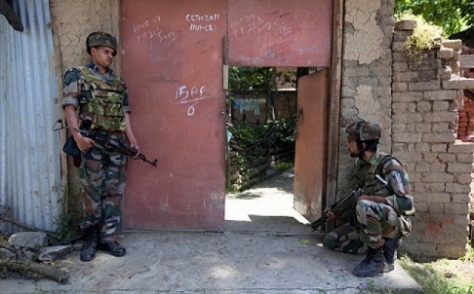
india_kashmir_rebel_attack
Indian Army soldiers at an encounter site with militants in Kashmir on Friday. AP photo

Guest post by JUSTIN PODUR: I spent a week in Srinagar, the capital of Kashmir, at the end of April 2013, talking to people among whom there was a wide range of opinion. While almost everyone supports freedom, some are resigned to India never letting Kashmir go, others believe that the struggle will go on and take different forms, some are just trying to survive. It seemed to me, at the end of a calm week during tourist season, that India is bringing about all of the things that it fears: Pakistani influence, violence,  radicalisation of youth, political Islam, and hatred of India. Continue reading Eleven things India must do in Kashmir: Justin Podur

Statement condemning the Maoist politics of murder Chhattisgarh

We, the undersigned, strongly condemn the horrific massacre of leaders and workers of the Congress Party and the security forces accompanying them, carried out by the CPI(Maoist) in Chhattisgarh on Saturday. We also wish to express our deepest condolences to the families of all those killed in the convoy of Congressmen returning from an election rally at Sukma in Bastar dtrict.

The killing of senior state Congress leaders and their cadre is particularly barbaric and reprehensible as they had, in the course of the Maoist ambush, become captives or had surrendered voluntarily. This is tantamount to cold-blooded murder of prisoners in custody, an act that goes against all norms even in a state of civil or international war. The targeting of a political party in this fashion by the Maoists is also highly disturbing. Continue reading Statement condemning the Maoist politics of murder Chhattisgarh

Manifesto of a New Initiative: Statement by New Path

This guest post is a statement by NEW PATHa collective of people, mostly from backgrounds in social movements and mass organisations, who have been discussing how the work of people’s struggle and revolutionary transformation can be taken forward in the Indian context. Those discussions led to the decision to found a new organisation, tentatively called “New Path”.

Below is the draft manifesto, sent to us by friends associated with the initiative. It is being circulated for comments, criticism, suggestions and observations. New Path does not aim to be a traditional revolutionary party. Rather, it seeks to be a political formation that seeks out opportunities, through struggle, to weaken bourgeois hegemony in this country.
Continue reading Manifesto of a New Initiative: Statement by New Path

Capitalism, Sexual Violence, and Sexism: Kavita Krishnan

Sexual violence cannot be attributed simply to some men behaving in ‘anti-social’ or ‘inhuman’ ways: it has everything to do with the way society is structured: i.e., the way in which our society organizes production and accordingly structures social relationships. Once we understand this, we can also recognize that society can be structured differently, in ways that do not require – or benefit from – the subordination of women or of any section of society. 

What are the material structures that underpin sexual violence? As I address this question I will also engage with some of the arguments made in two recent articles which offer a professedly Marxist analysis of sexual violence and women’s subordination in India; one is ‘On the Empowerment of Women’ by Prabhat Patnaik, People’s Democracy, January 27, 2013, and the other is ‘Class Societies and Sexual Violence: Towards a Marxist Understanding of Rape’, by Maya John, Radical Notes, May 8, 2013.    Continue reading Capitalism, Sexual Violence, and Sexism: Kavita Krishnan

The value of undergraduate education for ‘Other’ students: Sanjay Kumar

Guest post by SANJAY KUMAR.

We are a tired party after two days quick hike up to the base of IndraharPass in the Dhauladhar range. Half of the students are visually challenged, the other half have been painstakingly guiding them over tricky stretches of the trail. The bus for Delhi is three hours late. We are stretched over our carry mats, reclining on backpacks, on the pavement behind a row of buses at Dharamshala bus stand. The issue under discussion is Atheism. It hasn’t taken long for visually challenged students to split into firm believers who pray regularly, occasional/opportunist believers, agnostics and atheists. Arguments are both experiential and theoretical. During one particularly intense exchange an occasional believer asks a firm believer, “If there really is a God who is omnipotent, good and takes care of every one, then tell me why has he made us so that we can not see?” It is an old normative argument against the conception of God. Presumably Darwin turned atheist arguing similarly with himself after witnessing the pain of his infant daughter due to an incurable illness. Closer home, revolutionary Bhagat Singh gives a liberal juridical version of the argument in ‘Why Am I an Atheist?’ Believer’s reply is spontaneous, in a matter of fact way. “You know what, I find myself really fortunate in being visually challenged. Due to this I got a chance to study. Had it not been for this, I would have been selling sweets from my father’s push cart in our small town.”

Realities of life in a country like India have to be piercingly brutal for a talented young man to think that it is mainly through his physical disability that he got access to a decent education and moving out of a life of poverty. This note is intended to bring some consequences of such reality to the recent discussions on Kafila regarding education at Stephen’s College.

Continue reading The value of undergraduate education for ‘Other’ students: Sanjay Kumar

End of Postcolonialism and the Challenge for ‘Non-European’ Thought

A lively debate has been going on lately in Al Jazeera, following the question posed by Hamid Dabashi in an article provocatively titled “Can Non-Europeans Think“? Dabashi’s piece, published earlier in January this year was a response to an article by Santiago Zabala, Research Professor of Philosophy at the University of Barcelona. Zabala’s article, entitled “Slavoj Zizek and the Role of the Philosopher”, was actually on an entirely different issue, as will be evident from the title. Zabala attempts, in this article, to read in Zizek’s persona and oeuvre, the possible implications for the philosopher as such. He dwells on Zizek as a figure who is at once a philosopher and a public intellectual – a role not very easily available, according to him, to academic philosophers.

If most significant philosophers become points of reference within the philosophical community, he says, “few have managed to overcome its boundaries and become public intellectuals intensely engaged in our cultural and political life as did Hannah Arendt (with the Eichmann trial), Jean-Paul Sartre (in the protests of May 1968) and Michel Foucault (with the Iranian revolution).” Zabala explains this rare ability/ possibility by invoking Edward Said on the ‘outsider’ status of the intellectual and by underlining the direct engagement of the thought of such philosophers with contemporary events. He says:

These philosophers became public intellectuals not simply because of their original philosophical projects or the exceptional political events of their epochs, but rather because their thoughts were drawn by these events. But how can an intellectual respond to the events of his epoch in order to contribute in a productive manner?

In order to respond, as Edward Said once said, the intellectual has to be “an outsider, living in self-imposed exile, and on the margins of society”, that is, free from academic, religious and political establishments; otherwise, he or she will simply submit to the inevitability of events.

Read the full essay here at Critical Encounters.

India needs a third imagination

In a brilliant column in the The Indian Express, Pratap Bhanu Mehta (with whom I have much to disagree about reservations) calls the bluff of the “national” parties who want Indian voters to be wary of the ‘instability’ and impossibility of a third front coalition government. This argument, strangely posing itself in a nationalist tone, is unfortunately also bought by too many left-liberal intellectuals and activists who don’t want us to get out the non-choice of the BJP-Congress binary. Mehta writes:

Sometimes an ordered instability can be more productive than a comatose stability. It is said that a third front leadership is unlikely to have a national perspective. But the cringingly desperate way in which the leadership of the national parties have put their own survival above any principle makes you wonder what the charge of not having a national perspective is all about. The third front will make foreign policy hostage to regional interests. In a way, it already is. But the source of the problem is deeper. Even a supposedly national party like the BJP cannot get its act together on the enclaves agreement with Bangladesh. Why blame regional parties? The third front will be fiscally irresponsible. It is a risk, but no more than a risk with any political party. The Congress squandered the best of economic opportunities in a fiscally irresponsible way. It is something of an irony that the only Chidambaram budget described as a “dream budget” came under Deve Gowda. And many states have shown innovation in a kind of pro-business entrepreneurial capitalism and in social sector schemes. Many of the regional leaders who would make up the third front are autocrats. Indeed, many of them are. But that autocracy is more visible because the national parties can use the state structure in a very sophisticated way to further their ends. But they are articulate and engage with their constituents. In short, the constituents of the third front are as much India and Indian interests as anyone else. [Full article]

India needs a third imagination, and by constantly being told that it is not possible we are told not to imagine it. This is the argument of, as Mehta puts it, the ‘entrenched elites’, to save their privileges. The fear of the third front, of the ‘regional’, needs to be fought and defeated. We see this poverty of imagination thrown at us whether we’re talking of Nitish Kumar or Arvind Kejriwal or Mayawati by people who will do not think it necessary to subject the Congress and the BJP to similar scrutiny. This bias against the “regional” is remarkably shared amongst a lot of people across the ideological spectrum. Their bluff needs to be called.

Sinful liberals and the war against jihadi terror: Manisha Sethi responds to Praveen Swami

Guest post by MANISHA SETHI: It has been seven months since the Jamia Teachers’ Solidarity Association brought out its report, Framed, Damned, Acquitted, chronicling in detail how the Delhi Police’s Special Cell implicated innocents – former militants, police informers, businessmen, and just ordinary, unlucky men – as terrorists. It is one of the few documents that lends evidentiary credence to the widespread sense amongst Muslims that they are being targeted in the war against terror. Apologists for the police and investigative agencies however do not tire of contesting its conclusions, namely that there is a systemic and systematic bias against minorities when it comes to terror investigations. What bias, they ask. As does our chief National Security ‘analyst’ Praveen Swami, who has stressed that “liberals are compromising the war against jihadi terror“.

Could such ‘analysts’ be echoing the sentiments of a judge of the Allahabad High court, who less than two decades after India gained independence, noted, that “in the entire country there is not another criminal force whose misdeeds can come anywhere near the list of crimes of that organised body called the Indian Police force” (All India Reporter, 1964, Vol. 51, 702). Do they mean, that our extraordinarily brutal police force is even-handed in its application of cruelty across the spectrum of our citizenry, and is not especially biased against the Muslims, or Dalits, adivasis and so on?

Continue reading Sinful liberals and the war against jihadi terror: Manisha Sethi responds to Praveen Swami

Gandhi’s fourth monkey: Suvaid Yaseen

Guest post by SUVAID YASEEN: Incredible India is a land of promises. Amnesia and half narratives. Selective remembrance and deliberate forgetting. The national interest is incredibly important. And everything is allowed in this war.

Gandhi’s – the father of the nation – maxim of bura mat kaho, bura mat suno, bura mat dekho (don’t say evil, don’t hear evil, don’t see evil), interestingly forgets to say bura mat karo (don’t do evil). So, you can do it, and forget it. Gandhi should smile. And his monkeys can make merry.

Mohammad Yasin Malik, the Jammu Kashmir Liberation Front commander turned ‘Gandhian leader’ must know this irony very well.

When, in the early nineties, the guns started ringing, Kashmiris were told that they should leave the path of the armed struggle and have a peaceful agitation, and they would be listened to, by India and by the international community. Continue reading Gandhi’s fourth monkey: Suvaid Yaseen

On higher education in India: Saattvic responds to Thane Richard

This is a guest post by SAATTVIC

Hi Thane,

I recently read your piece for Kafila, which was subsequently reproduced in part in the Hindu. I studied economics there as well, batch of 2006. I subsequently went on to read for an MPhil in Economics at Oxford.

Good on you for writing that piece. It raised lots of questions about our education system, and I agree with a lot of what you wrote (and share the same dismay at the dictation sessions from one particular professor you referred to).

There’s just a few things that I’d like to say, but before I say them let me say that none of this comes from being ‘nationalist’ or ‘patriotic’ in the slightest – just as you spent three years studying, working and paying taxes in India, I spent five studying, working and paying taxes in the UK, and I would like to believe that doing so has given me a bit of a world view of these things. Moreover, my area of interest is education economics, which is what my research focused on. Continue reading On higher education in India: Saattvic responds to Thane Richard

Partha Chatterjee on Subaltern Studies, Marxism and Vivek Chibber

At the recent Historical Materialism conference held in Delhi from April 3-5, a panel was organized with great fanfare – an official panel by the HM editors – around Vivek Chibber’s new book Postcolonial Theory and the Spectre of Capital. This panel was billed to be a decisive refutation of Subaltern Studies and Postcolonial theory, not only by the chief  theorists and organizers of Historical Materialism but by many other Indians – most of whom in any case have little more than a religious faith in ‘Marxism’ and understand little of Marxism and its history.  There was glee all around and one came across the hurried announcement of a Centre for Marxist Studies that was to host further events around this book against the demon that Chibber had apparently slain. After all, Chibber  was backed by the likes of Slavoj Zizek, Robert Brenner and Noam Chomsky, all of whom  had  endorsed his book as the death knell to  Subaltern Studies and Postcolonial theory. The glee was to be short-lived.

On April 28, at the New York conference of Historical Materialism, the organizers made the mistake of inviting Partha Chatterjee (a representative of a spent force, already buried at the Delhi HM Conference!) to debate the new star on their horizon. The meticulous demolition of Chibber that followed, embarrassed even his most ardent supporters, who had hoped to see the redoubtable Partha vanquished in person. And Chhibber, let our marxist brethren note, is reduced to finally accepting that he is more inclined towards contract  theory than towards Marxism!

Partha, whose years of meticulous engagement with Marxism can hardly be taken on cavalierly by any upstart on the horizon, calmly tore Chibber’s claims to shreds. Many supporters of Chibber’s book have, in social media, glumly  described the 28 April event as a great setback to their cause…

Here is Partha in debate…

The Golchakkar of Premier Institutions: St. Stephen’s College as a Public Concern: N P Ashley

This is a guest post by N P Ashley: For a teacher, it feels strange to defend one’s workplace in public against the experiential remarks of an individual who happens to be in some ex-student capacity in the same college. “I didn’t like X’s classes” or “I found academic excellence in St. Stephen’s College a myth”  are statements that need no attempt to be disproven precisely because the writer, Thane Richard, makes no attempt to prove them in the first place. The narrative is anecdotal and validation is through “personal experience” which can only be countered, rather weakly, through other anecdotes. Hence, I won’t get into it. But there are certain methodological problems with the entire exercise, which, if not countered, will wrongly define the concerns of the readers.   Continue reading The Golchakkar of Premier Institutions: St. Stephen’s College as a Public Concern: N P Ashley

Students vs. SEWA or Dalit Student vs. Dalit Women Workers? Student ‘Politics’ on CDS Campus: Praveena Kodoth, J Devika, Sonia George

There have been reports in the media of an agitation by students of the Centre for Development Studies, Thiruvananthapuram,  because a fellow student was asked to leave the hostel  to facilitate an investigation of a complaint against him by the Self Employed Women’s Association, which runs the cafeteria on campus.  These reports and some exchanges between faculty have been circulated on the web / social media and has led to wider discussion of this event.  We consider it imperative to put forward our shared perspective as women activists as well as bring together our views as women faculty members of CDS and co-ordinator of SEWA respectively.

The student was informed in a letter that the action against him was until such time as the investigation was completed.  Media reports have portrayed the agitation as having been motivated by the victimization of a Dalit student by the workers of the cafeteria. Also it is being propagated that the student was ‘turned out’ of the campus when the letter from the Director required the student to ‘leave’ the hostel and refrain from using the cafeteria until the investigation was over.  Deliberately enough, the action was not to prevent the student from entering the campus.  We present here the context in which the student was asked to leave the hostel, the politics of the portrayal of the incident by the students as an infringement of the rights of a Dalit student and the larger implications of their claims, that feminism has been used to victimize students on the basis of caste.

Continue reading Students vs. SEWA or Dalit Student vs. Dalit Women Workers? Student ‘Politics’ on CDS Campus: Praveena Kodoth, J Devika, Sonia George

Taking Stock of the new Anti Rape law: Madhu Mehra

This is a guest post by MADHU MEHRA: The Criminal Law (Amendment) Bill, 2013, more popularly called the Anti-rape Bill, is now law. The outrage following the homicidal gang rape in Delhi unleashed events that lent force to the longstanding demand by the women’s movement for comprehensive reform of laws relating to sexual assault. These demands were bolstered by the recommendations of the high level committee, headed by retired Justice Verma, that called for reform of criminal laws, police reforms, prevention and education interventions to effectively tackle impunity for sexual violence. With the new bill passed by the parliament, the law stands substantially changed. This article takes stock of the ways in which the new amendments re-framed sexual offences in the law, their significance and the challenges that remain. While being far from comprehensive, these changes substantially transform the way legal redress for sexual offences have been framed in the law. A few examples below contextulise the significance.

Continue reading Taking Stock of the new Anti Rape law: Madhu Mehra