Category Archives: Debates

Patriarchy, Women’s Freedom and Capitalism: Kavita Krishnan

Guest post by KAVITA KRISHNAN

(This article began as a rejoinder to Hindi columnist Raj Kishor [Vaam se dakshin tak ek hi tark, (‘The same argument from Left to Right’), Rashtriya Sahara, January 13 2013], but it has also provided an occasion to address some common misconceptions about women’s freedom and capitalism.)

When women demand ‘freedom,’ why does it immediately raise the spectre of ‘licentiousness’?
Why, in other words, is women’s freedom automatically taken by many as equivalent with ‘licence,’ whereas the similar freedom on the part of men is never branded as ‘licence’?

This question arose in my mind after reading a piece by Hindi columnist Raj Kishor. Raj Kishor’s argument is that those – from Left leaders like I, to those whom he sees as representatives of the market – who are calling for women’s freedom are ‘consigning women into the fire of capitalism.’ When he hears me use the word ‘azaadi’ (freedom) he calls such freedom ‘utshrnkhalta’ (literally ‘unbridled-ness’, or licentiousness). He says and I, and the capitalist market alike, are calling for women to be free to ‘break all bounds of licentiousness’ if they so choose. Of course, Raj Kishor anticipates my criticism of his use of the word ‘utshrnkhalta’, since he says that is a word that ‘has feminists up in arms, demanding with red (infuriated) eyes the definition of ‘utshrnkhalta’.

Continue reading Patriarchy, Women’s Freedom and Capitalism: Kavita Krishnan

Implement Justice Verma Committee Recommendations Immediately: Freedom Without Fear Campaign

Guest Post from BEKHAUF AZAADI / Freedom Without Fear Campaign

UPA Government: Implement Justice Verma Committee Recommendations Without Delay!

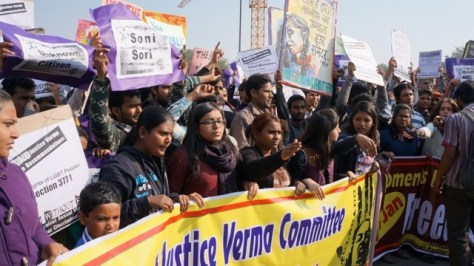
The Report submitted by the Justice Verma committee marks an important measure of victory for the ongoing people’s movement against sexual violence, as well as for the decades of the women’s movement and democratic movement in India.

Continue reading Implement Justice Verma Committee Recommendations Immediately: Freedom Without Fear Campaign

Many authors missing at Jaipur Lit Fest: Sajan Venniyoor

Guest post by SAJAN VENNIYOOR, our cultural correspondent

Threats from Hindu, Muslim and other cultural organizations may derail the Jaipur Literature Festival set to begin on Thursday, 24 January.

The BJP and RSS have threatened not to allow seven Pakistani authors to attend the event. “Looking at present Indo-Pak relations, it is unacceptable to allow Pakistani writers to be here as guests. We will make sure they are not allowed to enter Rajasthan. If they come, they will meet the fate of many others who have met similar fates,” said Suman Sharma, BJP state vice-president.

The Pakistani authors included in this blanket ban are British-Pakistani Nadeem Aslam, Canadian-Pakistanis MA Farooqi and Sharmeen Ubaid Chinoy and plain old garden variety Pakistanis Mohammed Hanif, Jamil Ahmad, Fahmida Riaz and Ameena Saiyid. Continue reading Many authors missing at Jaipur Lit Fest: Sajan Venniyoor

In Multiples of Ten Ravanas

Some (more) thoughts on Indian and Pakistani soldiers beheading each other at the ceasefire line in Jammu & Kashmir

Hindustan Times Graphic
From the Hindustan Times

In the early hours of 10 January 2013, I published a post here that asked, “Was an Indian soldier decapitated at the Line of Control or not?” Soon thereafter, the family of Lance Naik Hemraj Singh of 13 Rajputana Rifles cremated his body and went on a hunger strike, demanding the government get the head. Several readers commented that now that it was clear a beheading did take place, I owe them an apology. I do not see why I owe them such an apology considering  I never said that an Indian soldier wasnot beheaded. I only pointed to the conflicting reports, the absence of official mention about whether or not a soldier was beheaded, a quoted a Reuters report that categorically said that according to the official spokesperson of the Northern Command, no soldier was beheaded, though the two soldiers’ bodies were mutilated. Despite such an official denial quoted in a trusted news source, I had written, “It is possible the anonymous sources are right, because this is not the first time both sides are blaming each other of showing disrespect to bodies of dead soldiers in violation of the Geneva convention.” Continue reading In Multiples of Ten Ravanas

Dear Barkha Dutt: The Buck Stops Where?

On the of latest edition, (telecast a few hours ago, on the evening of the 15th of January, 2013) of ‘The Buck Stops Here’, (a flagship news show on NDTV anchored by Barkha Dutt) – ‘India-Pakistan:Another Tipping Point‘, Admiral (Retd.) Ramdas, former chief of the Indian Navy said he knew that Indian forces have beheaded Pakistani soldiers in the past. Gen. (Retd.) V.P. Malik, former chief of the Indian Army contradicted him, and said this had never happened. Barkha Dutt was silent on this matter.

Below is a summary of some highlights of the discussion. Continue reading Dear Barkha Dutt: The Buck Stops Where?

An open letter to Madhu Purnima Kishwar: Zahir Janmohamed

Dear Madhu ji,

I was very excited when I learned you were coming to Ahmedabad and I was honoured that you expressed interest in possibly meeting with me.

I was sitting with a journalist friend when I read your Tweet about visiting Ahmedabad and he told me you are a “pioneering feminist who did ground breaking work.” He also told me that in 2005 you signed a very strong petition calling for Gujarat Chief Minister Narendra Modi’s dismissal because of Modi’s role in the 2002 Gujarat riots. He also added that you have been very vocal on behalf of Kashmiri Pandits. After I witnessed the Gujarat riots in 2002, I returned to the United States—where I was born and raised—and I gave lectures for six months about the violence I saw. In each lecture, an audience member would inevitably shout at me that I have ignored the plight of the Kashmiri Pandits. It is true. I know very little about Kashmir, and for that matter Kashmiri Pandits, and I would have enjoyed and benefited from listening to your views on the conflict there.

I understand from your Twitter feed that you have left Ahmedabad. I know your days in Ahmedabad were limited and I fully understand that you were not able to meet. Therefore in this letter I will try to convey some of the things I had hoped to tell you in person, in particular about your Tweets. Continue reading An open letter to Madhu Purnima Kishwar: Zahir Janmohamed

Against Castration: Himika Bhattacharya and Deepti Misri

Guest post by HIMIKA BHATTACHARYA and DEEPTI MISRI

some-protestors-have-been-calling-for-rapists-to-be-castrated

The public preoccupation with both the death penalty and castration as punishment for rape continued last week, with the Pakistani activist Asma Jahangir reportedly suggesting that the rapists of the Delhi rape case be either punished with castration or else face the death penalty.[1] The consistent demand for punitive castration in India may be somewhat boosted by the Indian media reporting the following developments – last week, the South Korean court ordered Asia’s first chemical castration[2]; the Malaysian bar is pushing for castration[3] as a punishment for repeat sex offenders; and that such punishment has reportedly been long used in other countries[4]such as Germany, Denmark, and some states in the U.S. Continue reading Against Castration: Himika Bhattacharya and Deepti Misri

Breaking the Collective – Notes from Jantar Mantar & Koodankulam: Vivek Vellanki

Guest Post by Vivek Vellanki

The death of the young girl brought incommensurable grief for the ‘Indian’ people. A national angst ensued with divergent voices seeking divergent ends: justice, death penalty, fast track courts, end to patriarchy, chemical castration, and a long list that cannot be spelt out here. There was a glimmer of hope that the discursiveness would ensue a quintessentially democratic process of debate, discussion, and deliberation amongst the people. The Indian state with its long-standing reputation wouldn’t allow for that to happen. It had to continue on its pet peeve of Breaking the Collective! The people’s movement in Koodankulam, the anti-corruption movement, the movement for seperate Telangana are some of the many instances that remind us of this pet avocation of the Indian state being pursued in recent times, almost, vocationally. However cynical it may sound, amidst the entire candle lighting and sloganeering, we failed to realise that the protest in Delhi was happening on the terrain that the government decided, in a manner that it wished for it to play out, and was party to the people it wanted to see there. I wish to argue that the closing down of the metro stations has a relation to the nature of the protests at Jantar Mantar. Furthermore it concurs with the tactics of chocking people’s movements logistically and stifling the collective by pathologizing the everyday life of masses. The tragedy of this lies in the fact that such actions of the state have become so recurrent that they have entered our common sense and they present themselves as normal and logical responses. Albeit they have been rationalized by invoking a specious reference to law, order, and safety, there is a need to unpack such a rationalization. My attempt is to extract these actions from that location of common sense and present them for public scrutiny. Through this essay, I would like to draw the connections between the democratic protests happening in locations across the country and state action in dealing with them. In doing so, I hope to bring to notice how the Indian state uses its machinery to purge protests of their democratic tenor and eventually, at least, attempts to break the collective. Continue reading Breaking the Collective – Notes from Jantar Mantar & Koodankulam: Vivek Vellanki

The Country With A ‘Balancing Office’: Suvaid Yaseen

Guest Post by Suvaid Yaseen

Of late there has been a rising trend of Kashmiris – professionals, artists, writers, musicians et al presenting their works on Kashmir on a much wider level than before. The larger impression that comes out of it all is that the narrative has been taken up by the people for themselves. A welcome contrast to outsiders flying in and telling us what we want, how we think, and what is actually good for us.

So, every time a Kashmiri artist is presenting his/her work on Kashmir, the expectations among Kashmiris tend to go up. People start feeling that finally their narrative, of how they saw the things, what they went through, would be told to the world, bereft of the lenses of security paradigm through which Kashmir has been usually viewed  –  a strategic territory, with not-so-strategic, dispensable people.

This can be fortunate as well as unfortunate. On one hand there is a ready audience to appreciate and applaud your work. On the other hand there are expectations to ‘perform’. For the artists themselves, there are additional pressures of ‘balancing’ and having a ‘non-biased’ view from the other side.

Continue reading The Country With A ‘Balancing Office’: Suvaid Yaseen

Now that Owaisi is in jail, how about Praveen Togadia?: Mahtab Alam

Guest post by MAHTAB ALAM

Akbaruddin Owaisi, an MLA of Andhra Pradesh Legislative Assembly, who belongs to a Hyderabad-based political party All India Majlis-e-Ittihad al-Muslimin, better known as MIM, and its floor leader in the Assembly made an inflammatory speech against Hindus on 24 December 2012 at a public meeting in Adilabad District. The speech attracted widespread condemnation by Muslim activists, rightly so, apart from left, liberal individuals and organizations. Dr. Zafarul Islam Khan, President, All India Muslim Majlis e Mushawarat (AIMMM), an umbrella body of prominent Indian Muslim organizations termed it ‘a hate and rash speech’ arguing, ‘words that should never have been uttered by a responsible person, let alone a political leader, were used’.

Shabnam Hashmi, a prominent social activist and who has been relentlessly working on the issue of minority rights registered an FIR in Delhi against Owaisi stating, ‘the whole speech is highly objectionable, inflammatory and against the values of our constitution, democracy and secular values’. Similarly, FIRs were also registered in the State invoking section 295 A (for deliberate and malicious acts intended to outrage religious feelings) and 153 A (promoting enmity between different groups) of Indian Penal Code (IPC). Owaisi was arrested finally arrested on Tuesday (8th January) and sent to 14-day judicial custody. Continue reading Now that Owaisi is in jail, how about Praveen Togadia?: Mahtab Alam

Come Frolic with Me in the Streets of Delhi: Amrapali Basumatary

Guest post by AMRAPALI ‘TARA’ BASUMATARY

Another Report on the Gathering of the Night of 31st of December 2012/Ist January 2013 against Patriarchy in Delhi

It was 31st December 2012, city-Delhi, the same Delhi which has gained the infamy of being the Rape-Capital of a country called India, a nation whose ‘dignity’ has been maligned by the increasing cases of sexual assault on women. Around three hours before the clock struck the decisive moment of New Year, many of us gathered at the PVR Anupam complex in Saket to “take back the night”, back from the shackles of misogyny, sexual assault, patriarchy and above all from the banal and real fear of being subjected to crimes meted out by multifarious forms of male-supremacy and power. It was a night when ‘dented and painted’ females as well as males were showing that ‘denting and painting’ are not reasons that ‘invite’ rape or sexual assault and those ‘hormone driven gazes’. Continue reading Come Frolic with Me in the Streets of Delhi: Amrapali Basumatary

Your rapists and ours

Two interesting articles:

Emer O’Toole in the Guardian CiF:

There’s something uncomfortably neocolonial about the way the Delhi gang-rape and subsequent death of the woman now known as Damini is being handled in the UK and US media. While India’s civil and political spheres are alight with protest and demands for changes to the country’s culture of sexual violence, commentators here are using the event to simultaneously demonise Indian society, lionise our own, and minimise the enormity of western rape culture. [Full article]

And Ananth Krishnan in The Hindu:

The rape case was one of the most discussed topics in Chinese microblogs over the past week, prompting thousands of posts and comments. By Sunday, however, the authorities appeared to move to limit the debate: on Monday, a search for the topic triggered a message on Sina Weibo – a popular Twitter-equivalent used by more than 300 million people – saying the results could not be displayed according to regulations. The message is usually seen as an indicator of a topic being censored by the authorities. [Full article]


The things you learn at a protest: Aakshi Magazine

Guest post by AAKSHI MAGAZINE

She was sitting among a group of young men and women at Jantar Mantar, shouting “Hang those bastards.” When the slogan lost its effectiveness, it turned to “We want Justice,” “Inquilab Zindabad,” and then “Bharat Mata ki Jai”. Borrowed and heard slogans, but they came from a very real place. “I work in Saket but live in Dwarka.” That is a long distance to travel especially at night. She nodded. “I don’t like it when my parents tell me to come home early just because other people are at fault,” she said anger rising in her voice. She didn’t know any of the people in the group she was sitting with. “We just met here. I had come with a friend who I can’t locate at the moment.” Continue reading The things you learn at a protest: Aakshi Magazine

Notes from a Night Walk in Delhi University

[ B&W pictures, courtesy Chandan Gomes. Colour pictures and cell phone video footage, courtesy, Bonojit Husain, New Socialist Initiative ]

Dear young women and men of Delhi,

I am writing to you again because I have been listening to you. This is a strange time, when everybody is talking, and everybody is listening, and the unknown citizen, who could have been any one of you, has transformed us all.

I was with you last night, from five thirty in the evening to around nine at night, while we walked together from the Vishwavidyalaya (University) Metro Station to Vijay Nagar, Kamla Nagar and the North Campus of Delhi University. There were around twelve hundred of you. Several of you held candles. You made yourselves into a moving blur of light. As the shopkeepers of Vijay Nagar, as the rent collecting aunties of paying guest accommodations, as the men and boys and girls and women on the streets and in the verandahs looked at you in wonder, you looked back at them, many of you smiled and waved. I could see some people in the crowd lip-synch with your Hallabols.

[ video of the night march near Delhi University ]

Continue reading Notes from a Night Walk in Delhi University

What Do Men Have To Do With It?: Rahul Roy

Guest post by RAHUL ROY

I have been sitting quietly trying to finish my new film and had promised myself that I would not get side tracked and concentrate on the task at hand. But enough is enough. I am shocked and disappointed at the way men high jacked a protest that could have been and probably still is the most significant pouring out of women who may never have thought in their wildest dreams that they would be facing water cannons and cops giving them a chase with iron tipped sticks. I am sure it is a coming of age moment for many young women of the city of Delhi.

I am aware that there has been a fair bit of cynicism about middle class women running up and down Raisina Hill and whether it adds up to anything. It damn well does. The next time they see adivasis being chased down by the police in Chattisgarh or in Orissa a penny will drop. It already is, today there is an article by a 19 year old student form Lady Sri Ram College narrating her brush with Delhi Police at the Parlaiment Street Police station and quite significantly she adds that if they are capable of behaving the way they did with a group of ‘well connected’ college students in Delhi then what must be happening in the more remote areas of non metropolitan India. Continue reading What Do Men Have To Do With It?: Rahul Roy

To the Young Women and Men of Delhi: Thinking about Rape from India Gate

Dear young women and men of Delhi,

Thank you for the courage and the honour you have brought to Rajpath, the most dishonorable street in our city. You changed Delhi yesterday, and you are changing it today. Your presence, of all twelve thousand of you, yesterday, on Rajpath, that street that climbs down from the presidential palace on Raisina Hill to India Gate, getting soiled by the excreta of the tanks and missiles on Republic Day each year, was for me a kind of purificatory ritual. It made a claim to the central vista of ‘Lutyen’s Delhi’ as a space for democratic assertion in contravention of the completely draconian, elitist and undemocratic prohibitory orders that make the heart of this republic, a zone of the death, not the life and sustenance, of democracy.

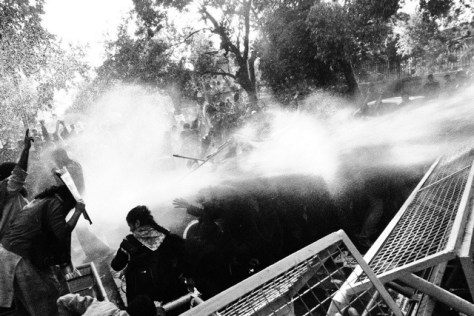
From now onwards, consider the heart of Delhi to be a space that belongs, first of all, to its citizens. Yesterday, when thousands of you gathered peacefully, intending to march up Raisina Hill to the president’s palace, you were charged with batons, tear gas and subjected to jets from water cannons. The violence began, not when protestors threw stones, but when the police started attacking people. Stones were thrown in retaliation. The television cameras that recorded what happened show us the exact chronology. The police were clearly under orders not to let people up Raisina Hill. Why? What is so sacred about Raisina Hill? Why can a group of unarmed, peaceful young people not walk to the gates of the president’s palace? So, lets be clear. Violence began when the state acted. Of course, the protest got hijacked by hooligans. But of course it had to be. When hooligans in uniform are let loose on an unarmed crowed, there can be no possibility of averting the possibility that hooligans out of uniform will respond in kind. Continue reading To the Young Women and Men of Delhi: Thinking about Rape from India Gate

An open letter to the President of India: G. Ananthapadmanabhan

Sri Pranab Mukherjee
President of India
Rashtrapati Bhavan
New Delhi – 110 004.
India

12 December 2012

Subject: Open letter regarding the resumption of executions in India

Dear President,

I am writing on behalf of Amnesty International regarding the recent resumption of executions in India after eight years, to urge the Indian authorities to immediately establish a moratorium on executions with a view to abolishing the death penalty. Continue reading An open letter to the President of India: G. Ananthapadmanabhan

Aam Aadmi party learns from aam mahila

This release was put out yesterday by the RIGHT TO FOOD CAMPAIGN

On the second day of the “Right to Food dharna” convened by the Right to Food Campaign, hundreds of poor women from across the country braved the morning cold and rain to assemble at Jantar Mantar and voice their concerns,  including the demand for a universal PDS, universalization with quality of ICDS, universal maternity entitlements, universal pensions for single women, and crèche facilities at the workplace.


Women living in urban slums, on the streets, working on construction sites, agricultural workers, single women, women with young children from different states shared their experiences of struggle for food security and access to the Public Distribution System and other food-related programmes. Continue reading Aam Aadmi party learns from aam mahila

Moditharam at IFFK 2012 : An Open Letter to the Young People Who Volunteered at IFFK

 Dear Friends

Writing this to you to share the pain, the insult, the deep sense of deprivation that I feel at the end of IFFK 2012.

I am sure many of you would be surprised by this statement. I expect a barrage of irritated questions: didn’t the IFFK 2012 present a most delectable selection of films, and that too, of impeccable political correctness? Weren’t the passes delivered promptly? Weren’t the theaters all spruced up and respectable? Were the loos great this time? So what more do you want, you crude, loud-mouthed female, who was shouting and protesting most of the time? And in any case, why should you write at all to the volunteers,  and not to the authorities if you plan to complain?

Continue reading Moditharam at IFFK 2012 : An Open Letter to the Young People Who Volunteered at IFFK

Can we solve Siachen without solving the Jammu and Kashmir dispute?

Myra MacDonald with Pakistani Army officers in the Gyari sector in 2004

Myra MacDonald is a London-based journalist with Reuters and a long-time observer of South Asia. She tracks the turning points in Pakistan politics at the Pakistan: Now or Never. MacDonald is best known for her book on the Siachen conflict, Heights of Madness: One Woman’s Journey in Pursuit of a Secret War. Published in 2007, the research for the book took her to both sides of the conflict, on helicopter and on ground. She was bureau chief of Reuters in India in 2000-2003. She then took leave-of-absence to research the Siachen conflict, becoming one of the very few people to visit the war zone on both the Indian and Pakistani sides. She has given presentations on Siachen to the Royal Military Academy Sandhurst and to the International Institute for Strategic Studies in London. Amidst alarmist rumours that track-two parleys between India and Pakistan are urging India to ‘give up Siachen’, MacDonald tells Shivam Vij in an e-mail interview why resolving Siachen without resolving the Jammu and Kashmir dispute may not be easy.

Q1) The idea of demilitarising Siachen is being seen by some in India as a demand to hand Siachen over to Pakistan, or at the very least, to ‘lose’ the territory for which Indian soldiers have made great sacrifices. Do you agree with such an interpretation of demilitarising the glacier? Do you think India has real strategic advantage with its occupation of the glacier? Continue reading Can we solve Siachen without solving the Jammu and Kashmir dispute?

Kurdistan, a Forgotten Nation of 40 Million People: Kamal Chomani

Guest Post by KAMAL CHOMANI

It has been for about 13 months I am living in Bangalore, India. I am here to study masters. India to me, as it is, is incredible. I feel as if I am at home. People here are friendly. My teachers and colleagues are just great. I have to confess that for a student that is his first time to leave his home for such a long time, certainly, will face many difficulties, but no difficulties have hurt me as much as a question of Indian people ‘where are you from?’

I am from Iraq, but Iraq is not my country. I cannot speak Arabic which is the official language the country. Luckily three more Iraqi people are with me who have helped me to manage my Arabic. My culture is different from Arabs. I don’t want to look like a nationalist, because I am telling the truth. I am a Kurd! My mother tongue is Kurdish. My homeland is Kurdistan.

So, who are the Kurds?

Kurdish community in Italy protesting for Ocalan's release. Photo courtesy demotix.com
Kurdish community in Italy protesting for Ocalan’s release. Photo courtesy demotix.com

Kurds are the original inhabitants of Middle East. They are the biggest stateless nation around the world that they are still struggling for freedom and independence. They have been forgotten by the world.

Yes, Kurds are a forgotten nation of 40 million populations. In India, few people know who Kurds are. I am really surprised when some Indians ‘love’ Saddam Hussein, the former Iraqi president. Saddam has killed more than 300,000 Kurds. He used poisoned gas against Kurds and killed 5000 Kurds in only one hour in Halabja, which is known as Hiroshima and Nagasaki’s sister! He mass murdered more than 182,000 Kurds in Anfal (Genocide) operations. The Anfal case is going to be an international case. Sweden Parliament has just decided to recognize it as a genocide act against humanity. In UK, Kurdish people have started a huge campaign to make pressures on UK parliament to recognize as Genocide. Continue reading Kurdistan, a Forgotten Nation of 40 Million People: Kamal Chomani