Category Archives: Ecology/Environment

Thinking a local Cosmopolitanism – the Kochi Muziris Biennale: Interview with Dilip Menon by Riyas Komu and CS Venkiteswaran

English transcript of  interview published in Malayalam in Mathrubhumi Weekly, October 17 2017.

CSV

Kochi is a curious choice as a site for an international art event like Biennale, isn’t it? It has played no prominent role insofar as art activity, practice or market is concerned, nor is it a metropolitan city like Mumbai or Delhi. One qualification, of course, could be its long cosmopolitan history of trade and the movement of people, ideas, religions or goods from time immemorial. Is KMB in a way, trying to invoke and re-imagine the cosmopolitan past or heritage of a place like Kochi?

Dilip Menon

I think there is a particular history to why such an event should happen in Kochi, and why it could be successful here alone. Kochi, being a port city, was always part of a universe that was much larger than the immediate geography within which it is located. So, like most port cities, it sits on the edge of land and looks out to the sea. When one thinks about the idea of cosmopolitanism, there is something about the already existing cosmopolitanism of port cities, whether it is Malacca, Kochi or Venice. It is not without significance that two of the more important biennales are in Venice and Kochi. I think that a port city is located in a much longer history of movements of people, ideas, materials and political ideologies across the ocean.  Even though these ports are now part of nation-states, their histories and memories are much deeper and much longer. The Kochi Muziris Biennale (KMB) is able to summon up these memories.

Continue reading Thinking a local Cosmopolitanism – the Kochi Muziris Biennale: Interview with Dilip Menon by Riyas Komu and CS Venkiteswaran

Statement Against Genocide and Deportation of Rohingya Muslims

Violence is sweeping Myanmar and in a short span of two weeks lakhs of ethnic Rohingya refugees have fled to Bangladesh and thousands have lost their lives. Satellite data shows, large parts of the Rakhine state, home to most of the Burmese Rohingya population have been set on fire, and murders, rape, arson, loot and forced displacement of the Rohingya population is taking place on a scale, that should be alarming for all humanity. Even the UN secretary general has called out to Mayanmar to end violence against the Rohingya and Nobel laureate Desmond Tutu has urged Mayanmar state Councillor Aung San Suu Kyi to speak out against the persecution of the Rohingya. The tragedy facing the Rohingya is of an unprecedented scale and needs to be addressed with a sense of utmost urgency.

As Indian citizens, we need to break the silence on ethnic violence against the Rohingya and the unconstitutional proposed deportation of a wide and long-residing Rohingya community from India, to certain death that awaits them in Myanmar. The Rohingyas have been living as a peaceful refugee community in various parts of India since the 1970s, with no criminal records or history of crime. Let us not be a part of this genocide. Let us stand up for justice and humanity, and raise our voice against the killings, displacement and deportation of the Rohingya!

Continue reading Statement Against Genocide and Deportation of Rohingya Muslims

Why tribals do mind being ousted by dams: Shripad Dharmadhikary and Nandini Oza

SHRIPAD DHARMADHIKARY and NANDINI OZA write a stinging response to Swaminathan Anklesaria Iyer’s unsupported claims in Times of India about how much tribals love being ousted for big dams. The newspaper did not care to publish this rebuttal so the authors posted this on Dharmadhikary’s blog and also in the comments section to Iyer’s article.

We reproduce Dharmadhikary and Oza’s original response in full below from Manthan.

However, here is an update from Shripad:

I put my comment in brief, within the allowed 3000 characters, yesterday in the Comments section. Today, it’s gone.

Then, a friend brought to my notice that Swaminathan has written a completely new version of the blog and put it out yesterday. Wonder if he is in the habit of writing different versions of the same blog within a matter of two days! https://blogs.timesofindia.indiatimes.com/Swaminomics/most-of-the-ousted-tribals-are-flourishing-and-loving-it-thank-you-activists/

Have yet to read the new version of his bog properly (am out since early morning), but it appears that he has rewritten it in a way that tries to skirt the response we had given. Now I am planning to write another response to the new blog….but can only do it tomorrow as busy with meetings today.

And now, Dharmadhikary and Oza’s original response in Manthan:

SA Iyers’s piece in Times of India dated 10 Sept 2017, “Why many tribals don’t mind being ousted by dams”, examining the condition of some of the oustees of Sardar Sarovar Narmada dam is a classic case of misinterpretation of data, hiding the more important issues, and conclusions not supported by research findings. Indeed, a proper reading of the article itself shows that unlike Iyer’s assertion, his own figures show that tribals do mind being ousted. Some important points are given below.

Iyer claims that their “surveys showed, unambiguously, the resettled villagers were better off than their former neighbours in semi-evacuated villages.” In support, among the figures given from their survey, they point out that comparing the resettled with their former neighbours who remain in the original areas, the access to drinking water was 45% against 33%, to PHCs was 37% versus 12% and to hospitals 14% versus 3%. Given that the oustees were resettled between 25-30 years ago, and that the Sardar Sardar project has poured in hundreds of crores of rupees for resettlement, these figures don’t speak of oustees being better off, but indeed, point to the pathetic case of the oustees.

Continue reading Why tribals do mind being ousted by dams: Shripad Dharmadhikary and Nandini Oza

Losing the Soul’s Acid Tongue … Terrorist State, Unbowed Children at Kerala’s Puthvype

[The title is inspired by Balachandran Chullikkad’s searing poetry]

I have recently been asked about why I didn’t write anything about the anniversary of the CPM-led government of Kerala.  Have also been asked why I don’t write about politics in Kerala anymore. The answer to the first is easy and painless: governments are not organic things. You measure your kid’s height and weight and other things and think about how they have grown in their minds and hearts on their birthdays. There is nothing that proves that anniversaries are the best occasions to reflect on how governments have grown and thrived. The answer to the second question is more conflicted and excruciatingly painful: it is because we have no politics in Kerala, but plenty of anti-politics. therefore, what one needs to do is invest in the silent, unglamorous, unpopular,  long-haul intellectual and political labour that may preserve the possibilities of politics in the future, and that may even create internalities capable of courage and responsibility necessary for being political. Continue reading Losing the Soul’s Acid Tongue … Terrorist State, Unbowed Children at Kerala’s Puthvype

Karl Marx in the Times of Climate Change

The Communist Manifesto had, as its object, the proclamation of the inevitable impending dissolution of modern bourgeois property. But in Russia we find, face-to-face with the rapidly flowering capitalist swindle and bourgeois property, just beginning to develop, more than half the land owned in common by the peasants. Now the question is: can the Russian obshchina, though greatly undermined, yet a form of primeval common ownership of land, pass directly to the higher form of Communist common ownership? Or, on the contrary, must it first pass through the same process of dissolution such as constitutes the historical evolution of the West?

The only answer to that possible today is this: If the Russian Revolution becomes the signal for a proletarian revolution in the West, so that both complement each other, the present Russian common ownership of land may serve as the starting point for a communist development. [Marx and Engels, ‘Preface’ to the 1882 Russian Edition of The Communist Manifesto; all emphasis added]

The above passage, jointly signed by Marx and Engels, appears at the end of the 1882 ‘Preface’ to the Russian edition of The Communist Manifesto. It also appears, towards the end of a decade-long engagement with the Russian social formation and the social formation of many Eastern societies like India’s. The detailed notes, excerpts and commentaries compiled by Marx, published later as The Ethnological Notebooks of Karl Marx, belong precisely to the end of this period, the years 1880-1882. Marx passed away the following year, in 1983. Continue reading Karl Marx in the Times of Climate Change

New Politics of Our Times and Post-Capitalist Futures

An earlier version of this essay was published in Outlook magazine

“The young students are not interested in establishing that neoliberalism works – they’re trying to understand where markets fail and what to do about it, with an understanding that the failures are pervasive. That’s true of both micro and macroeconomics. I wouldn’t say it’s everywhere, but I’d say that it’s dominant.
“In policymaking circles I think it’s the same thing. Of course, there are people, say on the right in the United States who don’t recognise this. But even many of the people on the right would say markets don’t work very well, but their problem is governments are unable to correct it.”
Stiglitz went on to argue that one of the central tenets of the neoliberal ideology – the idea that markets function best when left alone and that an unregulated market is the best way to increase economic growth – has now been pretty much disproved. Read the full report by Will Martin here

One often hears over-zealous warriors of neoliberalism say of Leftists that they live in a time- warp; that the world has long changed and that the disappearance of state-socialism has finally proved that all their beliefs were little more than pipe-dreams. They talk as though history came to an end with the collapse of actually existing socialisms and the global ascendance of neoliberalism in the early 1990s. As though all thought came to an end; as if the distilled essence of everything that could ever be thought, or need be thought, was already encapsulated in the neoliberal dogma.

Continue reading New Politics of Our Times and Post-Capitalist Futures

Recalling ‘Aaj Bhi Khare Hain Talaab’: Raj Kaithwar

Guest post by RAJ KAITHWAR

As I began to type this review, I struggled to begin with the beginning: how do I present this lively work on ‘talaab’ which does justice to its contents. It was not an easy task. Finally, I decided to begin with the end: the thoughts which clouded over me as I ended reading the book ‘Aaj Bhi Khare Hai Talaab’. How do we see a ‘talaab’ or do we even see it? Why are the modern ways of water conservation failing or are the modern ways even inclined at conserving? Who will protect the societies and ecologies from the rising dangers or is protection even a concern? As I describe some of the accounts from ‘Aaj Bhi Khaare Hai Talaab’ I hope it arouses a curiosity strong enough in the reader to pick up the book and scan through its pages. Continue reading Recalling ‘Aaj Bhi Khare Hain Talaab’: Raj Kaithwar

Take back the Poison-Rain: Ambikasutan Mangad’s Swarga

Swarga_300_RGBWhen I first encountered Enmakaje, it was already much praised in Kerala as the powerful little book that aroused the Malayali’s moral conscience towards the unspeakable tragedy wrought by the unbelievably-callous aerial spraying of the insecticide Endosulphan in north Kerala, over some of the most lush, verdant areas of the State. It was criticised by some for what I thought was a very interesting experiment with form: it begins as fiction, slowly shades into a historical account of the beginnings of the anti-Endosulphan struggle in north Kerala, and then shades back, in the end, to fiction again. For me, Enmakaje was much more than an activist tale. It was a determined effort to renew the Malayali self, through a prayerful weaving and imaginative retelling of the many stories that have shaped us. Reading of Neelakantan’s and Devayani’s stories, one remembers these stories, but differently. For example, what if Raman and Seetha left Ayodhya forever, renouncing its sickening power games? What if Adam and Eve voluntarily renounced Paradise? What if Vararuchi’s wife had rebelled in the origin-story of Kerala, of the Parayi petta panthirukulam?

Juggernaut has just published my translation of this gem of a book, and the title of the English version is Swarga: A Posthuman Tale . Below is an excerpt from the book.


It was past midnight.

Jayarajan started from his sleep and sharpened his ears for sounds from outside.

He shook Neelakantan, who was fast asleep, awake. Neelakantan woke to darkness assailing his open eyes. He was frightened.

‘What is it?’

In a trembling voice, Jayarajan said, ‘Something is happening outside. I can hear noises.’

Neelakantan’s throat was parched. He asked in a loud voice, ‘Who is there outside?’

Jayarajan noticed his fear in the dim light of the lantern.

‘Not human beings. Something like a storm and strong winds . . . I can’t make out much . . .’

Neelakantan’s breath returned.

‘Oh, that! Must be the wind . . . I’ve been scared ever since you came in . . . it’s just that I didn’t show it. You lie down, I’ll see you off tomorrow morning; put you on the first bus back. It is not at all safe for you to come and stay here again.’

Jayarajan got up.

‘Come, let’s go out for a bit.’

Neelakantan yawned. His voice was lazy. ‘The rain and wind will go their own way. You should lie down.’

Jayarajan took his hand and made him get up.

‘I’ve seen quite a bit of rain and wind too . . . but something extraordinary is happening outside.’

Neelakantan began to listen, alert now. There was a whole symphony of unpleasant sounds rising outside.

Taking care not to wake Devayani, they opened the door and stepped out.

They saw the most unbelievable sights on top of the Jadadhari Hill.

The huge trees were shaking hard, writhing, in the wind. From the clouds above, golden-coloured lightning-snakes descended, falling on the tops of the massive trees and enveloping them. As if from the impact of the lightning, the tall trees bowed as low as the ground, seeking to shake off the golden serpents . . .

In the next moment, the wind came hurtling like a demon’s hand, swooping up the trees. The branches clung and cleaved to each other as if in a paroxysm of desire, and shivered as though in the throes of an orgasm. And then, the lightning-serpents returned, and the whole cycle began again.

Startled, Jayarajan asked, ‘What is happening up there?’

For a few moments, Neelakantan had no words. He kept watching the hill’s frenzied dance and then said, ‘Terrible thunder and lightning. And the wind and rain besides. All of it together, that’s all.’

But even as he said those words, he knew how inadequate they were. Human language was too limited to describe this miraculous phenomenon. It was too vast to be comprehended by puny human consciousness.

‘Look, it is raining on top of the hill,’ Jayarajan pointed out. ‘Some of it is falling here too. But just see – there is not even a sign of rain or wind anywhere near here. Here the trees are still as if they have stopped breathing. It is a miracle . . . let me call chechi.’

‘No, she will be scared.’

Jayarajan remembered Devappa’s words. ‘On the night of the Kozhikkettu in Bhagyathimaarkandam, no one goes out!’

‘Two years ago, on a night like this, I heard the jungle sway like this around midnight. I thought it was a storm and did not go out.’

‘I think,’ Jayarajan said and stopped.

‘What?’

‘Is this really Siva’s dance of destruction, the thandava? Isn’t this the Jadadhari Hill?’

Neelakantan asked, ‘Are you a believer?’

‘No. What about you?’

‘I haven’t been to temples or shrines after I began to see things differently . . . In my view, Siva is Nature itself. Siva exists in every leaf, every flower. The thandava that you mentioned–’

‘The dance of destruction of Siva, who swallowed the divine serpent Vasuki’s deadly venom! This is it! Is this thandava- Jadadhari Hill’s, Nature’s – that means Siva’s – own attempt to shake off the terrible chemical poison, so like Vasuki’s venom, the Kalakoota?’

‘You tie up everything to your consciousness of the environment!’

Jayarajan pointed out: ‘See, the wind’s grasping fist now eases. The lightning retreats. The rain and thunder depart. The trees stand up straight once again.’

Neelakantan nodded, his eyes wide open and filled with the magic in the air. Yes, the dance of destruction was now ebbing.


Excerpted with permission of Juggernaut Books from Swarga by Ambikasutan Mangad, translated by J Devika available in bookstores and on Juggernaut.


Bovines, India And Hinduism: Rajani K. Dixit

Guest post by RAJANI K. DIXIT

In Vedic mythology we come across the story of sage Trita looking for fire and finding it in the head of a cow. Today we face a really big and scorching fire ensuing from bovines in India. Cows, we are told, are worshipped by Hindus and cow slaughter is therefore a religiously sensitive subject. Dalits and non-Hindus have been severely tortured or killed on suspicion of  cow slaughter by such sensitive people.

Let us see what the laws and constitution of our secular state as well as the religion claimed to be that of the majority of India’s population, have to say about cow slaughter.

In the Constitution of India, prohibition of cow slaughter is included in the Directive Principles of State Policy (guidelines to the central and state government for framing policies, not enforceable in any court of law). The directives on cow slaughter are recorded in Article 48 which reads

“The state shall endeavor to organize agriculture and animal husbandry on modern and scientific lines and shall, in particular, take steps for preserving and improving the breeds and prohibiting the slaughter of cows, calves and other milch and draught cattle” (Directive Principles of State Policy, Ministry of Law and Justice).

This makes it clear that, India being secular, the Directive Principles of the Constitution are not against the slaughter of cows, but of milch cattle in general, and not for religious but for economic reasons. The term ‘milch cattle’ includes cows, buffaloes as well as goats. India consumes much more of buffalo milk as compared to cow milk. Also, since more than 65% of the world population drinks goat milk, it is highly possible that large proportion of Indians also drink goat milk.

Continue reading Bovines, India And Hinduism: Rajani K. Dixit

On Barak Valley Bandh on 16th December, 2016 – Some Nascent Observations: Arunima Chakraborty

This is a Guest Post by ARUNIMA CHAKRABORTY

Let’s begin with the usual: by ruing over Indian mainstream media’s overlooking of what could have been treated as more newsworthy. Today, that is, 16th of December, 2016 witnessed a bandh in southern Assam’s Barak valley protesting against the statement by the union minister of state for railways, Rajen Gohain that ‘Bengali…should be withdrawn from Barak valley as official language’ since ‘there cannot be two official languages’.[1] And a simple, layman-like google-news search reveals that there are just three entries on the issue/event.

This piece is aimed not at joining the state Congress and the local SUCI(Socialist Unity Centre of India) cadres who are decrying comment by Gohain, the union minister and a senior BJP leader in Assam but rather at attempting a delineation of the ominous portents which it seems to have unleashed. And of course, to trace the genealogy of the statement.

First of all, a rather facile fact: Mr. Gohain’s observation that there cannot be two official languages clashes with article 345 of the Indian constitution which allows for the adoption of one or more official languages by any state of the Indian union. Article 347 also allows for respecting the desire of a significant section of a populace of a state for the usage of a language of their choice.[2] A couple of months ago, while visiting Assam, I watched, or rather listened, on an Assamese news channel, a shrill voice issuing a caveat to its viewers, “…barak upatyakat asomiya bhasha nokoya hoiche”. ‘Assamese is no longer spoken in the Barak valley’. Anybody remotely familiar with the history of the region could have retorted back with the question, when was Assamese ever spoken in the region?

Continue reading On Barak Valley Bandh on 16th December, 2016 – Some Nascent Observations: Arunima Chakraborty

Anguish and Insurrection – Travelling with Shubha’s Poem: Prasanta Chakravarty

Guest post by PRASANTA CHAKRAVARTY

अतिमानवीय दुख

शुभा
________________

इतना दुख आंसुओं से नहीं उठाया जाता
वे हार गए कब के
चीख़ इसे और वीभत्स बनाती है
गुस्सा तो सिर्फ राख पैदा करता है

कुछ देर इसे ख़ामोशी ने उठाया
कभी उठाया कविता ने
विचार ने उठाया इसे
इसे उठाया दोस्तों ने
मिलकर गीत गाते हुए

कम्युनिस्ट पार्टियां बिखरीं
कितनी बार इसे उठाते हुए

इसे उठाने के लिए
कुछ और चाहिये
इन सबके साथ
उठाने का कोई नया ढब
इतिहास ने इसे उठाया कभी-कभी

अब इसकी चिन्दियां बिखरी हैं
इन्हें बच्चे उठा रहे हैं
यह पहुंच रहा है प्रकृति तक
तूफान और कन्दराएं
उठायेंगी इसका बोझ

अगर धरती इसे न उठा सकी
अन्तरिक्ष में नाचेंगी इसकी चिन्दियां

1.

SUPERHUMAN GRIEF

Shubha

Tears cannot bear such a burden of grief
They gave up a while ago
A scream makes it even more horrid
And anger gives birth only to ash

For a while silence bore it
Occasionally it was borne by poetry
Thought bore it
It was borne by friends
As they sang songs together

Communist parties scattered
so many times as they bore it

To be able to bear it
Something more is needed
along with all of these
a new way to bear it
History bore it on occasion

Now its scraps are scattered
Children are gathering them
It is now reaching nature
Storms and ravines
Will bear its weight
If the earth cannot bear it
Its scraps will dance in the cosmos

(Tr. Suvir Kaul)

* * *

2.

GRIEF WAY BEYOND HUMAN

Shubha

A grief that is way beyond human
Is too hard for tears to hold
Defeated, they dry up before long
Howling makes it only worse, more horrendous
Anger yields nothing but ash

Silence shouldered this grief for sometime
As did poetry
As did ideas now and then
As did comrades singing in unison
History has carried it too

Communist parties fell apart so often
Carrying this burden

Surely we need something different now
To carry it any farther

Grief is everywhere now
Little children are carrying its shredded pieces
It has overcome nature
Caves and storms will bear it

If the planet too fails to contain this grief
Its shreds will swirl and spread
Into empty space beyond

(Tr. Bhupinder Brar)

* * *

3.

SUPERHUMAN SORROW

Shubha

So much sorrow cannot be borne by tears
They gave up a while ago
A shriek makes it more grisly
And anger only births ash

For a while silence bore it
And sometimes poetry did
Thought carried it
And friends too
Singing along together

Communist parties disintegrated
so often while carrying it

Something more is needed
Some new bearing
with the rest to carry it
Now and then history lifted it

Now its bits lie scattered
Children are picking them up
Now it’s reaching into nature
Storms and caves will
bear its burden

If the earth is unable to bear it
The bits will dance in the cosmos

(Tr. Aishwarya Iyer)

* * *

4.

SUPERHUMAN GRIEF

Shubha

Tears can’t bear this much grief
They had been defeated long ago
A scream makes it more grotesque
Anger can only turn to ashes

For a time silence carried the burden
sometimes poetry tried it
Ideas bore it for a bit
And then the friends
singing together

Communist parties disintegrated
trying to carry it ahead

To bear it
one needs something else
A new way
Beyond the known ones
Occasionally history too tried its hand

Now it lies scattered
And children pick up the pieces

It now enters the nature itself
Storms & Caves
Shall lift its burden
If the earth can not bear it
Universe shall see the pieces dance

(Tr. Tarun Bharatiya )

5.

SUPERHUMAN GRIEF

Shubha

Tears cannot bear this burden
They have dried up long ago
A scream makes it bizarre
And anger can only produce so much ash

Silence bore it for some time
Sometimes poetry
Thought carried it
As did friends
singing in unison

Communist parties disintegrated
Umpteen times under its weight

Something else is needed
To lift it
A new way
Along with the familiar ones
History lifted it occasionally

It is scattered into tiny strips now
Kids are picking and carrying them
It is now reaching the nature itself
Storms and caves and ravines
Will bear it

If the earth couldn’t carry its weight
The strips will dance in outer space.

(Tr. Asad Zaidi)

––––

Five translations of a single poem, by five leading poets, activists, artists and/or literary scholars. A rare occasion in contemporary translation on the subcontinent. A special poem it is indeed. Every single one of these attentive readers seems to have been scorched by the primitive, enunciatory power of its pure voice. Every single translation extends the afterlife of the original and shows how Shubha has been able to successfully communicate the force of a guttural shriek into something coherent and universally felt. Continue reading Anguish and Insurrection – Travelling with Shubha’s Poem: Prasanta Chakravarty

Killings in Kaziranga, Dantewada Hazaribagh – ‘National Interest’, ‘Internal Security’ and ‘Development’: Kamal Nayan Choubey

Guest post by KAMAL NAYAN CHOUBEY

In the last few weeks there were at least three gruesome incidents of killing of tribals or forest dwelling persons in different parts of the country. In the first incident two persons from Muslim community were killed in police firing near Kaziranga National Park (KNP) of Assam on 19 September 2016. These people were peacefully protesting against their eviction drive carried out by local administration, which was implementing the judgment of Gauhati High Court related to evictions. In the second incident two young boys were killed by police in the Bastar area of the Chhattisgarh, and following the long tradition of all such killings, the police claimed that they were Maoists. The third incident occurred on the 1st October in the Hazaribagh, Jharkhand where the police used its brutal power and killed four persons in an open firing. These people were peacefully protesting against land acquisition for a Thermal Power Plant, which would cause their displacement. It is should be asked that why the State used its brutal power against one of the most marginalized sections of the society? Was firing on these unarmed and, at least in two cases, peacefully protesting tribal and forest dwelling people necessary? Could it be claimed by the State authorities that they fulfilled all constitutional obligations in the context of the demands of these people, in other words, could it be claimed by authorities that their demands were absurd and unconstitutional? Or would it be more correct to underline that tribals represent the marginal voices of the Indian nation-state, and mainstream notions of ‘national interest’, ‘internal security’ and ‘development’ have meager or no space for their claims or rights?

Continue reading Killings in Kaziranga, Dantewada Hazaribagh – ‘National Interest’, ‘Internal Security’ and ‘Development’: Kamal Nayan Choubey

Ambedkar and the Environmental Tradition

The 125th birth anniversary of Ambedkar was celebrated in April 2016 all around, so much so that the United Nations, for the first time, observed this day with a focus on achieving Sustainable Development Goals (SDGs). As we know, the 17 goals along with 169 targets and 304 indicators, adopted in September 2015, aspire to transform our world by balancing the three dimensions of sustainable development: economic, social and environmental. The ‘plan of action for people, planet and prosperity’ has environment at its core, along with poverty and inequality: to ‘protect planet’, create ‘healthy environment’, and ensure equality, dignity and development ‘in harmony with nature’. And Ambedkar is found in this regard to be an apt and inspiring leader.

The world can see traces of Ambedkar’s vision in the SDGs and can find his views relevant for environmental sustainability, but not the Indian environmentalists! Indian environmental movements marginalize Ambedkar. From a historical past, environmental scholars have placed Gandhi at the apex of their inspiration. Recently, Nehru and Indira Gandhi too have been constructed through an ecological lens. However, Ambedkar’s engagement with the environmental question has been relatively unexplored, even when his thoughts and interventions on nature, village, land, agriculture, water, community, industry, technology and science are some of the enduring issues of India’s environmental and political traditions. In comparison with Gandhi, credited with having an intuitive critique of modern civilization, Ambedkar has often been criticized for his modernization vision, which it is argued, drew heavily on the west for inspiration (Nagaraj 2010: 56-7)

Continue reading Ambedkar and the Environmental Tradition

The Singur Judgement, End of Neoliberalism and the CPI(M) Comedy Show

The Supreme Court verdict on Singur land acquisition that eventually signaled the beginning of the end of CPI(M)-led Left Front’s 34 year long rule in West Bengal, has come as a breath of fresh air. It is especially so, because the advent of the Modi government at the Centre had succeeded in reinstating the logic of corporate development, brushing aside all concerns regarding environmental clearances to land acquisition, despite its attempts to undo the provisions of the Land Acquisition Act 2013 (LARR 2013), being effectively rebuffed. The implications of the Singur judgement go far beyond West Bengal, for the argument made by Justices V. Gopala Gowda and Arun Mishra underlines one thing starkly: the “brunt of development” should not be borne by the “weakest sections of the society, more so, poor agricultural workers who have no means of raising a voice against the action of the mighty State government.” While the 204 page still waits to be read more closely, it is clear that the break that the Singur-Nandigram moment had already initiated in the neoliberal consensus among the political and state elite in 2006-7, continues to acquire legitimacy. Even the 2013 Act was a consequence of that break. The SC verdict recognizes that ‘growth’ and industrialization’ do not come without costs and who pays for those costs remains a key question at the end of the day.

Continue reading The Singur Judgement, End of Neoliberalism and the CPI(M) Comedy Show

The Gurgaon Deluge Is Only A Taste Of Things To Come

This article was first published in The Huffington Post.

What happened in Gurgaon two days ago is only a foretaste of what is going to befall Delhi. The same fate awaits all other regions surrounding Delhi in the broader National Capital Region, if we refuse to draw appropriate lessons from the deluge that short-circuited the virtual dreams of those who had bought the chimera of the Millennium City.

 A short recap of what led to the deluge will help place the entire issue in perspective. The low-lying plains of the area receive precipitation run-off from the Aravalis and the Chhattarpur area of Delhi. All this run-off used to flow through the Badshahpur Nala.
Map: Shehla Hashmi Grewal Drainage pattern of Delhi
Map: Shehla Hashmi Grewal
Drainage pattern of Delhi

The Gaze of the Developmental State and the Narmada Action Plans: Ashwin V.S

Guest Post by ASHWIN V.S

Malud-Jal-satyagrah

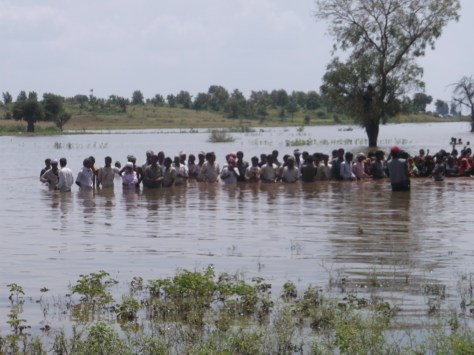
Jal Satyagraha in Narmada valley 2013

The years following the Second World War were characterized by a renewed focus on the ‘Modernization’ of nation-states. While the constant feature of the post-war years was the high-stakes rivalry and arms race between the USA and the USSR; both tread a common ground as regards high-modernization and ‘development’. ‘Development’ fuelled growth was considered a panacea to all ills and soon became dominant across the post-colonial world. WW Rostow’s The Stages of Economic Growth was a significant work which argued for five stages of growth in which “traditional societies” could transform themselves into the “age of high mass-consumption”. It was no wonder therefore as to which nation-states were characterized as ‘traditional’ under this rubric and pushed towards ‘development’.

A standard feature of ‘development’ in India has been the showcasing of large scale industrial and apparently ‘public purpose’ projects; an instance of this is seen in the construction of large dams. As much as ‘modernization’ or ‘development’ can be witnessed through the industrial or ‘public’ projects themselves; the ambition of the ‘developmental state’ and its vision can certainly be understood through the one-constant feature of the bureaucratic machinery – paperwork.

Therefore, for the purposes of this essay, I attempt to evaluate the ambition of the post-colonial ‘developmental state’ in India by analyzing the language of a few planning documents. In this case, I consider the Narmada Valley Development Authority’s (NVDAs) Action Plans prepared in the years 1991, 1993, 1995 and 2000 for the Resettlement and Rehabilitation (R&R) of Sardar Sarovar Project ‘oustees’ in Madhya Pradesh. These Documents are revealing in aspects of the modern state’s enterprise and it’s most significant undertaking, planning.

The State’s gaze and legibility:

James Scott’s magnificent work Seeing Like a State characterizes a crucial difference between the pre-modern state and the modern state: while the former “was in many crucial respects, partially blind” and “knew precious little about its subjects”, the modern state is consumed by a desire to know. Armed with statistics and other tools of ‘accuracy’, the modern state stakes its claim to the accurate depiction of the social world, which it then tries to alter in accordance to its designs of ‘development’. Continue reading The Gaze of the Developmental State and the Narmada Action Plans: Ashwin V.S

[Kafila Audio] Dilli Tha Jiska Naam: Recollections of a Forgotten City

Last week I caught up with Shubhum Mishra, a cartographer/geographer/urban planner, in Sundar Nursery – a Mughal garden turned  colonial green house spanning 70 acres in the heart of Delhi – that shall should be open to the public sometime next year.

Shubhum has just transliterated Intizar Husain’s famous book – Dilli Tha Jiska Naam – from the original Urdu/farsi script to devnagari, in the hope of making this incredible resource more accessible to north Indian readers. In this conversation he reads excerpts from the book and I asked him why modern Indian cities are so spectacularly ugly.

Listen in for a fascinating description of Chandini Chowk and “Old Delhi” – back from when “Old Delhi” was the only Delhi around.  Shubhum will respond to comments on the site. His book is now available in most book stores around the city and you can buy it here


[Audio] Delhi: A Hydrological History

In summer, Delhi’s fancy turns grimly to thoughts of thirst.

How can a mega-city provide a safe and sustainable supply of water to its 24 million residents? How has it done so in the past? What do we lose when we turn our backs on a river,  turn our streams into sewers and lay concrete over our ponds?

In this conversation, Sohail Hashmi summons the Delhi of history, and  the Delhi of his childhood through recollections of the Yamuna, ponds, streams, and the Urdu Bazaar where everyone had a favourite well from where they drew their daily sustenance.

Like what you hear? Leave us comments on how we can expand our audio section


Staking the Terrain – Political Economy, Environmental History and Nature Conservation: Shashank Kela

Guest post by SHASHANK KELA

The aim of this essay is to make connections between things that are usually studied separately – environmental history, political economy, conservation practice and adivasi politics – and I apologize in advance for the demands it makes upon the reader’s attention. The belief that this potential convergence could do with wider discussion is my sole justification for putting it up here.

Environmental history in India is not a very old discipline – the first mongraphs began appearing in the 1980s, and more and more books and papers have been added to the historiography since 2000. Let us examine certain themes as outlined in a cross-section of recent scholarship.

One key debate centers upon whether the colonial period can be regarded as an ecological watershed. An influential book by Ramchandra Guha and Madhav Gadgil argued that, before the advent of colonialism, there existed a harmonizing tendency between human beings and the environment, a balance between resource use and preservation mediated largely through the caste system: colonialism shattered this equilibrium and the values associated with it.[1] This idealizing view, eliding different time periods and state structures, was bound to come under attack and much subsequent scholarship has been devoted to unpicking its conclusions.

Sumit Guha shows how at least one natural resource, namely wild grass for fodder, had become scarce in the Deccan by the Maratha period thanks to the demands of armies, nobles and zamindars, who engrossed it by enclosing tracts of common land. This fierce arbitrariness fostered a system of free grazing and discouraged sustainable management through collective protection of the commons.[2] Meanwhile the argument that sacred groves are strands of untouched forest – repositories of biodiversity – is refuted by Claude Garcia and J-P Pascal in their study of Kodagu.[3] Far from being untouched, groves there are heavily used and managed, and show clear signs of degradation associated with use. Continue reading Staking the Terrain – Political Economy, Environmental History and Nature Conservation: Shashank Kela

“I used to feed fish to my widowed grandmother” by Buddhadeb Dasgupta: Soumashree Sarkar

This is an English translation by SOUMASHREE SARKAR of a column by Buddhadeb Dasgupta which appeared in the Sunday special supplement, Rabibashoriyo, of the Bengali daily Anandabazar Patrika on March 20, 2016 and can be found in the original Bengali here.

It was probably the month of November. Winter had set in firmly in a city that neighboured Kolkata. The quilts had come out even before that. Morning had not even broken and there was still a lot of sleep left to be slept when Ma yanked the quilt away from me and woke me up, “Don’t you remember who’s coming today? Get up and hurry, I’ve been calling you for the longest time, Khrushchev and Bulganin are coming, they might have reached already. My cooking’s almost done.” The words were pouring out of my mother’s mouth with frightening speed and excitement, all in the Dhaka’s native Bengali tongue.

Bathed in cold water, shivering through chattering teeth, and sufficiently clothes, we siblings went and stood in front of our mother. With a comb in hand, Ma sat on a chair, and neatly parted all our heads of hair.

I asked, “What does Khrushchev look like? What does Bulganin look like? The same rice-dal-fish curry that we eat – do they also eat that?”

Continue reading “I used to feed fish to my widowed grandmother” by Buddhadeb Dasgupta: Soumashree Sarkar

Jat Quota Stir and Violence in Haryana: Satendra Kumar

This is a guest post by SATENDRA KUMAR


jaat-protest--_647_022016112612
IMAGE COURTESY: INDIA TODAY

There is an uncanny academic public silence over the Jat quota stir and the unjustified violence enacted during the stir in Haryana. The scale of violence and destruction is such that it competes for the worst instance of caste violence in Haryana’s post-Independence history. So far 30 people have lost their lives while over 200 people were injured in the nine-day violent Jat agitation demanding job quotas in Haryana. There is anger, fear and helplessness among those who lost their kin, homes, businesses and properties.At least 10 Haryana districts were severely affected by the violence. After such a huge loss, as if it was a routine, matter the Union Home Minister announced that a committee led by M Venkaiah Naidu will examine the demand by Jats for reservation in central government jobs.

In Haryana, the BJP’s government in the state has promised to bring a Bill granting OBC status to Jats in the upcoming assembly session. The Jats’ demand for reservations in the central OBC list is not new. Since 1995, Jats in Haryana have been demanding an OBC (Other Backward Class) status, which will help them secure the 27 per cent reservation in government jobs. Earlier in 1997, the Jats in Haryana, Uttar Pradesh and Madhya Pradesh had demanded themselves to be included in the central OBC list. It was rejected by the National Commission for Backward Classes. Subsequently UPA government’s decision to include Jats from 9 states in the OBC list was also rejected by the Supreme Court in March 2015. Despite all this, political parties such as Congress and BJP continue promising quota to Jats during election campaigns. These promises have encouraged the Jats to organize and agitate for quotas. However, their agitations for reservations have not been so violent. That is why the most pressing and important question that needs analyses is why has the current agitation by Jats been so violent? Perhaps three factors will help us to understand this severe violence and loss of property worth crores of rupees.

Continue reading Jat Quota Stir and Violence in Haryana: Satendra Kumar