
Is this one of those rare occasions where policymakers self-critically correct a gigantic blunder? Or is it a cold turn-about guided by pure self-interest? On August the 15th, the Foreign Ministers of EU-countries gathered in Brussels and decided that each would henceforth be free to supply arms to Kurdish rebels fighting Sunni extremists of ISIS in the North of Iraq. Even Germany which in the past had been unwilling to furnish military supplies to warring parties in ‘conflict zones’, is now ready to provide armoured vehicles and other hardware to the Kurds opposing ISIS’ advance. The decision of Europe’s Foreign Ministers may surprise some, for barely a year and four months ago, in April of 2013, the European Union had lifted a previously instituted ban on all imports of Syrian oil (1). Moreover, the lifting of this boycott was quite explicitly intended to facilitate the flow of oil from areas in the North-East of Syria, where Sunni extremist rebel organisations had established a strong foothold, if not overall predominance over the region’s oil fields (2). ISIS was not the only Sunni extremist organisation disputing control over Syrian oil fields. Yet there is little doubt but that the fateful decision the EU took last year has helped ISIS consolidate its hold over Syrian oil resources and prepare for a sweeping advance into areas with oil wells in the North of Iraq (3). Continue reading The European Union And The Twin Civil Wars In Syria/Iraq: Peter Custers
Category Archives: Empire/ Imperialism
Creeping Dictatorship: Concerns from Kerala
Guest post by THUSHAR NIRMAL SARATHY
Are we living in a democratic dictatorship? ‘Democratic dictatorship’ is a much debated concept in Kerala. I am referring not to that here but to the dictatorship of the executive led by democratically-elected politicians. Recent incidents seem to indicate that this is now an ever-growing tendency in our democracy.
A few months back, a notice with the photos of well-known public figures, which identified them as Maoists, appeared in the Mananthavady police station at Wayanad. These were pictures of senior, very well-known activists who have fought battles for democracy in Kerala. Following widespread protests, the police was forced to remove the notice. On 28th July this year, Jonathan Baud, a Swiss citizen was arrested by Valappad police for attending a commemoration meeting of a Maoist leader, Sinoj, who died in an accidental explosion at the forested Kerala- Karnataka border. Mr Baud was in India on a tourist visa. His arrest was big news in the media which had happily swallowed policespeak, and so he was also projected as a Maoist. The reports claimed that he had come here with the express purpose of attending the meeting, and that he delivered a solidarity speech there. Later, when the Commemoration Committee made public its own version of events, the police sensationalism was refuted and had to be withdrawn. The charge against Mr Baud are apparently limited to violation of visa conditions and it was admitted that he had no Maoist links. Continue reading Creeping Dictatorship: Concerns from Kerala
Delhi Protests Gaza Bombing: 9 August 2014
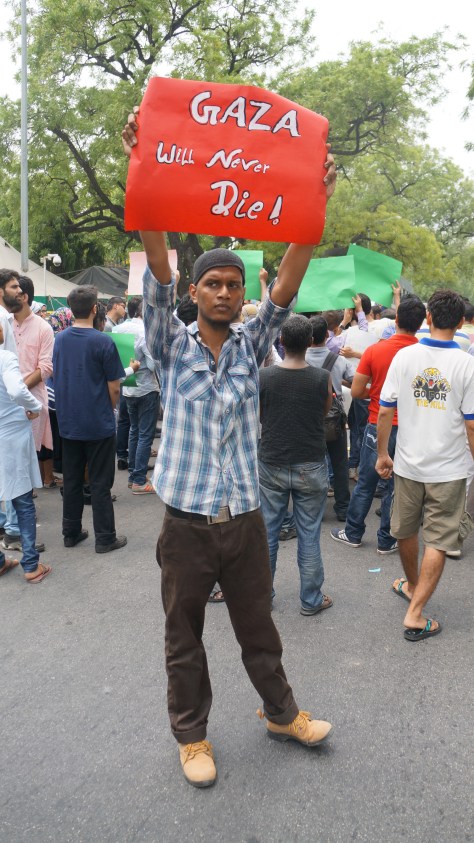
Let it not be said that nobody cried when the news came. Let it not be remembered by the children that India “stood with” Israel through the Gaza bombings of August 2014 (God, let it not continue beyond August 2014). Let no-one assume that all 1.3 billion of us continued – as the bombs fell on fields and courtyards and washing hung up to dry in Gaza – that we in India defined our ethical positions purely within the unholy triad of family, community, nation. Let there be a tiny record of protest. A tiny record of a tiny protest, given the monstrosity of the crime. But we are in the business of remembering, since they are profiting from our forgetting. They profit from our forgetting language, since we can’t name what is going on in Gaza as war. They profit from our not being able to remember our mythologies, because this is a war in which one side is David and the other Goliath, but Goliath is winning, because the world has been told he is David. In a nation without language, without myths, without memory, without ethics, jealously holding a tattered banner, with a single word on it – ‘development’ – some Indians protested.
Global Day of Rage against Gaza, Jantar Mantar, New Delhi August 2014:

Gandhi, Palestine and Israel: Irfan Ahmad
Guest post by IRFAN AHMAD
Amidst Israel’s recent deadly attacks on Gaza and what Venezuela’s President called ‘its policy of genocide’, many have invoked Mohandas Karamchand Gandhi (1869–1948) on two counts. First, he opposed settler colonialism. One analyst in The Economic Times gave a quote, also shared on Facebook: ‘Palestine belongs to the Arabs in the same sense that England belongs to the English and France to the French’. Second, implicit in invoking Gandhi is the idea that he stood for non-violence and thus the indicting advice to the terrorised Palestinians to ‘choose peace’.
Both these positions linked to Gandhi, when analysed historically, are misleading, even incorrect and wrong. In 1921, Gandhi did oppose the imposition of Jews over the Arab land. However, later he subtly endorsed settler colonialism. As for Gandhi’s official preaching of non-violence and civil disobedience (satyagraha), they were at best tactical, contextual and temporary. Contrary to his deified mythology as apostle of non-violence, Gandhi indeed justified killing, even felt proud of violence, and opposed civil disobedience when both suited his political and national interests. Continue reading Gandhi, Palestine and Israel: Irfan Ahmad
Concerned Public Health Professionals on the Israeli attack on Gaza
The following is a statement issued by some concerned public health professionals in New Delhi, on 21st July, 2014
The world is once again witness to the macabre dance of death in Gaza unleashed by the Israeli aggressors, and once again the news of scores of innocent Palestinian deaths, including those of a number of women and children, is flooding in. The tragedy is compounded many-fold by the conspiracy of silence on this issue entered into by all the major powers of the world, who have singularly failed to take any effective measure to restrain the Israeli aggressors. The only exception to this silence is USA, Israel’s long time sponsor, which has once again blocked efforts at the United Nations to pass any motion of censure against Israel.
Israel’s alibi for the latest attack – to punish perpetrators of abduction and murder of three Israeli boys, holds little merit when Israel is the occupying force in first place and its leaders are belligerently calling for annihilation of ordinary Palestinian lives without discretion in accordance with their doctrine of ‘collective responsibility.’ The deputy speaker of Israeli Knesset, Moshe Feiglin has called Arab people “a gang of bandits” and has argued in favor of Israeli government cutting off electricity supply to Gaza in order to paralyze its hospitals. His reported statement is – “The blood of a dialysis patient in Gaza is not redder than the blood of our IDF (Israeli Defense Forces) soldiers who will, God forbid, need to enter Gaza.” Continue reading Concerned Public Health Professionals on the Israeli attack on Gaza
Last Night in Gaza: Mads Gilbert
This correspondence has been received from Mads Gilbert
Dearest friends
The last night was extreme. The “ground invasion” of Gaza resulted in scores and carloads with maimed, torn apart, bleeding, shivering, dying – all sorts of injured Palestinians, all ages, all civilians, all innocent.
The heroes in the ambulances and in all of Gaza’s hospitals are working 12-24hrs shifts, grey from fatigue and inhuman workloads (without payment all in Shifa for the last 4 months), they care, triage, try to understand the incomprehensible chaos of bodies, sizes, limbs, walking, not walking, breathing, not breathing, bleeding, not bleeding humans. HUMANS! Now, once more treated like animals by “the most moral army in the world” (sic!).
My respect for the wounded is endless, in their contained determination in the midst of pain, agony and shock; my admiration for the staff and volunteers is endless, my closeness to the Palestinian “sumud” gives me strength, although in glimpses I just want to scream, hold someone tight, cry, smell the skin and hair of the warm child, covered in blood, protect ourselves in an endless embrace – but we cannot afford that, nor can they. Continue reading Last Night in Gaza: Mads Gilbert
Last of Warsaw Ghetto Survivors Calls for Rebellion Against Israeli Occupation
Rebel against the Occupation. No–it is forbidden for us to rule over another people, to oppress another [people]. The most important thing is to achieve peace and an end to the cycle of blood[letting]. My generation dreamed of peace. I so want to achieve it. You have the power to help. All my hopes are with you. If only [you could]. – Chavka Fulman-Raban, arrested and imprisoned at Auschwitz, two of her family members died as resistance fighters.
Last year, long before this current round of blood-lust, Chavka Fulman-Raban, among the last of the Warsaw Ghetto survivors delivered, On Yom Ha-Shoah (Holocaust Remembrance Day), “a fierce denunciation of evil and injustice, including the Israeli Occupation. Her speech was offered to guests at the ceremony of Beit Lohamey Ha-Getaot (the Ghetto-Fighters House)”, says Richard Silverstein, who has translated the speech into English.
The once-invincible Nazism did not last. Zionazism too will not last, however invincible it might appear today. And we must say it loud and clear: Zionism is not about Jews and Judaism. To oppose Zionism is not anti-Semitism. As if this simple fact needs to be stated. But it seems it does, over and over again. Just as Judith Butler had to recently, contesting Lawrence Summers, President, Harvard University. So virulent is the mobilization of the Zionist fascists, especially inside Israel, that what David Shulman recently referred to as “lynch gangs” and “organized fascist groups”, have been on the prowl attacking, killing Palestinians and protestors against the bombings. And cheering the lynch mobs and fascists gangs are spectators of the kind we see below:

Continue reading Last of Warsaw Ghetto Survivors Calls for Rebellion Against Israeli Occupation
Life in a ‘Sterilized’ Zone, Hebron, Palestine: Ravinder Kaur
Guest Post and Photograps by RAVINDER KAUR
Map of Hebron, Courtesy ‘Breaking the Silence‘
On 12th June, 2014, the kidnapping of three Israeli teenagers near Hebron resulted a massive military search operation in the area. Since 30th June when their dead bodies were found north of Hebron, a Palestinian teenager has been abducted and killed in a revenge attack in East Jerusalem, and concerted air strikes have been launched on Gaza by the Israeli forces as punishment to Hamas who Israel holds responsible for the abduction and murder of the teenagers. In ten days of Israeli air strikes more than 216 have been killed in Gaza, and rocket firing by Hamas has claimed one life in Israel. A ground invasion began yesterday evening. Even as talks of a possible ceasefire, and resuming normal life, take shape, one might consider what ‘normality’ constitutes in a place like Hebron that has been at the center of the current conflict. It is in the normal, the routine that the spectacular violence takes shape.
Continue reading Life in a ‘Sterilized’ Zone, Hebron, Palestine: Ravinder Kaur
Delhi Police Prevents Peaceful Protest in Front of Israeli Embassy – Students, Others, Injured and Detained
A Tale of Two Protests, On Two Days.
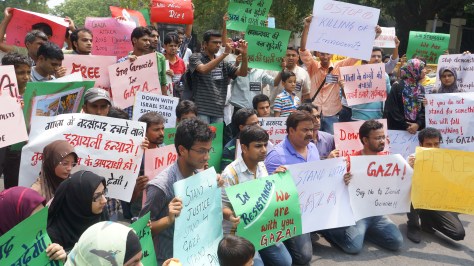
Protests against the situation in Gaza have been held in Delhi yesterday, (Sunday, 13th July, and today, 14th July, in the morning). Yesterday, on Sunday morning, there was a peaceful protest in front of the Israeli Embassy – this came out of a call for protest by individuals. Yesterday, about a hundred odd people, including many young people, had gathered. I was present at this gathering. Some people made statements condemning the Israeli state’s aggression against the Palestinian people. The Delhi Police was present, but did not try to disrupt or disturb the protest. The protest happened right in front of the Israeli Embassy gates on Aurungzeb Road.
The Memory of Fifty Seven Seconds: After Watching an Israeli Missile Strike in the Gaza Strip on Al-Jazeera
A short fragment of video, fifty seven seconds long, taken from behind a window in a building in the Gaza Strip which was aired last night on Al Jazeera television brought home (once again) the sheer horror of the Israeli Defence Forces’ (IDF) brutal, ongoing offensive against the people of Palestine with devastating clarity.
National Interest and the Aam Aadmi: Abhijit Dutta
Guest post by ABHIJIT DUTTA
Yesterday, Delhi Chief Minister and Common Man-in-Chief of the AAP, Arvind Kejriwal, declared that “We don’t agree with what Prashant Bhushan said about Kashmir, it’s his personal view. Whatever the Army wants to do regarding the deployment, there is no question of a referendum on it. We do not support Prashant Bhushan’s statement.”
Bhushan’s comments, made on NDTV’s ‘We The People’ show, which, in a matter of happy coincidence happens to be the Constitutional term for Aam Aadmi, was simply this: wishes of the people of Kashmir be taken into account while determining whether the Army was needed for internal security or not. Unreasonably, and with shattering common sense, Bhushan had argued that if the Armed Forces deployed within Kashmir (as opposed to the border areas) were meant to protect the general Kashmiri population, might it not be a good idea to ask that population whether they wanted the protection or not. Continue reading National Interest and the Aam Aadmi: Abhijit Dutta
We are all Anwar Congo

In 1965-66, Indonesia killed one million people it suspected were ‘communists’. Others who became victims of this cleansing were ethnic Chinese. An American filmmaker, Joshua Oppenheimer, goes to Indonesia and bumps into a man, Anwar Congo, who himself killed a thousand people. He and his friends, who were part of the extermination of real or imagined communists, happily boast about what they did and describe it in detail. Oppenheimer tells them that they should make a feature film reenacting what happened. Oppenheimer then makes a documentary about these people making a film about what they did.
The Act of Killing released last year but the world is still talking about it. When you watch it, you can scarcely believe what you see. Anwar Congo shows us how he perfected a method of killing that would produce the least blood. He wraps a steel wire around the victim’s neck, ties the wire to a pole and pulls it from the other end. He then watches how the video looks on television and says he shouldn’t be smiling, his face should look cruel, he shouldn’t be wearing white pants. He’d never wear clothes like that while doing the killings. Continue reading We are all Anwar Congo
Hayaat-e-Azadi, The Life of Freedom: Suvaid Yaseen
Guest Post by SUVAID YASEEN
Ho Agar Khudnigar-o-Khudgar-o-Khudgeer Khudi
Ye Bhi Mumkin Hai Ke Tu Mout Se Bhi Mer Na Sake
[If the ‘ego’ is self‐preserving, self‐creating and self‐sustaining,
Then it is possible that even death may not kill you.]
— Allama Iqbal, Hayaat-e-Abadi, Zarb-e-Kaleem
The News
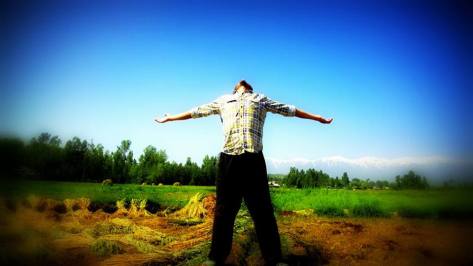
On the evening of 14th July 2013, I received a text message from a friend saying Hayaat had been hit by pellets in the eyes. Both his eyes were damaged. As I read the text, I became numb. I was at loss how to respond, trying to sink in what had just happened.
Continue reading Hayaat-e-Azadi, The Life of Freedom: Suvaid Yaseen
An Incomplete Reunion – Ruining the Post-Partition Party: Archit Guha
Guest post by ARCHIT GUHA
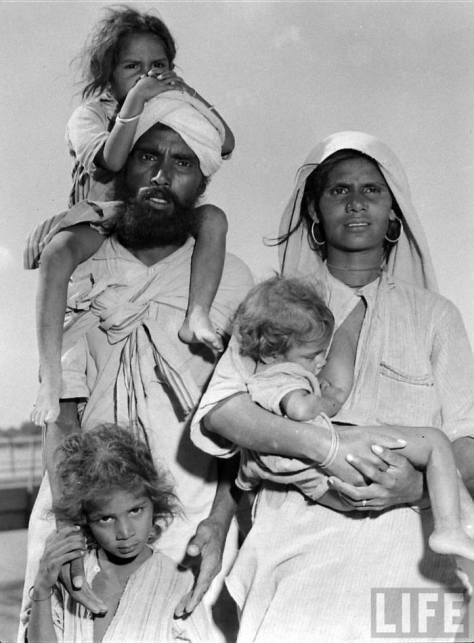
By this point, every Indian, Pakistani, and their grandfathers has watched the Google Partition ad, tears welled up in their eyes. For the uninitiated, Google’s recent advertisement tugs at heartstrings, telling the tale of two chaddi buddies, separated by Partition, and reunited by their grandchildren nearly seventy years later. When the ad went viral via Facebook, sitting thousands of miles away in America, I bawled as I watched the granddaughter listening to her grandfather’s nostalgic retelling of the idyllic life he led in Lahore, eating jhajhariya, with his buddy Yusuf, and his granddaughter’s instant Google fixes to reunite him with Yusuf in Delhi. Continue reading An Incomplete Reunion – Ruining the Post-Partition Party: Archit Guha
श्रीलंका और हम
श्रीलंका अभी खबरों में है. लेकिन ज़्यादातर हिंदी अखबारों को पढ़ने से आपको अंदाज़ नहीं मिलेगा कि सुदूर दक्षिण में स्थित इस नन्हें-से मुल्क में क्या कुछ हो रहा है जिससे हमारा भी रिश्ता है.वहाँ अभी‘कॉमनवेल्थ’ देशों का सम्मलेन हो रहा है और हमारे प्रधानमंत्री उसमें शामिल नहीं हो पा रहे हैं.श्रीलंका ने कहा है कि वह उनकी मजबूरी समझता है. तमिल राजनेताओं के हंगामे की वजह से प्रधानमंत्री ने अपनी जगह विदेश मंत्री को इस सम्मलेन में भारत का प्रतिनिधित्व करने को कहा है. इस सम्मलेन में श्रीलंका को अगले दो साल के लिए ‘कॉमनवेल्थ’ का नेतृत्व करने को कहा जाएगा. इस पर भारत को ऐतराज नहीं है और अब तक किसी और मुल्क ने भी अपनी आपत्ति दर्ज नहीं कराई है. Continue reading श्रीलंका और हम
Manmohan to go to CHOGM in disguise! Satya Sagar
Guest post by Satya Sagar
We have in our possession a letter from Indian Prime Minister Manmohan Singh to Sri Lankan President Mahinda Rajapakse explaining why he is not going to attend the upcoming Commonwealth Heads of Government Meeting (CHOGM).
Dear President Mahindar Singh Rajapakse,
I hope you don’t mind me calling you Mahindar in an endearing manner like a good Punjabi instead of calling you Mahinda! I know you are pissed off with me for not coming to your CHOGM coronation bash next week. But yaar, what to do, these Dravidian fellows got together and spiked my trip.
I mean all the Dravidians, from my own Congress Party too and not just that poet with dark glasses or that Iron Lady in Steel Saree. Even my IMF colleague Chidambaram, a fellow who really admires the way you guys killed so many civilians to get so few terrorists, turned against my visit. Continue reading Manmohan to go to CHOGM in disguise! Satya Sagar
A Night at the Pow Wow: Jay Desai
This is a guest post by JAY DESAI
As I approached the brown fields at the foothills of the rugged San Bernardino Mountains, the rhythm of the foot- stomping grew into a crescendo. I was visiting the annual pow wow of the San Manuel Band of Serrano Mission Indians. Thousands of Natives from many of the 500 or so Indian nations of North America had gathered for three days of dance, song and celebration of their rich heritage. Above us, the autumn California sun had turned the barren high peaks into a shade of angry red at dusk. As the night fell, the enthusiasm of the dancers grew to match the vibrant colors of their traditional outfits and headdresses. My young niece, visiting from India, asked me if the dancers wore these dresses in their everyday lives and if yes, why she never saw them during her long travels through this vast country. She asked me if they were Americans. Continue reading A Night at the Pow Wow: Jay Desai
Indian Government needs to differentiate the real vs false solutions in agriculture this World Food Day : Neha Saigal
This is a guest post by NEHA SAIGAL
It is well-recognized globally that hunger and malnutrition are serious issues, but even after years of failed attempts by world leaders to try and solve this complex problem there has been little change. In 2009 for the first time in history the population considered to be malnourished exceeded one billion people signalling the serious issue of food insecurity we are faced with. In an effort to bring this serious issue to the forefront, the Food and Agriculture Organization (FAO) of the United Nations marks 16 October every year as ‘World Food Day’. Continue reading Indian Government needs to differentiate the real vs false solutions in agriculture this World Food Day : Neha Saigal
Indians of Another Colour, Or why Goans are More than Just Portuguese: Hartman de Souza
This guest post by HARTMAN DE SOUZA is in response to Europeans of An Other Colour – Why the Goans are Portuguese
The news that Goa’s Catholics obtain Portuguese citizenship and flee wherever they can with their families, availing in fact of whatever loopholes are available, is not that new a phenomenon to Goans following matters on the ground – even though it may now serve to open out a new thread in the discussion of postcolonial societies, and in particular, the travails of immigrant communities in what is supposedly a ‘globalized’ world.
It helps to keep in mind that it is Goa that is the classic case of a ‘failed state’, and not Pakistan, as Indians like to believe. Goa was once a beautiful territory protected by Ghats on three sides, rich with an abundance of water, blessed with fertile land, and made up of villages each of which had control of their commons through a sophisticated system of village governance that far predated the Portuguese Colonialists. Today however it is a state governed by politicians who work hand-in-glove with their crony partners whether in mining, real estate or industry, a state in a freefall towards entropy. Continue reading Indians of Another Colour, Or why Goans are More than Just Portuguese: Hartman de Souza
When the lid will burst: Fahad Shah
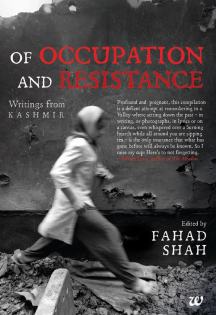 This is an excerpt from the introduction to the anthology Of Occupation and Resistance: Writings from Kashmir, edited by FAHAD SHAH
Once militancy took root in the Valley, it continued unabated, with a few exceptions in the years to come. The sentiment of the resistance movement prevailed across Jammu and Kashmir. At one point in time, blasts and encounters occurred almost every day. The first few years of the 1990s were the most brutal in the history of the conflicted Valley. After the 1996 assembly elections, when people were forced to vote at gunpoint, the National Conference Party and counter-insurgent groups ruled the state. People lived with trauma and threat – treating the injured, mourning for the dead and searching for those who had disappeared.
This was the story for more than a decade. A shift in the nature of resistance has been seen in the past few years; the generation that was born during the start of the war has been able to glean the nuances of the homeland’s political situation. Most of the youngsters from this generation, born between the late 80s and early 90s, choose stones over guns. Continue reading When the lid will burst: Fahad Shah
Europeans of An Other Colour – Why the Goans are Portuguese: R. Benedito Ferrão & Jason Keith Fernandes
Guest post by R. BENEDITO FERRÃO & JASON KEITH FERNANDES
This article serves as a response to Sir Andrew Green’s comment on the alleged misuse of Portuguese citizenship by Indian nationals of Goan origin whom the Daily Star and the Daily Mail have characterized as immigrants who travel to Great Britain to take advantage of it. Green’s perspective from a few months ago mirrors prevalent xenophobic views on the rights of immigrants to Europe; hence, the counterpoint offered here hopes to challenge such bias as it will surely continue to be expressed.
On 13 May, 2013, the Goan Ethernet was aflame with outrage at statements made by Sir Andrew Green, chairperson of Migration Watch, carried in the Daily Star and the Daily Mail. The Daily Star reported, “An Indian national from Goa can obtain Portuguese citizenship if their parents were Portuguese citizens prior to 1961,” and quoted Green as saying, “They can then move straight to the UK with their family. On arrival they can avail themselves, immediately, of all the benefits available to UK citizens.” The Daily Mail seems to have been spurred on by Green’s statement, going on to claim that “[a] number of Indian nationals from the former Portuguese territory of Goa are thought to have taken advantage of the loophole. Indians living in Goa can claim they have Portuguese heritage and so claim Portuguese citizenship. They can then move directly to Britain – without ever having to visit Portugal – and bring a family without meeting any qualification test.”
Given the manner in which the matter regarding Goan access to Portuguese citizenship has been reported in the British press, as academics studying Goa and the Goan community, we believe that there is a need to redress such misrepresentations and firmly call out, not only the wilful amnesia about Britain’s imperial past, but also the Anglo-centric interpretation of colonialism, the post-colonial, and de-colonised world order that motivates such representations. In so doing, our aim is to address not merely a need for Goans and others of former Portuguese India to assert the legitimacy of their actions, but to also enable a view of the global order from a position that is more respectful of the formerly colonised. Continue reading Europeans of An Other Colour – Why the Goans are Portuguese: R. Benedito Ferrão & Jason Keith Fernandes
 KAFILA - COLLECTIVE EXPLORATIONS SINCE 2006