Category Archives: Everyday Life

From Delhi to Djakarta, Protests Against Sexual Violence Across Borders: Bonojit Husain

Guest post by BONOJIT HUSAIN

20130115-211244.jpg

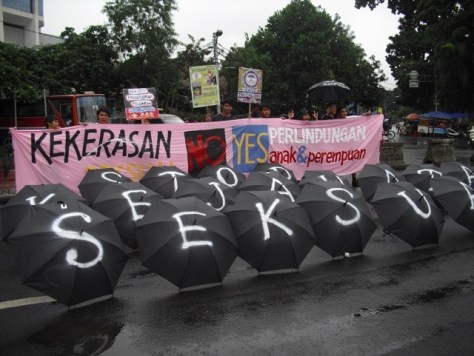
(Photographs courtesy: Pipit Apriani who is a Jakarta based activist and a blogger)

Protests against sexual violence are spreading across Asia. Last week demonstrations against rape and sexual violence were held in Nepal, Bangladesh, Pakistan and Sri Lanka.

Inspired by the protests held in Delhi for last three weeks, hundreds of university students and activists march on the streets of Jakarta few hundred meters away from the Presidential Palace for a world free of sexual violence. The call for the protest march was given by a coalition of University Students’ Unions and civil society organizations in response to the death of RI, a 11-year-old girl, who died last week after suffering severe vaginal and rectal injuries due to repeated sexual assaults. Continue reading From Delhi to Djakarta, Protests Against Sexual Violence Across Borders: Bonojit Husain

Stalking, Delhi Police and Memory – Another Encounter: Kavita Krishnan

Guest Post by Kavita Krishnan

I have been wanting to post about an experience with Delhi police since yesterday, but haven’t found the time yet… Here goes.

Some days ago, (early this month if I recall rightly), I got a call from a woman worker living in Usmanpur near Seelampur. She got my number through the son of one of our Trade Union comrades, who is a friend of her brother’s. She said she was being stalked by a man who made calls to her thretening an acid attack. She has 3 children and was concerned for their safety too. She told me she was scared to complain to the police, and asked for advice. I was reluctant to advice a police complaint without her being fully ready, knowing that it might not yield satisfactory results. So I suggested we meet and talk things over before deciding.

But soon after, she called again: feeling buoyed by a sense of hope arising from the ongoing movement, she had gone to the police station – alone – and written out a complaint, giving the stalker’s mobile number, the number of his bike, and offering to share recordings she had made on her phone of the threat calls. She said, though, that the police had not given her any proof of having received or recorded her complaint (in spite of her asking).

Continue reading Stalking, Delhi Police and Memory – Another Encounter: Kavita Krishnan

Breaking the Collective – Notes from Jantar Mantar & Koodankulam: Vivek Vellanki

Guest Post by Vivek Vellanki

The death of the young girl brought incommensurable grief for the ‘Indian’ people. A national angst ensued with divergent voices seeking divergent ends: justice, death penalty, fast track courts, end to patriarchy, chemical castration, and a long list that cannot be spelt out here. There was a glimmer of hope that the discursiveness would ensue a quintessentially democratic process of debate, discussion, and deliberation amongst the people. The Indian state with its long-standing reputation wouldn’t allow for that to happen. It had to continue on its pet peeve of Breaking the Collective! The people’s movement in Koodankulam, the anti-corruption movement, the movement for seperate Telangana are some of the many instances that remind us of this pet avocation of the Indian state being pursued in recent times, almost, vocationally. However cynical it may sound, amidst the entire candle lighting and sloganeering, we failed to realise that the protest in Delhi was happening on the terrain that the government decided, in a manner that it wished for it to play out, and was party to the people it wanted to see there. I wish to argue that the closing down of the metro stations has a relation to the nature of the protests at Jantar Mantar. Furthermore it concurs with the tactics of chocking people’s movements logistically and stifling the collective by pathologizing the everyday life of masses. The tragedy of this lies in the fact that such actions of the state have become so recurrent that they have entered our common sense and they present themselves as normal and logical responses. Albeit they have been rationalized by invoking a specious reference to law, order, and safety, there is a need to unpack such a rationalization. My attempt is to extract these actions from that location of common sense and present them for public scrutiny. Through this essay, I would like to draw the connections between the democratic protests happening in locations across the country and state action in dealing with them. In doing so, I hope to bring to notice how the Indian state uses its machinery to purge protests of their democratic tenor and eventually, at least, attempts to break the collective. Continue reading Breaking the Collective – Notes from Jantar Mantar & Koodankulam: Vivek Vellanki

The Country With A ‘Balancing Office’: Suvaid Yaseen

Guest Post by Suvaid Yaseen

Of late there has been a rising trend of Kashmiris – professionals, artists, writers, musicians et al presenting their works on Kashmir on a much wider level than before. The larger impression that comes out of it all is that the narrative has been taken up by the people for themselves. A welcome contrast to outsiders flying in and telling us what we want, how we think, and what is actually good for us.

So, every time a Kashmiri artist is presenting his/her work on Kashmir, the expectations among Kashmiris tend to go up. People start feeling that finally their narrative, of how they saw the things, what they went through, would be told to the world, bereft of the lenses of security paradigm through which Kashmir has been usually viewed  –  a strategic territory, with not-so-strategic, dispensable people.

This can be fortunate as well as unfortunate. On one hand there is a ready audience to appreciate and applaud your work. On the other hand there are expectations to ‘perform’. For the artists themselves, there are additional pressures of ‘balancing’ and having a ‘non-biased’ view from the other side.

Continue reading The Country With A ‘Balancing Office’: Suvaid Yaseen

Some thoughts on rape, sexual violence and protest – responding to responses: Devika Narayan

Guest Post by Devika Narayan

Rarely does a city experience the sort of upheaval that Delhi is witnessing.  Everyone is talking about it. Everyone has an opinion. It is impossible to walk down the street without overhearing snatches of conversation. Issues that usually find brief mention in some obscure corner of the newspaper are now being subject to analysis by every passer-by. A rickshaw driver refuses to take any money when he realises I am on my way to a protest. I remember the old man at a photocopy shop who had looked up and asked no one in particular: do you think she will die? The receptionist at the doctor’s clinic is distraught, providing waiting patients her explanation for the recent events. Men huddled around tiny fires littered across the foggy city carp on about the state of politics, the police and the government. Everyone is invested in this moment of reckoning.

An opportunity, in the most brutal manner, has been thrust upon us to challenge, critique and reconstruct unjust social relations. This is an opportunity to pledge our commitment to a vision of a gender just society. Unless we assert in powerful ways that women are autonomous beings and equal citizens it will not end. Continue reading Some thoughts on rape, sexual violence and protest – responding to responses: Devika Narayan

Male students, female teachers and patriarchy in the classroom: Snehlata Gupta

Guest post by SNEHLATA GUPTA

Smug patriarchal pronouncements about ‘dented and painted’ women and ‘rape in India and Bharat’ brought back to me an experience I faced in the classroom some years ago.

I teach English in grades 11 and 12 in a co-ed school in Delhi. That year I had this rather ‘difficult’ boy in class. I can’t remember now how the discussion really began. The discussion got to the point where students were talking about the amount of freedom available to girls and boys and why girls have far less ‘freedom’ than boys. It was somewhere at this point that this boy stood up (unlike the regular practice of standing to speak in the classroom, I insist students should sit and talk in my class) and stated with complete confidence that  ‘if girls dress so provocatively boys can’t help themselves.’

I remember being completely aghast at this blatant show of patriarchal arrogance. I went all hot and cold in the same moment. Continue reading Male students, female teachers and patriarchy in the classroom: Snehlata Gupta

Freedom in Three Acts: @Koinon3a

Guest post by @KOINON3A

New Friends Colony Park, 1996.

There’s a funny telepathy between people running or walking in opposite directions along a narrow jogging track. You both move to one side to avoid bumping into the other, only to find that the other person has moved in exactly the same direction you have. We exchanged half smiles at this long before we actually collided. As we approached each other, I smiled more widely as an acknowledgment of having managed to get it right and avoid each other.

His pockmarked face broke into a smile too. And in the moment he passed right by me, he reached out and grabbed my left breast hard and then moved on. Something I couldn’t have planned or thought about happened; I snapped like a brittle twig, swung around and went after him. His back was turned to me and he didn’t expect this. I hit him in the middle of his back with my fist, my keychain around my fingers giving him an additional gouge. He whirled around, surprised, the mouth now a quivering O, and went for my chest again.

Continue reading Freedom in Three Acts: @Koinon3a

January 6, 1993 – A Town Torched: Remembering the Sopore Massacre Twenty Years After: Sameer Bhat

Guest post by SAMEER BHAT

In Memory of the Massacre in Sopore, Kashmir, by the 94th Battalion of the Border Security Force on January 6, 1993.

[YouTube Video – Compiled from various sources – including a report by Savyasachi Jain, now with NDTV, for Eyewitness – a VHS delivered video news magazine active in the early 1990s.]

There was sound of a huge bang that morning, like someone blowing up a cartful of dynamite. Just before the cockcrow. Most of the townspeople were asleep. The dawn prayers had thin attendance, mostly because it gets very cold in January. By nine o’clock a military patrol was out, doing rounds of the main marketplace. Suddenly gunmen emerged from a narrow alley and shot random bullets at the party before quickly disappearing in the maze that old Sopore is. Taken rather off guard, the security detail ran back to their barracks only to emerge again as Frankenstein’s monsters, spitting hell fire. In the next fifty odd minutes, they murdered fifty five people in cold blood. And burnt the town down. Continue reading January 6, 1993 – A Town Torched: Remembering the Sopore Massacre Twenty Years After: Sameer Bhat

Unlearning submission: Neha Dixit

Guest post by NEHA DIXIT

In the last fortnight, we unlearned submission. On December 16, a 23 year old girl, just on the brink of leading a socio-economically independent life was raped in a moving bus at 9.30 at night.

We saw protests, we saw outraged masses. It is the first time in the history of this nation, when people were out on the streets on the issue of gender. For more than two weeks in a row. And it continues. Figures have been thrown at us: every 20 minutes a woman is raped in India, every third victim is a child, according to the National Crime Records Bureau.

At one of these protest sites, the car parking contractor informed me that they have slashed the parking charges from 30 bucks to 10 bucks in solidarity with the girl and her family. This may be dismissed as a ‘simplistic’ contribution by those who have been accusing these protests of being ‘middle class’. But we need to hit the core, to understand the wider repercussions of the Parking contractor’s this simple act. Continue reading Unlearning submission: Neha Dixit

You were amongst those six; un chhay main tum bhi shamil thay: Swaang Songs

This song in memory of the unknown citizen is produced by Swaang, a Bombay based cultural group, whose members include actors, writers, music directors, musicians and producers “all in the grips of the market-driven Bombay film industry, but whose hearts continue to pull towards progressive politics!”

Composer – Rohit Sharma
Lyrics – Ravinder Randhawa
Singers – Rohit Sharma, Pankaj Badra, Pinky
Narration – Pravishi Das, Ravinder Randhawa

English translation of ‘Maa Nee Meri’

Mixed in every morsel,
What was that chant you kept repeating?
In the garb of concern and worry,
Why was fear the only virtue I learnt of your teaching?
Mother, I will not fear
Mother, I will not become you. Continue reading You were amongst those six; un chhay main tum bhi shamil thay: Swaang Songs

Akbaruddin Owaisi – You are an Enemy of Muslims (and Hindus)

Guest post by IRSHADUL HAQUE
Translated from Hindi by Shuddhabrata Sengupta

Akbaruddin Owaisi, you are an enemy of Muslims. You are the kind of adversary who lurks like a snake in the grass, ready to strike at the person who cares for that patch. Your desire to provoke a confrontation between India’s 25 crore Muslims and 100 crore Hindus reminds us of Muhammad Ali Jinnah. This is why Javed Akhtar has gone to the extent of calling you ‘the greatest enemy of Muslims’. I know that I am not alone when I find myself agreeing with this view. Many other Indian Muslims will be in agreement with me. Continue reading Akbaruddin Owaisi – You are an Enemy of Muslims (and Hindus)

RSS Supremo Mohan Bhagwat’s Thoughts on Rape

The RSS supremo Mohan Bhagwat (or to call him out in the way he is referred to in the Sangh – Sarsanghchalak Param Pujya Shri Mohan-ji Bhagwat-ji) has now joined the pavilion of eminent Bharatiya moustachioed misogynists. In a breathtakingly revealing statement, he has told us that rapes happen in India, not in Bharat. What he means is that rape only occurs in urban areas where the influence of Paschatya Sanskriti (western culture) leads women astray into being raped by men unable to help or control themselves in the face of the assault of women, out and about, by day and night, defying Mohan Bhageat’s Sangh-mandated Lakshman Rekha.

When an upper-caste landlord in a village claims his ‘droit de seigneur’ (land-owner’s claim) with a Dalit woman, it is not rape, it is a yagya, a time honoured shastric ritual. When husbands persuade minor wives on their ‘suhaag raat’ with a few disciplinary measures that leave them with black eyes and sore limbs, it is not rape, it is the carrying out of an Upanishadic injunction. When swamijis, babajis, acharyas and prachaks have their way with ignorant and nabalik shishyas, it is not rape, it is the partaking of the naivedyam of a woman’s body. It is the realisation of a ‘pushp ki abhilasha’, even if the pushp gets pushed around a little bit in the process. Continue reading RSS Supremo Mohan Bhagwat’s Thoughts on Rape

Justice for Soni Sori. Gathering at Jantar Mantar, 02/01/13

Protests against Sexual Violence continue in Delhi. Earlier this morning, there was a gathering to protest against the gruesome sexual violence committed on Soni Sori while in custody in Chhattisgarh under the supervision of Ankit Garg, Superintendent of Police, Dantewada. Ankit Garg was awarded with a presidential police medal on Republic Day (January 26) in 2012.

Soni Sori’s petition at the Supreme Court is due to be heard tomorrow. Continue reading Justice for Soni Sori. Gathering at Jantar Mantar, 02/01/13

Naye Saal Mein Azaadi – Freedom from Fear in the New Year

[ Click to play above Youtube video of young women and men, led by Com.Lokesh (‘Lucky’) of Stree Mukti Sangathan (Women’s Liberation Organization) articulate their desires on the ‘Take Back the Night’ night walk and street party from Anupam PVR Complex to the road outside Select City Walk in Saket, New Delhi on the night of the last night of 2012 and into the early hours of 2013. ]

Delhi took back the night as we moved into the new year. Took it back from fear, from patriarchy, from misogyny and a stupid state. They said it loud and clear. This is what I remember, roughly in this order. Continue reading Naye Saal Mein Azaadi – Freedom from Fear in the New Year

Notes from a Night Walk in Delhi University

[ B&W pictures, courtesy Chandan Gomes. Colour pictures and cell phone video footage, courtesy, Bonojit Husain, New Socialist Initiative ]

Dear young women and men of Delhi,

I am writing to you again because I have been listening to you. This is a strange time, when everybody is talking, and everybody is listening, and the unknown citizen, who could have been any one of you, has transformed us all.

I was with you last night, from five thirty in the evening to around nine at night, while we walked together from the Vishwavidyalaya (University) Metro Station to Vijay Nagar, Kamla Nagar and the North Campus of Delhi University. There were around twelve hundred of you. Several of you held candles. You made yourselves into a moving blur of light. As the shopkeepers of Vijay Nagar, as the rent collecting aunties of paying guest accommodations, as the men and boys and girls and women on the streets and in the verandahs looked at you in wonder, you looked back at them, many of you smiled and waved. I could see some people in the crowd lip-synch with your Hallabols.

[ video of the night march near Delhi University ]

Continue reading Notes from a Night Walk in Delhi University

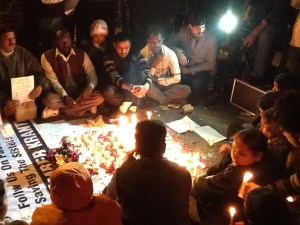
Evening at Jantar Mantar.

Candles at,Jantar Mantar
The Wake
The Wake
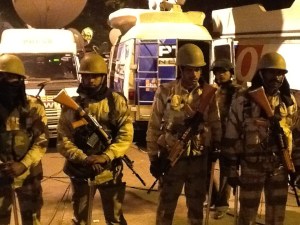
Armed, Cold, Bored
Armed, Cold, Bored

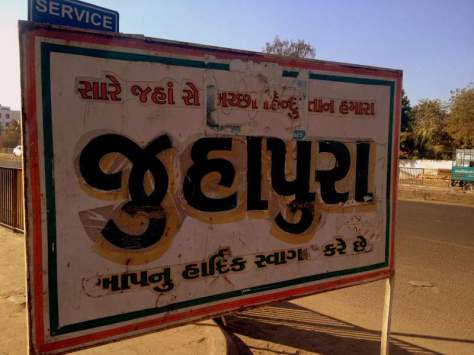
Seeing Pakistan from Juhapura: Zahir Janmohamed

Guest post by ZAHIR JANMOHAMED

Since I started conducting research in March 2011 about the aftermath of the 2002 Gujarat riots, I have learned that the worst way to begin a conversation with a Muslim here in Ahmedabad is to ask about the 2002 riots. I was an eye-witness to the riots in 2002 and I thought my experiences might make some Muslims in Gujarat feel more comfortable speaking with me. I was wrong.

Sometimes I had to interview a person four or five times before they felt comfortable speaking about the 2002 riots. The reasons are varied. Some feel there is no use speaking about the riots as they know justice will never come under Narendra Modi’s watch. Others feel exploited by NGOs and Islamic groups who have used their stories to raise funds for their organizations abroad. And others, as one rape survivor told me, do not want to “relive the trauma.”

But if you ask Muslims in Ahmedabad about Pakistan, chances are you will walk home with a notebook full of comments. Earlier this week I went around my neighborhood of Juhapura—an area pejoratively known as “mini Pakistan”—and asked residents for their comments on Pakistan. The answers are telling. Continue reading Seeing Pakistan from Juhapura: Zahir Janmohamed

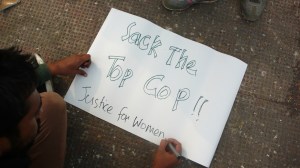
Justice for Women Now: Protest in New Delhi

Sack the Top Cop
Sack the Top Cop

On a day when the Prime Minister put his foot in his mouth by saying that ‘footlose migrants’ were responsible for heinous crimes like rape. On a day when the S.O.P – ‘son of a president / sign of a pervert’ – Abhijit Mukherjee said that the protestors were ‘dented and painted’ women, on a day when yet another gang rape was reported in Delhi, and a young woman ended her life in Patiala because the police harassed her in Patiala following her complaint of rape  – hundreds of young women and men, and many not so young and women and men, gathered under the single banner of ‘Justice for Women Now’ at noon in New Delhi, at the Nizamuddin ‘Sabz Burj’ with an intention to march to India Gate. They were stopped at the intersection of Zakir Husain Marg and Subramania Bharati Marg by several cordons of police. The police were arrayed across two intersections, several layers deep. The gathering was unarmed, peaceful, angry, joyous and disciplined. They were faced by a sullen array of police, armed with sticks and tear gas. The police did not let the gathering move towards India Gate, and the peacable, orderly gathering sat on the street for around two hours. There were several television and media crews.The primary demands articulated by the demonstration included ‘fast track’ processes for the 100,000 pending rape and sexual assault cases, the resignation of the police commissioner of Delhi, the drafting of gender sensitive and non-sexist laws, a call for a special session of parliament and a time bound commitment towards a massive expansion of safe public transport for women in metros. Continue reading Justice for Women Now: Protest in New Delhi

Cash Transfers and UID: Essential Demands

Statement by citizens (signatures below)

We support cash transfers such as old age pensions, widow pensions, maternity entitlements and scholarships. However, we oppose the government’s plan for accelerated mass conversion of welfare schemes to UID-driven cash transfers. This plan could cause havoc and massive social exclusion. We demand the following:

1. No replacement of food with cash under the Public Distribution System. 

The PDS is a vital source of economic security and nutrition support for millions of people. It should be expanded and consolidated, not dismantled.

2. Immediate enactment of a comprehensive National Food Security Act, including universal PDS.

Instead of diverting the public’s attention with promises of mass cash transfers before the 2014 elections, the government should redeem its promise to enact a National Food Security Act (NFSA).  Continue reading Cash Transfers and UID: Essential Demands

Bakht Arif, from Pakistan, sings Zinda Lash for Patronizing Indian Politicians (No, Don’t Listen to Honey Singh)

UPDATED : December 28, 2012

Don’t be a zombie. Never be a Zinda Lash.

No. Don’t Listen to Honey Singh talking about what he wants to do to the bodies of young women.

No. Don’t listen to Sushma Swaraj of the BJP talking about what she thinks is the zinda lash when she talks about the body of a young woman. Continue reading Bakht Arif, from Pakistan, sings Zinda Lash for Patronizing Indian Politicians (No, Don’t Listen to Honey Singh)

An ‘I Witness’ Account of Delhi Police and RAF Violence at India Gate on 23 December: Sangeeta Das

Guest post by SANGEETA DAS

[The Delhi Police has begun systematically lying about what has been happening in the past few days. We have seen spin doctoring around the unfortunate death of Constable Subhash Tomar. There has been efforts to plant generalized and unsubstantiated rumours about the presence of ‘terrorists’ amongst the crowds at India Gate. We have even seen the Chief Minister of Delhi, Shiela Dikshit and a sub divisional magistrate complain about the Delhi Police trying to interfere and influence that process of the recording of testimonies. Here is an important account by an eyewitness, Sangeeta Das, about the way the police behaved on the evening of the 23rd of December. Please note the kind of language that she says policemen were using. Can we trust the city to be safe in their hands.]

I am appalled at the lop-sided relay of events and incomplete images being telecast by some of the NEWS channels on TV, regarding the incident that happened at India Gate yesterday (this is an account of what happened on 23rd of December) at around 5:30 PM.

I was there. We were all on the other side of India Gate towards the Dhyan Chand Stadium.

I think I need to paint the correct picture for the nation. Except for CNN IBN and NEWS X, most other channels are not showing the peaceful gathering. Thus it gives out the wrong message to the nation, to the politicians, to other women that there was violence. Continue reading An ‘I Witness’ Account of Delhi Police and RAF Violence at India Gate on 23 December: Sangeeta Das