Category Archives: Everyday Life

Two Overheard Conversations, Delhi 2010

Guest post by ANAND VIVEK TANEJA

Conversation One. I’m sitting in a barber-shop in Sector 34, Noida, getting a haircut. The older guy sitting next to me, getting a shave, asks this younger fellow who’s just got up from a haircut –

  • Tu kahaan se hai bhai? Where are you from?
  • Main to Noida se hi hoon. I’m from Noida only.
  • Noida ka to na laage hai. You don’t look like you’re from Noida.

The young man in question was slight and skinny, and was dressed in what could be described as  generic global college student/hipster style. The conversation continued. The barber said, no he’s definitely not from Noida. The young man turned on him and said, Tum kaunse Noida ke ho, Well, you’re not from Noida either. The barber says, Main to Bihar se hoon. Main thodai hi chhupa ke rahkta hoon. I’m from Bihar. I don’t hide the fact. Then the barber says, Yeh to lawaris hai ji. He has no parentage, sir.

The Truth Behind the Strike

In a recent guest post, SIMON HARDING of Delhi’s AMAN Trust had explained why Delhi’s autowallah is not the villain he is made out to be but a victim of the Delhi government’s policies, the Supreme Court’s whims and the financier mafia’s greed. In this post he writes about the strike by Delhi’s auto drivers yesterday and why a majority of the drivers were not in support of it.

Yesterday there was an auto strike in Delhi. The city was crippled. Taxis tripled their fares and buses ran full to bursting. The strike, called by Rajendra Soni of the Dilli Autorickshaw Sangh (DAS) and supported by many other auto unions, was well observed with few drivers plying the streets. The striking unions demanded that Sheila Dikshit retract her recent comments about “phasing out” autos. They also called for a raise in the meter fare (Rs.4.5 per km) following an increase in the price of CNG. Continue reading The Truth Behind the Strike

Auto-rickshaws in Delhi: Why Sheila Dikshit’s comments are misguided

Guest post by SIMON HARDING

As every Delhite knows, taking an auto journey in the capital is not a pleasant experience. Drivers speed off at the very mention of your home or office, leaving you stranded on the roadside. When an auto-wallah finally agrees to go where you want, he steadfastly refuses to run by the meter and instigates a minute or so of stressful haggling. You arrive at your destination frazzled, irritated and over-charged. This situation has not gone unnoticed. Chief Minister, Sheila Dixshit recently announced plans to phase out the auto-rickshaw after five decades of service. Auto-rickshaws are “not a good option”, she complained, auto-wallahs “harass” passengers and up to half are plying the streets “illegally”. With the Commonwealth Games fast approaching, the eyes of the world will soon turn to Delhi. Auto-rickshaws do not fit with the CM’s desire to see visitors return home “with the impression that they have been to a truly civilised city”. She promised futuristic battery powered taxis, which thrilled middle class Delhi.

But before the auto-rickshaw and the much-maligned auto-wallah can be condemned, we must look at how the auto-rickshaw sector in Delhi operates: at the rules, regulations and policies, which govern the livelihoods of the city’s 80000 or so auto-drivers. Some questions need to be answered: why are Delhi’s auto-wallahs so greedy and grumpy? Why won’t they switch on the meter? Why do so many ply “illegally”? Continue reading Auto-rickshaws in Delhi: Why Sheila Dikshit’s comments are misguided

Moonwalking with the Comrades: Anirban Gupta Nigam

Guest post by ANIRBAN GUPTA NIGAM

The last book François Furet wrote before his death in 1997 was called The Passing of an Illusion. At the very beginning of the first chapter of that book, Furet spelt out the central question driving his study:

    What is surprising is not that certain intellectuals should share the spirit of the times, but that they should fall prey to it, without making any effort to mark it with their own stamp. […] twentieth century French writers aligned themselves with parties, especially radical ones hostile to democracy. They always played the same (provisional) role as supernumeraries, were manipulated as one man, and were sacrificed when necessary, to the will of the party. So we are bound to wonder what it was that made those ideologies so alluring, that gave them an attraction so general yet so mysterious.

Furet’s book emerged from an autopsy of his own past as a as a Communist “between 1949 and 1956.” He wrote, further, that his years as a Communist bequeathed to him an enduring desire to unlock the mystique of revolutionary ideology. Given this, it’s not difficult to see why he pioneered some of the most brilliant historiographical work on the French Revolution. The question we are concerned with here is the one I have quoted at length above; for it seems that in our own day, this strange romance between (formerly) fiercely independent intellectuals, scholars, activists and the – a – party, continues.

The latest document of this affair is a long essay by Arundhati Roy (once famous for her declaration of herself as an”independent mobile republic”), titled ‘Walking with the Comrades,’ published in the latest issue of Outlook. It makes for exciting reading, as a lot of well-written travel literature does; but it is significant for another reason: in the current debate over ‘Operation Green Hunt,’ with many versions of ‘ground realities’ fighting amongst themselves, this document is Roy’s attempt at producing an (her) authentic truth, so immersed in the charming details of revolutionary existence that everything else becomes secondary. If we were ever to perform an autopsy of our twentieth century’s ‘Communist’ pasts, ‘Walking with the Comrades’ would probably be as good a place to start as any. Continue reading Moonwalking with the Comrades: Anirban Gupta Nigam

Levelling the playing field before the Commonwealth Games

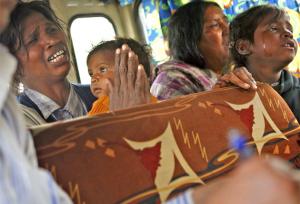
Ahead of the Commonwealth games, the capital city of the country with aspirations towards being anointed First Side-Kick to the only super-power left in the world, is busy cleaning up. Beggars, protesters, poor-looking people in general, out, out, all out.

Pholpata, her child and a friend inside a mobile court in a mini-bus, caught begging and brought before a magistrate who will decide whether to jail them for a year or release them. [The Independent on Sunday]


Also, see Partha Banerjee’s post on this in his blog
The Real Slumdog Story: India’s Ghastly Commonwealth Cleanup.

Meanwhile, of course, the labourers working day and night to complete the endless amounts of construction required to host an event of this magnitude, are “working and living in highly dangerous and deplorable conditions;  earning less than the stipulated minimum wage;  with no access to basic sanitation and health facilities;  and, lacking safety equipment”, found a Committee appointed by the Delhi High Court.

Continuing the saga of national triumph, below, we have AKHIL KATYAL and SHALINI SHARMA on the forced evictions of protesters from Jantar Mantar.

The Delhi State Government and New Delhi Municipal Corporation (NDMC) seem to have a particularly limited vision of a beautiful city. In the run up to the Commonwealth Games, Delhi is seeing a massive beautification drive which is really about an intolerant attitude towards democratic dissent and towards the urban poor. It is an idea of beauty that deals with urban protest or poverty simply by excising it from view.

Continue reading Levelling the playing field before the Commonwealth Games

Point Forty Five

Dear Mr P. Chidambaram,

On 8 March last year, Aman Kachroo was lynched to death in a college hostel in Himachal Pradesh. It was just another case of ragging. It happened nearly eight years after the Supreme Court of India banned ragging in May 2001. In fact, since May 2001, there has been at least one ragging death every other month, as reported by the English language media. You can imagine how many cases are hushed up, blamed on academic pressure and ‘depression’, and never investigated. We are also not going into the much larger number of cases of attempted suicides, drop-outs, and not even measuring the psychological impact on freshers.

In 2001, the Supreme Court’s orders said that an educational institution that is unable to control ragging would face grant cuts or even disaffiliation by affiliating bodies such as the UGC, AICTE, Medical Council of India and a host of others. Not one of them ever found any college unable to control ragging. Their bureaucrats issued circulars and thought their signatures on the circulars were good enough. Years later, some of them told the Supreme Court that they did not have the powers to act against institutions – even though a Supreme Court order had empowered them to do so!

Such matters clearly concern your colleague Kapil Sibal, so why am I writing to you? We shall come to that, just let me tell you what happened thereafter. Continue reading Point Forty Five

Trickster City

Trickster City, the English translation of Behrupiya Shahar, a collection of writings on Delhi by young writers was launched on the 12th of February at Sarai. During the event the writers performed segments from their new work which is excerpted below for those who missed the event, or those who simply want to read the texts. The details of Trickster city is also provided below the text.

Translation of the writers’ text

Azra Tabassum:

They say in Delhi, there are no red lights; there are only the hands of strangers.

We, along with all our co-writers of Trickster City, who are among the audience, welcome you all. We would like to thank Ankur and Sarai, along with whom we have made, through Cybermohalla, a generative space. A space where we pose and think through our most challenging questions. We thank all our co-travellers, who argued and debated with us, challenged us further as we wrote and questioned. Continue reading Trickster City

“Living outside the track”: A woman worker’s struggle against caste and patriarchy in Kerala

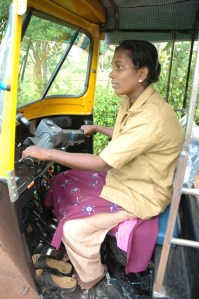
This is the report of a solidarity mission that was invited by Feminists Kerala Network to visit Payyanur and attempt to ascertain the facts around an incident of violence involving Chithralekha, a Dalit woman auto driver, on January 20, 2010.
Feminists Kerala Network is a loose network based in Kerala and outside, of feminists, Dalit activists, queer activists and other individuals involved with new social movements in Kerala.

The solidarity mission consisted of

Gail Omvedt, Professor, B. R. Ambedkar Chair at Indira Gandhi National Open University, Delhi; V Geetha , Publisher (Tara Books), author and social activist, Chennai; K.K Preetha, Advocate, Kerala High Court, Ernakulam; Nivedita Menon, Professor, Jawaharlal Nehru University, Delhi.

The team visited Payyanur on February 7-8, 2010.

Continue reading “Living outside the track”: A woman worker’s struggle against caste and patriarchy in Kerala

Johannesburg – Notes from a Mother City

Mother City?!? What is a Mother City?

We arrived at the Tambo airport, waiting to be received by the taxi driver. The taxi driver, also the initiator of the taxi services company led us from the arrival hall into the parking lot. He was an old, white man, with a completely white beard. He looked a bit like Santa Claus. Upon reaching the car, he opened the door to the boot and started lifting our heavy bags, one by one, to load into the boot. I said I would lift my bag myself (because somewhere inside my conscience, it seemed incorrect for an elderly person, my grandfather’s age, to lift my bags and put into the boot). He looked up and said,

In this country, we are all slaves. Let me do this. Continue reading Johannesburg – Notes from a Mother City

Royal Purple with a Green Crown

There is a story about Birbal and Akbar that goes something like this:

One day Akbar invited Birbal to join him at Lunch, one of the dishes served was the Brinjal, called Baigan in Hindustani, akbar liked the preparation and said as much, Birbal not only agreed but also praised the vegetable to high heavens, talking about its great qualities and about its ancient roots in the Indian lore.  Several days later he was invited for another meal with the Emperor and this time too Brinjal was on the Menu, Akbar did not like the preparation said that Baigan was an affront to finer sensibilities, Birbal promptly agreed and added that it had no taste of its own, had the consistency and colour of mud and destroyed anything that it was cooked with. Akbar remembered the fulsome praise that Birbal had just a few days earlier heaped upon the vegetable and reminded him. Birbal bowed his head and said, my lord, I am beholden to you, not to the Brinjal. Continue reading Royal Purple with a Green Crown

Green Hunt: The Anatomy of An Operation

An operation is underway in Central India, but no one really knows what it is. Variously described as a media myth, a comprehensive hearts and minds strategy, and an all-out offensive by paramilitary forces and the state forces along the borders of Chhattisgarh, Jharkhand, Andhra Pradesh and Maharashtra, Operation Green Hunt has become a shoebox of news clippings, police reports, public demonstrations and armed encounters.

Depending on the definition, Green Hunt either began in July 2009, September 2009 or November 2009. Speaking off record, senior policemen confirmed that the intensification of “search and comb” operations in Chhattisgarh began as early as July last year. In September 2009 the press reported on the progress of “Operation Green Hunt”: a massive 3 day joint operation in which the central CoBRA force and state police battled Naxal forces in Dantewada. Continue reading Green Hunt: The Anatomy of An Operation

Uncanny parallels between Beg’s and Shah’s deaths

This is a guest post by Akhilesh Upadhyay

The gruesome murder on Sunday of media entrepreneur Jamim Shah, 47, has brought back chilling memories of June 29, 1998. On that day, Mirza Dilshad Beg, a sitting lawmaker, was gunned down outside his home in Siphal, Kathmandu. It was a dark night and the hillside neighbourhood looked darker still due to load-shedding, when we (reporters and photographers from Kantipur and The Kathmandu Post) arrived at the scene, soon after the 9.30 hit-and-run incident.

The newsroom had received a tip-off from a local who had heard what he suspected were gun-shots. It was an innocent world in many ways. Nepalis were still unfamiliar with sounds of bombs and gun-shots, the Maoist-waged “people’s war” was still in its infancy, violent deaths still shook everybody, and political assassination was unheard of. But what shocked the Nepalis most was how ugly games from powerful external forces could play out in Nepal, as it watched haplessly. The incident also gave many of us in the newsroom a first-hand lesson on forces which operate from behind the scene. Two of the theories that made the rounds then clearly pointed at the cross-border nature of the operation; the third one was that Beg’s death had to do with “family problems,” which turned out to be false. Continue reading Uncanny parallels between Beg’s and Shah’s deaths

Drop A Beat, Turn Up My Symphony

This is a guest post by John Bevan

Nearly half the 8 million population of Haiti, (the size of Wales, Belize and El Salvador— seems that was one of the standard sizes for countries at the time) lived in the Capital Port-au-Prince.  So the elimination of the Capital approximates to the loss of half the country’s entire infrastructure, limited as it was.  The loss of many of its intellectuals and elected politicians, few enough in the first place, given the brain-drain northwards, with some third of Haitians living in the US, adds to the knock the country has taken.

In 2006, the main Port-au-Prince daily proudly lead with the story- “Haiti there at World Cup Final”- referring not to their football team but Wyclef  Jean who sang a duet with Shakira before the France-Italy final in Berlin.  Wyclef boosted the image and self-image of Haitians a few years earlier when he won a Grammy for the 1996 Fugees album, The Score, and accepted it while wearing a Haitian flag, Haitians still being at the bottom of the pile of all US immigrant groups.  He rarely appears on videos without the flag somewhere about his body. Continue reading Drop A Beat, Turn Up My Symphony

The Suicide of Sense

Mumbai has been in the grip of a wave of student suicides this past month. According to the Mumbai Mirror, as many as 25 suicides have taken place in the city in the new year, most of which have been by students. As expected, the media has tripped over itself reporting every sordid and tragic detail of the students’ personal lives, and public anxiety in Mumbai is climbing to the level of all-round hysteria. The general consensus is that there is too much pressure on young minds from schools and parents; the Maharashtra State government has reacted by issuing directives to all eight regional education boards in the state asking principals to arrange workshops to identify depressed students and urge them to seek psychiatric help. State education minister Balasaheb Thorat has promised a stress-free curriculum in school boards, and followed this up by a new rule that allows failure in one subject for an overall pass result in the SSC. A south Mumbai hospital has recruited a former depressive who has a history of three suicide attempts to counsel others against suicide. The Thane Mental Hospital has in the meanwhile gone one step ahead and created what they call a ‘20-minute anti-suicide psycho drama skit’ to be performed on the streets and in educational institutions. According to hospital superintendent Dr. Sanjay Kumavat, the skit will focus on the trauma that family members go through when a child commits suicide, and the ‘problems created by such a situation’ (Mumbai Mirror Jan 18th 2010) – this will hopefully prevent them from taking the proverbial ‘drastic step’.

Continue reading The Suicide of Sense

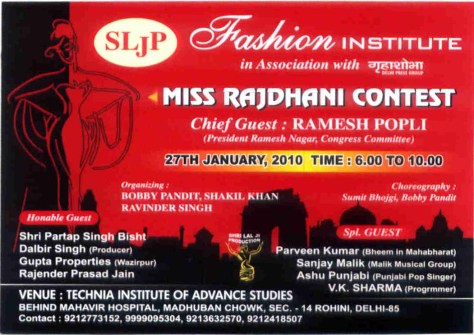
Miss Rajdhani Contest

You are cordially invited

Inaugurated: The Malabar Moral Police!

The dastardly attack on the eminent writer Paul Zachariah by the DYFI in the CPM fortress of Payyanur in north Kerala on 10 January has been roundly condemned across the political spectrum in Kerala. Zacharia was heckled and abused at a literary seminar organized by a publisher for  criticizing the moral policing  practiced by the official left in Kerala. He condemned the recent DYFI-PDP joint ‘moral action’ against the Congress leader Rajmohan Unnithan and a Sewa Dal leader which, according to the the DYFI leadership, were ‘provocative’. Zacharia was accosted by a gang of men when he was about to leave Payyanur and openly threatened. He was told that such talk was not permitted in the left bastion of Payyanur; when the threat did not produce the desired reaction, they resorted to physical intimidation, and relented only after the intervention of the organizers who are CPM sympathizers, and other writers present there. The day after, prominent leaders in the CPM, including the Chief Minister and the Minister for Education, condemned the action. Continue reading Inaugurated: The Malabar Moral Police!

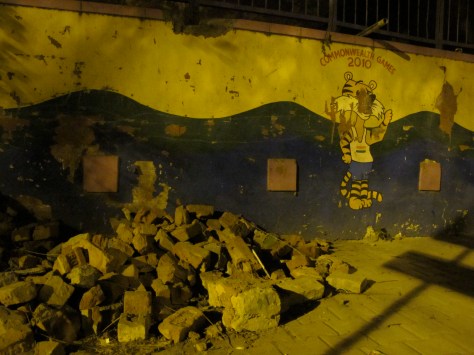
City Walls That Talk II

This image comes to us from Anand Vivek Taneja

Report on Violence Against Workers in Ludhiana: JTSA

[Here on Kafila we have written before about the new contours of class struggle and unrest in industrial zones. As the demands of capital become ever more rapacious, and worker’s bodies more dispensable, the last few years have witnessed increasing incidents of violent conflict in urban industrial areas across the country. In each case workers’ demands fall on the deaf ears of an increasingly unresponsive management backed by the weapons of the state. When the simmering violence finally comes to a head, it is workers who are demonized. We carry below a report by the Jamia Teacher’s Solidarity Association on the recent outbreaks of violence in Ludhiana’s industrial zone.]

A fact-finding team of university teachers from Delhi visited Ludhiana on Sunday (20.12.2009) to ascertain the facts of the incidents of violence that have gripped the industrial part of the city involving migrant workers. The team visited Dhandari kalan and Sherpur and spoke to a large number of migrant workers and visited their homes. The team found that despite a large number of the migrant workforce (around 12 lakhs) living in Ludhiana for over 15 years, sometimes even much longer, a majority of them had no voting rights or ration cards. Even when they applied for voters I cards, their applications were rejected on spurious grounds. It is not surprising that no political party, not even the local Member of Parliament, Mr. Manish Tiwari, has bothered to visit them. This attitude percolates down to the bureaucracy and police force, who treat the migrant workers as virtually second class citizens. Continue reading Report on Violence Against Workers in Ludhiana: JTSA

Media Induced Morbidity Syndrome: Anant Maringanti

Or, when suicide threat becomes political strategy

Guest post by ANANT MARINGANTI

I am witnessing a bizarre phenomenon in Andhra Pradesh which I can at the moment only call Media Induced Morbidity Syndrome. That this is pathological, and that this has to do with the media I am certain. But it is difficult to pin down what the pathogen is.

First, in the days and weeks following the then chief minister Y S Rajasekhar Reddy’s (YSR) death on September 2nd, 2009; over 450 people were reported to have died either of heart attacks or suicides. Newspapers kept a daily tally and the numbers kept mounting. Being in Singapore at the time, several thousands of miles away from Hyderabad during those weeks, I had no first hand experience of the mood in Hyderabad. I dismissed the reportage as a silly political gimmick. It was easy to surmise that vested interests had simply been collecting daily death reports from various government hospitals in different towns and attributing them to grief over YSR’s death. The largest number of these deaths – 227 occurred on the day of the funeral and the following day. Continue reading Media Induced Morbidity Syndrome: Anant Maringanti

Reflections on Biometric Attendance: Kriti Budhiraja

This is a guest post by Kriti Budhiraja

The latest in the list of efforts to “meet international standards” is the proposal to introduce biometric attendance for teachers across Delhi University. According to Vice Chancellor Deepak Pental, this new system is in keeping with the “spirit of transparency inculcated by the Right to Information Act.” But this commitment to a “spirit of transparency” becomes immediately questionable when one reflects on the undemocratic ways in which proposals such as these are being pushed through. Much like the semester system which is going to be implemented despite widespread dissent, it is rightfully feared that Deepak Pental may go ahead with this proposal while paying scant regard to teachers’ hostility towards it. Continue reading Reflections on Biometric Attendance: Kriti Budhiraja

Water…

In a tangential continuation of my last rant, a news report in the Hindu today caught my eye, because it made clear what we all know: the poor pay much much more for essential services than the rich do and therefore price of living indices as they are currently defined/calculated do not capture in any way the everyday realities of millions of Indians.

Continue reading Water…