
So Onam is here again — despite the fact that several contradictory stars above now form a malefic conjunction in the fate of poor Malayalis in Kerala. Indeed, rarely has a stranger gang dominated the starry heavens of our destiny: V M Sudheeran’s targeted gullet moralism that promises to close down a very large number of bars in Kerala and pave the way for total prohibition in the future, gangs of Hindu right wing youth and women forcing the government’s liquor outlets to close, policemen puffed up with jingoistic nationalism who hallucinate about Maoists in wake and sleep and declare social activists like Ajitha “dead”, CPM offspring who think that making foul, putrid public statements justifying murder is politics. All these are, well, rather drunk on self-righteousness and to be true, present a slightly ridiculous sight. Even the weather looks ridiculously inebriated – the sky alternates between bright sunny spells and horrid, harsh showers, crazily swinging between sunny smiles and bursts of tears. Continue reading Temperance in the time of Rahu
Category Archives: Feminism
Rape and Rakhi – Patriarchal-Communal Narratives: Kavita Krishnan
Guest Post by KAVITA KRISHNAN
Even as the communal cauldron in UP is kept on the boil, there is news that the RSS has launched a campaign to tie Rakhis to lakhs of Hindu men, asking them to pledge to protect their sisters from Muslim men and “love jehad.” The VHP has been running a helpline urging Hindus to approach them “if your daughter is being harassed by Muslim boys.” And a khap panchayat in Muzaffarnagar has imposed a ban on mobile phones and jeans for girls, claiming that these result in ‘eve-teasing’.
Woven into the above events is an old, familiar theme – that of patriarchal restrictions packaged as ‘protection’. In the wake of the anti-rape movement that followed December 16 2012, the streets of Delhi and many other parts of India had resounded with the voices of women declaring ‘Don’t take away our freedoms in the name of ‘protection’ – protect our right to fearless, fullest freedom instead’. Those women had raised their voice demanding freedom from sexual violence – and also freedom from rape culture that advices women to dress decently to avoid rape; and freedom from the khap panchayats, freedom even from the restrictions imposed by one’s own fathers and brothers.
Continue reading Rape and Rakhi – Patriarchal-Communal Narratives: Kavita Krishnan
Seen on a Bathroom Mirror
Received via KALYANI MENON-SEN

Women Have Been Branded Liars!
Guest Post by ANUBHA SINGH and SURABHI SHUKLA
The recent Supreme Court judgment in the case of Arnesh Kumar v. State of Bihar & Anr. (Criminal Appeal No. 1277 of 2014) has once again brought to light the concern shared by the larger society about the ‘misuse’ of Section 498-A of the Indian Penal Code (hereinafter “IPC”) and the Dowry Prohibition Act, 1961. This concern has been raised many times in the past (and present) and the judiciary has gone to the length of labeling this ‘misuse’, especially that of Section 498-A, IPC, ‘legal terrorism’ (in Sushil Kumar Sharma v. Union of India JT 2005 (6) SC 266.)
However, what has changed this time is that through this judgment the Supreme Court has endorsed and legitimized the common stereotype that women exaggerate and fabricate stories of violence to seek vengeance against their husbands and matrimonial families. Continue reading Women Have Been Branded Liars!
The Crisis of Devendran’s Father Muthu P.
One question I have faced umpteen times in my career as a Malayali feminist academic is the following: what is peculiar about patriarchy in Kerala? I have offered many answers to non-Malayalis but it is time now, I feel, to offer one which is non-technical makes unique sense to Malayalis. Why? Because the most conspicuous thing in Kerala’s contemporary cultural scene is the insecurity of the Malayali patriarchal-male, now bulging out like the paunches gifted to us by our recent prosperity. Like a feminist colleague once commented, patriarchy in Kerala is so ubiquitous, it is almost like air, all over the place. But a whole new generation of Malayali women have, mostly unwittingly,have caused it to condense into threatening dark clouds of male insecurity. What if the monsoon has been playing truant over my fair land, from these ominous clouds we now receive the copious showers of misogyny. Continue reading The Crisis of Devendran’s Father Muthu P.
Remembering our feminist heritage – Satyarani Chadha and Shahjahan Apa
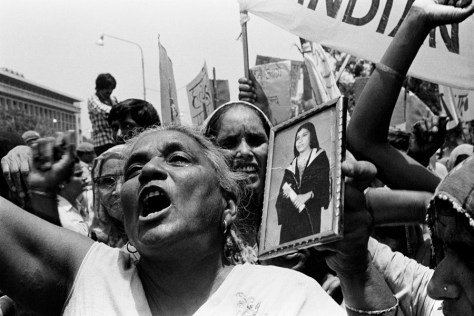
Sheba Chhachhi, artist, feminist and chronicler of feminist struggles, immortalized Satyaraniji and Shahjahan Apa in this image of an anti-dowry protest in 1981. Satyaraniji is in front, Shahjahan Apa on the right, behind her.
For those of us who came into the women’s movement in the 1980s in Delhi, the memory of Satyaraniji’s determined visage is a perennial source of energy and inspiration. In 1979, her daughter Kanchanbala, twenty years old and six months pregnant, was burnt to death following harassment for more dowry in her marital home. After her death, Satya Rani Chadha began a long battle for justice.
With the support of the parents of more than 25 other dowry death victims, Satyaraniji embarked on 21 years of sustained legal activism and court cases, which led to many landmark judgments and fundamental amendments in the criminal law. In 1987, Shakti Shalini, a Delhi-based organisation that helps and motivates other parents of dowry victims to fight this social menace, was formed jointly by Satyarani Chadha and Shahjehan Aapa.
Satyarani Chadha passed away this week, and Shahjahan Apa in October last year. Continue reading Remembering our feminist heritage – Satyarani Chadha and Shahjahan Apa
Harassment or Domestic Violence? The Case of Preity Zinta and Ness Wadia: Amrita Mukhopadhyay
Guest Post by AMRITA MUKHOPADHYAY
On Friday, 13 June 2014, a well known Bollywood actress Preity Zinta lodged a criminal complaint against her former boyfriend and business associate Ness Wadia, with the Marine Drive Police Station, Mumbai. In this case, the actress brought about criminal charges against a powerful businessman under different sections of the Indian Penal Code (IPC). The criminal complaint, which forms the basis of the First Information Report (FIR), alleges a range of behaviour that amounts to different crimes under the IPC falling under specific sections categorised as ‘offences affecting the human body’ and offences dealing with ‘criminal intimidation, insult and annoyance’. The first offence of ‘assault or criminal force to woman with intent to outrage her modesty’ under Section 354 of the IPC is a cognizable non-bailable offence liable with imprisonment ranging from one to five years with or without fine. Section 504 of the IPC forms the basis of another offence dealing with breaching ‘public peace’ on account of intentional insult or provocation, is a bailable non-cognizable offence with a maximum punishment of two years in imprisonment with or without fine. Under Section 506 of the IPC, the businessman is accused of criminal intimidation with ‘threat’ that may deal with intention to cause ‘death or grievous hurt’ or ‘destruction of property’ or to ‘impute, unchastity to a woman’. This offence is liable with imprisonment for seven years and is non cognizable and bailable. Finally under Section 509 of the IPC, the businessman stands accused of a cognizable and bailable crime of insulting the ‘modesty’ of a woman based on ‘any word, sound or gesture’ and carries a term of imprisonment for three years with or without a fine.
Ness Wadia dismissed the allegations as ‘false’.
In this maze of criminal charges, the glaring anomaly is the absence of a focus on nature of the relationship between the person who lodged the complaint and against whom the complaint is alleged. Continue reading Harassment or Domestic Violence? The Case of Preity Zinta and Ness Wadia: Amrita Mukhopadhyay
The untold tale of Soorpanakha: Drishana Kalita
DRISHANA KALITA’s subversive imagining of Soorpanakha’s version of the events that befell her, was one of the top 5 entries for June’s ‘Muse of the Month’ on Women’s Web.
I am Soorpanakha. My name is synonymous with Sin for many, encased for eternity in the pages of the epic Ramayana. I am not the role model parents would point their daughters towards. Why is that? You may ask. Because I admitted to lust. My name was pitted against Sita, the embodiment of purity and womanly virtues. She was everything I was not and I was everything she was not.
She was beautiful and so was I. Do not believe those terrible sketches of me with sharp fangs and blood shot eyes. I was a peerless beauty with large fish shaped eyes, for which my mother had named me ‘Minakshi’ at birth. A single woman, independent enough to roam the forests alone. I was free.
My freedom was my sin, as was my open sexuality. I dared to invite a man, the exiled king of Ayodhya, to make love to me.
Read this wonderful retelling here.
And as a bonus, watch Harinarayana Ehat Edneer performing Shoorpanakha in Yakshagana – ‘Main swachhand bhraman karti hoon!” she declares – I wander at my will!
Wikipedia, Bhanwari Devi and the need for an alert feminist public: Urvashi Sarkar
Guest Post by URVASHI SARKAR
Until June 20th 2014, if you visited the Wikipedia entry on Bhanwari Devi — a women’s rights Dalit activist who was raped for taking on child marriage in an upper caste community in her Rajasthan village— you would have been in for a nasty surprise.
The following lines from the biography section of the article would have stood out starkly:
“Bhanwari, the young, illiterate potter woman…strutting about the village giving gratuitous, unctuous advice to her social superiors made attempts to persuade the family against carrying out their wedding plans. Standing unveiled in the street outside the house of the brides-to-be she loudly berated the elderly patriarch… flaunted her government appointment…and threatening them that she would stop at nothing to ensure their public disgrace by stopping the planned marriage.”
The citation for this paragraph was provided as ‘Bhateri Rape Case: Backlash and Protest’ by Kanchan Mathur published in the Economic and Political Weekly (EPW).
Not a single sentence from that paragraph features in the EPW article; but a preceding paragraph in the Wikipedia entry, which describes Bhanwari Devi’s work as a sathin or grassroots worker with the Women’s Development Project of the Rajasthan Government, is correctly attributed to the EPW piece. Continue reading Wikipedia, Bhanwari Devi and the need for an alert feminist public: Urvashi Sarkar
Enough is enough: Anand Teltumbde
ANAND TELTUMBDE in The Hindu today
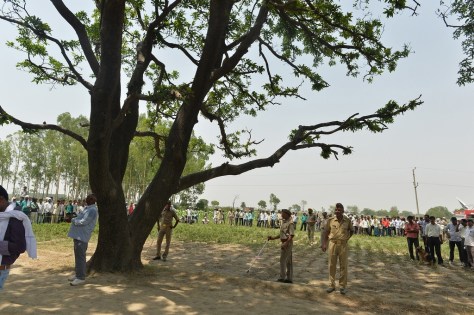
The tree in Katra Shahadatganj village (Badaun district) from which two young Dalit women, sisters, were found hanging after being gang-raped on May 27, 2014. Their bodies were found on May 28th.
The images of two innocent Dalit girls hanging from a tree in Katra village in Badaun district of Uttar Pradesh and a crowd of spectators looking bewildered at them best describes our national character. We can endure any amount of ignominy, can stand any level of injustice, and tolerate any kind of nonsense around us with equanimity. It is no use saying if those girls were our own daughters or our own sisters, we would still stare at them, bewildered and resigned like anyone in that crowd did. In just the past two months, while we as a country were busy playing fiddle to Narendra Modi and his promise of acche din, there have been a series of gory rapes and murders of Dalit teens across the country.
But beyond the residual anger, there is hardly any real concern for these atrocities. The rulers are not concerned, the media is hardly interested, and then there is indifference of the progressive lot and Dalits’ own frigidity towards them. It is shameful that we take the rape and murder of innocent Dalits as an adjunct of our social environment and forget about them.
A Brave and Startling Truth: Maya Angelou

April 4, 1928 – May 28, 2014
We, this people, on a small and lonely planet
Traveling through casual space
Past aloof stars, across the way of indifferent suns
To a destination where all signs tell us
It is possible and imperative that we learn
A brave and startling truth
And when we come to it
To the day of peacemaking
When we release our fingers
From fists of hostility
And allow the pure air to cool our palms
When we come to it
When the curtain falls on the minstrel show of hate
And faces sooted with scorn are scrubbed clean
When battlefields and coliseum
No longer rake our unique and particular sons and daughters
Up with the bruised and bloody grass
To lie in identical plots in foreign soil
When the rapacious storming of the churches
The screaming racket in the temples have ceased
When the pennants are waving gaily
When the banners of the world tremble
Stoutly in the good, clean breeze
When we come to it
When we let the rifles fall from our shoulders
And children dress their dolls in flags of truce
When land mines of death have been removed
And the aged can walk into evenings of peace
When religious ritual is not perfumed
By the incense of burning flesh
And childhood dreams are not kicked awake
By nightmares of abuse
When we come to it
Then we will confess that not the Pyramids
With their stones set in mysterious perfection
Nor the Gardens of Babylon
Hanging as eternal beauty
In our collective memory
Not the Grand Canyon
Kindled into delicious color
By Western sunsets
Nor the Danube, flowing its blue soul into Europe
Not the sacred peak of Mount Fuji
Stretching to the Rising Sun
Neither Father Amazon nor Mother Mississippi who, without favor,
Nurture all creatures in the depths and on the shores
These are not the only wonders of the world
When we come to it
We, this people, on this minuscule and kithless globe
Who reach daily for the bomb, the blade and the dagger
Yet who petition in the dark for tokens of peace
We, this people on this mote of matter
In whose mouths abide cankerous words
Which challenge our very existence
Yet out of those same mouths
Come songs of such exquisite sweetness
That the heart falters in its labor
And the body is quieted into awe
We, this people, on this small and drifting planet
Whose hands can strike with such abandon
That in a twinkling, life is sapped from the living
Yet those same hands can touch with such healing, irresistible tenderness
That the haughty neck is happy to bow
And the proud back is glad to bend
Out of such chaos, of such contradiction
We learn that we are neither devils nor divines
When we come to it
We, this people, on this wayward, floating body
Created on this earth, of this earth
Have the power to fashion for this earth
A climate where every man and every woman
Can live freely without sanctimonious piety
Without crippling fear
When we come to it
We must confess that we are the possible
We are the miraculous, the true wonder of this world
That is when, and only when
We come to it.
Maya Angelou
Queer Eye for Narendra bhai – Affect, Memory, and Politics in Desperate Times: Pronoy Rai
This is a guest post by Pronoy Rai
There is something awfully nostalgic about May 16. The election results brought with them a sense of melancholy-laden déjà vu. For the queers and allies on the political Left, the sinking feeling that May 16 brought with it, was reminiscent of yet another day, December 11, 2013; the day the Indian Supreme Court reversed the decision of the Delhi High Court decriminalizing homosexuality in India. It was once again criminal to be gay in India; once again the legal State apparatus had rendered queer bodies vulnerable to violence, from the State and from the political Right. There was a sense of desperation and disheartening injustice; what avenues remained to be sought when the country’s highest courts had us disappointed?
The Rashtriya Swayamsevak Sangh (RSS) and the Bharatiya Janata Party (BJP) had vehemently welcomed the Supreme Court judgment then, but our incoming Prime Minister, Narendra Modi, remained silent. It was perhaps too trivial an issue for him to address; when were rights anyway a matter of importance for him? If the indigenous people and forest dwellers of Gujarat could make the Indian mass media listen to them, they would tell us the story of Gujarat’s abysmal performance in settling land claims and distributing title deeds. Rights, especially of the fragments, are a roadblock for the Modi-style Development machine.
Fly, Manju, fly!
For some time now, I have been arguing that the apparent acceleration of tension around gender in Kerala, especially on the male-female axis,is because Malayalee women of this generation, as a group, have become far more individuated than their mothers.
Several friends have been quick to point out that I may be wrong — there seems to be quite a bit of evidence that women of this generation, despite improved access to higher education, are crawling before patriarchy when asked to bend. I do not deny this, but I would still argue that it may not be evidence for their lack of agency and that their subversive behaviour may, in the long term, actually confuse the system enough to render it ineffective. My fieldwork of the last seven years has only made my belief stronger: wherever I go, I have met women who struggle within the system, whose fights may not be feminist in a certain familiar sense but yet contain a noticeable anti-patriarchal charge.
But more importantly, I say this because it is hard to ignore what I experienced for eleven whole years of my life when I was a housewife-cum-research student, in a very middle-class, upper caste, very average Malayalee family that typically embodied the uniquely modernised patriarchy of twentieth century Malayalee society. More than ten years after I escaped its confines, Manju Warrier’s comeback movie, How Old are You? made me return there. Fourteen years ago when Manju decided to quit acting, she was admittedly the most successful female actor in Malayalam, and perhaps the most talented as well. Before she became a successful actor, she had shown tremendous potential as a classical dancer. She chucked all this, to become an ‘ideal’ housewife, retreating behind the fame enjoyed by her husband, the actor, the very ordinary Dileep – in fact so ordinary that he almost symbolizes the ‘average’, mediocre, insecure, young-to-middle aged Malayalee male both in his roles and his off-screen behaviour.That was the time when I had begun to plot my escape. I knew how wrong her decision was — and it saddened me that members of yet another generation of Malayalee women were mistaking what was a gaping cellar-hole to be a snug refuge. Continue reading Fly, Manju, fly!
A Matter of Honour ? A Response to B. G Verghese’s views on the Kunan Poshpora Mass Rape: Shrimoyee Nandini Ghosh
Guest post by Shrimoyee Nandini Ghosh
I have thought hard about why I want to write this piece at all, since so many others before me, have made robust critiques of Mr B.G Verghese’s well-known views on the Kunan Poshpora mass rape. Past criticism has focussed on questions of his obvious biases– both personal and professional, his misogyny and profound lack of empathy for the victims, his blinding nationalism, the tenor and language of his reportage. Most however accept his version of the facts, given his (often self proclaimed) claims to veracity bolstered by official hospitality, access to documents, and his reputation as an eminent journalist. ‘There was a delay in making an official complaint’ ‘medical evidence shows that the mass rapes did not take place’, ‘villager’s and early official accounts of that night are full of gaps and contradictions’, these have become the pervasive truths about the events of February 23-24, 1991, to the point where his decriers can often only counter him by explaining away the inconvenient and the inexplicable, within the narrative and factual scaffolding that he provides. Mr Verghese points to this when he writes, ‘Sadly, it [the Press Council of India Report] was and is widely criticised to this day, without critics having read it or controverted its substantive findings’. Mr Verghese fails to disclose that until recently no one has had access to the ‘substantive’ material that could allow such a critique, because the state had never disclosed that any other investigative material existed simply replying to RTIs seeking information on the status of the case, with the inscrutable ‘closed as untraced’. The unwieldy length of this piece (8000 words) will, I hope, serve to finally pursuade him that not only is his work read, it is read in painstaking detail.
Attitudes towards Menstruation – Notes from Assam: Priyanka Chakrabarty
This is a Guest Post by PRIYANKA CHAKRABARTY
GOOD NEWS, GOOD NEWS…They are blessed with a child! Oh, what child, boy or girl? This is the most common response that new parents will encounter, one that indicates what people find most interesting about a new birth. We examine its genital parts and then say, it is a boy or girl. During this time, the difference between male and female is only the biological difference of sex, of the presence of the penis or the vagina. Gradually the child is ‘socialised’ (read normalised) into a ‘woman’ or a ‘man’.
One of the key aspects of a girl’s socialization is her introduction to the bodily process of menstruation. Superficially, and as a purely biological process, menstruation is the discharge of blood from the vagina. This is widely considered to be the ‘development’ of the female body and after the start of menstruation, a girl is believed to have attained womanhood –attained puberty. Continue reading Attitudes towards Menstruation – Notes from Assam: Priyanka Chakrabarty
If you can’t join ‘em, beat ‘em: Ayesha Kidwai
AYESHA KIDWAI on FeministsIndia
Ayesha Kidwai on the need for Left-Secular people to take sexual harassment seriously when it comes home to “us”.
The burning question is why Mustafa and Joseph have done this? Are they misogynistic ‘supporters’ of Tejpal or fearless worshippers of fact and intrepid journalism? While the latter question may be good for an author’s self-image, and the former one can be dismissed as presupposing too tidy a critique, the real issue is a general failure amongst the professionals to come up with an adequate response to what the changed mood in the middle class demands. Mustafa and Joseph’s failures are just repeats of ones that we have witnessed over and over again, and each profession has plunged into a crisis when a colleague has been accused: How does a ‘senior’ professional approach the fact that some young woman has gone and complained about something that wasn’t even a grievance just a few years ago? After all, it is ”her’ word against ‘his’ and we know him; and while he may have his faults, he has done so many good things, and he is above all, secular. In any case, why are these outsiders, this “bunch of feminists” getting so involved in these matters (which are always so stippled with grey when seen from our side)?
For an outsider feminist like me, the answer is obvious: no one but this bunch knows what to do when a complaint is made from within one’s own kind. When the complaints have been made from within academia or within the judiciary, it is this bunch that has fought for them to be addressed, protested and thwarted the misuse of hierarchical power and its machinery of slander and intimidation, and reminded their professions that the ideal of equality must first be expressed in the creation of conditions conducive to its access. In doing so, they have imbued the phrase “let the law take its own course” with substantive meaning.
If a Woman is Raped in the Middle of a Forest and No Camera Sees it Was She Actually Raped? Fulana Detail
This is a guest post by FULANA DETAIL
When I was 19 years old I developed persistent headaches. My mother took me to the eye doctor to get my eyes checked. The doctor lived in our neighborhood. He was our family’s eye surgeon, he’d operated on both my grandfathers’ cataract, he was (and presumably continues to be) a well-respected doctor.
After the routine eye tests were done, the doctor noted I had slight myopia and that it, “appeared there was a weakness in the eye muscle that may be indicative of a general weakness.” I was anemic and underweight and he recommended a general physical examination. My mother said, “No problem, we’ll go to our GP”. “Why bother?”, he responded, “after all eye doctors are doctors first and receive the same medical training as everyone else”. Rather than bother with a separate visit he would be happy to do it himself, it would only take a few minutes. It sounded odd, but well he was the doctor. My mother knew him, and who were we to question the doctor? Why didn’t my mother step out, he suggested. I would be more comfortable that way. My mother looked at me: was I ok with that? I didn’t see why not, so she walked out.
He closed the door, I sat on the bed. He walked up to me, stood behind my right shoulder, began pressing my neck, unhooked my bra, felt my breasts, moved his hands down my stomach, pushed his hand into my underwear and began pushing his fingers into me. At this point I pushed him away, jumped off the bed and walked out. I didn’t go back in and my mother concluded the consultation. I said nothing to my mother at that point. She dropped me off at college. I felt strange and upset through the day, but I didn’t speak of this to anyone. In the evening I met my then boyfriend told him some of what had happened, but not the details. That evening, or perhaps it was the next day, I told my mother a version of what had happened but again, not in any detail. She asked if I wanted to lodge an official complaint. I didn’t. So my mother went back and confronted him. At which he flat denied anything untoward had occurred. If I were a victim, it was of a grievous misunderstanding. He had two daughters, he was terribly sorry if I had misunderstood, but really it was not his intention. He was only conducting a medical examination. I was not a child. I was a 19 year old, college educated woman. And I had let an eye doctor do something for which the new law prescribes a seven year jail sentence. Continue reading If a Woman is Raped in the Middle of a Forest and No Camera Sees it Was She Actually Raped? Fulana Detail
The Embarrassed Modern Hindu (Upper Caste Man)
Perhaps the clearest statement on what exactly it is in Wendy Doniger’s work that bothers some people – and who these people are – is outlined in Jakob De Roover’s empathetic account of the imagined ‘Hindu boy with intellectual inclinations’ born in the 1950’s. This boy grows up going to the temple, hearing stories about Bhima’s strength, Krishna’s appetite, Durvasa’s temper. If you were this boy,
Perhaps you rejoice when Rama rescues Sita, feel afraid when Kali fights demons, or cry when Drona demands Ekalavya’s thumb as gurudakshina.
The boy goes to school and learns about caste discrimination in Hinduism (that he had to go to school to learn about caste discrimination establishes his own caste position very clearly). This makes
You feel bad about your “backward religion” and ashamed about “the massive injustice of caste.”
But
You sense that it misrepresents you and your traditions—it distorts your practices, your people, and your experience…Everywhere you turn, people just reproduce the same story about Hinduism and caste as the worst thing that ever happened to humanity: politicians, activists, teachers, professors, newspapers, television shows… Continue reading The Embarrassed Modern Hindu (Upper Caste Man)
Feminist Reflections on the Tragic Suicide of Khurshid Anwar
THIS ARTICLE HAS BEEN COLLECTIVELY WRITTEN BY THE PEOPLE WHOSE NAMES APPEAR AT THE END
In the aftermath of the suicide of Khurshid Anwar, friend and comrade to many of us, on December, 18th 2013, there has been a concerted attack by some democratic and secular people on ‘feminists’ who supposedly drove him to take this extreme step. The charge is that feminists did not support him when an accusation of rape was made against him by a young woman, and exacerbated the situation by their irresponsible handling of the issue.
As feminists, we feel it necessary at this trying time to recognize that this pitched battle is after all, taking place amongst allies in a bigger struggle for democracy and secularism, and to think seriously about how we can move ahead. Rather than being a definitive statement of any kind, this collectively written piece is an attempt to think through a very messy situation. Continue reading Feminist Reflections on the Tragic Suicide of Khurshid Anwar
Theatres Of Rape: Srimati Basu
Guest Post by SRIMATI BASU
The Birbhum rape has thrown up images of the ‘kangaroo court,’ evoking the savagery of tribal subjects — but rather than feeling complacent at the exception and difference of this location, we might concentrate on the common modes of gendered control achieved by the rapes.
Jyoti Singh’s rape and murder in a Delhi bus in December 2012 seemed to evoke a sense of horror at the ultimate in human depravity. But in the time since, no week seems to go by without yet another gruesome gang rape, almost a one-upping of sadist violence across these uncoordinated episodes. Gang rapes have come to appear as the spectacular trendy crime of the moment. They underline the lethal consequences of women’s daily cultural transgressions: going to school, going to a night show movie, going to work, having a drink, being in politics. Even though we know they are miniscule in the corpus of sexual violence, which overwhelmingly happens in private and domestic spaces and among people who know each other, they have irritatingly given the impression that public spaces have become more unsafe, and further strengthened restrictions by families and communities on women’s mobility and choices.
As if the New Year’s report that a Kolkata schoolgirl was burned alive after being gang raped twice (the burning and second rape allegedly being retaliations to her police complaint) was not ghastly enough, this week we are talking about another woman in West Bengal (Birbhum), gang raped by diktat of the village council, on a public platform erected for optimal viewing. Continue reading Theatres Of Rape: Srimati Basu
For the sake of Form
The Aam Admi Party it seems has now decided to hit back at critics by uploading videos on Youtube to defend the controversial actions of Somnath Bharti, its Law Minister in Delhi done purportedly ‘in public interest’. Bharti has been chastised even by AAP supporters for his vigilantism and for trying to force the Delhi police to raid the house of suspected sex and drug racketeers and who in fact ‘helped’, along with his followers to catch two of the fleeing women.
Eight videos have been uploaded. They, according to the party contain incriminating evidence to prove that sex and drug racketeers were very much active in that area. Reporting the videos The Times of India says “… some of the scenes are not so easy to judge. Two clips show an African national walking around naked in the area. In another, three women in a car are rubbing some substance in their hands. Yet another shows several condoms lying about a car.” .
We do indeed see an African national moving around naked in the video. This is supposed to prove the allegation by the party that drugs are being used as according to one AAP worker “Walking around naked like this is an after-effect of drugs and this is a regular occurrence in the area”. You can also see for yourself condoms lying in the car. Do you need any more evidence to prove that the occupants of the car were indeed prostitutes carrying condoms with them and luring men to indulge in sex? Why are these three women rubbing some substance in their hands or trying to hide something by putting on gloves? Continue reading For the sake of Form
 KAFILA - COLLECTIVE EXPLORATIONS SINCE 2006