
Category Archives: Frontiers

An election in Nottingham

This is a guest post by AMAN BHARTI on the elections in UK

I had nipped out during my lunch break to post my voting ballot. The route back took me past Nottingham’s speaker’s corner, where for the first time ever, I saw some speakers. They appeared to be two of the three main political party candidates.

Intrigued, I joined the small crowd for my first experience of local electioneering. A desi chap in his shalwaar-kameez (or is that only what women wear?), sleeveless jacket and one of those Ahmad Shah Masood caps (I know they are called something, but I forget what) was just about to ask a question. In broken, accented English, he talked about the Muslim community suffering due to anti-terror laws, and asked which party would bring in “transparency and accountability” in the exercise of anti-terror laws, and adhere to the European courts’ views on individual human rights?

The brown faces in the audience cheered loudly. The white faces were conspicuously (and a little worryingly) silent. Continue reading An election in Nottingham

The City Turns Red – Kathmandu on May Day

When Maoist Newa state in charge Hitman Sakya asked the assembled crowd at Khula Manch to silently honor martyrs, the moment turned somber. The leaders stood with their heads down on the stage, and on the ground, all one could see were thousands and thousands of fists raised up. There was pin-drop silence.

A bit later, members of the Maoist cultural wing sang and danced. The lyrics were deeply political, hitting out at the NC, UML and India, projecting the Maoists as the only people’s party, and wooing the security forces by showing uniformed personnel shaking hands with Maoists ‘to build a new Nepal’. The crowd was enthralled. Continue reading The City Turns Red – Kathmandu on May Day

Madhuri and Zeenat

I recieved a mail today about the  deafening silence on the 24X7 newsbreakers regarding La affaire Madhuri and it got me thinking.

Is it not a bit strange that an OB van is not stationed permanently at the Vikaspuri residence of Ms Gupta? How is it that her milk man, her vegetable seller, the retired army major/ or a school principal or an old acquaintance who lives a few houses away have not been interviewed 200 times in the last two days?

How is it that archival shots of Ms Gupta driving away in her car, or recent shots of her being led away  in hand-cuffs, pan shots of her house from across the road, shots of authentic looking documents, of the schools she went to, of interviews with her old parents asking them how does it feel to be parents of a traitor? etc., etc. are not being run in a 24 hour loop? Continue reading Madhuri and Zeenat

‘Boycott of Israel would not serve any useful tactical purpose’: Amitav Ghosh

The British Committee for the Universities of Palestine (BRICUP) and Pakistanis for Palestine amongst others have appealed to the novelist Amitav Ghosh to decline the Israeli Dan David Prize he is being given jointly with Margaret Atwood.

The BRICUP open letter to Ghosh reads:

It’s surprising to have to raise Israeli colonialism with a writer whose entire oeuvre seems to us an attempt to imagine how human beings survived the depredations of colonialism. Gosh, even the Dan David judges like the way you evoke ‘the violent dislocations of people and regimes during the nineteenth and twentieth centuries’.

Those making him this appeal have reminded him of his rejection of the Commonwealth Writers’ Prize in 2001.

Give below is Ghosh’s response to the appeal: Continue reading ‘Boycott of Israel would not serve any useful tactical purpose’: Amitav Ghosh

‘Non-violent terrorism’ and India’s dirty war in Kashmir

Guest post by MOHAMAD JUNAID

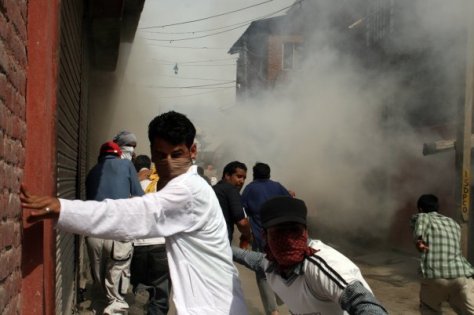
Dozens of young boys have been arrested across Kashmir under draconian laws over the last few weeks. The charges that have been filed against them range from “waging war against the state” to defiling “state honor”. In recent months Indian military and police commanders have described protests in Kashmir as “agitational terrorism” and “non-violent terrorism” in order to justify violent clampdown on protests by Kashmiris.

As the headlines go, Stone-pelting an act of war: J-K gov.

In the same period around 8 people, mostly teenagers, have been either shot to death or fatally injured by indiscriminate use of tear-gas shells. Over the last two years the number of dead in shootings is more than a hundred. Meanwhile thousands of people have been injured. Many of them will be left with permanent physical disabilities. The police authorities have banned any peaceful assembly of people. Many places in downtown Srinagar and other towns have reported police brutalities. Even the villages are not being spared. Only yesterday, mourning villagers were attacked by CRPF troopers in Redwani in South Kashmir. Dozens of them were injured by CRPF’s indiscriminate firing. Most of the injuries were inflicted above the waist showing an intention to kill Continue reading ‘Non-violent terrorism’ and India’s dirty war in Kashmir

“Twenty million out of twenty-seven million Nepalis are with the Maoists”: Interview with Prachanda

(This interview of Pushpa Kamal Dahal by me appeared in the Nepali Times a few days ago, along with another report.)

A conversation with Maoist supremo Prachanda this week not only brought out the party’s new line, but also offered a glimpse into his analysis of current politics and future strategy.

The root of the problem, according to Prachanda, is that the 12-point understanding was ‘tactical’ for everyone who signed the agreement. “The other side felt they could get us into the mainstream and weaken us. We thought we could use the process to create a new mainstream, which would include political competition.” Neither side got what they wanted, entirely. This paradox has forced the parties to make a more fundamental strategic choice. “This was inevitable and we are now heading for a crisis climax.”

The army issue is key. Neither side feels it lost the war. Prachanda concedes that no one won the war in material terms, but believes the Maoists won the war politically. “It was the then Royal Nepalese Army’s mandate and goal to protect the monarchy and block a republic,” he says. “They failed, and the PLA played a big part in bringing about this change.” The way forward for these “recognised and legitimate” outfits, he says, is “sticking to the peace accord, democratising the army and professionalising the PLA.” Continue reading “Twenty million out of twenty-seven million Nepalis are with the Maoists”: Interview with Prachanda

Uncanny parallels between Beg’s and Shah’s deaths

This is a guest post by Akhilesh Upadhyay

The gruesome murder on Sunday of media entrepreneur Jamim Shah, 47, has brought back chilling memories of June 29, 1998. On that day, Mirza Dilshad Beg, a sitting lawmaker, was gunned down outside his home in Siphal, Kathmandu. It was a dark night and the hillside neighbourhood looked darker still due to load-shedding, when we (reporters and photographers from Kantipur and The Kathmandu Post) arrived at the scene, soon after the 9.30 hit-and-run incident.

The newsroom had received a tip-off from a local who had heard what he suspected were gun-shots. It was an innocent world in many ways. Nepalis were still unfamiliar with sounds of bombs and gun-shots, the Maoist-waged “people’s war” was still in its infancy, violent deaths still shook everybody, and political assassination was unheard of. But what shocked the Nepalis most was how ugly games from powerful external forces could play out in Nepal, as it watched haplessly. The incident also gave many of us in the newsroom a first-hand lesson on forces which operate from behind the scene. Two of the theories that made the rounds then clearly pointed at the cross-border nature of the operation; the third one was that Beg’s death had to do with “family problems,” which turned out to be false. Continue reading Uncanny parallels between Beg’s and Shah’s deaths

The absurd theatre of Sri Lanka, applauded by India

Every time I go to Sri Lanka, my historical sensibility gets heightened. I still remember this huge hoarding of Mahinda Rajapaksa ‘lovingly’ holding an old woman, obviously Tamil as she was wearing a pottu. That woman could be one of the 2.5 lakh people who have lost their homes, belonging and land in the war. She could be part of the other lakhs who have lost all of this in the more than twenty-five years of war.

The day before yesterday, 26th January, was the first ‘free’ election ‘after the war’. During the months before the election, 700 incidents of violence were reported, leading to the death and injury of many. Yesterday, as the results rolled out, chaos hit the streets of Colombo. We don’t even have enough information about what happened in the rest of the country yesterday. Rumours were floating about. I shall not dwell on the rumours and provide them legitimacy, although I am tempted to, as some of them are shocking and could be true. Ethics come in the way. Continue reading The absurd theatre of Sri Lanka, applauded by India

Police States, Anthropology and Human Rights: Nandini Sundar

Guestpost by Nandini Sundar

3rd January 2010

Ujjwal Kumar Singh, Professor of Political Science, Delhi University and I have just returned  (January 1st) from a visit to the police state of Chhattisgarh. Ujjwal had gone for research and I had gone for a combination of research and verification purposes to assess the livelihood situation of villagers for our case before the SC, both entirely legitimate activities. In Dantewada, we had checked into Hotel Madhuban on the 29th of December around 2 pm without any problems, only to be told later that night that the management required the entire hotel to be instantly emptied out because they were doing some puja to mark the death anniversary of the hotel owner. We refused to leave at night, and were told we would have to leave at 6 am instead because the rooms had to be cleaned. As expected, other guests checked in the next morning, puja notwithstanding.
Continue reading Police States, Anthropology and Human Rights: Nandini Sundar

Engaging Nepal: some difficult questions

India can continue to let its suspicion of the Maoists be the over-riding objective of its Nepal policy or seek to play a pro-active role in engineering the kind of consensus it has done since 2005.

First published in The Hindu yesterday.

Indian Foreign Secretary Nirupama Rao arrives in Kathmandu on her maiden visit today, at a time when Nepal is grappling with its most serious and prolonged political crisis since the peace process began. India has to make certain difficult policy choices, reconcile the contradictions between its stated aims and actions, determine whether it remains committed to the process it helped facilitate, and use its leverage accordingly.

The fragile Madhav Nepal-led ruling coalition faces a severe crisis of legitimacy and a belligerent Maoist opposition. The Maoists have boycotted the legislature-parliament, paralysing government business to the extent that the budget has not yet been passed. They have demanded a house discussion on President Ram Baran Yadav’s “unconstitutional action” over-riding the Maoist government’s decision to sack the then Army Chief General Rukmangad Katawal in early May — a demand rejected by the other parties in government who see no wrong in what the President did. The Maoists have also launched a street movement, with the slogan of instituting “civilian supremacy” and a “Maoist-led national government.” Continue reading Engaging Nepal: some difficult questions

The (‘Quotation’) Gangs of Kerala

The media in Kerala is in a tizzy  these days over ‘quotation’ gangs and their influence on everyday life. Like evil spirits dancing upon the bodies of fallen heroes in abandoned epic battle-fields, ‘quotation gangs’, it seems, now dance upon the dead political heroism of the Malayalees. Suddenly, the media finds, they are everywhere, settling every kind of dispute. The institutions of law and order are turning, slowly, into adjuncts or versions of ‘quotation gangs’. The recent murder of the real-estate businessman Paul Muthoot, who was apparently traveling with two of the most notorious ‘quotation gang’ leaders in Kerala, has brought matters to a head. The papers are clogged these days with advertisements feeding Onam-time consumer-frenzy and news of the Paul Muthoot murder and they don’t see any connections between the two.

Continue reading The (‘Quotation’) Gangs of Kerala

The Ghost of Jinnah, Advani and Jaswant Singh

[That the BJP expelled Jaswant Singh for writing a book on Jinnah is hardly surprising, even if it represents really the most rotten part of contemporary India’s political culture from the Right to the Left: intolerance of intellectual differences. What is intriguing is that Jaswant Singh wrote the bookknowing well that this would be the end of his political career; even LK Advani could not survive his praise of Jinnah and even though he came back, he remains a pale shadow of his former self. So Jaswant never really had a chance. I have not yet read the book but have tried to follow those who have. While a more detailed analysis will have to wait, I am posting a piece I had written sometime ago as part of a larger academic paper which deals with Advani’s Jinnah episode and the seductions of secularism. – AN ]

Advani Meets the Ghost of Jinnah
On 5 June 2005, Bharatiya Janata Party leader and former Deputy Prime Minister, Lal Krishna Advani unleashed a storm within his party and its allied organizations of the Hindu Right. On that day, speaking at a function organized by the Karachi Council on Foreign Relations, Economic Affairs and Law (KCFREAL), Advani referred to Mohammed Ali Jinnah’s speech in the Pakistan Constituent Assembly on 11 August 1947 and described it as ‘a classic exposition of a Secular State’ and Jinnah as a genuine secularist (Advani 2005). In this speech, sections of which Advani read out at length, Jinnah, the founder of the ‘Islamic state of Pakistan’ had said: ‘You are free, you are free to go to your temples. You are free to go to your mosques or any other places of worship in this State of Pakistan. You may belong to any religion or caste or creed; that has nothing to do with the business of the State…You will find that in the course of time Hindus will cease to be Hindus and Muslims would cease to be Muslims, not in the religious sense, because that is the personal faith of each individual, but in the political sense as citizens of the State’ (Jinnah 2005).

On the previous day, Advani had already fired his first salvo. He had visited the Qaid-e-Azam mausoleum where he made the following entry in the visitor’s book: ‘There are many people who leave an inerasable stamp on history. There are very few who actually create history. Qaid-e-Azam Mohammed Ali Jinnah was one such rare individual.’ And further, recalling Sarojini Naidu, underlined: ‘Sarojini Naidu, a leading luminary of India’s freedom struggle, described him as an ambassador of Hindu Muslim unity. His address to the Constituent Assembly of Pakistan on August 11, 1947, is really a classic, a forceful espousal of a secular state…’ (Sarwar 2005, Kapoor 2005). If there was any doubt in anybody’s mind that this was not just a polite entry in a visitor’s book, made in a formalistic way, Advani hastened to clear it in the speech that followed the next day.
Continue reading The Ghost of Jinnah, Advani and Jaswant Singh

On Thinking Pakistan—Rambles and Recollections of an… upon Intezar Husain’s ‘Chiraghon ka Dhuvan’

Once it is granted that in India we practise a different kind of secularism, a secularism which is unique to us, it becomes very difficult not to grant the same status to Pakistan, Bangladesh, Sri Lanka and Nepal. This may seem bizarre given the fact that religion seems to pervade life in all these places, and a struggle over the definition of the state continues everywhere. However, defining oneself is different from the way one may be read. Many an avowed Muslim appears highly heretic to others. In fact the contemporary state, given the kinds of tasks of enumeration, surveillance, discipline and welfare that it is asked to command can only ever be secular, a fact that the Emory based legal scholar Abdullah Bin Naimi has been trying to hammer home to different kinds of Muslims over the last decade. For more of his works one can go to here and here.

The reason I bring this up in particular relates to the case of Pakistan. An avowed Islamic state, it has found it difficult to satisfy the urgings of different kinds of Islamists. And indeed it never can do so simply because protecting its citizens and assuring them equality is also one of its declared goals. The clash between the principle of treating each citizen as an individual, equal before the state, and the demands of different kinds of communities which may be ethnic, linguistic, regional or religious is precisely the playground of struggle that all South Asian, and now some European, states grapple with in their pursuit of secular goals. Continue reading On Thinking Pakistan—Rambles and Recollections of an… upon Intezar Husain’s ‘Chiraghon ka Dhuvan’

“China should break up India”

That’s the view of a Chinese strategic expert. The funniest part is:

China can give political support to Bangladesh enabling the latter to encourage ethnic Bengalis in India to get rid of Indian control and unite with Bangladesh as one Bengali nation; if the same is not possible, creation of at least another free Bengali nation state as a friendly neighbour of Bangladesh, would be desirable, for the purpose of weakening India’s expansion and threat aimed at forming a ‘unified South Asia’. [DS Rajan]

Anger Aftermath: ‘Encounter’ killings escalate in the Tarai

On Sunday night, around 10.30 pm, Chandrashekhar – a leader of the Madhes Rashtriya Janatantrik Party (MRJP), Revolutionary – called me up. An old acquaintance who had shifted from social activism to the armed movement, he was committed to the cause of Madhesi autonomy.

He was panic-stricken, and said, “Our chairman, Ram Narayan alias Manager Mahato, was arrested by Jaynagar police in Bihar this afternoon. They have just handed him over to a Siraha police team, which came to pick him up. We want to spread the news because they may kill him.” Continue reading Anger Aftermath: ‘Encounter’ killings escalate in the Tarai

MILITARIZATION WITH IMPUNITY: A Brief on Rape and Murder in Shopian, Kashmir

This release dated 19 July comes from the International People’s Tribunal on Human Rights and Justice in Indian-administered Kashmir (IPTK)

Enclosed, please find our brief on the events and investigative process in Shopian, Kashmir, connected to the brutalization and death of Asiya Jan and Neelofar Jan in end May 2009, in which the state security forces have been implicated.

While investigations have emphasized the procedural conduct of the police in their handling of the investigation, they failed to focus on the actual crimes that were committed, or the conduct of state institutions. The investigations in Shopian have not focused on the identification and prosecution of perpetrators or on addressing structural realities of militarization in Kashmir that foster and perpetuate gendered and sexualized violences, and undermine rule of law and justice. The investigations have instead concentrated on locating ‘collaborators’ and manufacturing scapegoats to subdue public outcry. ‘Control’ rather than ‘justice’ has organized the focus of the state apparatus, including all processes related to civic, criminal, and judicial matters.

What is the ‘truth’ of the matter, who are in the know, and what is being shielded?

We were compelled to write this brief to mark the inability of the state apparatus to deliver justice. We urge civil society institutions and international human rights groups and those working with issues of social justice to seek accountability.

In writing this, we have visited, and been in contact with, the family of Asiya Jan and Neelofar Jan, and civil society leaders and organizations in Shopian, and in Srinagar. We are grateful for the collegiality extended us, and especially to those that placed themselves at risk to offer us insight.

You can read here the full report.

When Pakistanis and Indians cheered for the same team

Continue reading When Pakistanis and Indians cheered for the same team

Iran: Inquilab Zindabad?

Once upon a time, only a hundred or so years ago, and earlier, Iranians were our neighbours. Many were friends, relatives – uncles, grandparents, ancestors, some were husbands, wives and lovers. And cities like Delhi, Lucknow, Murshidabad and Hyderabad spoke Persian better than they spoke English, or even Hindi. The distance from Tehran and Isfahan to Delhi, Lucknow and Lahore, or across the water from Bandar Abbas to Bombay or Karachi, in miles and in the imagination, seemed less than what we can even begin to understand today.

The Bengal renaissance had one of its points of origin in a Persian broadsheet called Mirat ul Akhbar published by Ram Mohan Roy in Calcutta. The first Iranian talking film and the last ‘Irani’ restaurant both have their origins in Bombay. The Sabk-e-Hindi, or the ‘Indian Style’ continued to adorn the more ornate fringes of Persian poetry in Iran. The miniatures painted in the ateliers of Delhi and Agra owed a great deal to the paints, brushes, colours and visions of visiting masters from Tabriz. The sitar and the sarod came from Iran, and stayed on. We shared jokes and stories, poets, prophets and pranksters, wine and spices, surnames (Kirmani, Rizvi, Mashadi, Yazdi) and clan histories, heresies and wisdom and a thousand other things that neighbours, friends, cousins and lovers share.

Continue reading Iran: Inquilab Zindabad?

The Snub

[Part of  Series. Introduction: For Movement]

Tanger, Morroco, June 2009

Sometimes you just have to seek the travel moment. Yes, the best moments are unexpected, everyday, hidden. Sometimes though, the textbook travel guide moments, mass produced as they are, still work. Try this for a classic travel guide must-do: you drive down to the south of Spain, get to a ferry, put your car in the hold and cross the water in an hour long ride from Europe to Africa. West to.. well… not West. Continent to Continent. Universe to Universe. It’s a [good] travel writer’s worst nightmare and a travel publisher’s wet dream.

Continue reading The Snub

64 for Aung San Suu Kyi

Burma’s imprisoned democracy leader Aung San Suu Kyi will mark her 64th birthday on 19 June 2009, her 14th year in detention. An iconic symbol of Myanmar’s political resistance, she is the world’s only imprisoned Nobel Peace Prize winner. She has committed no crime, she is the victim of crime, yet her detention can continue for many more years. The United Nations has ruled that Aung San Suu Kyi’s detention is illegal under international law, and also under Burmese law. The United Nations Security Council has also told the dictatorship that they must release her. Comparable to the personal, moral and democratic power of Mahatma Gandhi and Nelson Mandela, her continued detention is a powerful reminder of the unrelenting repression in Myanmar, and what must be done to make democracy and human rights a reality. Continue reading 64 for Aung San Suu Kyi

Bomb Blasts in Nepal: Global Dimensions of Hindutva Terror

Churches in Nepal, the erstwhile Hindu Rashtra on the face of the earth have maintained a unique tradition. They hold services on Saturdays because it is a public holiday when schools and offices are closed.

When Deepa Patrick, 22 and Celeste Joseph 15, both from Patna went to visit some of their relatives in Lalitpur, situated south of Kathmandu, they found this fact of Lalitpur’s christian communities social life very interesting. In one of her last emails to her parents back home Deepa even specifically mentioned this aspect of Lalitpur, which has a very small community of Christians living there for many decades. Continue reading Bomb Blasts in Nepal: Global Dimensions of Hindutva Terror