
Category Archives: Genders

Anatomy of a Rape and Its Immediate Aftermath – A Report from Kolkata: Kasturi

Guest post by KASTURI

Time flew fast. Over the last two days and sleepless nights. A girl I knew, a cheerful bubbly college first-year, eyes wide open with dreams, has been subjected to sexual violence. We had walked together in many marches against injustice, oppression, gender violence. I remember the day I first met her, several months back. It was opposite the Indian Coffee House on College Street. She had become an activist of the radical left students’ organization AISA by then. After that I met and chatted with her on many occasions. On the very day she was raped, she had participated in a students’ demonstration against the corporate-communal onslaught personified by Narendra Modi. She was slated to participate in another program the very next day. When night struck.

The night that rolled on to dawn
Continue reading Anatomy of a Rape and Its Immediate Aftermath – A Report from Kolkata: Kasturi

Lesser Citizens: Trapped in a Queer world of Dystopia: Indrani Kar, Shuvojit Moulik & Somya Tyagi

This is a guest post by Indrani Kar, Shuvojit Moulik & Somya Tyagi

Any dominant, mainstream model undoes the very idea of multiple modes of living and diversity which excludes the real demands of the minority groups and contributes to their social exclusion. Whereas everyone is entitled to equal and inalienable rights and opportunities set forth in the Preamble to the Constitution of India without distinction of any kind, such commitments are yet to be translated into action. Although Article 21 of the Constitution guarantees ‘Right to life and personal liberty’ to all, of which the Right to Healthcare forms an integral part, a large section of the society is still insensitive to the healthcare needs of the transgender community.
n1

The transgender population faces grave misunderstanding, prejudice, harassment, ridicule, rejection and even exploitation at the hands of health service providers as they do not fit into the society’s prescribed, rigid gender roles. Though the transgender community is hardly a homogeneous entity and is considerably diverse in terms of gender identity and livelihoods, in public imagination such complex identities of gender ranging from hijra to transgender are all lumped into one category, which becomes extremely problematic. Unfortunately, government policies also seem to feed on these generalisations, making use of such umbrella terms rather than focus on the specific needs of different groups.

Continue reading Lesser Citizens: Trapped in a Queer world of Dystopia: Indrani Kar, Shuvojit Moulik & Somya Tyagi

(En) Gendering a Rights Revolution: Siddharth Narrain

Guest Post by SIDDHARTH NARRAIN

The Supreme Court, in the National Legal Services Authority (NALSA) judgment delivered today has recognized the legal and constitutional rights of transgender persons, including the rights of the hijra community as a ‘third gender’. In judgment of immense breadth and vision, Justices K.S. Radhakrishnan and A.K. Sikri have brought hope and a promise of citizenship to a community that has largely been outside the legal framework.

NALSA filed this petition in 2012. In 2013, this matter was tagged together with a petition filed in the Supreme Court by the Poojaya Mata Nasib Kaur Ji Women’s Welfare Society, an organization working for kinnars, a transgender community. Laxmi Narayan Tripathi, a well-known transgender rights activist from Mumbai also intervened in this case.

In this piece, I will point to the highlights of this judgment and why it will go down in history as one of the most rights enhancing decisions in the Court’s history. I cannot but remark on the irony of this judgment being delivered just a few months after Koushal, in which the Supreme Court recriminalized LGBT persons and upheld the constitutionality of section 377 of the IPC. The Court acknowledges this, but makes it clear that while it recognizes that section 377 is used to harass and discriminate against transgender persons, this judgment leaves Koushal undisturbed, and instead focuses specifically on the legal recognition of the transgender community.

Continue reading (En) Gendering a Rights Revolution: Siddharth Narrain

If a Woman is Raped in the Middle of a Forest and No Camera Sees it Was She Actually Raped? Fulana Detail

This is a guest post by FULANA DETAIL

When I was 19 years old I developed persistent headaches. My mother took me to the eye doctor to get my eyes checked. The doctor lived in our neighborhood. He was our family’s eye surgeon, he’d operated on both my grandfathers’ cataract, he was (and presumably continues to be) a well-respected doctor.

After the routine eye tests were done, the doctor noted I had slight myopia and that it, “appeared there was a weakness in the eye muscle that may be indicative of a general weakness.” I was anemic and underweight and he recommended a general physical examination. My mother said, “No problem, we’ll go to our GP”. “Why bother?”, he responded, “after all eye doctors are doctors first and receive the same medical training as everyone else”. Rather than bother with a separate visit he would be happy to do it himself, it would only take a few minutes. It sounded odd, but well he was the doctor. My mother knew him, and who were we to question the doctor? Why didn’t my mother step out, he suggested. I would be more comfortable that way. My mother looked at me: was I ok with that? I didn’t see why not, so she walked out.

He closed the door, I sat on the bed. He walked up to me, stood behind my right shoulder, began pressing my neck, unhooked my bra, felt my breasts, moved his hands down my stomach, pushed his hand into my underwear and began pushing his fingers into me. At this point I pushed him away, jumped off the bed and walked out. I didn’t go back in and my mother concluded the consultation. I said nothing to my mother at that point. She dropped me off at college. I felt strange and upset through the day, but I didn’t speak of this to anyone. In the evening I met my then boyfriend told him some of what had happened, but not the details. That evening, or perhaps it was the next day, I told my mother a version of what had happened but again, not in any detail. She asked if I wanted to lodge an official complaint. I didn’t. So my mother went back and confronted him. At which he flat denied anything untoward had occurred. If I were a victim, it was of a grievous misunderstanding. He had two daughters, he was terribly sorry if I had misunderstood, but really it was not his intention. He was only conducting a medical examination. I was not a child. I was a 19 year old, college educated woman. And I had let an eye doctor do something for which the new law prescribes a seven year jail sentence.  Continue reading If a Woman is Raped in the Middle of a Forest and No Camera Sees it Was She Actually Raped? Fulana Detail

Bourgeois Imagination and Freedom from Gender Crimes – Limits of a Social Category: Sanjay Kumar

This is a guest post by SANJAY KUMAR

(This is an expanded version of the article that has appeared in Stree Mukti, January, 2014)

There is a reason crime fiction is one of the most popular genres in bourgeois societies. Nowhere else, except in the equally fictitious assumptions of the Neo-Classical economic theory, is a human being  made to appear an isolated individual in her motives and abilities, as completely as in crime fiction. Borrowing from a famous Ibsen play, in crime fiction, ‘a criminal stands most alone at the moment of crime’. Only her/his motives and acts determine the crime. Bourgeois law also assumes the same about criminal guilt, though punishment is often given under the light of ‘mitigating circumstances’, which mostly is a back door for all kinds of class and social prejudices. Among the ideologies that inhabit a society’s discursive world there often is a dominant ideology which mainly reflects imperatives of the prevailing economic and political order. The feudal ideological world is dominated by notions of  loyalty, honour, and community, all of which are the essential ideological glue, as well the felt reality of the hierarchical web of a feudal society. Bourgeois society is founded upon private property. Even though their consciousness is socially formed, its members see themselves as formed and ready prior to their social engagements. Their attributes appear to them as their own, inherent qualities. This gives a moral boost to the enjoyment of fruits of private property; that is the charm of bourgeois consciousness. In crime fiction, criminals as sole proprietors of their motives and abilities thrust themselves against social prohibitions in diabolically creative ways. That is its (hidden) charm.

Continue reading Bourgeois Imagination and Freedom from Gender Crimes – Limits of a Social Category: Sanjay Kumar

Are you celebrating free speech, Mr. Lit Fest? Harsh Snehanshu

Guest post by HARSH SNEHANSHU

This January, in a session at the Jaipur Literature Festival (JLF), the award-winning writer Jerry Pinto said something that sent most of us into a tizzy.

“We are sitting in the ‘Google’ Mughal Tent discussing how crucial the freedom of expression is for us writers,” Pinto said wringing his hands animatedly. “It’s the same Google that reads all our mails, encroaches on our privacy, and here, under its roof, we are discussing how we should feel free to say whatever we want without any fear.” The crowd was amused, and left with some food for thought. Would it have been possible to organize an event as grand as the JLF, free for all, without Google’s help? I asked myself. The answer was a no. Google’s deep pockets couldn’t be ignored. Should I refrain from attending the fest just because of Google’s invasion of my privacy? The answer, after some thought, was again a no. Google monitoring my mails doesn’t affect my freedom of expression that I prize most as a writer.

Two weeks later, another literature festival has arrived, this time in New Delhi. Run by arguably India’s most revered newspaper, The Hindu’s Lit for Life is being held at the Siri Fort Auditorium, New Delhi, on 8th February after its successful three day stint at Chennai in mid-January. The guest-list is embellished with names of noted luminaries like the writers Rana Dasgupta, Sam Miller, Rahul Bhattacharya among others, the Olympian Mary Kom, and politicians Shazia Ilmi and Manish Tewari. The entry, like every other literary festival nowadays, is free. The beautifully designed logo is aptly shaped as the fountain pen, representing the craft that it celebrates. However there is something below the logo that disturbs me. It says, ‘Powered by VIT University.’ Continue reading Are you celebrating free speech, Mr. Lit Fest? Harsh Snehanshu

Petition from IITs against Section 377

This petition may be signed by alumnae, faculty and students of IITs at IITs Against 377

To
The Honourable Chief Justice of India,
The Honourable Prime Minister of India,
The Honourable Minister of Home Affairs, India,
The Honourable Minister of Law and Justice, India,
The Honourable Minister of Human Resource Development, India,
and The Directors of the Indian Institutes of Technology.

Dear Sirs,
We are a group of students, alumni, faculty and staff of the Indian Institutes of Technology, collectively expressing our shock and disappointment at the Supreme Court’s decision to reinstate Section 377 of the Indian Penal Code. Section 377 is a British-era statute that outlaws “carnal intercourse against the order of nature” and includes within its ambit intercourse among consenting adults of the same sex. We hold that this law violates the fundamental rights of privacy and autonomy accorded to all Indian citizens by its Constitution, and the rights to dignity, equality and due process of Lesbian, Gay, Bisexual, Transgender and Queer (LGBTQ) citizens. While we demand that the law be immediately modified to exclude all forms of sexual intercourse among consenting adults, we wish to reiterate that this is merely one step towards the goal of equal membership in Indian society for everyone, regardless of sexuality and gender identity. Continue reading Petition from IITs against Section 377

For the sake of Form

The Aam Admi Party it seems has now decided to hit back at critics by uploading videos on Youtube to defend the controversial actions of Somnath Bharti, its Law Minister in Delhi done purportedly ‘in public interest’. Bharti has been chastised even by AAP supporters for his vigilantism and for trying to force the Delhi police to raid the house of suspected sex and drug racketeers and who in fact ‘helped’, along with his followers to catch two of the fleeing women.

Eight videos have been uploaded. They, according to the party contain incriminating evidence to prove that sex and drug racketeers were very much active in that area. Reporting the videos The Times of India says “… some of the scenes are not so easy to judge. Two clips show an African national walking around naked in the area. In another, three women in a car are rubbing some substance in their hands. Yet another shows several condoms lying about a car.” .

We do indeed see an African national moving around naked in the video. This is supposed to prove the allegation by the party that drugs are being used as according to one AAP worker “Walking around naked like this is an after-effect of drugs and this is a regular occurrence in the area”. You can also see for yourself condoms lying in the car. Do you need any more evidence to prove that the occupants of the car were indeed prostitutes carrying condoms with them and luring men to indulge in sex? Why are these three women rubbing some substance in their hands or trying to hide something by putting on gloves? Continue reading For the sake of Form

Open Letter to Delhi CM Demanding Action Against Racist Minister: Concerned Citizens

Guest Post by a group of Concerned Citizens

Open Letter by Citizens to Delhi CM Demanding Action Against Racist Minister

To 
Shri Arvind Kejriwal, 
Founder, Aam Aadmi Party and 
Chief Minister, Delhi


CC: Shri Yogendra Yadav, Shri Prashant Bhushan 


Our Demands


1. Remove Somnath Bharti from his position as Law Minister immediately


2. Punish all those, including Somnath Bharti, guilty of instigating and perpetrating racist and sexual violence on African women


3. Delhi Police must come under Delhi Government, but Delhi Police must be accountable to Constitution and not to the bidding of Ministers and mobs 


4. Meet and apologise to the Ugandan women who have complained of racist, sexual violence Continue reading Open Letter to Delhi CM Demanding Action Against Racist Minister: Concerned Citizens

Who will chop the Tree of Hubris?

devika

This is a photograph which appeared in the ‘Nagaram’ pullout on city affairs of the Mathrubhumi newspaper (Trivandrum edition,8 January 2014, p. III). The caption to the original photograph reads: ‘A man in Adivasi woman’s dress during the Secretariat March conducted by the Highrange Samrakshana Samithi and other farmer organizations’. The Highrange samrakshana Samity led by the Syro-Malabar Catholic Church, as is well-known, has monopolized the identity of ‘farmer’ in the hill districts and has been leading the protest against the implementation of the Gadgil Report and the Kasturirangan Report. Their rhetoric of helplessness in the face of state onslaught often leaves us blind to their history of ruthless exploitation and near-enslavement of adivasi people in these areas.No, they have never been helpless, and they never will be — the most powerful sections of civil and political societies in Kerala are on their side, as always. What else explains their hubris so well-reflected in this photograph? Continue reading Who will chop the Tree of Hubris?

Why I prefer the company of homophobic people: Anonymous

Guest post by ANONYMOUS

It may be a strange thing for a gay man to say, but I welcome the Supreme Court judgement re-criminalising the sexual acts I feel naturally inclined to engage in.

As someone who chooses to admit to his sexuality only before other gay men, and that too very selectively, you could call me closeted. Which means that I don’t feel as unfortunate as the ‘out’ lot which feels as though Indian law is asking it to go back into the closet.

I personally welcome the Supreme Court judgement because it will drill some sense of reality into my straight liberal friends who keep pestering, taunting, hinting, trying to make me say, ‘I am gay’. They will realise that there’s enough homophobia out there, enough of it for the Indian Supreme Court, considered a liberal institution, to re-criminalise ‘unnatural sex’. That gives me some semblance of an excuse, or so I hope, to remain closeted. Continue reading Why I prefer the company of homophobic people: Anonymous

Homosexuality and Islam – Indian Muslims’ Responses: Abhay Kumar

Guest Post by ABHAY KUMAR 

No sooner had the Muslim minority of India come to terms with a sudden surge of the Hindu right BJP in four assembly elections, seen as the ‘semi-final’ ahead of the General Election scheduled for early 2014, than their attention was gripped by yet another controversy. On December 11, 2013, the Supreme Court recriminalized homosexuality, overruling the three-year old  judgment of Delhi High Court.[1] The bench comprising Justice G.S. Singhvi and S.J. Mukhopadaya ruled that homosexuality or unnatural sex between two consenting adults under section 377 of Indian Penal Code (IPC) is an offence.[2] The judgment has evoked mixed response. The political elites and parties[3] along with religious leaders have responded in more than one way and some have supported the Supreme Court judgement while others are against it.[4]  But a strong protest against the verdict has been lodged by progressive, left circles backed up by English language media.[5]

Contrary to this, Muslim religious leaders and those politicians whose primary constituency is the Muslim belt, have wholeheartedly welcomed the ruling. While the English language media has acted as a ‘torch-bearer of liberal’ values, the Urdu press, on the other hand, has fought a spirited battle against the western ‘disease’. [6]

However, unlike these ‘guardians’ of the community, there are some other Muslim voices, who have broadly opposed criminalising people on the basis of their sexual orientation. This paper attempts to discuss the responses of Indian Muslims on the question of homosexuality. Continue reading Homosexuality and Islam – Indian Muslims’ Responses: Abhay Kumar

Sex and the courtroom

A politician is exposed using State surveillance to allegedly woo his love interest. An editor tells a reporter his daughter’s age that the easiest way for her to keep her job would be to have sex with him. A godman and his son are both arrested for sexual assault and rape. A riot in Muzaffarnagar over false rumours of inter-religious ‘eve teasing’ left 48 dead and 15,000 homeless. The debate on rape, consent, gender relations sparked by December 16, 2012 continued throughout 2013. And by the end of it the Indian Supreme Court decided that the Indian Constitution’s letter and spirit were not being violated by criminalising consenting adults for having sex, in case the sex happened to be anything other than peno-vaginal.

India 2013 is like a pubescent 13 year old realising there’s something about the body that the mind needs to grapple with. There’s something about power, pleasure, social mores, class, law and so on, that comes together in the body and negotiates its way through bodily desire. There’s a sexual churning out there, and it’s not as titillating as the annual sex surveys news magazines do, nor is it as literary and profound as the language an incarcerated editor wields. Continue reading Sex and the courtroom

In Tragic and Tough Times – Thoughts in the Wake of A Rape Charge and a Suicide: Sucheta De and Shivani Nag

Guest Post by SUCHETA DE and SHIVANI NAG

In Tragic and Tough Times, Let Us be True to Our Democratic and Gender-Just Principles.

We are confronted by a painful episode involving a rape charge and a suicide, that poses many tough and tangled questions to us – as the JNU community and also as individuals and activists committed to secularism, democracy and gender justice. Let us, for a moment, reiterate what one of the late Khurshid Anwar’s friends has said in his recent post on Kafila: the suicide does not prove him guilty of the charge of rape, and it does not prove his innocence either.

The suicide is a horrible, tragic occurrence – and it is a tragedy we should not compound with irresponsible utterances. A charge of rape does not necessarily turn the accused into a convicted rapist. True. And equally truly, it does not turn the woman making the charge, overnight, into a slut, a murderer, or a communal/political conspirator. Continue reading In Tragic and Tough Times – Thoughts in the Wake of A Rape Charge and a Suicide: Sucheta De and Shivani Nag

On the Death of Khurshid Anwar: Kalyani Menon Sen and Kavita Krishnan

Guest Post by KALYANI MENON SEN & KAVITA KRISHNAN

(Find Hindi translation below the English statement)

We are deeply shocked and saddened by the death of Khurshid Anwar.

As activists committed to ending violence against women, we have been trying to ensure the due process of law and justice in relation to the allegations against Khurshid Anwar. Continue reading On the Death of Khurshid Anwar: Kalyani Menon Sen and Kavita Krishnan

Section 377 and the Love with Odd Edges: Pallavi Paul

A Guest Post by PALLAVI PAUL

It is like watching an 80’s slasher film on an old VHS. The gruesomeness of mangled bodies, extra slimy trails of thick blood, intestines plastered against the screen. Parts of the image are eaten up by the glitch-ghosts that hang above them.  The erased bits , however, intensify the onset of the apocalypse instead of putting it away. It is impossible to tell whether something is happening, happened or will happen. Time is put through a particle accelerator, and what follows is a journey through a dilapidated scene of crime, with pure tone for background score.

Continue reading Section 377 and the Love with Odd Edges: Pallavi Paul

As a religious minority, I empathize with sexual minorities: M Reyaz

This is a guest post by M. REYAZ

The Apex Court judgment of December 11, putting aside the Delhi High Court order on decriminalisation of homosexuality, pertaining to Section 377 of the IPC has clearly divided into two ‘queer’ camps, where on one side besides LGBTS are those liberals extending their support to the LGBT cause, and on the other side, there are religious leaders and groups, who otherwise would not even see eye to eye with each other (what is ‘queer’ about this second camp is not so much its sexual orientation, as the strangeness of its banding together against queer people despite their antagonism toward each other).

Continue reading As a religious minority, I empathize with sexual minorities: M Reyaz

Suresh Koushal v. Naz Foundation: Pratiksha Baxi

Suresh Koushal v. Naz Foundation directs law’s violence on the body of the Constitution of India. Proclaiming colonial law as constitutional, the Supreme Court negates its role in the making of postcolonial constitutionalism. It departs from the theatres of comparative constitutionalism in the post–colonies, which used Naz to strengthen their battles against Macaulay’s legacies. Today the Supreme Court is cited amongst the infamous precedents of injustice that mark Indian legal history. Dubbed as ADM Jabalpur 2, the judgment declares sexual emergency on LGBT communities. By breathing life into s. 377, the Supreme Court attaches a badge of stigma on the body of Constitution.

Taking a jurispathic turn, the Supreme Court asserts that equality is subservient to scale by claiming that the LGBT community is a “miniscule fraction of the country’s population”. Inventing the category of a miniscule minority, the Supreme Court implies that equality provisions will apply only to numerically preponderant body populations. Thereby, overwriting equality jurisprudence by the insidious politics of numbers.  Continue reading Suresh Koushal v. Naz Foundation: Pratiksha Baxi

The Anti-Rape Movement -The Political Vision of ‘Naari Mukti/Sabki Mukti’: Kavita Krishnan

Guest Post by KAVITA KRISHNAN

Anti Rape Protest at CM Shiela Dixit's House, Photo by Vijay Kumar
Anti Rape Protest at CM Shiela Dixit’s House, Photo by Vijay Kumar

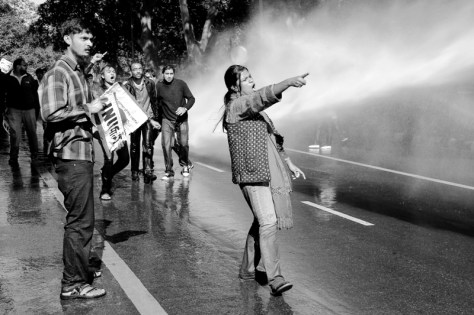
A year ago, a massive movement erupted on the streets of Delhi and the country – against the brutal gangrape of a young woman on a bus, leading to her death. Looking back at that movement a year later, it is clear that the questions, concerns and above all the tensions and debates embedded in that movement are with us still – and are quite crucial to the political discourse around us.

Continue reading The Anti-Rape Movement -The Political Vision of ‘Naari Mukti/Sabki Mukti’: Kavita Krishnan

Section 377 and India Shining: Pronoy Rai

Guest Post by PRONOY RAI

It is 2004 all over again. India is shining. Such a difference a decade can make. BJP is on the verge of returning to power, Modi could be India’s next Prime Minister, and the many failures of the UPA could give a new lease of life to Hindutva, if it was dead at all. As India shines, the state (its judicial arm, in this case) has abandoned the queers, questioning their claim to the status of “minority”, rendering them vulnerable to brutality at the hands of the hetero-normative society and other arms of the state (police, for instance), in equal measures. Other minority groups, strangely, or perhaps not so strangely, fought against the claim to citizenship of a (sexual) minority group, decisively defeating them at the altar of justice. 

Some of us queers, who stuck to every single word that was written in 2004 that went on to show how agrarian distress, farmer suicides, and saffronization of education didn’t quite add up to a shining India, were left puzzled by the reaction of the BJP to the Supreme Court verdict upholding section 377 in its original, pristine self. You’d think that the shrewd right-wing would take on the first opportunity to invoke a very obvious ancient Indian “culture of homosexuality” to make a progressive argument in favor of decriminalization. You’d assume that in a ravaging hunger to return to power, they would try to bring on board every single group that they can, maybe only later to abandon them, but at least carry them along through elections. Alas, no. For the BJP, India is still shining, and this shining confidence is perhaps sufficient to help them march into 7 Race Course Road, next year.  Continue reading Section 377 and India Shining: Pronoy Rai

An anti-constitutional judgement: Johannes Manjrekar

Guest Post by JOHANNES MANJREKAR

The ruling by a two-member bench of the Supreme Court, striking down the judgement of the Delhi high Court which had held that Article 377 – a pre-Constitution, 19th century colonial-era law – violated the spirit and directive principles of the Indian Constitution, seems to break new ground in jurisprudence. In an era where governments worldwide have been engaged in systematically rolling back hard-won civil liberties and individual rights and violating constitutionally guaranteed freedoms and principles, one might be excused for believing that the most urgent duty of an independent judiciary endowed with a reasonable degree of conviction and courage, would be to curb the transgressions of governments against the principles laid down in their own constitutions. The recent ruling of the SC does little to encourage such a belief. Continue reading An anti-constitutional judgement: Johannes Manjrekar