Category Archives: Government

Families and Dynasties, Lettered and Unlettered – Monobina Gupta

Minister in the Rajasthan government
Golma Devi, Minister in the Rajasthan government

Guest Post by MONOBINA GUPTA

It is jarring, to put it mildly, that Times of India, a leading daily, engaged in a high-profile ‘Teach India’ campaign should publish a front page story mocking the unlettered. This story exhibits a strange callousness in its reporting about the very constituency of people the campaign is hoping to address…or ‘uplift’…
The story published in the TOI on December 20, smacks of arrogance as it speaks disdainfully of an unlettered woman legislator recently elected in Rajasthan’s assembly elections. Golma Devi, elected from the Mahuwa constituency is the butt of ridicule and lament in this article authored by P J Joychen. The author, it seems, cannot get over the fact that an unlettered person like Golma Devi has been elevated to the rank of a minister in the Ashok Gehlot government.

No, she is not a history sheeter; nor does she have a scam hot on her heels. She is nevertheless an offender – in the sense of ‘offending’ your ‘sensibilities’ – in the supercilious eye of the media; an object of ridicule. Her offense: her of lack of reading and writing skills.

Continue reading Families and Dynasties, Lettered and Unlettered – Monobina Gupta

Your Rights End Where My Terror Begins

A phone in poll today on CNN-IBN’s Face the Nation:

Should human rights take a back-seat in favour of tougher terror laws?

65% say Yes!

Thus speaketh the great Indian middle-class- Enough is enough!

Continue reading Your Rights End Where My Terror Begins

Mumbai terror, the revolt of the elites and Life itself

You have said everything there is to say, and felt everything there is to feel. You have shouted angrily or reflected seriously or stated in the calm tone of conviction that terrorists are as authoritarian as the states they target, that terrorists have no religion, that terrorists are cowards who target soft civilian populations. You have despaired at the carnage wreaked on a city sick and tired of having to be “resilient”; of having faced one disaster after the other – from floods to targeted attacks on specific communities to bomb blasts – and “emerged with its spirit intact”. Your heart has clenched painfully at the inconsolable tears of baby Moshe; at the blood-spattered, newly motherless one-year old Viraj in an exhausted Head Constable Salunkhe’s arms, entrusted to him by his father, a utensil seller wounded by bullets at CST. You have gazed numbly at the image of Maharashtra ATS Chief Hemant Karkare’s young son with drawn countenance bearing the ritual paraphernalia of his father’s cremation ceremonies. Despite yourself you felt a sudden glimmer of hope steal into you at the stony dignity in Kavita Karkare’s dry-eyed grief at her husband’s funeral, at her steadfast bindi and her coloured sari. You have hated yourself for being relieved that those you know in that poor torn city are safe, when hundreds you did not know were not.

In fear and foreboding the feeling has overcome you – “What lies ahead of us now?”

But after all of that, after all of the sorrow and the grieving, in the midst of absolute despair, when you start to think again – STOP. Continue reading Mumbai terror, the revolt of the elites and Life itself

Victims of Terrorism

The multiple terror attacks in Mumbai are unprecedented and blatantly violate the most fundamental principles of law and justice. Regrettably, as Mumbai shows today, there is a huge gap between governmental counter terror rhetoric and the reality of human security observance on the ground. Much more needs to be done to mainstream counter terror strategy and action throughout the government security system and states must demonstrate the political will and promptness to translate human security and rights commitment into action. Continue reading Victims of Terrorism

Grotesque Terror Attacks in Mumbai

Courtesy Indian Muslims Blog

In one of the most daring and yet cowardly terror attacks, Bombay/Mumbai has been attacked. In an earlier post we had discussed the question of violence – ‘revolutionary’ violence, and the utter futility of resort to such methods. Violence is not a solution to anything; it cannot be. If anything, it is part of the problem; it is the problem. For violence begets more violence. Continue reading Grotesque Terror Attacks in Mumbai

Collateral Damage in our ‘War on Terror’

The Express Story today on the detention and torture of 6 Muslim men/boys in the wake of the Hyderabad blasts makes for chilling, terrifying reading. Amongst over 70 Muslim men who were arrested by the Hyderabad police, they detail custodial abuse and torture which ranges from stripping, to severe beatings on the hands and soles of their feet, to electrical shocks administered to genitalia. With characteristic insouciance and perversity the government has announced a ‘healing touch’ compensation of Rs 30,000 to each victim of the police’s tactile ministrations.

Continue reading Collateral Damage in our ‘War on Terror’

Some images do not disturb

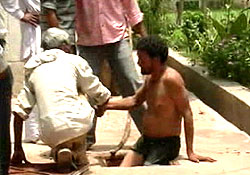
CBI-employed manhole workers in Noida

guest post by S. ANAND

There are times when our critical antennae do not perk up. We do not wish to decode certain signs because we are all implicated in them. Following the 14 September blasts in Delhi, suddenly the media found a new value in ragpickers, street vendors, auto drivers and others who live on the fringes of the city and are generally looked down upon by people who inhabit apartments, blogs, cars (and autos, I must add).

Suddenly, by 15 September, ragpicker Krishna was canonized as a ‘hero’ by the media, the police and the state (the Delhi government claims credit for saving some lives with its ‘eyes and ears’ policy). Yet, Times of India prefaced its report about Krishna thus: Continue reading Some images do not disturb

Mangalore – Hindutva in expansion mode

Broken limbs (by amathad)

Guest post by APURVA MATHAD Continue reading Mangalore – Hindutva in expansion mode

The Jamia Nagar Encounter: ‘Curioser and Curioser’

The well known journalist Praveen Swami, who is celebrated by some as an ‘encounter expert’ and ‘authority on terrorism’ has finally offered his comment on the Jamia Nagar encounter in the Hindu. See Behind the Batla House Encounter. It smells fresh.

Now, I really like Lewis Carrol, and am happy that Swami has invoked Carrol, Alice and Wonderland while criticising those (like me) who have chosen to take a skeptical stance towards the official handout of what exactly happened on the 19th of October in L-18, Batla House, Jamia Nagar. With due respect to Praveen Swami, lets read him in the spirit of Carrol and come to conclusions about who is Alice, who is the Red Queen and who is the white Rabbit, in due course.

It takes far more intelligence to read Swami than it must take for Swami to write like Swami. Which is disconcerting, given, that in Swamis case, he has a whole bureau full of intelligence to back him up, and all we have is the stuff between our individual ears, and occasionally our own eyes, our own ears and our own two feet. No wonder, we have to strain our credibility to believe the six and more impossible things that the police’s special cell, the intelligence bureau and its anointed experts would have us swallow whole for breakfast, with each morning’s headlines in the newspapers.

Continue reading The Jamia Nagar Encounter: ‘Curioser and Curioser’

Was it a recce or a planned raid?

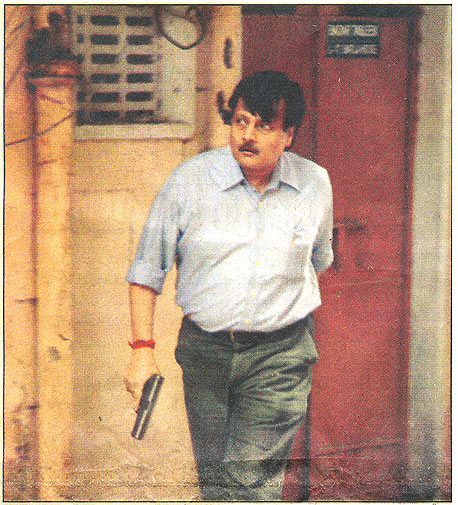
DCP Alok Kumar
DCP Alok Kumar

Guest post by AZIZ BURNEY, Editor, Rashtriya Sahara (Urdu), Delhi

It is a truth universally acknowledged that anything viewed from various angles presents various shapes. It is also a fact that your angle of view determines to a large extent the picture registered by your brain. An askew angle of view is bound to distort the picture. Reality defies comprehension without proper perspective. To date, we have not been able to understand what kind of picture the Delhi police is trying to draw in order to explain the incidents of September 19 as they happened. Continue reading Was it a recce or a planned raid?

Jamia Teachers’ Solidarity Group: Some Questions for the Delhi Police and Embedded ‘Journalists’

In the past few days, our favourite newspapers have been scrambling to counter the growing doubts about the supposed “encounter” at L 18. (See Indian Express and Times of India).

Jamia Teachers’ Solidarity Group responds to the latest claims by the police.

1) The police was caught by surprise. Or was it?

In its response to the questions being raised by the civil society, the police say, “the presence of armed terrorists took them by surprise.” “The police did not expect an encounter at L-18.” (Indian Express October 9)

Continue reading Jamia Teachers’ Solidarity Group: Some Questions for the Delhi Police and Embedded ‘Journalists’

Of “Killer” Buses and Car Lobbies: The Coincidental Death of the BRT

The sustained campaign by the elite press to jettison Delhi’s first mas transit bus system has been remarked upon and documented on Kafila. Today morning’s newspapers carries news of an accident in which 32-year old Poonam Sharma was killed as she tried crossing the road and was hit by an oncoming bus. Delhi’s record when it comes to road safety is abysmal and this is yet another instance of the the terrible and tragic fate that befalls many pedestrians every year on Delhi’s roads. What is interesting though is the way in which accidents on the BRT are reported compared to the reportage of other road fatalities. Here are some headlines from the recent past:

BRT Corridor Claims One More Life

BRT Delhi: Death Toll Continues, Pedestrians Blamed

Delhi BRT has it 10th Victim

BRT Claims another Life: Woman run over by Bus

Continue reading Of “Killer” Buses and Car Lobbies: The Coincidental Death of the BRT

Freedom of Conscience and Attacks on Christians

The idea that fundamental rights are enjoyed by all, without any distinction of race, sex, language, ethnic origin, nationality and religion, is a basic principle of democracy and international human rights law. Violent attacks on the Christian minorities in different parts of the country are an assault on the very notion of democracy and universal human rights. Despite the country’s obligation to respect and protect the right to freedom of conscience and religion, the wave of killings, beatings, sexual assaults, looting, destruction of property, and displacement have created a climate of fear and insecurity, particularly among the Christians. Representatives of Christians and minorities are exposed to the grave risk of communally motivated verbal abuse and physical attacks.

Worst, the governments of Orissa and Karnataka continued to deny the extent of violence prevalent, and failed to face up to their minimum responsibility of securing the life of their people. If India has to live up to any human rights standards, it must show a clear political will to combat attacks on Christians: speaking out strongly, and at all levels of governance; publicly acknowledging the seriousness of the issue; and the need to take concerted action. This is not ‘hooliganism’ or ‘anti-social’ activity, motivated by some hooligans and anti-social elements. It is a violent, and apparently a communal attack, carried out by organized groups. Crimes which are communally motivated must be effectively and thoroughly investigated and prosecuted as such. Treating communally induced violence and brutality on an equal footing with cases that have no communal overtones would be to turn a blind eye to the specific nature of the acts that are particularly destructive of fundamental rights.

Continue reading Freedom of Conscience and Attacks on Christians

“Gentle persuasion” in Kashmir

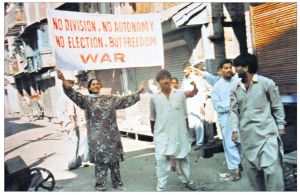
Some intelligence agencies have also warned of a low-poll percentage. But a senior police official said: “One cannot wait for the perfect situation in Kashmir.” According to him “gentle persuasion” in rural and border areas will help improve turnout. “After all, it is not a crime to ask people to vote. In several countries, voting is mandatory,” he argues. [George Joseph, Sakaal Times]
What an admission, what a giveaway! Indian democracy never went beyond Lakhanpur anyway. Nationalists and the weak hearted, please be ready to shut your eyes and ears for the next two months. The Indian state is planning to show its ugliest face in the Valley. Get ready, get ready.

Atta Boys, Delhi Police, Again

As the comments on the Jamia encounter pieces have flooded in, what has been amazing of course is how the defence of the police establishment comes often from the very same discourse which can’t stop crying itself hoarse about the corruption of the government. I am pretty sure many of those who have jumped to make us doubters and naysayers feel guilty about failing to support our boys in khaki would be wringing their hands at India’s sliding down the scale on Transparency International’s rating. What is required? What are we doing wrong? Does everybody in this country who can read and write need a Poli.Sci 101 course on what the Indian State is, and how it includes the elected and the non-elected arms, and how the ‘corrupt politicians’ are part of one large material and ideological whole that includes bureaucrats and internal security establishment? Continue reading Atta Boys, Delhi Police, Again

“Gandhi would be in your jail”: Protests against CSPSA at Berkeley

Justice and the Law
Director-General of Police Vishwaranjan of Chhattisgarh faces protesters in Berkeley / FDRI Seminar on Indian Democracy: Justice and the Law

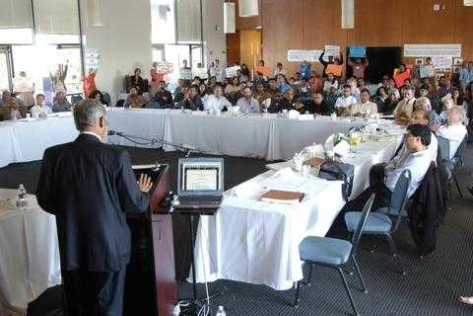
The Center for South Asia, University of California Berkeley and Foundation for Democratic Reforms in India jointly organized a seminar (September 27, 2008) on Indian Democracy where the Director General of Police of Chhattisgarh was a speaker. Continue reading “Gandhi would be in your jail”: Protests against CSPSA at Berkeley

Bye Bye Reliance: Pen Tehsil Says No SEZ!

In our continuing concern with the strange times that seem to have befallen our cities, lets not lose sight of the historic battle underway in the countryside. In the first instance of its kind, the referendum on the Maha-Mumbai Special Economic Zone being set up by Reliance has unambiguously returned the verdict of the farmers of Raigad- no SEZ in Pen! As Sanhati notes, the Tata’s 1500 crore investment in Singur sounds like loose change when compared to the one lakh crore that Reliance is planning to sink into 10,000 hectares. 22 villages in the Pen Tehsil voted against the acquisition of their lands at the paltry sum of 10 lakhs per acre. Unsurprisingly, Reliance Industries Limited has said the referendum is “not genuine”:

Continue reading Bye Bye Reliance: Pen Tehsil Says No SEZ!

A Little Less Melodrama and a Lot More Forensics

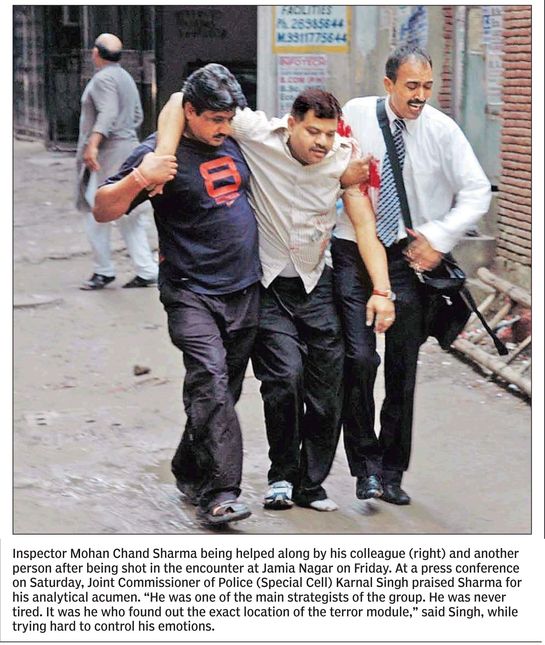
On Looking at a Photograph taken on the Margins of an ‘Encounter’

From page 3, Sunday Hindustan Times, 21 September, 2008

  Continue reading A Little Less Melodrama and a Lot More Forensics

Some Questions About the Delhi Encounter

By Shabnam Hashmi, Satya Sivaraman, Manisha Sethi, Tanweer Fazal, Arshad Alam, Pallavi Deka

First published on Countercurrents.

A team comprising activists, academicians and journalists visited the site of the police operation against alleged terrorists staying in an apartment in Jamia Nagar in the afternoon of 20.09.2008 (Saturday). Two alleged terrorists Atif and Sajid, along with Mohan Chand Sharma, an inspector of the Delhi Police’s Special Cell died in the operation while a third alleged terrorist was arrested. Continue reading Some Questions About the Delhi Encounter

The red mongoose in solemn procession: Samkutty Pattomkary

[This guest post by SAMKUTTY PATTOMKARY responds to the ongoing debate in Kafila on the Chengara issue. -AN]

Reading through the discussions on Chengara in kafila, some thoughts I felt I need to articulate as follows.

It comes out vividly through the Chengara struggle that a large section of people remain alienated from social and political powers in the so-called democratic society of Kerala. Why is it not possible for the ‘class proponents’ to see and engage themselves in working towards solving the issue politically? Continue reading The red mongoose in solemn procession: Samkutty Pattomkary

AFSPA – 50 Years of a Law

Come September 2008, and the Armed Forces Special Power Act (AFSPA) is now fifty years old in our country. It is a law in force in large parts of the northeast that gives armed forces special powers in a locality declared as ‘disturbed area’. However, while AFSPA is considered necessary by the state and army officials to protect the state against internal disturbances, to uphold the integrity of nation, to fight against terrorism and insurgency, and to protect sensitive border areas, it is being vehemently opposed and discarded by human rights groups, women’s organizations and political groups, as it is seen as facilitating grave human rights abuses, impunity, rape and torture, and silencing of democratic dissent. The Act has long been challenged internally through country-wide campaigns, coalitions, self-immolation, fast until death, and naked protests. It is also regularly referred to internationally, for example in the recently concluded UN Human Rights Councils’ Universal Periodic Country Review or in the previous Human Rights Committee, as an issue of serious concern.

Continue reading AFSPA – 50 Years of a Law