Category Archives: Identities

Freedom and the University – Reflections from a Teacher: Rimi.B.Chatterjee

Guest Post by RIMI B.CHATTERJEE. Photographs by RONNY SEN.

Graffiti on Jadavpur University Walls. Photograph by Ronny Sen

There has been a lot of noise about the recent agitation at Jadavpur University, and a lot of slanted media coverage. Allow me to set the record straight on a number of points.

Continue reading Freedom and the University – Reflections from a Teacher: Rimi.B.Chatterjee

Terror, Performance and Anxieties of Our Times – Reading Rustom Bharucha and Reliving Terror: Sasanka Perera

Guest Post by SASANKA PERERA

[ This post by Sasanka Perera is a review of  Terror and Performance by Rustom Bharucha (2014). Tulika Books, New Delhi. Kafila does not ordinarily post book reviews. An exception is being made for this post because we feel that the subject of terrorism, which has interested Kafila readers in the past, is an important one, and needs to be thought through with seriousness. We hope that this post initiates a debate on Kafila regarding terror, the state, performance, and the performances – serious, or otherwise – that typically attend to the discussions of terror, whether undertaken by the agents of the state or by non-state actors, commentators in the media, or by intellectual interlocutors. ]

When I started reading Rustom Bharucha’s latest book, Terror and Performance, it immediately became an intensely personal and gripping engagement. It was difficult to read in a single attempt as the mind kept wandering from one unpleasant moment in our recent annals of terror to another in some of which I had also become an unwitting part – mostly as a spectator. From the beginning, my reading was a conversation with Bharucha’s text through detours of my own experiences and an interrogation to a lesser extent. In 1986, as a young man when I went to the Colombo International Airport to pick up my father who was returning from the Middle East, I was shaken by a tremendously loud sound for which I had no immediate references. I had not heard such a sound before. People started running towards the sound. It was a bomb that had blown up an Air Lanka flight which had come from Gatwick. The Central Telegraph Office in Colombo was bombed in the same year. We learnt that everyone was running towards the sound and not away from it. Dry local political humor very soon informed us that people were trying to get inside the bombed out telegraph office hoping that they could get free phone calls to their relatives in the Middle East as they had heard phones were dangling from the walls with no operators in sight. That was long before mobile phones and call boxes. We were still young in terms of our experiences with terror. However, we soon had very viable references to what all this meant as the political narrative of Lanka unfolded with devastating consequences. But in 1986, when the kind of terror that was to follow in all its fury was still relatively new and quite unknown, we were acutely unaware of the dynamics of the actual act of terror and the structure of feeling it could unleash. This is why many of us in these initial years were naively attracted towards the epicenter of the act rather than being mindful to run away from it. But as the society grew in experience, people soon learned their lessons. Though an academic text in every conceivable way, I was reminded one could always find a few rare books of this kind which might personally and emotionally touch a reader in addition to whatever intellectual stimulation it might also usher in. Terror and Performance is clearly one such book. From the perspective of the writer, Bharucha himself recognizes this personal emotional engagement and investment early in the book. For him, “this writing demands stamina as it faces an onslaught of uncertainties and cruelties at the global level that challenges the basic assumptions of what it means to be human” (xi). It is the same kind of stamina that one also needs to read it as most of us in South Asia would be reading it squarely sitting in the midst of our own worlds of unfolding terror. This is why all those thoughts came gushing into my mind throughout the reading. I was not only reading Bharucha; I was also reading my own past.

Continue reading Terror, Performance and Anxieties of Our Times – Reading Rustom Bharucha and Reliving Terror: Sasanka Perera

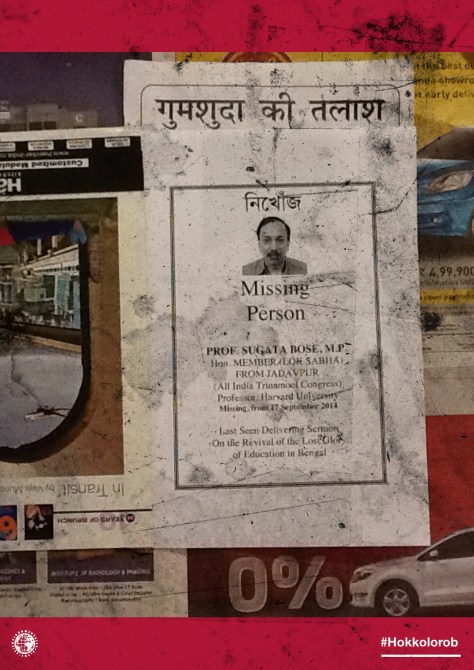
Missing Person Notice: Ben Zachariah

Guest Post by Benjamin Zachariah

Looking for Prof. Bose

It was not so long ago that Sugata Bose, now Lok Sabha Member for Jadavpur, made his way back from Harvard to serve his people. West Bengal had voted for ‘poriborton’, ‘change’, and as everybody assumed that Bengalis loved their fellow-men who had been anointed abroad, Sugata Bose returned to conquer the heights of Bengali higher education. The plan was to use a brand name within a brand name to shore up another brand name : Harvard, Netaji, Presidency. The Trinamul Congress, Bose was confident, would not interfere with his plans. Or so he said in public; his mother, Krishna Bose, had been the Trinamul Congress’s Presidential candidate, and long regarded as the force behind the attempted bhadramahilafication of Didi, apparently a prerequisite for political acceptability in West Bengal (otherwise known as Waste Bengal or Poschimbongobongo). It was therefore no surprise that his plans did not diverge from the plans of the TMC, although ‘internal differences’ were often heard of. It was also no surprise that, as the attempts to turn Presidency ‘University’ into the font of moral and intellectual legitimation for the TMC faltered, Bose took the mantle of his great-uncle upon himself and stood as a candidate for the TMC in the Lok Sabha elections, from the Jadavpur constituency. There was not even the pretence that Sugata Bose stood on his own credentials: his campaign marches were led by a child in Netaji uniform and Netaji glasses, prompting a complaint to the National Commission for Protection of Child Rights.

Now, in the Jadavpur constituency, duly won by Netaji’s heir, and not by a hair’s breadth, developments at Jadavpur University are cause for concern.

Continue reading Missing Person Notice: Ben Zachariah

Partha Chatterjee on Partha Chatterjee – An Interview with an Impostor: Partha Chatterjee

Guest Post by PARTHA CHATTERJEE

Continue reading Partha Chatterjee on Partha Chatterjee – An Interview with an Impostor: Partha Chatterjee

Notes from Jadavpur: Ahona Panda

Guest Post by Ahona Panda

About eight years ago, while lounging about doing nothing much in the campus of Jadavpur University where I was a student of the English department, I came across some callously etched graffiti:

Jodi prem na dile praane
Tobe Jadavpure pathanor ki mane?
(If you haven’t given this life some love–
What is the point of sending one to Jadavpur?)

Eight years on I cannot imagine the luxury of lounging about doing nothing much. One moves on in life after graduating from Jadavpur University. Meanwhile, in home and the world, the complete freedom (some will persist in calling this anarchy) of the JU campus has made it a legend somewhat like Dirty Harry: either worship and put it in on a pedestal, or condemn it thoroughly. The reputation of JU since the infamous 1970s has been as a hub of constantly bubbling anarchism, where Naxalites are hatching their next program of action, where ignorant armies like SFI and other anti-SFI groups clash by night.

Continue reading Notes from Jadavpur: Ahona Panda

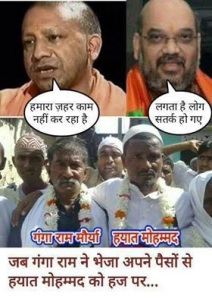
Muslims should Counter the Divisive ‘Love Jihad’ Campaign with Friendship Towards Secular Hindus: Kaleem Kawaja

This is a guest post by KALEEM KAWAJA

Abhee sub kuch nahin mita shaayad
Hindu-Muslim main pyaar baaqi hai
Ek Bhaayee kaa ek Bhaayee pur
Pyar ka kuch udhaar baaqi hai … 

Jawaid Badauni.

unnamed

Since the past one year, especially after the parliamentary elections were looming close, extremist RSS elements have become all the more aggressive all over the country, especially in the north, east and west. They have taken pains to circulate false news stories about Muslims in general, and Muslim youth in particular, as somehow prone to violence ,and conniving to entrap Hindu girls in romantic relationships with the sole object of securing their conversion to Islam. Regional vernacular newspapers have carried fabricated stories about Muslim youth turning to terrorism and planning bomb blasts in many Indian cities.

Since the past one year, especially after the parliamentary elections were looming close, extremist RSS elements have become all the more aggressive all over the country, especially in the north, east and west. They have taken pains to circulate false news stories about Muslims in general, and Muslim youth in particular, as somehow prone to violence ,and conniving to entrap Hindu girls in romantic relationships with the sole object of securing their conversion to Islam. Regional vernacular newspapers have carried fabricated stories about Muslim youth turning to terrorism and planning bomb blasts in many Indian cities. Continue reading Muslims should Counter the Divisive ‘Love Jihad’ Campaign with Friendship Towards Secular Hindus: Kaleem Kawaja

A Short Memoir On the Arabisation of Islam in India: Shireen Azam

This is a guest post by SHIREEN AZAM

A Pakistani writer Mina Malik Hasan recently wrote about the Arabisation of Islam in Pakistan, (The Sheepification of Bakistan), a movement of sorts which is transforming Islam in the Indian subcontinent by the day, even though it is remarkably dispersed and often subtle. The Arabisation of Islam seeks to “correct” Islam as Muslims in the subcontinent have understood, practiced and lived it, and instead replace it with an Islam which is uniform, seemingly universal and which need not have any affiliation with our cultural and local identities and beliefs. Having been a participant observer of this change in India, I wish to supplement Mallik’s experience in Pakistan with my own, in the form of a short memoir of the nearing extinction of the urdu phrase “Khuda Hafiz”, a customary way to bid goodbye, with the phrase “Allah Hafiz”. While both the phrases literally mean ‘May god keep you safe’, the reason for the shift was likely because of a lack of clarity in the particular god being invoked term by the term ‘Khuda’, since Khuda has Persian roots. If anything, “Khuda” speaks of Muslims’ age-old assimilation in the Indian subcontinent, something that ‘Arabisation’ of Islam would conveniently want to ignore, and is sadly becoming successful in. Continue reading A Short Memoir On the Arabisation of Islam in India: Shireen Azam

‘My Heart says Yes, but the Head says No’: Economizing Politics in the Scottish Referendum: Akshaya Kumar

Guest post by AKSHAYA KUMAR

I

About two months ago, while walking by the roadside in Glasgow, a middle-aged man handed me out a pamphlet. In an endorsement of UKIP, the pamphlet declared ‘Our government pays GBP 55 million a day in fees to the EU’ (emphasis added). It went on to inform that in return, the EU gives ‘us’ accounts riddled with fraud, no control over ‘our’ own borders – putting pressure on our health, education and welfare services – and a super-government that makes more than 70% of ‘our’ laws. The pamphlet intrigued me a fair bit, not in the least because as an international student in the UK, I wondered if my case was a bigger or smaller burden on the UK defined thus – their UK. But who are they? One might rubbish them as a deviant community, or one might consider them a threat to yet another definition of us – the liberals or suchlike. But what intrigued me was not the neatness of these boundaries, or the speculations about how many of ‘us’ and ‘them’ there are. I was intrigued by the language of the starkly political proposition. Let us tentatively assume that in the pamphlet, ‘us’ meant the citizens of UK and it constructs an antagonistic position vis-à-vis other national citizens who are entitled to living and working within the UK. Surely the two are politically distinguishable? Or are there too many of them living next to us, so they cannot exactly be identified as such? Continue reading ‘My Heart says Yes, but the Head says No’: Economizing Politics in the Scottish Referendum: Akshaya Kumar

A civil-war is on the doorstep of India: Interview with Kancha Ilaiah by Mahmood Kooria

This is a guest post by Mahmood Kooria

We are publishing an English translation of an important interview of the intellectual and academic Kancha Ilaiah, conducted by Mahmood Kooria for the Malayalam weekly Mathrubhumi. While what I see as Professor Ilaiah’s underestimation and perhaps misreading of the historic role of the Communists in Indian politics leaves me severely uncomfortable, especially when he exonerates the right from commensurate charges of elitism, his framing of Hindustva and Modi’s appeal within the great stream of caste in the subcontinent is brilliant and thought-provoking, as always. 

Kooria conducted the interview as well as translated it in to English. His introduction is as follows, “At a time when there was no any such discussion, in 2002 Professor Kancha Ilaiah predicted that Narendra Modi will be the prime-ministerial candidate of Baratiya Janata Party. It has come true and now Modi is in the office. At this point, I talked with him at Moulana Azad Urdu University Hyderabad where he chairs the Centre for the Study of Social Exclusion and Inclusive Policy. In the conversation, he talked about the future of Modi government and he predicted that a civil war is going to break out in India if Modi does not cater the needs of backward classes. A Malayalam-version of this interview was published in the Mathrubhumi Illustrated Weekly (August 24, 2014).”

Mahmood Kooria: Ten years ago you wrote that Modi will be the prime ministerial candidate of BJP. What would be your response as your prediction has come true?

Kancha Ilaiah: Well, at that time I was predicting that based on the Left parties’ indifference to understand the caste question. The caste question is not been seriously taken by the Left parties. And, after Mandal, the BJP and the RSS wings started looking at caste-question seriously because when Babari Masjid was demolished they mobilized a lot of backward classes. Though they oppose Mandal reservation, they wanted the backward classes to be part of the Hindu religion. Around 1994, a non-Brahmin called Rajju Bhaiya became the Sarsanghchalak of the RSS. Then he recruited a large number of backward classes, large number of youth, and he promoted the people like Narendra Modi, Uma Bharati at that time. Earlier, the first backward-class chief minister of Uttar Pradesh was a BJP man: Kalyan Sing. He was the chief minister in 1992 when the Babri Masjid was demolished.

The Sangh Pariwar was responding to the backward class demands more. But the Left or the Congress was not responding to the OBCs. The Congress was responding to the Dalits and Muslims. There was upper caste all the time on the top. So, when Narendra Modi became the chief minister and this whole atmosphere was created, I was writing a column in The Hindu. I thought that this seems to be cause/course of India, since the Hindu religion is surviving because of the backward classes. It is inevitable for the Hindutva organizations that they will have to project an OBC for the prime-ministership. But there was resistance from within itself. It is not that the Brahmins have given up the principle of varna-dharma. After that article came and of course after my writing Why I am not a Hindu itself, the backward classes even within RSS seemed to use that material for their advantage. The communists did not use or recognize it. The question of labour and caste which I have been consistently raising, which was also part of their theory, they did not care about. So the Communist Party remained tightly under the control of upper castes.

Continue reading A civil-war is on the doorstep of India: Interview with Kancha Ilaiah by Mahmood Kooria

If Gail Omvedt is Katherine Mayo, then Sugatha Kumari is …? Thoughts on Salman’s Predicaments

Salman Zalman is a young man from Kerala who has recently been arrested for an alleged act of disrespect towards the Indian National Anthem. As an observer in Kerala, I think young people like him who choose to get involved in public struggles for justice face a number of predicaments that were perhaps not so severe for my generation when we were young. For this reason, I do feel that members of my generation, those of us alive to public issues, need to be more open to the challenges that public-minded younger people face today. Continue reading If Gail Omvedt is Katherine Mayo, then Sugatha Kumari is …? Thoughts on Salman’s Predicaments

When David Became Goliath: Lee-Alison Sibley

Guest post by LEE-ALISON SIBLEY

Back in the 1960s when Hollywood was making a number of movies based on biblical stories, they came out with Orson Welles as King Saul in “David and Goliath.” I was a little kid when I saw this movie, but I remember identifying with little David who yes, played beautifully on his harp, and used his slingshot with divine accuracy. I also remember the monster Goliath – he was huge and ugly and represented the Philistines, our enemies.  I cheered in my head and my heart for David to defeat the monster and he did, so that I could feel the good guys won and God was indeed on our side, the side of the Israelites.

Like any idealistic Jew, though not religious, I went to Israel to work on a kibbutz in the summer of 1971.  I was in the south, near Eilat and the border with Jordan.  Young and naïve, I was friendly with everyone I met — the Sabras of Israel, the Christians in Bethlehem, and Arabs in Gaza. In Gaza?  Yes, I was there with a British fellow from the kibbutz who was picking up some cane furniture he had ordered.  I wasn’t supposed to be there, of course, and when an Israeli army jeep spotted me, my friend was in big trouble.  “Get her out of here immediately!” was the order he shouted.  I guess it had something to do with my appearance and that there were no other women on the street at that time.  Like I said, I was friendly with everyone – my parents did not raise me to hate, they raised me to love.  The Israelis tried to make me feel guilty for not staying in Israel, but I kept saying, “I’m an American, my home is the U.S.A.”  Still, I certainly supported Israel and every person I met there had lost someone, a family member or a friend in a war and I felt very sad for them and angry that they lived with the constant threat of attack. Continue reading When David Became Goliath: Lee-Alison Sibley

Scribbling in Dark Times


“In the dark times 
Will there also be singing? 
Yes, there will also be singing.
About the dark times.”

-Bertolt Brecht

 I.

There are moments in one’s life when one really feels perplexed.

You find yourself in a situation which you had never envisaged before.

Most of your predictions about the unfolding situation have gone awry or have not proved upto the mark.

One wants to remain calm, to contemplate things around you, take a break, but I know that for people gathered here – activists, writers committed to a cause, political workers – there is no such luxury. As rightly put by Jose Maria Sison, Filipino poet and revolutionary in one of his short poems

“The Tree Wants to be Calm

But the wind will not stop”

Continue reading Scribbling in Dark Times

Learning from Babasaheb: Harsh Mander

Guest post by HARSH MANDER

Among most  secular progressive people in India today there is the belief – indeed an article of faith – that India has been, through most of its long history, a diverse, pluralist and tolerant civilization – the land of Buddha, Kabir and Nanak, of Ashoka, Akbar and Gandhi. It is a culture in which every major faith in the world found through the millennia the space and freedom to flourish and grow, where persecuted faiths have received refuge, where heterodox and sceptical traditions thrived alongside spiritual and mystical traditions, and where ordinary people live and instinctive respect for faith systems different from their own.

All of this is true, and this is why the rise of a narrow, monolithic and intolerant interpretations of Indian culture – what Romila Thapar describes as the right-wing Semitisation of Hinduism – in new India causes us deep disquiet. But what our analysis does not stress often or deeply enough is that all of India, both old and new, has been also built on the edifice of the monumental inequality and oppression of caste, and that this is equally the story of India, old and new. Continue reading Learning from Babasaheb: Harsh Mander

Creeping Dictatorship: Concerns from Kerala

Guest post by THUSHAR NIRMAL SARATHY

 Are we living in a democratic dictatorship? ‘Democratic dictatorship’ is a much debated concept in Kerala.  I am referring not to that here but to the dictatorship of the executive led by democratically-elected politicians. Recent incidents seem to indicate that this is now an ever-growing tendency in our democracy.

A few months back, a notice with the photos of well-known public figures, which identified them as Maoists, appeared in the Mananthavady police station at Wayanad.  These were pictures of senior, very well-known activists who have fought battles for democracy in Kerala.  Following widespread protests, the police was forced to remove the notice. On 28th July this year, Jonathan Baud, a Swiss citizen was arrested by Valappad police for attending a commemoration meeting of a Maoist leader, Sinoj, who died in an accidental explosion at the forested Kerala- Karnataka border. Mr Baud was in India on a tourist visa. His arrest was big news in the media which had happily swallowed policespeak, and so he was also projected as a Maoist. The reports claimed that he had come here with the express purpose of attending the meeting, and that he delivered a solidarity speech there. Later, when the Commemoration Committee made public its own version of events, the police sensationalism was refuted and had to be withdrawn. The charge against Mr Baud are apparently limited to violation of visa conditions and it was admitted that he had no Maoist links. Continue reading Creeping Dictatorship: Concerns from Kerala

Don’t let the Magic Fade: Thoughts on Kudumbashree’s Sixteenth Anniversary

I do not write on Kafila as frequently as I used to because I don’t want to be writing stories of impending doom all the time. These are times in which we appear doomed, but it does not help to get obsessed with it; in fact, the obsession may actually hasten the downfall.

But these days, we also hear stories which may be told either way. For example, I can tell the story of the mining going on at Mookunnimala in Trivandrum as yet another episode in the continuing story of the destruction of our natural environment and its impending collapse. But I can also tell it another way, foregrounding the resistance that has shaped up there despite the formation of a deadly nexus of Kerala’s political parties, bureaucracy, predatory capitalists and other criminals against local people. Or, I can tell the story of the ‘development’ of the government school at Attakkulangara in the heart of Trivandrum city as another incident that proves the unrelenting march of ‘urban development’ which is nothing but shorthand for the steady takeover of prime urban space by corrupt officials and venal politicians. But it is also a David-and-Goliath tale of how a few dedicated members of the school’s old students’ association, and nature-lovers and environmental activists who go by the name Tree Walk  managed to draw the attention of others, alert authorities, and arrest the steady pace of these forces. Continue reading Don’t let the Magic Fade: Thoughts on Kudumbashree’s Sixteenth Anniversary

Gandhi, Palestine and Israel: Irfan Ahmad

Guest post by IRFAN AHMAD

Amidst Israel’s recent deadly attacks on Gaza and what Venezuela’s President called ‘its policy of genocide’, many have invoked Mohandas Karamchand Gandhi (1869–1948) on two counts. First, he opposed settler colonialism. One analyst in The Economic Times gave a quote, also shared on Facebook: ‘Palestine belongs to the Arabs in the same sense that England belongs to the English and France to the French’. Second, implicit in invoking Gandhi is the idea that he stood for non-violence and thus the indicting advice to the terrorised Palestinians to ‘choose peace’.

Both these positions linked to Gandhi, when analysed historically, are misleading, even incorrect and wrong. In 1921, Gandhi did oppose the imposition of Jews over the Arab land. However, later he subtly endorsed settler colonialism. As for Gandhi’s official preaching of non-violence and civil disobedience (satyagraha), they were at best tactical, contextual and temporary. Contrary to his deified mythology as apostle of non-violence, Gandhi indeed justified killing, even felt proud of violence, and opposed civil disobedience when both suited his political and national interests. Continue reading Gandhi, Palestine and Israel: Irfan Ahmad

Breaking the Silence about Gaza from Israel: Yehuda Shaul

Guest Post by YEHUDA SHAUL

In November 2012, Israel launched a military operation in the Gaza Strip called “Amud Anan”, the literal English translation of which is, “Pillar of Clouds”. Though, the official name in English was deemed, “Pillar of Defense”. A few days ago we launched another operation named, “Mighty Cliff”, which is officially called, “Protective Edge”. Both chosen titles are highly defensive in their essence. When I hear the names given to military operations in Gaza – especially the versions chosen for an international audience – I am reminded of my military service as a combatant in the Israeli army, whose full name (both in Hebrew and English) is: the “Israel Defense Forces” (IDF).

Continue reading Breaking the Silence about Gaza from Israel: Yehuda Shaul

Anti-Semitism Cannot be the Response to Israeli Attacks on Gaza

Extremely disturbing reports of anti-Israeli sentiments spilling over into generalized attacks in France have been coming in lately.  This is completely unacceptable. The just cause of the Palestinian people is about occupation of their land by Zionists and all Jews are by no means responsible for the brutality that Israel is exhibiting in its attacks on Gaza, sparing no one and even specifically targeting small children. This is not a religious or a racial issue but one of political justice. Let us make no mistake that any attempt to make it into either a religious or race issue will only harm the Palestinian cause in the long run. Here is an extract from a report in Huffington Post:

France’s politicians and community leaders have criticised the “intolerable” violence against Paris’ Jewish community, after a pro-Palestinian rally led to the vandalizing and looting of Jewish businesses and the burning of cars.

It is the third time in a week where pro-Palestinian activists have clashed with the city’s Jewish residents. On Sunday, locals reported chats of “Gas the Jews” and “Kill the Jews”, as rioters attacked businesses in the Sarcelles district, known as “little Jerusalem”…

Religious leaders gathered for an interfaith service on Monday to call for calm, and Haim Korsia, the chief rabbi of France, and Hassen Chalghoumi, the imam of Drancy shook hands on the steps of the synagogue.  Read the full report here

That said, it also needs to be underlined that in this no-holds-barred war, Zionists themselves have been keen and eager to see that the anti-Zionist feeling is transformed rapidly into an anti-Semitic one. Thus Mondoweiss published a Youtube video along with a report that showed that the attack on the synagogue was actually provoked by members of the Jewish Defense League. Mondoweiss’ story has since been confirmed by the President of the Synagogue de la Roquette. His words:

In an interview broadcast Friday on the 24-hour news channel i-Télé, Serge Benhaïm said that there was “not a single projectile thrown at the synagogue” and that “at no moment, were we ever physically in danger.” (“Pas un seul projectile lancé sur la synagogue”. “A aucun moment, nous n’avons été physiquement en danger.”)

While Benhaïm did not describe the street fight outside as resulting from a JDL “provocation”, he did say that the extremist group smashed up a cafe on Rue de la Roquette (“le président de la synagogue de la rue de la Roquette confirme également que la LDJ a ‘cassé des chaises et des tables’) in order to confront pro-Palestinian demonstrators (“pour aller livrer ce face-à-face”). He added that he did not condone the action, and described the JDL as having a “bad reputation” using a French phrase – “une renommée un peu sulfureuse — that is not done justice by a literal translation. Read the full Mondoweiss report here.

There will be – as there are – desperate attempts to drown the groundswell of anti-Israeli sentiment in a flood of outcries of anti-Semitism, by all interested quarters. There is need therefore to see that no quarter is yielded to those who wish to transform the present mood of anti-Zionism into anti-Semitism.


Sunni Muslims Must Reject ISIS ‘Caliphate’: Irfan Al-Alawi

Even as Israeli bombings and ground attacks on Gaza continue, there are no less disturbing reports of ISIS attacks on Christians, the last of whom are reportedly fleeing Mosul. One of the oldest churches has been attacked and reduced to ashes. The rise of ISIS is not only a danger signal for non Muslim or even non Sunni minorities, it represents one of the most serious threats in recent times to the entire heritage of Islam and the diversity within it as well. We reproduce below a piece by Irfan Al-Alwai argues that Sunni Muslims must reject the ISIS’ new ‘Caliphate’. Irfan Al-Alawi is the executive director of the Islamic Heritage Research Foundation and international director of Centre for Islamic Pluralism in the United States. Here are some extracts from the article:

On July 5, the pan-Arab television channel Al-Arabiya, Saudi-owned but based in Dubai, reproduced images of vandalism by the “Islamic State,” using bulldozers against Sunni and Sufi shrines, and dynamite to blow up Shia meeting houses, or husseiniyat, in the Iraqi province of Nineveh, which the marauders seized in June. The pictures were released by the “Islamic State.” Four Sufi shrines and six Shia husseiniyat had been leveled.

Shia mosque being dynamited by ISIS

In addition, Chaldean Christian and Syrian Orthodox cathedrals in Mosul, the capital of Nineveh province, were found emptied by the fanatics, who removed their crosses then hung black “Islamic State” flags on them.

The “Islamic State,” through its supposed caliph, declared, “rush O Muslims to your state. Yes, it is your state. Rush, because Syria is not for the Syrians, and Iraq is not for the Iraqis. The earth is Allah’s… Muslims everywhere, whoever is capable of performing hijrah [emigration] to the Islamic State, then let him do so, because hijrah to the land of Islam is obligatory… We make a special call to the scholars, fuqahā’ [experts in Islamic jurisprudence], and callers [to religion], especially the judges, as well as people with military, administrative, and service expertise, and medical doctors and engineers of all different specializations and fields… their emigration is wājib ‘aynī [an individual obligation], so that they can answer the dire need of the Muslims for them.”
This demand reveals the cynical nature of the “Islamic State” and its bid for jurisdiction over all Sunnis. Although it has seized parts of Syria and Iraq, it cannot defeat the bloodthirsty regime of Bashar Al-Assad in Damascus, and it certainly cannot protect Muslims in Burma. Regardless of its bluster, it cannot “conquer Rome,” as it threatens. Therefore, the “caliph” pleads for a supposed religious duty by Sunnis throughout the world to travel to the “Islamic State” and reinforce it. Read the full article here.

Last of Warsaw Ghetto Survivors Calls for Rebellion Against Israeli Occupation

Rebel against the Occupation. No–it is forbidden for us to rule over another people, to oppress another [people].  The most important thing is to achieve peace and an end to the cycle of blood[letting].  My generation dreamed of peace.  I so want to achieve it.  You have the power to help.  All my hopes are with you.  If only [you could]. – Chavka Fulman-Raban, arrested and imprisoned at Auschwitz, two of her family members died as resistance fighters.

Last year, long before this current round of blood-lust, Chavka Fulman-Raban, among the last of the Warsaw Ghetto survivors delivered, On Yom Ha-Shoah (Holocaust Remembrance Day), “a fierce denunciation of evil and injustice, including the Israeli Occupation. Her speech was offered to guests at the ceremony of Beit Lohamey Ha-Getaot (the Ghetto-Fighters House)”, says Richard Silverstein, who has translated the speech into English.

The once-invincible Nazism did not last. Zionazism too will not last, however invincible it might appear today. And we must say it loud and clear: Zionism is not about Jews and Judaism. To oppose Zionism is not anti-Semitism. As if this simple fact needs to be stated. But it seems it does, over and over again. Just as Judith Butler had to recently, contesting Lawrence Summers, President, Harvard University. So virulent is the mobilization of the Zionist fascists, especially inside Israel, that what David Shulman recently referred to as “lynch gangs” and “organized fascist groups”, have been on the prowl attacking, killing Palestinians and protestors against the bombings. And cheering the lynch mobs and fascists gangs are spectators of the kind we see below:

Israeli viewers enjoy the spectacle of Gaza

Continue reading Last of Warsaw Ghetto Survivors Calls for Rebellion Against Israeli Occupation

Why its hard for me to accept the killing of Mohsin Sheikh in Pune: Sameer Khan

Guest Post by SAMEER KHAN

The nation was outraged with the news of the murder of Mohsin Shaikh in Pune following the riots after the suspected defaming face book post. Many people were horrified by the killings of the young techie. The news media and the social media used the word Pune in a very generic manner but the fact was much of Pune remained unaffected with the violence. The initial protest that started on the day of FB rumors took place mainly in selected places and appeared to have been clearly organized by some group that was closely coordinating its cadres by use of social media and other communication by circulating fake planted stories and directing the mobs to target specific places.

The place Mohsin Shaikh was murdered, and where the worst damage occurred was the Hadapsar area of Pune which is actually on the outer limits of Pune towards the Sholapur road.Hadapsar was a sleepy town couple of decades ago. It is Hadapsar that is the native place of the author of this article. My father was raised in Hadapsar and completed his primary education from the local Bunter School, one of the oldest surviving schools in the region

I was born and raised in South Mumbai and my world came crashing down when my father decided to move back to his native Hadapsar in mid 1980’s. I was in 7th grade and my transition from a south Mumbai boy to sleepy Hadapsar town was a very painful one. It took my very long to reconcile the fact that Hadapsar the sleepy semi rural town was now my new home. Continue reading Why its hard for me to accept the killing of Mohsin Sheikh in Pune: Sameer Khan