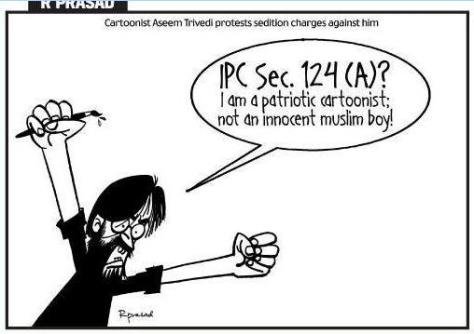
There’s a time for everything. When a cartoonist is being arrested for his cartoons, for cartoons that caused no harm, incited no violence, killed no people, then do you discuss his art or his incarceration? Continue reading Aseem Trivedi and the guardians of good taste→
This press release was put out by MY-FACTS, Guwahati, on 3 September 2012
As a response and being aggrieved over the communalisation of the recent violence and mass displacement in BTAD (Bodoland Territorial Autonomous Districts) area and in order to analyse the situation, on 2 September, 2012 about 60 highly educated, secular and liberal Muslim youths from all over Assam assembled at the Bhagabhati Prashad Baruah Bhaban, Guwahati, Assam, to brainstorm about a peaceful solution for the present scenario of hatred and violence prevailing in Assam that is spreading all over the country. The meeting was convened under the aegis of a newly formed platform named MY-FACTS (Muslim Youths: Forum Against Communalism, Terrorism and Sedition). Continue reading Muslim youths launch peace forum in Assam→
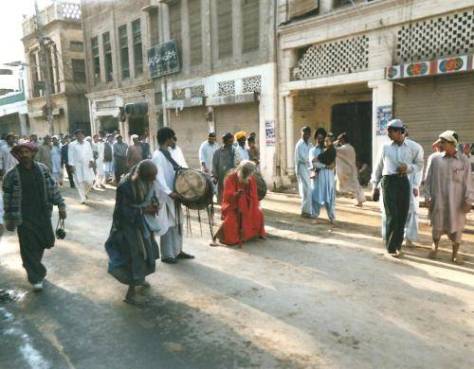
Sufi dervishes join a Sikh Nagar Kirtan parade at the Nankana Saheb shrine near Lahore. Photo credit: S Khalsa
As a child I gave my mother a tough time with all sorts of questions about the world; she would often not have answers. I would ask, for instance, why we couldn’t just go to Nankana Saheb as and when we wanted. Nankana Saheb is the birthplace of Guru Nanak, founder of the Sikh faith. It is in Pakistan, on the outskirts of Lahore.
Sikhism must be the only religion in the world whose official prayers include a plea for visa relaxation. Believe it or not, millions of Sikhs all over the world do that as part of their daily prayer, the Ardas, in which we pray to almighty to grant us free access (“khulle darshan deedaar”) to the birth place of Guru Nanak and other places in present-day Pakistan, considered holy by Sikhs. Continue reading A Visa for Mahiwaal: Maheep Singh→
The National Commission for Minorities (NCM) received a letter from the Jamiat-ul Ulama-e-Hind. The letter wanted 31 protected mosques to be opened for prayers. “Although the commission was not very keen that heritage monuments should be opened for prayers, it decided to suggest a joint survey for ascertaining the condition of these mosques.” Officials from the NCM, the Archaeological Survey of India (ASI) and the Wakf Board will carry out the joint inspection according to the suggestion made by the commission in its letter sent to the Ministry of Culture towards the end of July.
This reference made by the NCM needs to be looked at a little carefully, because the issue is not likely to remain restricted to these 31 mosques nor will it remain confined to Delhi. The reference impinges on questions of law and will eventually inform our attitude to the wider question of heritage protection. Continue reading Saving our heritage→
This online petition has been put out byAMAN KI ASHA
The people of Pakistan and India, people of Indian and Pakistani origin around the world, and friends of India and Pakistan, are fed up of the visa restrictions that prevent them from visiting families in the other country. There isn’t even a tourist visa protocol between these two biggest neighbours of South Asia. People in the region want the right to travel and to trade, to walk along coastlines and roads that represent their collective past, to seek and spread harmony across a subcontinent not divided by politics and propaganda. In this modern age of interdependence, it is a tragedy that the citizens of India and Pakistan are left peering over a border made indomitable and intimidating. There is little space for the hand of friendship to be extended across this border. This must change.
Yousuf Saeed wrote in Kafila on 13 August how fake images of violence against Muslim Rohingyas in Burma – images that were in fact, of, say, earthquake victims. In his post he mentioned how even some Urdu papers in India were fooled by the images,which provoked violent protests in Mumbai,and recently, Lucknow.
Now, CM Naim describes in detail how Sahafat, an Urdu newspaper published from Delhi, fell for these fake images. Naim translates large parts of two charged-up articles in Sahafat, one of which calls for the boycott of Buddhists in Delhi. One article was published on 10 August and one on 16 August. As Naim says, it’s time for the Press Council of India to take note. One excerpt: Continue reading How Delhi paper ‘Sahafat’ fell for fake images of violence in Burma→
Publishing a post for Lawrence Liang who is unable to do so himself at the moment. This piece also appeared in the Hindu this morning. I flew in myself from Bangalore last night and scenes of departure, though not nearly similar to those at the train stations, were palpable at the airport as well. Let me add to Lawrence’s words below three more thoughts that are still forming in my head. The first is the weakness of the word of public institutions and officers in our cities and how little solace they seem to offer or reliability they seem to have, particularly for “minority” residents — (how that word seems to have lost all other meaning other than identifying targets). Panic is also evidence of the fragility of structures that are meant to protect difference rather than just tolerate it. As Lawrence says below, the empirics do not negate how real the fear itself is.
The second is the limits to ideas of “tolerance” in response to diversity versus a more affirmative and protective inclusion — what would it take for the space between rumour and panic to be wider, deeper and further so it is not so easy to bridge? Here a range of global experiences on cities and their attempts to hold difference are well worth looking at — we are not the first and nor will we be the last to fight this battle which is, in a sense, as old as cities themselves. But, to take one example, would we tell a different story today if public services in Bangalore were framed in response to the diversity of the residents — where they were offered, in all the languages really spoken by residents including the hundreds and thousands of residents from the states of the Northeast? Would the word of the Law minister have more power then? Would panic hesitate?
The third is a reminder of how Indian cities still belong to states. The supposed linguistic and ethnic organisation of our federal structure has scripted a different urban future for many of our cities — how can Lawrence’s desired anonymity and cosmopolitanism take root if Bangalore still belongs not to its residents but to the idea of Karnataka? Onto Lawrence’s much more articulate thoughts.
Strangers in a Place They Call Home
Lawrence Liang
One of the underrated pleasures of living in a city is anonymity —guaranteed not by the fact that you look the same as everyone else but that no one really cares that you look different. And a truly cosmopolitan city is one in which everyone looks different. I have been fortunate that for the 30 or so years that I have lived in Bangalore I have not had to deal with the fact that I look different. Save for occasional reminders of my Chineseness, the city has given me enough space to be who I am — cinephile, bibliophile, foodie — without having to bother too much about questions of identity. It is therefore disconcerting to suddenly step out into public spaces self-conscious of my Mongoloid features. Paranoia is not a grand sensation and it manifests itself in the myriad minute gestures and encounters. It seems unbelievable that the experience of a city can change so rapidly because it is clear to me that the last few days in Bangalore have been precisely about that. A miasma of fear, doubt and anxiety has descended on the city. It is possible that much of this has been fuelled by rumours and hearsay; and while the rumours may be false the fear sadly isn’t.
The recent spate of violence that began in the Kokrajhar district of Assam in the month of July 2012 and then spread to the adjoining districts of the Bodoland Territorial Council, primarily between the Bodos and the Muslim community of immigrant origin settled in these districts, has once again unleashed a vicious debate on the perils posed by alleged unrestricted illegal immigration from Bangladesh, this time even on the floor of the Lok Sabha.
The situation has been further complicated by a ‘protest’ in Mumbai against ‘violence on Muslims in Assam’ turning into a riot or by sundry attacks as ‘retaliation’ against people from North East elsewhere in India. Thanks to either shockingly uninformed or brazenly motivated opinions being aired around incessantly, much of it in the national electronic and print media, the dominant discourse that has evolved around the issue has created three distinct perceptions:
First, that illegal immigration of Bengali Muslim peasants from neighbouring Bangladesh into Assam has been continuing unabated, leading to skewed demographic profiles of Assam’s districts bordering Bangladesh and thereafter, turning several adjoining districts of Assam to Muslim majority.Continue reading The Myth of the Bangladeshi and Violence in Assam: Nilim Dutta→
This press statement comes from the JAMMU AND KASHMIR COALITION OF CIVIL SOCIETY
Srinagar, 15 August 2012: It is despicable that the police officers responsible for serious human rights violations are receiving awards despite the crimes they have perpetrated. Today’s awards to some of the Jammu and Kashmir Police officers are an act of celebrating tyranny and victimization.
Superintendent of Police, Altaf Ahmad Khan is one of the officers who has been awarded with the President’s Police Medal for Gallantry. Altaf Ahmad Khan is notoriously known for perpetrating human rights violations in the areas where he has served. Continue reading Celebrating Tyranny and Victimisation in Kashmir: JKCCS→
The predominant emotion with which jingoistic Indians and Pakistanis view each others’ misfortunes is schadenfreude. They count each other’s conflicts and rebellions to keep score. The Indian will talk about sectarian violence in Pakistan, and the Pakistani will ask about the treatment of Dalits in India. The Pakistani will complain against Indian atrocities in Kashmir and the Indian will point fingers at Balochistan.
I am utterly shocked and pained to read about the violent rally that many Muslims took out at Azad Maidan in Mumbai on 11 August 2012 in protest against the recent communal carnage in Assam and Burma. More than the accidental death of two men and 50 injured in yesterday’s protest, what alarmed me was the public anger targeted on the media for “not reporting about the violence against Muslims in Assam and Myanmar”. Several vans of TV channels and their equipment were smashed or burnt besides a number of police vehicles destroyed. Of course, the authorities are still probing as to who really began the violence in an otherwise peaceful rally (and we are open to the results of such a probe). But my worst fear came true with this assertion of one of the protesters in a newspaper report: “Why is the media not covering Burma and Assam? We learnt about the incidents from videos posted on the Internet.” This seems to be a very disturbing statement on various accounts. Of course, the media can sometimes be biased, and the Muslims do feel victimised by it all the time. But are the random videos and images posted on the Internet any less biased or misleading? Continue reading How to start a riot out of Facebook: Yousuf Saeed→
A new product ’18 Again’ has hit the Indian market. A vaginal tightening gel, the advertisement left us mildly bemused.
With her newly tautened privates, the saree-clad lady seems in remarkably good cheer, given she apparently ‘feels like a virgin’ and ‘it’ (it presumably being sex), ‘feels like the very first time’. Namely awkward, painful, inexperienced fumbling? Ah well! There’s no accounting for tastes, not least the fantasies of the Indian man.
Regardless, we think this is a step in the right direction. Virgins being a scarce commodity these days, a handy at-home converter for any sacrifices you may have planned is a thoughtfully designed product indeed. (The makers of ’18 Again’ are unclear on what to do with those of us who escaped the wastelands of virginity before 18, but there you have it. You can’t please everyone, certainly not those sluts who didn’t even wait till they were legal). The makers of 18 Again are hoping for strong revenues on the back of exponential domestic demand.
As this article details, the Indian vagina now caters to a broad spectrum of consumer taste and preference. Backed by a strong commitment to product diversification, the Indian vagina is set to enter the 21st century with applications and appliances, room fresheners and Christmas trees. Needless to say, we are delighted; our only grouse being that the products are somewhat limited in scope and vision. And so with an eye to the future we present a small list of potential uses and a plea that we all broaden, rather than tighten, our imagination. Continue reading Gird Your Loins→
Following the submission of the report by the Committee to Review NCERT Textbooks, we had posted the full text of the Report in Kafila, along with Prof MSS Pandian’s Note of Dissent. The controversy has since continued over the report as well as Pandian’s Note of Dissent, many questioning the very term ‘note of dissent’ on the ground that he had not participated in the proceedings of the Committee. Recently Prof Sukhdeo Thorat, head of the Committee has further put this point of view in print in The Hindu which has been followed by a response by MSS Pandian.
Since we have had a long and lively debate on the matter of the ‘Ambedkar cartoon’ in Kafila and the controversy seems to be continuing now in a different form, we reproduce here the links to the articles by Sukhdeo Thorat and MSS Pandian. In his piece, Sukhdeo Thorat defends the Committee’s work and presents his opinion on Pandian’s non-participation. Pandian responds in his piece raising serious questions about the way the work of the Committee proceeded from its early stages by excluding members. We present the links to these two pieces here so that readers can form their own judgement on the Committee’s work.
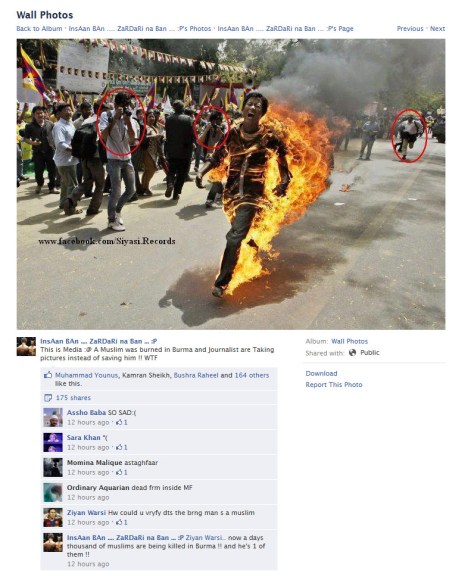
This photo is a screenshot of a Facebook page that incorrectly shows the self-immolation of a Tibetan activist in Delhi as an image of Rohingya persecution in Myanmar. This is one of countless such images circulated in social media. Image credit: Express Tribune, Pakistan.
These days, the social media is abuzz with discussion on Myanmar. Interestingly, it is not even a constructive discussion but one which is meant for point scoring. The nature of the discourse has complicated the issue even more and thus calls for at least a couple of articles: one on the issue and another one meant to be an analysis of the situation of Burmese Muslims. It is important at this stage to disentangle the two dimensions to make sense of what is actually happening. Continue reading National contestation, not religion, responsible for the plight of Myanmar’s Rohingyas: Ayesha Siddiqa→
The following is the text of a Statement issued in Delhi on 27 July 2012, endorsed by a number of concerned organizations and individuals
We the people from various parts of northeast residing in Delhi, along with concerned individuals, university members, various students’, teachers’, trade union, women’s, civil and human rights organisations from Delhi, strongly condemn the ongoing ethnic conflict with serious communal undertone that has erupted in four districts (Kokrajhar, Dhubri, Chirang and Bongaigaon) of Lower Assam. This has been the most widespread and alarming conflict in the recent history of Assam.
In the last one week we have witnessed the tragedy of nearly 200,000 people belonging to the Bodo and the Muslim communities, being forced to flee from their homes and villages. Currently they stand internally displaced, and are scarred and traumatized. Official figures state that around 41 people have lost their lives so far, while unofficial estimates from the grounds are much higher. More than 400 villages have been torched down until now. Continue reading On the ongoing ethnic violence in Assam: A Statement→
Set in 2002, shot in 2009, Aamir Bashir’s film Harud will be in select PVR cinemas on Friday, 27 July. Harud is clearly inspired by Iranian films which manage to say a lot without saying much. Like a lot of Iranian cinema, a child is at the centre of the film. The brilliant acting by Shahnawaz Bhat, who plays the protagonist Rafiq, makes the film. In the expressions on his face there is ambiguity and wonderment as much as there is humiliation, helplessness and a desire to do something to change things around him. Here is a film about Kashmir that does not begin with beautiful landscape and does not end with a big encounter between militants and forces. This is not a film that seeks to explain the Kashmir conflict – rather, it takes you inside the lives of ordinary people and how they faced the madness of a conflict. Regardless of what your views on Kashmir are, Harud succeeds in making you empathise with Rafiq and others around him. That, for any narrative on Kashmir, is no small achievement.
In a case where the “facts” are both complex and yet also the question at hand, let us start with one that should be undisputed: Pinki Pramanik says she is a woman. She has lived as one, competed as one, and identifies as one. She and no other person or institution – particularly the law or medical science – has the right to decide what her gender identity is regardless of her anatomy, her chromosomes or her hormones. As the investigations against her began, her claim to be a woman should have been accepted at face value regardless of whether narrow judgments of her appearance, manner, physicality or dress led some to believe otherwise.
To add to Nivedita’s post below and track what the Pinki Pramanik case continues to tell us, here is a link to the rest of the Times of India piece cited above that appeared on Monday. The argument I make in that piece has taken a new turn. The gender test results, as reported by the media currently, now say that Pinki is “male” because she has XY chromosome. Yet the report says at the same time that she has “female genital ducts and female external genitalia.” What indeed, then, are we to make of a “conclusive” report that finds Pink to be “male”? The terms and words of the test undo themselves and the underlying assumptions and pathways to the conclusion are far from apparent. If Pink is indeed intersex, then all of these results can stand without the conclusion the report draws of her being “male.” Worth reading are a Journal of American Medical Association article here on Gender Testing and the Olympics, Alice Dreger on sex and gender testing in sports here.
In a national daily this morning, there is a photograph of Pinki. She is taking cooking lessons with her mother in her village. The performance of her gender has begun as her sex is questioned. The only strategy open to her is to now constantly claim all that is uncontestably “woman”: a saree, a pallu over the head, in the kitchen, learning from her mother. Yet again the binaries and essentialisms of our gender identities are reproduced as Pinki tries to erase signs of the apparent “masculinity” of her appearance and behaviour that has driven much of the outrage against her thus far.
The Sufi Courtyard: Dargahs of Delhi by Sadia Dehlvi; pp 252; Harper Collins Publishers, India, 2012
There is a sudden spurt of interest in Sufism among a section of our population that did not have such an interest a decade or two ago. Some were introduced to Sufism and its spiritual philosophical moorings through interactions with those who knew something about it, and realised that the ideas of Wahdat-ul-Wujood had parallels in the Adwait philosophy and it was this consonance that intrigued many to an extent that they got interested in exploring Sufism a little more. There were others who discovered Sufism through the west. Just as many had discovered Hindustani classical music when George Harrison began to learn the Sitar from Pandit Ravi Shankar in the ’60s, there are those who discovered Rumi when there was a spurt of interest in Jalal-ud-Din Rumi in the west, particularly in the US, with several translations appearing within a short span. Rumi has been known for centuries in our parts as Maulana Room; his poetry was quoted by Persian-knowing Indians till the 1950s and early 1960s, in conversations and writings, almost as often as Mir and Ghalib are quoted by the Urduwallas. An introduction to Rumi in the last decade or so has led eventually and inevitably to Sufism and a kindling of interest in our own indigenous Sufis. Continue reading Discordant notes: A review of Sadia Dehalvi’s “The Sufi Courtyard: Dargahs of Delhi”→
G. P. Deshpande’s play Satyshodhak is currently being performed in Maharashtra and Delhi and has received positive reviews in print and electronic media1 .It is praised for portraying Jotiba Phule’s life and work, its relevance for dalit emancipatory politics and also for the participation of the Pune Municipal Corporation’s workers as actors. There is a mood of celebration and a congratulatory back patting tone in the appraisal of a supposedly qualitatively different production. In addition to that, the writer has claimed that the production means a ‘successful and meaningful experiment of political education’ 2 of the workers/actors who are dalits. However, the flaunted success of the play and claims about its political import are belied by a performance that offers a very brahmanised Phule. It is very interesting to see that the author claims ‘a meaningful experiment’ of political education of the workers by offering them a pro-upper caste version of Phule. The very choice of producing a play about Phule in 2012 after a shelf life of twenty years 3, the writer’s articulated positions regarding it and the knowledge of Phule delivered through it, involve, I suggest, an upper caste cultural politics embodied in the brahman friendly figure of Phule.
It is a minute and a half long, and from the moment you see it, you will know that there is something sinister about it—a scenario of forced forgetfulness. It is displacement incarnate, and what is it doing, this aesthetic of obscenity? Is this retribution or charity, or retribution through charity, the developmental discourse of murderous sustainability through erasure? You will be puzzled and worried, harried and then it will make you sleep again in pious numbness, for isn’t the world—its deep blue sky and crystal fluid and cleansing sunlight, and bright flowery faces, its innocent time—just so beautiful! You will find that you cannot respond to it, physically, humanly, for it is not receptive to the organic. It cannot be mediated. It is a ghoul, perched to haunt and hypnotize us out of the memory of its past terrors. You remember, lenore, and wasn’t it to be nevermore? It is an electrical transmission and nothing more, or is it? It is a triumph of pre-postmodern, oily chic, so cloaked in ancient blood, that the blood has caked and turned black and fallen off, revealing the identical colour of the master’s heart, now you see it, now you don’t. The laceration has been hidden by the three-day apoptosis—the extra-cellular matrix, the forgetful memory’s collagen. But you will need to dig outward and inward from here, and very deep. It is there on my screen, this light of blood-lust, “Vedanta: Creating Happiness”, and every time a new or repeated tale from half way across the world is beamed, news every quarter of an hour, this monstrosity accompanies those facts like some leech feeding on reality. You remember Sontag, and isn’t she who had her way with those words: “Now there is a master scenario available to everyone. The color is black, the material is leather, the seduction is beauty, the justification is honesty, the aim is ecstasy, the fantasy is death.”