Category Archives: Identities

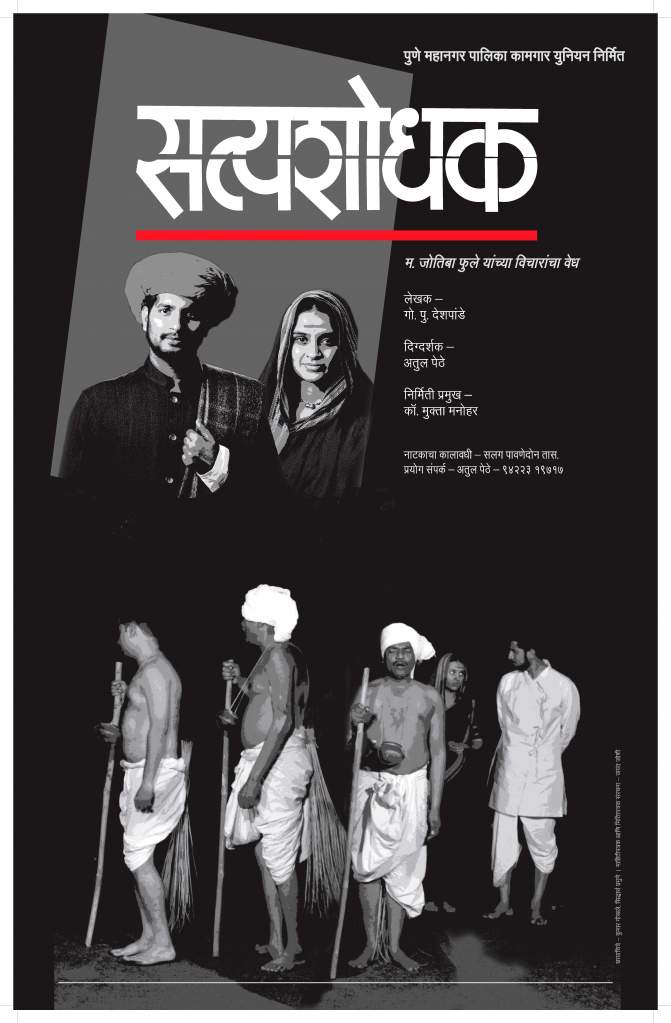
Satyashodhak – A Performance

(A shorter version of this review appeared in Tehelka)

Writer: G P Deshpande

Director: Atul Pethe

Performed by Pune Safai Karmacharis Union

Image

It was apt that a landmark production of G P Deshpande’s 1992 play Satyashodhak on the life of the 19th century anti-caste crusader Jyotiba Phule was performed in a week that witnessed the killing of the head of the Ranbir Sena – a week in which we were reminded that the bitter legacy of caste haunts us as strongly as ever. It was unusual however, that the performance should be held at the recently-opened May Day café and bookstore in Delhi – a space dedicated to the different and more hopeful legacy of the international working class movement, and located close to the heart of a former industrial district in a city that practices careful amnesia about its working classes. It is entirely unusual further that the performers were both Dalit and members of the Pune Municipal Safai Karmacharis Union. While the ancient, poisoned streams of caste and class have often overlapped on the subcontinent, they have not, as we are aware, produced unified or even similar political responses.

Continue reading Satyashodhak – A Performance

The Myth of the Muslim Vote Bank

The recently concluded assembly elections in U.P were marked once again by an intensified debate on ‘Vote Bank Politics’. The debate was not provoked by the emergence of any new trends in political mobilization but was the standard fare that is dished out by so called commentators, experts, political analysts and people who not only think that they have inside information about how entire communities think and react, they also claim that there are agencies capable of engineering conditions that programme these communities to go and vote for this or that party.

The essential argument behind this discourse hinges on two presuppositions, one that particular religion or caste based communities can be mobilised and made to move in one pre-determined direction and two that this becomes possible because such communities react and behave as one individual and therefore all that is required is to catch hold of a handful of community leaders and you can as good as have the entire community in your pocket. Continue reading The Myth of the Muslim Vote Bank

Terrorism in India – Between Facts and Fiction: Imran Khan

Guest post by IMRAN KHAN

More and more concerns are being expressed by human rights activists in India today on the question of fabricated and false charges on innocent people. When Dr. Binayak Sen spent his time in jail on such charges, activist groups all over the country and abroad came out and protested. For the first time in the history of human rights movement in India, around two dozen Nobel Prize Winners came out to defend him. It should also be noted that there were even protests against such fabrication in front of Indian embassies in different parts of the world.

However, with the arrest of Binayak Sen, the contemporary history of `fabricating false cases’ by the Indian state took a new turn. The arrest took place while Dr. Sen was a national leader of India’s pioneering human rights organization, People’s Union for Civil liberties (PUCL).  The activists felt that the message was loud and clear: That even human rights defenders can be imprisoned for no reason under repressive laws of the post-independent India.

Dr. Sen was released due to public pressure. But thousands are still languishing behind bars, waiting for justice. The nameless adivasis who were arrested like Sen from different parts of Chhattisgarh, speak of an unknown territory even to the best of our human rights activists. And new messages are given. Even journalists can be grilled. Thus, K.K. Shahina, Azmi, Seema Azad, Advocate Naushad Kasimji and others have become victims of attacks on freedom of expression. Fabricating false cases has become a norm today rather than an exception, according to human rights groups. Minorities, dalits, adivasis,  people’s movements and self determination movements become an easy prey to false charges. Continue reading Terrorism in India – Between Facts and Fiction: Imran Khan

False Charges and Brutality in Prison: Mohd Amir Khan

Guest post by MOHD. AMIR KHAN

[ Mohd. Aamir Khan has spent 14 years in prison and was acquitted earlier this year]

I am in deep pain today. As though terrible, terrible memories, locked away in the deep recesses of my mind have been pried open. Heard on news that an accused in terror case was killed in judicial custody in Yerwada jail. That too in his high security cell.

I had read that the British rulers unleashed physical and mental torture on prisoners in colonial jails, but have never heard that they carried out killings of hapless convicts or undertrials in their custody. The naked truth of Abu Ghraib and Guantanamo has been brought before the world. But who will illumine the dark secrets of the netherworld of our prisons? Brutalisation and torture are routine in our jails.

I speak from experience, having lived for fourteen long and seemingly unending years in prisons in three states. There was a near fatal attack on me twelve years ago while I was lodged in the model prison of India, Tihar Jail. But when I survived the attack, a case was slapped on me. While I was thankfully acquitted in the case, not one of those who attacked me was charged until my father – who was still alive then—appealed to the court to intervene. Mercifully, the Court accepted his complaint and registered a case, which still goes on in Tees Hazari court. Continue reading False Charges and Brutality in Prison: Mohd Amir Khan

Response to “In defense of the democratic struggle against Shankar’s cartoon”

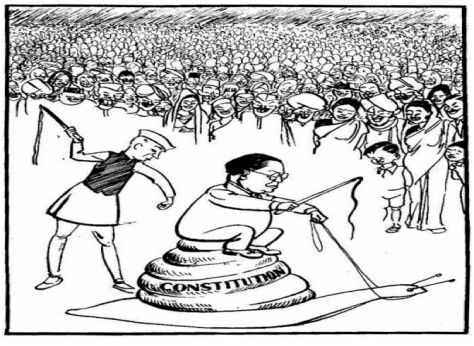
This is a longer version of an article published today in The Hindu. This version includes a section with illustrative examples that refute the contention of the petition that there is “inadequate representation of the role of Ambedkar” in the new textbooks.

At the end of this, I respond to the points raised by K. Satyanarayana and Anoop Kumar in their response to my article, also published today in The Hindu, to which I have linked below.

The petition against the Ambedkar – Nehru cartoon published in the Hindu makes for sad reading. Sad, because it bears the signatures of some of our best scholars, universally admired for their rigorous scholarship, who nevertheless chose to sign a petition short on facts. The petition asks the Thorat Committee to “reconsider the Ambedkar cartoon (and possibly other such insensitive material)”and urges “Kapil Sibal, the Union HRD Minister, to desist from seeking any major overhaul of the basic National Curriculum Framework on which the textbooks are based.” Perhaps the petitioners are not aware that the particular cartoon is now beyond the purview of the committee. A decision to remove it had already been taken by the Minister himself, and a commitment made to this effect on May 11 by Kapil Sibal on the floor of the Rajya Sabha. It was after this announcement that the parliamentarians intensified their attack and targeted other cartoons in all the textbooks claiming that they mocked and ridiculed the political class in general. It was in response to this outrage that the government announced the formation of a review committee to be chaired by Prof. S K Thorat to find out if there is any ‘educationally inappropriate’ material in the textbooks. Continue reading Response to “In defense of the democratic struggle against Shankar’s cartoon”

Disability Law Violations in Delhi University admissions – notes from the margins: Rijul Kochhar

Guest post by RIJUL KOCHHAR

Contrary to what they may tell you, they don’t really give a damn about the disabled in this country. Systemically flouted laws, polite terms substituted for impolite realities, and stony silences meted to those who seek to question—these comprise the working of the disability model in this nation, a model that only goes so far as the abundance of obligation and ‘feel-good’ eye-wash will take it. The juggling of words—‘disabled’ for handicapped, then annihilation of ‘crippled’, and finally that awful phrase regnant in contemporary fashionable use, ‘differently/specially-abled’—constitutes our single biggest achievement as far as dealing with the disabled as rights-bearing persons is concerned. Continue reading Disability Law Violations in Delhi University admissions – notes from the margins: Rijul Kochhar

Foregrounding Insult: Gopal Guru

Guest post by GOPAL GURU

Let me at the very beginning make it clear that I do not want to discuss insult in the context of the recent cartoon. Although I think that a progressive interpretation of that recent cartoon may not lead to the feeling of insult and hurt.

I would like to discuss here who should feel insulted and under what subjective conditions? Those who have inherited insult from the past, not invented it for the present, are the ones who should feel insulted. The past which continues to unfold in a series of social interactions necessarily insults, and gets reproduced through rigid and regressive assumptions.

The gut level or unmediated reaction finds quick expression because those who express it know that it would yield desired reaction from the dalit community which has graduated only in thick emotionalism. Those who offered this unmediated reaction exactly had the same background assumption that Ambedkar exclusively belongs to dalits and dalits have heavy emotional attachment to Babasaheb.

This assumption is insulting for two reasons: Continue reading Foregrounding Insult: Gopal Guru

Humiliation condemned to remain ‘Hurt’ – Notes from a talk by Gopal Guru: Parth Pratim Shil & Ankita Pandey

Guest post by PARTH PRATIM SHIL and ANKITA PANDEY

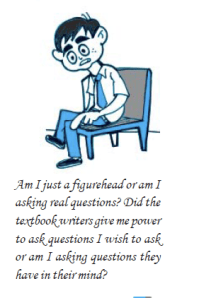
Unni [a cartoon character] asks:

“Am I just a figurehead or am I asking real questions? Did the textbook writers give me power to ask questions I wish to ask or am I asking questions they have in their mind?” [Page 85, Chapter 4: Executive, Indian Constitution at Work, for class XI]

This cartoon appears in the context of the discussion on the powers of the President of India in the political science textbook of NCERT. It seems this question has a function far wider than the limited task of revealing the institutional blueprint of Indian politics. It pushes the student to ask something very uncomfortable. Am I really the one asking the questions I ask? Or am I rehearsing questions that someone else has decided for me?

As teachers of political science, our constant effort is to understand the ways in which power operates. None of the themes of our syllabi can be taught without reference to the resistance, critique and offending positions taken by groups who challenge the status quo. Sanitizing the history of critique and resistance that is encapsulated in satirical modes of representation like cartoons, can only be at the cost of keeping the discipline of political science uprooted from its very object of study. In the recent cartoon controversy, however, the issues at stake are many more than a defence of critical pedagogy.

Continue reading Humiliation condemned to remain ‘Hurt’ – Notes from a talk by Gopal Guru: Parth Pratim Shil & Ankita Pandey

Dalit organisations demand NAC to recommend SCP/TSP legislation

This press release comes from the SC/ST BUDGET ADHIKAR ANDOLAN 

The SC/ST Budget Adhikar Andolan welcomes the draft recommendations of the NAC to the GOI. However, it is very disappointing that the National Advisory Council (NAC) has not suggested legislation for SCSP and TSP. It is a known fact that without legislation, accountability would not be possible, and the entitlements under the SCP will not be implemented. The Dalit  organisations strongly urge the NAC to recommend SCP/TSP legislation and that this be placed in the parliament in the coming session.

The recommendations of the NAC on the reform of the Scheduled Caste Sub-Plan (SCSP) were sent to the Government in December 2011. In line with the recommendations of the NAC, the Working Group of the NAC on Dalit Issues have now enunciated a set of Essential Elements of Implementation Framework of SCSP. Some of the recommendations of the NAC are as followed: Continue reading Dalit organisations demand NAC to recommend SCP/TSP legislation

Oppressing the teacher, democratic style

( In 2006 the Parliament had debated and lambasted  Hindi NCERT textbooks prepared as part of the NCF, 2005 process . Our Parliamentarians were then offended  by Premchand, Pandey Bechan Sharma Urg, Dhoomil, M. F. Husein,  Avtar Singh Pash and Omprakash Valmiki. The argument of hurt sentiments had united political parties from left to right to demand action against  the culprits. In the eyes of MPs like Sushma swaraj , Ravi Shankar Prasad and Sita Ram Yechury ,  Hindi textbooks  were full of offensive and abusive words and descriptions which could hurt Brahmin, Women , Dalit and Hindu sensibilities. They were also very concerned about the the effect that these books were to leave on the impressionable minds of our children. The extra-ordinary unity seen this time in the Parliament in   the case of  the  ‘offending’ Political science texts books is not unprecedented. What we need to ask is that why did we not react to This debate and assault on Hindi textbooks then.

Back then I had published this open letter to our MPs in Tehelka. I am re-posting it here to bring historical context to the ongoing debate on an NCERT political science textbook.)

In an open letter, Apoorvanand asks members of Parliament to stop politicising education

Do we really need to legislate on how languages should be used by our writers? Should the State be given authority to issue licenses to our poets? Continue reading Oppressing the teacher, democratic style

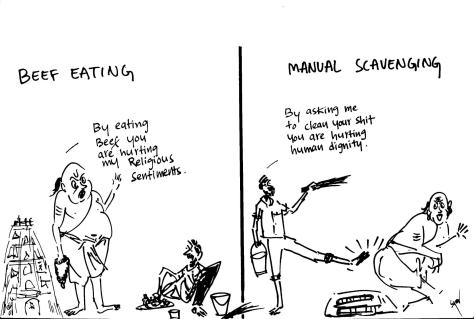
I have a beef with you: Unnamati Syama Sundar

This guest post by UNNAMATI SYAMA SUNDAR is a cartoon

From Kafila archives:


’बिगड़ैल बच्चे की खोज में’: हिमांशु पंड्या

“क्या आपको इस बात का अहसास है कि ताकाहाशी को ‘तुम्हारी पूँछ तो नहीं है?’ पूछने पर कैसा लगा होगा” बच्चे शिक्षिका का जवाब नहीं सुन पाए. उस समय तोत्तो चान यह नहीं समझ पायी कि पूंछ वाली बात से हेडमास्टर साहब इतना नाराज़ क्यों हुए होंगे क्योंकि अगर कोई उससे यह पूछता कि तोत्तो चान तुम्हारे क्या पूंछ है? तो उसे तो इस बात में मजा ही आता.
-‘तोत्तो चान’ (तेत्सुको कुरोयांगी, अनुवाद – पूर्वा याग्निक कुशवाहा)

दलित चेतना और कार्टूनों का पुनर्पाठ
इस कार्टून पर चली ऐतिहासिक बहस के बाद अब यह पक्के तौर पर कहा जा सकता है कि साहित्य से आगे अभिव्यक्ति के अन्य क्षेत्रों में भी दलित चेतना ने दस्तक दे दी है। शायद हम कल चित्रकला और बहुत आगे संगीत में भी दलित चेतना युक्त दृष्टि से इतिहास का पुनर्पाठ देखेंगे। Continue reading ’बिगड़ैल बच्चे की खोज में’: हिमांशु पंड्या

Forging a Nepal for all its peoples

As the constitutional endgame approaches, Nepal is witnessing its most fierce and polarised political debate since the process to transform the state began with the Comprehensive Peace Agreement in 2006. Strikingly, it is not a battle between political parties, but different social groups.

This is the battle over the nature of federalism, the boundaries of future states, and the names and number of provinces. The issue of state restructuring perhaps resonates most among ordinary citizens, especially those belonging to communities excluded from the power structure due to their ethnic, caste, regional and religious identities. It is a battle that has been fought in Constituent Assembly (CA) committees, the State Restructuring Commission, and in the past week, on the streets. Continue reading Forging a Nepal for all its peoples

If ‘temporary’ meant special, what would ‘special’ mean?: Gazala Peer

Guest post by GAZALA PEER

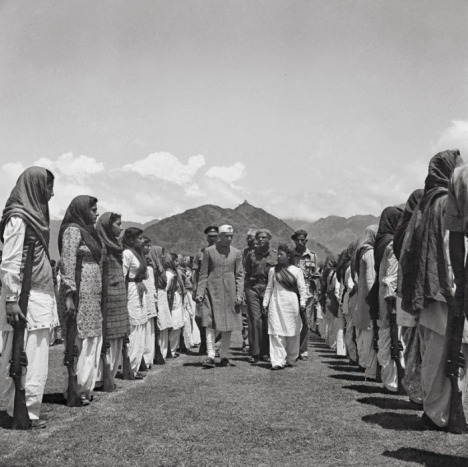
Circa 1948, this photograph shows Jawaharlal Nehru inspect a women’s militia in Kashmir. Via andrewwhitehead.net

On 13, October 2010 a team of interlocutors was appointed by the Government of India to hold dialogue with all the sections of the society in Jammu and Kashmir. The team of interlocutors consisted of journalist Dileep Padgonkar, educationist Radha Kumar and the former Information Commissioner M. M. Ansari. After almost one and a half years the report was released on 24 May 2012 by the Ministry of Home Affairs (.pdf here). The report calls for formation of a Constitutional Committee to review the extension of central laws to the state of J&K from 1952 onwards. Some of the major recommendations are: changing the temporary nature of Article 370, dividing the state into three Regional Councils and appointment of the Governor but after consultation with the state legislature. The Report further says that the findings of this Constitutional Committee shall be binding on all the ‘stake holders’ in the State. Continue reading If ‘temporary’ meant special, what would ‘special’ mean?: Gazala Peer

Violence and Laughter: Ajay Skaria on the Ambedkar cartoon controversy

Guest post by AJAY SKARIA

Earlier this month, I signed, with some disquiet, onto this petition. Initiated by some members of the CHS at JNU, the petition protests against the withdrawal, in the wake of the cartoon controversy, of all NCERT Political Science textbooks, and seeks to defend the ‘gains of the new National Curriculum Framework 2005’. One reason I signed the petition was because it seems to me urgent that we try to save the NCF 2005 textbooks. They are, quite simply, amongst the most superb provocations available anywhere to critical thinking for young minds. I have over the years read them with my two children, and I would be very disappointed if other children were deprived of the same experience. There were other reasons too: I share the petition’s criticisms of the government’s arbitrary way of making its decisions about the textbooks, and its demand that textbooks be produced by an ‘academic, collective, democratic and inclusive process’ that excludes any ‘direct government intervention’. Continue reading Violence and Laughter: Ajay Skaria on the Ambedkar cartoon controversy

This, that and other cartoons: Prabhat Kumar

Guest post by PRABHAT KUMAR

I wish to intervene in the ruckus over usage of Shankar’s cartoon in the NCERT’s political science text book. At the outset I want to clarify my personal impression (although inconsequential!) of the book and the cartoon therein. I feel the textbook in general is pedagogically superior to the previous ones for it does not infantilise young students as lacking critical ability. I also believe, as Aditya Nigam has rightly pointed out, it has accorded Ambedkar the status of a leading political and intellectual figure so far ignored. The cartoon in particular, both in the context of the narrative of the textbook as well as of its production in 1949, is not attacking Ambedkar the crusader of Dalits’ rights.

Continue reading This, that and other cartoons: Prabhat Kumar

Dalits in Hindurashtra – Time for another sadbhavna fast Modiji!

…27 of the 30 complaints that were addressed to the commission spoke of indifference of police officials towards dalits.These issues were raised immediately after NHRC chairman KG Balakrishnan praised status of scheduled castes (SC) in Gujarat. He said the state’s schemes for development of the marginalised are working well and penetration of education among scheduled caste and scheduled tribes has reached 70%.Almost all dalits and their leaders present in the audience were not in agreement with this statement. [DNA]

 I

Justice Balakrishnan, retired Chief Justice of the Supreme Court of India, and at present Chairman of the National Human Rights Commission (NHRC), – who has remained in news since his retirement altogether for wrong reasons – provided further ammunition to his critics with his recent visit to Gujarat. The manner in which he lauded the state government for its ‘innovative schemes for the upliftment of dalits’ and claims that ‘..[f]uture of the SC community seems to be fairly good in Gujarat as compared to many other states’ is being seen as an attempt to clean chit and whitewash acts of ommission and commission.of a government which is still mired in the controversies surrounding the carnage in 2002

The said two day visit (14-15 th March) was part of the plan envisaged by the Commission to hold “open hearing” sessions on issues related to dalit atrocities in different parts of the country. According to media inputs, this was one of the important recommendattion by the K.B. Saxena committee which had done a painstaking job and brought out a report on dalit atrocities in the country few years back.for the commission itself. Not some time ago the commission had held its first such hearing in the state of Orissa.

Continue reading Dalits in Hindurashtra – Time for another sadbhavna fast Modiji!

Red Herrings, Red Rags and Red Flags – Once More on the Cartoon Controversy

With the recent article by Prabhat Patnaik, the controversy over the ‘Ambedkar cartoon’ issue has now moved into a different terrain. In this important statement, Prabhat undertakes the task of pointing out the numerous red herrings that have entered into the debate. These include  ‘freedom of expression’ and ‘sense of humour’ and the question of  whether Ambedkar had actually seen and let pass this cartoon. Prabhat’s point about the changed sensitivities and increased audibility of the dalit movement today is also well taken.

We must also be thankful to Prabhat for stating his views so candidly over the past few years, on a number of critical issues ranging from Nandigram and the electoral defeat of the Left to the ongoing cartoon controversy. We must thank him because  because in my opinion, all his positions on these disparate sets of issues are of a piece and take us to the very heart of the impasse, not merely in the Left but in our politics itself. But before I respond to some of the issues raised by Prabhat, let me restate my positions on some aspects of the ongoing controversy. This is also necessary in order to identify what exactly it is in Prabhat’s piece that is so disturbing.

 Dalit Response and Hurt Sentiments

In its initial phases, the cartoon issue was certainly a ‘dalit issue’ – even if it was raised only by a section of the dalit political leadership and intelligentsia. Very soon, however, it became clear that there was a more cynical game being played where the most corrupt and compromised sections of our politicians – especially those in parliament – were using Ambedkar as a shield, in order to deflect the blows that were actually aimed at them. The amazing unity of purpose and determination displayed by the parliament has rarely been seen in recent times; nor has the love for Ambedkar ever been expressed with such vigour.

These circumstances give enough reasons to suspect that the game had already changed by the time it reached the parliament. Not many people may have noticed but it was a Congress MP (an official spokesperson in Madhya Pradesh) who raked up a long dead issue of the book by Arun Shourie (Worshipping False Gods), demanding that it be banned. Continue reading Red Herrings, Red Rags and Red Flags – Once More on the Cartoon Controversy

In Defense of Critical Pedagogy: A Petition

The following is a petition initiated by a group of scholars who have been centrally involved in the debate on pedagogy and the writing of textbooks that followed National Currriculum Framework 2005

We have been watching with deep dismay the events as they have unfolded on the floor of the Indian Parliament and outside. Uproar against an individual cartoon has now snowballed into a wide-ranging attack against the new NCERT textbooks. The office of one of the Advisors of the Political Science textbooks has been ransacked, the Political Science textbooks have been withdrawn from circulation, and the Government has resolved to conduct an inquiry into the role of those who sanctioned the inclusion of the offending material in the textbooks. Clearly what is at stake here is not just the life of cartoons on the pages of school textbooks.

But the fear of cartoons is not unimportant. It tells us a lot about the democracies we now inhabit. Jawaharlal Nehru told Shankar Pillai ‘Don’t spare me Shankar’. B.R. Ambedkar saw the cartoon that is now being seen as ‘offensive’. He had no problem with it. Nehru and Ambedkar, and great democrats like them, were aware of what cartoons mean. They were aware that creative cartoonists like Shankar or Laxman can encourage us to question what is taken for granted, reveal the ambiguities and contradictions of individuals, persuade us to see things in a new light. India has a long creative tradition of satire and irony. The productive power of laughter has been used not only in movements for social justice, but in children’s literature as well. If we celebrate this tradition, we celebrate democracy. Only in non-democratic countries is there a fear of cartoons. Continue reading In Defense of Critical Pedagogy: A Petition

पाठ्यपुस्तक का संघर्ष 

संसद राजनीति और लोकतंत्र पर स्कूली किताबों में कार्टून नहीं चाहती हैइस मसले को लेकर संसद के दोनों ही सदनों में सारे राजनीतिक दलों में अभूतपूर्व मतैक्य देखा  गयाएक राजनीतिक  दलजिसका नाम नेशनल कान्फरेंस हैइस दमनकारी बहुमत से अलग स्वर में बोलने की कोशिश करता रह गयाउसे क्रूर बहुमत ने बोलने नहीं दियाआखिर वह एक बहुत छोटे से इलाके का थामुख्य भूमि में बन रही सहमति में विसंवादी स्वर पैदा करने की अनुमति उसे दी ही कैसे जा सकती थीउसे उसकी लघुता के तर्क से नगण्य माना जा सकता थायह स्वर कश्मीर  से आ रहा था जिसे भारत का अंग बनाए रखने के लिए देश के क्रूरतम क़ानून की मदद लेनी पड़ती है.

 यह विवरण यहाँ अप्रासंगिक लग सकता है.लेकिन मुझे इसमें एक तरह की प्रतीकात्मक संगति दिखलाई पड़ती हैवह संगति  असहिष्णुताजन्य  अधैर्य  के तत्व से निर्मित होती है जो हमारे सामाजिक और सांस्कृतिक जीवन को परिभाषित करता है और इसीलिए सरलीकरण की पद्धति उसके चिंतन की दिशा तय करती है. Continue reading पाठ्यपुस्तक का संघर्ष 

Resisting the Second Childhood: Towards Universal Pension in India

Guest post by AKHIL KATYAL

Ashiya Begum, an elderly widow, had worked as a road construction labourer after her husband’s death. She recalls that when all the workers used to have lunch by the construction site, she tried to sleep under the bushes as there was no food and it was better than seeing others eat. When the pangs of hunger grew insistent, she would drink a lot of water and then tie her saree end tightly around her stomach and continue to work. At night if the children cried and she had nothing to feed them, she peeped out of her tent to neighbours’ utensils and used to beg a glass of ganji (water which is to be drained out of rice once it is cooked) from them. Everybody got 5-6 spoonfuls of ganji before sleeping. Sometimes in the evening, after the road construction work, she cooked in other people’s houses. They gave her four rotis that the entire family ate…‘Even if I tell you (what we eat to survive),’ she told the researcher, ‘will you ever be able to feel what we eat?’
–          from the ‘Study on Destitution and Hunger’, Centre for Equity Studies, Delhi

Old age mostly inspires the sentiment of the universal in us, the aesthetics of the general, so much so that when we speak of the old, we often let go of the specific and relish statements that tend to be as wide-ranging as they could be naïve: the old are wiser, we say, the age is just a number, our frames turn more literary, more contemplative, it is the dusk of life, we think, or sometimes being metaphorical, we consider to be old to be in a second childhood. The last one is Aristophanes, no less. Continue reading Resisting the Second Childhood: Towards Universal Pension in India